
Mets Outright Justin Ruggiano
The Mets have outrighted outfielder Justin Ruggiano off of the team’s 40-man roster, ESPNNewYork.com’s Adam Rubin reports. Ruggiano elected free agency after clearing waivers.
After a brief stint early in the year with the Rangers, the 34-year-old was added by the Mets in July as the club sought to fill in for a variety of injured players. The hope was that he’d provide a boost from the right side of the plate, but his own maladies kept Ruggiano from playing much of a role (though he did have one rather memorable moment).
Ultimately, Ruggiano ended up taking just 26 plate appearances on the year, breaking a string of five consecutive seasons in which he had topped 100 trips to the plate. He did hit well in that very limited action, though, and also ended the 2015 season on a high note. With a .258/.322/.439 lifetime batting line to support him, Ruggiano figures to have a solid chance to earn a roster spot somewhere next spring.
Diamondbacks Claim Jeremy Hazelbaker
The Diamondbacks have claimed outfielder Jeremy Hazelbaker off waivers from the Cardinals, according to Derrick Goold of the St. Louis Post-Dispatch (via Twitter). He represents the first player acquisition for new GM Mike Hazen.
[RELATED: Updated Diamondbacks Depth Chart]
Hazelbaker debuted last year in St. Louis at 28 years of age, breaking onto the scene with an unexpectedly hot start. He ultimately came back down to earth, though, and ended the year with a cumulative .235/.295/.480 slash and 12 home runs over 224 plate appearances. Hazelbaker’s sub-par on-base percentage and 28.6% strikeout rate raise questions about whether he can produce consistently at the big league level — particularly if he isn’t able to maintain a lofty .245 isolated power mark.
While there is cause for pessimism in a player who has never really been seen as much of a prospect and wasn’t able to crack the majors until his age-28 campaign, there are also some reasons for hope. Hazelbaker has abused Triple-A pitching since coming to St. Louis in the middle of the 2015 season, and has shown some pop at times in the past. Plus, the lefty hitter was much better against right-handed pitching, suggesting he could have some platoon function.
It’s not yet clear just what Arizona intends to do with Hazelbaker, but he could certainly share time in a corner outfield spot or play off the bench. David Peralta is the team’s only established, southpaw-swinging outfielder, though youngster Socrates Brito also saw a good bit of major league time last year and players like Zach Borenstein may be ready to challenge for an opportunity.
Phillies Acquire Pat Neshek
The Phillies have struck a deal to acquire reliever Pat Neshek from the Astros, as Jake Kaplan of the Houston Chronicle first reported (via Twitter). Houston will receive a player to be named later or cash in the swap.

Neshek, 36, was controllable for the coming season through a $6.5MM club option. Philadelphia has exercised that option, as it announced along with the trade. The Astros were reportedly considering a trade of the veteran righty with his option decision coming due, and found a willing partner in a Phillies organization that has a need for bullpen depth.
The sidearming Neshek primarily delivers a sinker-slider combo has been rather effective over the past few years. While he hasn’t matched his output from a breakout 2014 stint with the Cardinals, Neshek is fresh off a year in which he contributed 47 innings of 3.06 ERA pitching with 8.2 K/9 and 2.1 BB/9.
Neshek has never carried much velocity, and has maintained his average fastball over recent years, so his age isn’t a significant concern. The biggest issue is his performance against lefties, who torched him for a .250/.321/.646 batting line and four home runs in 55 plate appearances last year. Of course, Neshek was exceedingly stingy when facing righties, who managed an anemic .172/.209/.254 batting line against him in 2016.
Those dramatic splits make Neshek somewhat unlikely to challenge for the Phillies’ somewhat unsettled closer’s role. But he could take an important spot in the pecking order for late-inning setup opportunities. Neshek provides the team with a veteran pen piece to help lock down winnable games as the Phils seek to move back towards contention — just the kind of target posited in our offseason outlook for the organization. He could also turn into a deadline trade chip. With only a single-season commitment required, and very little on the Philadelphia books, it was a fairly easy risk to take.
[RELATED: Updated Phillies Depth Chart]
For the Astros, whose bullpen was one of the game’s very best last year, it obviously made more sense to re-allocate the cash that might otherwise have gone to Neshek. Houston has plenty of options on hand to take over Neshek’s innings, and is already busying itself with building out the rest of its roster as it seeks to return to the postseason following a disappointing 2016 campaign.
Photo courtesy of USA Today Sports Images.
Rays Promote Erik Neander, Chaim Bloom
The Rays have announced a restructuring of their front office, as Marc Topkin of the Tampa Bay Times reported on Twitter. Erik Neander has been promoted to senior VP of baseball operations and general manager, while Chaim Bloom will also receive a promotion to a senior VP title.
President of baseball operations Matthew Silverman will remain in his position, though it sounds as if there are some changes in the team’s decisionmaking process forthcoming. The organization’s press release says that Neander and Bloom “will directly oversee all functions within baseball operations,” with Neander specifically “focus[ing] on the department’s player evaluation and procurement process.”
Silverman explains in a prepared statement that the move had been envisioned since he took over for Andrew Friedman before the 2015 season. “This evolution is one that we envisioned two years ago,” he said. “I’m proud to work together with Erik and Chaim and empower them to direct the operations of our department.”
At the time of Silverman’s hiring, his primary duties were on the business side of the organization, as Topkin explained at the time. Though he was also involved in significant decision in the operations department, that was primarily Friedman’s domain. With Silverman’s changed role, Brian Auld took over as the team president.
Now, Silverman tells Topkin, he’ll hand off more day-to-day responsibility. “Going forward, the charge is the same with my focus shifting away from daily management and more towards our longer term vision and priorities,” said Silverman. “When it comes to key decisions, we will all work closely together.”
The organization will turn over greater authority to a pair of 33-year-old executives who have long served as key staff members in the organization, with indications being that they’ll work not only as a pair, but also in conjunction with Silverman and newly-anointed VP of baseball ops James Click. “Because of their decade-long working relationship, Erik and Chaim are ideal partners to team up on the daily management of our department,” Silverman explained. “The GM title marks Erik’s focus on our player acquisition process.”
Mariners Claim Dean Kiekhefer
The Mariners have announced the claim of lefty Dean Kiekhefer off waivers from the Cardinals. Seattle now has four open spots remaining on its 40-man roster.
Kiekhefer, 27, debuted last year for the Cardinals, but didn’t impress in his 22 frames. He allowed 13 earned runs with a 14:7 K/BB ratio over that span while averaging just 88 mph with his fastball. Right-handed hitters mashed against the soft-tossing southpaw, though he did limit opposing lefties to a .209/.261/.326 slash. Presumably, Seattle has thoughts of possibly using him in a LOOGY role.
Things do look a lot more promising when you glance at the minor league numbers. Kiekhefer has shown masterful command, permitting just 1.2 walks per nine to fuel a 2.38 ERA through 151 Triple-A innings, though he has never been much of a strikeout pitcher (6.5 K/9 in the highest level of the minors).
Jeurys Familia’s Court Date Pushed Back
NOV. 2: Familia’s court date has been pushed back to Nov. 10, tweets Newsday’s Jim Baumbach.
NOV. 1, 9:42pm: Ken Davidoff and Kenneth Garger of the New York Post report that Familia’s wife, Bianca, is the previously unidentified victim, as her name was redacted from initial reports. Familia told Dominican reporter Hector Gomez: “Somebody is trying to damage my reputation with this info. I’m at peace with my family.” (Twitter link) However, The Post’s report cites the authorities and anonymous court officials in providing details of Familia’s arrest, including the fact that he was arraigned at the Fort Lee police station on Monday and released on $1,500 bail. Familia, according to Davidoff and Garger, is due back in court on Thursday.
2:11pm: Mets closer Jeurys Familia has been arrested and charged with simple assault in an alleged domestic violence incident, according to a report from Andrew Wyrich and Abbott Koloff of the Record.
Public judicial records suggest that the 27-year-old pitcher is alleged to have caused bodily injury to an unidentified person, with police officers stating in the filing that there was probable cause “to believe that domestic violence had occurred.” A “scratch to the chest and a bruise to the right cheek of the victim” are said to have been observed.
The incident in question occurred early Monday morning in Fort Lee, New Jersey, per the court documents. That is where Familia, 27, resides with his wife and young child, according to the report.
The Mets provided a statement to the Record on the subject, stating: “The matter was brought to our attention and we are monitoring the situation.” Major League Baseball says that it has opened an investigation into the matter, according to James Wagner of the New York Times (via Twitter).
It is certainly too soon to know where this matter may lead. Needless to say, the primary concern is with the victim and their loved ones.
Baseball (like other professional sports leagues) has struggled to deal with several high-profile domestic violence matters that have allegedly been perpetuated by its players. The league and player’s union agreed to a domestic violence protocol that vests significant power in the commissioner to assess and punish domestic violence offenders, whether or not they are arrested, charged, or convicted.
That policy was quickly put to the test by Jose Reyes, who was charged with assaulting his wife (though he never went to trial) and was ultimately suspended for 52 games. Aroldis Chapman also received a ban, in his case thirty games, though he was neither arrested nor charged in the incident in question. And Hector Olivera was punished with an 82-game suspension following an assault for which he was ultimately convicted.
Reyes later joined Familia with the Mets and is expected to stay with the team next year by operation of a club option. At the time, the organization suggested that Reyes “deserved a second chance,” in the words of GM Sandy Alderson. “I came away feeling that he had taken responsibility for this mistake on his part, that he was remorseful,” Alderson said of Reyes. “He obviously has paid a penalty for this, both financially and in terms of his career.”
As with Reyes, Familia’s situation has arisen in the offseason, meaning that the league will likely not need to utilize its powers to impose a paid administrative leave period pending investigation — at least initially. Reyes was later placed on administrative leave while the league awaited the results of the legal proceedings that had been initiated against him.
Looking ahead at hypothetical consequences, if Familia ultimately is suspended, he would not be entitled to his pay during the period of any ban. He is projected to earn $8.7MM in 2017, his second season of arbitration eligibility. It is not apparent whether Familia has gained U.S. citizenship, so it is also possible that any conviction could not only result in jail time but also carry consequences relating to his ability to continue working and residing in the United States.
Mets Have Yet To Open Contract Talks With Yoenis Cespedes
The Mets have not opened contract talks with outfielder Yoenis Cespedes in advance of his opt-out decision, which is due on Saturday, according to ESPNNewYork.com’s Adam Rubin. Cespedes will reportedly turn down the two years and $47.5MM remaining on his contract and instead re-enter the open market.
While there are still a few days to try some last-minute bargaining, it seems that the club is resigned to allowing Cespedes to test the market. There is still interest in a return, but the Mets also seem to have a realistic appraisal of how the veteran’s own interests align with the team’s willingness to spend.
New York isn’t particularly interested in striking a lengthier deal, says Rubin, with the team not even inclined to go to four years to retain their best offensive producer. It seems that the Mets are still not convinced that Cespedes would provide the desired everyday effort if given that kind of deal.
It remains to be seen what the market will bear, but other teams were reportedly willing to guarantee Cespedes five years last winter. He’s a year older now, but also has another season of top-notch production under his belt. All told, Cespedes seems positioned to achieve at least five guaranteed seasons at a rather lofty salary as the best available free agent.
What’s most interesting about the Mets’ situation, perhaps, is the question of how the club will balance ongoing interest with Cespedes with the need to go in an alternative direction if that doesn’t come about. Presumably, New York will adopt a wait-and-see strategy as it did last winter. That approach led the team to sign Alejandro De Aza earlier in the market, and he ended up being a largely superfluous piece.
This time, the Mets will need to add a right-handed-hitting piece if Cespedes isn’t brought back, Rubin suggests. While the club hopes Lucas Duda will play more or less everyday at first, he says, a righty bat could be added to pair at first and provide an option in a corner outfield mix that is also dominated by lefties. Expectations are that any new addition would be relatively “modest,” per Rubin.
Interestingly, also, the Mets could also revisit the idea of utilizing Jose Reyes on the outfield grass. The switch-hitting infielder has never played there as a professional outside of a single appearance in Rookie ball at 17 years of age. But he could be utilized in a ranging utility role, per the report, at least so long as David Wright is able to take back over at third and Neil Walker (or some other player) is added to handle second.
Tigers Sell Contract Of Dean Green To Japan’s Yakult Swallows
The Tigers announced today that the contract of first baseman/DH Dean Green has been sold to the Yakult Swallows of Japan’s Nippon Professional Baseball. Presumably, Green has negotiated a salary with his new organization for the 2017 season.
Green, 27, is a former 11th-round draft pick who has played in the upper minors in Detroit’s system over the last several seasons. He has not yet reached the majors, and would again have been eligible for the Rule 5 draft had he not been moved to Japan. In all likelihood, though, his major league prospects weren’t great. He has spent most of his time in the minors serving as a DH, and has never played any position in the field other than first base.
Still, there’s a lot to like about Green’s bat. He mashed at Double-A (as he had over the prior two seasons) and kept things up following a call-up to Triple-A last year, posting a cumulative .296/.356/.500 batting line with 23 home runs over 534 plate appearances.
Offseason Outlook: Washington Nationals
MLBTR is publishing Offseason Outlooks for all 30 teams. Click here for the other entries in this series.
The Nationals coasted to the NL East crown in 2016 but came up short in October. Washington’s still-loaded roster is primed to compete yet again, but it nevertheless promises to be an interesting winter in D.C.
Guaranteed Contracts
- Max Scherzer, SP: $180MM through 2021 (including scheduled signing bonus payments)
- Stephen Strasburg, SP: $175MM through 2023
- Ryan Zimmerman, 1B: $58MM through 2019 (including buyout on 2020 club option, post-career personal services contract)
- Daniel Murphy, 2B: $29.5MM through 2018
- Jayson Werth, OF: $21MM through 2017
- Shawn Kelley, RP: $11MM through 2018
- Oliver Perez, RP: $4MM through 2017
Arbitration Eligible Players (service time in parentheses; projections via MLB Trade Rumors)
- Ben Revere (5.149) – $6.3MM
- Jose Lobaton (5.138) – $1.6MM
- Danny Espinosa (5.113) – $5.3MM
- Bryce Harper (4.159) – $9.3MM
- Anthony Rendon (3.130) – $6.4MM
- Tanner Roark (3.055) – $6.1MM
- Non-tender candidates: Revere
Options
- Gio Gonzalez, SP: $12MM ($500K buyout)
- Yusmeiro Petit, RP: $3MM ($500K buyout)
Free Agents
- Aaron Barrett (elected free agency), Matt Belisle, Sean Burnett, Stephen Drew, Chris Heisey, Mat Latos, Mark Melancon, Wilson Ramos, Marc Rzepczynski
Washington Nationals Depth Chart; Washington Nationals Payroll Information
The Nationals answered what would have been one major offseason question early in the 2016 campaign, locking up righty Stephen Strasburg to a significant extension. While it came with a big price tag, the deal looked wise for most of the year — right up until Strasburg went down with what was diagnosed as a strained flexor mass. He’s expected to be ready for camp next year, but the injury raises yet more questions about the supremely talented, oft-injured starter.
Still, the Nats are in good shape in the rotation, which could feature the same five arms that opened 2016. Strasburg and Max Scherzer form a potent one-two punch, and Tanner Roark has established himself as another quality starter. Though his 2.83 ERA was not supported by ERA estimators, he has carved out a unique niche as a contact-manager with his five-pitch mix. Gio Gonzalez has been something of the opposite — a strikeout pitcher who generally underperforms his peripherals — though he’s still a good bet to provide innings. There’s enough upside in Gonzalez’s left arm to make his option an easy pick-up, particularly given his clean health history. And then there’s Joe Ross, who was putting up outstanding numbers for a fifth starter before going down with shoulder issues. If he can return to health, he’s another sure bet to take a spot on the staff.
That’s not to say there isn’t any potential for change. Washington GM Mike Rizzo will surely have his eye on quality outside options after the team again washed out in the NLDS following a third division title in five years. And the organization’s younger right-handed starting talent not only could pressure the five arms noted above, but might also represent intriguing trade fodder. Top prospect Lucas Giolito showed poorly in his limited time in the majors but remains a highly valuable asset. Some are just as impressed by fellow young fireballer Reynaldo Lopez, who was trusted with a postseason roster spot. A.J. Cole remains a factor after making eight MLB starts in which he showed some swing-and-miss potential but didn’t generate stellar results. And Erick Fedde reached Double-A, making him a plausible second-half contributor with top-100 prospect billing. There’s another near-MLB arm in the system who’s probably ready for the majors: Austin Voth, who finished with a 3.15 ERA over 157 Triple-A frames last year.
With open-market starting pitching nearly non-existent, and controllable starters as valuable as ever, the Nationals could take any number of different directions to utilize that mass of talent. Gonzalez, for instance, could be shipped out for a solid, not-so-cheap veteran at another position of need. (The Yankees are one team that would surely have interest and, as noted below, could have players who’d match.) Or one or more of the upper-level pitchers might be moved to add a quality regular position player. Rizzo has engineered a wide variety of quality trades over the years and will surely put his creativity and scouting instincts to the test again this winter.
Despite the impressive array of starting options, the team again finds itself with at least one notable pitching role in flux. The front office will need to address the ninth inning, hopefully providing manager Dusty Baker with a sure hand to lock up late-game leads, with mid-season acquisition Mark Melancon heading to the open market. He’s certainly a plausible target, as are top free agent relievers Aroldis Chapman and Kenley Jansen, though it’s far from certain that Washington will spend big to address the opening. Lower-priced free agents such as Koji Uehara, Greg Holland, Santiago Casilla, Sergio Romo, Joaquin Benoit, or Brad Ziegler could be brought in, though perhaps the Nationals will be more inclined to trust those veterans with set-up roles. The trade market holds some promise, too, with pen pieces such as Wade Davis, Francisco Rodriguez, David Robertson, and Sean Doolittle conceivably of interest.
Otherwise, Shawn Kelley and Blake Treinen look to be the two top set-up men from the right side, with Sammy Solis providing a power left-handed option if he can stay healthy. Youngster Koda Glover will compete for a job out of camp, and the team surely still has hopes for the live-armed Trevor Gott despite a generally disappointing 2016. Oliver Perez provides another southpaw, though it’s possible the team could still look to add another after parting with Felipe Rivero in the Melancon deal. It’s also possible that the Nats could filter some of their young rotation options into the bullpen. With Yusmeiro Petit fading badly in the second half, his option no longer seems likely to be exercised, perhaps opening a spot for Cole in a swingman capacity. And while the Nats would surely prefer to see Lopez succeed in the rotation, he could provide another power setup arm in a relief capacity. There’s probably not a need, strictly speaking, to add greater depth, but it wouldn’t at all be surprising to see Washington go after some of the veterans listed above, pursue a reunion with Matt Belisle, and/or bring in a few veterans on minor-league deals for a camp tryout.
On the position-player side, there are two everyday openings that could be filled with outside additions. The first is pretty straightforward: after suffering a late-season ACL tear that ended an excellent campaign, Wilson Ramos is heading to free agency. It’s not clear whether the team is giving serious consideration to making him a qualifying offer, but that’s a risky proposition. Taking a $17.2MM payday for what might be a half-season of play would be awfully enticing for the 29-year-old, even if he’s still holding out hope for a much lengthier contract.
Regardless, there’s a need here. The switch-hitting Jose Lobaton is useful but limited to a backup role. Athletic youngster Pedro Severino showed very well in his limited MLB action and can handle things defensively, but he has never hit much in the minors. For a team with obvious World Series aspirations, an addition has to be a strong consideration. Outside of Ramos, the open market’s best options are Matt Wieters and Jason Castro. They’ll surely be considered, but the many less-heralded free agent receivers probably won’t hold a ton of appeal given the presence of Lobaton and Severino. The trade market doesn’t seem terribly promising, but Brian McCann could make for an interesting fit, and Derek Norris might conceivably be a candidate to bounce back with his original professional organization. Otherwise, the options are slim: Welington Castillo could be had, perhaps, but the D-Backs may not be willing to part with him absent an overpay. And Miguel Montero — with whom Rizzo is familiar from their time in Arizona — could be shopped by the Cubs, though he’s expensive and didn’t impress at the plate in his age-32 season. With catching in high demand leaguewide, Rizzo will be put to the test in addressing this area.
The second major need features more options, but also less clarity of direction. Trea Turner emerged as a force upon his call-up in 2016, making him a definitive everyday option for the team. But it’s not clear where he’ll play: center field, which he learned on the fly, or his native shortstop. The Nats have internal alternatives at both positions, though the bet here is that the club looks to upgrade in one area while using Turner in the other. We’ll take each in turn.
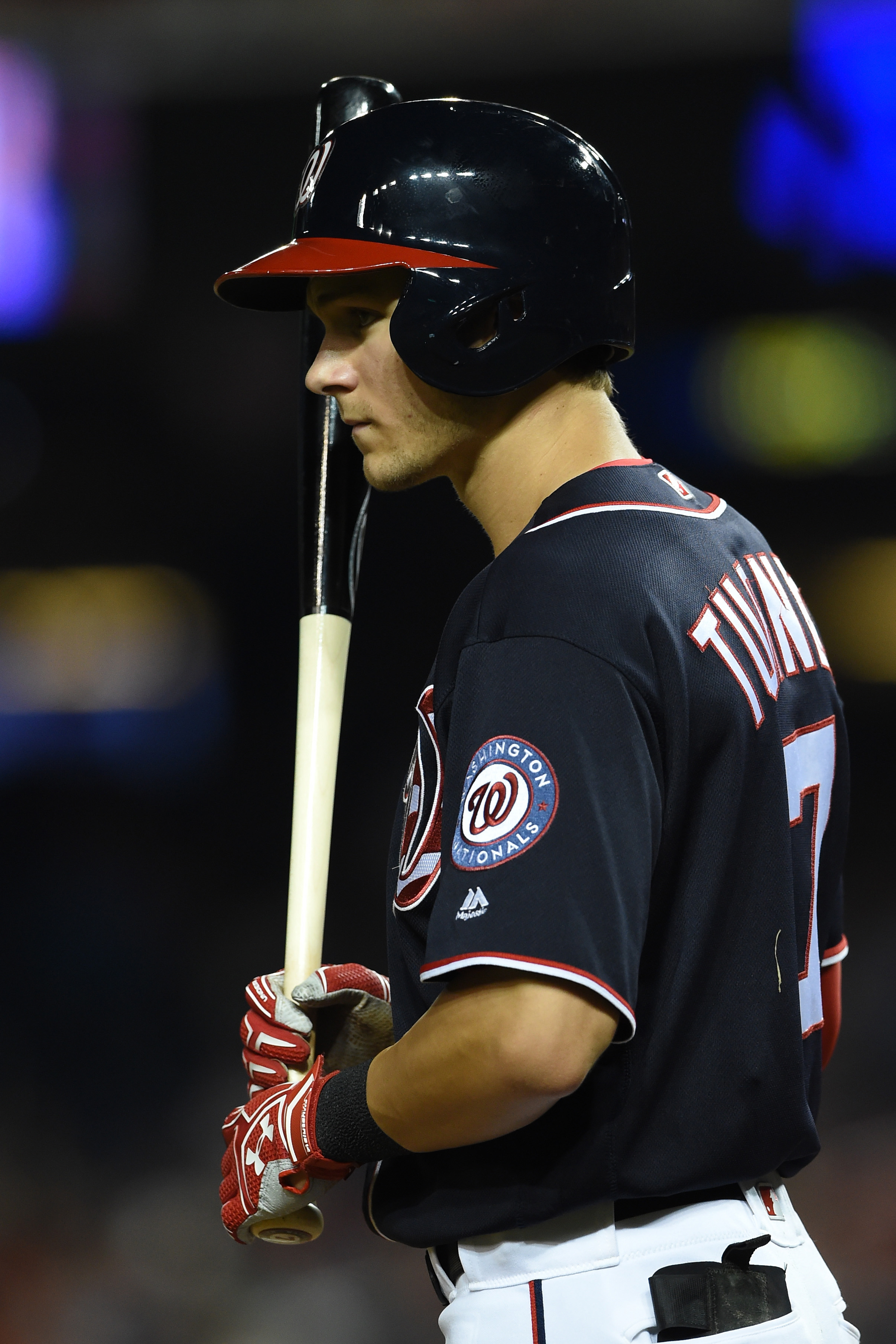
In the outfield, Bryce Harper will try to resume his presumed march to greatness while veteran Jayson Werth will play out the final year in D.C. There are plenty of options to play between them. Washington could platoon toolsy but strikeout-prone Michael Taylor with either of two lefties — Ben Revere and post-hype prospect Brian Goodwin, but that would mean multiple rolls of the dice. Odds are the team will non-tender Revere, who won’t come cheap and was dreadful in 2016. And Taylor and Goodwin seem more likely to compete for a reserve role — presumably, spelling Werth with some frequency — or continue to try to refine their talent at Triple-A.
Looking elsewhere, though Turner’s presence atop the order reduces the need for a true table-setter, switch-hitter Dexter Fowler‘s high-OBP bat would certainly slot in nicely. Other free agent possibilities include former Nats shortstop-turned Rangers center fielder Ian Desmond and Carlos Gomez. The trade market, too, has some intriguing possibilities. Rizzo has pursued younger veterans with two or three years of control before — e.g., Denard Span, Doug Fister — and that type of asset could line up nicely with the promotional timeline of skyrocketing center field prospect Victor Robles (who’d also be a heck of a trade chip). Charlie Blackmon of the Rockies fits that bill with two seasons of arb control remaining and is perhaps the best reasonably achievable trade target. The Nats reputedly had interest in him this summer. A.J. Pollock would be another two-year piece, though it’s not clear that Arizona will sell low after his injury-plagued campaign. With the Marlins reportedly considering dangling their three years of control over Marcell Ozuna in a bid to add pitching, there’s a possible match on paper. Indeed, the Nats reportedly pitched a deal to the Fish last year involving Gonzalez (though they were apparently trying to get Christian Yelich). Such an intra-division swap still feels like a bit of a stretch, and it’s perhaps even harder to see something coming together with the Braves for Ender Inciarte, who is another piece of the potential center field trade puzzle this winter. A readier match could be found with the pitching-needy Yankees, who might be interested in a swap involving Gonzalez and Brett Gardner (who has two guaranteed seasons plus an option remaining). If — big if — the Royals decided to market Lorenzo Cain, he’d presumably also be of interest.
There’s one other possible route to consider in the outfield. The Nationals put significant money on the table last winter for Yoenis Cespedes, who ultimately chose an opportunity to opt out after a year with the Mets over Washington’s heavily-deferred, five-year offer. Cespedes would give the team another premium bat, though either he or (perhaps more likely) Harper would need to spend part of the year in center to make that happen. It’s a bit of a strained fit, but it makes more sense when one considers that the Nats will be looking to replace Werth this time next fall. With Taylor and Goodwin available, the team could field Harper and Cespedes in the corners when Werth sits.
The other general strategy would be to keep Turner in center for at least another year or two, which would open the question of what to do at short. Taking that approach wouldn’t necessarily mandate a major acquisition, either, as Danny Espinosa has a final year of arbitration control after playing every day at short in 2016. But while the switch hitter provided 24 long balls, quality glovework, and excellent baserunning, his lack of contact (and resulting .209/.306/.378 batting line) make him a less-than-ideal choice. The Nationals would surely prefer to utilize him as a utility infielder.
Thing is, there’s a lot less out there at the shortstop position than there is in center. While the Nats could bring back Stephen Drew, pair Espinosa with young infielder Wilmer Difo, or sign another platoon partner, the free agent market doesn’t include any regulars. (Well, unless you really want to make things interesting and consider Desmond there.) Barring an exceedingly crafty trade for a high-quality young shortstop, there’s also not much of interest in the trade market. The clear target for teams hoping to improve at the position is Zack Cozart of the Reds, who has one more year of reasonably-priced control. Though he faded at the plate and ended the year with an injury, Cozart is a supremely talented gloveman with pop. It isn’t inconceivable that the Nats would look at the Cardinals’ Jhonny Peralta, too, though he’s 34 and struggled through an injury-ravaged 2016 season.
Regardless of how those issues are worked out, the Nats figure to rely upon familiar faces elsewhere in the infielder. Daniel Murphy and Anthony Rendon are stellar options at second and third. There are plenty of questions about longtime franchise face Ryan Zimmerman, but he’s set to remain the regular at first base. If his batting line doesn’t improve — and the team hopes it will, after a year in which good contact didn’t fall very frequently — and/or he is again limited by injury, then it will be useful to have alternatives.
That brings us to the bench mix, which will likely see some change as the team watches productive reserves like Drew and Chris Heisey return to the open market. Espinosa and/or Difo are likely candidates, as are the younger outfielders noted above. But the Nats may have some room to add impact with a market that’s chock full of platoon sluggers. The team has traditionally carried a power left-handed bat, a role filled most recently by Clint Robinson. He could be retained, but struggled mightily last year and isn’t really capable of playing the corner outfield. Particularly if the Nats don’t make a big move in center field, the team could make a play for free agent Brandon Moss, who might take 400 or more plate appearances while functioning as a complement to and insurance for Werth in left and Zimmerman at first. That sort of addition wouldn’t be particularly cheap and isn’t strictly necessary, of course: Murphy could also shift over if a need arises at first base, with Espinosa and Difo on hand for middle-infield protection.
In the final analysis, the Nationals have most of the pieces in place to believe they’re positioned for a repeat run at the NL East crown. It’s easy to imagine a relatively straightforward winter mostly spent shoring things up in a few areas. But holding off the Mets, and finally advancing in the postseason, may require more. The payroll already projects to include $139MM in commitments as things stand, but this is a team that opened the 2015 season with a payroll north of $160MM. If it’s willing to do so again, there’s still some room to add impact pieces. With intriguing roster flexibility provided by a deep reserve of pitching and the presence of Turner, Rizzo and co. may yet have some surprises up their sleeves.
Photo courtesy of USA Today Sports Images.
Latest On CBA Negotiations: Revenue Sharing, Schedule, Rosters
Word of various potential changes in the MLB-MLBPA collective bargaining agreement has been trickling out of late, and Susan Slusser of the San Francisco Chronicle reports on a series of new matters under consideration. In particular, she looks at discussions involving the cash flow to the Athletics.
Revenue sharing is the key topic of interest for Oakland, which has been allowed to participate in the system despite its large-market status because of its inability to find a new ballpark. The O.Co coliseum has allowed the team to continue receiving funds, which Slusser pegs at $34MM in 2016.
Some around the game — including rival teams and the union — believe that the A’s aren’t putting those funds to use as intended. Reduction or even elimination of Oakland’s participation has “definitely been a topic” of discussion, a union source tells Slusser.
The interplay with the longstanding stadium question is complicated, as the report details. There’s a concern in some quarters not only that the club isn’t funneling enough cash into player salaries, but also that the team has been slow to settle its ballpark situation. (Of course, there’s a counter-argument to be found as well.)
If the team ultimately has its revenue-sharing pipeline narrowed, with a resulting hit to profitability, sources tell Slusser that there could be ownership changes. That might involve a minority owner leaving or even a full-on sale of the organization, she suggests.
There are a variety of other possible changes being discussed that could have even wider-ranging impact, per the report. That includes the possibility of trimming the regular season down to 154 games and inserting more off-days.
Even more intriguingly, perhaps, there’s apparently at least some consideration being given to expanding rosters from 25 to 26 players. That would certainly reduce the need to utilize the 15-day DL, increase teams’ flexibility to carry more specialty players, and perhaps add to the frequency of reliever usage during the regular season. It would also seem likely to enhance the value of somewhat marginal roster pieces (lefty specialists, power bench bats, glove-first players) who might otherwise be without a spot, while perhaps increasing the viability of the Rule 5 draft and opening service-time opportunities for less-developed players who’d otherwise be left playing in the upper minors.
MLBTR contributor Ryan Spilborghs recently advocated for several such provisions, reasoning that both teams and players could benefit. The current grind is arguably too great, leading to injuries (and rushed returns) that can harm players’ earning capacities as well as the investments already made by organizations.