
MLBTR Poll: Should The Rockies Trade An Outfielder?
In addressing the three biggest needs for the Rockies heading into the offseason, I advocated that the team trade away Carlos Gonzalez and his hefty $20MM salary. You can read the full reasoning here, but it boils down to the fact that he’s expensive and isn’t as necessary to the organization given its other left-handed-hitting options and many other needs. The emergence of David Dahl gives the Rox three southpaw-swinging outfielders, and it’s probably sub-optimal to have so many resources tied up in such players.
Still, there’s an argument to be made that Colorado ought instead to pursue deals involving another player. Charlie Blackmon‘s monster 2016 season and two affordable years of control make him a highly appealing piece, especially with numerous rival organizations in the market for a center fielder. Of course, he’s also the Rockies’ primary option up the middle, though there are some alternative strategies.
The club could conceivably pair Gerardo Parra with a cheaper right-handed-hitting bat in center. Free agents such as Rajai Davis, Austin Jackson, Peter Bourjos, and Drew Stubbs should all be available on short-term deals. If trusting Parra up the middle isn’t desirable, Jon Jay or Michael Bourn could fill that role. Colorado could even provide a highly appealing bounceback locale for Carlos Gomez, though he’ll likely cost nearly as much as Gonzalez.
Parra himself could also be moved, though that would involve eating some salary. The Rockies owe him another $19.5MM over two years, including the buyout on a 2019 option. That’s a reasonable-enough commitment for the Parra of old, but he posted a 65 OPS+ in an injury-marred 2016 — which followed up a disappointing second-half run with the Orioles in 2015.
Dahl, meanwhile, only debuted last year, and seems much more likely to represent a foundational piece in Colorado than trade fodder. He spent most of his time in the minors in center field, and appeared a few times there last year, so could potentially step in for Blackmon rather than occupying a corner spot. Certainly, trading him now wouldn’t make a whole lot of sense for a team with limited willingness to spend. His development, following numerous other success stories on the position player side, demonstrates that the Rockies may be well-situated to ship out position players who are closer to free agency in exchange for pitching, as they did last year with Corey Dickerson. The team has struggled to attract free agent arms (or, at least in the past, to develop their own) even as they churn out quality bats.
Dealing Gonzalez or Blackmon would hold out the promise not only of opening some salary, but also of bringing back some interesting pieces in return. The Rockies are always hunting for pitching, of course. Even if the team is in better shape in the rotation than it has been in years, there’s room to add there. And the bullpen remains an area of concern. Plus, Colorado has needs behind the plate and at first base that could be addressed.
So, let’s put it to a vote … should the Rockies pursue a trade of an outfielder, and if so which one? (Link for mobile users.)
Should The Rockies Trade An Outfielder?
-
It's time to trade CarGo 49% (2,945)
-
Cash in Blackmon 29% (1,767)
-
Cut bait on Parra 16% (950)
-
Nah, keep this trio and pursue alternative strategies 6% (389)
Total votes: 6,051
Free Agent Notes: Cespedes, Wieters, Tolleson
Things remain quiet as the World Series draws to a close, but here are a few recent notes on the free agent market:
- While some analysts and fans think there’s a match to be made between the Giants and top expected free agent outfielder Yoenis Cespedes, we haven’t heard any firm reports connecting those dots. And there may not be reason to do so, according to Andrew Baggarly of the Mercury News (via Twitter), who labels any link “outside speculation based on apparent need.” Of course, it would be surprising if San Francisco didn’t at least consider such a move, given the team’s opening in left field and middle-of-the-road offensive output in 2016. But whether the organization will undertake a real pursuit seems unclear at this point.
- The Orioles are still undecided on whether to issue catcher Matt Wieters a qualifying offer, Roch Kubatko of MASNsports.com writes. At present, the sense is the team will let him reach the market unhindered, says Kubatko, which would match the consensus recommendation of MLBTR readers (per a recent poll). There’s certainly an argument to be made that a one-year, $17.2MM commitment wouldn’t be a terrible outcome, though, and Kubatko says he doesn’t think Wieters would again take the QO, which would net the club a draft pick if he signed elsewhere.
- Righty Shawn Tolleson is open to a return with the Rangers despite being cut loose recently, as MLB.com’s T.R. Sullivan reports. Poor performance, bad luck, and a back injury conspired to create a lackluster 2016 campaign for Tolleson after he entered the year as the club’s closer. While he’ll surely be looking for the best opportunity available, and says he’s allowing his agent to lead the charge, Tolleson noted that he is “not closing any doors” and won’t let the disappointing ending prevent him from returning to Texas. The 28-year-old, who turned in strong efforts in 2014 and 2015, added that he is back to full health after rehabbing his back strain and has been cleared for “a normal offseason.”
This Date In Transactions History: Derek Jeter
On November 1st of 2013, the Yankees did one of the most natural things imaginable for the organization, deciding once again that Derek Jeter would be the shortstop for the following season. At the time it wasn’t clear, but it turned out to be the final time the organization would make that call, as Jeter announced just before 2014 Spring Training that it would be his final campaign.
The one-year, $12MM contract struck between the Yanks and their aging franchise icon kicked off a dramatic farewell tour, brought Jeter’s fantastic career to a close, and wrapped up an interesting transactional history between the two sides. His first big contract — ten years, $189MM — came one year after the sides had seemingly agreed to a lesser deal that ultimately wasn’t consummated by owner George Steinbrenner.
In the 2010-11 free agent period, Jeter was already a Yankee legend but was coming off of a poor season as he entered the open market. It took a bit of gamesmanship — MLBTR’s Mark Polishuk called it a “tug-of-war” before the month of November was out — before the sides finally agreed to a three-year, $56MM deal. (GM Brian Cashman said this on November 23, 2010: “He should be nothing but a New York Yankee,” Cashman said. “He chooses not to be.”) There was drama even after that deal was struck, too, with chatter about moving Jeter to the outfield (see here and here) and discussion of hurt feelings.
Heading into 2013, it seemed that Jeter might again command a multi-year pact. He was fresh off of a productive and healthy 2012 in which he slashed .316/.362/.429. But the aging star managed to appear in only 17 games in 2013, with a variety of leg injuries keeping him off the field.
Complicating matters was a player option that was ultimately valued at $9.5MM by operation of incentives provisions. Negotiations weren’t contentious this time around, but nevertheless proved as complicated as anything the sides had previously arranged due to CBA considerations that still seem unclear in retrospect. (Want to have a crack at understanding it? You can check out all the contemporaneous reporting right here.)
Ultimately, the deal didn’t pay off from an on-field perspective. Though Jeter made his 14th All-Star game, that was an honorary nod — albeit one that delivered some memorable moments. He did still play nearly every day, wrapping up his career with a .256/.304/.313 batting line over 634 plate appearances. And New York’s second place finish in the AL East wasn’t enough to snag a Wild Card spot.
Of course, that tepid finish did little to change the fact that Jeter enjoyed an unbelievable run with the game’s most iconic franchise. All told, he took over 12,000 plate appearances over two decades and compiled a lifetime .310/.377/.440 batting line with 260 home runs. He helped lead the organization to five World Series titles, and racked up 71.8 wins above replacement by measure of both fWAR and rWAR. Jeter is a surefire first-ballot Hall-of-Famer, with the only question now is whether he’ll become the first player to receive unanimous support in his first year of eligibility.
Blue Jays Notes: Saunders, Encarnacion, Bautista, Free Agent Targets
The Blue Jays are about to embark upon an interesting offseason in which three key offensive producers — first baseman/DH Edwin Encarnacion, right fielder Jose Bautista, and left fielder Michael Saunders — will qualify for free agency. Their situations have been the subject of much analysis and debate, but we’ll soon begin to receive some clarity with qualifying offers due to be made (and either accepted or denied) shortly after the end of the World Series.
Here’s the latest on those positions out of Toronto:
- Despite indications that the Jays are still weighing the issuance of a QO to Saunders, a rival executive tells Jon Heyman of Fan Rag that there’s “no chance” that happens. We’ll learn soon enough what direction that situation is headed in, but Saunders’s marginal second half makes the one-year, $17.2MM offer seem like a rather lofty outlay.
- Toronto may now be more inclined to push to retain Encarnacion than Bautista, Heyman adds, noting that the preference for the younger slugger perhaps represents a change of position from the organization. Encarnacion certainly outproduced Bautista in 2016, though that also figures to elevate his market standing. Regardless, odds are that the Blue Jays will need to compete with the rest of the league to land either player, as both are expected to decline the QO.
- Ultimately, the Jays have several bat-first roster spots in flux — both corner outfield positions, first base, and the DH slot. The overriding mandate, Shi Davidi of Sportsnet.ca writes, is “to get more athletic, flexible and balanced in the batting order.” There are certainly some pieces on hand to assist in that regard, including the left-handed-hitting Ezequiel Carrera and righty swingers Melvin Upton Jr. and Chris Colabello. Young switch-hitter Dalton Pompey could also factor in, though he has yet to put it all together in the upper minors. Clearly, though, there’s room for additions (or, perhaps, re-acquisitions).
- Toronto will be able to look to a reasonably robust market in filling these voids. According to Davidi, the club has interest in the switch-hitting Dexter Fowler, who could add a significant on-base threat to the top of the order while playing left field (and, perhaps, also stepping in from time to time for light-hitting center fielder Kevin Pillar). There’s certainly reason to believe the Jays would be well-served to add an everyday player to their lineup given the number of areas that will need to be addressed. Ian Desmond is another, quite different player who the team is expected to contact, per Davidi. Though he’s a greater home run threat than is Fowler, he’s also inconsistent in the on-base department. As Davidi notes, though, the converted shortstop could also provide some insurance against an injury to infielder Troy Tulowitzki.
- Alternatively, or perhaps additionally, the Jays could look at some players who are somewhat more limited and may require platoon partners. The club is said to have some interest in Josh Reddick, who hits from the left side and could be paired with Upton — though he figures to be fairly expensive for a player who ought to be limited mostly to facing right-handed pitching. Brandon Moss and even former Blue Jay Colby Rasmus could represent more budget-friendly, southpaw-swinging options, Davidi suggests. And there are a variety of other, presumably reasonably-priced players with solid offensive chops (but also plenty of limitations) who’ll be available.
- That’s all before getting to the trade market, of course, which could offer some interesting possibilities. Davidi indicates that the Jays are likely to “work on parallel fronts” to open possibilities with a variety of combinations of players. GM Ross Atkins recently suggested that the club will remain flexible as the offseason progresses. “I think it’s a matter of being transparent as you are considering your alternatives,” he said. “So it would be something as simple as letting others know that you’re weighing alternatives as you make these certain offers.”
- It’s worth bearing in mind the role that financial considerations will play in dictating the course for the Jays. The team has never reached the $140MM line in Opening Day salary, and is already approaching $120MM in 2017 commitments after accounting for a few arbitration cases and the option over reliever Jason Grilli. Those obligations fall off quite a bit in the years that follow, so backloading salary could be a possibility, but one truly significant expenditure (say, Encarnacion) or a few quality veteran additions would leave Toronto without much wiggle room to address other needs — barring, perhaps, a payroll increase.
MLBTR Poll: Top Prospect Heading Into 2017
It’s always interesting to see who is tabbed as the game’s next great prospect. Some make it, others don’t, but the number one prospect tag remains a nice prize for a pre-MLB player. There’s no clear candidate for that lofty position heading into the 2017 season, so it’s particularly interesting to see where the MLBTR readership sees things heading.
Prospect eligibility is an essentially arbitrary matter, but we’ll draw the line at 100 plate appearances or 50 innings pitched. That takes players like Trea Turner, Andrew Benintendi, Julio Urias, Dansby Swanson, Alex Bregman, Orlando Arcia, Joey Gallo, Jose Berrios, and David Dahl out of consideration for our purposes. Many or all of them have largely earned MLB spots for 2017 regardless.
As a guide in putting together a list of candidates, I’ve drawn from the most recent rankings of MLB.com, Baseball America, and Baseball Prospectus. There’s a range of opinion, and they also haven’t been updated to reflect late-season observations.
It may be a shade premature to assess the top prospect, so you can consider this something of a predictive undertaking — which is what prospects are all about anyway. Here are the candidates for the poll:
- Yoan Moncada, INF, Red Sox — Moncada has all the tools, and had a highly impressive year in the minors in 2016. He draws walks, but also has plenty of swing and miss — which was on display in his brief MLB cameo (12 strikeouts in 20 plate appearances).
- J.P. Crawford, SS, Phillies — A premium defender at shortstop and reputedly polished hitter, Crawford holds out the promise of being an everyday mainstay in Philly even though he doesn’t figure to post massive home run or stolen base tallies. Crawford still needs to master Triple-A and is coming off of a minor knee surgery.
- Lucas Giolito, SP, Nationals — There have been some ups and downs for the big righty, who struggled rather notably in 21 1/3 major league frames last year. But he’s just 22, turned in 115 1/3 innings of 2.97 ERA pitching with 9.1 K/9 and 3.4 BB/9 in the minors last year, and has the kind of arsenal that leaves prospect hounds tabbing him for a limitless ceiling.
- Brendan Rodgers, SS, Rockies — The least-experienced players in this stratosphere, Rodgers showed immense potential at the Class A level last year in his first full season of pro ball. The 20-year-old slashed .281/.342/.480 with 19 home runs over 491 plate appearances.
- Alex Reyes, SP, Cardinals — Reyes didn’t produce great results at Triple-A last year, continuing to mix high strikeout rates with high walk rates, but exploded in 46 MLB frames. He continued to show questionable command, but racked up 52 strikeouts and allowed just eight earned runs on 33 hits.
- Tyler Glasnow, SP, Pirates — Another power starter whose command is the major question, Glasnow was unhittable in the upper minors (69 knocks in 116 2/3 innings). He showed both the good and the bad in 23 1/3 big league innings, with 11 earned runs crossing and a 24:13 K/BB ratio.
- Austin Meadows, OF, Pirates — The 21-year-old stalled out a bit at the highest level of the minors after dominating at Double-A, but delivered 48 extra-base hits over 352 plate appearances on the year. Just 21 years old, Meadows could soon push the Bucs to make some difficult decisions in their outfield.
- Amed Rosario, SS, Mets — Rosario reached Double-A in the middle of 2016 at just 20 years of age, and delivered a .341/.392/.481 slash over 237 plate appearances — though his .433 BABIP indicated both hard contact and some good fortune. Like Crawford, he probably won’t ever wow with counting stats, but projects as a strong defender at a premium position who can provide useful offensive production when he reaches the majors.
- Victor Robles, OF, Nationals — Just 19, Robles is considered a true five-tool prospect with the makeup to match. He has shot up prospect charts while climbing the system, though a hand injury slowed him and he cooled off at the High-A level. While his upside is tremendous, Robles still has yet to grow into his power potential and has yet to face polished pitching in the upper minors.
- Other — There are a host of others who could conceivably enter the discussion. Brewers outfielder Lewis Brinson has a monster ceiling, Braves infielder Ozzie Albies could provide immense all-around value, and Padres righty Anderson Espinoza has shown huge gifts for his age — just to name a few.
Weigh in here: who’s the single best prospect in the game as 2017 beckons? (Link for app users; responses are randomized.)
Who Is Baseball's Top Prospect Heading Into 2017?
-
Yoan Moncada 35% (2,704)
-
Alex Reyes 17% (1,306)
-
Other 11% (833)
-
Lucas Giolito 9% (688)
-
J.P. Crawford 7% (507)
-
Amed Rosario 6% (454)
-
Brendan Rodgers 5% (365)
-
Tyler Glasnow 5% (348)
-
Austin Meadows 4% (296)
-
Victor Robles 3% (198)
Total votes: 7,699
Offseason Outlook: Miami Marlins
MLBTR is publishing Offseason Outlooks for all 30 teams. Click here for the other entries in this series.
It feels wrong — not only in a moral and emotional sense, but also in pure baseball terms — to suggest that the Marlins can or should try to replace dearly departed ace Jose Fernandez. His sobering loss leaves gaping voids in the game writ large; in the Marlins organization, generally; and in the team’s pitching staff — none of which can be filled.
Guaranteed Contracts
- Giancarlo Stanton, OF: $285.5MM through 2027 (including $10MM buyout on 2028 club option; may opt out after 2020, with $218MM left on contract)
- Wei-Yin Chen, SP: $61MM through 2020 (may opt out after 2017, with $52MM left on contract; 2021 conditional player option)
- Christian Yelich, OF: $48MM through 2021 (including $1.25MM buyout on 2022 club option)
- Dee Gordon, 2B: $45.5MM through 2020 (including $1MM buyout on 2021 club option)
- Martin Prado, 3B: $40MM through 2019
- Ichiro Suzuki, OF: $2MM through 2017 (includes club option for 2018)
Arbitration-Eligible Players (service time in parentheses; projections via MLB Trade Rumors)
- David Phelps, SP/RP (4.156) – $5.2MM
- Adeiny Hechavarria, SS (4.060) – $3.7MM
- A.J. Ramos, RP (4.030) – $6.8MM
- Tom Koehler, SP (4.016) – $6.2MM
- Marcell Ozuna, OF (3.124) – $4.5MM
- Derek Dietrich, IF (2.151) – $1.8MM
Options
- Fernando Rodney, RP: $4.1MM club option ($400K buyout)
Free Agents
[Marlins Depth Chart; Marlins Payroll Information]
Fernandez was the beating heart of the Miami franchise, its best and most passionate player. We may never truly be able to take full stock of the effects of his death — not just on the organization, but also on the Miami and broader baseball communities — but the heartrending reaction of the organization in its aftermath suggests that they will be profound.
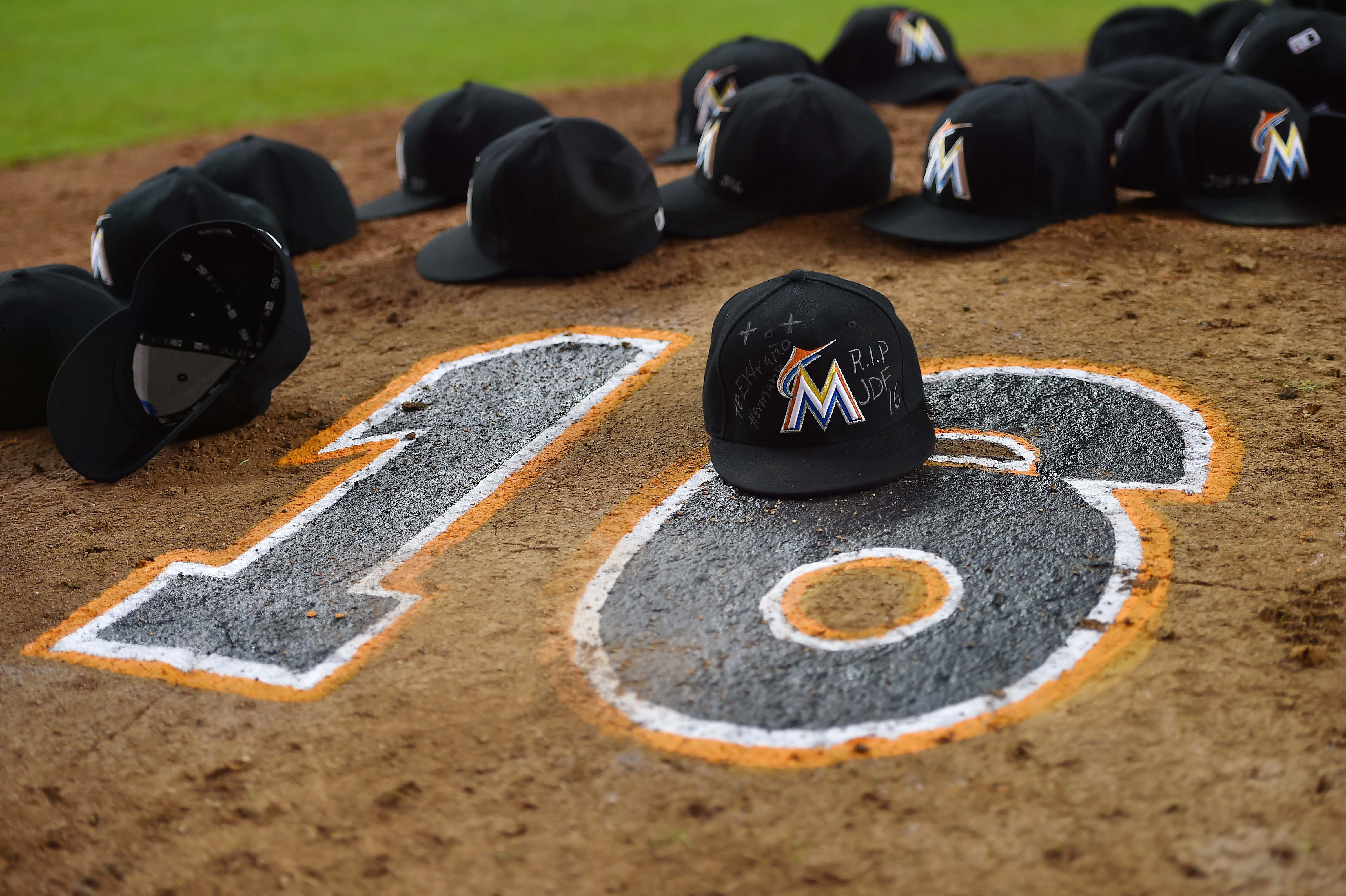
From a roster perspective, the loss of Fernandez is mercilessly easy to assess: the Marlins had one of the most valuable pitchers in baseball. Now, they don’t. Teams wait for decades to unearth a single player of his talents in the draft. Without Fernandez racking up strikeouts at a prodigious rate, while earning a bargain salary during his arbitration years, the Marlins look like a decidedly less promising team.
The team already had plenty of limitations, and plenty of needs, when looking ahead to 2017. Coming into 2016, the Fish carried an Opening Day payroll of just over $74MM — second only in franchise history to the ill-fated, $100MM+ 2012 roster. Once guaranteed salaries and the approximate arb obligations are tallied, Miami already has about $70MM committed for the season to come. While some payroll increases are anticipated, it would require a rather significant step northward to accomodate the addition of multiple quality veterans.
Trades are always possible, of course, but Miami is short in prospect capital. The organization already parted with top first base prospect Josh Naylor, as well as bounceback-candidate MLB pitchers Jarred Cosart and Carter Capps, in the failed deal to acquire rental starter Andrew Cashner. The Marlins did recover youngster Luis Castillo after unwinding the portion of that trade involving injured starter Colin Rea, so he could again be cashed in. Fellow young starters like Jarlin Garcia, recent first-round draft pick Braxton Garrett, and the TJ-recovering Tyler Kolek, could all be flipped. But the Fish will need to be judicious in parting with young arms after shipping out pitchers like Anthony DeSclafani and Andrew Heaney in recent years. Corner infielder Brian Anderson has shown promise and is nearing major league readiness, so he’s another asset that could hold appeal.
Miami did take steps forward in the win-loss department last year, and the team does feature a talented core even without its young ace. But there are many areas in need of improvement if the club hopes to return to the postseason for the first time since a 2003 World Series run. Catching the Nationals and Mets would be no small feat.
Giancarlo Stanton, Christian Yelich, and Marcell Ozuna make up one of the very best young, controlled outfield units in baseball. Most of the infield mix is settled, too. Second baseman Dee Gordon will look to bounce back from a suspension-marred 2016, and the club will hope that double-play partner Adeiny Hechavarria can at least return to hitting at a near-average rate while continuing to provide quality glovework at short. (There has been some chatter that the team would consider dealing Hechavarria for starting pitching, but he may not have enough value and the team doesn’t really have an alternative barring a surprise move of Gordon back to short.) The Marlins kept veteran third baseman Martin Prado off the market by inking a reasonable, but hardly bargain-priced extension in September. At first, Justin Bour has continued to provide power and a strong overall batting line against right-handed pitching, though he’s in need of a platoon partner. And behind the plate, J.T. Realmuto turned in a strong campaign and looks to be one of the better young catchers in the game.
The supporting cast could use some work, but the Marlins can fill out those ranks with the kinds of cheap, veteran additions the team has pursued in recent years. The venerable Ichiro Suzuki will return in the fourth outfielder’s role. Chris Johnson didn’t perform well as the right-handed-hitting complement to Bour, so Miami will look into a market that includes options such as Steve Pearce, Dae-ho Lee, and Ryan Raburn. The light-hitting Miguel Rojas remains on hand as an affordable utility option, though perhaps the club could look to bring in a veteran such as Erick Aybar or Alexei Ramirez to push Hechavarria and step in as needed elsewhere. A move to bring back defensive specialist Jeff Mathis as the reserve receiver wouldn’t be surprising, and there are a wide variety of other veteran backup types available.
That brings us to a player who is perhaps the biggest wild card on the Marlins’ roster: left-handed-hitting infielder/outfielder Derek Dietrich. Though he fell off after a big start to the year and is much better against right-handed pitching, Dietrich’s overall offensive performance has been plenty promising. Dating back to the start of 2015, he has posted a .270/.362/.438 batting line with 17 home runs over 701 plate appearances. Better still, defensive metrics have come around on him, rating him as an approximately average defender at second, third, and (briefly) the corner outfield in 2016.
It’s possible that the Marlins will find it hard to maximize Dietrich’s value with their current roster. He can’t play short or center. Second and third are largely occupied. And Dietrich won’t be of much utility at first since he swings from the same side of the plate as Bour.
As the Marlins look to build out their depleted rotation, then, Dietrich could be a key asset. Certainly, he could be traded if there’s another organization willing to give up a useful arm to add him — though with such limitations in his game, trade partners would likely also be looking for some of the above-mentioned pitching prospects to give up a quality starter. More intriguingly, perhaps, the Marlins could explore the possibility of moving one of their young outfielders — Ozuna seems most likely, though Yelich could also be considered — to add an impact arm. In that scenario, Dietrich could pair with a righty bat in left field.
Just what does Miami need in the rotation? Three spots are clearly accounted for, with the inconsistent-but-talented Adam Conley, steady-but-unspectacular Tom Koehler, and veteran Wei-Yin Chen (who’s looking to make amends for a miserable first year with the team) all more or less locked in. Righty David Phelps certainly made his case late in the year, turning in five outstanding starts after breaking out in the pen earlier in the year. He will have a prominent job of some kind in 2017, and the club seems to have quite a lot to gain by stretching him out next spring. And there are some possibilities for a fifth arm, including Justin Nicolino (who managed just 3.8 K/9 last year), Jose Urena (a low-K pitcher who has had good results in the minors), Jake Esch, Kendry Flores (if he can return to health), and perhaps Jarlin Garcia.
You could squint at that group and see a complete staff, but the Marlins obviously aren’t content. The real question at this point is just how big they’ll look to go in adding another starter (if not two). Miami is reportedly willing to consider moving Ozuna, Gordon, Hechavarria, or Dietrich — but not Stanton, Yelich, or Realmuto — to facilitate the addition of an arm. Ozuna likely has the most appeal after a strong 2016 season, and the Marlins have indicated a willingness to move him in the past. Garrett, an exciting power lefty, is the real prize in the prospect pool and would surely draw significant interest.
Even if Miami doesn’t gun for the biggest names (Chris Sale, Jose Quintana, Chris Archer) that could be available, rival teams with quality, controllable arms — think Jake Odorizzi — will have high asking prices. If the Marlins can’t stomach the sticker shock, it’s conceivable that they could take on part of a veteran’s deal, perhaps even becoming the third team to own a part of James Shields‘s contract. They could also look to take a shot at adding a bounceback arm in the mold of Jaime Garcia of the Cardinals, or aim somewhat higher for his teammate Michael Wacha. In recent years, the Fish have shown a predilection for taking some risks in trades for young-ish, higher-upside starters (e.g., Cosart, Cashner, Mat Latos), so a reasonably bold move could be in the offing.
Free agency isn’t without its options in the rotation department. While the premium talent just isn’t there, that’s not typically where Miami goes shopping anyway. A play for the best-available arms — Rich Hill, Jeremy Hellickson, and Ivan Nova — can’t be ruled out, but doesn’t seem particularly likely. They could seek some functional innings from a pitcher in the mold of Doug Fister, Jorge De La Rosa, Charlie Morton, or (for a budget option) Tommy Milone, though it’s fair to wonder whether that’s really what the team needs. A calculated gamble on Cashner would make quite a bit of sense — were it not for the fact that he struggled badly in Miami (and really doesn’t like its no-beard policy). Edinson Volquez is a workhorse who still has pretty good velocity, so he’d look to be a reasonable fit.
Assuming that Phelps remains in the rotation, the top two pen options will remain A.J. Ramos and Kyle Barraclough. Recent trade addition Hunter Cervenka looks to be the primary southpaw set-up man, but he’ll likely be joined by another lefty. A new deal with Mike Dunn could make sense. Nick Wittgren probably has a job secured after a strong season. Brian Ellington has posted a sub-3.00 ERA in each of the last two years, and could take a job even if his peripherals don’t quite support the results. There are a variety of other internal options, including some of the youngsters noted above who are being developed as starters, but there’s plenty of room for improvement and good reason to think the Fish will look to add one or two useful veteran righties. Dustin McGowan had a successful season and could return, and the free agent market contains a wide variety of veteran performers with late-inning experience (including Sergio Romo, Joaquin Benoit, Santiago Casilla, and the hard-throwing Daniel Hudson).
All told, there’s quite a bit of variability for the Marlins this winter, especially if they go hunting for a high-quality rotation piece. What does seem clear is that the organization won’t stop trying to contend. The team dealt some intriguing assets for Cashner despite a mediocre postseason outlook. And even after the disheartening loss of Fernandez, Miami struck a new deal with the veteran Prado. While it’s probably optimistic to expect a division title even with a fairly aggressive offseason, the Marlins could certainly profile as a solid Wild Card contender if they manage to bolster the pitching staff and make a few good calls on role players.
Indy Ball Signings: 10/28/16
Here are the day’s minor signings, featuring three independent league additions:
- The Marlins added third baseman David Vidal on a minor league deal, per an announcement from the Somerset Patriots. Vidal, 27, never made it past Double-A with the Reds, but had a big year for Somerset in 2016. Over 370 plate appearances, he slashed .320/.413/.633 and added 26 long balls. Vidal also showed quality plate discipline, with 45 walks to go with 68 strikeouts.
- First baseman Art Charles is heading to the Reds on a minors pact, Matt Eddy of Baseball America tweets. He earned BA’s indy ball player of the year honors after washing out of the Phillies system. Charles posted a ridiculous .352/.461/.699 batting line with 29 homers in 436 plate appearances. J.J. Cooper of Baseball America recently took an interesting look at his journey.
- The Brewers have purchased the contract of righty Chad Nading, the Wichita Wingnuts announced. Nading re-emerged in his age-28 season after a long layoff, throwing 39 1/3 innings of 1.83 ERA ball with 6.9 K/9 against 3.9 BB/9. The right-hander’s only affiliated experience came with the Padres’ rookie affiliate way back in 2010, when he coughed up nine earned runs on 13 hits in just 5 2/3 innings.
Giants Re-Sign Kyle Blanks
The Giants have agreed to a minor-league deal to bring back outfielder/first baseman Kyle Blanks, Matt Eddy of Baseball America tweets. Blanks, 30, never suited up for San Francisco last year as he continued to deal with foot injuries.
With Angel Pagan and Gregor Blanco set to depart, the Giants have a need in left field. Though Blanks could theoretically share time there, it’s not clear whether he will be able to patrol the outfield grass at this stage. He could also conceivably challenge for a spot as a bench bat and could pick up some appearances at first base.
Blanks had seemed to have a good shot at earning a reserve role in San Francisco last spring, and he has exhibited real promise at times with the bat. He carries a solid lifetime .241/.322/.416 slash with 33 home runs over 933 MLB plate appearances. And Blanks has laid waste to Triple-A pitching. The biggest question remains whether he can stay healthy.
West Notes: Claire, Dodgers, Gallo, Felix, Marlette
MLBTR offers its best wishes to former Dodgers GM Fred Claire, who is battling skin cancer that developed on his lip after a life in the sun at baseball diamonds. He spoke with JP Hoornstra of the Los Angeles News Group about his challenge and many fortunes in life, and it’s well worth a read. Claire has generously discussed his lengthy tenure with the Dodgers previously with MLBTR’s Zach Links. MLBTR wishes him our very best.
Here are a few notes from the western divisions:
- Current Dodgers president of baseball operations Andrew Friedman recently addressed the team’s 2016 campaign, as Mike DiGiovanna of the Los Angeles Times reported. Los Angeles faces decisions on several positions heading into the offseason with a variety of notable free agents, including closer Kenley Jansen, third baseman Justin Turner, starter Rich Hill, and infielder Chase Utley. “We have a lot of talented players who are free agents, and I expect we’ll have ongoing dialogue with every one of them,” said Friedman. “There are so many ways the off-season could play out. It’s so hard to try to corral it at this point.”
- Power-hitting Rangers prospect Joey Gallo suffered a hamstring injury in his third game of action in the Venezuelan Winter League, as Jeff Wilson of the Fort Worth Star-Telegram reports. He may need to head back stateside to have the muscle assessed, and it seems that it could well interrupt his time with the Navegantes del Magallanes. There’s no reason to think it’ll impact Gallo’s availability in the spring, certainly, but the hope had been that he would use the winter ball stint to develop at the plate while also providing the team an opportunity to assess his readiness to play a larger role at the major league level in 2017.
- This offseason is a critical one for Mariners righty Felix Hernandez, Ryan Divish of the Seattle Times writes. Once one of the game’s most dominating pitchers, the 30-year-old has exhibited a variety of worrying signs of late. By virtually any measure, Hernandez faded last year; though his 3.82 ERA was still plenty useful, earned-run estimators viewed 2016 as his worst season as a professional. Now, says Divish, King Felix will need to figure out a way to succeed despite waning velocity and wavering command. With $79MM owed to Hernandez over the next three years, Seattle has plenty riding on his ability to return to something approaching his prior form.
- The Mariners face a decision on catcher Tyler Marlette, who could be a Rule 5 draft candidate if he’s not added to the team’s 40-man roster, Bob Dutton of the Tacoma News Tribune writes. Marlette, 23, is hitting well in the Arizona Fall League, continuing to make a case for the team to trust him with a valuable roster placement. He performed well at the High-A level, too, slashing .273/.335/.472 over 358 plate appearances before earning a promotion to Double-A. As Baseball America’s staff explains, Marlette needs his bat to carry him, as he’s considered a marginal defender.
Brewers Outright Garin Cecchini, Jake Elmore, Andy Wilkins, Sean Nolin
The Brewers have outrighted four players, per a club announcement, leaving the team’s 40-man roster with three openings. Milwaukee has dropped infielders Garin Cecchini and Jake Elmore, infielder/outfielder Andy Wilkins, and lefty Sean Nolin from the major league slate.
None of the moves are particularly surprising. Milwaukee is preparing for another winter in which the club figures not only to protect some of its own Rule 5 draft-eligible players, but also to seek undervalued assets that don’t stick with other organizations. The club lost outfielder Rymer Liriano via waivers earlier today as well.
Of course, some of the players now leaving the 40-man were brought in with hopes they’d thrive in a new environment. That is most apparent, perhaps, in the case of Cecchini, who was once a fairly highly regarded Red Sox prospect. He never earned a major league shot in Milwaukee after hitting .271/.325/.380 over 469 plate appearances at Triple-A, with 13 stolen bases and five home runs.
The 29-year-old Elmore is no stranger to this process. He has appeared in the majors in each of the last five years, every time with a different team. All said, he has produced a miserly .215/.297/.280 batting line in 478 trips to the plate, but continues to be seen around the league as a useful depth piece given his defensive versatility.
Wilkins, 28, has also bounced around a fair bit of late. He’s still looking for his first real shot at major league playing time, but hasn’t impressed at the Triple-A level since a strong 2014 campaign with the White Sox’ top affiliate. In 2016, he posted a .235/.321/.419 batting line with a dozen home runs in 374 plate appearances in the highest level of the minors.
As for Nolin, health problems have derailed his career. He had been acquired by the A’s as part of the deal that sent Josh Donaldson to the Blue Jays, but Oakland gave up on him after one year and he was claimed by Milwaukee. The 26-year-old never ended up pitching competitively for the Brewers; after trying to stave off Tommy John surgery, he wound up going under the knife late in the summer. Nolin will likely miss most or all of the ensuing campaign.