
NL West Notes: D-Backs, Gray, Grandal, Seager
Diamondbacks middle infielders Jean Segura, Nick Ahmed, and Chris Owings have all thrived offensively in Spring Training, as Ken Rosenthal of FOX Sports writes. On whether he’d move any of the three for help elsewhere, general manager Dave Stewart told Rosenthal, “Not going to happen. If you make a trade, you’re depleting your depth. One thing we have right now is three major-league middle infielders capable of playing — and in my opinion starting — for a lot of teams at a top level.” Stewart is quite bullish about the D-backs as a whole, saying, “When I look at our team, I don’t have any concerns whatsoever.” Click here to read a newly published, in-depth interview between Stewart and MLBTR contributor Brett Ballantini.
Here’s the latest on some injury situations in the NL West:
- The Rockies expect righty Jon Gray to require about two weeks before returning to action while he rests his strained abdominal, MLB.com’s Thomas Harding reports. That doesn’t sound too serious, of course, but Gray expressed frustration that he won’t be able to fine tune in camp before the season starts. It seems likely that he’ll open up on the DL, with Christian Bergman and David Hale being the most obvious fill-in candidates. Of course, that might also open a roster spot for another pitcher to slide into the pen.
- Dodgers catcher Yasmani Grandal is dealing with a right forearm issue and, as a result, isn’t allowed to swing a bat or throw a ball, Bill Plunkett of the Orange County Register reports. The Dodgers will limit Grandal in workouts until at least Sunday and then try to ease him back in as a designated hitter in minor league camp games, according to manager Dave Roberts. With the season just 10 days away, that would seem to put Grandal’s status for the opener in jeopardy. Grandal downplayed the injury – saying it’s not “major” or worthy of concern – and an MRI on his forearm “showed there was nothing of significant damage,” Roberts said. Still, Roberts didn’t rule out a season-opening stint on the disabled list for the 27-year-old. “I think if you look at his at-bats this spring, he hasn’t had many,” Roberts stated. “To get him back in a major-league game, optimistically Monday, you’re up against the calendar. That’s taking out any other setbacks.” The Dodgers could back-date Grandal’s placement on the DL to Friday and only lose him for the first five games of the year, per Plunkett.
- Dodgers shortstop Corey Seager looks like a better bet than Grandal to take the field on Opening Day. Seager, who sprained his left knee two weeks ago, took four at-bats in minor league games Thursday and tested his knee on the base paths beforehand. Though Seager didn’t run out of the batter’s box after his four ABs or play defense, he did come away encouraged by how his knee held up in his pregame workout, according to Ken Gurnick of MLB.com. “Everything was fine,” Seager said. “I rounded first, stopped like I did when it buckled the last time, did other little things, no problems so far. No pain, that was nice.” While that’s generally positive news, his presumptive double-play partner, Howie Kendrick, may be another Los Angeles player to keep an eye on; as Gurnick tweets, he was scratched today with calf soreness.
Connor Byrne co-authored this post.
Diamondbacks Seek To Pursue New Ballpark
Chase Field opened in 1998, the year of the Diamondbacks’ inception, and has long drawn praise from the baseball community. But if the D-backs have it their way, it may not be their home for much longer, as Craig Harris of the Arizona Republic reports.
In a letter to the Maricopa County Board of Supervisors, President and CEO Derrick Hall argued that there is no reasonable recourse for the club but to “pursue other stadium options.” The problem, from the club’s perspective, is that the Maricopa County Stadium District — the board-controlled entity that owns the park — has failed to honor its alleged obligation to account for upwards of $187MM in maintenance and repair costs through 2027.
Hall puts it in even more dramatic terms in a statement released by the club today. “This spiral is insurmountable,” he said, apparently referring to the lack of funding for capital improvements, “and will result in a Chase Field that will no longer be a state-of-the-art facility as our agreement requires and may, in fact, become unsuitable for continued use. We cannot risk being put in that position.”
Even if that funding was available, however, the D-Backs say it wouldn’t make sense to use it towards the current, 18-year-old ballpark. Therefore, the team concludes in its letter, a new facility is necessary. While the organization says it strongly prefers to build in Phoenix, it also warns that it willing to “go elsewhere” to find an arrangement to its liking.
Of course, the contract at issue does not permit the team to pursue alternative stadium sites until 2024. While contending that the stadium district has ceded that right by breaching the contract, the club also requests authorization to explore alternatives — a request that has already been denied — under threat of pursuing court action.
Clearly, these maneuvers have set up a political and legal battle over the future home of the franchise. As Harris notes, the city’s hockey and basketball teams are also angling for new public commitments relating to their facilities, so there’s a broader picture at play here.
The Diamondbacks recently locked up a big new TV contract, ultimately dedicating over $200MM of that expected revenue flow to Zack Greinke. But new taxpayer-funded stadiums have long been another popular — yet highly controversial — means of boosting teams’ bottom lines yet further. The Braves’ shocking move out of downtown Atlanta provides a recent model, as Turner Field opened two years before Chase; the D-Backs’ letter calls that decision “economically efficient and responsible.”
Connor Byrne co-authored this post.
Shane Victorino Won’t Make Cubs’ Roster, Mulling Rehab Offer
Cubs manager Joe Maddon announced today that outfielder Shane Victorino will not be on the Opening Day roster, as ESPNChicago.com’s Jesse Rogers was among those to report on Twitter. As an Article XX(B) free agent, he’d have posed a $100K retention bonus question to the club in just a few days’ time.
It appears that Chicago has offered Victorino an alternative arrangement, as MLB.com’s Carrie Muskat tweets. He is still considering the new deal, pursuant to which he’d rehab his ailing calf before reporting to Triple-A in hopes of earning a major league opportunity.
It’s not entirely clear whether a new contract is being contemplated or whether the veteran would be given his retention bonus (and an automatic June 1st opt-out date). Implicitly, it seems, he could instead elect to look for another organization on the open market.
Victorino, 35, signed on with the Cubs on a minor league deal in late February. He’s managed only ten plate appearances this spring, and already seemed to face an uphill battle to crack a roster full of outfield options. Long a sturdy regular, Victorino posted a meager .230/.308/.292 batting line in just 204 plate appearances last season — by far his worst output since he established himself in the majors back in 2006.
MLBTR Live Chat: 3/24/16
Click here to read a transcript of today’s chat with host Jeff Todd.
Orioles Acquire Edgar Olmos
The Orioles have acquired lefty Edgar Olmos from the Cubs, per a Baltimore announcement. Chicago will receive a player to be named later in the swap.
Olmos will join just-signed southpaw Zach Phillips in the mix to fill in for injured reliever Brian Matusz. Baltimore gave Phillips a 40-man spot, but will be able to hold onto Olmos without committing to him on the major league roster since he was previously outrighted by Chicago.
Baltimore has obviously been intrigued with Olmos before, as he was briefly a member of the organization before the Cubs claimed him off waivers. Soon to turn 26, the former third-round draft pick only has minimal major league experience but posted a 3.55 ERA with 9.3 K/9 against 3.5 BB/9 in 33 Triple-A innings last year.
Alex Rodriguez May Retire After 2017
THURSDAY: Rodriguez may not be entirely firm about his decision to retire, as he texted Mark Feinsand of the New York Daily News that “I’m thinking in terms of my contract which ends in 2017. After that, we’ll see what happens. I’ve got two years and more than 300 games to play.” One of Rodriguez’s friends tells Feinsand that the slugger could decide to keep playing if he’s reasonably close to Barry Bonds‘ all-time home run record. A-Rod currently has 687 homers, so he’s still a significant distance behind Bonds’ mark of 762.
WEDNESDAY: Long-time MLB star Alex Rodriguez has decided to retire after the 2017 season, he tells Andrew Marchand of ESPNNewYork.com. The veteran will wrap up his career when his contract with the Yankees is up after next season.
Rodriguez, 40, will no doubt go down as one of the most talented and controversial players in baseball history. He went from hyped prospect to star in his first full season, a 1996 campaign with the Mariners in which he led the league in batting average while playing a stellar shortstop. That was his first of five outstanding seasons in Seattle and first of six in which he finished with an OPS of over 1.000.
Entering the open market in advance of his age-25 season, Rodriguez inked a ten-year, $252MM contract with the Rangers — an unheard-of sum at the time and still one of the three largest baseball player contracts ever. A-Rod continued to produce in Texas, finally winning an AL MVP award in 2003, though the club didn’t post a winning season over his three years.
Things took an interesting turn when Rodriguez was shipped to the Yankees for Alfonso Soriano before the following season. Though he was still a quality defender up the middle, he moved to third base to play alongside Derek Jeter. Rodriguez went on to take home two more most valuable player nods in 2005 and 2007, then opted out of his deal in the midst of the World Series — only to strike yet another ten-year pact to stay in New York, this one for $275MM. Rodriguez ultimately helped lead the way to a 2009 World Series win, though his offensive production began to wane as he entered his mid-thirties.
PED allegations and a 2014 suspension significantly marred his legacy, however, and at one point it seemed in question whether he’d ever suit up for the Yankees again. But Rodriguez has, rather miraculously, managed to rebuild some of his public image and turned in a strong .250/.356/.486 campaign last year as the club’s regular DH.
New York owes Rodriguez $20MM in each of his final two campaigns. He’ll likely surpass Babe Ruth on the career home run list at some point before hanging up his spikes. While his performance record will always come with at least an implicit asterisk, Rodriguez already rates among the top 15 position players in history in terms of total fWAR.
Offseason In Review: Philadelphia Phillies
Check out all the published entries in our Offseason in Review series here.
The new Phillies front office continued the tear-down while adding a wide array of low-cost, low-risk assets in an offseason of continued change.
Major League Signings
- RP David Hernandez: One year, $3.9MM
Trades
- Acquired SP Vincent Velasquez, SP Brett Oberholtzer, SP Mark Appel, SP Thomas Eshelman, SP/RP Harold Arauz from Astros for RP Ken Giles, INF Jonathan Arauz
- Acquired SP Charlie Morton from Pirates for SP David Whitehead
- Acquired SP Jeremy Hellickson from Diamondbacks for SP Sam McWilliams
- Acquired RP Yoervis Medina from Pirates for SP Jesse Biddle
- Acquired 2B Taylor Featherston from Angels for cash/PTBNL
Claims
- Claimed OF Peter Bourjos off waivers from Cardinals
- Claimed RP Michael Mariot off waivers from Royals
- Claimed RP A.J. Achter off waivers from Twins; later claimed by Angels
- Claimed RP Dan Otero off waivers from Athletics; later traded to Indians for cash
- Claimed RP Bobby LaFromboise off waivers from Angels
- Claimed OF Tyler Goeddel from Rays in Rule 5 draft
- Claimed RP Daniel Stumpf from Royals in Rule 5 draft
Extensions
- None
Notable Minor League Signings
- J.P. Arencibia, Andrew Bailey, Emmanuel Burriss, Ernesto Frieri, Frank Herrmann, Cedric Hunter, Edgar Ibarra, Ryan Jackson, Chris Leroux, David Lough, Edward Mujica, James Russell, Anthony Vasquez
Notable Losses
- Biddle, Chad Billingsley, Brian Bogusevic, Domonic Brown, Jordan Danks, Chase d’Arnaud, Justin De Fratus, Kelly Dugan, Jeff Francoeur, Giles, Aaron Harang, Erik Kratz, Cliff Lee (declined option), Adam Loewen, Nefi Ogando, Jonathan Pettibone, Jerome Williams
Needs Addressed
If you’ve ever wondered what a modern-day expansion draft would look like, the Phillies’ offseason provides a decent proxy. The organization turned over huge swaths of its 40-man roster, re-stuffing it (and the non-roster invite rolls) with a mix of placeholders, interesting youngsters, and bounceback veterans.
Former GM Ruben Amaro Jr. had already sold off most of the team’s marketable veteran assets, leaving only Ryan Howard and Carlos Ruiz from the 2008 championship club. Truth be told, they’d probably be gone, too, but it’s not entirely clear that either warrants a guaranteed roster spot at this point — let alone anything close to the $35MM and $9MM they’re respectively owed.
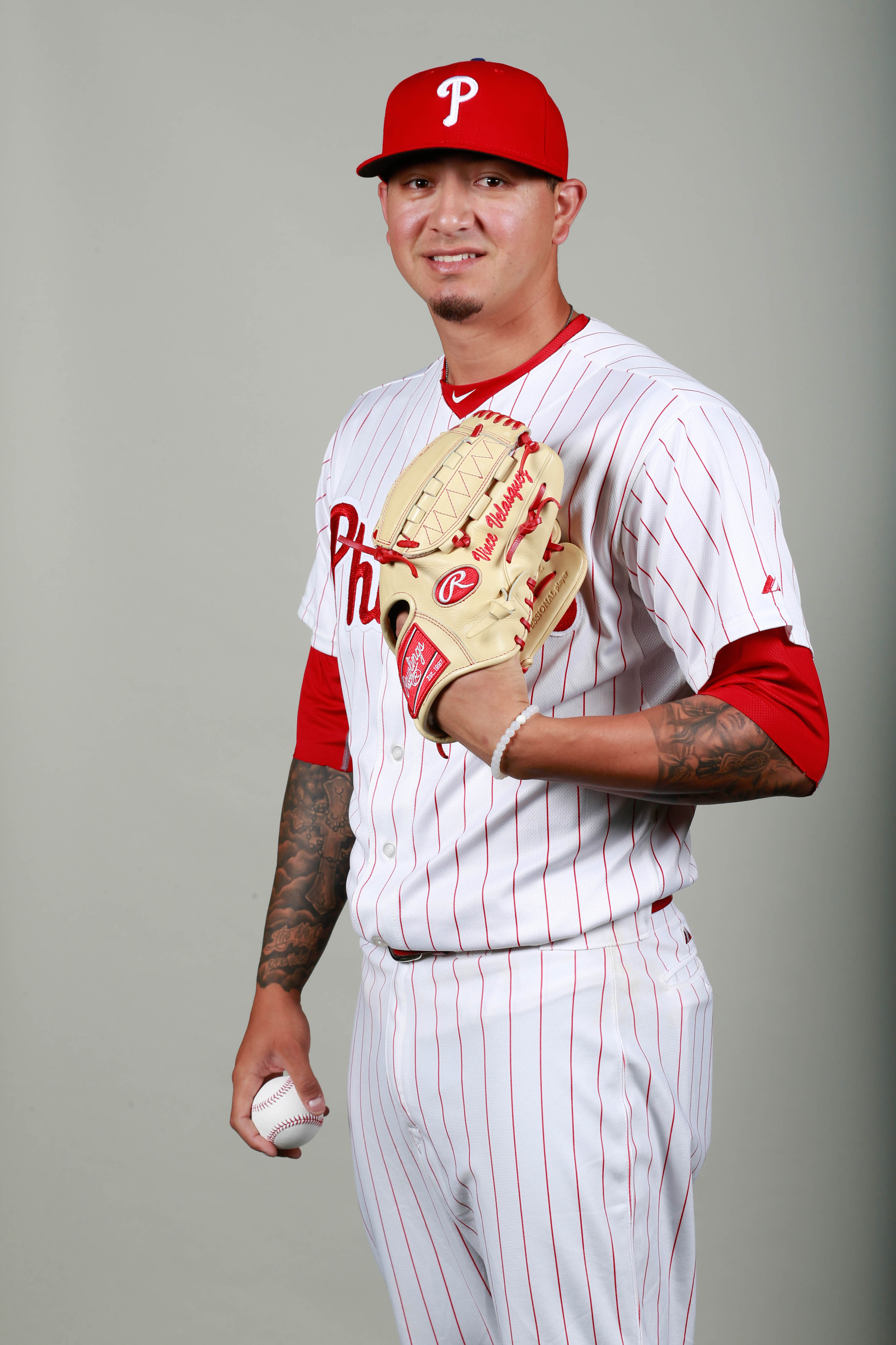
Incoming president Andy MacPhail and hand-picked GM Matt Klentak did have one major trade piece to market, however: young closer Ken Giles and his five remaining years of control. He might well have been retained had he played any other position, but the new Phillies brass was probably wise to cash in the fireballing righty while his value was high. There aren’t any sure things in the return, but Vincent Velasquez and Mark Appel have their share of upside, with late-inning relief potential if they can’t stick in the rotation. Harold Arauz represents a fun lottery ticket to track, while Brett Oberholtzer and, eventually, Thomas Eshelman could provide some cheap and solid innings.
Stocking future assets remains the unmistakable lodestar of the new front office, but there were near-term roster practicalities to be considered. And 25-man opportunities are their own kind of asset for rebuilding clubs, which can offer veterans a chance to receive playing time, rebuild value, pass on some lessons to the youngsters, and hopefully turn themselves into appealing summer trade pieces. The rotation, in particular, was ripe for would-be comeback tales, with several short-term veterans departing and the inimitable Cliff Lee cut loose, his $12.5MM buyout representing an easy decision given his elbow issues and questionable desire to pitch in 2016.
Convincing intriguing veterans to come to Philadelphia may not have been a fruitful task with the roster ripped down to the studs, so the Phils went after unwanted, mid-priced castaways. Charlie Morton and Jeremy Hellickson offer the promise of some stability and will help prevent the need to press younger arms for non-developmental reasons. At $9MM (including option buyout) and $7MM, respectively, they aren’t obvious values. And neither seems particularly likely to be worthy of a qualifying offer after the season. (Morton’s option turned into a mutual one with the deal, so he’ll likely decline it if he’s productive and healthy.) But the TV-rich Phillies have pared their payroll to levels not seen since 2003 even with those additions, neither pitcher required much in the way of player assets to acquire, and sturdy performances over the season’s first few months could turn the pair into trade chips.
Those two starter additions constituted the largest salary commitments of the winter, with the Phillies only making one major league signing. David Hernandez seemed penciled in as the team’s closer, and figures to have a chance at the role with a $3.9MM guarantee in hand, but he’s been taking it slow this camp given his history of arm injuries. He isn’t controllable past this season, so the bet is that his arm will stay healthy and that he’ll come close enough to his double-digit K/9 numbers of yore to anchor the pen and, perhaps, turn into prospects on or before August 1st.
Otherwise, the Phillies turned their spring home of Clearwater, Florida into a veritable island of misfit toys — while mixing a group of young but talented prospects — ultimately inviting 65 players to big league camp. The new front office plucked seven players from DFA limbo, whether by trade or claim, though it later lost two of those through the same process in the course of making yet more additions. It also added a host of minor-league free agents. We’ll walk through the more significant among them in tackling the team’s many areas of uncertainty.
Read on for more analysis …
Central Notes: Indians, Meyer, Rosenthal, Rivera
The Indians have little time to evaluate Marlon Byrd and make final roster decisions, as Ryan Lewis of the Akron Beacon Journal writes. Manager Terry Francona acknowledged the dilemma of making a call after a brief look at the late-to-sign veteran. “It’s not like we need to see him hit a home run,” said Francona. “This is going to be a hard one. I think we’re balancing not trying to do too much, too quick. … Because it’s going to be hard unless something jumps out one way or another.” As Lewis notes, the organization does have some flexibility since it can retain some of the competitors for outfield jobs — including Joey Butler, Collin Cowgill, and Tyler Naquin — via options. Will Venable is also in the hunt for a role, per the report, while Robbie Grossman and Shane Robinson appear to be “outside contenders” at this point.
Here’s more from the central divisions:
- Twins righty Alex Meyer will return to the rotation to open the 2016 season, MLB.com’s Rhett Bollinger reports. The former top-50 leaguewide prospect shifted to the pen last year after a disastrous beginning to the season, with up-and-down results. Meyer has a long way to go to restore his prospect sheen, but it seems he’ll at least have a chance to harness his big arm as a starter.
- Trevor Rosenthal of the Cardinals, meanwhile, has established himself as one of the game’s best relievers, but still hopes to have a chance to return at some point to the rotation, Rick Hummel of the St. Louis Post-Dispatch writes. Rosenthal mostly pitched as a starter in the brief time he spent in the minors, but has operated exclusively in relief at the major league level. Though he didn’t take issue with his 9th-inning role, Rosenthal said he “would definitely like to have [a starting] opportunity,” preferably “sooner rather than later.” Of course, his role is highly unlikely to change this spring or over the season to come, and it remains to be seen whether the organization will be willing to tinker next spring. Rosenthal’s work as a closer has already earned him a $5.6MM payday in his first of three years of arbitration.
- Infielder Yadiel Rivera has impressed the Brewers this spring, but finds himself in a tough spot in the organization’s hierarchy, as Tom Haudricourt of the Milwaukee Journal-Sentinel reports. The 23-year-old is behind Jonathan Villar in the pecking order at the major league level, with the heralded Orlando Arcia rising quickly as well. But there’s little question that a rebuilding Milwaukee organization will find some way to give Rivera a chance if his added strength and confidence show up in the results; indeed, none of the club’s likely starting infielders appear to have a stranglehold on their jobs heading into the season.
MLBTR Live Chat: 3/22/16
Click here to read a transcript of today’s chat with host Jeff Todd.
NL East Notes: TJ, Wright, Marlins, Nats, Chacin
In a piece for ESPN The Magazine, Sam Miller speaks with Scott Boras about pitching injuries — focusing, particularly, on several key NL East former TJ patients who are repped by the super agent. It’s an interesting piece, and I recommend you give it a full read. Boras says that his sometimes rather public discussion of the care of arms is “not an authority-driven exercise,” but rather “an education exercise” designed to draw attention to the issue. He explains that he hopes only to help ensure that all involved — including teams and, especially, his players — are able to “make an informed decision” for themselves. As Miller notes, that was precisely the purpose of the recent Tommy John study of MLBTR contributor Bradley Woodrum, which endeavored to identify statistical clues of UCL tear susceptibility.
Here’s more from the National League East:
- Speaking of key injury situations, Mets third baseman David Wright faces an ongoing battle to overcome spinal stenosis, as Ron Berler writes in an excellent article for Men’s Fitness. New York will hope that he is able to remain productive and healthy, but it’s going to take a continued effort from the veteran — who has certainly been up to the task thus far, as the piece details.
- The Marlins announced several camp decisions today; among them, the team is optioning righty Kyle Barraclough and southpaw Justin Nicolino to Triple-A. Barraclough had an impressive debut last year after coming over in the Steve Cishek trade, and looked to be a power pen option to help fill in for the injured Carter Capps. He still may have that chance, but will need to keep working on refining his command after permitting eight walks to go with eight strikeouts in 6 1/3 spring innings. Nicolino, meanwhile, had good results in the earned run department but only managed two strikeouts in his 8 1/3 frames, but he’ll likely be the first man up if and when a rotation need arises.
- The Nationals have an interesting potential dilemma brewing in the outfield, Ken Rosenthal of FOX Sports writes. Michael Taylor has had a strong camp, and seems clearly ready for a full test at the MLB level, but Ben Revere is now in the fold at center while Jayson Werth‘s contract (and, it might be added, standing in the organization) make it difficult to create space. From my perspective, Werth’s injury history makes him a prime candidate for regular rest, which ought to provide plenty of opportunity for all of these players. It’s interesting to note, though, that Rosenthal says the Nats likely would have traded Taylor had the club managed to sign Jason Heyward or Yoenis Cespedes over the winter.
- Off the field, but relating to it, the Nationals are engaged in a renewed effort to sell their ballpark’s naming rights, Chelsea Janes of the Washington Post reports. Valerie Camillo, the organization’s chief revenue and marketing officer, explained that “this is a major revenue opportunity that was untapped by the team, when you look at overall picture of revenue growth potential.” Particularly with the MASN television dispute still proving a tough nut to crack, it obviously makes sense to pursue all avenues to improve the bottom line. While that may require some difficult tradeoffs with the Nationals Park name fairly entrenched, Camillo says that the club is doing it for a good reason: “It’s not as if we’ll be maximizing revenue without a competitive product on the field. We’re doing what we can to keep the fans happy, and I think the predominant thing fans want is winning.”
- Braves righty Jhoulys Chacin is making a push for a rotation job, as Michael Kolligian reports for MLB.com. He has generally been expected to land in the pen after signing a minor league pact, but skipper Fredi Gonzalez says that Chacin is “really making a case.” Gonzalez continued: “he is definitely a guy who, if he keeps pitching like he is, he’ll be in the rotation someplace.” Utilizing Chacin and other veterans in the starting staff would certainly allow the organization to be conservative in deploying its younger options — a topic I discussed in reviewing the Braves’ offseason earlier this morning.