
You can find all the published entries in our Offseason in Review series here.
The rebuild continues, but the Braves have concentrated the bulk of their talent acquisitions at or near the MLB level.
Major League Signings
- C Tyler Flowers: Two years, $5.3MM
- C A.J. Pierzynski: One year, $3MM
- SP Bud Norris: One year, $2.5MM
- RP Jim Johnson: One year, $2.5MM
- IF Kelly Johnson: One year, $2MM
- IF Gordon Beckham: One year, $1.25MM
- IF Emilio Bonifacio: One year, $1.25MM
- RP Carlos Portuondo: $990K bonus (minor-league deal)
- Total spend: $18.8MM
Trades and Claims
- Acquired SS Erick Aybar, SP Sean Newcomb, SP Chris Ellis and $2.5MM from Angels for SS Andrelton Simmons and C Jose Briceno
- Acquired CF Ender Inciarte, SP Aaron Blair, SS Dansby Swanson from Diamondbacks for SP Shelby Miller, RP Gabe Speier
- Acquired RP Ian Krol, RP Gabe Speier from Tigers for OF Cameron Maybin
- Acquired SP/RP Casey Kelly, C Ricardo Rodriguez from Padres for C Christian Bethancourt
- Acquired RP Jose Ramirez from Mariners for PTBNL (RP Ryne Harper)
- Claimed LHP Evan Rutckyj from Yankees in Rule 5 Draft (since returned to New York)
Extensions
- None
Notable Minor League Signings
- Willians Astudillo, Reid Brignac, Jhoulys Chacin, Chase d’Arnaud, Jeff Francoeur, Nate Freiman, David Holmberg, Kyle Kendrick (since released), Blake Lalli, Ryan Lavarnway, Alexi Ogando, Alex Torres, Carlos Torres, Matt Tuiasosopo, Rob Wooten, Chris Volstad (since released)
Notable Losses
- Betancourt, Pedro Ciriaco, Ross Detwiler, Edwin Jackson, Mike Minor, Sugar Ray Marimon, Maybin, Miller, Peter Moylan, Eury Perez, Simmons, Joey Terdoslavich
Needs Addressed
The biggest move made by Atlanta last winter came on the eve of Opening Day, when closer Craig Kimbrel was shipped to the Padres. This time around, the stunner came early in the offseason, with defensive magician Andrelton Simmons heading to the Angels for one year of veteran shortstop Erick Aybar and two pitching prospects: the high-upside Sean Newcomb and near-ready Chris Ellis.
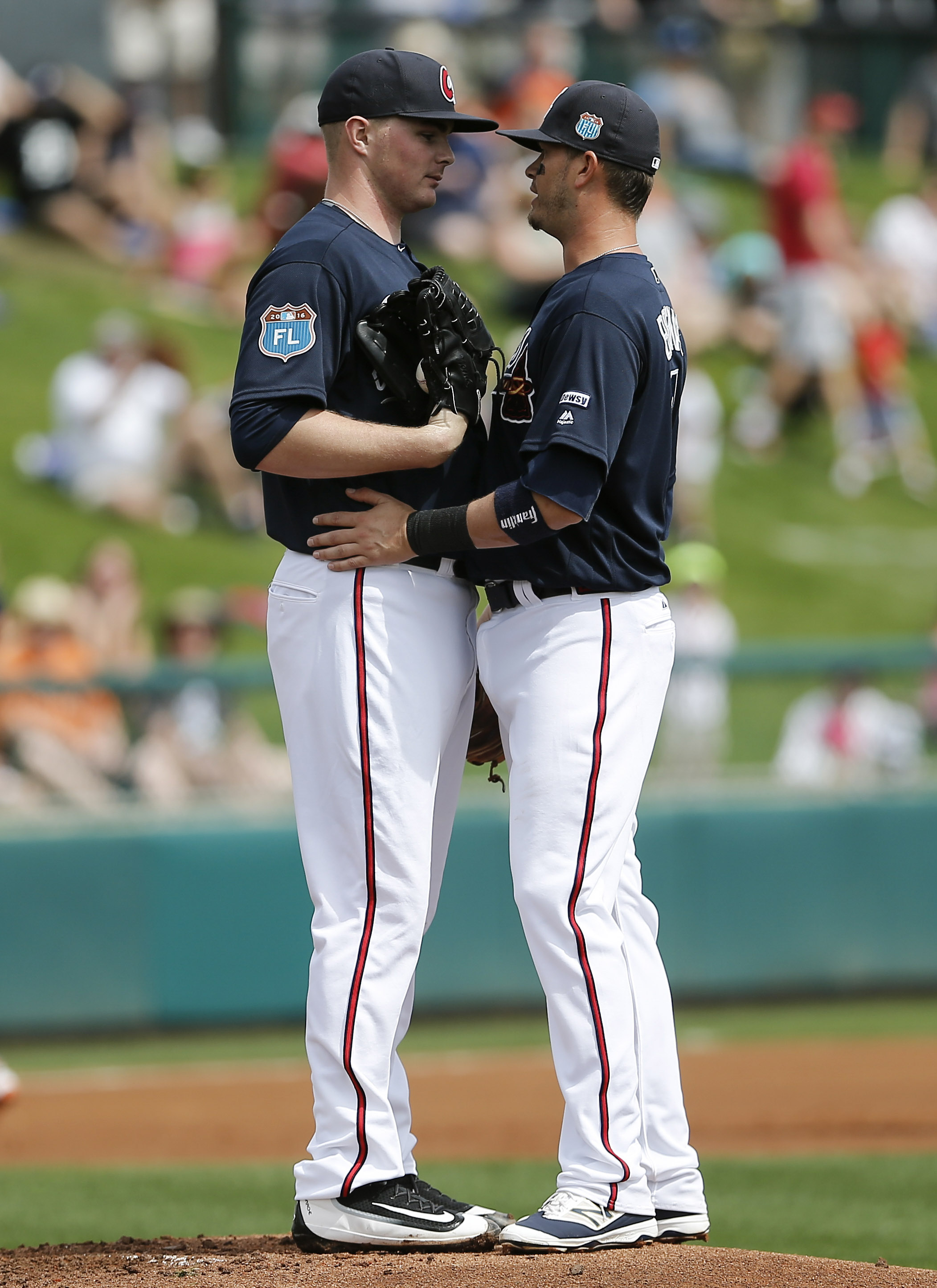
While GM John Coppolella had to defend the Simmons swap to fans and observers, the later send-off of Shelby Miller largely sold itself. The 25-year-old Miller, the key piece of last year’s Jason Heyward deal, had a strong first campaign in Atlanta and is controllable for three more seasons. But the Diamondbacks paid big to get him, parting with five years of Ender Inciarte, last year’s top overall pick Dansby Swanson, and highly-rated pitching prospect Aaron Blair. Inciarte looks like a solid building block piece — if he, too, isn’t eventually flipped — while Swanson may form a future middle infield pairing with rising youngster Ozhaino Albies. As for Blair, he joins Newcomb and Ellis in an increasingly loaded stockpile of promising young arms.
That’s not all that Atlanta accomplished on the trade front. Cameron Maybin was another recent trade piece who was passed along, adding to the cost savings achieved in the Kimbrel pact. And the club officially gave up on one-time catcher-of-the-future Christian Bethancourt, who was out of options, preferring instead to roll the dice on promising but oft-injured righty Casey Kelly and young backstop Ricardo Rodriguez.
That set of swaps opened quite a few needs and opportunities at the major league level. Aybar promises to play regularly at short, keeping the seat warm for Swanson and Albies while providing a potential trade chip at this year’s deadline. Likewise, Inciarte will move into the center field role, shifting Michael Bourn to a reserve role.
Joining those new faces are a host of veterans signed to short-term contracts. At catcher, Atlanta gave two years to the non-tendered Tyler Flowers and brought back A.J. Pierzynski on a one-year pact. That looks like a fairly sturdy duo behind the plate: Flowers has an average bat for the position and has posted good framing numbers, while the 39-year-old Pierzynski slashed .300/.339/.430 last year for the Braves. Ryan Lavarnway was re-signed to a minor league deal to provide further depth.
Kelly Johnson, Emilio Bonifacio, and Gordon Beckham will join Jace Peterson and Adonis Garcia in the mix at second and third at a total cost of just $4.5MM. It would be a surprise if that group produced at a terribly high level, but the club will hope that it will be able to make out a serviceable enough unit from those options. If nothing else, the pressure will be reduced on Peterson, who wasn’t quite up for everyday duty when he joined Atlanta before last season as part of the Justin Upton trade.
Among the team’s minor league signings were veteran utilitymen Reid Brignac and Chase d’Arnaud, who could step in at short if Aybar is moved. (Light-hitting Daniel Castro also represents a place-holding option there.) And players like Jeff Francoeur, Nate Freiman, and Matt Tuiasosopo also joined the organization over the winter in hopes of pushing for a bench spot.
Rounding things out were a host of pitching additions, led by guaranteed deals for right-handers Bud Norris and Jim Johnson. The 31-year-old Norris will be relied upon in the rotation, where he’ll look to re-establish himself as a durable back-of-the-rotation starter. Kyle Kendrick might’ve hoped for the same, but was already released after struggling early this spring. The same fate befell Chris Volstad, though David Holmberg and Carlos Torres are still in camp as depth options for an otherwise youthful staff.
Meanwhile, Johnson will hope to replicate his solid form in the first half of 2015 with the Braves after struggling following his mid-season move to the Dodgers. Minor league signees like Jhoulys Chacin, Alexi Ogando, and Alex Torres all bring plenty of experience to the pen mix, too.
Continued analysis after the break …
Questions Remaining
Needless to say, there are quite a few moving parts in Atlanta, and the Opening Day roster will likely see quite a bit of turnover during the season to come — and yet more down the line.
The rotation is an area on which Coppolella, John Hart, and company have focused plenty of attention in acquisitions. Norris will join staff ace Julio Teheran as the two most established arms. The youthful Williams Perez will likely have an opportunity to prove himself, though he isn’t generally seen as having much upside. Chacin may yet crack the staff and provides a swingman option. Otherwise, the vanguard of the team’s large group of hopeful future staff members — Matt Wisler, Manny Banuelos, and Mike Foltynewicz — will get a longer look after receiving their first exposure to starting in the majors in 2015 (none with particularly impressive results).
Unfortunately for the Braves, they didn’t get to see what Mike Minor has left, as he was deemed too great a risk for a tender when he experienced a rehab setback this winter. The organization has been stung by this situation recently: the organization also lost Kris Medlen and Brandon Beachy without recompense after they, too, were beset with arm trouble in the midst of arbitration.
It’s possible to imagine a scenario where Atlanta gets some decent performances and enjoys relative stability from the rotation in 2016, but it’s also not difficult to foresee some quality and depth issues. Teheran could end up being trade bait if he performs, and Norris has quite a bit to prove. Holmberg and Torres aren’t the most established depth options, while youngsters like Blair, Kelly, Ellis, and Tyrell Jenkins may or may not be ready for the majors this season. (The highest-upside arms, such as Newcomb, Kolby Allard, and Touki Toussaint, are probably further off.) All told, it wouldn’t be surprising if Atlanta picked up some castaways late this spring or during the season.
There’s some room for critique here, as Atlanta could have pursued more compelling rotation pieces if it’s serious about putting a solid product on the field in 2016. After all, the organization’s current projected Opening Day payroll projects to land south of $75MM for the first time in the 21st century. The Braves could’ve pushed for Doug Fister in free agency, pursued the trade route that the Phillies used to land Charlie Morton and Jeremy Hellickson, or even pushed for a more controllable, MLB-level arm. The price of pitching was high, to be sure, but a bigger move might also have reaped greater rewards at the trade deadline and/or given the team a better chance to hang in the postseason picture.
Over in the pen, at least, there appears to be more in the way of depth. Veterans Johnson and Jason Grilli could turn into deadline movers if they can be as healthy and effective as they were early last year, and Arodys Vizcaino showed immense promise as a late-inning arm. In terms of middle relievers, aforementioned trade acquisitions Ramirez and Krol may slot right in, and there’s a wide variety of depth pieces — including Chacin, Ogando, and already-optioned 40-man members Chris Withrow and Danny Burawa. Atlanta will need to carry Rule 5 pick Daniel Winkler for at least a few weeks to lock down his rights from the Rockies. The club already sent lefty Evan Rutckyj back to the Yankees, and will unfortunately have to wait a while before getting a look at injured southpaws Andrew McKirahan and Paco Rodriguez, but that could at least open the door for Alex Torres.
It’s a testament to the amount of turnover in this organization that we’re only now able to turn to one of the most important questions facing the team: the ability of Hector Olivera to adapt to the big leagues. We won’t go through the details of the complex, 13-player trade that brought Olivera (and Rodriguez, Zachary Bird, and a competitive balance pick) to Atlanta, but suffice to say the Braves gave up some real future value in hopes that Olivera would turn into an affordable, steady regular. Soon to turn 31, Olivera underwhelmed at the plate and in the field in his first taste of the majors, but he’s shown better this spring and will move from third base to left field. He’s controlled through 2020, so it’s still a long-term play, but the organization will need to see significant strikes in 2016 or begin to make alternative plans.
With Inciarte up the middle and Nick Markakis holding down right — at least unless the club considers a mid-season deal for the sturdy veteran — the regular rotation should largely be set. If Bourn sticks as a fourth outfielder, with Bonifacio and Johnson also capable of time on the grass, that would likely mean that Nick Swisher would be set onto the market. Atlanta will surely be happy to find any team interested in taking on some of his salary, but that seems unlikely given the veteran’s injury-aided fall-off at the plate. (The Indians are already paying $15MM of the $29MM owed in total to Swisher and Bourn for the coming season.)
Much attention has been given to youngster Mallex Smith‘s big spring, though it doesn’t seem there was ever much chance that he’d head north out of camp (at least once Inciarte was added). He’s only 22 and didn’t exactly master Triple-A after a mid-season promotion last year, so it seems likely he’ll get more seasoning. But a nice showing could earn him a big league nod at some point in the coming season.
The same holds true of Albies and Swanson, and perhaps also third baseman Rio Ruiz, though in all cases the Braves will surely keep an eye on service time and avoid rushing any of the players that they hope will form a solid position-player core for years to come. We already covered the infield mix above; odds are, the club will let things play out without any aggressive promotions at least until the Super Two deadline has passed and the summer trade market has begun to materialize.
But it’s fair to note here that, as with the rotation, there might’ve been some room for greater improvements. Players like Howie Kendrick, Ian Desmond, and David Freese all languished on the market and would have upgraded a cheap but largely uninspiring second and (especially) third base situation. To be fair, the investments in Johnson, Bonifacio, and Beckham had already been made before the asking prices fully dropped. And parting with a draft pick (for Kendrick or Desmond) would’ve been painful due to the lost bonus dollars. Nevertheless, the overall situation at these spots is sub-optimal, particularly since the rising prospect crop may not quite be ripe for a big league challenge over the season to come.
There’s one very notable player we’ve yet to mention, of course: first baseman Freddie Freeman. There’s some concern about his nagging wrist issues, but otherwise Freeman is the organization’s surest asset. (He’s also the most expensive and longest-controlled, as his deal guarantees $118.5MM through 2021.) If any player is bolted down in Atlanta, it’s the 26-year-old first baseman. There were plenty of trade rumors early in the offseason — some of them, perhaps, more serious than the team prefers to acknowledge — but Coppolella made clear in mid-November that Freeman wasn’t going anywhere. (At least, not until he first parted with his own right arm; no word whether such a move was ever discussed.) It is certainly still possible that Freeman will end up somewhere else at some point in the future, but there’s now a rather significant presumption against that scenario.
Deal of Note
Parting with Simmons — a young, up-the-middle player who had seemed a franchise cornerstone — was a much greater surprise than was moving Kimbrel, a trade that was more stunning for its timing. Coppolella took a lot of heat from fans who felt the organization’s contention timeline was being pushed back with the Simmons move, but made clear he felt the return was too good to pass up.

Newcomb is the gem of the deal, but he’s no sure thing. Still, the free-wheeling front office no doubt sees the benefit of stockpiling a large volume of live arms. Even if pitchers like Newcomb and Foltynewicz can’t harness their repertoire in a rotation, they might well become dominant late-inning relievers. And the stockpile could also be deployed to fill in the gaps on the position player side.
But what’s most interesting about the organization’s decision is less the quality of those young arms, which largely remains to be seen, so much as what it says about the organization’s view of the 26-year-old Simmons, who hasn’t developed at the plate, and up-and-coming Albies. There’s little question that Simmons has a high floor with his outstanding glove, but Atlanta may well have decided he’d never turn into even an average offensive producer and might eventually decline in the field in his late twenties. (The significant cost savings probably didn’t hurt, either.)
The Simmons deal looks quite a bit different in light of the organization’s future decisions, though that may in part be due to happenstance. It took nearly a full month for the Miller deal to come together, amidst an over-heating pitching market. But the addition of another exciting young shortstop in Swanson — who’s expected to be a quick mover as a polished college draftee — leaves good reason to believe that the organization can fill the position from its prospect ranks as soon as late 2016.
Overview
The totality of the offseason continues to highlight the Atlanta front office’s focus on value and flexibility. You can certainly quibble with one or another exchange, but the overall rebuilding efforts seem to have nicely balanced the desire to add upside with the imperative to begin plugging production onto the MLB roster in advance of the new ballpark opening next year.
With Freeman as the “rock” — he and Teheran are the lone holdovers from the organization’s last post-season appearance in 2013 — Atlanta hopes that it can begin a new ascendancy and return to being a perpetual contender. There’s an expectation of more TV money to come down the line, to say nothing of added financial opportunities in Cobb County, and that — along with a collection of young talent widely seen as one of the best in the game — ought to make last year’s 67-win season a low-water point. Of course, the organization was still careful to keep down costs this winter, possibly foregoing some opportunity for fringe contention.
What remains to be seen is precisely who’ll lead the renaissance, and how long it will take to mature. Coppolella and Hart will need to continue to be creative and opportunistic, while remaining increasingly cognizant of the need to make hard calls on balancing near and long-term prerogatives and choosing which players to rely upon.
If the club is even on the fringes of the playoff race this summer, will it sell or hold its many short-term veteran assets? Is Teheran a core piece or another chip to be cashed in? How aggressively should the prospects be moved up and how will service time factor in? When and how will the team begin pursuing established major leaguers in trade and free agency?
Regardless of how these questions are answered, it’s sure to be interesting.
How would you rate the Braves’ offseason work? (Mobile app users can click here to access the poll.)
How would you grade the Braves' offseason?
-
A 50% (1,367)
-
B 37% (1,006)
-
C 9% (249)
-
D 3% (84)
-
F 2% (43)
Total votes: 2,749
Given all the new talent the Braves infused their already promising farm system with, while still acquiring players to help them win now like Aybar and Enciarte, and for holding on to Freddie Freeman, I give them an A. They also signed some veterans to cheap one year deals that could be flipped for prospects at the deadline if they perform well, so this was a very good offseason for them.
I didn’t think anyone could write about the Braves offseason without mentioning they got the #1 pick of last years draft for basically a mid-rotation SP but here we are.
They won pretty much every trade they made and only spent $18M in FA getting a bunch of guys who might have value to someone at the deadline – this is how you rebuild, folks.
The Braves went from looking at 2019 as regaining relevance, to 2017. Braves are about to be really, really good again really really soon.
Maybe I’m mis-reading this, but the post obviously does mention the addition of Swanson in the Miller trade. In fact, I noted his importance several times.
Needs Addressed and Deal of Note sections pretty much covered that point.
I knew you were a Braves fan lol haha stay on your own bord not go troll on the Cubs lol at Just Another Fan
Seeing Mallex Smith, Swanson, Albies already look mature in spring training action is a sign of confidence in the rebuild, while it would come a long way if we can get anything from Wren’s prospects: Lucas Sims, Jason Hursh (fading fast), Braxton Davidson and the like. I’d give them a B+ for their offseason with the possibility of a higher grade if Aybar/Inciarte are productive and/or flipped for prospects. I can imagine one, if not both, will be eventually, if Mallex Smith continues is ascension and Markakis keeps producing.
Off getting Swanson alone they get an A grade. I still cannot believe someone topped the Donaldson trade in terms of 1-sided trades from the jumpoff so quickly.
I don’t know, that Ken Giles trade was pretty crazy too. Not to mention the Craig Kimbrel one. It’ll be interesting to see how those pan out, especially if Appel does anything and Velasquez continues to look good.
Also, Jeff, this is the Ricardo Rodriguez you need to link:
baseball-reference.com/register/player.cgi?id=rodr…
And this is the Jose Ramirez: baseball-reference.com/players/r/ramirjo02.shtml
You gotta stop self-populating these links!!
Thanks, I will fix those. It takes forever to do that manually, and it’s hard to catch some lesser names.
Trade Tehran to the Red Sox or Astros for some hitters
Trade Andrew Benintendi to ATL for some pitchers.
Saying “. . . Peterson, who wasn’t quite up for everyday duty when he joined Atlanta . . .” is a bit harsh. Before injuring his hand – April through June – he posted a .266/.346/.375/.720 line while the league as a whole last year posted a line of .266/.319./.384/.703.
No one is claiming he’s the next Roberto Alomar but a healthy Peterson is a solid defender and a league average hitter for his position.
I think I’ll stand by that characterization. Not saying he isn’t an interesting player who is a solid piece and could be more. But he wasn’t really an everyday caliber guy last year, and I don’t think it’s too harsh to say that. It’s a pretty high standard for anyone, especially a rookie.
There was an interesting write-up and comments made about Peterson that when he hit a few Home Runs he changed his swing to try to duplicate that and that caused him to fail the rest of the season. I agree with your assessment and the plan the Braves seem to be employing. He needs to be a super utility guy if he can’t break out.
Well written piece Jeff. As a life long Braves fan, a mere 33 years, I give the FO an A- for the offseason. Yes some of the trades were hard to swallow (Simmons) as they came about, but the end results (Swanson replacing Simmons) were astounding.
I still think there are a few moves that can be made, but none that have to be made. Many “lifelong” fans say this is the worst that the FO has ever been. But prior to the dynasty that we all remember, the Braves had 4 straight seasons in which they didn’t win 70 games. And that dynasty was built in the same fashion this team is being built now. 14 years without a playoff winning series is all the more reason to start a massive overhaul.
Credit to Hart for the start and Coppy continuing the process. Yes it has been a hard couple seasons, but excited to see where the team is headed. A midsession blockbuster trade for a controllable ace or 2 man in the rotation would be great to see. Otherwise the FA crop of pitchers looks like Gio, Strasburg, Danks, Volquez, Fister, and so on.
Hope the Olivera experiment in LF is not as bad as the Chipper experiment was. With the OF, would like to see the team hold onto Bourn and Swish to feel out the first month of the season. Wouldn’t mind seeing Bourn shipped back to Cleveland with a few million or a prospect. And if Markakis can build on last year, I think he still holds great trade value.
GO BRAVES. Have a good day all.
Thanks!
Hold onto Bourn/Swish…? With those contracts and taking up the roster spot, they have no choice. If anyone, including a Japanese team, offers them their weight in Mardi Gras beads – ATL would pay one-way shipping faster than Swisher chants the Ohio State fight song.
They do have a choice, it is called releasing them, which most have suggested. My thoughts are CLE and PHI at this point have need for OF and others may soon as well.
Sure, they do. But there are still some teams around MLB that need OF depth (i.e. PHI) and they still haven’t finalized their roster with hope to Francoeur and/or Bourn filling in roles. Obviously, once they release them there’s no way to return any more value on their deals – and it’s not exactly at that point just yet. Though, we’re getting close.
If Freeman continues to look healthy and Brignac looks decent, among others (i.e. Adonis Garcia at 1B to spell Freeman), then they should cut bait of Swisher. Highly unlikely he returns any value, unless they value his social media accounts.
I think we just agreed without stating it. I mentioned PHI along with CLE. And good call on the social media/Swish comment, that had me at a laugh. I think they can trade Bourn with $3M or a prospect and not have to eat the ~$7-8M owed entirely.
For Swish, cannot see why a farm baron team would not take him with a decent prospect to add to their farm. But I am not a GM.
Why would you want the Braves to give up a decent prospect just to save the owner some money?
I wasn’t saying give them Newcomb, Blair, or Jenkins. But the ownership is not giving up the cash easily, hints Coppy being creative.
Besides the group of people that believe that every team should attempt to win every single year, how can ANYONE vote F on their offseason? It’s an A as far as I am concerned, maybe some squabbling can be done in different areas, but F or even D? Why?
They purchased an Andrelton Simmons Braves jersey in October.
Under “Notable Losses”, you might want to add Shelby Miller–AT THE TOP OF THE LIST! This is a slipshod article at best.
Okay. He is mentioned throughout, including in that breakdown segment (see: “Trades and Claims”), but I did forget to add his name to that particular portion. Doesn’t seem to me a substantive flaw, but to each his own.
Oh, and those guys are in alphabetical order.
Just a general comment that the “offseason in review” series is some of MLBTR’s best work–especially because so much of local baseball writing is, well, local.
Much appreciated. We do work hard on these, and they are quite time intensive. Still manage to miss quite a few things, naturally.
It’s a good write up, Jeff. The only thing that I might argue is the whole notion of the Braves pursuing better pitching. The price on pitching absolutely was high…and that includes financially and trade wise. I don’t see the Braves really entertaining that direction then, since they’ve been pretty clear on their ambitions within the upcoming international market. And it’s not like they have much left to bargain with regarding a trade.
It’s not like they actually intend on being competitive this year. The limited comments made by the front office about them being competitive seem to be nothing more than pillow talk to the fanbase. They’ve been fairly consistent on focusing on 2017 and on.
Thanks. I don’t mean to overstate the point on pitching, and obviously the idea of putting a good product on the field now is largely PR-related (though I do think they mean it to some extent). But I do think it’s fair to point out – since they have said what they’ve said – that there might’ve been more aggressive options out there if they had been willing to spend more.
After the Miller trade I was really hoping to see the Braves acquire a back end of the rotation guy to lessen the dependence on young / unproven pitching.
That didn’t happen. Instead they sighed a bunch of retread hoping at least one would pitch well enough to stick in the rotation. (There’s a reason why Chacin and Norris were cheap.)
At this point it looks like the team will have trouble filling out the rotation to start the year with healthy MLB quality players.
Jhoulys Chacin is a solid pitcher. He’s posted fWAR’s of 2.7 (2010), 2.0 (2011), 3.9 (2013) in his career.which pitching home games in Colorado. For his career he’s got a fWAR of 9.2.
We’ve done well enough with retreads to keep that route, especially during a non-contention depth where we can add future depth if we do happen to strike gold (not unlike the acquisitions of Kelly Johnson/Juan Uribe to later trade to NYM; only to have Kelly Johnson return…). Bud Norris will pitch better in 2016, so I can understand his addition, especially for his price.
Pitching war is already park adjusted. Those same e.r.a’s mean lower wars elsewhere
I think the only way they would’ve been willing to spend more is if they were able to rid themselves of a couple of the albatross contracts they acquired (Bourne & Swisher mainly). If the rumours are true about what they’re thinking of spending on the international market (approx 20 million) then they’re a lot more cash strapped than people think.
If I’m them I’d likely go the same route. Especially with a rebuilding club in the final year in their current park. There isn’t a ton of incentive to spend money on the major league club right now.
Since the Braves are having a logjam issue with their reserves, this is what i’d suggest.
1) Since Peterson is having such a bad spring, maybe send him down to start the season in Gwinnett (i’m assuming he still has options left)
2) Let Brignac/Beckham platoon at second
3) Kelly Johnson/Garcia platoon at third
4) Give Frenchy & Bourn the backup OF spots
5) Trade Boni to someone who needs a backup OF (Cleveland comes to mind).
6) Release Swisher because everyone reading this knows the Braves won’t get squat for him (in regards to prospects or $$)
One other thing I forgot to mention. Going with Frenchy over Boni makes sense.
Bourn gives you the speed factor. Frenchy can play all 3 OF spots. You have three guys (four if you count Peterson who I suggested be optioned to AAA) that can play 2nd, 3rd, SS). Boni isn’t the best fielder anyhow, so the edge goes to Frenchy (plus he has the leadership, fans on his side). If they can’t find a trade suitor, it’s only $1.5M (nothing in today’s game).
When looking at Atlanta’s offseason its impossible to not focus on the Miller/Swanson trade. This trade along accelerated the rebuild by a least a year.
But once you look past that trade things are less certain. Many of pitching acquisitions over the past year or so have been very risky prospects. And the farm system still lacks impact bats. The outfield is especially thin. While catcher and third base will also be problem spots in coming years.
Its not realistic to expect the front office to fix everything overnight, but its hard not to feel like the organization loaded up on pitching while neglecting position players.
Very nice write-up. I gave them a B, mostly because I would have loved to see how the team would progress with a Freese, the bullpen addition we were promised and a starter or two. I’m okay with giving Garcia a shot and using the money for the IFA market, but it would have been nice to stay somewhat competitive to alleviate frustration and get the fans at the Ted. Which is needed before SunTrust opens.
Solid write-up. I thought ATL did a nice job re-tooling, as they could have easily had a 3-4+ yr rebuild ahead of them. The Miller trade almost single=handedly given them a chance to compete sooner; I still scratch my head at what they got for a solid #3 with a chance at being a #2 guy. As a Met fan I want ATL to be good bc it’ll mean more if they can beat them.
My worry continues to be lots of talented players,very bad major league manager
They will be fine with a group of more than capable coaches including Bo Porter, Eddie Perez, Roger McDowell, and more. There’s a reason they surround Gonzalez with more qualified candidates – to remind him of the ticking clock. Bring in Chipper as a “consultant” and Gonzalez better not plant any trees in his front yard.
I had hoped they would have gone after Maddon when it seemed like he may leave Tampa but Cubbies got there first. Would like to see someone like Gardenhire or Valentine brought in. I am tired of the same ole ” we lost and will tip our caps” philosophy that seems to be okay in the clubhouse. Bring in someone like Guillen to fire these kids up. Fragile Fredi seems like he is perfect for little league coaching. “Its okay that we lost kids. Tip your cap and line up for your participation trophy”
Any word on where and what is going on with Dian Toscano?
Why are people so hung up on Toscano? The guy isn’t on the 40-man any longer. If he does make it to ATL at some point, he will be a bench/4th OF type guy. I’d be more excited about guys in rookie ball than keep talking about Toscano.
Dian has been in pre season games this year. He is here, but as you said is not important at all.
Because he is still a player the Braves saw a future in and signed him to a ML contract.
and has since been dropped off their 40-man roster. I think Coppy/Hart regret making that signing last year, now that they have better options.
Ok, he was signed to ML contract, is that money just lost? Granted it was only $6M, but still.
Yankees have no back up to Headley and Headley is Tex backup so they could use a back up there do let me ask you this would Teahran, Jace, Vizcaino & Jenkins pry Sanchez and Heathcott from the Yankees.
Teheran himself is worth more than both of these guys. If the Yankees considered Judge in a trade for Teheran they may talk but I don’t see that happening. Also just wondering who the backup for Headley and Texeira is in this deal (Peterson at 3B?, maybe a possibility but doesn’t seem like a good fit and definitely not at first). If you want a backup 3B I’m sure they would consider Adonis Garcia or Kelly Johnson.
I agree that the trade is unbalanced. Granted I do think we need a new “Catcher of the future” after the Christian letdown.
Any suggestion I made in Yankee forums is responded “Hal is not breaking up core 4 (Judge, Mateo, Bird, and Sanchez).
I am sure as the season shakes out we will have opportunities for good trades.
Astudillo?
“At least, not until [Coppolella] parted with his own right arm; no word whether such a move was ever discussed.”
Love it. 🙂 Anyway, I’m really surprised that half of the voters gave the Braves’ offseason an A; while I know that the team is widely considered to have “won” the Shelby Miller trade, the rest of its moves were just okay, which is why I gave them a C.
“..is widely considered to have ” won” the Shelby Miller trade, the rest of the moves were just okay…” So what would you call it? It was a win from any analytical perspective.
There were really only two big moves. Shelby Miller and Andrelton Simmons. Shelby was an A and Simmons was a C. The rest of the moves are negligible. Moves that any rebuilding team does. Moves like Bonifacio and Flowers are what rebuilding teams do to save money, fill positions with gap fillers until the future of that position comes in. So it seems more reasonable to give the Braves a B.
So do you have a difficult time giving a divisional rival credit? Or maybe you are simply over reactingreacting in the opposite direction that Atlanta fans are over reacting?
Only problem is, we have no future at catcher right now. But agree to your points mainly. Would give Braves a B on the Simmons trade though, he wasn’t exactly a cornerstone piece in my opinion. But was great to watch in the Braves uni.
Astudillo
As a Braves fan I’d give Dave Stewart an A and Coppy/Hart a B-minus. Stewart has done more to benefit the Braves than Frank Wren ever did. Hopeful we’ll get Brito or O’Brien for Aybar at the All-Star break.