
Giants Acquire Jackson Williams From Angels
The Giants have acquired catcher Jackson Williams from the Angels in exchange for cash considerations, Angels director of communications Eric Kay announced on Twitter. Williams had spent his entire professional career in San Francisco prior to 2014.
Last year was the first in which Williams cracked the big leagues, picking up 16 plate appearances with the Rockies. He also enjoyed his best campaign at the plate at the Triple-A level, slashing .256/.353/.368 with four home runs. The former late-first round pick made his way to the Halos on a waiver claim early last fall.
Presumptive backup catcher Andrew Susac has been dealing with wrist inflammation, which may have led San Francisco to pursue another depth option. While Williams is slated to head to minor league camp, as Alex Pavlovic of CSNBayArea.com tweets, he represents another link in the chain alongside names like Hector Sanchez and Guillermo Quiroz.
Extension Candidate: Gerrit Cole
The Pirates have recently been amongst the game’s most aggressive teams in pursuing early-career extensions. Since taking the GM seat in Pittsburgh back in the fall of 2007, Neal Huntington has locked up deals with ten players for a total of 37 years and $182.9MM. Only two of those contracts went to players with four or more years of service.
Among the team’s most recent efforts were successful pacts with star outfielders Andrew McCutchen (six years, $51.5MM) and Starling Marte (six years, $31MM), with the former inking with 2.123 years of service and the latter signing with just 1.070 years to his credit. While those deals haven’t all been successful — neither Jose Tabata nor Nate McLouth, for instance, delivered value on their deals, though neither did they hamstring the club — the aggregate benefit to the organization is undeniable.
Pittsburgh, riding high on two straight postseason appearances, spent a relatively large amount through free agency this last offseason and seems in good position to stay competitive for years to come. The team has continued to explore ways to add value to its player assets through extensions: in particular, it made a long-term offer to then-untested outfielder Gregory Polanco last year, though those negotiations seemingly stalled. In spite of their relatively meager spending capacity, the Pirates appear to have plenty of future flexibility, with less than $12MM on the books for 2018 and even less thereafter.
While another run at Polanco obviously remains possible, it is fair to wonder whether the team might turn its sights elsewhere this spring. Josh Harrison remains an intriguing possibility, as MLBTR’s Steve Adams discussed last fall. Beyond that, there is one obvious potential candidate who brings immense upside — and, given the nature of his craft, risk: young ace Gerrit Cole.
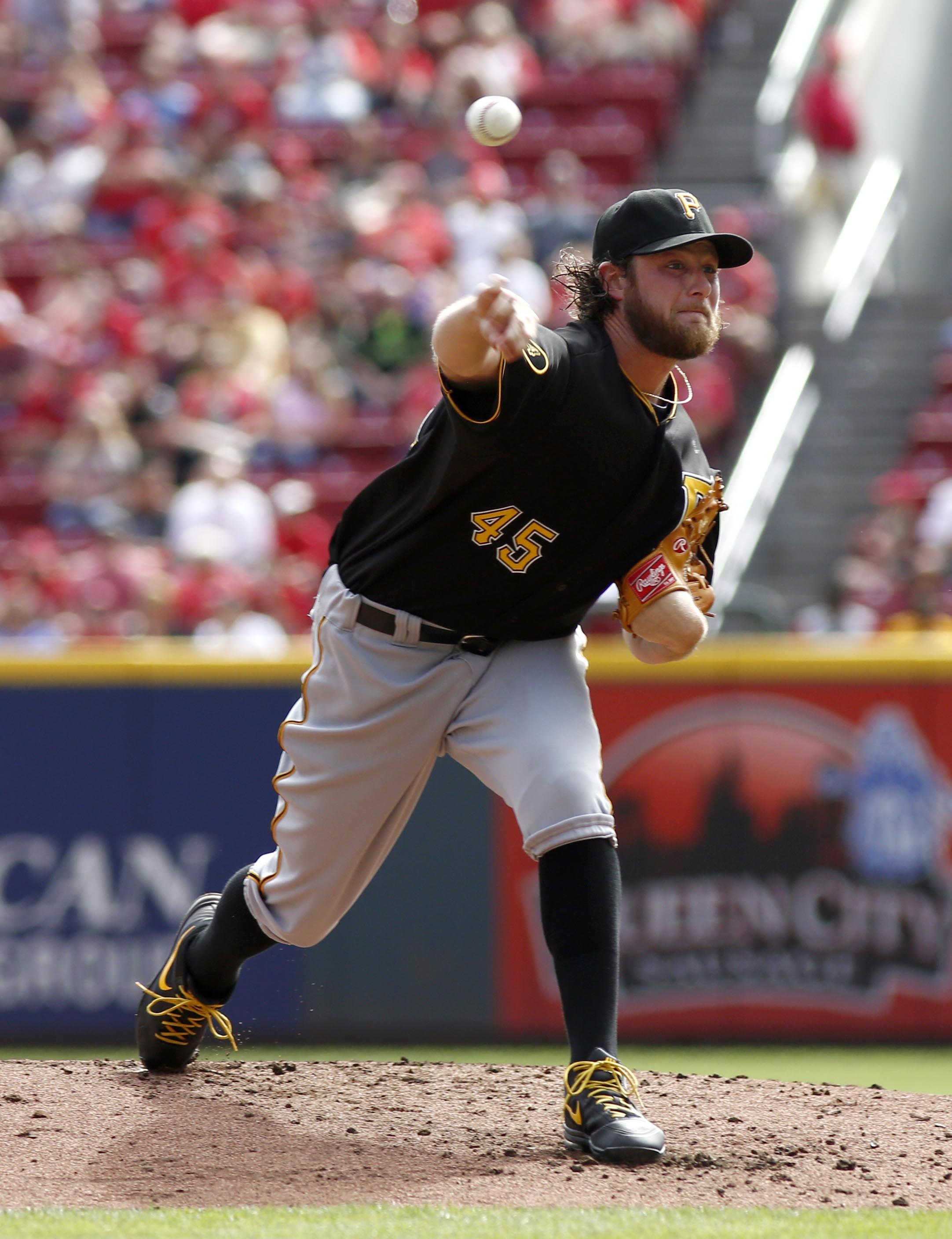
Cole, 24, has done exactly what the Bucs hoped when they made him the first overall pick in the 2011 draft, reaching the bigs in 2013 and establishing himself as a quality starter off the bat. To date, he has thrown 255 1/3 big league innings with a 3.45 ERA and 8.4 K/9 against 2.4 BB/9. Advanced metrics suggest he’s been even better, as he owns a career 3.09 FIP, 3.20 xFIP, and 3.28 SIERA. Cole consistently works in the mid-90s with his fastball and has averaged a strong 49.1% groundball rate thus far. Needless to say, the outlook is positive.
If there is one red flag on Cole, it is health. First and foremost, he is a pitcher; as we are constantly reminded, any arm is at risk of injury at any time. But there is some additional cause for concern in his case, as Cole missed significant time last year owing to shoulder issues. He returned and posted good results late in the season, and does not have any significant history of problems prior to 2014. And he has reportedly worked to smooth out his mechanics and incorporated exercises to maintain his shoulder health.
With just 1.111 years of service to his name entering the 2015 season, Cole will not qualify as a Super Two and is set to hit arbitration eligibility in 2017. That means he will not reach free agency until 2020. Despite his rapid ascent to the bigs, Cole will reach the open market at age 29 — still relatively young, but not as early as some quick-to-the-bigs phenoms. Those factors, along with the risk of injury and performance, generally transfer significant leverage to a team, of course.
In this case, though, there are some significant offsetting considerations. For one, Cole was signed to an $8MM deal out of college, meaning he has already secured life-changing money. For another, he is represented by agent Scott Boras. Contrary to popular opinion, Boras has overseen pre-free agent deals for his clients, many of those contracts have not sacrificed free agent seasons. And, on balance, he certainly carries a deserved reputation for bringing his players onto the open market in search of huge paydays.
To be sure, it is far from a sure thing that Cole would be receptive to contract talks at this stage. If he is, however, both sides will have plenty of precedent to work from. Looking in at recent extensions for starters with between one and two years of service, one finds a host of comparables. First on the list has to be Madison Bumgarner, who got five years and $35MM from the Giants while giving up two option years back in 2012. More recently, Julio Teheran and the Braves linked up on a six-year, $32.4MM deal that conveyed one option year to Atlanta.
The Bumgarner comp, in particular, appears to be a good one; indeed, he was perhaps slightly more accomplished — and significantly younger — at a similar point in his service timeline, and had already put up a fully healthy season of over 200 frames. Teheran signed before his age-23 season, coming off of a 185 2/3 inning season of the sort that Cole has yet to accomplish. Cole’s representatives would no doubt point to the $200MM+ contracts that have been given to free agent starters in recent years as evidence of salary growth, though Cole’s shoulder concerns and additional age would serve as counterpoints. While it is, perhaps, possible to argue that Cole possesses greater upside than Teheran, or at least more than he did at the time his deal was struck, projection systems seem to hold the two righties in approximately the same regard heading into 2015.
What is most interesting about Cole’s situation, perhaps, is what it could theoretically tell us about where pre-arb extensions are headed. Somewhat unlike other areas of the market, early-career pitching extensions have not exhibited much growth. In addition to the Bumgarner and Teheran examples, which came two years apart, extensions for pitchers with between two and three years of service have largely followed a script for some time: Gio Gonzalez (five years, $42MM, two options) holds the record in that class, but Chris Sale‘s 2013 deal (five years, $32.5MM, two options) was not substantially different from, say, the 2011 Trevor Cahill contract (five years, $30.5MM, two options).
As I explained in breaking down last year’s notable Freddie Freeman extension, and as the Mike Trout and Giancarlo Stanton extensions further demonstrate, the position player extension market has seemingly broken out of any molds. On the pitching side, the most significant recent deals have gone to players on the verge of free agency (Clayton Kershaw and Homer Bailey, for instance). Locking up Cole could require a market-resetting deal; it remains to be seen, of course, whether either team or player are willing to make that happen.
Quick Hits: Stadium Funding, Service Time, Soriano, Olivera
We’ve discussed recently the ways in which international politics can influence baseball’s player market, and now there’s an important example of domestic politics to consider. As USA Today’s Elaine Povich reports, President Obama’s new federal budget proposal contains a provision that would preclude states and municipalities from issuing tax-exempt bonds as a means of financing professional sports stadiums, including ballparks. This is an issue with widespread implications that go well beyond the game of baseball, of course, but within the MLB (and MiLB) world, the measure could cut off a source for future revenue streams. Taxpayer subsidies of various kinds fueled the last (and still-ongoing) round of ballpark building, which along with TV revenue has helped to drive player spending.
Here are some more notes from around the game:
- MLBTR readers are no strangers to the idea of service time considerations, which last year focused on players like George Springer of the Astros and Gregory Polanco of the Pirates. Now, Cubs super-prospect Kris Bryant is squarely at issue, and Mike Petriello of Fangraphs opines that the league needs to fix what he calls a broken system. Coming up with a workable (and agreeable) solution is the primary roadblock here, of course. Petriello suggests a change in rules: rather than requiring 172 days of service over a season to reach one full year for purposes of determining free agent eligibility, which allows teams to keep prospects down for a short time to begin the year in order to add a full season of future control, his system would allow a player to accumulate a year of service if they reach 100 days (or some similar number) of MLB active roster time in a given season. That would largely keep the present considerations intact, of course, but would shift the math in favor of calling up players who are truly ready to provide value at the big league level. As Petriello notes, this would function as an obvious boon to players, who would reach free agency sooner, likely requiring significant concessions from the union in other areas. Union chief Tony Clark has indicated that he expects negotiations on the next CBA to ramp up in early 2016, the year in which the present agreement will expire.
- As we’ve discussed previously, former Nationals closer Rafael Soriano is the most eligible free agent remaining. August Fagerstrom of Fangraphs explores the reasons for his continued availability, explaining that Soriano’s tendency to give up hard contact in the second half — and related questions about his stuff — have hurt his value. Soriano still looks to be a capable big league reliever, of course, and it could be that agent Scott Boras is taking things down to the wire because he is confident in the still-existing market demand, which figures only to increase as injuries arise.
- Hector Olivera remains the most interesting free agent, of course, though he has only been officially available for less than two weeks to this point. Ben Badler of Baseball America provides an updated scouting report, noting that Olivera’s bat still looks strong but that there are some questions about his range and arm in the infield. While much of this ground has been covered before, the report is well worth a look as it compiles the most recent opinions. For what it’s worth, in a series of polls, MLBTR readers have predicted that Olivera will land a guarantee in the $40MM to $50MM range, with the Braves, Padres, and Dodgers being the likeliest landing spots.
NL Notes: Turner, Reds, D’Backs, Mets
Cubs righty Jacob Turner will likely not return to action for another spring game, MLB.com’s Carrie Muskat reports, but medical review after he experienced elbow discomfort revealed no ligament damage. “I’m just going to see how it feels,” said Turner. “The plan is four to six weeks of not throwing, and then go off how I feel.” Given his lack of options, I would expect the club to bring him along quite slowly — possibly utilizing a 60-day DL stay to free a roster spot.
Meanwhile, here are some roster situations percolating elsewhere in the National League:
- We noted earlier today that Tony Cingrani is destined for the Reds pen. John Fay of the Cincinnati Enquirer discusses the implications of that move for the team’s rotation battle. Another candidate — David Holmberg — was bumped down to minor league camp, leaving the relatively inexperienced Raisel Iglesias and Anthony DeSclafani to fight veteran non-roster invitees Jason Marquis and Paul Maholm for two permanent spots (and a temporary substitute for Homer Bailey to start the year). Skipper Bryan Price explained that considerations of control will come into play: “The thing is, we’ve got veteran guys like Marquis and Maholm and we don’t want to use them one start,” Price said. “If they’re going to be on our team, the hope is they’re on our team for the entire season if not longer. That’s how we have to look at it. You can back-and-forth a young guy. He can start a game or two, go down the minor leagues or go into the bullpen and help as a long guy. Marquis and Maholm are looking more like long-term, start-to-finish options for us.”
- The Diamondbacks will be fascinating to watch this year, albeit not necessarily in terms of the on-field product, Ken Rosenthal of FOX Sports writes. As he notes, the team’s newly-installed front office leaders seem to have different ideas than many of their counterparts in the industry. While the organization is saddled with some less-than-ideal contracts, and seems higher on several players than others, it nevertheless has no shortage of young talent, trade chips, and roster options. That should make Arizona an active player in the transactional game over the course of the season.
- Meanwhile, it is time for the Mets to press forward with delivering a winning team, even with Zack Wheeler likely lost to Tommy John surgery, Ken Davidoff of the New York Post writes. In the immediate term, there have been conflicting signals on how the club will fill in for Wheeler, with skipper Terry Collins saying Dillon Gee will move back to the rotation, GM Sandy Alderson declining to provide such a clear answer, and Joel Sherman of the New York Post reporting that prospect Rafael Montero could have a chance at breaking camp. In the aggregate, there is enough depth and talent to make up for losing Wheeler, says Davidoff, removing his injury as an excuse if a legitimate contender does not emerge. For his part, Sherman wonders whether the club has staked too much of its future on the health and development of young arms, though it seems worth echoing Davidoff’s point here: the sheer number and upside of the alternatives in camp give New York ample options.
Pitching Notes: Richard, Masterson, Morrow, Hochevar
Spring Training will always involve unfortunate news of injuries, but it also represents an opportunity for players making a comeback — whether from injury or otherwise — to reestablish themselves. In addition to restoring their own career trajectories (Scott Kazmir, anyone?), such players can deliver immense value to the teams that give them another chance.
Let’s take a look at a few situations from around the league, focusing on pitchers:
- When lefty Clayton Richard signed a minor league deal with the Pirates, everyone’s first thoughts went to the hurlers whose careers have recently been revived in Pittsburgh. (A.J. Burnett, Francisco Liriano, and Edinson Volquez being the prime examples.) As Travis Sawchik of the Pittsburgh Tribune-Review reports, that is essentially what Richard was thinking about, too. “I was able to talk to [Volquez] a little bit and see what he thought of the organization,” said Richard. “It was positive. Just in talking with [GM] Neal [Huntington], [manager] Clint [Hurdle], and [pitching coach] Ray [Searage], I got a good feel of what they are all about. it made sense for me that this was the place.” The non-roster invitee is said to be hitting the gun in the low-nineties, where he previously has worked, and says he is “loosening up my entire body through my delivery” after having seen his motion limited in the past by shoulder troubles.
- After good vibes at the opening of Red Sox camp, Justin Masterson had a less-than-promising outing yesterday, as Nick Cafardo of the Boston Globe writes. A scout called Masterson’s work “awful,” while manager John Farrell said the righty “started to flash some better stuff into the fourth inning” but lacked “late action” on his pitches from “inconsistencies and when the velocity drops.” That group of issues — i.e., mechanical struggles and waning fastball velocity — were perhaps the two most-cited underlying difficulties that led Masterson to fall from his early perch near the top of this year’s free agent class to a one-year, $9.5MM deal with Boston. Of course, there is still plenty of time for Masterson to rebound this season.
- Brandon Morrow of the Padres also signed a make-good, one-year deal but was guaranteed much less than Masterson. But he is off to a strong opening to his year, having posted nine innings with one earned run and seven strikeouts against two free passes thus far. In post-game comments today to his counterpart, Cubs skipper Joe Maddon said that Morrow showed “real stuff” in his four scoreless frames, as MLB.com’s Alyson Footer tweets. It seems at this point that the fifth starter’s role is Morrow’s to lose.
- Royals reliever Luke Hochevar made his way back to competitive action today, throwing a clean inning, as Andy McCullough of the Kansas City Star reports (Twitter links). Working his way back from Tommy John surgery, Hochevar nevertheless landed a $10MM guarantee (over two years) to return to Kansas City. He was throwing in the 92 to 93 mph range in his work today, but despite that successful first appearance still seems likely to start the regular season on the DL.
NL East Notes: Wheeler, Braves, Lee, Halladay
ESPN.com’s Jim Bowden (Insider link) lists five spring transactions that ought to occur. Among them are trades involving two veteran Phillies players — Chase Utley and Jonathan Papelbon. While Papelbon has been discussed quite frequently this offseason, as has fellow hurler Cole Hamels, Utley has scarcely seen his name come up in rumors (and is only just returning to action after suffering a sprained ankle). Bowden also advocates an early-career extension for Christian Yelich of the Marlins
Here’s more from the NL East:
- Injured Mets starter Zack Wheeler dealt with rather significant elbow pain last year, as GM Sandy Alderson has indicated and Andy Martino of the New York Daily News further reports. Per Martino, the team maintains publicly and privately that Wheeler’s UCL never was a matter of concern for the team, but he details some of the developments last year that raised red flags about the young righty’s health. Of course, as Martino is right to explain, there are not only many unknown details but also plenty of medical uncertainties in the world of pitching elbows.
- The Braves are prepared to announce a deal with Comcast involving the team’s new ballpark and mixed-use development, the Atlanta Journal-Constitution reports. It appears that the cable company will occupy office space and provide technology services for the controversial new facility.
- Of course, that stadium opening is still years away, and the Braves are still working to resolve numerous roster matters before the start of the upcoming season. MLB.com’s Mark Bowman updates the situation in camp, writing that Jace Peterson appears to have the inside track on a 25-man spot, if not the starting gig at second base. The team has numerous infield and outfield slots still up for grabs.
- The Phillies have insurance on Cliff Lee‘s contract and will have a chance to recover an unknown sum for the time he is expected to miss, MLB.com’s Todd Zolecki reports. That will not match the return the team had hoped to be able to achieve if a healthy Lee had turned into an attractive mid-season trade chip, of course. As part of his rest and rehab plan, Lee will not even throw a ball for several months. While the decision not to undergo surgery was announced a mutual one between team and player, Ryan Lawrence of the Philadelphia Daily News tweets that all doctors consulted recommended surgery and that it was Lee’s decision not to pursue that option.
- As Lee faces the possibility of retirement, former teammate Roy Halladay says he is interested in pursuing sports psychology as a second act, as Zolecki reports.
2014-15 Free Agent Market: Multi-Year Deals In Context
Last year, I compiled a whole lot of data on free agent spending to assess overall spending trends over the 2007-08 to 2013-14 time period. That post was the culmination of a lot of research, and includes plenty of observations about the broader period in question which I will not repeat here.
Recently, I updated thing to assess the 2014-15 free agent market, which is in its very final stages as we speak. First, I broke out spending by team. Then, I looked at overall spending, noting that the total outlay had declined from the all-time high in 2013-14 but that AAV continued to rise.
I also touched upon the trends as regards multi-year contracts, showing that the average total commitment ($41.59MM) and AAV ($12.85MM) for contracts of two or more years in duration had both risen significantly. That is particularly notable since that element of spending had remained largely flat over the 2011-12 to 2013-14 timeframe, even as the total number of players achieving multi-year commitments rose.
Here, again, is the table:
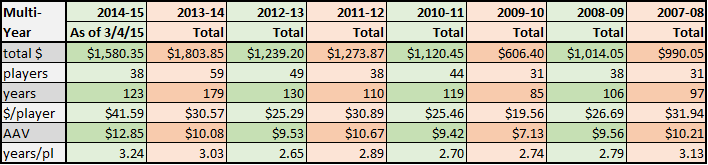
Now, let’s take a look in more visual form. The charts show a similar shape for both measures, and make clear that there continues to be healthy growth in spending on the game’s best players.
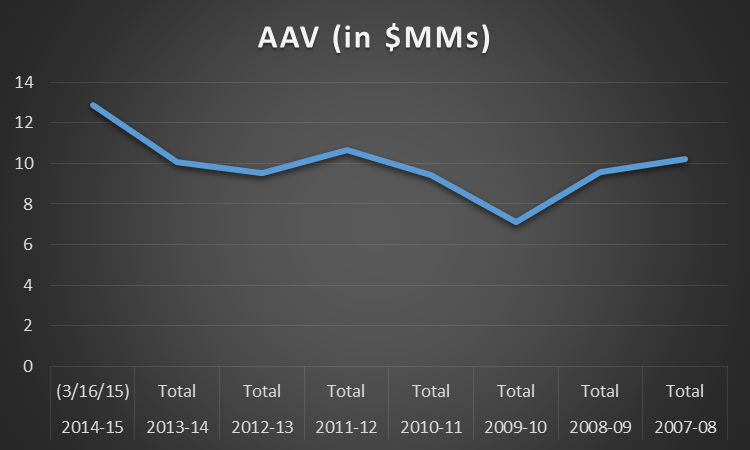
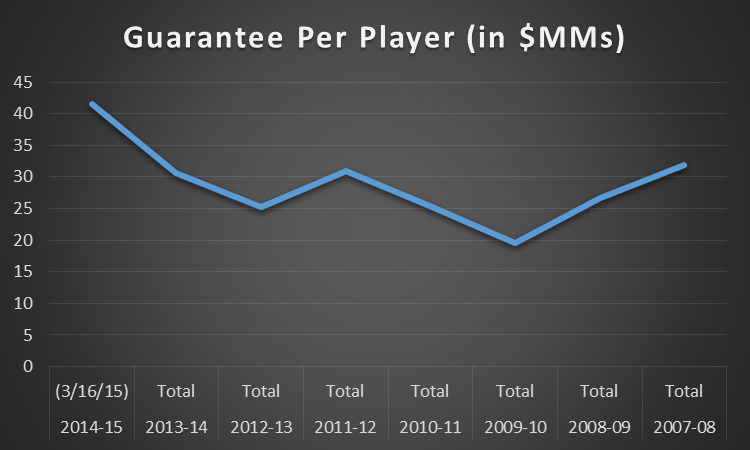
Of course, that only provides part of the story. As the data also reveals, this year’s market showed a rather significant drop in the absolute number of players who were able to achieve those kinds of commitments.
Previously, I showed only the multi-year deals as a group. Now, we’ll look at them in more detail. First, total contracts by year:

And now, by percentage:
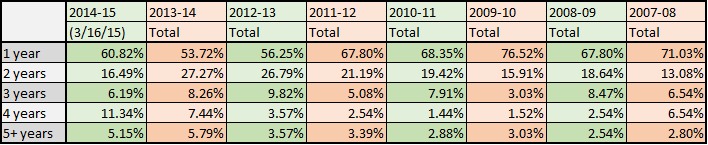
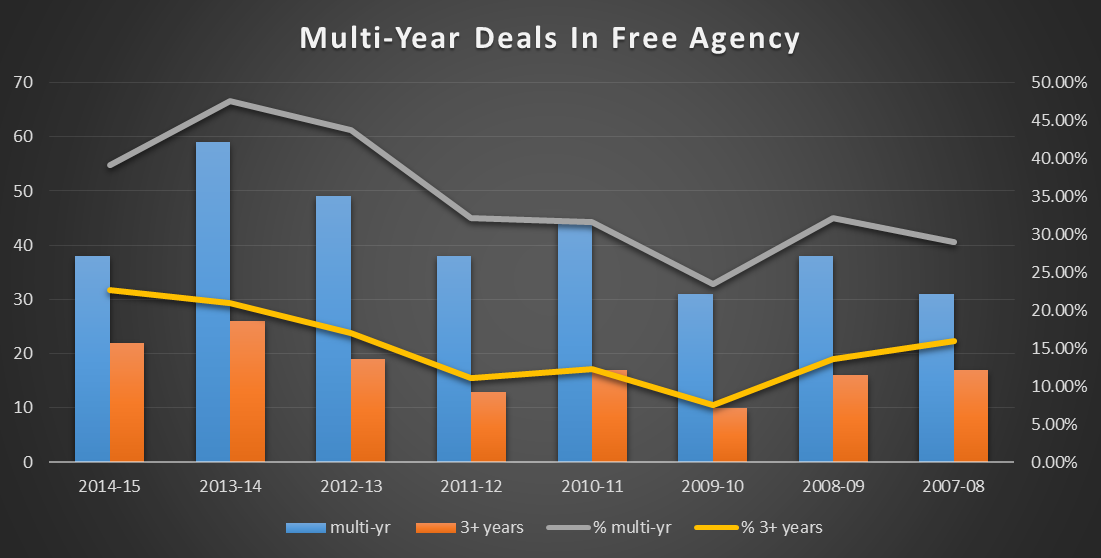
There are several elements at play here. As I already discussed in my previous post, there were simply less MLB contracts given out this year, which does influence the absolute numbers. Nevertheless, less of those deals were of the multi-year variety. In particular, two-year deals fell rather dramatically. On the other hand, as the below table also demonstrates, the likelihood of a big league contract going for three or more years actually continued to rise (as a percentage of total MLB deals).

Here is the above table in chart form. It is largely impossible to make any definitive statements about the reasons for the step back in multi-year contracts, but it seems most plausible to hypothesize that the differences are due largely to the necessarily different group of free agent players available in each season.
What is most interesting, perhaps, is what the 2014-15 market tells us about how to interpret the 2013-14 market, which seemingly represented a rather substantial increase in all types of spending as the league continued to cash in on television contracts. As I noted then, however, variations in the market — if, say, Robinson Cano and Masahiro Tanaka had not been available, or if the Yankees had not chosen to spend big — could make things look quite a bit different.
That is the case this year as well, but in the inverse: many of the team’s highest-revenue teams (Yankees, Dodgers, Phillies, etc.) largely kept their money on the sidelines; there were no nine-figure foreign players; a previous extension prevented Clayton Kershaw from hitting the market as one of the most valuable free agents in history. And then there’s the fact that next year’s market appears to be loaded, with both top-end talent and depth. This spring has yet to produce a major extension for a 2015-16 free agent; if that class stays largely intact it should be rather interesting to check in this time next year.
West Notes: Romo, Harrison, Athletics, Padres
Giants reliever Sergio Romo left no doubts about how glad he is to be back with San Francisco, as Alex Pavlovic of CSNBayArea.com reports (Twitter links). “It was like, we can get this done in five minutes, for real,” Romo said of his free agent stance towards the Giants. “Call me up.” Though other clubs offered him a chance to return to a closing role, Romo says he “just didn’t want to go anywhere.”
Here’s more from the game’s western divisions:
- Rangers lefty Matt Harrison feels increasingly confident in his ability to make it back to the big leagues, MLB.com’s T.R. Sullivan writes. Now working his way up to a full-size mound, Harrison still faces a difficult road in his return from spinal fusion surgery. “I don’t think about [retirement] anymore,” Harrison said. “It would definitely be hard to do without giving it another shot. The more I learn and the more I understand the rehab, I feel good about the possibility of getting back to a five-day rehab.” Obviously, any future contribution from Harrison — who is owed owed $41MM between now and 2017 (including a buyout on an option for 2018) — would be welcome news for a Texas club that has been beset by a variety of pitching injuries in recent years.
- New commissioner Rob Manfred says a new ballpark for the Athletics is a priority, as the Associated Press reports (via ESPN.com). While Major League Baseball will remain involved, Manfred said that he is not sure how much influence it can have on the process and said he prefers the team to work with Oakland on a solution.
- Padres owner Ron Fowler vetoed a June 2013 proposal from the team’s baseball executives to make a bid to acquire Cliff Lee, Tom Krasovic of the San Diego Union-Tribune reports. Then just ten months into his chairmanship, and overseeing a front office led by then-GM Josh Byrnes, Fowler decided the move did not make sense given the team’s overall situation and Lee’s expense. San Diego had been hovering at .500 at the time, but quickly fell back and out of contention that year, and obviously the move could have had significant long-term repercussions as things turned out.
Josh Edgin To Have Tommy John Surgery
SUNDAY: Edgin will undergo Tommy John surgery, Adam Rubin of ESPNNewYork.com tweets.
The Mets left the decision up to Edgin, but Rubin (link) doesn’t believe that this was the course of action that they preferred. The Mets, he says, wanted Edgin to give rehab a try for two or three weeks before making a determination. Mets GM Sandy Alderson told reporters (link) that the team was in accord with Edgin on having surgery. The pitcher felt that he rested all winter and a few weeks wouldn’t have made a difference in his condition.
THURSDAY: Mets southpaw reliever Josh Edgin is likely to start the season on the disabled list with a stretched elbow ligament, GM Sandy Alderson told reporters today, including Matt Ehalt of the Record (Twitter links). Rest and rehab is an option, but season-ending Tommy John surgery is on the table.
Regardless which way Edgin decides to proceed, the news has ramifications for a Mets club that was relying on him as its top left-handed option out of the pen. New York had already seemed a bit thin in that department, and will now be forced to turn for at least some portion of the season to options such as the more senior Scott Rice and younger players like Rule 5 pick Sean Gilmartin, Jack Leathersich, and Dario Alvarez.
Of course, it would not be surprising to see the Mets make a play to bolster that group. Joe Beimel and Phil Coke were snatched up only last week, taking away the best remaining options for immediate help. But other players surely will become available as roster battles and opt-out situations shake out, and there is always the possibility of a trade.
It is also a disappointing turn for the 28-year-old Edgin, who was excellent last year and is entering his arbitration platform season. He tossed 27 1/3 innings last season in 47 appearances, striking out 9.2 and walking only 2.0 batters per nine innings. ERA estimators support the underlying quality of his effort in 2014. While Edgin was limited to facing same-handed hitters as much as possible — he faced lefties as opposed to righties at nearly a 2:1 ratio — he actually posted even better numbers against right-handed hitters in a short sample and has rather palatable overall career splits.
Brewers Re-Sign Francisco Rodriguez
The Brewers have announced that they’ve signed closer Francisco Rodriguez to a two-year, $13MM deal with an option for 2017. The Scott Boras client will receive $3.5MM in 2015 and $5.5MM in 2016, with $2MM in deferred salary and a $2MM buyout on the option. That option will cost either $6MM and $8MM, as Tom Haudricourt of the Milwaukee Journal Sentinel reports.
 At $13MM, Rodriguez will land just shy of the $14MM that MLBTR predicted before the start of the offseason, though the option structure had to be agreed upon to achieve that. The deal appears to slot in fairly sensibly among recent contracts for similar-quality relievers. Only the younger Luke Gregerson landed a three-year deal (at a $6MM AAV), while Koji Uehara ($18MM — just before hitting the market), Sergio Romo ($15MM), and Pat Neshek ($12.5MM) all got significant guarantees on two-year pacts.
Rodriguez, 33, has spent most of the past four seasons in Milwaukee. All said, he owns a 3.11 ERA over his 193 2/3 frames with the Brewers. He has maintained double-digit strikeout-per-nine rates over the last two years in addition to an excellent K%-BB%. Though FIP has been down on Rodriguez’s work in recent campaigns, other ERA estimators like xFIP and SIERA view him as a 3.00 or better performer.
One potential knock on Rodriguez — the many miles on his otherwise relatively young arm — has a positive side as well. Rodriguez has been exceptionally durable, putting up an average of 69 innings running all the way back to 2003. And he still delivers his fastball in the same general, low-90s range that he has found success with in the past.
In nailing down the closer role in Milwaukee and taking Rodriguez off of the market, the signing goes a long way to clarifying the remaining relief market. For one thing, it leaves Rafael Soriano as the undisputed best free agent still available. For another, it takes away the most obvious trade match for the Phillies and closer Jonathan Papelbon.
Jon Heyman of CBSSports.com reported the signing, length, and presence of an option (Twitter links). Ken Rosenthal of FOX Sports reported the total guarantee on Twitter. Haudricourt tweeted the annual breakdown.
Photo courtesy of USA Today Sports Images.