
Minor Moves: Nate Robertson, R.J. Seidel
Here are today's minor moves of note:
- The Tigers have brought back lefty Nate Robertson on a minor league deal, reports Jason Beck of MLB.com (via Twitter). Now 36, Robertson spent five years as a mainstay in the Detroit rotation between 2004-08, but has not pitched in the bigs since 2010. Last year, in 50 1/3 Triple-A innings with the Rangers organization, Robertson put up a 3.04 ERA with 7.2 K/9 and 4.1 BB/9.
- The Brewers have released righty R.J. Seidel, tweets Chris Cotillo of MLB Daily Dish. The 6'5" Wisconsin native posted a 4.64 ERA in 75 2/3 innings and whiffed more than a batter per inning at the Triple-A level last year. The 26-year-old has spent his entire career in the Brewers organization since being a 16th-round draft pick in 2006. Last season was the first time Seidel's strikeout rate has climbed to that level; he's punched hitters out at a rate of 6.8 per nine in 521 minor league innings.
Steve Adams contributed to this post.
Orioles Among Teams Interested In Nick Franklin
The Orioles have joined the Rays and Mets as teams discussing a deal with the Mariners for middle infielder Nick Franklin, reports Jon Heyman of CBSSports.com. Baltimore would be interested in using Franklin at second base, where the team remains somewhat unsettled entering the season.
Franklin is competing (nominally, at least) with Brad Miller at short for Seattle after being displaced at second by Robinson Cano. The 23-year-old had a solid debut last year, posting a .225/.303/.389 line in 412 plate appearances after taking over at the keystone for Dustin Ackley. Franklin is considered a more marginal defender at shortstop than Miller, and has no apparent alternative spot in the Seattle infield, opening the possibility for a deal.
Nationals Manager Matt Williams Has Two-Year Deal
The deal signed by Matt Williams to manage the Nationals, which was agreed upon back in October, is a two-year pact that includes two club options, reports Adam Kilgore of the Washington Post. Details of the contract were previously unreported.
As Kilgore notes, two years is a fairly typical guarantee for a manager without MLB experience, and Williams follows in the footsteps of the Cardinals' Mike Matheny in that regard. On the other hand, other first-time skippers to sign on for the 2014 season — Brad Ausmus of the Tigers, Ryne Sandberg of the Phillies, Rick Renteria of the Cubs, and Bryan Price of the Reds — secured three-year deals. (Of course, we do not know the guaranteed dollars included in all of the deals.)
Coming to Washington after serving as the Diamondbacks' third base coach, Williams will face high expectations at the helm of a club that underperformed in 2013. The 48-year-old was a highly productive big leaguer over 17 seasons, most of which were spent with the Giants and D'Backs.
D’Backs To Return Rule 5 Pick Marcos Mateo To Cubs
The Diamondbacks will return Rule 5 choice Marcos Mateo to the Cubs, reports Paul Sullivan of the Chicago Tribune (via Twitter). The right-handed reliever was the eighth player chosen in this year's draft, though he was selected from the 15th slot.
Since seeing time in the bigs over 2010-11, Mateo missed all of 2012 and threw at Triple-A last year. In 31 innings, he posted a sparkling 1.74 ERA, with 8.7 K/9 against 3.8 BB/9. Across his previous 44 2/3 MLB innings, Mateo notche only a 5.04 ERA but for every nine innings did manage to strike out 10.3 while surrendering only 3.8 free passes.
As with most Rule 5 choices, Mateo would have struggled to stick on Arizona's roster for the year. That was especially so given the number of additions and commitments the team made to the pen made over the offseason. As MLBTR's Tim Dierkes has noted, Mateo was among the NL West players who are out of options. As a result, Arizona had little reason to work out a trade to retain Mateo's rights, since it could not hold onto him in the minors without passing him through waivers.
AL East Notes: Ramirez, Ortiz, Britton, Hardy
Manny Ramirez last saw MLB action with the Rays (briefly), and of course will always be associated with the Red Sox. As he continues to look for another chance at the bigs, the slugger spoke with Ken Rosenthal of FOX Sports, acknowledging and expressing contrition for his prior PED use. Ramirez says he could play a role similar to that of Raul Ibanez on the field and in the clubhouse. Here are some notes from around the American League East:
- Always-interesting Red Sox slugger David Ortiz says that he faces an unprecedented amount of responsibility to lead the way in the lineup, reports WEEI.com's Rob Bradford. "I'll give it a try, but I don't think there's a baseball player that has lived through this pressure at my age," said Ortiz. "Think about it. Guys my age are supposed to be complementary players. Nobody signs guys my age to be 'The Man.'" The 38-year-old, of course, is entering the final year of his current contract, and there has been no word of progression on extension negotiations.
- The Orioles are looking at out-of-options pitcher Zach Britton in different roles in anticipation of a possible move to the pen, reports Eduardo Encina of the Baltimore Sun. Britton, a 26-year-old lefty, has been mentioned as a possible trade chip for Baltimore. As MLBTR's Tim Dierkes recently explained in addressing the O's out-of-options players, the team faces a roster crunch that will require it to make some tough calls on a number of players, Britton among them.
- There is still no movement on the extension situation of Orioles shortstop J.J. Hardy, writes MASNsports.com's Steve Melewski. Hardy comes across as somewhat frustrated with having to deal with speculation, noting that his previous extension came about in short order. "There has been not much talk at all," he said. "I don't know what they're thinking. The ball is in their court if they want me. They know I like it here." Hardy also added that he would want to address his long-term position before inking a new deal. "If there are any intentions at all of signing me to a long-term deal and wanting Manny to move over to short I would definitely want to know that before," he explained, "because, yeah, I still feel like I can play shortstop and that is what I want to do."
Contextualizing The Qualifying Offer System
At base, the qualifying offer system provides a mechanism that allows teams to allocate resources elsewhere while still obtaining the services of certain desirable, established ballplayers. Those players, in turn, sacrifice a portion of the contractual guarantees they would otherwise obtain in an unqualified market. In effect, the system taxes the prospective earnings of certain players who are (or soon will be) free agents.
For more background on the function of the qualifying offer system, see Avoiding The Qualifying Offer, by MLBTR's Tim Dierkes.
The impact of the qualifying offer system has come under much scrutiny over its first two offseasons of implementation. Some have argued that it unfairly penalizes the above-average but non-superstar players that are made a QO (which, if declined, requires another club signing that player to give up its best non-protected draft pick and the accompanying bonus pool money). Others claim that it allows such players a fair chance to sign a substantial contract, pointing to the offer's value (last year, $13.3MM; this year, $14.1MM). A range of arguments also claims that the system perversely favors larger-market clubs.
But before considering such criticisms (and potential reformulations of the system), it is worthwhile to put the system in its broader context, and to consider carefully how it serves (or disserves) its various actual or potential purposes. While it seems exceedingly unlikely that changes will be made before the current CBA is expired and replaced in December of 2016, the topic deserves consideration and debate leading up to that point. In approaching the issue, it is worth looking carefully at both the money at play and where the various risks, benefits, and incentives fall.
A. Overall Market Impact
How much money — in both real and baseball terms — is at stake here? Dave Cameron of Fangraphs posited recently that a 3x valuation of a draft pick's slot value is a good approximation for that pick's value. In other words, a team considering gaining or losing a draft choice would factor that amount in when assessing the potential impact of signing a player (or allowing that player to sign elsewhere). For the 2013 amateur draft, slot values rose by 8.2%, according to Jim Callis of Baseball America. I will assume both a 3x slot value in reaching a market rate, as well as a like 8.2% increase for the upcoming 2014 draft. (Note: because slots shift with every move impacting the draft, the resulting numbers will not be perfectly precise, but should nevertheless easily qualify as accurate for our purposes.)
In 2012-13, six players declined qualifying offers and changed teams. According to River Ave. Blues, teams sacrificed the 17th, 22nd, 28th, 29th, 42nd, and 70th picks, while other clubs picked up the 28th through 33rd selections.
In 2013-14, to date, nine players have declined qualifying offers and changed teams. (Two QO-declining players have yet to sign.) Again, according to River Ave. Blues, teams have sacrificed the 17th, 18th, 21st, 26th, 44th, 48th, and 54th choices, while other teams gained the 28th through 34th pick. In addition, the Yankees both earned and sacrificed two supplemental first round choices. Because they finished with the worst record among clubs to have earned a supplemental pick, they would have stood to gain the first two of those picks.
Add up the slot values, and apply the 3x multiplier, and these are the results: In 2012-13, teams sacrificed a total value of $27.51MM ($4.585MM per player) and gained $29.33MM ($4.889MM per player). In 2013-14, to date, teams have sacrified a total value of $48.90MM ($5.433MM per player) and gained $48.85MM ($5.428MM per player). The 8.2% assumed increase in draft slot bonuses fairly well accounts for the rise in per-player figures, with the increase in overall impact coming otherwise from the increased use of qualifying offers.

It is worth putting these numbers up against the overall free agent spend to gauge their magnitude. I recently broke down free agent spending trends, including numbers for the 2012-13 period and the 2013-14 period to date. In the 2012-13 free agent period, clubs committed just over $1.463B in total via free agency, while this year's spending has now topped $2B (it was at $1.88B as of that post). Thus, the net draft value transferred through the qualifying offer system has been around 2% to 2.5% of the total open-market spend over the last two years.
That, surely, is a relatively minimal savings for MLB teams on the whole. When considering the full gamut of ways in which teams invest money into players — including free agency, extensions, the draft, and international signings — the money saved (i.e., allowed to be re-allocated) makes up a meager portion of the aggregate. Of course, it is worth wondering the extent to which the prospect of a future qualifying offer also transfers savings and leverage to teams negotiating extensions with players close to hitting free agency. This is impossible to calculate, but nevertheless does also transfer value to individual teams and savings to the league as a whole, as against current MLB players.
B. Impact On Individual Teams
On an individualized basis, teams assessing whether to make a qualifying offer, or whether to sign a player bound by draft compensation, have ample flexibility to value the choices at stake and decide whether and how to factor them into their decision.
Generally, a team making a qualifying offer to a player obviously reaps a substantial, albeit variable, benefit (in addition to having the right to choose whether or not to make the offer). It may ultimately retain that player at a one-year rate which, in theory, is at or below that player's market value. Or, it may instead receive a supplemental draft choice that lands between the first and second rounds of the draft. (It has been suggested that a team can sign a player that declined a QO at a lower rate than can other clubs, but that is not entirely true: once the offer has been declined, a re-signing effectively entails the sacrifice of a draft choice that, as explained below, comes with roughly the same value as the choices given up by other teams.)
A team signing a player that declined a qualifying offer, on the other hand, theoretically ends up in a neutral position, because it can discount its offer by the value it places on the pick that it sacrifices. While draft picks move as they are added and subtracted, teams have a very clear idea of what they are giving up in future value, and can apply their own valuations (including the tradeoff of present and future, and the actual slate of available draftees) to reach a discount.
As noted above, teams that are considering extensions of current players — especially, those close to reaching free agency — can also utilize the threat of a QO (implicit or otherwise) to achieve leverage. That may mean little in negotiations with superstars, but could have a sizeable impact on talks with "merely" above-average players. The possibility of a qualifying offer adds to and even enhances the risks of injury or performance decline already present to an above-average free agent-to-be, which could result in savings to current teams. This factor is, perhaps, enhanced in the situations of older or defensively-limited players who could be looking at short-term contracts after their walk years, even if they put up good numbers.
C. Impact On Players Subject (Or Potentially Subject) To Qualifying Offer
Meanwhile, for players, those issued a QO are subject to the whims of their team and other circumstances outside of their control. The take-it-or-leave-it offer is presented at the team's initiative, before the market even opens. (This year, for instance, Ubaldo Jimenez came with draft compensation; Matt Garza and A.J. Burnett did not.)
Further, the cost of the small reduction in overall spending falls squarely on the shoulders of the small number of players who are made a qualifying offer: their market value is decreased by whatever amount prospective teams choose to discount for the lost pick. And that burden is not shared by any other stake-holders (other players, the league, teams).
One line of sentiment says that some players over-value themselves by rejecting the QO. (No player has yet accepted one.) Even if the offer is an arguably fair price for one year of a certain player's services, however, that does not end the matter. It is quite difficult to reach free agency through service time, let alone to do so at an optimal point in time. Players that do naturally seek to maximize their overall guarantee, often choosing a longer contract with a lower average annual value to avoid the risks inherent in suiting up for another season before securing a future commitment. As Ubaldo Jimenez recently explained it: "I knew that I would have a better offer than the qualifying offer. Or at the very least, I wasn't as much worried about the annual salary, I was more concerned with having the long-term security."
For those that decline the qualifying offer and test the market, the resulting tie to draft compensation can be a significant drain. Though it is often suggested that the downside of the QO system lands solely on the more marginal players that receive an offer, that may be true only in relative terms. We do not know whether, say, Robinson Cano would have garnered a $245MM (rather than a $240MM) guarantee from the Mariners without an offer. But it is likely that the impact of a lost pick was factored in on some level. While the effect is a relative drop in the bucket for top-dollar free agents, it appears nonetheless.
(This is not to suggest that the team would have any focus on the loss of the draft pick in negotiating with a star-level player; rather, the value of the lost pick would be baked into the valuations that the team uses in setting internal parameters before entering negotiations. As Blue Jays GM Alex Anthopoulos has explained, for example, "there's still value" even for picks after the first round, "and you still build that into an offer." Of course, teams may still be willing to go past those valuations to land premier free agents, and/or effectively adjust their internal valuation of a pick downward based on their present roster construction and expected point on the win curve.)
More importantly, though, it is clear that non-superstars take the largest proportional impact. That is made obvious by Nelson Cruz, who recently became the first QO-declining player to sign a deal worth less than the qualifying offer itself, with his one-year, $8MM contract falling over $6MM shy of the $14.1MM he could have taken before the start of free agency. (Previously, the least guaranteed money in a deal to a player who declined a qualifying offer was Adam LaRoche, who signed for two years and $24MM last year after declining the one-year, $13.3MM QO.)
Indeed, the greatest risk for a player may lie not in the possibility that they will see a reduction in their earnings to compensate for the value of a lost pick, but in the impact on that player's overall market. Some teams may decide that they will not sacrifice their draft pick in a given year at all, for any number of reasons. Others may decide that, whatever the theoretical value of the pick, organizational needs dictate that they not cede the choice unless they are signing a player of a certain, higher order. Some clubs may simply put a greater internal value on the draft choice than that suggested by Cameron.
Whatever the case, teams clearly do not take lost picks lightly. "You hear people say, 'Well, what if the [drafted] player doesn't make it,'" Brewers GM Dough Melvin has said. "That's not the sole purpose of a draft pick. You can use those picks for trades. … I'm glad we have Kyle [Lohse], but don't tell me that about overrated draft picks. Their asset value is huge." The net effect, in all likelihood, is often to take away some teams that would be potential suitors and, perhaps, to limit the willingness of some others to offer multiple years.
This could explain, in part, how a player like Ervin Santana ended up taking a one-year pact (at the precise value of the qualifying offer) just to get in camp before the end of the spring. This kind of situation is not unprecedented even without draft pick implications — for instance, Edwin Jackson signed a $11MM pillow contract with the Nationals the year before the QO system went into effect, and did not cost the Nats a pick (he was a Type B free agent under the old system). Like Jackson, Santana had multi-year offers, apparently at about the price achieved last year by Kyle Lohse. But Santana was unwilling to sign for three years at a total value roughly equivalent to two years of qualifying offers, as was Lohse, and was apparently unable to translate relatively strong demand into a fourth year.
The point here is not that the QO in and of itself prevented Santana from achieving the four or five-year deal he was hypothetically entitled to. Rather, it is that, for the reasons just noted above, the qualifying offer played a role in dampening his market and reducing his leverage to pry away more years at a strong average annual value. And that, in turn, makes for an even greater potential increase in the proportion of the burden borne by a limited class of players.
Then, there are the soon-to-be free agents facing the possibility of a market hampered by the burden of draft compensation. As noted above, their leverage is surely reduced by the prospect of carrying that added cost, especially if always-shifting demand turns out to be less than robust. And the qualifying offer introduces risk to the player through the unpredictability of its effects, especially since the system drastically skews the market (through the protection of some draft picks and the fact that teams signing multiple compensation free agents sacrifice increasingly less valuable choices.) Indeed, players like Justin Masterson and Chase Headley have reportedly seen their current teams insert the qualifying offer into extension talks.
D. Conclusion
With this understanding of the broad parameters of the function of the qualifying offer system, the question becomes one of purposes. What does the system hope to accomplish, and hope to avoid? And how well has it done? I will suggest an approach to those questions in a second post.
Offseason In Review: San Diego Padres
The Padres made two substantial free-agent additions while otherwise mostly tinkering at the margins of the roster, and will look to their young core to move the team forward in 2014.
Major League Signings
- Joaquin Benoit, RHP. Two years, $15.5MM.
- Josh Johnson, RHP: One year, $8MM. Conditional $4MM club option.
- Total Spend: $23.5MM
Notable Minor League Signings
Trades and Claims
- Acquired OF Seth Smith from Athletics for RHP Luke Gregerson.
- Acquired LHP Alex Torres and RHP Jesse Hahn from Rays in exchange for IF Logan Forsythe, RHP Brad Boxberger, RHP Matt Andriese, RHP Matt Lollis, and 2B Maxx Tissenbaum.
- Acquired IF Ryan Jackson from Astros in exchange for OF/1B Jesus Guzman.
- Acquired RHP Ben Paullus from Yankees in exchange for IF Dean Anna.
- Acquired OF Alex Dickerson from Pirates in exchange for OF Jaff Decker and RHP Miles Mikolas.
- Acquired LHP Patrick Schuster (Rule 5 pick) from Astros in exchange for RHP Anthony Bass.
- Acquired RHP Devin Jones from Orioles for RHP Brad Brach.
- Claimed OF Alex Castellanos from Rangers.
Extensions
- None
Notable Losses
- Clayton Richard, Ronny Cedeno, Jose De Paula, Colt Hynes, Mark Kotsay, Jason Marquis (still unsigned)
Needs Addressed
Sitting here today, one year ago, did anyone think that Benoit would get nearly double the guarantee of Johnson? Nevertheless, that's what happened, and both righties are now Padres. Benoit, of course, will plug into the setup role vacated by Gregerson, and could ultimately supplant Huston Street in the closer's role with the latter coming up on an option year. In a sense, this was a need of GM Josh Byrnes' own making, though Benoit does represent an interesting choice as a closer-in-waiting who has spent most of his career as a setup man. It remains to be seen how the gambit will turn out, of course; though Benoit has been quite good in recent seasons, he is already 36 years of age.
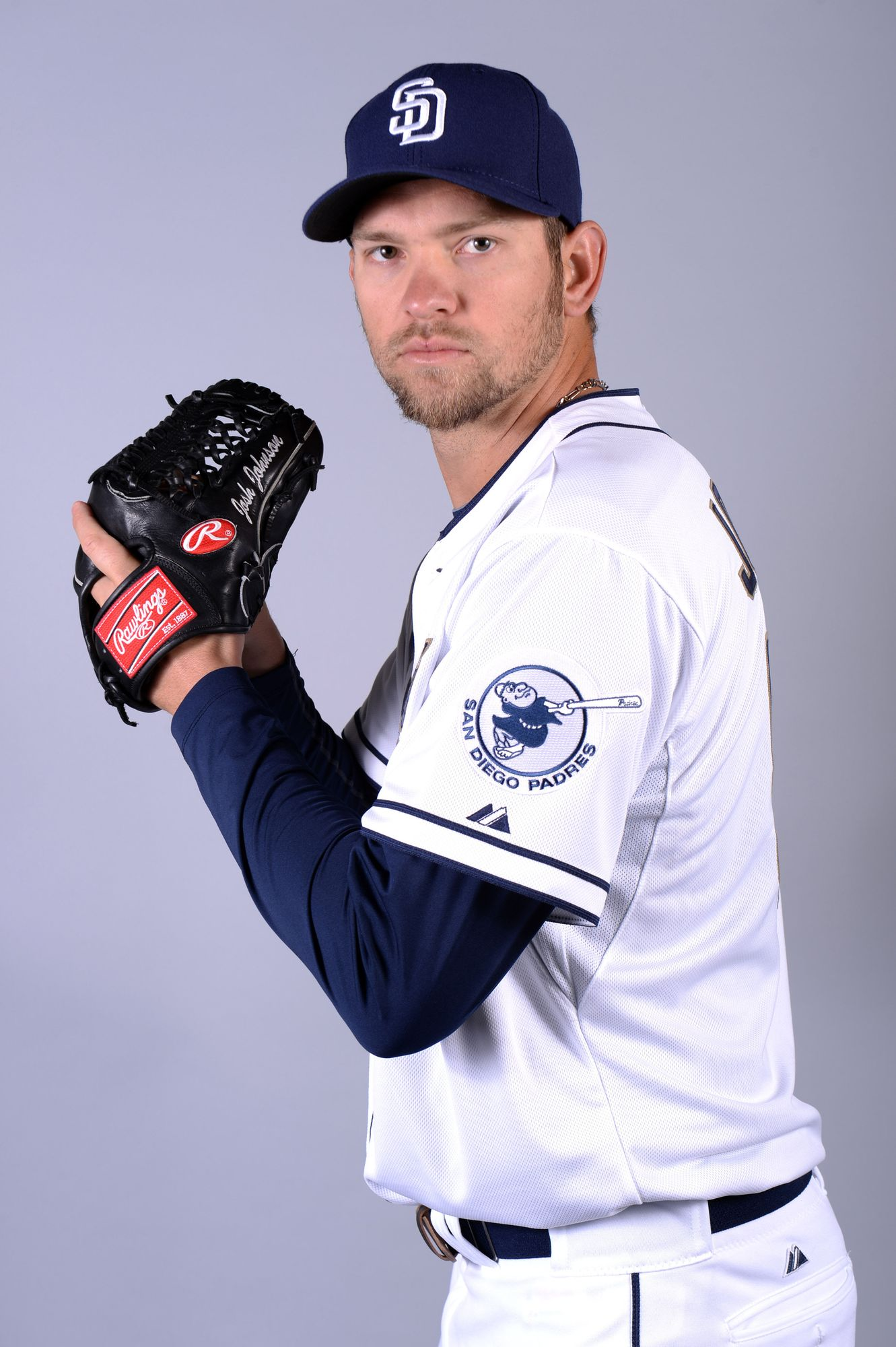
Johnson, meanwhile, represents the last major piece of a re-worked rotation. After moving on from former key arms Edinson Volquez and Clayton Richard, and adding something of a reclamation project by trading for Ian Kennedy last July, the club had room for another arm to put alongside Andrew Cashner, Tyson Ross, and Eric Stults. With younger pitchers like Joe Wieland, Robbie Erlin, and Burch Smith in the organization, GM Josh Byrnes could have stood pat or waited to land a cheap deal with a veteran, innings-eating arm. Instead, he went for upside.
Otherwise, the 2014 roster had no significant, pressing needs. That did not mean that Byrnes and company would sit on their hands, however, particularly with a host of somewhat marginal MLB players occupying valuable 40-man spots. What ensued was a re-working at the edges of the roster seemingly designed to capture some value for surplus parts.
There were many moves, but their net impact is relatively minor. San Diego purged its bullpen of a series of players who threw for the big club last year, led by Gregerson but also including Bass, Boxberger, Brach, Hynes, and Mikolas. Likewise, the Pads moved on from a variety of reserve types, led by Forsythe and including Anna, Guzman, and Decker.
The return for this big group, and the prospects that accompanied them, will have some impact on the MLB roster. Torres is the team's only sure southpaw in the bullpen, while Smith will see plenty of plate appearances from the corner outfield. Schuster is currently battling minor-league signee Sipp for a spot in the 'pen as a second lefty, while Jackson and Castellanos are in the mix for bench roles. Meanwhile, Hahn and Dickerson are both top-thirty organizational prospects (though so was Andriese).
On the whole, the Pads' front office put out a lot of effort that may not make a huge difference. Looking at the two main trades involving MLB players, it is fair to ask whether Torres and Smith are a better combination than Gregerson and Forsythe? San Diego had dealt its primary lefty, Joe Thatcher, in the Kennedy trade, so adding Torres bypassed the need to purchase a new southpaw. But moving Forsythe still left the club with ample outfield options, and does little to make sense of the earlier Gregerson-for-Smith swap.
By sending out Gregerson for an equivalently-priced platoon outfielder, San Diego not only failed to free up salary space but created a need to book an even more expensive replacement in Benoit. Smith, at least, offers a different skillset than Forsythe, who was perhaps redundant with Alexi Amarista. But his power has declined since leaving Coors Field, and defensive metrics are not fans of his outfield work. While it made some sense to bring in a righty-masher, San Diego never moved any of its other corner bats, leaving it with five outfielders deserving of a roster spot (at least until Cameron Maybin suffered his most recent injury). And it is far from clear that Smith was fair value for Gregerson, who has been consistently effective over all five of his MLB seasons.
Questions Remaining
The biggest questions in San Diego relate to the fulfillment of potential. The club features many important young players, two of whom — shortstop Everth Cabrera and catcher Yasmani Grandal — are coming off of PED suspensions arising out of the Biogenesis investigation. While the roster arguably features an over-abundance of right-handed-hitting corner outfielders, one (Maybin) will be out to start the year and another (Carlos Quentin) has really never been consistently healthy. The steady Chris Denorfia is also available, though he lacks the talent of the other two. And in the rotation, in addition to a return to form from Johnson, the club will hope for a bounceback from Kennedy and continued development from Andrew Cashner and Tyson Ross. Getting the answers to these questions is simply a matter of waiting and watching.
On the transactional side, speculation on a Chase Headley extension has undergone a roller-coaster ride ever since he broke out in 2012. It has appeared at times that San Diego was set to make the third baseman the long-term face of its franchise, but at present that seems unlikely. "This has been a topic for a couple years. There's been dialogue. Both sides have tried. We just haven't been able to agree to the essential deal parameters," said Byrnes. "There are no active discussions. But the door's always open." As Headley himself has made clear, the gap between his healthy and productive 2013 and his injury-plagued, less-excellent 2013 campaigns posed a major obstacle.
So, all signs point towards Headley playing out the 2014 season without a new deal, allowing both sides — and the rest of the league — to assess his actual value. The open question, then, is somewhat different at this point: If Headley performs, but the Padres are not within shouting distance of a post-season bid at the trade deadline, will he be dealt?
Deal Of Note
Of course, the Pads are surely hoping that dealing Headley is not an option due to the team's performance on the field. If Byrnes did not feel there was a legitimate chance at a post-season run, it is unlikely that he would have participated in a competitive auction for the towering Johnson. Taking advantage of Petco Park's reputation for suppressing the long ball, San Diego was able to beat out several other teams — including the Pirates, who instead brought in Volquez — for a roll of the dice on Johnson returning to form.
Looking past his misleading ERA totals from last year (he suffered from high BABIP and HR/FB rates with a low strand rate), Johnson has an impeccable track record — when healthy. His SIERA and xFIP marks, for instance, have not strayed above the 4.00 level since 2007. His swinging strike percentage last year was right at his career mark, and he punched out hitters at a career-best rate of 9.18 K/9.
The issue, of course, is durability: Johnson has endured a string of health issues. In fact, he has exceeded 200 innings in just one season and has made it to triple-digit inning tallies in only four MLB campaigns. San Diego bought itself some protection by negotiating a conditional $4MM club option for 2015 that will be available to the club if Johnson fails to make seven starts. While that provides some benefit to the club in the event of a catastrophic injury, the fact remains that Johnson's signing is a roll of the dice.
Johnson's signing, ultimately, makes a lot of sense for both parties. For Johnson, a pillow contract in a pitcher-friendly situation made San Diego a natural fit. The Padres wanted a pitcher of his talent level to supplement their excellent group of younger players, but they did not want to pay the premium needed to get a more established option. There's risk sure, but at one-third the guarantee given to Bronson Arroyo, the potential payoff is worth putting the cash on the line. As Byrnes has explained, "if [Johnson] can pitch like he has for many years in his career, we're a different team."
Overview
On the whole, the Padres' moves seem solid enough. Indeed, in a survey conducted by ESPN.com's Jayson Stark, the team landed second on the "most improved" list among NL clubs. Of course, as Stark noted, San Diego's additions (like those of most of the National League) paled in comparison to what some AL clubs did in terms of impact. But given the organization's solid group of younger players, and limited overall payroll capacity, Byrnes and his staff have put the team in a position to make a run like that of the Pirates last year — if some things break in San Diego's favor.
Photo courtesy of USA Today Sports Images.
Brewers Outright Jose De La Torre
The Brewers have outrighted righty Jose De La Torre to Triple-A, reports Tom Haudricourt of the MIlwaukee Journal Sentinel (via Twitter). With the move, Milwaukee now has one free spot on its 40-man roster.
De La Torre was claimed off of waivers from the Red Sox back in September. The 28-year-old was solid in Triple-A last year, posting a 2.75 ERA in 52 1/3 innings with 10.1 K/9 and 4.6 BB/9. In his first taste of MLB action, however, De La Torre struggled in just 11 1/3 innings of work, allowing 6.35 earned runs per nine frames. Though he showed he could generate strikeouts of big league hitters (11.9 K/9), his walk rate (7.9 BB/9) left much to be desired.
Quick Hits: 2-Sport Athletes, Carpenter, Pineiro, Cook
Two-sport stars do not always choose baseball, but those who do tend to cite the better financial prospects from the player's perspective, writes USA Today's Gabe Lacques. Diamondbacks prospect Archie Bradley, for example, says it was hard to turn down the chance to be "a legend" by playing quarterback for Oklahoma, but his awareness of the lack of guaranteed money and attrition in football led him to take a $5MM signing bonus. Billy Hamilton and Carl Crawford are other players quoted in the article who do note regret their choice. "Look, there's way more money in baseball," says Cubs president Theo Epstein. "We have to do a better job as an industry in promulgating that fact." Or, as Bradley puts things, "obviously, guaranteed money is never a bad thing."
Here are a few more stray notes from the day:
- Longtime Cardinals ace Chris Carpenter says he is at peace with his decision to hang up his spikes, writes Derrick Goold of the St. Louis Post-Dispatch. The 38-year-old says that, after working out over the winter, he knew it was time: "It's not going to work," he realized. "No matter how hard I push it's just not going to happen." Carpenter and GM John Mozeliak are still sorting out what role he will play in the organization going forward.
- Veteran hurler Joel Pineiro is still working on his comeback, tweets Jesse Sanchez of MLB.com. He showed off his form a few days back in front of at least a dozen teams' representatives. The 35-year-old righty has played in parts of twelve MLB campaigns, posting a lifetime 4.41 ERA over 1,754 1/3 innings, but has not pitched in the bigs since 2011.
- Another familiar arm, Aaron Cook, is now pumping the brakes on his own attempt at a return, tweets Chris Cotillo of MLBDailyDish.com. Though he is not retiring, Cook is reportedly unlikely to pitch in the coming season. The 35-year-old has a career stat-line not unlike that of Pineiro, with a 4.60 ERA over 1,406 1/3 frames in parts of 11 seasons. After developing into a solid innings-eater in his late twenties, Cook's production took a distinct downturn over the 2010-12 campaigns.
Reactions To And Fallout From Ervin Santana Signing
Addressing his team's sudden and successful entry into the market for starter Ervin Santana, Braves GM Frank Wren said that he did not expect to be in the market for free agent starters, but felt Santana was the best option available going into the offseason. (Video of press conference via the Atlanta Journal-Constitution.) It was Atlanta's good fortune that Santana remained unsigned when Kris Medlen walked off the mound with an injury on Sunday. Wren immediately made contact, knowing that he had to catch up quickly with other clubs further down the road on talks with Santana. "Once we started talking, we realized that Ervin was very interested in us as well, thought this was a good opportunity for him, and it was a perfect fit for us."
- For Atlanta, the message to the field staff and players was clear. "[The signing] means our GM and our front office want to win," manager Fredi Gonzalez said, as MLB.com's Joe Frisaro tweets.
- The key for Santana was his desire to pitch in the National League, Shi Davidi of Sportsnet.ca reports on Twitter. Blue Jays GM Alex Anthopoulos confirmed, saying that he was told Santana "had a strong desire to pitch in the NL and there was no way to compete with that." (MLB.com's Gregor Chisholm provides a transcript of Anthopoulos's chat with the media today.) The GM also emphasized that he was "very comfortable we did everything we could" to land Santana, who the club "viewed … as an impact starter." Anthopoulos implied some disappointment with the way things unfolded, declining comment on several questions about reports that a deal was done last Saturday by saying that he was "trying to take the high road here."
- From the Twins' perspective, most talks were "very exploratory," assistant GM Rob Antony told Mike Berardino of the St. Paul Pioneer Press. "I think what they were looking at and were looking for was different from what we were thinking," explained Antony. "… We weren't necessarily looking for a one-year guy."
- Meanwhile, the Royals' short run with Santana is now officially over, but the team feels fine about how things worked out, Andy McCullough of the Kansas City Star reports on Twitter. "I think Erv's going to do very well," GM Dayton Moore said, "and we're going to get the pick. And it all worked out." Indeed it did: K.C. got a valuable draft choice and excellent season from Santana, all for the low price of $12MM and the rights to minor league lefty Brandon Sisk.