
Nationals Sign Colin Poche To Minor League Deal
The Nationals announced Friday that they’ve signed left-handed reliever Colin Poche to a minor league contract with an invitation to major league spring training. He was non-tendered by the Rays earlier in the winter.
Poche, 31, has spent his entire big league career with the Rays to this point. He’s pitched in parts of four seasons, logging a collective 3.63 ERA with a sharp 27% strikeout rate, a 9.2% walk rate and a 30% ground-ball rate. His best season came in 2023, when he tossed 60 1/3 innings of 2.23 ERA ball while fanning about one-quarter of his opponents and issuing walks at a 9.8% clip.
Strong as Poche’s track record is, the 2024 season clearly wasn’t his best. He spent time on the injured list due to back and shoulder troubles, ultimately pitching only 37 1/3 innings. Poche’s 3.86 ERA was still solid, but his 21.6% strikeout rate was a career-low mark, while his 1.69 HR/9 rate was the highest of his career.
Poche’s four-seam fastball, which averaged 92.9 mph in his first three big league seasons, sat at just 91.2 mph in 2024, further suggesting that he wasn’t right physically. His slider was down about 1.5 mph from peak velocity, too, sitting at an average of 83.1 mph. Unsurprisingly, given the reduced stuff, he allowed more contact, recorded a career-low swinging-strike rate and saw opponents produce career-best exit velocity and hard-hit rates against him. The always cost-conscious Rays opted to move on a year early rather than pay Poche a projected $3.4MM salary in his final season of club control.
If Poche is back to full strength, he should have a good chance to not only make the Nationals’ bullpen but pitch in a key role. He’s been a high-leverage setup man for Kevin Cash in Tampa Bay throughout his career, logging 81 holds and a dozen saves in 225 career appearances (208 1/3 innings). Washington’s bullpen is lacking in experienced lefties — and, more broadly, just experienced relievers in general. Jorge Lopez and Derek Law are the only two Nats relievers with even two years of MLB service. Only one other, Jose A. Ferrer, even has one full year of service time.
Giants Acquire Osleivis Basabe
The Giants acquired infielder Osleivis Basabe from the Rays in exchange for cash, according to announcements from both teams. Tampa Bay designated Basabe for assignment earlier in the week. The Giants already had an open 40-man spot to accommodate Basabe.
The 24-year-old Basabe’s only big league experience came back in 2023, when he totaled 94 plate appearances across 31 games and batted .218/.277/.310. That inauspicious debut came after a more encouraging .296/.351/.426 output (95 wRC+) in Triple-A that year. However, the 2024 campaign brought significant declines for Basabe in nearly every meaningful category. He spent th entire year in Triple-A Durham, hitting .248/.293/.336. Basabe’s walk rate dropped from 7.3% to 4.9%. His strikeout rate jumped from 15.5% to 18%. His average exit velocity dipped by nearly three miles per hour, while his hard-hit rate fell by a hefty eight percentage points.
Rough as the previous season was, Basabe is regarded as a solid defender who can handle shortstop, second and third. He ranked within the top 10 prospects in Tampa Bay’s system an offseason ago and has a minor league option remaining, so the Giants can send him to Triple-A without needing to expose him to waivers.
With Willy Adames at short, Matt Chapman at third and Tyler Fitzgerald at second, there’s no immediate path to Basabe logging any kind of consistent at-bats in the majors, even if he has a big spring showing. However, the Giants’ bench is far less solidified, and he’ll join Brett Wisely, Casey Schmitt and David Villar (among others) in competing for a utility role on Bob Melvin’s bench.
MLB Owners Approve John Seidler As Padres’ Control Person
John Seidler, the brother of late Padres chairman Peter Seidler, was unanimously approved as the team’s new control person in a vote among the league’s other 29 owners, Kevin Acee of the San Diego Union-Tribune reports. The move will become official once the paperwork naming John the trustee of Peter’s trust is finalized in about a month’s time, Acee adds.
Padres ownership has been embroiled in a legal battle in recent months, as Peter’s widow, Sheel Seidler, has filed suit against her late husband’s brothers, alleging that they’ve breached fiduciary duty and committed fraud as successors of Peter’s trust. Sheel Seidler accused brothers-in-law Matt and Bob Seidler of selling assets to themselves “far” below market prices in an effort to consolidate control of the franchise and of violating Peter’s wishes that she serve as interim control person of the club before passing ownership onto the couple’s children at a later date.
Matt Seidler contested the suit in a formal response wherein he accused his sister-in-law of attempting to “manufacture claims against the Trustees in pursuit of the control that Peter intentionally chose not to give her.” Per Matt’s response, the trust has made numerous transactions, totaling tens of millions of dollars, benefiting Sheel and her children.
Sheel’s attorney suggested in a statement that the Seidler brothers have no evidence to support claims of wrongdoing by his client: “It’s ironic that they accuse Sheel — Peter’s wife of two decades and the mother of his three children — of misusing his assets, while at the same time they have reaped the benefits of Peter’s generosity for decades. The fact is, we will win in court because the defendants have shown they have no case.”
To date, Matt’s formal response to Sheel’s lawsuit is the only on-record comment provided by any of the brothers. John was not present for and has not issued comment on today’s vote. While John has now been approved by the league’s other owners, it remains possible that the forthcoming legal battle could yet impact the team’s ultimate ownership outlook. Any timeline on a resolution is impossible to predict. If the case is litigated in full and not settled outside of court, it could prove to be a yearslong process.
Giants, Lou Trivino Agree To Minor League Deal
The Giants and right-handed reliever Lou Trivino have agreed to a minor league contract, reports Robert Murray of FanSided. The Pro Edge Sports client will be invited to major league camp this spring.
Trivino, 33, hasn’t pitched in the big leagues since 2022 due to a series of arm injuries. He underwent Tommy John surgery prior to the 2023 campaign and missed all of the 2024 season due to ongoing inflammation in that elbow and a separate shoulder issue. He recently held a bullpen session for scouts — the Giants were among those in attendance — and seemingly has a clean bill of health. By signing in San Francisco, he’ll be reunited with his longtime manager in Oakland, Bob Melvin, at least for spring training.
When he’s been healthy and at the top of his game, Trivino has been a quality high-leverage arm. He throws hard, misses bats and picks up grounders at strong rates. From 2020-22, the righty averaged just under 96 mph on his four-seamer and sinker while pitching to a 3.76 ERA with a 24.5% strikeout rate, 10.4% walk rate and 48.7% grounder rate. In parts of five big league seasons, he’s tallied 37 saves and 52 holds.
The Giants recently shipped out one veteran reliever, lefty Taylor Rogers, in a trade with the Reds that looked to be more about cost-savings than improving for the upcoming season. That left Taylor’s twin brother, Tyler, and righty Camilo Doval as the Giants’ only two relievers with even two years of big league service. If he impresses in camp, Trivino can add a veteran option to a late-inning group that includes Tyler Rogers, Ryan Walker and Doval. Others in the bullpen mix include Sean Hjelle, Erik Miller, Landen Roupp, Tristan Beck, Spencer Bivens and Randy Rodriguez.
Can The Astros Find Their Left-Handed Bat And Sill Stay Under The Luxury Tax?
It’s been a whirlwind offseason for the Astros. While Houston isn’t rebuilding by any stretch, it’s fair to call this something of a transitional winter. They’ve traded an MVP-caliber outfielder (Kyle Tucker) to the Cubs and appear likely to part ways with a cornerstone of their World Series teams (Alex Bregman) in free agency. Justin Verlander is in San Francisco. Longtime closer Ryan Pressly followed Tucker to Wrigleyville in a separate trade. With those names out the door (or likely out the door, in Bregman’s case), the ‘Stros have brought in Isaac Paredes, Christian Walker, Hayden Wesneski and their new top prospect, Cam Smith.
Owner Jim Crane has maintained that the club has the “wherewithal” to match last year’s spending (i.e. pay the luxury tax) in the right scenario and for the right player. Presumably, with Houston leaving its six-year, $156MM offer to Bregman on the table — even after acquiring Paredes and Walker and even as Bregman seeks lengthier/larger contracts elsewhere — Crane feels a Bregman reunion is such a scenario/player. However, general manager Dana Brown said yesterday that he hasn’t recently talked to agent Scott Boras and used the past tense when talking to the Astros beat about Bregman (video via Brian McTaggart of MLB.com). A reunion doesn’t seem likely.
In that same media availability, Brown continued to voice his hope to acquire a left-handed bat — ideally in the outfield:
“We’re trying to get a left-handed bat for the outfield,” said Brown. “Most of the options are slim to none, but we’re still working through it and grinding to get some left-handed at-bats in our outfield.”
Cynics will point out that Houston had one of the best left-handed hitters in all of baseball (Tucker) and traded him to the Cubs — although doing so brought them multiple years of control over their new third baseman (Paredes), their potential fifth starter (Wesneski) and their new top prospect (Smith). Tucker wasn’t likely to sign an extension, and the ‘Stros undoubtedly received more long-term value than they’d have garnered with a compensatory draft pick by simply letting Tucker reach free agency. That long-term value comes at the cost of a lesser 2025 roster but could well prove to be the best play in the long run.
Regardless of how one feels about the Tucker trade, he’s gone and won’t factor into this year’s roster. That leaves the Astros with a heavily right-handed lineup. Paredes, Walker, Jeremy Pena, Jose Altuve, Yainer Diaz, Jake Meyers and Chas McCormick all bat from the right side. Yordan Alvarez is the lone left-handed bat assured to be in the lineup.
On top of that general lack of lefties, the Astros also more broadly lack certainty in the outfield. Meyers plays great defense but is a .222/.290/.369 hitter over the past two seasons. McCormick is coming off a career-worst .211/.271/.306 batting line. The other outfield spot, as things stand, projects to be filled by a combination of utilityman Mauricio Dubon and DFA pickup/former top prospect Taylor Trammell. Houston can hope that a combination of Kenedy Corona, Pedro Leon, Jacob Melton, Quincy Hamilton and Cooper Hummel can factor into the outfield puzzle, but no one from that group is close to established in the majors. Leon’s stock is down considerably from when he was Houston’s top prospect. Melton is still well-regarded but didn’t hit all that well in last year’s Triple-A debut.
Even if someone from that group steps up, the Astros arguably need better outfield options. Alvarez played 53 games in left field last year, and manager Joe Espada said this week that the club hopes to reduce that number significantly in 2025, so more time on the grass for the team’s top slugger isn’t the answer. One injury or continued offensive decline for Meyers or McCormick could lead to a disastrous outfield setup.
It all leaves the Astros in a tough spot. They’re about $4.75MM shy of the $241MM luxury tax threshold, per RosterResource, with an owner who seemingly doesn’t want to cross that line for anything other than a Bregman reunion (at the Astros’ price rather than Bregman’s price). There are some free agents who could fit the bill, but would they sign for under $5MM? That’s far less clear.
Let’s run through some potential options.
Free Agents
Jason Heyward: The Astros got a decent run out of Heyward after the Dodgers cut him loose. He appeared in 24 games and hit .218/.283/.473 with four big flies in just 61 plate appearances. Heyward still plays a strong right field, but he’s coming off an overall .211/.288/.412 showing last year. He and McCormick could form a platoon, but Heyward only has 73 plate appearances versus lefties over the past three seasons combined. He shouldn’t face them. Given his age (35), marginal 2024 showing and platoon splits, it seems plausible that the Astros could sign him for something similar to Ramon Laureano‘s $4MM in Baltimore and keep themselves under the tax line.
David Peralta: The 37-year-old Peralta hit .267/.335/.415 for the Padres in 2024, with about 90% of his plate appearances coming against right-handed pitching. As with Heyward, he’s a veteran in the twilight of his career who’d require strict platooning. That said, Peralta has consistently hit right-handed pitching, with the 2023 season standing as the lone exception of note in recent years. He bounced back nicely in 2024 after signing minor league deals with the Cubs and Padres. A big league deal with a small enough guarantee to comfortably remain under the luxury tax at least feels plausible.
Eddie Rosario: After four productive years as a regular in Minnesota, Rosario has alternated between league-average offense and bottom-of-the-scale production, in every-other-year fashion, from 2021-24. He posted exact 100 wRC+ marks in ’21 and ’23 but hit .212/.259/.328 (63 wRC+) in 2022 and .175/.215/.316 (45 wRC+) in 2024. A minor league deal with a low base salary seems to be the likely outcome here. The Astros could swing that, but there’s zero guarantee that the 33-year-old Rosario can bounce back from that woeful ’24 showing. Over his past 1517 MLB plate appearances, he’s hitting .231/.278/.396 (82 wRC+).
Alex Verdugo: Still just 28 years old, Verdugo picked a poor time to have a career-worst season. He hit just .233/.291/.356 as the Yankees’ regular left fielder last year, and that came despite a blistering start to the season. From mid-May onward, Verdugo fell into an interminable slump and ranked as one of the game’s least effective hitters. In Verdugo’s final 480 plate appearances, he posted a .221/.270/.330 slash. That’s 31% worse than league-average, by measure of wRC+. Verdugo is very likely looking at a one-year deal, but he made $8.7MM last season, so a cut to less than $5MM is probably a hard sell. Plus, most teams with interest in Verdugo are likely willing to include incentives to boost whatever base salary he accepts. For the Astros, such an arrangement might push them north of the tax line again.
Plausible Trade Options
To be clear, this isn’t an exhaustive list of every left-handed bat the Astros could pursue — nor is it necessarily a collection of high-impact, cost-effective prospects. Sure, the Astros would probably love to pry Heston Kjerstad away from the Orioles, but short of offering up a compelling top-of-the-rotation arm like Framber Valdez — which doesn’t at all seem like something Houston is considering/has considered — a prospect of that caliber isn’t likely to be available. Some of these names have, and surely will again, already come up in trade talks, but broadly speaking this is a speculative list of potential fits who’d check some boxes for Houston.
James Outman, Dodgers: Outman was one of the Dodgers’ top-ranked prospects a few years back but hasn’t been able to overcome his penchant for strikeouts. The outfield in L.A. no longer has room for him. Teoscar Hernandez, Tommy Edman and Michael Conforto look likely to start there, and even if Edman shifts to the infield, Andy Pages has leapfrogged Outman on the depth chart.
Outman posted a miserable .147/.256/.265 slash in 156 plate appearances with the Dodgers last season but slashed .248/.353/.437 in 567 turns at the plate the year prior. He hit .279/.390/.543 in Triple-A last year. Outman has a minor league option remaining, so the Dodgers don’t need to be in any rush to trade him. He’s nice depth to have on hand. But he’s also 27 going on 28 (in May), not in the team’s immediate plans, and has fast-rising prospects Josue De Paula and Zyhir Hope climbing the minor league ranks behind him.
Jesus Sanchez, Marlins: After a brief run of trying to compete, the Marlins are back to teardown mode — perhaps even more so than at any point in recent history. They traded 10 big leaguers last year between Opening Day and the deadline, and they’ve shipped out Jesus Luzardo this offseason as well.
Sanchez, earning $4.5MM this year, is one of two players on Miami’s active roster earning more than $2MM. (Ace and likely summer trade chip Sandy Alcantara, at $17MM, is the other.) Since he’d effectively be replacing a league-minimum player, he’d be a net $3.75MM add to the team’s luxury bill, allowing Houston to stay under the tax line. Sanchez has subpar plate discipline and can’t hit lefties. He also has enormous raw power and elite batted-ball metrics. He’s only an average runner but nonetheless swiped 16 bags in 18 tries this past season. Since 2023, the 27-year-old is hitting .252/.319/.431 with 32 homers in 931 plate appearances. He’s a solid, if unremarkable right field defender and is under club control through 2027. With the Marlins in a rebuild, Sanchez could be had for prospects.
LaMonte Wade Jr., Giants: Wade is probably a stretch as a regular outfielder. He ranks among the game’s slowest runners, sitting with seventh percentile sprint speed, per Statcast, and the Giants haven’t played him on the grass even semi-regularly since 2021-22. The Astros have a grounder-heavy rotation, though, and the short left field porch at the newly renamed Daikin Park inherently reduces the amount of ground Houston left fielders need to cover (especially relative to Oracle Park in San Francisco).
Wade excels in two key areas, however. He hits right-handed pitching and, more broadly, he gets on base. Wade has walked in nearly 13% of his career plate appearances. That includes a 14% clip across the past three seasons and a massive 15.5% mark in 2024. He’s a lifetime .251/.359/.431 hitter against righties. Wade is earning $5MM in 2025, his last year before free agency. The Astros can probably shoehorn him into the payroll and narrowly duck under the tax line. He’s lined up to be the Giants’ primary first baseman in 2025, but the Giants have listened on Wade this winter and there are first base alternatives still on the market that San Francisco could pursue if they receive an offer to their liking for Wade.
Jack Suwinski, Pirates: Similar to Outman, Suwinski is a strikeout-prone lefty who had an encouraging 2023 showing (26 homers, .224/.339/.454, 112 wRC+) before tanking in 2024. The Bucs opened 2024 with Suwinski locked into their outfield but optioned him multiple times amid a disastrous .182/.264/.324 performance at the plate. Part of Suwinski’s struggles were BABIP related, as he hit just .225 on balls in play, but poor luck doesn’t tell the whole story. He saw notable drops in his excellent batted-ball metrics from ’23 and saw his ground-ball rate skyrocket from 27.9% to 46.4%. Even with above-average speed, that’s a bad trend for a pull-heavy lefty.
The Bucs still have one unsettled outfield spot, and Suwinski will be in the mix barring a late acquisition. Strikeouts are an issue, but Suwinski walks a lot (career 12.1%), runs well and is a passable, albeit slightly below-average left fielder. He hasn’t reached arbitration yet, so salary isn’t an issue.
Jake Fraley, Reds: There’s no urgency for the Reds to move Fraley, but he’s a moderately priced ($3.125MM) lefty who’s controlled through 2026 and could feasibly net Cincinnati a bullpen option in a trade. Fraley is a career .264/.346/.440 hitter against righties. He runs and throws well but still draws only average (or slightly below) grades for his glovework in right field. The Reds recently added Austin Hays on a one-year deal. They now have Hays, TJ Friedl, Gavin Lux, Spencer Steer and Stuart Fairchild as big league outfield options, with Rece Hinds, Blake Dunn and Will Benson on the 40-man roster and likely Triple-A bound. They could afford to move Fraley for some relief help.
Andrew Benintendi, White Sox: Maybe we’ve reached the point of silliness here. Benintendi is owed $47.5MM over the next three seasons and hasn’t panned out at all since signing a five-year deal with the South Siders. That said, he quietly batted .251/.326/.470 (124 wRC+) with 16 homers over his final 322 plate appearances. Would the White Sox eat a (significant) portion of the contract to move on? Would they take back an underwater contract like Rafael Montero (still with the organization after being outrighted, still owed $11.5MM) or erstwhile top starter Lance McCullers Jr. ($34MM through 2026)? Calling Benintendi any sort of a solution is an extreme stretch, but he finished nicely in 2024, is still only 30 and was a quality all-around performer as recently as 2022.
Longer Shots
There are ample names to consider around the league, but many would require the Astros to part with talent from their current big league roster. The D-backs have received interest in Jake McCarthy and Alek Thomas this winter — likely some from the Astros — but both will play big league roles, with McCarthy in particular looking like a starter for a win-now Arizona club. The Cardinals don’t have a great spot for Alec Burleson other than DH but also have no reason to consider moving him unless they’re getting meaningful prospects in return. Atlanta’s signing of Jurickson Profar leaves Jarred Kelenic without an everyday role once Ronald Acuña Jr. returns, but the Braves are probably reluctant to move on after engineering a convoluted series of salary-driven trades to acquire/purchase Kelenic last offseason.
There are countless scenarios to draw up, but the bottom line is that Houston faces an uphill battle in adding a credible left-handed bat to its outfield group if Crane remains intent on staying under the tax threshold for anyone other than Bregman.
Yankees Claim Owen White, Designate Allan Winans
The Yankees have claimed righty Owen White off waivers from the Reds, per a team announcement. It’s their second waiver claim in the past 20 minutes, as New York also claimed infielder Braden Shewmake from the Royals. The Shewmake claim brought their 40-man roster to capacity, so the Yankees have designated righty Allan Winans (another waiver pickup) for assignment in order to open a roster spot for White.
Like Shewmake, White is a former top pick — No. 55 overall to the Rangers in 2018 — whose original club has moved on. He ranked among the game’s top-100 prospects head into the 2023 season but has seen his stock tumble in the years since. White posted a 4.22 ERA with a middling 17.2% strikeout rate and 11.9% walk rate in 108 2/3 innings between Double-A and Triple-A in 2023. He spent most of the 2024 campaign back in Triple-A and was tagged for a 5.64 ERA in 99 frames with slightly improved strikeout and walk rates.
The 25-year-old White has pitched in the majors, but with exceeding brevity. He’s tossed a total of seven MLB frames and been clobbered for 13 runs in that time. His velocity ticked up a bit when the Rangers moved him to the bullpen last year, but Baseball America noted in this year’s scouting report on him that his stuff had dropped in general relative to the point at which he was drafted. For a pitcher whose pro debut was delayed for about three years due to Tommy John surgery and the canceled 2020 minor league season, a loss in stuff and step backward in development is unfortunate but not necessarily shocking.
Baseball America also notes that after a midseason grip change, White’s slider sharpened; the Yankees could well be betting on some in-season changes that are obscured by his broader struggles. White still has a minor league option remaining, so they can afford to take a gamble on the former top prospect and see if they can unlock some of those gains over a larger sample and convert White into a viable relief option.
Winans, 29, pitched in the majors with the Braves in both 2023 and 2024 but was hit hard. Opponents tagged him for a 7.20 ERA in 40 innings. The Yankees claimed him off waivers about two weeks ago.
Winans sits 90-91 with his four-seamer and 89-90 mph with his sinker, so he’s not the prototypical power arm that today’s front offices covet, but he does have a strong Triple-A track record and a minor league option remaining. In 256 innings of Triple-A work, he carries a 3.26 ERA, 21.8% strikeout rate and 6.9% walk rate. Between that performance and the remaining option, another club could look at him as a worthwhile depth addition. The Yankees will have five days to trade Winans, after which he’d have to be placed on outright waivers, which last for 48 hours.
Yankees Claim Braden Shewmake
The Yankees announced Wednesday that they’ve claimed infielder Braden Shewmake off waivers from the Royals. He’ll bring their 40-man roster to capacity, meaning New York will now need to make a roster move once lefty Tim Hill‘s deal is finalized. Kansas City designated Shewmake for assignment last week. They’d claimed him off waivers from the White Sox earlier in the season.
The 27-year-old Shewmake spent the 2024 season with the White Sox after being acquired in the trade that sent left-hander Aaron Bummer from Chicago to Atlanta. The former first-round pick has appeared in parts of two big league seasons but has posted a bleak .118/.127/.191 batting line in 71 plate appearances between the Braves and Sox. He hasn’t offered much more offense in the upper minors, where he’s a .240/.299/.395 hitter in 866 Triple-A plate appearances.
Shewmake clearly doesn’t hit much, but he’s regarded as a surehanded infielder with strong defensive tools at multiple positions. He’s spent the bulk of his career at shortstop but has experience at second base and third base as well. Statcast credits him with better-than-average sprint speed and arm strength, though he’s not plus in either regard.
The addition of Shewmake is a depth play for the Yankees and surely not intended to address the hole in their lineup at either second base or third base (depending on where Jazz Chisholm Jr. plays). Shewmake has a minor league option remaining and could provide depth at multiple spots around the diamond if he sticks on the 40-man roster into the season. However, with a move needed to open space for the aforementioned Hill, Shewmake could find himself designated for assignment once again, with the Yankees hoping to pass him through waivers and keep his glove in Triple-A as a non-roster depth piece.
Orioles, Terrin Vavra Agree To Minor League Deal
The Orioles are bringing infielder/outfielder Terrin Vavra back to the organization on a minor league contract, MLBTR has learned. The NPG Sports client be invited to major league spring training.
Vavra, 27, was a third-round pick out of the University of Minnesota by the Rockies back in 2018 but has spent the bulk of his career in the Orioles organization. The Rox traded the former Golden Gopher to Baltimore alongside Tyler Nevin in 2020’s Mychal Givens trade.
Vavra has played in parts of two big league seasons with the O’s, logging a combined 159 plate appearances with a .254/.331/.304 batting line (87 wRC+) in that time. Vavra was briefly in the Mariners organization last summer after the O’s designated him for assignment and lost him to Seattle on waivers. It was a short stay, as he was cut loose by the M’s after just three games in Tacoma and wound up re-signing to finish out the minor league season back with the Orioles organization. He’ll now land back with the O’s for another stint on another minor league deal.
While he was drafted as a shortstop, Vavra has spent more time at second base in his professional career. He’s logged nearly 500 innings in the outfield in recent seasons as well, spending time at all three positions. Vavra has played in parts of three Triple-A seasons and carries a career .283/.382/.413 batting line at the top minor league level. He doesn’t have one standout tool but has walked in a strong 11.7% of his Triple-A plate appearances against a slightly lower-than-average 21.6% strikeout rate. Statcast credited Vavra with above-average sprint speed as recently as 2023, placing him in the 64th percentile of big leaguers.
Baltimore obviously has a crowded infield that’s headlined with former top prospects. Gunnar Henderson is locked in at shortstop and has developed into an MVP-caliber talent. Jordan Westburg will be back at third base after a breakout 2024 showing. Jackson Holliday has yet to solidify himself in the majors, but the former No. 1 pick and No. 1 overall prospect only turned 21 in December. He’ll get the opportunity to claim the second base job. Ryan Mountcastle is a relative veteran at first base now, and top prospect Coby Mayo would likely get a look in the event of a notable injury at either infield corner. The outfield is arguably even more crowded after offseason signings of Tyler O’Neill, Ramon Laureano and Dylan Carlson added to incumbents Cedric Mullins and Colton Cowser.
Suffice it to say, there’s no real path to an everyday role for Vavra, but his ability to back up at multiple spots and his OBP-driven skill set at the plate could put him into the bench mix. If nothing else, he’s a nice versatile hand to have waiting in the wings down in Triple-A Norfolk.
Marlins Considering Veteran Rotation Additions
The Marlins have yet to sign a major league free agent to a fully guaranteed deal this offseason. (They signed former Angels farmhand Eric Wagaman to a major league pact, but that’s a non-guaranteed/split contract.) That could change in the near future, however, as Barry Jackson of the Miami Herald reports that the Fish are considering a late-offseason addition of “a veteran starter or two.”
Miami lost lefty Braxton Garrett to UCL surgery and traded Jesus Luzardo to the Phillies this offseason. They’re not going to rush star prospect Eury Perez back from last April’s Tommy John surgery. Their once-vaunted rotation depth has been gutted by injuries and trades of several young arms.
As things stand, Miami projects to open the year with a rotation headlined by returning former Cy Young winner Sandy Alcantara (who missed the 2024 season due to Tommy John surgery) and also including lefty Ryan Weathers, righty Edward Cabrera, and former No. 3 overall pick Max Meyer. Among the candidates for the final rotation spot are righties Valente Bellozo and Adam Mazur and southpaw Robby Snelling. Lefty Dax Fulton is also on the 40-man roster and once ranked as one of the system’s best arms, but he missed all of 2024 with the second Tommy John procedure of his young career.
Despite the trade of Luzardo and myriad question marks up and down the pitching staff, the Marlins have yet to make any big league additions and haven’t even been active in adding depth options on non-roster deals. It’s generally been a silent offseason for a Miami club that RosterResource currently projects for a paltry $67MM Opening Day payroll (with just $84MM of CBT obligations).
With a basement-level payroll (even by their standards) and plenty of fringe big leaguers on the current 40-man roster (plus the ability to put Garrett and/or Perez on the 60-day IL when camp opens), Miami has no real roadblocks to signing a starter or taking on a veteran via trade — other than whatever self-imposed spending limitations are in place. There are plenty of options to consider both via trade and free agency.
The Yankees, for instance, are eager to move sixth starter Marcus Stroman and willing to pay down some of his $18MM salary, though Miami might balk at the $18MM vesting player option that’d kick in if Stroman reached 140 innings. The D-backs would welcome trading a portion of Jordan Montgomery‘s remaining year and $22.5MM. Ditto the Phillies and the remaining two years and $36MM on Taijuan Walker‘s contract or the Cardinals and the $12MM they still owe to Steven Matz.
While the Fish could opportunistically use a Stroman, Montgomery, Matz or Walker trade as a means of effectively purchasing a prospect or two, the likelier and more straightforward path would be to finally venture into free agency. Miami isn’t going to surrender a draft pick to sign Nick Pivetta, but virtually any of the other remaining rotation arms could make sense. Among the yet unsigned names are Andrew Heaney, Kyle Gibson, Patrick Corbin, Cal Quantrill, Jose Quintana, Spencer Turnbull, Ross Stripling, Lance Lynn, Jakob Junis and Alex Wood. There also some post-injury rehab candidates to consider (e.g. Anthony DeSclafani, John Means, Jose Urquidy).
The Marlins are only in their second offseason under president of baseball operations Peter Bendix, but free agency essentially hasn’t been utilized during his tenure. Tim Anderson is the only guaranteed deal given out by Bendix in nearly two full offseasons at the wheel.
Looking For A Match In A Dylan Cease Trade
For a second straight offseason, Dylan Cease enters spring training as his team’s staff ace … and also as perhaps the most prominent trade candidate in the sport. The Padres, strapped for cash all winter, have made next to no additions to a roster that needs help in left field, at designated hitter and in the final few spots of the rotation. Trading Cease would only exacerbate their rotation need, but he’s the type of arm who could return an immediate fill-in (albeit one with a lower and less established ceiling) in addition to young prospects.
The Padres have entertained offers on the majority of their impending free agents under similar lines of thinking. Cease, Michael King, Luis Arraez and Robert Suarez (opt-out) have all seen their names pop up on the rumor circuit this winter. Cease probably has the most trade value of them all, given his track record, durability, reasonable $13.75MM salary, high-octane arsenal and the potential for an acquiring club to not only add a Game 1 or Game 2 playoff starter to its roster but also to potentially recoup a draft pick in 2026 if/when Cease rejects a qualifying offer in November.
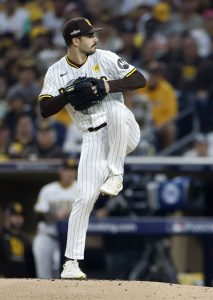
A Cease trade at this juncture would in many ways run parallel to last offseason’s trade of Juan Soto, whom the Padres shipped out for immediate MLB help (King, Kyle Higashioka) and slate of MLB-ready (or close to it) arms: Randy Vasquez, Jhony Brito and top prospect Drew Thorpe. The Padres moved Thorpe before the season even began, using him as the headline prospect to acquire Cease in the first place. Now, they could conceivably trade Cease for a lower-ceiling/less-established rotation arm and some additional pitching depth and/or a young outfielder.
Exact parallels for a Cease swap are hard to come by, though Anthony Franco recently took a look at some general frameworks that the Padres could seek in a piece for Trade Rumors Front Office subscribers. Corbin Burnes, who went from the Brewers to the Orioles in exchange for MLB-ready help in the infield (Joey Ortiz) and on the pitching staff (DL Hall) — plus a competitive balance draft pick — is the clearest comparable in recent memory. Burnes was more consistent but also a bit more expensive ($15.637MM to Cease’s $13.75MM).
It’s feasible to think the Padres could command a big league-ready arm and outfielder to fill two holes on their roster while simultaneously freeing up some cash to backfill some of the innings lost in a Cease trade. Any deal shipping him out will bring back a lesser arm(s), and whatever savings the Padres secure could be used to further address the back of the rotation. San Diego probably isn’t going to give up the picks necessary to sign Nick Pivetta, but the free-agent market still has Andrew Heaney, Kyle Gibson, Cal Quantrill, Spencer Turnbull, Ross Stripling and Alex Wood, among others.
Alternatively, any money saved via trading Cease could be put toward taking on a chunk of a pricey starter’s contract. Marcus Stroman, Jordan Montgomery and Steven Matz are all buy-low candidates but all could probably be had with the current team picking up some of the bill.
Let’s take a look at some of the best fits for Cease based on a variety of factors including team need, payroll availability, luxury tax status and what type of young/inexpensive pitching and outfield help said theoretical trade partners could offer…
Orioles: The Orioles have made several additions to the rotation this winter, but they’re generally lacking ceiling. Charlie Morton and Tomoyuki Sugano would’ve been a higher-end pair to sign back in 2019 than in 2025. They could both still provide some average or even slightly better-than-average innings in bulk, but it’d be a surprise if either looked like a clear playoff-caliber starter at season’s end. Baltimore’s current rotation includes that pair, Zach Eflin, Grayson Rodriguez and Dean Kremer. It’s a solid enough quintet on paper, and they could get late-season help from Kyle Bradish and/or Tyler Wells as that pair mends from a UCL surgeries performed last June.
Baltimore hasn’t replaced Burnes, who signed a six-year deal in Arizona, with an arm of comparable quality. Cease would be just that. Between Kremer, Cade Povich, Trevor Rogers and Chayce McDermott, the O’s have a collection of inexpensive arms who could step into the back half of San Diego’s rotation. The prize for the Padres in a trade with Baltimore would probably be the bat acquired. The Orioles aren’t giving up Coby Mayo or Jackson Holliday for one year of a starter, but Heston Kjerstad once again looks like he’s a man without a clear path to playing time. The O’s could’ve penciled him in to replace Anthony Santander, but they instead signed Tyler O’Neill. Kjerstad turns 26 this month, has nearly a year of MLB service and hasn’t been given a full-time look. The O’s have touted outfielders like Enrique Bradfield Jr. and Dylan Beavers on the rise behind him, plus Colton Cowser already in the majors.
Red Sox: Boston hasn’t made the big free-agent splash that many expected, but it’s hard to say that any team that acquired Garrett Crochet hasn’t invested in bolstering the rotation. Crochet joins Tanner Houck, Brayan Bello, Kutter Crawford, free agent signee Walker Buehler and (eventually) a returning Lucas Giolito in a deep and talented Red Sox rotation mix. You could argue the Sox don’t need to further augment the group, but Buehler is a rebound candidate and Giolito could be on some kind of set workload. Even if that’s not the case, a September (and hopefully for Craig Breslow & Co., October) rotation scene including Crochet, Cease, Giolito, Houck and Buehler could be overpowering.
Crawford wilted considerably down the stretch, but he has four years of control remaining and is earning just $2.75MM this season. Depth arms like Quinn Priester, Richard Fitts and Cooper Criswell could all hold appeal to the Padres as well. None of that group has reached arbitration. Criswell is controlled for five more years. Priester and Fitts can be controlled for six. The Sox aren’t giving up Jarren Duran or Ceddanne Rafaela for a year of Cease, but would they consider selling high on Wilyer Abreu? They could turn to an outfield stopgap like Randal Grichuk or Mark Canha to give them a right-handed bat while leaving the door open for uber prospect Roman Anthony to seize a regular job sooner than later.
Twins: The Twins’ interest in Cease is a head-scratcher at first glance, if only because Minnesota is in a similar payroll crunch to the Padres. However, as the offseason has gone on, it’s been reported that Minnesota might not actually need to cut payroll and might even have a couple million to spend. The Twins could shed some money in other trades, perhaps shipping out Chris Paddack ($7.5MM), some of Christian Vazquez‘s contract (one year, $10MM remaining) and/or utilityman Willi Castro ($6.4MM). A trade with the Padres could also send a bit of money to San Diego, depending on which pitcher(s) and/or outfielders are included.
The Twins have Pablo Lopez, Joe Ryan, Bailey Ober, Simeon Woods Richardson and Paddack in the rotation at present, with top prospects David Festa and Zebby Matthews already having made their major league debuts. Other arms like Andrew Morris and Travis Adams aren’t terribly far from getting a look. The Athletic’s Dan Hayes recently suggested that the Padres would probably want Ryan or Ober to headline a deal. Ryan seems like a bridge too far for the Twins. Ober is earning $3.35MM this season and has three years of club control remaining. Any of Woods Richardson, Festa and/or Matthews is pre-arbitration. The Twins have young outfielders like Trevor Larnach and Matt Wallner to pitch. Larnach is making $2.1MM. Trading one of Larnach or Wallner could open a clearer path for top prospects Emmanuel Rodriguez or Luke Keaschall to step into the big leagues. Keaschall has played more infield, but the Twins’ infield is already quite crowded, so his eventual home could be in the outfield or in a multi-position role.
Braves: With Spencer Strider on the mend from UCL surgery and expected back sometime in May, the Braves don’t necessarily have a glaring rotation need. Chris Sale, Reynaldo Lopez, Strider and Spencer Schwellenbach will create a formidable top four — health permitting. Righties Ian Anderson, Grant Holmes, Bryce Elder, AJ Smith-Shawver and Hurston Waldrep are in the mix for starts while Strider is out and give Atlanta ample depth for the fifth spot in the rotation should each of the top four be healthy early in the summer. Drue Hackenberg, a 2023 second-rounder, climbed three minor league levels and posted sharp results across the board in 2024, providing even more depth.
That glut of arms for what ostensibly appears to be one final rotation spot gives Atlanta plenty of options on the trade market. If the Padres want to acquire multiple lower-end but MLB-ready arms in exchange for Cease, the Braves are a potentially prime trade partner. President of baseball operations Alex Anthopoulos has implied that any rotation addition would need to be a clear upgrade over Anderson and Holmes, who are out of minor league options and thus virtual locks to make the roster. Cease checks that box emphatically. And with Jurickson Profar now in the outfield, Atlanta could at least consider the possibility of including Jarred Kelenic in a deal as well. Kelenic’s value is way down after a middling 2024 season, but he has four seasons of club control remaining and — once Ronald Acuña Jr. is healthy — minimal path to everyday at-bats on a roster with Profar, Acuña and Michael Harris II.
Cubs: As with the Braves, the Cubs have a deep collection of arms competing for what looks to be one rotation spot. Justin Steele, Shota Imanaga, Jameson Taillon and Matthew Boyd are all rotation locks. Candidates for the fifth spot include Javier Assad, Jordan Wicks and Ben Brown — with top prospect Cade Horton on the rise as well. Assad is probably the favorite thanks to a 3.40 ERA through his first 294 big league frames, but below-average command and a subpar strikeout rate lead to less-appealing marks from alternative metrics like FIP (4.49) and SIERA (4.66). The Cubs also signed veteran Colin Rea on a one-year deal, giving them a seasoned No. 5 option or swingman in the bullpen.
On top of the plethora of young arms, the Cubs have two top-100 outfield prospects in Owen Caissie (an original Padres draftee who went to the Cubs in the Yu Darvish trade) and Kevin Alcantara. Both are essentially MLB-ready. Alcantara has already debuted. Chicago has Ian Happ, Pete Crow-Armstrong and Kyle Tucker in the outfield with Seiya Suzuki at designated hitter. There’s no path to 2025 playing time for Caissie or Alcantara if the current outfield is healthy. Plus, Happ and Suzuki are signed through 2026 while Crow-Armstrong is controlled all the way through 2030. Dealing from their stock of outfield talent to further cement themselves as the NL Central favorite and add a clear playoff starter makes good sense. The Cubs already made a big one-year bet on Tucker. That ought to embolden them to further push all-in on 2025. At the very least, they could expect 2026 draft compensation for Tucker and Cease, lessening the sting of some of the prospects they surrender.
Mets: President of baseball operations David Stearns doesn’t seem to want to commit long-term to starting pitchers, making Cease a natural target. He’d immediately ascend to the top of the rotation in Queens, giving the Mets the clear Game 1 type of starter they presently lack. Cease, Kodai Senga and Sean Manaea would make a nice top three, with Frankie Montas, Clay Holmes, David Peterson and Paul Blackburn as options to round out the staff … unless, of course, Peterson is one of the names headed back to the Padres in a theoretical trade package. Like Cease and Michael King last year, he has two seasons of club control remaining. He’d give the Friars an experienced arm to take up some of Cease’s innings, and the Mets have plenty of additional names to offer on top of that.
Tylor Megill doesn’t look to have a clear spot on the roster, barring injuries. He looks like more of a depth piece but could add some innings to the San Diego rotation. Top pitching prospect Brandon Sproat is the type of near-MLB arm who could serve as a headliner. The Mets also have appealing young hitters like Brett Baty, Ronny Mauricio and Luisangel Acuña. All three are infielders, but they’ve all at least tinkered in the outfield as well. All three have the athleticism to handle left field. Mauricio is recovering from an ACL tear and might not be ready for Opening Day, while Acuña struggled in the minors last year and could need more seasoning. Regardless, they could be early-season options, while someone like Baty might be an option to step right into left field if the Padres feel a spring training of work there could ready him for a full-time look in the majors.
—
There are, of course, other clubs that have rotation needs and would surely inquire. The Angels seem like an obvious fit but don’t necessarily have the collection of young arms and/or outfielders that the above teams possess. Jo Adell already has three years of MLB service and has yet to establish himself. Taylor Ward is only controlled through 2026 and is making nearly $8MM. The Angels need controllable young arms just as badly as the Padres.
The Blue Jays make some sense, as a team aggressively pursuing 2025 upgrades, but they’ve made those upgrades without sacrificing much in the way of prospects — perhaps in a nod to a potential Plan B if this year’s run at contention doesn’t pan out.
The Rangers, Brewers and Guardians could all make varying degrees of sense, but all three are running up against payroll issues at this point. Texas could try to send Jon Gray and/or Leody Taveras back to San Diego, but they’d need to include significant prospects to offset that pair’s lack of long-term value. The Brewers haven’t signed a free agent to a fully guaranteed deal and seemingly have no money to spend. The Guards haven’t rented a veteran starter like this at any point in recent memory and may be tapped out after re-signing Shane Bieber, Austin Hedges and Carlos Santana and signing Paul Sewald. Perhaps the Tigers could try to package some younger arms (e.g. Casey Mize, Matt Manning, Keider Montero, Ty Madden) and a young hitter like Justyn-Henry Malloy, but their recent addition of Jack Flaherty seems like their final move in the rotation.
Broadly, it’s pretty easy to make a case for Cease on quite a few teams. He’s a Cy Young-caliber arm at his best and is being paid less than the collection of aging veteran arms who signed one-year deals worth $15-16MM this winter (Justin Verlander, Max Scherzer, Charlie Morton, Alex Cobb). The best fits, at least from our vantage point, appear to reside in Baltimore, Boston, Atlanta, Minneapolis, Chicago (Cubs) and New York (Mets), however.