
Johnny Cueto Elects Free Agency
Right-hander Johnny Cueto elected free agency after being designated for assignment by the Angels, per transaction log at MLB.com. That indicates he first went unclaimed on waivers and then rejected an outright assignment to the minors.
Cueto signed a minor league deal with the Angels in late July and was selected to the big league roster a month later. He tossed a quality start against the Royals in his first outing as an Angel before being tagged for six runs in five innings versus Detroit in his second start. Cueto pitched a total of 11 1/3 innings for the Halos, gave up nine runs (four homers) and posted a 6-to-3 K/BB ratio. That performance came on the heels of a nice run with Triple-A Salt Lake, where he posted a 3.09 ERA and 15-to-5 K/BB ratio in four starts — a total of 23 1/3 innings. This year’s 91 mph average fastball was down from last season but not a career-low mark and not all that different from the 91.3 mph he averaged from 2018-22.
Other clubs around the league can now mull a pickup of Cueto down the stretch if they’re looking for some veteran rotation depth. He won’t be eligible for any team’s playoff roster if he signs at this point, however. It’s possible Cueto simply waits until the offseason to sign another contract — assuming he’s intent on continuing his pitching career into his age-39 season.
The 2023-24 seasons have been tough for the former All-Star. Cueto has been tagged for 6.22 ERA in 63 2/3 innings across the past two seasons, spending time with both the Marlins and Angels (in addition to a minor league run with the Rangers earlier this year). His ’23 campaign was impacted by a biceps injury that limited him to 11 starts.
As recently as 2022, Cueto was a quality big league hurler, making 24 starts for the White Sox and recording a 3.35 earned run average in 158 1/3 innings with a 15.7% strikeout rate and 5.1% walk rate. And, of course, Cueto was one of the game’s steadiest and most-productive pitchers in his peak. From 2010-16 the right-hander piled up 1294 2/3 innings of 2.86 ERA ball, striking out 20.6% of his opponents against a 6.2% walk rate. He had three top-six Cy Young finishes, two All-Star nods and won a World Series ring with the 2015 Royals along the way. In 2256 1/3 career innings, Cueto sports a 3.52 ERA and 144-113 record.
Paul Goldschmidt Plans To Continue Playing In 2025
Cardinals first baseman Paul Goldschmidt is having the least-productive season of his storied big league career, but the soon-to-be 37-year-old made clear to MLB.com’s John Denton that he has every intention of continuing his career in 2025. The seven-time All-Star was named the National League MVP as recently as 2022, but he’s seen a notable drop-off in virtually every offensive category in 2024 — to the point where he for the first time in his career has been a below-average hitter (99 wRC+, 96 OPS+).
On the season, Goldschmidt carries just a .244/.302/.410 batting line. He’s still popped 20 home runs, but his 27.2% strikeout rate and 7.3% walk rates are the worst of his career. To his credit, Goldschmidt has righted the ship of late; over his past 150 plate appearances, he’s slashing a much-improved .295/.342/.532 (141 wRC+). He’s still not walking anywhere near his career 12.7% rate (6.3% during this hot streak), but he’s cut his strikeout rate (23.3%) to be closer to his career levels.
Goldschmidt made no excuses regarding his struggles this year, noting that even spite of solid batted-ball and running metrics via Statcast, “there’s no denying I haven’t played well.” The five-time Silver Slugger winner acknowledged that his struggles have “created some bad habits” with his swing that have been hard to break. Fans of both the Cardinals and Goldschmidt will want to check out the interview in full, as Goldschmidt offers candid reviews of a down season at the plate. Denton also spoke with manager Oli Marmol who said he “loves” Goldschmidt when asked about a potential reunion for the upcoming 2025 season.
Obviously, that won’t be Marmol’s call at the end of the day. President of baseball operations John Mozeliak originally acquired Goldschmidt from the D-backs (in exchange for Carson Kelly, Luke Weaver, Andrew Young and a 2019 competitive balance draft pick the D-backs used to select Dominic Fletcher, whom they traded to acquire righty Cristian Mena this past offseason). The Cardinals quickly extended Goldschmidt on a five-year, $130MM contract, and he’s playing out the final season of what’s proven to be a good deal for the club at the moment.
The Cardinals reportedly have some interest in bringing Goldschmidt back, but there are in-house options to consider as well. Twenty-five-year-old Alec Burleson opened the season with two months of roughly average offense at the plate before catching fire in the summer. He’s now hitting .280/.320/.453 on the season overall. Burleson has primarily served as a corner outfielder and designated hitter in 2024, but he’s not a strong defender in the outfield. A move to first base could be of benefit, particularly if the Cardinals envision another shaky defender, Jordan Walker, as the team’s right fielder in future seasons.
There’s also 27-year-old Luken Baker to consider. While he’s older than the standard “prospect,” Baker bashed 33 home runs in just 84 Triple-A games in 2023 and has swatted another 32 big flies in 108 Triple-A games this season. He’s yet to hit in his tiny sample of 126 big league plate appearances (.202/.325/.356, 30.2% strikeout rate), but Baker’s Triple-A track record of hitting for power is intriguing. At the very least, his right-handed bat could pair with the lefty-swinging Burleson to form a platoon, with both players also seeing some time at designated hitter. Baker has decimated lefties this season, posting a 1.142 OPS and homering in 15 of his 150 plate appearances against them.
A Goldschmidt reunion would limit the playing time for both Burleson and Baker. It’d be understandable if the Cards’ front office wanted to take whatever resources would be put toward a Goldschmidt deal and reallocate them to pitching help. At the same time, if the Cards believe the late surge from Goldschmidt is a portent for a rebound in 2025, then re-signing him on a short-term deal has obvious appeal.
From a payroll vantage point, there’s a compelling case to use the resources elsewhere. The Cardinals’ payroll has landed within a couple million dollars of $180MM in each of the past two seasons ($183MM in 2024), and per RosterResource, they have about $111MM on next year’s books already. That doesn’t include decisions on the matching $12MM options on Kyle Gibson and Lance Lynn, nor does it include arbitration raises for Ryan Helsley, JoJo Romero, John King, Lars Nootbaar, Brendan Donovan, Andre Pallante and Nolan Gorman.
Even at a presumably reduced rate from his current $26MM annual salary, Goldschmidt would likely still push the Cardinals north of $150MM (assuming arb raises for the entire class and just one of those two rotation options being picked up) before addressing any other potential offensive upgrades or starting pitching additions. That money could arguably be better spent focusing on other areas and turning first base over to a combination of Burleson and Baker — or perhaps simply a lower-cost free agent option (e.g. Carlos Santana).
Goldschmidt’s future is one of several key decisions for the Cardinals as they look to put disappointing 2023-24 seasons behind them. Last year’s club went 71-91, finishing last place in the NL Central. At 69-69, they’ll finish better than that in 2024, but they’re 5.5 games out of the final Wild Card spot with only 24 games to play, making a postseason berth overwhelmingly unlikely this season as well. That would be their first consecutive postseason misses since a three-year absence from playoff play in 2016-18 and mark just the third time since the turn of the century that St. Louis has missed the playoffs in back-to-back seasons.
Giants Outright Andrew Knapp
TODAY: Knapp clears waivers and was outrighted to Triple-A, according to Alex Pavlovic of NBC Sports Bay Area (X link).
AUGUST 29: The Giants announced Thursday that they’ve reinstated catcher Patrick Bailey from the 10-day injured list and designated fellow backstop Andrew Knapp for assignment to open roster space.
Knapp signed a big league deal with the Giants just last week, although it seemed clear at the time he’d only be relied upon while Bailey mended from an oblique strain that had sent him to the injured list. The 32-year-old Knapp went 1-for-6 in what was his second stint with the Giants, for whom he also played back in 2022.
With this brief Giants stint, Knapp has now played in parts of seven major league seasons, spending time with the Phillies, Mariners and Pirates in addition to his time in San Francisco. He’s a career .209/.309/.312 hitter in 879 plate appearances as a major leaguer. Knapp spent the bulk of the current season with the Rangers’ Triple-A club, hitting .294/.383/.457 in 81 games and 345 plate appearances. He’s a lifetime .259/.351/.415 hitter in parts of six Triple-A seasons.
Now that he’s been designated for assignment, Knapp will head to waivers and be made available to the other 29 clubs. He’ll likely clear, giving him the right to become a free agent, but a club in need of some catching depth down the stretch could look to bring him aboard on a minor league deal if and when that happens.
2024-25 Free Agent Power Rankings: Late August
Since Opening Day, MLBTR has taken periodic looks at the upcoming free agent class. This is our third (and likely final) installment of our in-season power rankings. Players still have a month and potential postseason play to move things around, yet the class is coming into focus.
There’s no suspense at the top of the list. The 1-2 have remained unchanged from start to finish (although the gap between 2 and 3 has closed in the past few weeks). This is our attempt to capture a player’s earning power, so age is big factor. This is not strictly a list of the best players in the class, though talent is obviously the starting point.
Our power rankings are compiled collaboratively. We worked with Darragh McDonald — with input from MLBTR founder and owner Tim Dierkes — for this installment. Players with opt-out clauses and player options are eligible for the list. Stats are through play on August 29.
- Juan Soto, OF, Yankees
Soto has been the clear top free agent in the class for years. He has been on track for a record-setting deal (in terms of total guarantee, AAV or both) for a while. To top it off, Soto is amidst arguably his best season during his platform year. He has already established a new career mark in home runs. He’s going to hit 40 for the first time and could top 45 by year’s end. Soto is hitting .291/.421/.590 on the season. This will be his fifth consecutive season with more walks than strikeouts.
Approaching his 26th birthday, Soto is ostensibly at the beginning of his prime. There’s not much room for him to get better, but a signing team could realistically expect another seven to 10 years of elite offensive production. Soto’s league-best strike zone awareness should age gracefully. It’s essentially unheard of for teams to be able to sign a player who is on an inner circle Hall of Fame trajectory with another four full seasons before he turns 30. Every high-payroll organization should be involved.
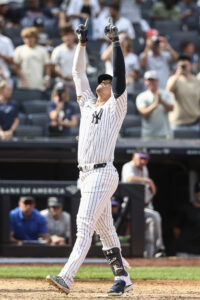
While Soto generally doesn’t provide a ton of defensive value, he’s having a decent season in that regard. He has a career-high five defensive runs saved in nearly 1100 innings. Statcast has him right around average. Soto could move to designated hitter in the latter half of a deal that exceeds a decade but shouldn’t have any issue sticking in right field for the foreseeable future.
Soto turned down a reported $440MM extension offer from the Nationals a few years ago. His camp subsequently rebuffed overtures from the Padres and Soto shut down any chatter about a potential midseason deal with the Yankees in June. He’ll be three years younger than Shohei Ohtani was during his free agency. Soto isn’t likely to accept a deal with the kind of deferrals that Ohtani took, but he should handily beat the approximate $461MM net present value of the Ohtani contract. He should top half a billion dollars and it wouldn’t be surprising if his camp at the Boras Corporation were aiming for something close to or north of $600MM and/or multiple opt-out chances.
2. Corbin Burnes, SP, Orioles
Burnes has been the #1 pitcher in the class throughout the summer. He has finished in the top 10 in Cy Young balloting in four straight years, highlighted by his ERA-leading 2021 season in Milwaukee. Burnes is having a good year, working to a 3.23 earned run average across 164 1/3 innings. His production has slipped coming out of the All-Star Break though. He carried a 2.43 ERA into the Break but is allowing more than five earned runs per nine in 45 2/3 innings in the second half.
The recent results are the continuation of a slightly alarming trend. Burnes was among the game’s top two or three strikeout artists a couple seasons ago. That has gone in the wrong direction over the last two years. After fanning north of 30% of opponents in each season from 2020-22, his strikeout rate dipped to 25.5% last year. It is down three more percentage points during his first (and potentially only) season in Baltimore. Burnes had a 23.3% strikeout rate before the Break and is fanning a slightly below-average 20% of batters faced within the past six weeks.
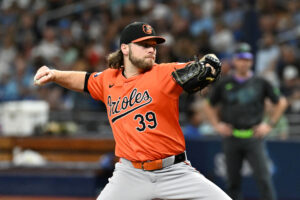
There hasn’t been an obvious corresponding downturn in his stuff. Burnes is averaging a personal-high 95.5 MPH on the cutter that serves as his primary pitch. The speed on his breaking pitches is in line with his career marks. Yet as his velocity has picked up throughout the season, the whiffs have dropped. Opponents have jumped all over his cutter and curveball in uncharacteristic fashion this month.
None of this means Burnes is no longer a good pitcher. He’s in the top 30 among pitchers (minimum 100 innings) in both ERA and swinging strike rate. Burnes is averaging over six innings per start. He hasn’t had a non-illness related stint on the injured list in four years. There’s some amount of concern with every pitcher in the class and Burnes provides the best combination of durability track record and ace upside. Still, teams will need to determine how concerned they are about his two-year dip in swinging strikes when considering whether to meet an asking price that’ll very likely remain north of $200MM.
3. Alex Bregman, 3B, Astros
Early this season, Bregman looked headed for a lost year. The former No. 2 overall pick was hitting .201/.270/.264 as deep into the season as May 12 — a span of 160 plate appearances. At that point, it was fair to wonder whether he’d be able to turn his season around.
Bregman has done that in spades. Over his past 388 plate appearances, he’s hitting .284/.335/.518 with 20 homers, 20 doubles, two triples and his typical above-average glovework at the hot corner. His overall season batting line is still skewed by that ugly start, but for the past 87 games, Bregman’s 3.6 wins above replacement (per FanGraphs) rank 15th in all of baseball.
It’s worth emphasizing that even throughout this turnaround, however, Bregman isn’t quite the same superstar-level hitter he once was. He’s been 42% better than average during this run, by measure of wRC+. That’s still great, but it’s a ways shy of the elite levels of offensive output he delivered in 2018-19, when he finished fifth and second in AL MVP voting, respectively. Bregman’s once outstanding plate discipline has faded this season as well. After walking in 13.8% of his plate appearances from 2018-23, he’s down to 6.8% in 2024. It’s the first time he’s had a below-average walk rate since his 49-game rookie season back in 2016.

Some teams might be turned off by Bregman’s batted-ball data as well — an issue that harmed Cody Bellinger’s free agency last offseason. Though Bregman has long been a plus hitter, he’s never made loads of hard contact. He’s sitting on an 89.4 mph average exit velocity and 41.4% hard-hit rate this year. Both marks are only a bit higher than the league average, but they’re higher than Bregman’s career 88.8 mph and 37.8% marks in those respective categories.
Some might think Bregman to be a product of Minute Maid Park’s friendly dimensions. The short left field porch, the Crawford Boxes, sits only 315 feet down the line. That’s surely benefited Bregman throughout his career and perhaps even informed his swing mechanics and approach at the plate. However, Bregman also flat-out hits wherever he is. The difference between his rate stats at home (.271/.371/.475) and on the road (.275/.363/.489) are negligible. If anything, he’s hit for slightly more power on the road than at home.
Even setting aside his ’18-’19 peak, Bregman has been a consistently standout player in the five seasons since. He’s batted .261/.352/.443 during that time, shown elite contact skills (12.6% strikeout rate) and played above-average defense at an important position. Bregman never settled in as a perennial MVP candidate, but he’s averaged 25 homers and better than four wins above replacement (4.4 bWAR, 4.8 fWAR) per 162 games since 2020. Teams are going to covet his hard-nosed personality as well; one general manager who’d like to sign Bregman told ESPN’s Jeff Passan that he would “completely change our clubhouse for the better.”
The MLBTR team is perhaps more divided on Bregman’s earning power than any other player on this list, but we generally agree there’s a clear nine-figure deal to be had here. Heading into his age-31 season significantly limits him, however. The question is whether the market views him with some trepidation and tries to stick in the low $100MMs or whether interest is bullish enough to push Bregman close to the $200MM range — despite minimal precedent for such a contract at his age. How he finishes the season will be a key factor.
4. Willy Adames, SS, Brewers
Adames has rebounded from his worst offensive showing in Milwaukee. He slumped to a .217 average with a .310 on-base mark a year ago, but he’s up to a .252/.337/.451 slash over 572 plate appearances this season. Adames has already matched last year’s total of 24 homers and has a shot to get to 30 longballs for the second time in his career. That’s not easy to find at the infield’s toughest positions. Among primary shortstops, only Corey Seager and Francisco Lindor have more homers than Adames’ 79 over the past three seasons.
He pairs that above-average power with a patient approach. Adames has walked in more than 11% of his plate appearances in consecutive seasons. He doesn’t have great pure contact skills and his strikeout rate has spiked over the past couple months. While the whiffs keep Adames a tier below the game’s elite infielders, he’s an above-average regular who routinely draws praise from teammates and coaches for his leadership and clubhouse presence.
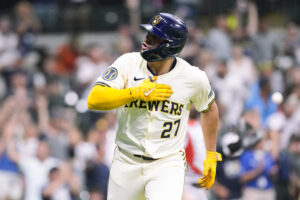
Traditionally, Adames’ glove is one of his calling cards. He has been a plus defender for the bulk of his career. This year’s defensive performance has been erratic. Statcast has graded him as an average defender, while Defensive Runs Saved has been very down on his work (12 runs below average). It’ll be his first season with a subpar DRS since his 2018 rookie year.
Adames has committed 17 errors this year, fourth-most among shortstops. Statcast still credits him with plus range and arm strength. He’s not showing signs of physical decline. The walk year isn’t an ideal time for Adames’ defensive performance to crater, but this season’s poor numbers seem like more of an aberrant spike in errors than an indication that he’s losing athleticism that’ll force him off the position.
As he approaches his 29th birthday, Adames has pulled away from Ha-Seong Kim as the top shortstop in the class. He’s far better than anyone who was available in last winter’s group of shortstops. Adames should beat nine figures and has an argument for a six- or seven-year deal that puts him in the $150MM+ range. Javier Baez, Trevor Story and Dansby Swanson all leveraged this general profile into strong contracts. None of those deals have worked out well, so perhaps teams will round down on Adames, but the market has thus far placed a lot of value in shortstops with power.
5. Blake Snell, SP, Giants *
Two months ago, Snell had fallen off this list. How things have changed. The two-time Cy Young winner is back. As MLBTR’s Steve Adams explored at greater length in a piece for MLBTR Front Office subscribers, Snell has been the best pitcher in baseball for two months. Since the start of July, he carries a 1.30 ERA with an MLB-best 37.1% strikeout rate through 55 2/3 innings. His 18% swinging strike rate over that stretch easily leads all pitchers with 40+ innings. He has reached 10 strikeouts in four of his last six starts. He followed up a career-high 15 punchouts against the Rockies on July 27 with an 11-strikeout no-hitter of the Reds in his first appearance of August.
Snell’s disastrous start to the year feels like a distant memory. He signed late and allowed more than a run per inning through his first 23 2/3 frames. He had two stints on the injured list related to left groin issues. Snell’s sheer dominance since returning from his second IL stay makes it seem like he simply wasn’t healthy for the first couple months.

While Snell has been famously streaky throughout his career, few pitchers can match his highs. Over the last three seasons, he owns a 2.93 earned run average with a 32% strikeout rate over 387 innings. Even Burnes probably doesn’t have Snell’s ceiling at this point, though the left-hander has not been as consistent as the Baltimore ace.
Unless he suffers an injury in the next few weeks, Snell is a virtual lock to decline his $30MM player option for next season. He’ll return to free agency at age 32 and likely take another swing at the kind of deal that alluded him a year ago. Snell recently refuted (X link via Foul Territory) a report that the Yankees had offered him a six-year, $150MM deal last winter. It’s not clear what kind of money was on the table, but it wasn’t sufficient for Snell and his camp at the Boras Corporation to consider it preferable to the two-year guarantee that he ultimately signed with the Giants. He’ll try again without being tied to draft compensation and could take aim at a deal in the $150-200MM range.
6. Matt Chapman, 3B, Giants *
As with Snell, Chapman signed with the Giants late in the winter upon not finding a long-term deal to his liking. He started the year slowly, running a .266 on-base percentage through the season’s first month. Chapman has been fantastic since then, slashing .251/.349/.458 since the start of May. He’s up to a .244/.331/.440 mark with 21 homers across 562 plate appearances — offense that checks in 17 percentage points above league average, as measured by wRC+.
That’s par for the course for Chapman. While he’s been prone to significant swings in performance within seasons, his results at the end of the year tend to be consistent. He’ll hit around 25 homers with enough walks to offset a higher than average strikeout rate and middling batting average.
Chapman pairs that solid offense with some of the best third base defense in the majors. He’s a four-time Gold Glove winner who still rates as one of the game’s top glovemen. Chapman will play next season at 32, so his athleticism and defensive metrics might drop off within the next few seasons, but he’s one of the better all-around infielders in the majors right now.
The Giants have already opened extension talks with Chapman’s camp at the Boras Corp. He’s a Fullerton product who has a strong relationship with San Francisco manager Bob Melvin. Chapman looks likelier than anyone else on this list to sign an extension before free agency opens as a result. If he makes it to the open market, he could seek a five-year deal that exceeds $100MM.
7. Max Fried, SP, Braves
Fried established himself in the Atlanta rotation by 2019. He has been a consistent top-of-the-rotation presence since then. Over the past five-plus years, the 30-year-old southpaw has a 3.09 ERA over 139 starts. Fried hasn’t been quite as effective in the postseason, but he’s one of the biggest reasons for the Braves’ recent run of success.
The former seventh overall pick doesn’t miss bats at the level of a typical ace. He has a career 23.8% strikeout rate and has fanned 22.8% of batters faced this season. His 10.1% swinging strike rate is a hair below average. Fried excels in contact management. His 58.1% ground-ball rate is fourth among pitchers with 100+ innings. He has a five-year track record of suppressing hard contact. While Fried’s 93-94 MPH fastball isn’t overpowering, his secondary stuff (especially his curveball) is excellent.
The biggest concern with Fried is his recent injury history. A forearm strain cost him three months between May and August last summer. Fried spent a couple weeks on the injured list with ulnar neuritis coming out of the All-Star Break this season. He hasn’t pitched especially well since coming back, allowing a 5.26 ERA (albeit with a strong 27.7% strikeout rate) over his last 25 2/3 innings. It’s possible teams will have some trepidation about his arm health, but Fried has an argument for a deal in the Patrick Corbin ($140MM) or Carlos Rodón ($162MM) range if he finishes strong.
8. Jack Flaherty, SP, Dodgers *
If Fried offers consistency despite pedestrian strikeout totals, Flaherty is a more volatile upside play. The 28-year-old righty has some of the best bat-missing stuff in the majors. He has punched out 31.1% of batters faced behind a 13.6% swinging strike rate over 23 starts. He’s fifth in strikeout rate and 11th in whiffs among pitchers with 100+ innings. Flaherty has paired that with a career-low 4.8% walk rate, firing 135 frames of 3.07 ERA ball.
Excellent as his production has been this season, Flaherty is a year removed from posting a 4.99 earned run average between the Cardinals and Orioles. He has looked like a Game 1 starter at his best and a back-of-the-rotation arm at his worst.
Flaherty battled oblique and shoulder injuries between 2020-22, limiting him to 154 2/3 innings over that stretch. He has not been on the injured list in the last two years, yet that hasn’t silenced questions about his health. The Yankees reportedly pulled out of a preliminary deadline deal with the Tigers after identifying an undisclosed concern in his medical review. The Dodgers apparently didn’t share such concerns, as they sent prospects Thayron Liranzo and Trey Sweeney to Detroit thereafter.
Entering his age-29 season, Flaherty is one of the younger pitchers in the class. He doesn’t have the consistency of a $200MM arm but could land in the lower nine figures on a deal similar to Robbie Ray’s five-year, $115MM contract with Seattle.
9. Pete Alonso, 1B, Mets
The personification of the prototypical slugger, Alonso has been the second most consistent power hitter in the game since his 2019 debut. In that time, only Aaron Judge’s 225 home runs top Alonso’s 220 for the MLB lead. The Polar Bear simply mashes. He’s never hit fewer than 37 homers in a full 162-game season. He’s as durable as they come, never missing more than 10 games in a season since debuting, and the only two players with more plate appearances than Alonso since 2019 are Marcus Semien and Freddie Freeman. Teams know Alonso is likelier than most to be out there every day, and he’s assuredly going to hit for more power than nearly any of his peers.
On the other hand, Alonso will turn 30 in the offseason. He’ll receive and reject a qualifying offer in search of a multi-year deal. His defense at first base is not considered to be strong. Alonso walks at an above-average but not-elite clip. Paired with his low batting averages, that typically limits his on-base percentage to the .330 to .340 range.
None of those are glaring flaws on their own, but bundled together they could make for a concerning profile among today’s front offices. A 30-year-old slugger without defensive value who sports pedestrian OBP marks and is tied to draft pick compensation — that’s not a recipe for a mega-contract. Modern teams have been increasingly wary of paying a first-base-only profile late into their 30s — or even signing such players to truly long-term deals as well.
Freeman (six years, $162MM) and Paul Goldschmidt (five years, $130MM) both inked long-term deals beginning with their age-32 seasons. Alonso is younger but also not considered as complete a hitter as those two were when they signed. It’s easy to imagine Alonso and Scott Boras wanting to top Freeman, but Alonso could have a hard time climbing to such heights.
10. Anthony Santander, OF, Orioles
Santander’s been a quality power hitter for the Orioles for years now, but he picked the right time to take his game to another level. The 29-year-old switch-hitter popped 33 home runs back in 2022 but surpassed that mark weeks ago. He’s currently sitting on a career-high 38 home runs. A 40-homer campaign seems like a lock, and Santander could finish with 45 to 50 homers if he enjoys a hot September.
Even if this is a career year in terms of power output, Santander has proven himself a perennial 30-homer threat. He does damage from both sides of the plate, though he’s a more pure lefty hitter. Santander draws more walks, strikes out less often and is a generally well-rounded hitter from the left side. From the right side, he morphs into more of a three-true-outcomes slugger. It all balances out for steady production that any club would be happy to plug into the middle of its lineup.
As is usually the case, the impressive power profile isn’t without its flaws. Santander is limited to the outfield corners (plus some briefer cameos at first base) and doesn’t grade out as a plus defender anywhere. He’s a passable enough right fielder, showing above-average arm strength to go along with plodding range, but no one’s ever going to claim Santander is an elite defender. He’s a bat-first player who figures to slow down as he enters his 30s. It’s reasonable to think that by the second half of a contract, he’ll be a clearly below-average defender in the outfield.
Even at the plate, Santander is a free-swinger who doesn’t walk like the quintessential slugger. He has a slightly above-average walk rate from the right side of the dish but is below-average from the left side. Overall, he’s walked in just 7.1% of his career plate appearances, including a below-average 8% in 2024. Santander doesn’t strike out much (20.7% career, 19.4% in 2024), but he’s still prone to low OBPs because he broadly lacks patience.
Much of what was said regarding Alonso applies here, too. Santander has more defensive value as a currently playable outfielder but a less consistent track record of 40-homer power. But like Alonso, he’ll reject a qualifying offer and head into free agency as a 30-year-old slugger with OBP questions and middling defensive contributions. While Alonso’s regular display of 40-homer pop makes him feel like a lock to reach five years, Santander could be hard-pressed to find that length. A high-AAV three- or four-year contract will likely be in play as one of the best non-Soto power bats on the market.
* Denotes ineligible for qualifying offer
Honorable Mentions (listed alphabetically): Cody Bellinger *, Gerrit Cole *^, Paul Goldschmidt, Teoscar Hernández, Clay Holmes, Ha-Seong Kim, Sean Manaea, Tyler O’Neill, Nick Pivetta, Jurickson Profar, Max Scherzer *, Luis Severino, Justin Verlander *, Christian Walker
^ Cole has the ability to opt out of the final four years and $144MM remaining on his deal at season’s end. If he triggers the opt-out, the Yankees can void it by exercising a $36MM option covering the 2029 season — bringing their commitment to five years and $180MM. MLBTR explored the Cole situation in detail in a post for Front Office subscribers this week.
Anthony Gose Elects Free Agency
August 30: Cleveland announced Friday that Gose cleared waivers and again elected free agency in lieu of an outright assignment.
August 28: The Guardians announced Wednesday that they’ve designated left-hander Anthony Gose for assignment. It’s rather incredibly the third DFA of the month for Gose, who has twice cleared waivers and returned to the organization (the second time after very briefly electing free agency). His spot on the roster will go to fellow left-hander Erik Sabrowski, whose contract has been selected from Triple-A Columbus. Sabrowski is now in line to make his major league debut the first time he takes the mound for Cleveland.
Gose, 34, pitched two innings in last night’s loss to the Royals, allowing a run four hits with one strikeout. The outfielder-turned-reliever has pitched 3 1/3 big league frames this season and allowed three runs. He’s spent the bulk of the season pitching for Cleveland’s Triple-A affiliate in Columbus, where he’s logged 39 innings with a solid 3.46 ERA, a huge 32.9% strikeout rate and a problematic 15% walk rate.
The 2024 season is Gose’s first year back from a Tommy John procedure that wiped out his entire 2023 campaign. A former second-round pick who ranked as one of the top prospects in the game during his days as a center fielder, he’s still looking to establish himself as a viable big league option in the bullpen. Gose has pitched 31 innings in the majors since making the switch to the mound and recorded a 4.35 ERA with big strikeout numbers (29.5%) and also big walk issues (12.9%).
A two-way star in high school who had some draft interest as a pitcher, Gose was brandishing a fastball that averaged 99.3 mph when he made his mound debut in 2021. He’s since undergone elbow surgery and seen that average heater dip to 95.2 mph — still a well above-average mark (particularly for a lefty), but not the same type of overpowering offering it was a few years back. Gose is still piling up strikeouts in Triple-A, but the command of his fastball/slider combination is a work in progress.
Gose will once again head to the waiver wire now that he’s been designated for assignment. He has the right to reject an outright in favor of free agency, but at this point of the season there’s a good chance he’d just re-sign with Cleveland and head back to Columbus anyhow, as he did following his previous DFA.
As for Sabrowski, this is his first call to the big leagues. The 6’4″, 230-pound southpaw was a 14th-round pick by the Padres in 2018 who came to the Guardians organization by way of the Rule 5 Draft’s minor league phase in 2021. Although he’s a 2018 draftee, he’s only pitched in parts of three professional seasons, thanks to the canceled 2020 minor league campaign and a pair of Tommy John surgeries that both cost him at least a full season. He has just 99 1/3 professional innings under his belt at this point.
Even with that minimal workload, Sabrowski has been impressive with the Guardians since returning from his most recent elbow surgery. Like Gose, he’s posted huge strikeout numbers but also bloated walk rates. His 2023 season saw Sabrowski log 21 2/3 frames with a 2.49 ERA in Double-A. He punched out 30.4% of his opponents but also walked 19.6% of the batters he faced.
Sabrowski opened the 2024 season back at Double-A and notched a pristine 0.77 ERA in 11 2/3 innings there, fanning a comical 54.2% of his opponents against a vastly improved 4.2% walk rate. Since being promoted to Triple-A, he’s logged a 4.38 ERA in 37 innings while recording a 31.2% strikeout rate against a once-again troublesome 17.6% walk rate. He’ll need to improve that command in order to find sustained success in the majors, but there’s little doubting Sabrowski’s ability to miss bats in droves. For now, he gives Cleveland skipper Stephen Vogt a fresh arm as the Guards look to fend off a surging Royals club in the AL Central, with the Twins only 2.5 games behind as well.
Second-Half Snell Is Doing It Again
Over the course of any given calendar year, Major League Baseball is full of oddities. The Dodgers gave the largest pitching contract ever to a starting pitcher who'd never pitched in the majors. The Marlins waved the white flag on their season after about five weeks. Rich Hill signed his eighth career free agent deal with the Red Sox. Heck, Danny Jansen played in the same game for two different teams. All that said, Blake Snell has had one of the strangest calendar years of any player in the game.

Unlock Subscriber-Exclusive Articles Like This One With a Trade Rumors Front Office Subscription
- Access weekly subscriber-only articles by Tim Dierkes, Steve Adams, and Anthony Franco.
- Join exclusive weekly live chats with Anthony.
- Remove ads and support our writers.
- Access GM-caliber tools like our MLB Contract Tracker
Tigers Designate Joey Wentz For Assignment
2:55pm: The Tigers made these moves official and also announced that right-hander Alex Faedo was transferred to the 60-day IL. He landed on the 15-day IL on August 22 due to a right shoulder strain and the club announced that his season is over, per Cody Stavenhagen of The Athletic on X. Detroit’s 40-man roster count drops to 39.
2:03pm: The Tigers have designated left-hander Joey Wentz for assignment, reports Evan Petzold of the Detroit Free Press. He’ll be the corresponding roster move for right-hander Casey Mize, who is being reinstated from the 60-day injured list.
Wentz, 26, was the No. 40 overall pick by the Braves back in 2016. The southpaw quickly became one of the more prominent pitching prospects in what was then a stacked Braves farm system and made his way to the Tigers alongside outfielder Travis Demeritte in the trade that sent righty Shane Greene to Atlanta. Wentz made his big league debut with the 2022 Tigers and has pitched for Detroit in each of the past three seasons.
That 2022 cup of coffee proved to be a solid debut effort. Wentz started seven games, totaled 32 2/3 innings and posted a 3.03 earned run average along the way. His 20% strikeout rate and 9.6% walk rate didn’t necessarily stand out, but for a 24-year-old making his debut after just 12 appearances at the Triple-A level, it was an encouraging start all the same.
Unfortunately, that’s the most success Wentz has enjoyed in the majors to date. He appeared in 25 games with the 2023 Tigers — 19 of them starts — and was rocked for a 6.90 ERA with nearly identical strikeout and walk rates to that ’22 debut. Wentz became extremely homer-prone, however, surrendering an average of 2.13 round-trippers per nine innings pitched — the third-worst mark of any pitcher who totaled at least 100 innings last year.
Wentz’s 2024 season has been somewhat better but not enough to save his roster spot. In 55 1/3 innings, he’s pitched to a 5.37 ERA with a career-high 23.6% strikeout rate but also a career-worst 10.6% walk rate. He’s out of minor league options, so the Tigers couldn’t simply send him to Triple-A if they wanted to free up his roster spot. The DFA became a necessity in that regard, and Wentz will now be made available to all 29 other clubs via waivers.
If another club claims him, he’ll need to go right onto the big league roster, as he can’t be sent to the minors without clearing waivers. If he goes unclaimed, he lacks the service time and prior outright needed to reject a minor league assignment. As such, he’d stick with the Tigers as a depth option in Triple-A Toledo without occupying a 40-man roster spot.
Rangers Place Robbie Grossman, Travis Jankowski On Outright Waivers
The Rangers have placed outfielders Robbie Grossman and Travis Jankowski on outright waivers, reports ESPN’s Kiley McDaniel. Both are free agents at season’s end. Grossman and Jankowski can continue to play for Texas while on waivers, as neither was designated for assignment prior to his placement. However, outright waivers are irrevocable, so if either player is claimed when the 48-hour waiver period expires on Saturday, he’ll head straight to his new club with that team taking on the remainder of his contract.
In Grossman’s case, that’s the final 30 days of his prorated $1.5MM base salary — about $242K overall. For Jankowski, who’s on a $1.7MM base, the price would jump to about $274K. Either player would be postseason-eligible for a new team if claimed. If either goes unclaimed, he can remain with the Rangers and does not need to be removed from the 40-man roster. Waiver priority is determined based on the reverse order of MLB-wide standings and — unlike the now-defunct August trade waiver system — is not league-specific.
Grossman, 34, started the season with the White Sox but was traded to Texas just a few weeks into the year. He’s slashed a combined .225/.333/.318 between the two teams — production that’s about 9% below league-average, by measure of wRC+. That looks at his overall production this season, however, and his production is skewed by sub-par output against right-handed pitching. Against lefties, the switch-hitting Grossman has been has typically productive self: .279/.388/.430 (136 wRC+) in 103 plate appearances.
Grossman has made a career out of tormenting left-handed pitchers. He’s usually more productive against righties than he has been this season, but a strong split against lefties has been a hallmark throughout his career. Dating back to his 2013 MLB debut, Grossman’s ultra-patient approach has resulted in a .282/.382/.427 batting line versus lefties, with the switch-hitter drawing a free pass in nearly 14% of his plate appearances from the right side of the dish. A playoff contender seeking a boost against left-handed pitching could definitely have interest in Grossman’s track record and 2024 production against lefties — and the minimal acquisition cost can’t hurt his chances of being claimed, either.
No team is going to claim the 33-year-old Jankowski for his bat. He’s turned in a bleak .195/.257/.234 batting line in 167 plate appearances, rendering him as one of the league’s least productive players at the plate. That said, Jankowski is an above-average defender across all three outfield spots who ranks in the 84th percentile of MLB players in terms of sprint speed.
Jankowski hasn’t been productive at the plate this season, but he’s only a year removed from a decent showing. He hit .263/.357/.332 for the Rangers’ World Series-winning club last year — including a solid .269/.365/.333 slash against right-handed pitching. Jankowski is a typical speed-and-defense focused fourth outfielder who can provide a late-game defensive replacement and/or pinch-running weapon off the bench for a new club. He’s 8-for-9 in stolen base attempts this season and went 19-for-20 in 2023.
Rockies Outright Antoine Kelly
The Rockies announced Thursday that left-hander Antoine Kelly passed through waivers unclaimed and has been assigned outright to Triple-A Albuquerque. The team did not make a corresponding transaction, nor had Kelly previously been designated for assignment. His outright drops Colorado’s 40-man roster to a count of 39 players.
Kelly, 24, was claimed off waivers out of the Rangers organization back on July 15. The 2019 second-rounder went from Milwaukee to Texas in 2022’s Matt Bush trade. He had a breakout 2023 showing in the Rangers’ system, splitting the year between Double-A and Triple-A while working to a combined 2.04 ERA with 11 saves, a 32.1% strikeout rate and a 9.3% walk rate.
That performance had Kelly looking as though he could be on the cusp of joining the Rangers and carving out a permanent place in the bullpen. Had he continued on that trajectory, perhaps that’d have been the case. However, Kelly missed time with a forearm injury this season, and his control has been nonexistent when healthy. He’s posted a staggering 10.98 ERA in 19 2/3 innings between Double-A and Triple-A, and he’s walked more batters than he’s fanned. A woeful 25.4% of Kelly’s opponents have reached via base on balls, compared to a 23.7% strikeout rate. He’s also plunked a pair of hitters and thrown five wild pitches.
There’s little doubt that when healthy and at his best, Kelly had the look of a viable big league reliever. He’s never demonstrated plus command, but in the past, his strikeout rate and an above-average ground-ball rate have helped to offset a walk rate that was a tick or two higher than average. This year’s injury-marred and walk-riddled season has clearly thrown the lefty’s future outlook into question. For now, he’ll stick with the Rockies’ Triple-A affiliate and look to get back on track without occupying a spot on the 40-man roster.
As for the Rox, they now have a vacancy if they wish to claim any of the recently DFA’ed players or veterans who’ve been placed on outright waivers as teams look to shed salary. Colorado isn’t likely to claim anyone who’s a free agent at season’s end, but speculatively speaking, they could potentially consider taking a look at someone who’s signed/controlled beyond the current season. At the moment, only the Marlins and White Sox have waiver priority over them.
Vinny Nittoli Opts Out Of Mets Deal
Right-hander Vinny Nittoli opted out of his minor league deal with the Mets and is once again a free agent, reports Robert Murray of FanSided. He’ll head back to the open market and continue his 2024 tour of the league.
The Mets were the fourth organization to sign Nittoli this season alone. He began the year in the A’s system after signing a minor league contract over the winter. After being selected to Oakland’s big league roster and later designated for assignment, Nittoli elected free agency and has since signed a minor league deal with the Orioles, a big league deal with the Cubs and a minors pact with the Mets. The Cubs cut ties with Nittoli before he got into a game with them, but he did also pitch for the Orioles in addition to some work with the A’s.
In 12 innings this year, Nittoli carries a 1.50 ERA, 17.4% strikeout rate and 4.3% walk rate. He’s only pitched a total of 18 2/3 major league innings overall, during which time he’s logged a 2.41 ERA. Nittoli’s primary pitch this season has been a cutter that’s sat in the 89-90 mph range, and he’s paired that with a slider and occasional curveball. He’s been sharp in Triple-A as well, pitching 30 innings of 3.60 ERA ball between the A’s, O’s and Mets. During that Triple-A run, Nittoli has fanned a hefty 33.9% of his opponents against a 9.4% walk rate.
Nittoli can now look to latch on with another club, and if he’s with a new organization on or before Aug. 31, he’d be a postseason-eligible depth piece. He might not get an immediate look in the big leagues, although with rosters set to expand from 26 to 28 players on Sept. 1, it’d be easier for a new club to give him a look at the MLB level.