
2024-25 MLB Free Agent Power Rankings
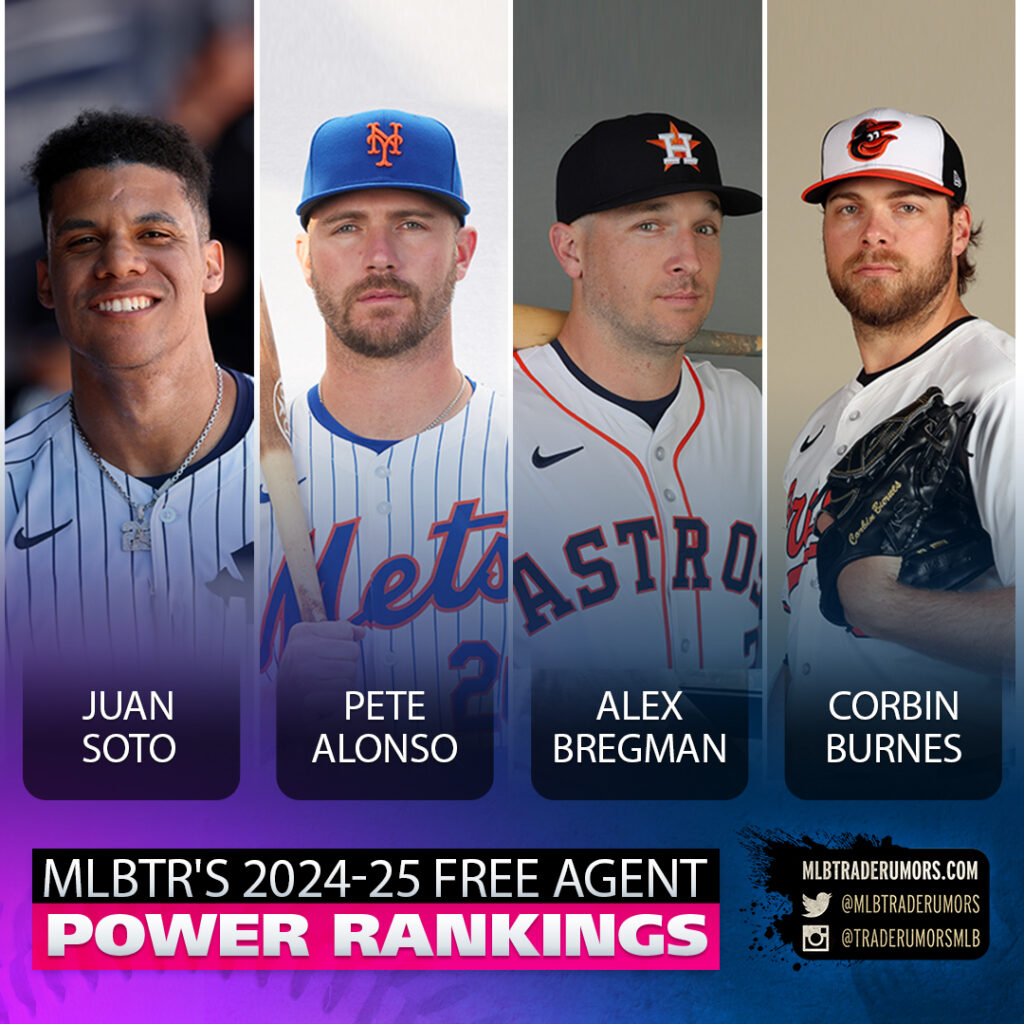
The season is underway, which makes this a good time to look ahead to next winter with the first installment of the 2024-25 MLB Free Agent Power Rankings! It’s an annual series here at MLBTR, wherein we try to rank the upcoming class of free agents by measure of their estimated earning power.
MLBTR will take periodic looks at the top of the class from now through the remainder of the season. Season performance will start to influence these rankings, but two to three weeks into the season, it’s not a huge factor. By the end time the season draws to a close, however, 2024 results will weigh heavily into the rankings. A strong platform year can elevate any player’s status in free agency, just as a poor walk year can tank their stock.
Our power rankings are compiled collaboratively. I worked with colleagues Anthony Franco and Darragh McDonald as well as MLBTR founder and owner Tim Dierkes for the first installment of this year’s rankings. Players with opt-out clauses and player options are included, even if they’ve previously given indications they may forgo the opportunity to return to the market.
Statistics are up-to-date through April 12.
* denotes players who are ineligible for a qualifying offer
1. Juan Soto, OF, Yankees
Were it not for Shohei Ohtani reaching the open market a year sooner, Soto might have a claim to the most coveted free agent ever. Because he skyrocketed through the minor leagues and took MLB by storm beginning at age 19, Soto’s final year of arbitration eligibility comes in just his age-25 campaign. He’ll play the entirety of his first free agent season at 26 years of age. For some context, Aaron Judge — who re-signed on a nine-year, $360MM contract with the Yankees upon reaching free agency — debuted at 24 and had 773 big league plate appearances heading into his own age-26 season.
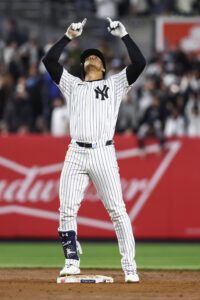
Soto is a freak of nature who was one of MLB’s best hitters at an age when most top prospects are still in college or just entering the low minors. He hit .292/.406/.517 as a teenage rookie in 2018, and his preternatural plate discipline, bat-to-ball skills and raw power have only improved since. Through more than 3400 career plate appearances, Soto has walked at a staggering 18.9% clip and struck out in just 17% of his plate appearances. He entered the current season with 160 home runs, and while he’s never had a 40-homer campaign before, a move to Yankee Stadium and its notorious short porch in right field could help him get to 200 long balls before he turns 26.
Since his 2018 debut, Soto leads qualified big leaguers with a mammoth .422 on-base percentage. Mike Trout‘s .415 mark ranks second, and Freddie Freeman (.402) is the only other hitter north of .400. Soto is “only” 16th in home runs in that time, but his 154 wRC+ — which indicates he’s been 54% better than an average hitter after weighting for home park and league run-scoring environment — is tied with Mookie Betts for fourth-best in baseball, trailing only Trout, Yordan Alvarez and Judge.
If there’s one wart to Soto’s game, it’s that he’s limited to the outfield corners and isn’t regarded as an especially strong defender. He’s had seasons with positive grades from both Defensive Runs Saved and Outs Above Average, but on the whole he has negative marks from both in his career — both in left field and in right field. That said, he’s also only had two truly *bad* seasons per both of those metrics, and taken in totality, he sits around -2 DRS and -4 OAA per season. Obviously, that’s not great, but it’s also not exactly egregious. And given the otherworldly contributions he makes at the plate, playing a slightly below-average left or right field is more than an even trade-off.
Soto famously rejected a 14-year, $440MM extension offer from the Nationals before being traded to the Padres. Rejecting an offer of that magnitude led to plenty of jaws dropping, but when considering that it included his three final arbitration seasons and 11 free agent years, it’s not as jarring as it seems at first blush. Soto wound up earning $71.1MM over those three seasons, meaning he really “only” needs to earn $370MM or so in free agency to come out ahead. There’s already talk of a potential $500MM free-agent deal for Soto. Barring a catastrophic injury, he’ll likely come out ahead in that bet on himself. He’s the clear No. 1 free agent on next year’s market and will be one of the most sought-after free agents not only in baseball history but in all of professional sports.
2. Corbin Burnes, RHP, Orioles
Since his 2020 breakout, Burnes ranks fifth in the majors in innings pitched, eighth in strikeout rate, fourth in K-BB%, second in opponents’ batting average, fifth in ERA, second in FIP and third in SIERA. Put another way — regardless of which metric you prefer to judge pitchers, Burnes ranks in the top-eight in just about any metric. He’s a bona fide No. 1 starter — very arguably one of the five best pitchers the sport has to offer at the moment.
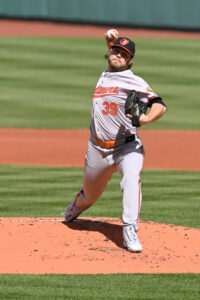
Detractors might point to Burnes’ 2023 numbers as the potential beginning of a decline. His 3.39 ERA, 25.5% strikeout rate and 8.4% walk rate were all more “very good” than elite. Through three starts in Baltimore, he’s trending back in the other direction. Small sample caveats obviously apply, but Burnes has opened his first season with his new club on a tear, tossing 18 2/3 innings of 1.93 ERA ball with a 28.6% strikeout rate and superlative 2.9% walk rate. His velocity is as strong as ever; his devastating cutter is averaging 95.1 mph — an exact match for his career-best mark, set back in 2021 when he won the National League Cy Young Award.
Burnes won’t turn 30 until October. He’s never been on the injured list due to an arm issue. His only IL stints were due to an oblique strain and Covid. Burnes might not be quite as dominant as he was when he was striking out more than 35% of his opponents from 2020-21, but he’s a workhorse ace and former Cy Young winner who still ranks among the game’s elite arms. Gerrit Cole‘s nine-year deal with the Yankees began in his age-29 season. Teams have generally been wary of committing to long-term deals for pitchers that span beyond their age-37 season (though there are exceptions, as evidenced by Jacob deGrom‘s current five-year deal).
Burnes is dominant enough that he could prove to be an exception, but even if he’s limited to eight-year terms, he’ll have a chance at surpassing a $250MM guarantee. With a big enough year, nine years and/or $300MM+ could be on the table.
3. Alex Bregman, 3B, Astros
Bregman would’ve hit free agency in the 2022-23 offseason were it not for a five-year, $100MM extension he signed upon first reaching arbitration. That locked in his first — but very likely not his last — nine-figure contract and still allowed him to hit the open market at a fairly standard point, heading into his age-31 season.

There’s perhaps a perception that Bregman is declining or trending in the wrong direction, as his production has dipped from the MVP-caliber levels he displayed in 2018-19. He also doesn’t have the most appealing batted-ball profile, which we saw work to Cody Bellinger‘s detriment in free agency this offseason. Bregman’s 88.6 mph average exit velocity and 38.2% hard-hit rate in 2023 were both pretty pedestrian marks.
One key difference between Bregman and Bellinger, however, is that Bregman has never had gaudy Statcast numbers — even when he was putting up the type of numbers that led to consecutive All-Star nods and top-five MVP finishes in 2018-19. Bellinger, on the other hand, previously had top-of-the-scale exit velo and hard-hit numbers, leading to more questions about whether his resurgent 2023 showing was truly sustainable.
Bregman has always possessed sensational contact skills. He’s never fanned at higher than a 15.5% clip in a full season. The former No. 2 overall draft pick legitimately possesses one of the best hit tools in all of baseball. He couples that with elite plate discipline, too; Bregman has walked at a 12.6% clip in his career and a 13.7% rate dating back to 2018. He’s walked more than he’s struck out in four individual seasons and in the aggregate from 2018-24. His 41-homer campaign from 2019 looks like a clear outlier in what’s now known as the juiced-ball season, but Bregman still popped 48 homers from 2022-23.
Some may question how much power he can manufacture following a potential change of scenery. Minute Maid Park’s short porch in left field — the Crawford Boxes — seems practically tailor-made for Bregman’s fly-ball heavy, pull-side approach. (Or, perhaps alternatively, he reworked his swing to take advantage of that quirk in his home park.)
There’s little doubting that he’s had some home runs that are Crawford Box specials over the years, but a look at Bregman’s career splits don’t paint the picture of someone who is a product of his hitter-friendly home environment. Bregman’s a career .273/.377/.473 hitter in Houston and a .275/.368/.498 hitter on the road. He’s actually hit nine more homers on the road in his career despite having only 64 more plate appearances away from Minute Maid Park than at home.
Defensively, Bregman isn’t an elite third baseman, but he’s posted average or better marks in DRS and OAA nearly every season of his career. There’s no reason to expect a position change in the near future, but if he does need to move off the hot corner at some point, a shift to second base, left field or first base seems feasible for the former shortstop. And as someone who’s been 36% better than average at the plate in his career — and 25% better dating back to 2020 — he has more than enough bat to profile as a regular anywhere on the diamond.
A seven- or eight-year deal seems plausible in free agency, and there’s always the chance that a luxury-paying team will gauge his interest in a longer-term deal with a non-premium AAV in order to tamp down the CBT hit. A deal north of $200MM seems plausible for Bregman. The Astros have said at multiple points in the past they’ll make an extension offer at some point, but there haven’t been serious talks on that front yet and Bregman can justifiably seek the type of long-term pact that owner Jim Crane has completely avoided over the years.
4. Pete Alonso, 1B, Mets
The Polar Bear is raw personified, bashing 40-plus homers on the regular since his 2019 debut. Alonso has not only established himself as one of baseball’s premier sluggers — he’s done so while maintaining a strikeout rate that’s lower than the league average. At a time when many prodigious sluggers are comfortable selling out for power, Alonso has the type of easy, plus-plus power that doesn’t require him to do so. He’s fanned in just 20.7% of his plate appearances dating back to 2021 and popped the fifth-most long balls in baseball along the way. He trails only Aaron Judge, Matt Olson, Kyle Schwarber and Shohei Ohtani in that span. All four of those sluggers have whiffed at higher rates than Alonso.
Alonso’s extreme fly-ball approach does lead to a glut of pop-ups and some low BABIPs — though last year’s bottom-of-the-barrel .205 average on balls in play (and .217 average overall) were likely outliers. He’s a career .250 hitter who walks at around a 10% clip — enough to boost his OBP into the .340 range most seasons. Paired with his prodigious power, that’s plenty to make Alonso one of the most feared hitters in the National League.
After debuting as a 24-year-old back in 2019, Alonso is on pace to hit the open market heading into his age-30 season. He’s not unusually young like Soto but is reaching free agency at the same point that’s seen plenty of sluggers get paid. He’ll be two years younger than Freddie Freeman and Paul Goldschmidt were when signing their current contracts (Freeman’s in free agency, Goldschmidt’s as an extension). That pair of contracts pays those star first basemen $26-27MM annually.
Alonso isn’t as good a pure hitter as either Freeman or Goldschmidt, nor is he the same defensively. He’s consistently graded out as a sub-par defender, per OAA, and a roughly average first baseman by measure of DRS. But Alonso is younger, has more power than either of those two former MVPs, and has the benefit of Mets owner Steve Cohen likely being extra-motivated to keep his franchise slugger. It wouldn’t be at all surprising to see Alonso follow a similar path to Judge. That’s not to say he’ll sign a $360MM deal — he won’t — but he could reject a qualifying offer, explore what the market has to offer, and then take the top offer back to the Mets and effectively ask that they match it.
A six-year deal would run through Alonso’s age-35 season. Seven years would take him through age-36. Either of those terms feels plausible, as does an AAV in the vicinity of — or even slightly in excess of — the Freeman and Goldschmidt deals.
5. Blake Snell, LHP, Giants*
Will the second time prove to be a charm for Snell? The $200MM+ contract he sought in free agency this past winter never materialized, likely due to a confluence of factors. Beyond the sheer scope of his ask, Snell hit free agency at a time when roughly half the league was experiencing uncertainty regarding its long-term television status. We’re also slated for a record number of CBT payors, including several big spenders — Yankees, Dodgers, Mets — currently paying a 110% tax that made a long-term deal for Snell wholly unpalatable. Further yet, recent high-profile spenders like the Padres, Rangers, Red Sox, Blue Jays and Mets all took steps back in terms of their aggression.
None of that even touches on Snell’s command troubles, though his penchant for issuing free passes hasn’t stopped him from dominating opposing lineups over the past several seasons. Snell is now a two-time Cy Young winner — one of just 22 in MLB history — who’ll spend the 2024 season pitching in an even more spacious home park than he enjoyed in San Diego.
Snell will turn 32 in the coming offseason, so he won’t have age on his side. But he already rejected a qualifying offer from the Padres, meaning he’s ineligible to receive another one at any point in his career. That lack of draft pick compensation will be a bonus, and it’s possible next offseason’s market will bear more favorable circumstances. If the Mets, Red Sox, Rangers or Padres begin spending again and if even a couple of CBT payors are suddenly in position to dip back under the threshold, Snell could find more suitors this time around.
He’s not a lock to hit the market, of course. Snell’s two-year $62MM deal with the Giants allows him to opt out at season’s end, leaving a $30MM player option on the table. So long as he remains healthy and effective, he’ll be a lock to do so. The left-hander ranks 11th in ERA (3.05) and seventh in strikeout rate (31.7%) among qualified big league starters dating back to the 2018 season. He’s had a couple rough seasons along the way, but the broader body of work is genuinely excellent.
As previously mentioned, teams are typically wary of committing beyond a starting pitcher’s age-37 season. For Snell, hitting the market at 32, that’d make it tough to secure a contract lengthier than six years. A six-year deal checking in at $28MM or more would allow Snell to still claim that he topped $200MM in free agent earnings (when combined with his current $32MM in earnings). That type of offer seemingly wasn’t there this time around, but if Snell turns in a third straight dominant season — he had a 2.72 ERA and 31.7% strikeout rate in 2022-23 — someone’s likely going to pony up with a big offer.
6. Max Fried, LHP, Braves
Few starters in baseball have been as consistent as Fried on a year-to-year basis. The former No. 7 overall draft pick has turned in a sub-3.00 ERA in three of the past four seasons, with the lone exception being a 3.04 mark in 2021. Fried’s strikeout rate has fallen between 22.3% and 25.7% for five straight seasons. His walk rates in that time have landed between 4.4% and 8.5% (though that 8.5% came in 2020’s short season and is something of an outlier, he’s been under 7% in every other full season). His ground-ball rate sits between 51.2% and 57.7% each year.
Fried isn’t an overpowering ace in the sense that he hits triple digits with his heater and strikes out a third of his opponents. He has above-average but not elite velocity, leading to average or slightly better strikeout rates. However, Fried has plus command and ground-ball tendencies, and he dodges hard contact at consistently excellent levels.
Prior to the 2023 season, Fried was also quite durable, ranking 19th in the majors in innings pitched and 21st in games started. That doesn’t include his 10 postseason starts (and four relief outings) — a total of 58 2/3 additional innings. A forearm strain suffered in early May last year, however, knocked Fried out of action for about three months. Though he was characteristically excellent when health — 2.55 ERA, 3.14 FIP, 3.38 SIERA — Fried was limited to 14 starts and 77 2/3 innings.
Proving that forearm strain is behind him will be paramount to his free agent platform. Another 30-plus starts won’t completely eliminate any trepidation stemming from last year’s injury, but another season with considerable missed time — particularly due to an arm injury of any nature — would create cause for clear concern.
Fried has been more durable than Carlos Rodon (six years, $162MM with the Yankees) and has a far lengthier track record of success. He and his reps will likely take aim at toppling that mark in free agency. Braves fans would surely like to see an extension, but it hasn’t happened in the past, and Fried is plenty justified in asking for the type of long-term deal and semi-premium AAV that the Braves have steered clear of in recent years. He seems likelier to follow Freddie Freeman and Dansby Swanson out the door than he does to receive an extension offer that’s commensurate with his market value.
7. Cody Bellinger, OF/1B, Cubs*
Bellinger didn’t get the mega-deal he sought this past offseason. Excellent as his 2023 campaign was, there were surely teams wary of his woeful 2021-22 showing on the heels of shoulder surgery. Beyond that, his exit velocity, hard-hit rate and other batted-ball metrics were decidedly pedestrian.
Agent Scott Boras has pointed to Bellinger’s massive decline in strikeout rate as a factor, painting his client as a hitter who adopted a two-strike approach more focused on putting the ball in play than on doing massive damage. There’s surely a blend of truth and garden-variety agent spin woven into that defense.
A repeat of his 2023 production — or anything close to it — would strengthen Bellinger’s case immensely. It’d further distance him from that awful 2021-22 showing, lending further credence to the notion that injuries played a significant role in his perceived decline. And whether Bellinger replicates his numbers by returning to his maximum-damage approach or simply proves that his newer brand of more well-rounded, low-strikeout offense is sustainable, either approach should prove lucrative.
Even though an opt-out would trigger Bellinger’s third trip to free agency, he’ll still be heading into just his age-29 season next year. He can still play a fine center field (or corner outfield, presumably) and remains a good option at first base as well. There’s plenty of defensive and baserunning value to supplement his bat.
Bellinger will pocket $30MM in the first season of his three-year, $80MM deal with the Cubs, meaning he’ll be opting out from two years and $50MM. That seems likely, barring a 2021-22-esque collapse or a massive injury. Because of his age, that immense long-term deal that eluded him this past offseason still feels plausible. That he can no longer be saddled with a qualifying offer — players can only receive one in their career, and he rejected one last offseason — only strengthens his case.
8. Willy Adames, SS, Brewers
Adames joins Javier Baez, Trevor Story and Dansby Swanson as the latest in a line of high-end shortstops to reach free agency heading into his age-29 season. That trio signed for respective guarantees of $140MM (Tigers), $140MM (Red Sox) and $177MM (Cubs). Adames doesn’t have the individual accolades that group possesses. He’s never been an All-Star like each of that trio has. He hasn’t won Gold Gloves like Swanson and Baez. He hasn’t won the Silver Sluggers that Story has.
Yet despite the lack of hardware, Adames has a strong claim to be valued in similar fashion. It’s true that he had a down year at the plate in 2023, but that was in part driven by a career-low .250 average on balls in play. Since 2020, Adames is a .240/.316/.450 hitter. He’s been 8% better than average overall, by measure of wRC+, and he peaked with a 121 wRC+ (21% better than average) from 2020-21. Adames fanned at a sky-high 36.1% back in 2020 but has reduced that mark considerably; over his past 1300 plate appearances he’s punched out at a worse-than-average but far more manageable 26.2% rate. He struggled badly against lefties early in his career (despite being a right-handed hitter) but has improved against them in recent seasons.
From 2021-23, Adames averaged 26.67 homers per season — topping out at 31 round-trippers in 2022. He’s walked at an above-average but not elite 9.4% rate in his career — including a personal-best 11.1% in 2023. Adames has long been touted as having plus defensive tools, but his execution and consistency were lackluster early on, leading to some middling grades. Over the past two seasons he’s been outstanding, tallying 17 DRS and a flat-out elite 26 OAA.
If Adames can bounce back from last year’s .217/.310/.407 line and turn in something closer to the .251/.319/.471 slash he logged from 2020-22, he’ll have an easy case to be paid comparably to Story, Baez and Swanson. He’s likely to hit the market on the heels of four straight 20-homer campaigns. He’s a plus defender. He’s relatively young. He’s not the most consistent hitter on a year-over-year basis, but that was true of Baez, Story and Swanson. They all got paid. Adames will also draw bonus points for his gregarious personality and leadership skills. Both the Rays and Brewers have lauded him in that regard, and the primary reason Tampa Bay traded him — Wander Franco‘s looming emergence — now looks regrettable (even if getting Drew Rasmussen in return for him has yielded plenty of value).
9. Ha-Seong Kim, SS/2B, Padres
Kim came to MLB with great fanfare as a 25-year-old KBO superstar who’d been posted by the Kiwoom Heroes. He signed a four-year, $28MM deal with San Diego that contains a mutual option for a fifth season. Mutual options are generally accounting measures and are almost never exercised by both parties. In Kim’s instance, it’s a no-brainer to decline his end of the option and hit free agency in search of a deal that could pay him three to four times his original MLB guarantee.
While Kim’s rookie season didn’t live up to the hype, he’s since acclimated to MLB quite nicely. Now 28, he posted a .256/.338/.391 batting line (109 wRC+) from 2022-23. His power has increased in each MLB season, resulting in a career-high 17 homers last year, and he swiped a hefty 38 bases in 47 tries for the Friars last season. Kim’s walk rate has climbed every MLB season as well, topping out at a robust 12% in 2023, and after fanning in 23.8% of his plate appearances as a rookie he’s dropped that mark to 18.5% in 2022-23.
Decent power, strong on-base skills and plus speed give Kim plenty of appeal, but his glove is perhaps his greatest selling point. Kim is an elite defensive infielder capable of handling any of second base, shortstop or third base. He won his first Gold Glove for his play at second base last season, though that’s unlikely to be his last. (He also won a Gold Glove in his final three seasons of KBO play.)
There’s no defensive metric that pegs Kim below average at any of those three positions. He’s logged more than 1000 innings at second base, nearly 600 at third base and more than 1600 at shortstop. Defensive Runs Saved, Outs Above Average and Ultimate Zone Rating agree that he’s excellent at all three. The Padres signed Xander Bogaerts to an 11-year contract and moved him to second base just one year later despite Bogaerts posting decent numbers at short in 2023. Kim has racked up 23 DRS and 10 OAA in his 1600+ innings at shortstop. He has fluid infield actions, sure hands and is a regular source of highlight-reel defense.
Kim doesn’t have a strong batted-ball profile, but it’s not out of the question that he could crack 20 homers, walk in more than 10% of his plate appearances, swipe 40 bags and play Gold Glove defense this season. He’ll play all of the 2025 season at 29 years old. A nine-figure contract isn’t out of the question.
10. Jordan Montgomery, LHP, Diamondbacks
As the old adage goes, if at first you don’t succeed — hire a new agent and try again. Montgomery languished in free agency all winter, never landing the six- or seven-year contract he was seeking. He took a one-year, $25MM deal with the D-backs that’ll afford him a player option at $20-25MM basically just for staying healthy. The contract wasn’t finalized before Opening Day, meaning Montgomery can’t receive a qualifying offer this winter. Barring a major injury, he’ll likely decline that player option and return to the market.
Montgomery, 31, has made at least 30 starts in each of the past three seasons. In that time, he’s pitched 524 1/3 innings of 3.48 ERA ball with a 22.5% strikeout rate, a 6.2% walk rate, a 44.5% ground-ball rate and just 1.00 HR/9. His 2023 campaign was the finest of his career, featuring a personal-best 188 2/3 innings of 3.20 ERA ball, plus another 31 innings of 2.90 ERA ball in the postseason — a strong performance that helped push the Rangers to their first-ever World Series title.
Though he doesn’t miss bats at an elite level, Montgomery is better than average in just about every meaningful category for starting pitchers and has been a workhorse since his 2020 return from Tommy John surgery. We at MLBTR erred in thinking a six-year deal was attainable heading into the 2023-24 offseason. Another typical Montgomery season could put him in position for a strong four-year or perhaps a five-year deal at a lighter AAV than we predicted last offseason. He should be able to top teammate Eduardo Rodriguez‘s four-year, $80MM contract — and a deal in the $100-110MM range over five years doesn’t feel out of reach if Monty continues at his recent trajectory.
Honorable Mentions (listed alphabetically): Walker Buehler, Matt Chapman*, Gerrit Cole^, Jack Flaherty, Paul Goldschmidt, Teoscar Hernandez, Rhys Hoskins, Frankie Montas, Tyler O’Neill, Luis Severino, Max Scherzer*, Gleyber Torres, Justin Verlander*, Christian Walker
^=Cole is currently on the 60-day IL and expected to be out into June. He can opt out of the remaining four years and $144MM on his contract at season’s end, though if he signals his intent to do so, the Yankees can override his opt-out by tacking on a tenth year at another $36MM. Because Cole is currently injured and because the Yankees can effectively veto his opt-out, we’re not including him on the initial version of our rankings. If, as the season wears on, he’s pitching well enough to trigger that opt-out and there’s talk of the Yankees allowing him to walk, he could land on future installments of the list.
White Sox To Select Jonathan Cannon
The White Sox will promote right-hander Jonathan Cannon from Triple-A Charlotte to start Tuesday’s game, tweets Daryl Van Schouwen of the Chicago Sun-Times. He’s not on the 40-man roster, so they’ll need to formally select his contract and make a corresponding transaction to open a 40-man spot. It’ll be the big league debut for the 2022 third-rounder.
Listed at 6’6″ and 225 pounds, Cannon has been a fast riser through the South Siders’ system. The former Georgia Bulldog split the 2023 season between High-A and Double-A, and he was also on the roster for the 2023 Futures Game during last year’s All-Star festivities. He’s opened the 2024 campaign with 9 2/3 decent frames at the Triple-A level (three earned runs on ten hits and five walks with 11 punchouts). Baseball America ranks Cannon eighth among White Sox farmhands, while FanGraphs tabs him tenth in the system and MLB.com lists him 11th.
Cannon, 23, pitched 121 innings last season, working to a 4.46 ERA with a 20.5% strikeout rate, 7.5% walk rate and an impressive 53% ground-ball rate. Baseball America tabs him as a potential fourth/fifth starter, barring improvement to his command, which could further boost his ceiling. Their report on Cannon praises a deep arsenal (four-seamer, two-seamer, cutter, slider, curveball, changeup) that generates grounders and weak contact. Cannon sits 93-97 mph with his fastball, and scouting reports from BA, FanGraphs and MLB.com all call him a high-floor, high-probability fourth starter who can eat plenty of innings for the White Sox in the years to come.
It’s not clear yet how long Cannon or tonight’s starter, Nick Nastrini (another rookie who’s making his MLB debut) will stick in the rotation. Sox Machine’s James Fegan tweets that manager Pedro Grifol alluded to a potential bullpen move for struggling veteran Chris Flexen, but Grifol also didn’t commit to Nastrini or Cannon remaining in the mix beyond their debut efforts this week. Certainly, given the dismal results from the rotation thus far — Sox starters rank 26th in the big leagues with 72 1/3 innings pitched, 28th with a 5.60 ERA and dead last with a 5.20 FIP — an impressive debut for either pitcher could earn him another opportunity in the next trip through the rotation.
Beyond Garrett Crochet — who’s likely to be on an innings limit this season — there’s virtually no certainty in the Chicago rotation. Flexen, Erick Fedde and Michael Soroka opened the year in starting roles, but Flexen and Soroka are on cheap one-year deals and will be free agents at season’s end. Fedde’s two-year, $15MM contract after his KBO breakout gives him a longer leash, but he’s also not a long-term piece of the puzzle at Guaranteed Rate Field. The Sox will hope that between Cannon, Nastrini and other prospects like Jairo Iriarte, Jake Eder and Noah Schultz, the Sox have at least a few long-term rotation pieces who can help to quickly usher them out of the team’s latest rebuilding phase.
White Sox Promote Nick Nastrini
3:40pm: The Sox have now made Nastrini’s promotion official and also activated outfielder Eloy Jimenez from the injured list. To open active roster spots for those two, they optioned right-hander Justin Anderson and infielder/outfielder Zach Remillard. To open a 40-man spot for Nastrini, they transferred catcher Max Stassi to the 60-day injured list. The backstop opened the season on the 10-day IL due to hip inflammation but was hit on the hand by a backswing while rehabbing recently, per Scott Merkin of MLB.com. His exact timeline isn’t clear but he’s now ineligible to be activated until late May.
9:27am: The White Sox will call up right-hander Nick Nastrini to start today’s game in what will be his MLB debut, manager Pedro Grifol announced (link via Kyle Williams of the Chicago Sun-Times). He’s not on the 40-man roster, so the Sox will need to open a spot for his contract to be formally selected.
Nastrini, 24, is widely regarded as one of the White Sox’ top pitching prospects. Acquired from the Dodgers in the trade sending Lance Lynn to Los Angeles last summer, the 2021 fourth-round pick has routinely posted massive strikeout numbers throughout his minor league tenure but has also battled sub-par command for much of his professional career.
Scouting reports at Baseball America, MLB.com, FanGraphs, The Athletic and ESPN all rank Nastrini eighth or better among ChiSox farmhands, with BA listing him third in the system. The Athletic’s Keith Law ranked Nastrini 76th on his 2024 top 100 list, touting him as a possible No. 4 starter and with the ceiling to become quite a bit more than that, given the strength of his secondary pitches.
There’s little doubting the quality of Nastrini’s stuff; he runs his fastball up as high as 98 mph and complements it with a slider, curveball and changeup that all project as potentially average to plus offerings. Nastrini features high-end spin rates on his heater and breaking pitches, and his changeup helped him limit lefties to a .226 average with a 29.7% strikeout rate between Double-A and Triple-A last season. (Righties hit .216 and punched out at a 26.1% clip.) Law touts the changeup, in particular, as a potential plus-plus pitch (70-grade on the 20-80 scale).
If Nastrini had better control of his electric arsenal, he’d undoubtedly grade as one of the game’s elite prospects. At 6’3″, 215-pound righty has the size and deep repertoire to profile as a starter, but he’s walked 11.1% of his career opponents. His penchant for missing the zone leads to plenty of deep counts as well; in 2023 he averaged about 4 2/3 innings per start. There’s still some refinement to be made, though he’s improved his command since college ball at UCLA and has also seen further gains in that field since being traded from L.A. to Chicago (9.5% walk rate in the Sox’ system).
The state of the White Sox’ roster amid their current rebuild gives Nastrini ample opportunity to show he can stick. The Sox are out to their worst start in franchise history, sitting at 2-13 on the season. The woeful state of their rotation has played a significant role in those struggles. Even with Garrett Crochet pitching like a borderline No. 1 starter through his first four turns, White Sox starters rank 26th in the big leagues with 72 1/3 innings pitched, 28th with a 5.60 ERA and dead last with a 5.20 FIP. Despite totaling MLB’s fifth-fewest innings, the rotation is tied for the MLB lead with 14 home runs allowed.
Nastrini will join Crochet, Erick Fedde, Michael Soroka and Chris Flexen in the rotation for the time being. Recently re-signed Mike Clevinger will join that group in a few weeks as well, once he’s sufficiently built up, and other prospects like Jake Eder, Jairo Iriarte and Jared Shuster (currently working as a long reliever in the big league ‘pen) could eventually garner looks over the course of the season.
Even if Nastrini is in the big leagues to stay, he won’t accrue enough service time to reach a full year in 2024. Were it not for an illness that rendered Nastrini unavailable the first time Chicago needed a fifth starter, that may not have been the case, but he wasn’t healthy enough in the season’s first week to step onto the staff at the time. He’s still made just two starts in the minors this season, in part due to that illness. Further optional assignments could always alter his timeline anyhow, but for now, Nastrini will be controllable all the way through 2030.
Marlins Option Max Meyer
The Marlins announced Monday that they’ve optioned right-hander Max Meyer to Triple-A Jacksonville. He’ll be the corresponding move for the previously reported activation of fellow righty Edward Cabrera, who’s been on the injured list with a right shoulder impingement. MLB.com’s Christina De Nicola first reported that Meyer would be optioned to open a roster spot for Cabrera.
It’s a surprising move, given the Marlins’ struggles and Meyer’s excellence through his first three turns. The former University of Minnesota standout, No. 3 overall draft pick and top prospect has been outstanding in his first big league action since returning from 2022’s Tommy John surgery. In 17 innings, Meyer touts a 2.12 ERA; he’s surrendered just four runs on 11 hits and three walks with 14 punchouts and a 48.9% ground-ball rate.
Heading into the season, Meyer wasn’t expected to break camp with a rotation spot. Spring injuries to Cabrera, Braxton Garrett and Eury Perez changed that calculus and put the 25-year-old Meyer back onto the rotation radar. Nothing he’s done this season takes away from his promising long-term outlook, but the Fish also plan to be mindful of his workload and limit his innings in his first year back from that UCL reconstruction procedure.
Be that as it may, the optics of the move aren’t great. The Marlins have only won three games this season, and Meyer has started two of them. He’s been both excellent and highly efficient, topping out at 91 pitches in his most recent start, which included six innings of one-run ball against a juggernaut Braves lineup. It’s easier to manage his innings at the minor league level, but given the overarching struggles of the Marlins’ big league roster, optioning one of their lone bright spots is tougher to justify.
It should be noted that it’s unlikely the decision to option Meyer was overly motivated by service time. He entered the year at 1.082 years of service, meaning he needed just 90 days on the active roster or big league injured list in order to reach two years of service and remain on track for free agency following the 2028 season. He’s picked up 17 days of service already, so unless the Marlins are planning to keep him in Jacksonville for as many as 95 more days this season, his free agent timeline will be unchanged. One would imagine he’ll rejoin the big league rotation sooner than later.
Miami certainly had other paths to consider when opening a spot for Cabrera’s return. Struggling top starter Jesus Luzardo was never going to be sent down, but reliever-turned-starter A.J. Puk has struggled mightily in his first three trips to the mound. Even if they understandably didn’t want to give up on that experiment yet, lefties Trevor Rogers and Ryan Weathers have both demonstrated worrying command issues.
A six-man rotation would also make some sense, creating an organic means of limiting not only Meyer’s workload but also those of Rogers and Puk — both of whom have innings concerns as well. Rogers pitched just 27 innings last season due to injury. Puk tossed just 59 1/3 innings last year while working as a reliever; his 66 2/3 innings in 2022 were his most since the 2017 season when he was still working as a full-time starter in the A’s minor league ranks.
Dodgers Shut Emmet Sheehan Down; Walker Buehler Could Return Soon
Dodgers right-hander Emmet Sheehan hasn’t pitched this season while rehabbing from a forearm injury. He’d recently resumed throwing to live hitters, but manager Dave Roberts told reporters last night that the 24-year-old righty has been shut back down because his arm “hasn’t been responding” the way Dodgers medical personnel hoped (link via Fabian Ardaya of The Athletic). Sheehan said he had another round of testing on his arm that didn’t reveal any structural damage, but Roberts still called his injury a “longer-term situation.” The Dodgers had already transferred him to the 60-day injured list at the end of March.
Sheehan entered the 2023 season as one of the Dodgers’ top pitching prospects and pushed his way into top-100 consideration with a strong minor league showing early last year. By mid-June, he was up in the big leagues for his debut. While the right-hander’s 4.92 ERA in a subsequent sample of 60 1/3 innings didn’t exactly cement him as a long-term fixture just yet, he entered camp as perhaps the favorite to land a rotation spot behind Tyler Glasnow, Yoshinobu Yamamoto, Bobby Miller and James Paxton. That spot instead went to fellow righty Gavin Stone, who started his 2024 campaign with two shaky starts before an excellent third outing that saw him carry a perfect game into the sixth inning before running into trouble.
The setback for Sheehan creates further uncertainty in a Dodgers’ rotation that also has Miller, Walker Buehler, Tony Gonsolin, Clayton Kershaw and Dustin May on the injured list. Sheehan’s status on the 60-day IL already meant he was out until at least mid-May, but there’s no way to gauge how long he might be expected to miss right now.
The Dodgers still rank tenth in the majors in rotation ERA, thanks in no small part to a dominant start to the season from Glasnow. Some alarm bells sounded when Yamamoto was torched for five runs in one inning during his MLB debut, but he’s responded by rattling off 15 innings with just three runs allowed while posting a terrific 19-to-3 K/BB ratio. Paxton has quality run-prevention numbers, but his success isn’t sustainable if he keeps walking more hitters than he’s striking out. He’s issued 14 free passes in 16 innings, yielding a walk to a glaring 20.6% of his opponents on the season. He’s fanned just ten (14.7%).
In Glasnow and Paxton, the Dodgers are banking on a pair of oft-injured veterans to help lead the staff while awaiting the returns of Buehler, Kershaw and May. Buehler is expected to make another rehab start this Thursday, per Mike DiGiovanna and Jack Harris of the L.A. Times. His most recent rehab outing was cut short when a comebacker struck his pitching hand, but Buehler escaped that injury scare unscathed. Roberts indicated that Buehler is targeting 80 to 85 pitches in that scheduled Thursday outing. He’ll be reevaluated after that point. If the team feels he’s ready, that’d point to a return next week. If he needs one more rehab start following Thursday’s outing, he could still return in the final days of April.
Mariners, Luke Barker Agree To Minor League Deal
The Mariners agreed to a minor league contract with right-handed reliever Luke Barker, Jon Morosi of MLB.com reports. The Gaeta Sports client will head to Triple-A Tacoma.
Barker, 32, made three appearances for the Brewers in 2022 — his lone MLB experience to date. The right-hander was undrafted out of Division-II Chico State University in California back in 2015 but parlayed a dominant showing in the independent Frontier League into a minor league look with the Brewers organization. He spent the next six seasons in the Brewers system, working toward that ’22 debut.
While Barker was tagged for five runs in four innings during his MLB cup of coffee, his minor league track record is outstanding. In 261 2/3 minor league innings, the righty carries a 2.38 ERA, 27.6% strikeout rate and 6.4% walk rate. That includes three seasons of Triple-A work — a total of 116 1/3 frames with a 2.32 earned run average, an even better 30.4% strikeout rate and a 6% walk rate. Barker doesn’t throw hard, averaging just 91 mph on his heater during his brief MLB look, but he’s routinely posted swinging-strike rates north of 14% in the upper minors.
Barker didn’t pitch in 2023. He spent the season rehabbing from Tommy John surgery after suffering a UCL tear late in the 2022 campaign. He’ll now join just the second organization of his career.
The Mariners aren’t short on talented relievers, though two of their best are currently on the 15-day injured list: righties Matt Brash and Gregory Santos. Brash was slowed by a bout of elbow inflammation during spring training, while Santos suffered a lat strain late in camp. Neither has pitched in the big leagues or on a minor league rehab assignment so far this season. Barker will give the M’s some more depth in the upper minors. Seattle has a recent track record of striking gold on unheralded bullpen acquisitions — Paul Sewald, Drew Steckenrider, Justin Topa, Gabe Speier, Tayler Saucedo among them — and Barker will hope to add his name to the list.
Astros Outright Cooper Hummel
Catcher/outfielder Cooper Hummel, whom the Astros designated for assignment last week, went unclaimed on outright waivers and has been assigned to Triple-A Sugar Land, per the team’s transaction log at MLB.com. He hasn’t been outrighted before and doesn’t have three years of MLB service, so Hummel can’t reject the assignment. He’ll remain in the organization as a depth piece.
Hummel is no stranger to the DFA circuit, having bounced from the Mariners, to the Mets, to the Giants, to the Astros just from the end of the 2023 season until now. The 29-year-old has just 227 big league plate appearances under his belt, most of which came with the 2022 Diamondbacks. He’s a .166/.264/.286 hitter between the D-backs and the Mariners (10 games in 2023). Those numbers aren’t much to look at, but Hummel hit .262/.409/.435 in Triple-A last season and walked at a mammoth 18% rate along the way. He’s a .287/.419/.488 hitter in 992 overall plate appearances in Triple-A.
Given that standout production in the upper minors and his unusual blend of defensive versatility, Hummel makes a nice depth option for the Astros to be able to stash in Triple-A. He’s logged more than 1800 innings in left field, 1054 frames behind the plate, 508 innings at first base and another 296 innings in right field. He also still has a minor league option remaining, so if he plays his way back onto the 40-man roster, he doesn’t necessarily need to be exposed to waivers a second time if Houston wants to send him down.
Marlins To Place Jake Burger On Injured List, Activate Edward Cabrera
The Marlins are placing third baseman Jake Burger on the 10-day injured list due to a left oblique injury, tweets Christina De Nicola of MLB.com. She adds that Burger likened the discomfort he experienced to a 2023 oblique injury where he only missed the 10-day minimum. The team hasn’t provided a timetable for his return just yet. The Fish will recall utilityman Otto Lopez, whom they claimed off waivers from the Giants earlier this season, to take Burger’s spot on the roster.
Burger, 28, is tied for the Marlins’ team lead with three homers and is currently pacing the club with 15 runs knocked in. His overall .228/.281/.421 batting line is still well shy of league-average production (86 wRC+), but he’s been one of the better hitters in a dismal Marlins lineup — particularly with runners on base. Even a short-term absence figures to be a notable hit to a Marlins lineup that has mustered a collective .209/.273/.316 slash to begin the season.
The injury to Burger is exacerbated by the fact that utilityman Vidal Brujan is also banged up at the moment. Jordan McPherson of the Miami Herald tweets that Brujan is dealing with a right knee injury and is currently considered day-to-day. The Marlins are still in the process of evaluating that injury, and it’s possible he’ll wind up missing some time as well.
As such, the Marlins’ top options at third base right now are Emmanuel Rivera — acquired from the D-backs for cash following his DFA earlier this month — and Lopez. Rivera hit .261/.314/.358 in 283 plate appearances with Arizona last season but is out to a 3-for-17 start (all singles) in his time with the Marlins. Lopez is hitting .485/.528/.788 in a tiny sample of 36 Triple-A plate appearances this season and carries a career .288/.354/.401 slash in parts of four Triple-A campaigns overall. He’s spent far more time at both middle infield slots than at the hot corner, but he does have 205 career innings at third base.
It’s not all bad news for the Marlins. They’re expected to reinstate right-hander Edward Cabrera from the injured list to make his season debut tonight, reports Kevin Barral of Fish On First. De Nicola tweets that left-hander A.J. Puk had been slated to take the ball, but he’ll be pushed back a couple days due to an illness that’s been making the rounds in the Miami clubhouse and is currently impacting him. The Marlins will need to make a second roster move to open space for Cabrera’s return.
Cabrera, 26, has spent the first two-plus weeks of the season on the injured list due to a shoulder impingement. However, he’s made three Triple-A rehab starts now, allowing just one run in 12 2/3 innings. He walked seven batters over seven innings in his first two appearances, showing a bit of rust, but Cabrera punched out nine batters and walked just one over 5 2/3 frames in his most recent outing — yielding only an unearned run along the way. He’s pitched 171 1/3 innings over the past two seasons for the Marlins, working to a 3.73 ERA with a strong 26.6% strikeout rate but a dismal 13.7% walk rate that’s in need of further refinement.
Rimas Sports Agency Facing MLBPA Sanctions
5:15pm: Reporter Francys Romero relays that Ronald Acuna Jr. hired Rimas Sports as his agency in recent days.
2:20pm: Rimas Sports, the fledgling baseball agency launched last year by rapper and singer Bad Bunny, is facing sanctions from the MLB Players Association for violating the MLBPA’s agency regulations, as first reported by Britt Ghiroli of The Athletic. ESPN’s Jeff Passan, Alden Gonzalez and Jorge Castillo have also reported on the unfolding controversy. Per the ESPN report, Rimas’ lead agent, William Arroyo, has had his agent certification revoked.
Multiple other agencies have filed complaints against Rimas, alleging that the firm has offered large sums of cash and gifts to players as incentive to leave their prior agencies and join Rimas — a violation of the MLBPA’s code of conduct for agents. Ghiroli writes that some players have allegedly been given new cars. She adds that Rimas has had employees who are not certified as agents but have nevertheless represented themselves as such and acted in that capacity. Those employees had been seeking certification but are now expected to have their requests denied, per both Ghiroli and ESPN.
Rimas issued the following statement on the controversy:
“At Rimas Sports, we uphold the highest standards of professionalism and integrity of our industry. Out of respect for an ongoing process within the context of the MLBPA Agent Regulations, we will refrain from making any comments at this time. We remain committed to continue serving our clients with excellence.”
While decertification of a firm’s lead agent is obviously rare and noteworthy, violations of this manner are hardly unprecedented. Former MLBTR writer Zach Links and I wrote spoke with various agents about client poaching as far back as 2014.
Rimas Sports most notably negotiated the seven-year, $63.5MM extension for Rockies shortstop Ezequiel Tovar earlier this year. Included among their other clientele are Mets catcher Francisco Alvarez, Mets infielder Ronny Mauricio, Nationals outfielder Eddie Rosario (who only hired Rimas this offseason), Giants infielder Wilmer Flores, Guardians shortstop Brayan Rocchio, Reds infielder Santiago Espinal and Dodgers catching prospect Diego Cartaya (among others). The MLBPA has informed all of Rimas’ clients about the purported transgressions, per ESPN and The Athletic.
Mets Acquire Joe Hudson From Cubs
The Cubs traded journeyman catcher Joe Hudson to the Mets yesterday, per the teams’ transaction logs at MLB.com. It’s presumably a cash deal that’ll give the Mets some additional depth behind the plate. Hudson was assigned to Double-A Binghamton.
Hudson, 32, has seen brief action in three big leagues seasons but none since 2020. He has just 33 MLB plate appearances under his belt. Hudson has spent the past two seasons in Triple-A with the Rays and Braves, hitting for a low average but posting strong on-base marks and showing off good pop at the plate. He was hitless in eight plate appearances with the Cubs’ Iowa affiliate in 2024 but batted .230/.362/.432 with 20 homers in just 437 plate appearances with the top affiliates for the Rays and Braves from 2022-23.
Behind the plate, Hudson is 0-for-7 in halting steals at the MLB level but boasts an enormous 40% caught-stealing rate in 11 minor league seasons. He’s also typically posted strong framing marks in the upper minors, per Baseball Prospectus.
The Mets are set at catcher on the big league roster, with young Francisco Alvarez shouldering the bulk of the workload and veteran Omar Narvaez backing him up. In Triple-A, they’ve got veteran Tomas Nido and well-traveled Austin Allen — a pair of backstops with big league experience (quite a bit of experience, in Nido’s case). For now, Hudson will head to Double-A and pair with top catching prospect Kevin Parada.