
Mets Plan To Play Brandon Nimmo Primarily In Left Field This Season
The Mets plan to move Brandon Nimmo from center field to left field for the 2024 season at least, manager Carlos Mendoza revealed to reporters yesterday (link via Anthony DiComo of MLB.com). The outfield shuffle comes on the heels of New York’s offseason signing of Harrison Bader on a one-year, $10.5MM contract.
The move is hardly unexpected, given that Bader ranks as one of the sport’s top defenders in center, but it’s still notable just one year after Nimmo’s ability to handle center field was a contributing factor in the team’s decision to re-sign him on an eight-year, $162MM contract. President of baseball operations David Stearns suggested last month that a specific outfield alignment had not yet been settled upon, but the Mets will go with what looked to be the most probable option. With Bader on a one-year pact, it’s possible Nimmo will end up patrolling center again in the near future — and he could do so as soon as this season in the event of an injury to Bader. But for the time being, Mendoza made clear the plan is an alignment of Nimmo in left, Bader in center and Starling Marte in right field on most days.
Mendoza praised Nimmo’s openness to the move. Nimmo himself told DiComo and others that Stearns asked him early in the offseason about his willingness to move to a corner, should the team sign a free agent center fielder with plus defensive skills. “I told him, ‘Honestly, my goal at this point in my career is to win a World Series. If you think that creating a better outfield defense or adding these guys to our roster is going to help our chances of winning a World Series, then I’ll do whatever it takes to do that,'” Nimmo said.
On paper, it should give the Mets a strong defensive group on the grass. Nimmo’s defensive grades in center field took a step back in ’23, but Statcast and Ultimate Zone Rating both pegged him as roughly average. (Defensive Runs Saved was more bearish, casting his glovework as a negative.) Bader ranks fourth among all big league players, regardless of position, in Statcast’s Outs Above Average metric, dating back to the 2018 season. DRS has him tied for 18th among all MLB players in that same span. Marte posted negative grades in 2023 but was also hobbled by a groin strain in addition to missing time with migraines. At 35, he’s likely lost a step or two, but Marte previously graded as an elite left fielder — so a return to at least solid glovework in right field shouldn’t be out of the question.
In all likelihood, Nimmo will play some center this year. Bader has been on the injured list seven times in the past three seasons (once the Covid-related IL, but the 10-day IL on six other occasions). In that span, he’s dealt with a fractured rib, plantar fasciitis and strains of his groin, oblique and hamstring. As is common with many elite defenders in center, the devil-may-care attitude with which Bader approaches his craft leaves him susceptible to IL stints. The reckless abandon required to crash into a wall at full speed or lay out for spectacular diving grabs leads to plenty of highlight reel appearances but also plenty of bumps and bruises (if not worse).
In the big picture, the Mets’ outfield alignment could continue to change in the short term. Outfielder Drew Gilbert, acquired from the Astros in the Justin Verlander trade, is widely considered to be among the game’s top 100 prospects and could push for a spot in the majors this season. He’s a center fielder with a real chance to stick at the position. Next year’s free agent class in center is pretty thin — unless Cody Bellinger signs a deal that allows him to opt back into free agency next winter — though if the Bader fit works out, it’s always possible the two parties explore a longer-term fit.
Rays Sign Yu Chang To Minor League Deal
The Rays announced Monday that they’ve signed versatile infielder Yu Chang to a minor league contract. He’s been invited to big league camp and will compete for a spot on manager Kevin Cash‘s bench.
It’s the second Rays stint for Chang, who played 36 games and slashed .260/.305/.385 in 105 plate appearances with Tampa Bay in 2022. The Rays were one of four teams for Chang that season. He’s appeared in each of the past five MLB campaigns, suiting up for Cleveland, Pittsburgh, Tampa Bay and Boston along the way. In 650 trips to the plate at the MLB level, Chang is a .204/.269/.359 hitter.
Chang likely won’t offer a ton at the plate against either left-handed or right-handed pitching. He’s a right-handed hitter without a glaring platoon split; if anything, he’s been slightly better against same-handed opponents in his career than he has versus southpaws. He’s shown modest pop over the past three seasons (.167 ISO, 16 homers in 553 plate appearances), but that’s been accompanied by a 5.4% walk rate and ugly 29.3% strikeout rate.
Now 28 years old, Chang has logged time at all four infield positions in his career, with a relatively even distribution of playing time between the four spots. Both Defensive Runs Saved and Outs Above Average consider him a strong defensive player at each of second base, shortstop, third base and first base.
Chang offers the Rays some depth all around the infield, which is of extra importance with Wander Franco in legal limbo and Taylor Walls recovering from offseason hip surgery. At the moment, they expect trade acquisition Jose Caballero to be the primary shortstop, with Isaac Paredes at third base, Brandon Lowe at second base and Yandy Diaz at first base. Jonathan Aranda, Osleivis Basabe, Curtis Mead and Junior Caminero (one of the top prospects in all of baseball) are all on the 40-man roster and give the Rays plenty of exciting young options to consider in their ever-changing infield outlook.
Giants Sign Jorge Soler
Feb 18: The Giants officially announced Soler’s deal this afternoon. The slugger will received a $9MM signing bonus in addition to $7MM in salary for the 2024 season and $13MM salaries for each of the 2025 and 2026 seasons. To make room for Soler on the club’s 40-man roster, right-hander Austin Warren was placed on the 60-day injured list.
Feb 13, 6:58AM: Soler’s contract with San Francisco guarantees the slugger $42MM, according to Mike Rodriguez (X Link). The deal is a nearly exact match with MLBTR’s prediction of a three-year, $45MM pact for Soler back in November as part of our annual Top 50 MLB free agents list.
1:02AM: The Giants have agreed to a three-year deal with free agent designated hitter/outfielder Jorge Soler, reports Susan Slusser of the San Francisco Chronicle. The agreement is pending a physical. Soler is a client of the MVP Sports Group.
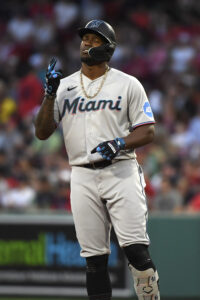
Talks between Soler and the Giants have been going on for at least the past week. As of this morning, the Giants were still reported to be in the mix but had balked at Soler’s request for a third guaranteed season. That, it seems, has changed over the course of the day.
Soler, 32, opted out of the final season of his three-year, $36MM deal with the Marlins back in November after belting 36 home runs while hitting .250/.341/.512 on the season (126 wRC+). Soler posted the second-best walk and strikeout rates of his career at 11.4% and 24.3%, respectively, and Statcast pegged him in the 81st percentile or better in average exit velocity, hard-hit rate and barrel rate.
It’s the type of power profile that the Giants have lacked in recent years. The 2023 Giants ranked 19th in the Majors in home runs (174), 24th in runs scored (674), 28th in average (.235), 24th in on-base percentage (.312) and 27th in slugging percentage (.383). The Giants notoriously haven’t had a player deliver a 30-homer season since Barry Bonds in 2004, and they’ve only had one 20-homer hitter in their lineup in each of the past two seasons (Joc Pederson with 23 in 2022 and Wilmer Flores with 23 last year).
Soler brings a wholly different brand of power. Last year’s 36 big flies were only the second-most he’s hit in a season. Soler paced the American League with 48 homers for the Royals back in 2019, and while injuries have limited him to just two 30-homer seasons in his career, he’s averaged 32 homers per 162 games played in his career. Dating back to that 2019 breakout, Soler ranks 17th among 302 qualified hitters with a .248 isolated power mark (slugging minus batting average). Overall, he’s batted .240/.331/.488 during that time.
The path Soler takes to get to his production isn’t the most straightforward. He’s a streaky hitter in-season and a volatile one from a year-to-year standpoint, with his 2019 and 2023 output teetering on excellent while his 2022 numbers were decidedly below average. Even in the 2021 season that saw Soler catch fire following a trade to Atlanta and go on to be named World Series MVP, he was hitting just .198/.288/.377 in 360 plate appearances at the time Kansas City traded him. He slashed .269/.358/.524 following the change of scenery. A three-year deal with Soler figures to come with its share of peaks and valleys, but he’s the type of bat who can near-singlehandedly carry a lineup for brief stretches, given his top-of-the-scale power.
Though he has plenty of experience in the outfield corners, Soler isn’t likely to see much time there in San Francisco. His defensive grades have continue to decline over the years, and the Marlins only played him sparingly in right field — including just 241 innings last year. Soler has only twice reached 500 defensive innings played in a season. He’ll serve as the Giants’ primary designated hitter, though it’s possible he’ll make occasional appearances in left or right field.
That’s particularly true given that Soler does offer a nice right-handed complement to left-handed corner outfielders like Michael Conforto and Mike Yastrzemski. Production against left-handed pitchers, in particular, was a problem for the 2023 Giants (.245/.306/.376). Soler’s mammoth .277/.393/.688 output against lefties last year represents an enormous boost to San Francisco in such situations.
Adding Soler to the lineup likely cuts into the playing time for J.D. Davis and/or Wilmer Flores against right-handed opponents, but that’s a trio of potent right-handed bats to be able to trot out against opposing southpaws. New backup catcher Tom Murphy (career 126 wRC+ against lefties) should help in that regard as well, as will a full season of switch-hitting catcher Patrick Bailey, who feasted off lefties but struggled against righties. Broadly speaking, the San Francisco lineup looks far more equipped to handle left-handed pitching than last year’s club.
At $14MM per year for Soler, the slugger’s decision to opt out his final year and $13MM in Miami was overwhelmingly the right call. Miami opted not to issue a qualifying offer to Soler, so they won’t receive any draft compensation for his departure, nor will San Francisco be required to forfeit a draft pick or any international money.
Prior to the deal with Soler, San Francisco’s rough $155MM payroll was more than $33MM from their 2023 levels and more than $46MM south of the team’s franchise-record payroll level. That leaves plenty of room for the Giants front office to remain aggressive in free agency, even if ownership isn’t willing to set a new highwater mark on player payroll. That’s true even if the dollars are evenly distributed over the life of the three-year term, but if the deal is at all backloaded there’ll be perhaps a bit more to work with for the upcoming season.
To that end, it’s worth noting that the Giants have been linked to high-profile names like Blake Snell, Matt Chapman and Jordan Montgomery in recent weeks. A deal with Soler shouldn’t preclude them from continuing those pursuits, although with Soler now penciled in as the primary DH, a Chapman signing could perhaps be a precursor to a trade of J.D. Davis. Time will tell whether that’s worth pondering much or goes down as one of many unanswered offseason hypotheticals. Regardless, it seems quite likely that Soler’s signing won’t be the Giants’ last significant addition this winter.
Rangers Notes: Jung, Duffy, Rotation
TODAY: The MRI revealed a minor strain for Jung, according to RangersToday.com’s Jeff Wilson and other reporters. Both Jung and manager Bruce Bochy feel Jung will be recovered for Opening Day, with some slight disagreement on the timeline — Jung said he’ll miss two weeks, while Bochy feels Jung will be sidelined for three weeks.
FEB. 16: Camp only just opened this week, but the Rangers are already facing one potentially worrisome injury situation. Third baseman Josh Jung experienced discomfort in his calf while fielding grounders today and is headed for an MRI, tweets Jeff Wilson of RangersToday.com. The club will provide further details once the imaging has been performed and evaluated by medical personnel.
Jung just turned 26 years old this week and was the fourth-place finisher in American League Rookie of the Year voting this past season. The former No. 8 overall draft pick belted 23 home runs and slashed .266/.315/.467 with sharp defense at the hot corner. Were it not for a fractured left thumb that kept him out of action for six weeks, he’d very likely have been a top-three finisher and could’ve potentially even given eventual winner Gunnar Henderson a run for his money.
At this point, there’s no indication the team believes the injury to be serious, though the pending MRI exam suggests there’s at least some degree of concern. The Rangers are relatively deep in infield talent, so in the event that Jung needs to miss any time, they’ll have options. Ezequiel Duran stepped up in Duran’s absence last season, and Josh H. Smith has ample experience at the corner as well. Veteran Matt Duffy is in camp as a non-roster player this spring and would give the Rangers a solid glove and contact-oriented bat at the position if he makes the team.
On the topic of non-roster Duffys, Matt isn’t the only one in camp. Veteran left-hander Danny Duffy also inked a minor league pact with Texas this season and could be an important depth piece for a club that will open the season with Max Scherzer, Jacob deGrom and Tyler Mahle on the injured list and all likely out into the summer. The 35-year-old southpaw hasn’t pitched in the big leagues since the 2021 season due to injuries but has been with the Dodgers (2022) and Rangers (2023) for the past two seasons while working toward a return. Texas used him as a reliever in the minors in ’23, but Kennedi Landry of MLB.com tweets that Duffy is building up as a starter in camp this time around.
It’s a familiar role for Duffy, the longtime Royals hurler who’s made 204 of his 234 career appearances out of the rotation. Aside from a brief dalliance in the bullpen in 2015-16, Duffy was a fixture on Kansas City’s starting staff from 2014-21, during which time he logged a 3.82 ERA in 1015 innings while punching out 21.3% of his opponents against an 8.2% walk rate. Duffy is now 35 years old and hasn’t pitched in the bigs since undergoing surgery to repair a torn flexor tendon in Dec. 2021. He’s pitched a total of 42 1/3 innings in the minors across the past two seasons. Expecting a full bounceback to his peak Royals form isn’t realistic, but if he’s healthy he should be a legitimate option to help the staff.
Getting any contributions from Duffy or fellow non-roster invitees José Ureña and Adrian Sampson would be a boon for the Rangers. Texas is set to enter the season with a rotation including Nathan Eovaldi, Jon Gray, Andrew Heaney, Dane Dunning and likely Cody Bradford. It’s a much weaker group than the World Series-winning outfit that finished out the 2023 season with Scherzer and current free agent Jordan Montgomery atop the staff. But general manager Chris Young has indicated he doesn’t anticipate any more additions to the big league roster at this point, strongly suggesting that the current group is the one the Rangers will carry into the season.
Evan Grant of the Dallas Morning News takes a look at the in-house depth options that stalled out last season. Former top prospects Jack Leiter, Cole Winn, Owen White and Zak Kent all struggled in various ways in ’23. Righty Kumar Rocker, the No. 3 pick back in 2022, underwent Tommy John surgery last May.
That group was expected to produce some pivotal long-term rotation pieces, but each prospect has seen his stock drop amid poor performance and/or injury. Grant notes that Leiter, who was shut down for nearly two months last year to work on his mechanics, spent the offseason working out with American League Cy Young runner-up Sonny Gray and veteran catcher Curt Casali. The trio all attended Vanderbilt (at different times, obviously). Gray worked with Leiter on simplifying his approach and his plan on the mound. Grant chatted not only with Leiter but also White and Kent about some of the changes they’ve made as they look to get back on track and contribute at a time when the Rangers will be leaning more heavily on internal pitching depth than at any point in 2023.
What Could Cody Bellinger’s Market Look Like On A Short-Term Deal?
As the top free agents continue to linger on the market, an increasing number of fans have begun to inquire — on social media, in the comments at MLBTR, in questions to the MLBTR Podcast and in our regular chats here at MLBTR — about the possibility of any of the top four pivoting to a short-term deal. MLBTR’s Darragh McDonald recently outlined the potential pitfalls in that scenario for lefty Blake Snell, whose stock isn’t likely to ever be higher than it is right now coming off his second career Cy Young win at 31 years of age. Jordan Mongtomery, likewise, probably won’t have a better platform than this past year’s postseason heroics. Like Snell, he’d be 32 next winter, which won’t do his earning potential any favors. Matt Chapman is also heading into his age-31 season.
If there’s one of the “big four” who might be best-suited to go with a short-term deal, it’s the youngest of the bunch: Cody Bellinger. At 28 years of age (29 in July), a return trip to free agency for Bellinger would come at a time when he’d still be positioned as one of the youngest names on the market. A short-term deal for Bellinger would also allow him to hit free agency next winter without a qualifying offer — he rejected one from the Cubs in November, and players can only receive one QO in their career — and it could provide him the opportunity to “prove” that his 2023 output wasn’t a fluke.
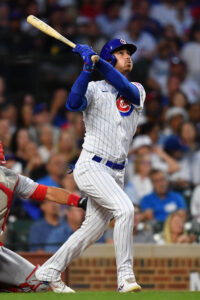
After a pair of injury-ruined 2021-22 seasons, Bellinger was non-tendered by the Dodgers. He’d undergone shoulder surgery following the 2020 season, and agent Scott Boras has unsurprisingly contended that Bellinger was never fully healthy during that pair of dreary seasons in ’21-’22, when he slashed a combined .193/.256/.355 in 900 plate appearances. The Cubs bet $17.5MM on Bellinger bouncing back to something closer to his prior Rookie of the Year and NL MVP form and were rewarded with a huge .306/.356/.525 slash with 26 homers and 20 steals.
It was an outstanding resurgence but not one without its red flags. Bellinger’s 15.6% strikeout rate was a career-low, but his 7.2% walk rate was the second-lowest of his career. More concerning to interested teams was Bellinger’s batted-ball profile. Despite his success at the plate, Bellinger ranked in the 27th percentile or lower among MLB hitters in terms of average exit velocity, hard-hit rate and barrel rate. At his peak, Bellinger was a hard-contact juggernaut who ranked among the league leaders in virtually every Statcast category of note. The opposite was true in 2023, and there are likely some teams who wonder whether he can continue to produce at such lofty levels in the absence of premium (or even league-average) quality of contact.
It puts Bellinger in a precarious situation. He surely feels he’s back to his MVP form, but players coming off such a dominant performance rarely have to take a one-year “prove-it” deal. Bellinger and Boras surely feel he’s already “proven it” and that the 2021-22 can now be framed as injury-marred outliers. Teams are clearly wary of regression, if not all the way to the miserable 2021-22 output than to something decidedly less than his 2023 output.
It’s not an identical situation to the one faced by Carlos Correa in free agency two winters ago, but there are some parallels. Both were atypically young free agents and were regarded as strong defenders at premium positions. Both had won Rookie of the Year early in their careers. Neither was at his offensive peak upon reaching free agency. Correa didn’t enter the 2021-22 offseason with the Boras Corporation representing him, but he changed agencies and hired Boras midway through the offseason.
Correa’s eventual contract — a three-year, $105.3MM deal with the Twins — shocked baseball, both due to the landing spot and to the fact that top-ranked free agents rarely settle for such a short-term arrangement. He had a pair of opt-outs baked into the contract, allowing him two more bites at the free agent apple.
A similar structure, logically speaking, could provide Bellinger some protection against another injury or regression while still rewarding his massive rebound season with a top-tier annual value. There’s some merits and risk for both parties, even if it’s not the type of deal he envisioned upon bouncing back to such lofty heights with the Cubs.
The problem Bellinger might run into, however, is finding the 2024 equivalent of the 2022 Twins. Minnesota was a clear postseason hopeful aiming to win now but also had plenty of payroll room at that late stage of the offseason. The Twins were also nowhere near the luxury tax threshold. It looked like an ideal short-term partnership (though it’s obviously since turned into at least a seven-year match).
For Bellinger, the landscape looks different. Right now, there are only five Major League teams whose projected payroll is more than $20MM south of their 2023 payroll levels. Two — the White Sox and Rockies — aren’t aiming to contend and aren’t likely to put down a lucrative short-term offer for Bellinger. A third, the Padres, is only facing such a gap between current spending and 2023 spending because they’ve actively been working to cut payroll by as much as $50MM. Signing Bellinger isn’t in the cards, barring a major last-minute philosophical shift. That’s particularly true when considering that the Padres are $22MM shy of the luxury threshold; signing Bellinger would put them right back into the tax penalty when it’s clearly been a goal to reset that level.
The luxury tax is a key issue here, too. Signing Bellinger short-term will likely require a high annual value and multiple opt-outs. For a team that’s already in luxury territory, that means a potentially exorbitant overall price. As such, when looking for Bellinger landing spots on a short-term deal, it’s best to break the 30 teams up into a few different categories. Let’s run through them…
Current Luxury Tax Payors
Phillies: Over the past week, there’s been plenty of speculation about the Phillies jumping at one of the top four free agents on a short-term deal. That’s primarily due to president of baseball ops Dave Dombrowski’s comment that he can’t promise that no further additions are coming because an unexpected opportunity can always present itself. But the Phils are a third-time payor who already have a projected $261MM of luxury obligations, putting them firmly into the second tier. Even a conservative estimate of a $25MM AAV on a short-term deal would mean paying a 62% tax on the contract’s first $16MM and a 95% tax on the final $9MM. In other words, it’d cost the Phillies around $18.5MM in taxes on top of Bellinger’s actual salary. Assuming an evenly distributed $25MM, that’s a total of $43MM in just 2024 to sign Bellinger. And, again, on a short-term deal the AAV will likely be much higher. Correa’s AAV was $35.1MM.
Astros: Houston’s $254MM of projected luxury obligations is a near-perfect match with Philadelphia. Unlike the Phillies, the Astros are only a first-time offender right now. They’d owe a 20% tax on the first $2MM of Bellinger’s deal, a 32% tax on the next $20MM and a 62.5% tax thereafter. Bellinger would push them into the third tier of penalization, meaning their top pick in the 2024 draft would be pushed back 10 spots. The Astros already have a record-high payroll. Signing Bellinger for even a $25MM AAV would cost around $8.675MM in taxes on top of his salary, require the forfeiture of their second-highest draft pick (by virtue of the QO) and knock their top pick back by 10 spots. Ouch.
Rangers: If Texas were going to push further into luxury territory than their current projection of $243MM (just $6MM over the first threshold), it’d surely be to sign a pitcher — likely Montgomery. The outfield is already largely set with Evan Carter, Leody Taveras and Adolis Garcia, with top prospect Wyatt Langford blitzing toward the majors. GM Chris Young has all but said he’s done signing Major League free agents. This match isn’t happening.
Blue Jays: The Jays are about $11MM over the first luxury barrier. They’re a second-time payor. That’d mean a 30% tax on the first $9MM or so of Bellinger’s deal, plus a 42.5% tax on the next $20MM and a 72.5% tax on anything thereafter (in addition to the same draft losses outlined for the Astros). GM Ross Atkins has said any notable addition would likely require subtracting elsewhere on the roster. The Jays could fit Bellinger into the mix by giving George Springer and Vladimir Guerrero Jr. more time at designated hitter, but Atkins’ comments make this hard to see. Just for illustrative purposes, a $25MM AAV on a Bellinger deal would cost the Jays $9.5MM in taxes, while jumping into Correa range would mean about $15.5MM in taxes (on top of his 2024 salary).
Braves: Atlanta is rolling with a Jarred Kelenic–Michael Harris II-Ronald Acuña Jr. outfield, with Matt Olson at first base and Marcell Ozuna at designated hitter. They don’t fit even from a roster vantage point, and they’re already $33MM over the tax line anyhow. It’s interesting to note that between the contracts they ate and the associated taxes, they wound up spending about $26MM to take on Kelenic, which isn’t all that far off from what Bellinger might end up costing — but that was much earlier in the offseason.
Yankees, Mets, Dodgers: The Yankees don’t really have room in their outfield, and the Dodgers/Bellinger relationship might not be the healthiest at the moment anyhow. Regardless, all three of these clubs are third-time payors who are already into the top luxury tier, meaning any additional dollars spent come with a 110% tax. Signing Bellinger to a $25MM AAV deal would mean $27.5MM in taxes. Bump that to $30MM AAV and you’re at $33MM in taxes. A $35MM AAV matching Correa comes with $38.5MM in taxes. All of that is on top of any salary for Bellinger.
Relatively Close to the Luxury Tax
Cubs: The incumbents! It’s not the spiciest take to suggest it, but this still seems like the most logical fit. The Cubs obviously wouldn’t have to forfeit any draft picks to sign Bellinger, since they’re the ones who made him the QO (although they would give up the right to receive a compensation pick). He’d “block” Pete Crow-Armstrong in center field or Michael Busch at first base, but perhaps only for a year. And, with injuries, both PCA and Busch would very likely still get their opportunities. The Cubs are $29MM shy of the luxury tax threshold and have $195MM in actual payroll commitments. Bellinger would push them well past the $203MM franchise-record mark and perhaps just over the first luxury tier, but should that matter? This is the cleanest and best fit, and a short-term arrangement should only add to the appeal.
Red Sox: Like so many of the teams on this list, if the Sox were to make one more big splash, it’d probably be on pitching (likely Montgomery). Boston is $39MM from the tax line and sits at $177MM in actual payroll commitments. They have the financial wherewithal to do this, but they also have an outfield of Tyler O’Neill, Jarren Duran, Wilyer Abreu and Ceddanne Rafaela — with DH Masataka Yoshida also in the fold. This doesn’t feel viable.
Angels: The Angels’ focus should be on pitching, but owner Arte Moreno has historically balked at long-term deals for starting pitchers. The Halos have Taylor Ward and Mike Trout in the outfield, but Mickey Moniak and Jo Adell aren’t the most exciting options for the remaining spot. Moniak hit well in 2023 but did so with a .397 BABIP and 35% strikeout rate that both scream for regression. Adell was once a top prospect but is out of options and hasn’t established himself. Moreno said this week the team will likely operate on a lesser budget in 2024, but we’ve seen time and again that he’s drawn to star hitters and Bellinger on a short-term deal would fit that mold. With $188MM in tax obligations, the Angels could sign Bellinger and still avoid reaching the threshold.
D-backs: Arizona is already at a new record payroll ($142MM) and is surprisingly within striking distance of the $237MM tax line ($189MM). Bellinger wouldn’t put them over, but signing him would require a level of aggression we’ve not seen from the Snakes since they shocked the world with their Zack Greinke signing nearly a decade ago. The Diamondbacks don’t need outfielders, necessarily, but center fielder Alek Thomas hasn’t proven himself at the plate. On a short-term deal, could GM Mike Hazen feel opportunistic?
Padres: The entire baseball world has learned to never say never with regard to San Diego president of baseball operations A.J. Preller, but in an offseason where they Padres have been trying to cut payroll by as much as $50MM and have pronounced questions at the back of the rotation, this feels like a bridge too far. If the Friars were to trade Ha-Seong Kim, pick up some kind of arm in that deal and then reallocate some of the savings to Bellinger, you could almost squint and see it. Typing this feels crazy, but that’s often how I feel when writing about Padres moves that actually did happen as well. The Padres are $25MM shy of the tax line at the moment. Signing Bellinger likely puts them over for a third straight year, meaning a 30% tax on a portion of his deal.
Giants: San Francisco already signed a center fielder to a nine-figure deal. They now have an all-lefty outfield and substantial questions in the rotation. It does feel like the Giants have the capacity for one more big move — they’re $33MM from their franchise-record payroll and $24MM from the luxury tax threshold — but if they make that move it’ll probably be on a pitcher. Still, they could probably sign Bellinger short-term and only cross into tax territory by $5-8MM. And since they didn’t cross the CBT threshold in ’23, they’d only be hit with a 20% tax.
Nowhere Near the Luxury Tax
Royals: Let’s get weird! I don’t think anyone seriously expects the Royals to sign Bellinger … but no one seriously expected the Twins to sign Correa. They also didn’t expect the Royals to sign Bobby Witt Jr. to a $288.78MM extension, or to spend a (so far) combined $109.5MM on seven big league deals in free agency this winter. But here we are! This would be a shocking fit — more shocking than the Twins signing Correa — but take a look at the Kansas City outfield candidates: MJ Melendez, Kyle Isbel, Drew Waters, Nelson Velazquez, Hunter Renfroe, Dairon Blanco. Bellinger is an immediate upgrade over every member of that group. The Royals currently project for a $115MM payroll and $161MM of luxury obligations. They’re around $28MM shy of their franchise-record payroll, which came back in 2017 and under a different owner.
Mariners: The M’s have been operating under TV-related budget constraints. President of baseball operations Jerry Dipoto has never signed a free agent hitter to a contract larger or longer than Mitch Garver‘s two-year, $24MM deal since taking the reins in Seattle. This doesn’t seem particularly plausible barring a late change in approach from ownership. Perhaps the allure of signing a star like Bellinger short-term would be enough to spur that tactical shift. It’s unlikely, but we’re talking about dark horses here, aren’t we?
Twins: Like the Mariners, the Twins have been working to reduce payroll. Their current projection of $123.5MM is right around the bottom end of their reported $125-140MM target range for payroll. Minnesota has been open to adding a right-handed-hitting outfielder and further rotation depth. They did this with Correa, so let’s not rule them out entirely. But if they were to, say, trade Kyle Farmer to free up $6.3MM and then make one more notable addition, a pitcher like Montgomery seems much more plausible than another lefty-swinging outfielder.
Orioles: If the Orioles make another big splash after Corbin Burnes, it seems likely to be on a pitcher. Their outfield is set with Austin Hays, Cedric Mullins and Anthony Santander, plus top prospects like Colton Cowser and Heston Kjerstad on the MLB doorstep.
Cardinals, Brewers: The Cardinals already have more outfielders than they know what to do with, and Bellinger isn’t going to displace Paul Goldschmidt at first base. Milwaukee has a similar situation in the outfield, and they’ve got Rhys Hoskins at first base.
Tigers: President of baseball operations Scott Harris suggested this week he’s not inclined to sign another “everyday-type” hitter, instead preferring to give legitimate looks to the team’s young hitters. With Riley Greene, Parker Meadows, Kerry Carpenter and veteran Mark Canha in the outfield/DH mix, plus Spencer Torkelson at first base, there isn’t a great roster fit here anyhow.
Pirates, Marlins, Reds, Guardians, Rays: Five of the lowest-payroll clubs in the game. It seems safe to say no one from this group is going to seriously pursue Bellinger, even on a short-term deal.
Nationals, A’s, Rockies, White Sox: All four of these teams are in some form of rebuild/reset. The A’s certainly aren’t going to spend this type of money. Nats GM Mike Rizzo suggested he’s done adding MLB free agents. The Rockies balked at Bellinger’s one-year price last winter and are in a worse spot now. Maybe you could call the White Sox an off-the-wall dark horse, but would GM Chris Getz forfeit a draft pick to sign Bellinger short-term, knowing he’d either opt out next winter or perform poorly enough to be an unwanted contract in 2025? Doubtful.
—
The ideal fit for Bellinger on a short-term deal is a team that’s not already a tax payor or is only minimally over the line. The Cubs have been considered something of a presumptive favorite due to Bellinger’s strong year there in 2023, but as outlined above, they also make sense both from a roster and financial standpoint. Other plausible long-shot options when considering the tax and payroll ramifications could include the Angels and Giants. The Padres could add Bellinger without paying substantial taxes, but it’d run counter to the team’s cost-cutting efforts this winter. Long-shot fits with the D-backs and particularly the Royals sound a bit more sensible than one might imagine at first blush.
We certainly don’t know that Bellinger will wind up going short-term, but he’s the most sensible candidate to do so of the remaining marquee Boras clients, and if he goes that route, it could open the door for some unexpected suitors.
Orioles Claim Diego Castillo, Designate Livan Soto
The Orioles announced Friday that they’ve claimed infielder/outfielder Diego Castillo off waivers from the Phillies. Fellow infielder Livan Soto was designated for assignment to open a spot on the 40-man roster.
The 26-year-old Castillo has bounced from the D-backs, to the Mets, to the Yankees, to the Phillies and now to the Orioles all in the span of two months. He appeared in only one game at the MLB level for Arizona last year and went hitless in a single plate appearance. A year prior, he logged 283 trips to the plate with the Pirates but mustered only a .206/.251/.382 batting line in his debut campaign in the majors.
Though he’s yet to have any big league success, Castillo possesses an outstanding track record in the upper minors. He hit .313/.431/.410 in Triple-A Reno last season, walking more often than he struck out: 17.4% versus 14.2%. Castillo has played in 177 Triple-A games to this point in his career and delivered a stout .296/.410/.407 line thanks to that keen eye at the plate and his excellent bat-to-ball skills. He’s walked 124 times in Triple-A against 125 strikeouts. Beyond that, he’s experienced at second base, shortstop, third base and in left field.
While Castillo has never been touted as a top prospect, he’s a versatile and contact-oriented hitter who can provide some depth — hence the whopping five teams he’s now been with in just two months. That said, there are reasons he’s been unable to hold down a roster spot. Castillo hit just three homers last year and has only twice reached double-digits in plate appearances. He’s never swiped more than 13 bases in a season. He’s generally considered a below-average runner with below-average power and a sub-par (albeit versatile) defensive skill set.
But Castillo has a minor league option remaining, and there’s still value in a bat-first utilityman with plus bat-to-ball skills. He can provide cover for the Orioles at a number of different positions, and as shown by last year’s .323/.445/.439 slash against lefties, his right-handed bat is particularly interesting in platoon situations.
Soto, 23, was just claimed off waivers from the Angels eight days ago. He’s hit .375/.414/.531 in a tiny sample of 71 big league plate appearances but benefited from a sky-high .469 average on balls in play during that time. Despite that strong showing in the majors, Soto has typically been a light-hitting but solid defensive shortstop in the minors. He split the 2023 season between Double-A and Triple-A in the Angels system, hitting a combined .237/.342/.358 between those two levels.
The Orioles will have a week to trade Soto or attempt to pass him through outright waivers. If he goes unclaimed, they can retain him without dedicating a 40-man roster spot.
Dodgers, Justin Wilson Agree To Minor League Deal
The Dodgers have agreed to a deal with free-agent lefty Justin Wilson, reports Robert Murray of FanSided. It’ll be a minor league pact with a spring training invite for the ACES client, Fabian Ardaya of The Athletic adds.
Wilson, 36, has been limited to just 3 2/3 innings over the past two seasons due to Tommy John surgery and a lat strain. That brief sample of work came with the Reds and saw Wilson create some intrigue with a bump back to his peak velocity levels (95.1 mph average fastball). He faced only 13 hitters as a Red but fanned seven of them and didn’t issue a walk. Surgery cut his season short, however, and he signed with the Brewers on a one-year deal with an option. The TJS rehab and subsequent lat strain wound up combining to keep Wilson off a big league mound for the entirety of the 2023 season.
Prior to those health setbacks, Wilson had enjoyed a lengthy run as a quality setup man for the Pirates, Yankees, Tigers, Cubs and Mets. From 2013-21, the lefty rattled of 458 2/3 innings of 3.43 ERA ball with 132 saves and 18 holds. He’s never had great command (career 10.7% walk rate), but Wilson has fanned just shy of 26% of hitters in his MLB career and sat north of 29% with his strikeout rate from 2017-20 after shelving his sinker and ramping up the usage of his four-seamer.
The Dodgers lost some left-handed depth in the bullpen this winter, trading Victor Gonzalez and Caleb Ferguson to the Yankees in separate swaps. Alex Vesia and Ryan Yarbrough are currently slated to manager Dave Roberts’ left-handed options in the ‘pen, with fellow southpaw Matt Gage also on the 40-man roster (and still possessing a minor league option). Wilson and veteran T.J. McFarland give the Dodgers a pair of experienced lefty relievers who’ll be non-roster invitees in camp. They’ll be joined by NRI righties Daniel Hudson, Dinelson Lamet, Nabil Crismatt and Jesse Hahn, among others, in looking to win a spot in a crowded Dodgers bullpen.
Angels, Ehire Adrianza Agree To Minor League Deal
The Angels have agreed to a minor league deal with veteran infielder Ehire Adrianza, manager Ron Washington announced to beat writers in camp this morning (X link via Rhett Bollinger of MLB.com). It’s a minor league deal, although Adrianza hasn’t completed his physical, so the Warner Sports Management client’s deal is not official just yet.
The 34-year-old Adrianza knows Washington well, having spent the majority of the past three seasons in the Braves organization where Washington was coaching before being hired back to a manager’s post in Anaheim this offseason. He’ll bring some versatility to camp and compete for a spot on the Halos’ bench.
Adrianza has appeared in the majors in each of the past 11 seasons, typically filling a bench role. He’s suited up for the Giants, Twins and Nats in addition to the Braves and sports a career .238/.308/.352 batting line in 1550 trips to the plate. He appeared in only five big league games and another 15 Triple-A contests with Atlanta last season due to an elbow injury that sent him to the 60-day IL for the bulk of the 2023 campaign.
Though his numbers from 2022-23 are unsightly (.159/.248/.187 in 121 plate appearances), Adrianza was an important utility piece for the Braves as recently as 2021, when he hit .247/.327/.401 and played six positions during Atlanta’s World Series-winning season. He’s played every position other than catcher in the big leagues — including three innings of mop-up work on the mound. At this stage of his career, Adrianza isn’t considered the plus infield defender he was in his 20s, but he’s unlikely to be a liability in the infield, either.
The Angels’ bench right now will include backup catcher Matt Thaiss and outfielder Aaron Hicks, who signed a big league deal earlier this offseason. The other two spots are more open for the taking. Former top prospect Jo Adell is out of minor league options and will need to make the club or else be traded or placed on waivers. Infielder Michael Stefanic could make the club as a bat-first utility option, but he does have a minor league option remaining. Adrianza will join fellow non-roster veterans Hunter Dozier, Miguel Sano and Richie Martin (among others) in vying for a spot on the Opening Day roster.
Marlins Made Recent Offer To Tim Anderson
The Marlins recently made an offer to free-agent infielder Tim Anderson, reports Ken Rosenthal of The Athletic. Miami has been on the lookout for help at shortstop throughout the offseason. Their interest in Anderson isn’t a new revelation, but the fact that they just recently put forth an offer is certainly of note.
The 30-year-old Anderson became a free agent back in November when the White Sox declined a $14MM club option. That would’ve seemed unthinkable a year prior, as Anderson was one of the game’s top-hitting middle infielders from 2019-22. During that time, he led all qualified big leaguers in batting average and turned in an overall .318/.347/.473 line in more than 1600 plate appearances.
Fortunes can change quickly, however, and Anderson’s 2023 season was nothing short of calamitous. His average, on-base percentage and slugging percentage somehow all clocked in south of .300; his overall .245/.286/.296 slash and one home run rendered him one of baseball’s least-productive hitters. Anderson saw his exit velocity and hard-hit rate both drop, but the larger issue may have been a sky-high 61.1% ground-ball rate — a jump of nearly 10 percentage points over the 52% mark he’d posted in his career prior to the 2023 campaign. No matter how fast a player may or may not be, it’s difficult to be productive when close to two-thirds of batted balls are hammered into the ground.
On that note, it bears mentioning that Anderson’s speed took a notable hit in 2023. It’s not uncommon for players to lose a step as they enter their 30s, but Anderson’s downturn could well be due to injury. Anderson missed nearly a month early in the 2023 season due to a left knee strain, and the fact that his average sprint speed (per Statcast) dropped by about a full foot per second seems likely to be related. He’d sat between 28 ft/sec and 28.7 ft/sec every season of his career prior to 2023, never ranking lower than the 74th percentile of MLB position players. In 2023, he averaged 27.2 ft/sec and clocked into just the 45th percentile. He still went 13-for-15 in stolen base attempts, but Anderson has always been deft in that regard, evidenced by a career 81.3% success rate.
On what would presumably be a one-year contract, Anderson is a sensible buy-low candidate for a team in need of middle infield help. The Marlins fit that bill and could certainly stand to improve the lineup — which a healthier Anderson could well achieve — but the Miami defense is already quite suspect, which makes Anderson a less optimal fit. With Jake Burger at the hot corner, Luis Arraez at second base and Josh Bell at first base, the Fish already have three questionable infield defenders. Defensive metrics have panned Anderson’s glovework at shortstop for the past two years — making it harder to blame any shortcomings on last year’s injury. Questions about his defense were substantial enough that Anderson voiced a willingness to shift to second base following the ’23 season.
Presumably, that wouldn’t be necessary in Miami, although the Marlins could conceivably shift Arraez to first base and deploy Bell more as the designated hitter. Before trading Arraez to the Marlins, the Twins utilized him more at first base than at second base due to concerns about his defense and his history of knee troubles. Such an alignment could improve the overall defensive outlook of the team, though it would leave the Marlins with the same hole at shortstop they’re currently looking to fill.
It’s not clear how much the Marlins have to spend. Miami is the only team in baseball that has not signed a free agent to a big league contract this winter. They’ve effectively sat out that portion of the market, instead operating only in minor league deals and small trades around the fringes of the roster. Catcher Christian Bethancourt and utilitymen Nick Gordon and Vidal Brujan — all acquired via trade — are the only new additions to the roster so far. Miami has also added veterans like Curt Casali, Trey Mancini, Yonny Chirinos and Matt Andriese on minor league deals.
Twins Still Interested In Michael A. Taylor
The Twins are known to be looking for rotation depth and a right-handed-hitting outfielder even as spring training gets underway, and Bobby Nightengale of the Minneapolis Star-Tribune writes that Minnesota hasn’t ruled out a reunion with Michael A. Taylor. The veteran Taylor was seeking a two-year deal earlier in the offseason, per the report, though it’s not clear whether that ask remains in place.
Taylor, 33 next month, played his typical brand of plus defense in 2023 with the Twins. He logged 960 innings in center field and wound up being credited with five Defensive Runs Saved and eight Outs Above Average. He went 13-for-14 in stolen base attempts, adding to his track record as a contributor on the basepaths. His season at the plate was a bit more unusual, at least by his standards.
Though he’s not typically known for his power, Taylor belted a career-high 21 homers in just 388 trips to the plate. His .223 isolated power mark (slugging percentage minus batting average) was 83 points higher than the .140 career mark he carried into the season. That surge came at a cost, however. Taylor appeared to perhaps be selling out for power, as his 33.5% strikeout rate was easily a career-high mark over a full season — and nearly 10 percentage points higher than the 23.9% mark he’d turned in with the Royals just one year prior. Taylor finished out the season batting just .220 with a paltry .274 on-base percentage but a heartier .442 slugging percentage.
By all accounts, Taylor enjoyed his time in Minnesota. He said back in October that he hoped to return for the 2024 season. However, he’s not likely to have the same role waiting for him if he opts to return. Byron Buxton didn’t play a single game in center field last season as he battled lingering effects from offseason knee surgery. Buxton is slated to return to center field work this season, which would leave less playing time available for Taylor at Target Field. Of course, Buxton’s injury history is among the lengthiest in baseball, so there’d likely be some stretches where Taylor is pressed into regular duty in center — but it nonetheless seems unlikely he’d approach 1000 innings in the outfield in 2024, as he did last year.
That said, even in the unlikely event that Buxton were healthy enough to play nearly everyday in center, there’d still be ways to get Taylor into the lineup. He tattooed left-handed pitching in ’23, hitting .252/.313/.602 with nine homers in only 112 plate appearances. The Twins will have lefty-swinging bats in both the outfield corners — Matt Wallner, Max Kepler — and could use Taylor to spell either player against southpaw opponents. Kepler is a premium defender himself, making him unlikely to be lifted for a late-game defensive replacement. Wallner, on the other hand, is more of a bat-first left fielder and could be swapped out in such situations. A defensive outfield with Taylor in left, Buxton in center and Kepler in right would be among the best in the game.
Taylor has drawn interest from a wide range of teams this offseason. Each of the Pirates, Angels, Padres, Blue Jays, Reds, Dodgers and Red Sox have been linked to him at various points throughout free agency. Some of those clubs (e.g. Dodgers, Jays) have since gone in other directions in their outfield search, but Taylor is still stands as a fit with many of them.
Minnesota’s front office is likely working with a somewhat limited budget. The Twins stated early in the offseason that they planned to reduce payroll due to uncertainty regarding their television broadcast situation, with Dan Hayes of The Athletic reporting a $125-140MM range as the target at the time. They’re currently projected at about $123.5MM, per Roster Resource, so there’s certainly room to add Taylor back into the fold. Adding Taylor and another arm could prove more difficult within those budgetary constraints, barring some type of late trade to free up a bit more payroll space (e.g. Kyle Farmer). The Twins have also reportedly shown interest in righty-hitting outfielder Adam Duvall. Other options on the market include Randal Grichuk, Enrique Hernandez, Tommy Pham and perhaps Whit Merrifield, who’s expecting to decide on his next team within the next couple days.