
Cardinals Recently Met With Nolan Arenado; Team Also Planning To Pursue Catching Help
It’s been a Cardinals-heavy day in the news, with the team agreeing to re-sign Adam Wainwright for what will be his 18th Major League season. St. Louis also announced that a trio of coaches will not return for the 2023 season — one day after losing bench coach Skip Schumaker, who’ll become the new Marlins manager. Beyond that pair of headlines, president of baseball operations John Mozeliak held court with the Cardinals beat, revealing in an extensive press conference that he recently met in person with Nolan Arenado about the third baseman’s looming opt-out (link via Jeff Jones of the Belleville News-Democrat). Beyond that, Mozeliak pledged that the Cardinals’ payroll will increase and unsurprisingly acknowledged he’ll be on the lookout for a successor to Yadier Molina this offseason.
Chief among those details is the team’s recent meeting with Arenado, who can opt out of the remaining five years and $144MM on his contract this winter. Mozeliak indicated there’s a sense of optimism regarding a resolution on that front, though there’s nothing official between the two parties just yet.
A year ago, that opt-out provision was far from a lock to come into play. Arenado chose to forego an opt-out clause last winter, when he could’ve returned to the market and sought a larger guarantee than the six years and $179MM he had remaining on the contract. Arenado was coming off a strong season but far from his best year, having batted .255/.312/.494 in his first season following a trade from the Rockies.
One year can make quite a difference, however. A sensational 2022 campaign has Arenado among the front-runners for National League MVP honors (alongside teammate Paul Goldschmidt), and with $144MM remaining on the deal, an opt-out now looks far likelier. The nine-time Gold Glove winner and five-time Platinum Glover turned in a sensational .293/.358/.533 batting line with 30 home runs, 42 doubles, a triple, a career-low 11.6% strikeout rate and his typical brand of elite defense at the hot corner. Despite the fact that he’ll turn 32 next April, Arenado suddenly has an easy case to eclipse the remaining money on his contract.
Granted, it’s rare for players of this age to secure contracts of more than five years in length, although exceptions are often made for the game’s top stars. One need only look to this past March, when Freddie Freeman inked a six-year deal with the Dodgers — one that, as will be the case with Arenado, begins in his age-32 season. Even if the market were to draw a hard line at five years for Arenado, there’d surely be a greater annual value than his current $28.8MM waiting for him in free agency. Annual salaries in excess of $30MM have become increasingly common, and Arenado himself at one point held the record for position player AAV ($32.5MM). That AAV took a hit when the Cardinals tacked on an additional year and $15MM at the time of the trade — but also granted Arenado a second opt-out opportunity.
Since Arenado signed his extension, Anthony Rendon ($35MM), Mike Trout ($36MM), Carlos Correa ($35.1MM), Corey Seager ($32.5MM) Francisco Lindor ($34.1MM) have all inked deals with annual salaries equal to or in excess of Arenado’s original AAV (to say nothing of Gerrit Cole’s $36MM annual value with the Yankees and Max Scherzer’s $43.33MM with the Mets). On the heels of such a brilliant season, Arenado could well find an AAV in the mid-30s over a five- or six-year term.
Understandably, the Cardinals appear to have little interest in allowing things to reach that point. Arenado’s opt-out decision is due five days after the World Series draws to a close, but the Cardinals can spend the interim trying to persuade him to stay. Tacking on an additional year or perhaps restructuring the deal to pay him at an annual rate more commensurate with the sport’s top hitters could well be in play over the next couple weeks.
All of that dovetails with Mozeliak’s comments about a forthcoming payroll hike. The Cardinals already have $105MM in guaranteed salary between Arenado, Goldschmidt, Miles Mikolas, Steven Matz, Giovanny Gallegos, Paul DeJong and Drew VerHagen (though the Rockies are reportedly covering $21MM of Arenado’s 2023 salary under the terms of the trade). Whatever salary Wainwright agreed to will add to that figure, and MLBTR contributor Matt Swartz projects just shy of $40MM in salary for the team’s 11 arbitration-eligible players. There are some non-tender candidates within — Mozeliak mentioned Alex Reyes’ name when discussing looming 40-man roster decisions, per Jones — but the majority of that arbitration class is a lock to return.
That gives the Cardinals more than $150MM on the books before even factoring in a slate of pre-arbitration players to round out the payroll. Jones notes that last year’s payroll, following trade deadline acquisitions, clocked in around $170MM. Extending or restructuring Arenado’s contract won’t necessarily impact the 2023 payroll on its own — he’s owed $35MM and the Rockies are paying that $21MM to the Cardinals even if Arenado were to opt out — but there are clearly other needs to consider.
Catching help, as Mozeliak acknowledged, figures to be among the most critical needs. Molina, a franchise icon, has played the final game of his Major League career, but the win-now Cardinals unsurprisingly aren’t content to merely hand the reins over to Andrew Knizner or prospect Ivan Herrera. Jones notes that the team will likely be looking for a starting-caliber option and not a part-time player.
The free-agent market has a handful of starting options, headlined by longtime division rival Willson Contreras but also including Christian Vazquez and Omar Narvaez. On the trade market, Oakland’s Sean Murphy will be available as the A’s continue their rebuild, and the Blue Jays have a surplus at backstop with Danny Jansen, Alejandro Kirk and Gabriel Moreno all on the 40-man roster and capable of shouldering a starter’s workload at the MLB level. Other options, of course, will emerge.
With Wainwright back, the rotation doesn’t figure to be a dire need, though depth could be pursued. The Cards will have Wainwright, Mikolas, Matz, Jack Flaherty and Jordan Montgomery as the likely top five, with Dakota Hudson, Matthew Liberatore, Zack Thompson and Jake Woodford serving as depth. Mozeliak and his staff will still likely be on the hunt for upgrades at some combination of shortstop, outfield and designated hitter, however, as the Cardinals look to inject more force into the lineup. Bullpen help is a near-annual need for every contending club.
For the time being, now that Wainwright’s status has been resolved, all roads will point to Arenado. Whether he and the Cardinals are able to reach a middle ground will not only shape the long-term outlook of the organization as we know it but also the very fabric of the 2022-23 offseason. If Arenado were to reach free agency, he’d join the likes of Aaron Judge, Trea Turner and Correa atop another star-studded open market.
A Closer Look At The Braves’ Payroll
Among the biggest questions on the minds of Braves fans at the moment is whether star shortstop Dansby Swanson will be retained, and whether the long-circulating speculation about a potential run at Jacob deGrom, who’ll opt out of his Mets contract in a couple weeks, will come to fruition in the looming offseason. Either of those endeavors would likely require a nine-figure expenditure, and while Atlanta has spent plenty of money over the past half year, it’s worth taking a deeper look to see just how plausible those scenarios — and any other major splashes on the free-agent or trade markets — might be.
Firstly, with regard to that comment about the Braves spending money, any look at their payroll should begin with a recap of president of baseball operations Alex Anthopoulos’ historic run of contract extensions. Dating back to March, each of Matt Olson (eight years, $168MM), Austin Riley (ten years, $212MM), Michael Harris II (eight years, $72MM) and Spencer Strider (six years, $75MM) have put pen to paper on long-term deals, effectively etching them in stone alongside Ronald Acuna Jr. and Ozzie Albies as the Braves’ foundation for the foreseeable future. The Braves also preemptively exercised Charlie Morton’s $20MM club option for 2023 and tacked on another $20MM club option for the 2024 season.
It might not have been quite as jarring as seeing the Rangers spend a half-billion dollars on a pair of free agents in a span of about 72 hours last winter, but the Braves still put down their own half-billion dollar investment to keep the bulk of this 2022 core intact for the long haul. That doesn’t even include the eye-opening deadline addition of closer Raisel Iglesias, whom the Braves acquired at a relatively cut-rate prospect cost because they agreed to absorb the entirety of his remaining contract from the Angels. He’ll be paid $48MM from 2023-25.
What does that do to their payroll? As one might expect, even though the majority of the extensions have bargain potential and are backloaded in nature, the 2023 books have inflated in a hurry. The Braves owe a combined $153.8MM to the 15 players who have guaranteed contracts on next year’s books. Add in a potential $12.5MM salary for Jake Odorizzi, who has a player option, and the number jumps to $166.3MM.
Further taking into account Matt Swartz’s projected $20MM in arbitration salaries to Max Fried, A.J. Minter and Mike Soroka (presuming non-tenders for Guillermo Heredia, Silvino Bracho and Tyler Matzek, who recently had Tommy John surgery) — the number balloons to $188.3MM for 19 players. Round that out with pre-arbitration players earning at or near the league minimum, and the Braves will have just over $193MM on next year’s Opening Day roster, before even making an addition.
That figure checks in north of what was this season’s franchise-record Opening Day payroll of roughly $178MM, making the Braves one of just three teams in MLB whose current 2023 payroll projection would be a record high before even making a single move. (The Rockies and Blue Jays are also in this boat, by my calculation.)
Does that mean hope is lost for a significant offseason expenditure? Not necessarily. Braves chairman Terry McGuirk told the Atlanta Journal-Constitution earlier this month that his goal is to be able to allow his front office to field one of the sport’s five largest payrolls. That doesn’t mean the Braves will spend for the sole purpose of soaring up the payroll ranks, but it’s nonetheless a bold declaration from a team’s control person and the type of candor we rarely see from such personnel.
For context’s sake, the sport’s top five Opening Day payrolls in 2022, per figures from Cot’s Contracts, belonged to the Dodgers ($281MM), Mets ($264.5MM), Yankees ($246MM), Phillies ($229MM) and Padres ($211MM). The Braves already ranked ninth in Opening Day payroll this past season, and the projected increase to $193-194MM could well boost them another spot or two.
Of course, when looking at large-scale expenditures and top-five payrolls, the notion of the luxury tax has to be considered. The Braves have never before paid that tax, but if McGuirk is being earnest about fielding a top-five payroll, incurring luxury-related penalization becomes practically a given.
It should be noted, too, that while the Braves’ bottom-line payroll for the 2023 season should check in around $193MM (as things currently stand), the luxury bill is quite a bit higher. That’s the one “downside” to locking in so many stars so early; those extensions come with inherent luxury hits that would not have existed had the team gone year-to-year. Luxury taxation is based on the average annual value of a contract, so keeping Strider and Harris on one-year, pre-arbitration contracts for the 2023 season would’ve meant they’d count for around $1.5MM combined against the tax threshold. Instead, they’ll now come with a combined $21.5MM hit. Roster Resource’s Jason Martinez already has the Braves projected for a bit more than $217MM in luxury obligations — only about $16MM shy of next year’s $233MM first-tier threshold.
Perhaps the Braves will be able to find some takers for a portion of the less-desirable contracts on the books. It’s hard to imagine any team wanting much to do with the remaining two years and $36MM on Marcell Ozuna’s ill-fated four-year deal, but finding a taker for Odorizzi’s final season or the one year and $4.5MM owed to backup catcher Manny Pina is more feasible.
Still, there’s no viable scenario where the Braves could shed enough payroll to be able to re-sign Swanson and make a play for one of the market’s other top free agents without skyrocketing into luxury territory. If McGuirk and Liberty Media (the corporation that owns the Braves) are genuinely willing to push toward a top-five payroll, though, then the Braves can’t be ruled out from making ample free-agent splashes this winter.
It’s also worth bearing in mind that the team could yet have hope of extending top starter Max Fried. If that’s the case, the notion of re-signing Swanson and extending Fried alone would push the Braves into luxury territory. In other words, merely keeping the current group together will make the Braves a luxury tax payor. Adding a marquee free agent/trade acquisition (in addition to a potential Swanson and/or Fried deal) could send them hurtling toward the second tier of luxury penalization.
If the Braves are going to have a particularly active offseason — or even if they’re just going to maintain the status quo — they’re going to have to follow a Padres-esque trajectory and set themselves up as potentially annual luxury-tax payors for the foreseeable future.
Latest On Royals’ Managerial Search
The Royals are already known to have interviewed Phillies third base coach Dusty Wathan and Rays bench coach Matt Quatraro as they look for a replacement for manager Mike Matheny, who was dismissed at season’s end, and Anne Rogers of MLB.com adds (via Twitter) that they’ve also interviewed a trio of in-house candidates. Bench coach Pedro Grifol, third base coach Vance Wilson and Triple-A skipper Scott Thorman have each interviewed for the post as well, per Rogers.
That Grifol would interview for the now-vacant Royals position is hardly a surprise. He’s been a popular managerial candidate both in the past — interviewing with the Tigers in 2020, the Giants in 2019, the Orioles in 2018 — and in the early stages of the 2022-23 offseason. In addition to interviewing with his current organization, Grifol has also interviewed with the Marlins and been connected to the division-rival White Sox.
Grifol, 53, has been with the Royals since the 2013 season. In addition to his time as the Royals’ bench coach, he’s also served as the catching coach and a quality control coach. A former minor league catcher himself, Grifol has also worked for the Mariners organization, where he was the team’s director of minor league operations.
Wilson, like Grifol, Matheny and longtime Royals skipper Ned Yost, is also a former catcher. The now-49-year-old Wilson spent parts of eight seasons catching for the Mets and Tigers from 1999-2006, posting a career .250/.302/.377 batting line in 1054 big league plate appearances and notching a whopping 40% caught-stealing rate behind the dish. Wilson, who has also previously served as the Royals’ bullpen coach, interviewed for the team’s vacancy following Yost’s retirement — before the job ultimately went to Matheny. Of course, that interview was conducted when since-dismissed president of baseball operations Dayton Moore was running point in Kansas City; he’s since been replaced by longtime lieutenant J.J. Picollo.
Thorman, 40, was the Braves’ first-round pick back in 2000 — when Moore was in the Atlanta front office — and appeared in parts of two seasons as a first baseman and outfielder in Atlanta. He’s now spent eight years as a minor league coach and manager in the Royals’ system, with the 2022 campaign being his first managing at the Triple-A level. He’d previously managed the Royals’ Double-A and High-A affiliates. Given his experience in the system, Thorman knows young Royals talents like Bobby Witt Jr., MJ Melendez, Vinnie Pasquantino, Nick Pratto and others quite well.
Tigers Name Rob Metzler Assistant General Manager
The Tigers announced Tuesday that they’ve hired Rays senior director of amateur scouting Rob Metzler as a vice president and assistant general manager. His hiring comes just one day after longtime assistant GM David Chadd and the organization parted ways. Detroit also dismissed former amateur scouting director Scott Pleis earlier this month.
“I hope all Tigers fans will join me in welcoming Rob and his family to our organization,” president of baseball operations Scott Harris said in a statement announcing the move. “I am thrilled to add an executive of Rob’s caliber to lead our Amateur and International Scouting departments. Rob’s track record of success with the Rays speaks for itself, and his innovative approach to talent acquisition will help us achieve one of our main goals: to acquire, develop and retain young talent in Detroit.”
Metzler, who’s spent the past 15 years in the Rays organization, previously oversaw Tampa Bay’s scouting activities in the United States, Canada and Puerto Rico in advance of the amateur draft for the past seven of those campaigns. Prior to joining the Rays organization, Metzler was an intern with the Red Sox, with the Cape Cod League’s Brewster White Caps, and with Baseball Info Solutions. He earned a physics degree from Bowdoin College while playing baseball there and a master’s degree from the University of Massachusetts Amherst.
“We’re going to hit the ground running to ensure our processes of amateur scouting at both the domestic and international levels are the best they can possibly be, and search for the most comprehensive information possible to help inform our decision making,” Metzler said in a statement of his own. “I’d also like to thank the Tampa Bay Rays organization for an incredible 15 seasons, and I couldn’t be prouder of what we accomplished. The reason I’m here in Detroit is to bring that same energy, passion and innovative spirit, culminating with winning baseball on the field at Comerica Park for years to come.”
MLBTR Chat Transcript
Click here to read a transcript of Tuesday’s chat with MLBTR’s Steve Adams.
D-backs’ Caleb Smith Diagnosed With Ligament Tear In Elbow
Diamondbacks lefty Caleb Smith has been a diagnosed with a ligament tear in his left elbow, Nick Piecoro of the Arizona Republic reports. However, after receiving multiple opinions on the injury, he’ll first opt for a rest-and-rehab approach rather than immediately undergoing Tommy John surgery, GM Mike Hazen tells Piecoro. The team has not provided a timetable for Smith’s potential recovery.
As with any tear, the possibility of eventual surgery will linger as Smith works through the rehab process. However, given the timing of the injury — Smith pitched in the D-backs’ final game of the season but departed with a trainer — he’d have been in line to miss the entire 2023 campaign even if he’d undergone surgery right away. If the tear is minimal enough that doctors feel he has a chance for it to heal without surgery, there’s little reason for him not to try the rehab route before going under the knife. That at least leaves the door open for him to pitch in 2023, and if he has surgery in a couple months’ time anyhow, he’d still be on track for an early 2024 return.
Regardless of whether he eventually requires surgery or is successful in rehabbing the tear, it’s quite possible that the ligament issue will bring an end to Smith’s tenure with the Diamondbacks organization. The 31-year-old southpaw is eligible for arbitration for the third and final time this winter, and MLBTR contributor Matt Swartz projects him to receive a raise from $2MM to $2.7MM. With the specter of major surgery looming in a worst-case scenario and a presumably months-long rehab process on the docket even in a best-case scenario, Smith becomes an even clearer non-tender candidate than he already was.
Smith has had an up-and-down tenure in Arizona, splitting time between the bullpen and rotation with a few promising stretches but a general lack of consistency. He looked like a viable trade candidate for the D-backs early in the summer of 2021, pitching to a 3.08 ERA with a 26.9% strikeout rate (albeit against a bloated 11.6% walk rate) in 64 1/3 innings. Smith, however, was blown up for an ERA north of 12.00 over his next six starts, causing him to lose the rotation spot he’d seized at the beginning of June.
A solid finish out of the bullpen in 2021 (2.70 ERA in 26 2/3 innings) kept Smith in the team’s plans and set the stage for him to occupy a bullpen role full-time in 2022. He gave the Snakes 70 innings of 4.11 ERA ball this past season but did so with the worst full-season strikeout and walk rates of his career (21.5% and 12.9%). Since his Aug. 2021 shift to the bullpen, Smith has a solid 3.72 ERA but lackluster marks in strikeout rate (21.5%), walk rate (12%), ground-ball rate (30.6%), homers per nine innings (1.68), FIP (5.28) and SIERA (4.60).
The Orioles Struck Waiver Gold Last November
The last time left-hander Cionel Perez was tagged on a post at MLBTR was 11 months ago, when the Orioles announced they’d claimed him off waivers from the Reds. Ditto righty Bryan Baker, whom the Orioles claimed from the Blue Jays two weeks prior. They were the definition of innocuous offseason moves at the time: a last-place team claiming a pair of little-known relievers who’d been waived by non-playoff clubs performing garden-variety 40-man roster maintenance. The moves were met with the expected cynicism associated with waiver claims of this ilk.
At the time, it wasn’t wholly clear whether either would even survive the offseason on Baltimore’s 40-man roster. Perez was out of minor league options, so he’d have to win a big league spot during Spring Training or else be subjected to waivers a second time. It’s not at all uncommon for fringe 40-man players in that spot to eventually be designated for assignment when a team signs a free agent, acquires an established player via trade, or claims someone else on waivers.
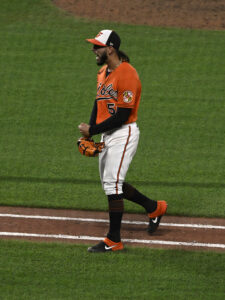
Fortunately for the O’s, both Perez and Baker indeed survived the winter on their 40-man roster. Perez fired six shutout innings with just three hits and two walks against seven strikeouts during the truncated Spring Training. Baker tossed four innings of one-run ball. Both found their way onto the Opening Day roster. Prior to this year, Perez had pitched to a 6.04 ERA in 50 2/3 MLB innings, including a 6.38 mark in 2021. Baker had one MLB inning to his name.
Before long, Perez found himself building a strong start to his 2022 season, however, solidifying his hold on a place in Brandon Hyde’s bullpen. He opened the year with 9 2/3 shutout frames, and while an 8-to-4 K/BB ratio along the way was a bit less impressive, he followed that strong first month with seven more innings of one-run ball and an 8-to-2 K/BB ratio. By the time the Orioles’ game on June 1 drew to a close, Perez had pitched 16 2/3 innings with a 0.55 ERA, a 25.8% strikeout rate, a 10.6% walk rate and a 51.2% ground-ball rate.
Along the way, Perez increasingly began to incorporate a new pitch into his repertoire: a power sinker that averaged a hearty 96.6 mph. He’d never thrown a sinker in a Major League game before, and Perez used the offering sporadically through the season’s first three months, only flashing it 9.6% of the time. In mid-July, however, Perez committed to the pitch more decisively, and from July 16 through season’s end he used that new sinker at a 22.4% clip. His four-seamer, which he’d previously thrown 52.4% of the time, saw its usage rate dip to 36.9%.
Perez posted a sparkling ERA both pre-sinker and post-sinker, but the secondary numbers suggest that Perez’s success with the sinker was more sustainable than without. Once he leaned more heavily into the new pitch, he fanned 25.2% of his opponents, walked 9.0% of them, induced grounders at a 52.8% rate and yielded an 88.2 mph average exit velocity. Prior, those rates were 22%, 8.9%, 50% and 89.6 mph. The gains weren’t Earth-shattering, but Perez’s results were better once he gained more comfort with his new pitch. Seventy percent of the sinkers that were put into play against Perez were grounders.
Good as Perez was in 2022, there’s likely some regression in store. His .284 average on balls in play isn’t especially fortunate, but few pitchers can sustain marks as low as Perez’s 0.31 HR/9 and 4.3% homer-to-flyball ratio. He’s also unlikely to continue stranding 87.4% of his runners moving forward — a rate that ranked ninth in MLB (min. 50 innings) behind a collection of some of the game’s most proficient strikeout artists. Still, there’s not much about his 2022 season that portends a complete implosion next year.

Baker took the opposite route of Perez, getting hit hard and hit often early in his first extended look at the MLB level. Through June 19, he’d been tagged for a grisly 5.60 ERA in 27 1/3 innings of bullpen work. The O’s opted to stick with him rather than option him to Triple-A, however, and they’re likely quite glad they did.
Baker threw his changeup less than 10% of the time in those first two-plus months but more than doubled his usage to 21.4% from late June through season’s end. Meanwhile, he continued to up his fastball velocity, averaging 97.3 mph over the final few months after sitting just 95.2 mph through his first 27 1/3 innings. From June 24 through season’s end, Baker posted a 2.13 ERA, 29.6% strikeout rate and 8.9% walk rate.
It’s an open question whether he can sustain the velocity gains he picked up during the season, but his changeup was a devastating out pitch for him down the stretch. Baker finished off 48 plate appearances with a changeup in 2022, surrendering only two hits (both singles) and racking up 25 strikeouts in the process. Statcast credits him with a hearty 37.7% whiff rate on the pitch and gives his opponents credit for an expected wOBA of just .123. Hitters averaged just 83.1 mph off the bat when they put Baker’s changeup in play — with 55% of those batted balls taking the form of grounders.
Neither Perez nor Baker will draw the fanfare of up-and-coming Baltimore stars like Adley Rutschman and Gunnar Henderson, but that doesn’t mean they can’t fill key roles as the team looks to continue its emergence from an arduous rebuild. Perez is controllable for another four seasons, and Baker can be controlled for five more years. There’s some obvious volatility when it comes to year-over-year performance with relievers, so perhaps Perez and/or Baker will come crashing back to Earth at some point. For now, however, the O’s have what looks like a pair of setup men they acquired for free — a quality lefty/righty combo that’ll help to form a bridge to fellow out-of-the-blue breakout Felix Bautista.
Keep in mind that this is the same Orioles team that traded another waiver wire All-Star, Jorge Lopez, prior to the Aug. 2 trade deadline. Building quality bullpens has proven to be an Achilles heel for countless front offices, but at least for the 2022 season, the O’s made it look downright easy. Their ability to continue doing so could well be as important to turning the tide as the arrival of many of the system’s vaunted top prospects.
The Guardians Have Some Middle Infield Decisions To Make
Two months ago, I wrote about Andres Gimenez‘s 2022 breakout and how it was a critical factor in propelling the Guardians toward what would eventually be their first division title since 2018. Gimenez finished strong following that Aug. 30 writing, going on to bat .282/.387/.385 in his final 137 plate appearances.
For the season on the whole, Gimenez batted .297/.371/.466 with 17 home runs, 26 doubles, three triples and 20 steals — pairing that all-around offensive value with some of the game’s best defense at second base. Even if you expect some regression based on this year’s .353 average on balls in play — Statcast pegged him with an “expected” .257 batting average, based on the quality and frequency of his contact — Gimenez still looks like a strong defensive infielder with quality on-base percentages, some power and plenty of speed.
The excellence of Gimenez’s season goes a long way toward justifying the organization’s trade of Francisco Lindor, at least from a pure roster standpoint. Lindor was terrific in his second season with the Mets, but Guardians ownership was never going to give Lindor the type of contract he received in Queens, and Gimenez showed that he can be a building block himself. With four years of club control remaining, he could be — or at least should be — an offseason extension candidate.
Of course, Gimenez alone was not the sole return for Lindor. Also acquired in that swap was another longtime top infield prospect of the Mets: Amed Rosario (plus outfielder Isaiah Greene and right-hander Josh Wolf). Soon to turn 27, Rosario perhaps hasn’t lived up to the sky-high expectations set when he was ranked among the top five to ten prospects in all of baseball, but he’s settled in as a solid option for the Guardians at shortstop. He hit .283/.312/.403 in 670 plate appearances this season, bringing his collective output in two seasons with Cleveland to .282/.316/.406. By most metrics, this was also his best defensive season (though Statcast disagreed, grading him at seven outs below average).
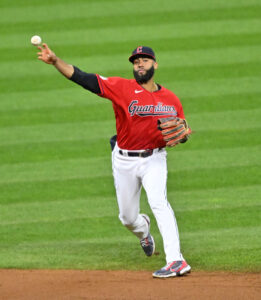
Unlike Gimenez, however, Rosario’s contract status isn’t quite so favorable. Despite his youth, Rosario debuted with the Mets way back in 2017 and spent three full seasons as a regular with them. As such, he came to the Guardians with “only” three seasons of club control remaining. He’s now coming up on the third and final of those three seasons.
Rosario not only has just one season of club control remaining — he has one relatively expensive season of control remaining. MLBTR contributor Matt Swartz projects a $9MM salary for Rosario next year in his final season before free agency. For a solid everyday shortstop with at least an average bat, that’s a reasonable price to pay. Rosario hit 11 home runs, stole 20 bases, knocked 26 doubles and paced the Majors with nine triples. Baseball-Reference’s version of wins above replacement (which uses Defensive Runs Saved as the primary defensive component) pegged him at 4.1 WAR. FanGraphs’ version (which uses Ultimate Zone Rating and Statcast’s OAA) pegged him at 2.3 WAR. Any way you slice it, Rosario looks like a good value at that rough price point.
Then again, that’s simply looking at the situation in a vacuum — which few front offices have the luxury of doing. That $9MM figure would’ve represented about 13% of the Guardians’ Opening Day payroll from the 2022 season. Cleveland only has a combined $18MM in guarantees on next year’s books, but their arbitration class could tack another $37MM or so onto the ledger. Add in another 15 pre-arbitration players at or around next year’s $720K league minimum, and the Guardians are right back to the $68-69MM mark at which they opened this past season — before making a single addition.
Granted, the strength of Cleveland’s young players is a large reason they defied expectations and won the AL Central in 2022, and it’s justifiable to suggest that they could effectively run out nearly the same group again in 2023 and be competitive. Doing so, however, would rely on replicating this year’s uncanny level of health; the Guardians had by far the fewest IL days of any team in baseball. There’s also the simple fact that even with a roster good enough to take the division, the Guards fell in the ALDS. The very fact that they had a postseason run at all could provide some extra revenues and boost payroll in 2023, but the extent to which that might be true isn’t clear at this juncture.
Beyond the payroll implications is the simple fact that Cleveland is rife with middle-infield options and could look to fill Rosario’s role internally while reallocating that salary to other areas of need. Gimenez rose through the minors as a shortstop and has thrived there in limited Major League work, posting six Defensive Runs Saved, five Outs Above Average and a 2.3 Ultimate Zone Rating in just 452 innings. There’s good reason to believe that he could slide to the other side of the bag and not only handle the position but even improve Cleveland’s infield defense.
Looking beyond Gimenez and Rosario, Tyler Freeman and Gabriel Arias both made their MLB debuts in 2022 and have been considered among the organization’s best prospects for the past couple seasons. Neither hit much in the Majors, and Arias struggled in Triple-A as well, but both are young and at least on the cusp of MLB readiness. Freeman, who fanned in just 9.3% of his Triple-A plate appearances, seems to fit a brand of Cleveland baseball that particularly emphasizes bat-to-ball skills.
Elsewhere in the minors, the Guardians have touted 21-year-old Brayan Rocchio, though he has just 33 games in Triple-A under his belt and struggled at the plate as one of the younger players in that league. Jose Tena gives Cleveland yet another 21-year-old middle infield option who’s already reached Triple-A; he’s not as highly touted as Rocchio but did bat .267/.306/.419 between Double-A and Triple-A in 2022.
Depending on which of the in-house middle infield prospects forces his way onto the big league roster first, Cleveland could deploy Gimenez at either middle infield spot. Freeman, for instance, has played plenty of shortstop but is generally regarded as a future second baseman. Rocchio and Arias, meanwhile, have drawn plus grades for his glovework at shortstop in scouting reports — as did Gimenez during his prospect days. The logjam of talented, young, up-the-middle defenders is hardly a true “problem” for the Guardians, though, and Gimenez’s ability at either spot gives the team the luxury of letting the situation play itself out in Spring Training and early next season.
Suffice it to say, there are plenty of options for Cleveland in the middle infield if they look to move Rosario and spend the roughly $9MM or so he’d command in another manner, be it in the outfield, behind the plate or to deepen an already excellent pitching staff. The question facing the front office this winter is whether it’s prudent to spend more than 10% of the 2023 budget on Rosario when the organization is flush with talented middle-infield options who could play a key big league role for the league minimum.
There’s certainly an alternative scenario where they keep Rosario and trade some middle-infield talent to bolster another position on the roster, so Rosario shouldn’t necessarily be viewed as a sheer lock to be traded. That said, history tells us the Cleveland organization will be plenty comfortable listening to offers on him this offseason. And, given the number of teams that are on the lookout for middle infield help every offseason — and the number of teams for which that projected $9MM salary wouldn’t be nearly so cumbersome — it’s easy enough to connect the dots and see that a trade is at the very least quite plausible.
Marlins Down To Four Managerial Finalists
11:30am: Heyman tweets that the Marlins have narrowed the group down to four and expect to make a decision soon. Heyman tweets that the Marlins have narrowed the group down to four and expect to make a decision soon. Raul Ibanez was interviewed early in the process but is not among the four, Heyman adds.
Craig Mish of SportsGrid and the Miami Herald reports that former Mets skipper Luis Rojas, who’s currently the Yankees’ third base coach, also secured a second interview, suggesting that he’s the fourth (and apparently last) finalist in the mix for the job.
9:37am: The Marlins are continuing to narrow the field in their search for manager Don Mattingly’s successor and have deemed a handful of names to be finalists in their search. Per Marc Topkin of the Tampa Bay Times, Rays bench coach Matt Quatraro and Astros bench coach Joe Espada are among a “small field” of finalists in Miami. Jon Heyman of the New York Post adds Cardinals bench coach Skip Schumaker to the list of finalists.
Both Quatraro and Espada were considered finalists in last offseason’s Mets managerial search, before the team ultimately hired a more experienced option in the form of veteran Buck Showalter. The Marlins, it seems, are taking a different approach; the entire group of known candidates to have interviewed in Miami would be first-time managers at the big league level. Quatraro and Espada have both interviewed with at least five teams for managerial vacancies in recent years.
Schumaker, meanwhile, is a fast-rising name in the coaching ranks himself. The former big league utilityman was playing in the Majors as recently as 2015 and landed his first Major League coaching gig when the Padres named him first base coach in the 2017-18 offseason. San Diego eventually elevated him to the unusual title of “associate manager,” before the Cardinals, for whom he played eight Major League seasons, tabbed him as their new bench coach a year ago. Along the way, Schumaker has also interviewed for managerial vacancies with the Mets and Red Sox.
Other names known to have interviewed thus far include Royals bench coach Pedro Grifol and Phillies third base coach Dusty Wathan. Braves bench coach Walt Weiss reportedly declined an opportunity to interview, though the fact that there was even interest suggests that the Marlins aren’t dead-set on hiring a rookie skipper. Weiss spent four seasons as the Rockies’ manager from 2013-16.
MLBTR Chat Transcript
MLBTR owner Tim Dierkes just wrapped up the first of MLBTR’s new team-specific offseason outlook chats not long ago (Cubs), but that doesn’t impact our weekly Tuesday chat here at MLBTR. Click here to read a transcript of today’s chat with Steve Adams.