
Injury Notes: Robertson, Benintendi, Means
Phillies right-hander David Robertson threw a bullpen session yesterday and went through fielding drills, tweets Scott Lauber of the Philadelphia Inquirer. That’s the first baseball activity for the veteran closer since sustaining a calf strain while celebrating Bryce Harper‘s home run during the team’s Wild Card win over the Cardinals. Robertson was left off the roster for the Phillies’ NLDS showdown with the Braves, but throwing off a mound and running through some fielding drills Monday at least opens the door for him to be reinstated for Philadelphia’s NLCS date with San Diego. The Phils will make a formal announcement on their NLCS roster by 10am PT this morning.
A few more injury items of note…
- Yankees outfielder Andrew Benintendi received an injection in his wrist this week after experiencing continued pain in his ailing right wrist, tweets MLB.com’s Bryan Hoch. Benintendi underwent surgery in early September after suffering a hamate fracture in his wrist and has not appeared in a game since. There’s been hope that, if the Yankees advance beyond today’s ALDS Game 5 against the Guardians, that he could potentially return for the ALCS, though the latest update on him casts plenty of doubt on that possibility. If the Yankees were to advance, they’d have to announce an ALCS roster by 10am CT tomorrow. Benintendi hit .304/.373/.399 with five home runs in 521 plate appearances prior to his injury — including a .254/.331/.404 output in 131 plate appearances with the Yankees (following a trade from the Royals).
- Orioles lefty John Means underwent Tommy John surgery back in late April, and just shy of six months later he’s resumed throwing. Means shared video his session yesterday, labeling it “day one” of his return to a throwing program. There’s still a long road back from this point, as Means isn’t throwing anywhere near 100% at this juncture and will have plenty of milestones to clear as he rehabs his new elbow ligament and eventually builds up strength to return to a Major League mound. An early summer return in 2023 would be a good outcome, though each pitcher’s recovery from Tommy John surgery varies. Means, who’s pitched to a 3.81 ERA in 356 2/3 innings since making his big league debut with the O’s, signed a two-year, $5.925MM deal covering the 2022 season and 2023 season but is under club control via arbitration through the 2024 campaign.
White Sox Appear Likely To Move On From Jose Abreu
For the past nine seasons, Jose Abreu has been a White Sox mainstay, serving as their primary first baseman and displaying uncanny durability by appearing in 93.6% of the team’s possible games. With his three-year, $50MM contract now drawing to a close, however, it’s fair to wonder whether the 35-year-old (36 in January) has played his final game with the ChiSox. USA Today’s Bob Nightengale wrote recently that the Sox plan to let Abreu move on in free agency this winter, and Daryl Van Schouwen of the Chicago Sun-Times offers a similar sentiment, writing that the Sox are planning to move Andrew Vaughn back to his natural position, first base.
Certainly, there’s room for both Vaughn and Abreu on the roster, but such an arrangement inherently pushes the Sox to divide first base, designated hitter and corner outfield duties between Abreu, Vaughn and slugger Eloy Jimenez. Both Vaughn and Jimenez are among the game’s worst-ranked defenders in the outfield. Jimenez has posted -15 Defensive Runs Saved and -16 Outs Above Average in 1957 career innings in the outfield. Vaughn effectively matched those totals (-14 DRS, -16 OAA) in 2022 alone, through just 645 innings. Moving on from Abreu would allow Vaughn to play his natural position with Jimenez seeing the lion’s share of playing time at designated hitter.
Also telling is Van Schouwen reporting that the Sox’ decision to re-sign Abreu the last time he reached free agency, following the 2019 season, was a decision directly from owner Jerry Reinsdorf. The front office “was not 100% behind” the idea of re-signing Abreu to a long-term deal, but Reinsdorf himself put forth the $50MM offer to Abreu after the slugger had accepted a one-year, $17.8MM qualifying offer.
On the one hand, that ownership-driven decision saddled the team with some less-than-ideal defensive alignments for the next three seasons. Jimenez was already established at the time of the signing. Vaughn had already been drafted and was widely expected to be a fast riser through the system. There was no clear defensive fit on the roster for all three.
On the other, Abreu more than justified the expenditure, playing all but 15 of the White Sox’ games over that three-year term and posting a combined .289/.366/.489 slash (137 wRC+). He was the decisive first-place finisher in 2020 American League MVP voting and followed that with a 30-homer campaign in 2021. Even this past season, as Abreu’s power dipped, he topped a .300 batting average and struck out in a career-low 16.2% of his plate appearances.
That said, merely writing off this year’s power outage would be an oversimplification. Abreu’s .304/.378/.466 batting line was still excellent (137 wRC+), but he turned in a career-high 47.9% ground-ball rate and elevated the ball with diminishing frequency as the summer wore on. He hit just four home runs after the All-Star break and only six from July 1 through season’s end. Two years removed from hitting 19 home runs in the truncated 60-game season and watching a Herculean 32.8% of his fly-balls leave the yard for home runs, Abreu hit just 15 homers through 157 games and saw that HR/FB ratio plummet to 9.6%.
Again, there’s little denying that Abreu’s end-of-the-day results in 2022 remained excellent, but they were buoyed by a .350 average on balls in play that a plodding slugger of his ilk will be hard-pressed to sustain, particularly if nearly half his batted balls are hit on the ground. Furthermore, the White Sox and any other potential suitors will be more concerned with what they project him to do moving forward. If there are doubts about his ability to elevate the ball and rediscover his power stroke, that’ll weigh on his earning power in free agency. However, if other clubs are confident in his ability to either repeat his 2022 output or, even better, reestablish himself as an annual 30-homer threat, then Nelson Cruz has proven that there could be healthy paydays even into a player’s early 40s.
The other element to consider in Abreu’s future with the Sox, or lack thereof, is the team’s already bloated payroll. Chicago has $121MM in guaranteed money on next year’s books, per Roster Resource, and that’s before exercising Tim Anderson‘s $12.5MM club option and before outfielder AJ Pollock likely exercises a $10MM player option. Add in a projected $27.4MM in arbitration salaries (courtesy of MLBTR contributor Matt Swartz), and the South Siders are at a payroll of roughly $170MM, not including pre-arbitration players to round out the 26-man roster.
This past season’s $193MM Opening Day payroll was a franchise record, and the Sox are within striking distance of that sum before even making a single move to address the 2023 roster. Viewed through that lens, it’s less surprising that the Sox appear poised to move on from their longtime first baseman, even if it won’t be an easy sell for fans who’ve grown to love Abreu during his nine years with the team.
Twins Likely To Explore Catching Market This Offseason
Though the Twins’ top priority at the moment is likely ascertaining whether they have a real chance to extend Carlos Correa before he formally triggers his opt-out clause, they’ll head into the winter with a lengthy list of needs. Among the priorities will be looking for some help behind the plate. President of baseball ops Derek Falvey recently spoke of the “co-catcher” model — that is, two catchers splitting time more evenly rather than a conventional starter/backup committee (link via Aaron Gleeman of The Athletic). He implied that there’s “an opportunity to match up” right-handed-hitting Ryan Jeffers with a partner who can provide some more offense against right-handed pitching.
Falvey notably emphasized that Jeffers isn’t viewed as a strict platoon candidate, but there’s little denying that the 25-year-old has been vastly more productive in platoon matchups to this point in his career. Jeffers hit .306/.377/.532 in a small sample of 70 plate appearances against southpaws this season and carries a career .263/.344/.450 output against left-handers. Comparatively, he’s batted just .185/.256/.361 against right-handers. From a pure power standpoint, Jeffers’ .187 ISO against lefties and .176 mark versus righties are comparable, but Jeffers strikes out more often and walks less against same-handed opponents. He also makes far less hard contact against righties and pops up nearly four times as often in those matchups as he does against lefties.
While the pure offensive splits do speak to a potential platoon scenario being advantageous, it’s also worth pointing out that Jeffers is still young and any such numbers are coming in a small sample. Though he’s been a prominent factor in the Twins’ catching mix since late in the 2020 season, injuries have limited his availability. Most recently, spent more than two months on the injured list this season due to a fractured thumb. Considering that Jeffers hit .276/.362/.427 against righties in his final full minor league season (2019), the Twins may not want to completely cut off his avenue to at-bats against right-handed pitching; there’s still time for him to improve in that regard.
Beyond that, limiting Jeffers to a platoon setup inherently subtracts as quality defensive player from the lineup. True, Jeffers’ 19% caught-stealing rate is five percentage points below the league average during his three years in the Majors, but he regularly grades out as a strong framer and has long drawn praise for his receiving skills on the whole. In about a season’s worth of innings over the past two years, he’s been credited for eight Defensive Runs Saved.
Still, there’s some obvious cause to add not just catching option who can provide some clout against right-handed opponents, but one who can shoulder the workload in the event of any additional absences from Jeffers. This year’s injury was fluky in nature, but the Twins’ system is generally thin on catching prospects at the moment, so adding a veteran who can step up and take a bigger role, if needed, makes good sense.
Unfortunately, among this year’s group of free-agent catchers, the options in that regard are fairly limited. Certainly, the market’s top catcher, Willson Contreras, would provide some extra thump against right- and left-handed pitching alike (and bring more than enough bat to occasionally mix in at DH), but the competition for him figures to be strong. Some lefty-swinging backstops are available in the form of Omar Narvaez and switch-hitting Tucker Barnhart, but neither did much against righties or lefties in 2022. Both are coming off down seasons, though Narvaez in particular does carry a career .268/.345/.406 line against right-handers. The trade market will present everything from top-tier regularsi (Oakland’s Sean Murphy) to out-of-options rolls of the dice (the Angels’ Matt Thaiss).
The quintet of Jeffers, Gary Sanchez, Sandy Leon, Caleb Hamilton and Jose Godoy combined for a .197/.275/.355 batting line while catching in 2022, equating to an 81 wRC+ that ranked 17th in the Majors. Twins catchers were far from the sport’s least-productive unit, but that’s as much an indictment on the current production (or lack thereof) from catchers throughout the league as a testament to the Twins’ catching corps. Whichever route Falvey and his staff take, some form of complement to Jeffers feels inevitable. And, with only about $52.5MM on next year’s payroll (when factoring in Correa’s opt-out and the likely exercising of Sonny Gray‘s club option), there’s plenty of room for upgrades up and down the roster.
Previewing The 2022-23 Free Agent Class: Shortstops
With the offseason drawing nearer, MLBTR will be breaking down the free-agent class on a position-by-position basis. We’ve already run through this winter’s crop of catchers, first basemen, second basemen and third basemen. You can check out the full list of this offseason’s free agents here, but today we’ll dive into yet another deep class of star-caliber shortstops who are likely to become available.
The Big Four
- Xander Bogaerts (30 years old next season)
While not technically a free agent yet, there’s no doubt that Bogaerts will opt out of the remaining three years and $60MM on his contract — if the two parties can’t first work out an extension. That’ll be the team’s focus for the next month, but failing a new long-term deal, Bogaerts will opt out, receive a qualifying offer, reject it and become a free agent for the first time in his career.
The 2022 season marked something of an odd year for the four-time All-Star and four-time Silver Slugger winner. Bogaerts’ power numbers (15 home runs, .149 ISO) dipped to their lowest point since 2017, but he also enjoyed the defensive season of his career by measure of virtually every publicly available metric (4 Defensive Runs Saved, 4.9 Ultimate Zone Rating, 5 Outs Above Average).
In seasons past, Bogaerts’ glove was seen as his primary flaw. He’s typically graded out as a below-average defender and been seen as a candidate for an eventual position change. This year’s performance will likely quiet that chatter for now, and while the drop in power is of some concern, power was down throughout the league and Bogaerts did regain some extra-base pop in the season’s final couple months.
Besides, his .307/.377/.456 batting line from 2022 was still excellent, and when looking at the past half-decade on the whole, Bogaerts owns a stout .300/.373/.507 slash with 105 homers, 177 doubles, a 9.9% walk rate and an 18.1% strikeout rate in 2737 plate appearances. He’ll play all of next season at 30 years old, and it’s reasonable to expect the market could produce at least a seven-year deal for him.
- Carlos Correa (28)
There was never much doubt, but last week, Correa publicly declared for the first time that he’ll opt out of the remaining two years and $70.2MM on his contract (barring an extension before his opt-out date, five days after the World Series). Correa will return to the open market having just turned 28 years old and on the heels of a strong .291/.366/.467 batting line in what could very well be his lone season as a Twin. He’s said all the right things about enjoying his time in Minnesota and hoping to ink a long-term deal in a setting that his young family has already grown to love, but an extension feels like a long shot.
The 2022 season wasn’t Correa’s best, but that’s only because of the lofty standards he’s previously established. Correa was 40% better than average with the bat, by measure of wRC+, but his previously Platinum Glove-winning defense fell to merely above-average, per DRS and UZR. (Notably, OAA pegged his glovework as actually slightly below average.) Twins brass has spent much of the year lauding Correa’s glovework, leadership and clubhouse presence. There’s surely some genuine interest in keeping him, but doing so would require eclipsing Joe Mauer‘s $184MM guarantee for the largest contract in franchise history — likely by a rather large margin.
Correa had plenty of injuries earlier in his career and had a pair of brief IL stints in 2022 due to a minor finger injury and a spell on the Covid list. But he’s played in 89% of his team’s games over the past three seasons and logged a hefty 132 wRC+ in that span. Since 2018, his 50 DRS are tied for sixth-most in MLB, regardless of position. His 45 OAA places him seventh.
It’s hard to imagine Correa securing the reported $330MM+ he was reportedly seeking in free agency last winter. He’s a year older now and coming off a strong but lesser season than his career year in 2021. That said, he’s still squarely in his prime, is generally regarded as a plus contributor on both sides of the ball and in the clubhouse, and he finished out the season on a high note, ranking as one of the AL’s most productive bats over the final two months. He’s also the only one of this top-tier group that can’t receive a qualifying offer (by virtue of receiving one last year).
- Dansby Swanson (29)
Traded by the Diamondbacks just six months after being selected with the No. 1 pick in 2015, Swanson made his big league debut barely one year after that top overall selection. After a few years of anywhere from lackluster to downright poor offensive output, Swanson turned a corner in 2019 and, since 2020, has been an above-average offensive player: .265/.324/.451, 62 home runs, 80 doubles, three triples, 32-for-42 in stolen bases.
Granted, by measure of wRC+, Swanson has “only” been nine percent better than league-average at the plate in that three-year span (though 16% in 2022 alone). But, for a player who provides plenty of baserunning value and has been considered anywhere from a plus to an elite defender at shortstop, that’s plenty of bat. Swanson’s 2022 season, in particular, has been sensational in the eyes of DRS (9) and OAA (20). Statcast has been particularly bullish on Swanson’s defense over the years, ranking him 13th among all big leaguers in OAA (38) and 15th in Runs Above Average (28) since the start of the 2018 season.
Swanson will receive and reject a qualifying offer from the Braves, subjecting him to draft pick compensation this winter. At 29 years old this February, he’s the second-youngest in this top tier. Swanson surely took note as both Javier Baez and Trevor Story — who also had a qualifying offer attached to him — landed six-year deals with $140MM guarantees last year at the same age last winter.
- Trea Turner (30)
Quite arguably the best shortstop on the market this winter, Turner will reach free agency for the first time on the heels of a .298/.343/.466 slash (128 wRC+) in 160 games and 708 plate appearances. Turner’s 21 homers this year were down from last year’s career-best 28, and with “just” 27 steals (in 30 tries), he’s perhaps no longer the annual threat for 40-plus steals he was earlier in his career.
That said, Turner has hit .298 or better in each of the past four seasons and has never fanned at even a 20% clip in a full Major League season. He’s batted .311/.361/.509 (133 wRC+) over the past four seasons, played in 89.6% of possible games along the way (92% since 2018) and averaged 26.5 home runs and 35.1 steals per 162 games played. Turner graded as a standout defender at shortstop in 2018 but has been about average by measure of both DRS and OAA since that time. Even if he eventually moves off shortstop, Turner’s athleticism figures to make him adaptable to a new position; he posted plus defensive grades in two months as the Dodgers’ second baseman following the 2021 trade that sent him to L.A.
Turner, who’ll turn 30 next June, is younger than Bogaerts but 10 months older than Swanson and nearly two years older than Correa. Like Bogaerts and Swanson, he’s both eligible to receive and extraordinarily likely to reject a qualifying offer, which will subject him to draft-pick compensation this winter. With the market’s very top free agents, that’s often the cost of doing business and rarely something that will cause a big-market club to withhold interest entirely — but it’s a factor that’s at least worth noting.
The ten-year megadeals that 30-year-old free agents were once occasionally able to command (e.g. Robinson Cano, Albert Pujols) have generally fallen to the wayside, as teams tend to reserve lengths of ten or more years for players who are in their mid-20s. Position players reaching the market around Turner’s age have more recently been capped at signing through age-37, which would mean an eight-year deal in Turner’s case. Given his rare blend of power and speed, his durability and his general athleticism, Turner can also expect to command a salary near the top of the AAV scale for position players.
Veterans Coming Off Solid Seasons
- Elvis Andrus (34)
At 34, Andrus isn’t the player he once was, but he still hit quite well after being released by the A’s and signing with the White Sox (.271/.309/.464, nine homers in 191 plate appearances). The 17 home runs Andrus hit this past season were his most since 2017. (It bears mentioning, too, that his release was less about his level of play than about ensuring that he didn’t receive the playing time to trigger a $15MM player option.)
A premier defender earlier in his career, Andrus now receives split grades from defensive metrics. Statcast still feels that he’s a plus defender, but DRS has given him negative marks for the past four years. If a team agrees that Andrus remains at least an above-average shortstop, this year’s rebound at the plate could net him a two-year deal. At the very least, Andrus should command a one-year, Major League contract to serve as a team’s primary shortstop.
- Aledmys Diaz (32)
Diaz has played at least 45 innings at five different positions this season: all four infield spots and left field. He was primarily a shortstop early in his career and still has more total innings there than at any position. He never graded well there, and as he enters his mid-30s, he’ll be viewed as more of a utility player. Diaz’s .255/.302/.427 line in 2022 is quite similar to the .259/.318/.433 slash he’s posted over four total seasons with the ’Stros. He’s a right-handed bat who’s shown a pretty noticeable platoon split over the past couple seasons, though early in his career he hit fellow righties better than lefties. He’s had just eight plate appearances with the Astros in the postseason thus far, going 1-for-7 and also getting hit by a pitch.
- Jose Iglesias (33)
Like Andrus, Iglesias was once considered one of MLB’s top defensive shortstops but has seen his ratings plummet. He posted a staggering -22 DRS with the Angels and Red Sox in 2021, though he bounced most of the way back in 2022 and finished with a -4 mark. OAA has him as a scratch defender over the past few years.
At the plate, Iglesias continues to post solid or better batting averages thanks to excellent bat-to-ball skills, but he still has one of the worst walk rates in the game. He hit .292/.328/.380 with the Rockies in 2022. Iglesias will turn 33 in January and, after signing one-year deals in his last two trips to the open market, will find similar offers this winter.
Notable Rebound Hopefuls
- Didi Gregorius (33)
It’s been a swift decline for Gregorius, who starred in the Bronx as the successor to Derek Jeter and looked strong in the first season of his post-Yankees career, hitting .284/.339/.488 for the Phillies while playing in all 60 games of the shortened 2020 campaign. In two seasons since, he’s flopped with a .210/.267/.345 batting line, leading to his release in August. He won’t turn 33 until February, so there’s time for him to bounce back, but the 2021-22 seasons were disastrous.
- Andrelton Simmons (33)
It’s hard to compare the defense of current players to those from prior generations, but Simmons has a legitimate case as one of the greatest defensive players ever. He’s the all-time leader in DRS, which dates back to 2002, and is fourth since the inception of UZR and OAA. He has four Gold Glove Awards and a Platinum Glove win, and Simmons would probably have more hardware were it not for a few injury-shortened seasons. Unfortunately, his bat has also cratered in recent years, with just a .216/.277/.261 slash between the Twins and Cubs in 2021-22. Among hitters with at least 500 plate appearances over the past two seasons, Simmons ranks third-worst with a 53 wRC+. The Cubs released him on Aug. 7.
- Jonathan Villar (32)
Villar hit 24 homers and swiped 40 bags with the O’s in 2019, struggled through a dismal showing between Miami and Toronto in 2020, and rebounded nicely with the 2021 Mets. The pendulum swung back in the other direction this year, as he was released by both the Cubs and Angels while hitting a combined .208/.260/.302. At his best, Villar is a switch-hitter with some power and difference-making speed, but he’s been wildly inconsistent in a career that has featured more valleys than peaks.
Depth Options
- Johan Camargo (29): Camargo had a big 2018 season with the Braves and has never recreated it, hitting .219/.271/.348 over the past four seasons. He’s a utility option but did log 186 innings at shortstop for the Phillies this year.
- Alcides Escobar (36): Escobar had a brief resurgence with the 2021 Nats, but that was the only time since 2014 his bat has been close to average. He hit .218/.262/.282 in 131 plate appearances with Washington this year.
- Marwin Gonzalez (34): Gonzalez played only 94 innings at short from 2019-21, but the Yankees gave him 134 innings there in 2022. The veteran switch-hitter is primarily a utility option, though, and this year’s .185/.255/.321 slash in 207 plate appearances leaves plenty to be desired.
- Dixon Machado (30): Machado hit .280/.359/.393 in 277 games in the Korea Baseball Organization from 2020-21 and posted similar Triple-A numbers between the Cubs and Giants this year. He’s never hit in the Majors, however, evidenced by a .226/.285/.292 batting line in 522 trips to the plate.
- Deven Marrero (32): A former first-round pick and top prospect, Marrero is a .191/.246/.279 hitter in 373 Major League plate appearances across parts of seven seasons. He saw brief time with the Mets in 2022.
- Richie Martin (28): The top pick by the Orioles in the 2018 Rule 5 Draft, Martin survived his Rule 5 season in the Majors but never found his stride, perhaps in part due to injuries. He’s now a career .212/.261/.311 hitter in 447 MLB plate appearances and has just a .240/.336/.366 slash in parts of two Triple-A seasons.
- JT Riddle (31): Riddle got some run with the Marlins in 2017-19 but has barely surfaced in the Majors since. He’s a .223/.261/.354 hitter in 797 MLB plate appearances.
- Dee Strange-Gordon (34): The fact that the 2022 Nats gave Strange-Gordon 100 innings at shortstop for the first time since 2013 says more about the team than the player. The three-time NL steals champ hasn’t logged 100 plate appearances in a season since 2019. He hit .305 in 59 plate appearances this year but did so without a walk and with just two extra-base hits. Since 2018, he’s batted .268/.293/.343 in 1150 plate appearances.
- Tyler Wade (28): Wade hit .264/.354/.328 in 145 plate appearances with the 2021 Yankees but has couldn’t duplicate it with the 2022 Angels. He’s a .214/.291/.298 hitter in the Majors but does have some defensive versatility to go along with a more palatable .279/.353/.408 slash in parts of four Triple-A seasons.
Fernando Tatis Jr. Undergoes Follow-up Procedure On Wrist
Padres shortstop Fernando Tatis Jr. underwent a second procedure on the fractured left wrist which required surgery back in March, Kevin Acee of the San Diego Union-Tribune reports. There was no setback in Tatis’ recovery from the first surgery, per the report. However, given that Tatis is also on the mend from September shoulder surgery, Padres medical staff and multiple specialists agreed that the second procedure, performed last week, could provide greater long-term stability. Padres president of baseball ops A.J. Preller tells Acee that the recovery timetable of this new surgery aligns with that of September’s shoulder operation. Tatis is expected to be ready for Spring Training.
Of course, Tatis won’t be a part of the Padres’ Opening Day roster, regardless. His nightmarish 2022 year has included not only three surgeries to address two injuries but also an 80-game PED suspension, which was handed down on Aug. 12. He cited a ringworm medication which, unbeknownst to him contained a banned substance, as the reason for his positive test and did not appeal the punishment.
The exact amount of time Tatis will miss early next season is dependent on the Padres’ performance over the next few weeks, as postseason games count toward the suspension. He was suspended for the final 48 games of the Padres’ regular season and was unpaid during that time.
Tatis, 23, originally injured his wrist during an offseason motorcycle accident that the team didn’t learn of until the lockout lifted. (Teams were barred from communicating with their players in any form during the 99-day lockout.) The shoulder issue, meanwhile, dates back to a pair of subluxations suffered during an otherwise stellar 2021 season — the first on a swing early in the season and second while sliding into second base in July. Despite the pair of shoulder injuries, Tatis not only avoided surgery but recorded a .282/.364/.611 batting line with 42 home runs and 25 steals in 130 games (546 plate appearances).
There are still 12 years remaining on the 14-year, $340MM contract extension Tatis signed following his second season in the Majors. He’ll be paid $7MM in 2023 (minus the prorated portion of that salary for any days still remaining on his suspension). He’s then owed salaries of $11MM in 2024, $20MM in 2025-26, $25MM in 2027-28 and $36MM annually from 2029-36. His contract affords him full no-trade protection through 2028 and limited no-trade protection (to 13 teams of his choosing) thereafter. If not traded in 2029-30, he’d gain 10-and-5 rights heading into the 2031 season and then once again be able to veto any trade.
Rays Name Jorge Moncada Bullpen Coach
The Rays announced Monday that they’ve named Jorge Moncada their new bullpen coach, replacing the retiring Stan Boroski, who’d spent 11 years as Tampa Bay’s bullpen coach.
Despite being just 38 years of age, Moncada has been with the Rays as a minor league pitching coach or coordinator since 2006. He briefly pitched in the Astros’ system in the early 2000s before taking a position as the bullpen coach with Houston’s affiliate in the Venezuelan Summer League in 2005, Neil Solondz of Rays Radio writes. He was hired by the Rays in 2006 and has since spent seven years as the Rays’ VSL pitching coach, another two as a Class-A pitching coach and, eventually, a seven-year stint as the organization’s minor league pitching coordinator — a role he held until this promotion.
Swapping out Boroski for Moncada is the only coaching change the Rays presently expect to make, tweets Marc Topkin of the Tampa Bay Times. The rest of Cash’s staff is expected to return for the 2023 season. That said, it’s possible that the Rays’ coaching ranks could be pillaged by other teams if they offer promotions. Bench coach Matt Quatraro has been seen as a manger-in-waiting for years and has already been linked to a few of the several managerial openings around the league, for instance. He’s interviewed for several positions in the past and was a finalist for the Mets’ job last offseason before Buck Showalter ultimately got the nod.
Offseason Outlook: Texas Rangers
The Rangers spent half a billion dollars last winter and still lost 94 games in 2022. The focus was always more on the 2023 season than the 2022 campaign, given the timeline of the team’s top prospects. Still, ownership likely expected better results, as evidenced by the surprising August dismissal of president of baseball operations Jon Daniels — who’d been the third-longest-tenured baseball ops leader in the game. It’s now general manager Chris Young’s ship to steer.
Guaranteed Contracts
- Corey Seager, SS: $287.5MM through 2031
- Marcus Semien, 2B: $150MM through 2028
- Jon Gray, RHP: $41MM through 2025
- Brad Miller, INF/OF: $4MM through 2023
2023 commitments: $80MM
Total long-term commitments: $482.5MM
Option Decisions
- Jose Leclerc, RHP: $6MM club option for 2023 with a $750K buyout (contract also contains $6.25MM club option for 2024)
- Kole Calhoun, OF: $5.5MM club option for 2023 (no buyout)
Arbitration-Eligible Player (service time in parentheses; salary projections via Matt Swartz)
- Mitch Garver (5.045): $4.2MM
- Brett Martin (3.151): $1.5MM
- Taylor Hearn (3.125): $1.7MM
- Dennis Santana (3.095): $1.1MM
- Jonathan Hernandez (3.041): $1MM
- Nathaniel Lowe (2.145): $4.3MM
- Non-tender candidates: Martin, Santana
Free Agents
With Young installed as the baseball operations leader, the Rangers don’t need to go through a time-consuming search for a new front office boss. However, Young’s first order of business will be to determine whether interim manager Tony Beasley, who stepped up when manager Chris Woodward was fired (just two days before Daniels), is right for the permanent job. The 55-year-old Beasley’s time with the Rangers organization predates Young by years; Young, in fact, was still active as a player and won a World Series ring with the Royals in 2015 while Beasley was just getting started as a Rangers coach.
Given his eight-year stint on the Rangers’ staff, Beasley will likely have a role of some sort offered to him, even if he’s not tabbed as the long-term skipper. It’s common, however, for a newly minted general manager or president of baseball operations to want to bring in his own field staff. Young has already interviewed Beasley, but he’ll presumably be just one of several candidates.
Whether it’s Beasley or an outside hire, the new manager and Young will be tasked with finding a new pitching coach, as co-pitching coaches Doug Mathis and Brendan Sagara were ousted earlier this month. As with any managerial change — particularly one on the heels of a disappointing season — it’s possible the switch could bring about further turnover on the coaching staff.
As far as the roster is concerned, left-hander Martin Perez’s future is the first piece of the offseason puzzle for Young and his staff to consider. Originally signed by the Rangers more than a decade ago, the now-31-year-old Perez ranked as one of the game’s top overall prospects while rising through the minor league ranks. He had a solid, if unspectacular rookie campaign as a 22-year-old, and the organization saw enough to lock Perez up on a four-year extension with multiple club options.
As is too often the case with pitchers, injuries set in and quickly derailed the promising start to Perez’s career. He had Tommy John surgery in 2014, missed most of the 2014-15 seasons as a result, and upon returning settled in as a fifth starter — never recreating the 3.62 ERA that led to a sixth-place Rookie of the Year finish for him in 2013. Perez bounced from Texas, to Minnesota, to Boston, soaking up innings at the back of the rotation and generally beginning to look the part of a journeyman.
A one-year, $4MM reunion with Texas last offseason was met with a collective eye roll by many longtime Rangers fans, but Perez not only rebounded — he turned in far and away the best season of his career. Leaning more heavily on his changeup, Perez made 32 starts and piled up 196 1/3 innings with career-best marks in ERA (2.89), strikeout rate (20.6%), FIP (3.27) and Statcast’s “expected” ERA (3.59) — among other categories. Along the way, both he and Young publicly expressed interest in working out an extension, and the two parties are set to meet this week to discuss just that. Given Perez’s strong desire to remain in place and the Rangers’ arguably stronger need for reliable pitching, it seems quite possible that Perez won’t even reach the open market.
Even if the Rangers are able to secure a new contract with Perez — which would surely be a multi-year deal at a much heftier price than this year’s $4MM rate — that’ll just be the beginning of the team’s offseason quest for pitching. Re-signing Perez will give the club some direly needed dependable innings, but even an optimistic projection of Perez’s 2023-24 seasons would bake in some regression from this year’s peak performance. It’s sensible to view Perez as a No. 3/4 starter, but there’s a need for higher-impact arms to lead the starting staff, with or without Perez.
At the moment, right-hander Jon Gray is the only clearly above-average starting pitcher on the Texas staff. Signed to a four-year, $56MM contract last winter, Gray made 24 starts and pitched to a 3.96 ERA through 127 1/3 innings, striking out 25.7% of his opponents against a strong 7.5% walk rate. He had three brief IL stints, all unrelated to his arm (blister, knee strain, oblique strain), but was a solid performer with even better secondary metrics (3.80 FIP, 3.59 xERA, 3.46 SIERA).
Right-hander Dane Dunning, acquired two years ago in the trade that sent Lance Lynn to the White Sox, has proven a capable back-of-the-rotation arm, pitching to a 4.48 ERA in 271 frames since the trade. Both Dunning’s strikeout and walk rate are a bit worse than league average, though he offsets some of that with a very strong 53.6% grounder rate. So long as the hip surgery that ended Dunning’s season doesn’t impact him moving forward, he can be slotted into the fourth or fifth spot on the starting staff.
Righty Glenn Otto and lefties Taylor Hearn and Cole Ragans were the only other Rangers pitchers to work 40 or more innings out of the rotation this season, but the results were lacking. Hearn, who finished the year with a 5.13 ERA in 100 innings, might look like a non-tender candidate at first glance but posted a 3.51 ERA and 3.56 FIP in 41 innings as a reliever. That figures to be his role moving forward. Otto made 27 starts with a 4.64 ERA but more concerning under-the-hood numbers (18.2% strikeout rate, 10.6% walk rate, 5.21 FIP). Ragans posted a 4.95 ERA in 40 innings with just a 15.5% strikeout rate.
Suffice it to say, the Rangers have a clear, pressing need for both innings and, more importantly, for a top-of-the-rotation caliber arm. The free-agent market this winter features several such arms, and it stands to reason that the rumors connecting longtime Dodgers ace Clayton Kershaw to his hometown Rangers will again swirl this winter. For the bulk of the 2021-22 offseason, it was believed that Kershaw would either return to the Dodgers or sign with the Rangers, allowing him to live in his Dallas-area home, commute to the park and spend more time with his wife and four young children.
Beyond Kershaw, the market will also include names like Carlos Rodon, Justin Verlander and Jacob deGrom, all of whom will opt out of their current contracts and return to the open market. Verlander and deGrom might prefer to sign with surefire contenders, but Rodon will be hitting the market in search of the first long-term deal of his career. If the Rangers are willing to put forth another nine-figure offer to lure a marquee free agent, he’s a viable target. Alternatively, Texas seems like a logical candidate to pursue star Japanese righty Kodai Senga, who boasts a 2.39 ERA over his past four NPB seasons, features a triple-digit heater, and is expected to be available to MLB clubs this winter.
That might seem unfathomable to some onlookers after the aggressive manner in which the Rangers spent last year, but despite doling out a half-billion dollars to Corey Seager and Marcus Semien, the Rangers’ payroll outlook is relatively clean. Texas has just $80MM in contractual guarantees in 2023 and one of the smallest arbitration classes in MLB. By 2024, they have just $74MM on the books, and because each of the Gray, Seager and Semien contracts were slightly front-loaded, those commitments won’t be quite as cumbersome in their later stages as the typical free-agent deal (which is oftentimes backloaded).
The Rangers ran a payroll of more than $142MM this season and have previously taken that number to nearly $175MM. Between that history of spending and the fact they’re still in the early years of a new stadium, it stands to reason that the Rangers will be able to spend aggressively this winter, even after last year’s spending spree. Young, in fact, has already publicly stated that owner Ray Davis has given the green light to increase payroll with the specific focus of improving the pitching staff.
If this feels like a lot of focus on the rotation thus far, well… it is. That’s due both to the acuteness of the need and also due to the fact that the Rangers’ roster is perhaps more rounded than one might expect of a 68-win team. Picking up Jose Leclerc’s $6MM option is an easy call after he returned from Tommy John surgery to post a 2.83 ERA in 47 2/3 innings. He’ll be joined by fellow Tommy John returnee Jonathan Hernandez, 2022 team saves leader Joe Barlow, the aforementioned Hearn and lefty Brock Burke, who had one of the most quietly dominant rookie showings in recent memory: 82 1/3 innings, 1.97 ERA, 27.4% strikeout rate, 7.3% walk rate.
Certainly, there’s room to add to the relief corps. Journeyman Matt Moore, like Perez, returned for a second stint in Texas this past season and (also like Perez) posted one of the finest seasons of his career. Moore, another once-vaunted starting pitching prospect who never fully recovered from Tommy John surgery, broke out as a successful high-leverage reliever this season, pitching 74 innings of 1.95 ERA ball. As with Perez, there’s good reason for the Rangers to want him back, but Moore should have no shortage of interest in free agency. Whether it’s Moore or another veteran, it’s fair to expect Young & Co. to bring in some reinforcements in the ‘pen.
Turning to the lineup, things are mostly set. Seager and Semien will, of course, form the middle-infield duo. Former Rays prospect Nathaniel Lowe turned in a second half for the ages, elevating his stock from quality regular to potential All-Star. Lowe hit .339/.399/.566 following the All-Star break, and while his poor defensive ratings could portend an eventual move to designated hitter, he’s going to rack up as many plate appearances as possible.
Top prospect Josh Jung got a late-season look at third base, and although he struggled in 102 plate appearances, there’s not much left for him to prove in Triple-A. Jung missed most of the season following shoulder surgery but beat his originally projected recovery timeline by a notable margin and returned with a flourish in Triple-A Round Rock. He’s still appeared in just 58 total Triple-A games, so perhaps the organization will want him to spend a bit more time there, but Jung’s .316/.389/.598 batting line at that level doesn’t suggest there’s too much more minor league seasoning required.
Behind the plate, the Rangers entrusted Jonah Heim with the lion’s share of the workload and figure to do so again in 2022. While his .227/.298/.399 batting line isn’t going to win him any awards, Heim smacked 16 home runs and graded out as one of MLB’s top defensive catchers. Former Twins catcher Mitch Garver, the presumptive regular on Opening Day, missed most of the season with a flexor strain that eventually required surgery. He should be healthy again in 2023, but Garver has more than enough bat to mix in as a designated hitter while shouldering a lesser portion of the catching workload than Heim.
Former top prospect Sam Huff gives the Rangers the option of carrying three catching options on the big league roster, and former Royals prospect Meibrys Viloria is also still on the 40-man roster after a strong year in Triple-A — though he’ll be out of options next year.
The window is open for the Rangers to add a veteran corner infield/designated hitter option, but there’s enough depth that they shouldn’t deem it an absolute need. A veteran catcher on a non-roster deal — particularly if Viloria doesn’t hold his 40-man spot — could also be an option. It’s possible Kevin Plawecki will fill this role; Beasley praised Plawecki’s clubhouse presence when explaining the team’s rationale for bringing in a recently released pending free agent with under two weeks remaining in the season.
More broadly, however, if there’s a clear spot in the lineup where the Rangers could invest, it’s in the outfield. Adolis Garcia has cemented his spot in the outfield mix since being acquired from the Cardinals (for cash) prior to the 2021 season, belting 56 homers and swiping 41 bases while posting standout defensive metrics in both center field and right field. The Rangers would surely prefer an improvement on his .293 OBP in that time, but Garcia’s blend of power, speed and defense have generally offset that deficiency.
Elsewhere in the outfield, however, things are more open. Leody Taveras had a decent showing in center field, and fleet-footed rookie Bubba Thompson stole 18 bases despite tallying just 181 plate appearances. That said, Thompson hit only .265/.302/.312, and even that below-average output (77 wRC+) included a grisly 30.9% strikeout rate while being buoyed by a .389 BABIP he’s unlikely to sustain. Taveras’ .344 BABIP mark isn’t as suspect, but if it dips even slightly, his already tepid offense could become untenable.
There are other options on the roster, including 25-year-old Josh Smith, 27-year-old Nick Solak and 28-year-old Eli White. Smith, however, didn’t replicate his strong Triple-A numbers in the Majors. Solak will be out of minor league options next year and might well have played his way off the 40-man roster, whether it be via non-tender or trade. (He did have a solid showing in Round Rock.) White profiles best as a fourth outfielder.
If the Rangers prefer to find an outfield upgrade on the free-agent market, there’s no shortage of options. Brandon Nimmo headlines center field options, but Garcia’s defensive prowess — plus the presence of Taveras — don’t box the Rangers into searching for a center fielder only. Corner options range from clear multi-year candidates like Andrew Benintendi and Mitch Haniger to potentially shorter-term veterans like Joc Pederson and Michael Brantley. There’s enough of an outfield need and enough spending capacity to warrant an obligatory Aaron Judge mention, but it’s hard to envision Judge realistically landing in Texas with such a pronounced need for pitching and with last year’s Seager/Semien mega-deals still being so fresh.
The alternate route for the Rangers to explore, be it for outfield or pitching help, is the trade market. Texas has a quality farm from which to deal, ranking sixth on Baseball America’s midseason ranking of MLB’s minor league systems. Given the need for pitching, one would imagine it’d be hard to deal top prospects/former first-round picks like Jack Leiter, Kumar Rocker and Cole Winn. That said, the Rangers still have plenty of position prospects who are blocked long-term on the big league roster and/or who are far enough from the Majors that Young and his staff would consider dealing them in an effort to put a winner on the field now. The aforementioned Smith, outfielder Evan Carter, infielder Ezequiel Duran, and infielders Luisangel Acuna and Justin Foscue would all hold varying levels of value.
Certainly, there’s more than enough value in the Texas system to acquire a controllable outfielder, but the Rangers are also deep enough in minor league talent they can make a compelling offer for virtually any starting pitcher that hits the trade market. A lot will need to go right in 2023 for Texas to reverse course, but this is a team that already ranked eighth in the Majors in home runs (198) and 12th in runs scored (707). There are some organic improvements to the offense on the horizon, and Young will now try to pull the right strings with the pitching staff and in the outfield to position Texas as a surprise postseason contender in 2023.
Tyler Matzek To Undergo Tommy John Surgery
Braves left-hander Tyler Matzek, who was left off the NLDS roster due to elbow discomfort, is undergoing Tommy John surgery today, manager Brian Snitker announced to reporters (Twitter link via Jeff Schultz of The Athletic). Given the timing of the surgery, Matzek will likely miss the entire 2023 season as well.
There’s never really a good time for a baseball player to undergo go Tommy John and then have to spend 12-18 months recovering, but the timing here is especially unfortunate for both Matzek and the team. After winning a fifth-straight NL East crown, the club just began its postseason run yesterday, leaving Matzek off the roster. Now that the prognosis is known, Matzek can be ruled out of the entire playoff run and then some.
2022 was his third season with Atlanta after a lengthy absence due to “the yips.” He pitched for the Rockies in 2014 and 2015 but then dealt with control problems so bad that he was relegated to the minors for chunks of the 2016-2019 period, including missing the 2017 season entirely and pitching in indy ball in 2018. He eventually made his way back to the majors and established himself as a useful piece of the Atlanta bullpen. From 2020 to the present, he’s thrown 135 2/3 innings with a 2.92 ERA, 38.2% ground ball rate and 27.4% strikeout rate, despite a high 13.4% walk rate.
In addition to that strong work in the regular season, Matzek has shown a knack for taking things up a notch in the playoffs. In 2020, he threw 8 2/3 innings with a 1.04 ERA and followed that up with a 1.72 mark in 15 2/3 frames last year, playing a big role in helping Atlanta grab their first World Series title since 1995. Unfortunately, he won’t get a chance to build on his track record of postseason heroics here in 2022. Without Matzek, the club will charge ahead in their attempt to repeat as champions with A.J. Minter and Dylan Lee as their only lefty relievers.
Looking ahead to next year, Matzek, who turns 32 next week, is eligible for arbitration again after earning $1.4MM here in 2022. He will be due a raise for 2023, with MLBTR contributor Matt Swartz projecting his salary to come in around $1.8MM. The team could consider not tendering Matzek a contract since he likely won’t be able to contribute at all in 2023. However, if they did tender him a contract, they would still be able to control him for 2024. Since Matzek will likely miss the entire season, he wouldn’t be able to push his 2024 salary much beyond his 2023 number, if at all. Players who are free agents but about to embark on a significant absence will often sign two-year deals with the signing club aware they won’t see a return on their investment until the second half of the deal, and Matzek’s final two arb years could effectively function in that way if the Atlanta front office considers him worth the gamble.
Rays Notes: Offense, Choi, Arozarena, Kiermaier, Zunino
For a fourth consecutive season, Rays president of baseball operations Erik Neander held a press conference to discuss his team’s playoff exit — this time after seeing the Rays’ lineup held to just one run in 24 innings during a two-game Wild Card ousting at the hands of the Guardians (links via Adam Berry of MLB.com and Marc Topkin of the Tampa Bay Times). In broad terms, Neander spoke of a need to improve the offense, particularly against right-handed pitching, while also praising the depth and quality of the returning pitching staff.
As a collective unit, Rays hitters batted just .234/.305/.373 against right-handed pitching. Their 24% strikeout rate against righties was seventh-worst in MLB (and trailing only one playoff club, Atlanta). Rays hitters connected on 108 homers against righties, placing them 22nd among MLB clubs.
There are varying reasons for the struggles against righties. Playing much of the season without injured lefty-swinging Brandon Lowe, a career .257/.353/.505 hitter when holding the platoon advantage, deprived the Rays of one of their top power threats against right-handed opposition. Wander Franco and Kevin Kiermaier also missed substantial time, and the Rays received a fairly pedestrian showing from deadline pickup David Peralta, who was largely acquired for his track record in this specific area. The spate of health issues pushed the Rays to lean on younger, unproven players more often than they’d have liked and also brought about more right-on-right matchups than the team would surely have preferred.
To that end, Neander indicated that changes are likely on the horizon. While of course declining to mention specific names, the team’s top decision-maker indicated a need to “raise” the team’s “offensive standards” and plainly indicated that the Rays cannot simply “stand pat and assume things will get better.” As ever with the Rays, an active offseason seemingly awaits.
Some degree of turnover was always to be expected, given the Rays’ massive slate of 19 arbitration-eligible players — the most of any team in Major League Baseball. That group will cost a projected $42MM next season, per MLBTR contributor Matt Swartz. Paired with the roughly $25MM in guaranteed contracts on next year’s books (Franco, Lowe, Manuel Margot, Tyler Glasnow and Brooks Raley), plus a handful of pre-arbitration players to round things out, that $42MM sum would push the Rays north of $70MM — a small payroll number for most organizations but one that’s more significant at Tropicana Field. The Rays ran out a franchise-record payroll in 2022 but still clocked in around $85-86MM, illustrating the relative heft of this year’s arbitration class.
As far as potential candidates for a change of scenery, Topkin unsurprisingly indicates that first baseman Ji-Man Choi “seems to be on the way out.” Given Choi’s projected $4.5MM salary, his proximity to free agency (next winter), and the fact that he’s seen his power dip while his strikeouts have risen over the past couple seasons, he stands out as a fairly obvious trade or non-tender candidate. The Rays regularly find low-cost platoon options at first base and designated hitter, which is how Choi landed in Tampa Bay in the first place. (Southpaw Ryan Yarbrough, who lost his rotation spot this year, is out of minor league options in 2023 and could earn more than $4MM in arbitration, seems like another clear candidate, in my view.)
More interestingly, Topkin suggests that the Rays will at least be open to the idea of trading Randy Arozarena this winter (though, to be clear, that’s a far cry from suggesting he’ll be shopped or that he’s likely to be moved). The 27-year-old is still controllable for another four seasons and is only projected to earn $4MM next season in the first of what’ll be four trips through arbitration as a Super Two player, so there shouldn’t be any urgency for the Rays to move him. At the same time, Arozarena could fetch some immediate MLB help in other areas if the Rays are either confident in their in-house outfield options or if they’re able to acquire some additional corner outfield help, be it via trade or free agency.
While subtractions from the arb class — be they via trade or free agency — will lower the club’s payroll, so will the expected departure of some veteran mainstays. Kiermaier’s $13MM club option will surely be declined in favor of a $2.5MM buyout after the perennial defensive standout saw his season truncated by July hip surgery. Catcher Mike Zunino, meanwhile, underwent surgery to alleviate thoracic outlet syndrome. That pair accounted for a combined $19MM in salary this past season.
Neander noted that both players have been important to the Rays over the past several seasons and that the team will be open to discussing returns with each of them. Obviously, with Kiermaier and Zunino both less than three months into their rehab from notable surgeries, the status of their recovery will be paramount both with regard to the potential fit and price point in free agency. Both figure to draw interest from other clubs, too, considering their defensive excellence and the near-perennial scarcity of quality open-market options in center field and behind the plate.
Braves Extend Spencer Strider
The Braves have extended yet another key member of their impressive young core, this time announcing a six-year, $75MM contract for right-hander Spencer Strider. The contract, which covers the 2023-28 seasons, also contains a $22MM club option for the 2029 season. The six-year guarantee buys out Strider’s final two pre-arbitration seasons, all three arbitration years and what would have been his first free-agent season. The 2029 club option gives the Braves control over what would’ve been Strider’s second free-agent campaign. Strider is represented by Frontline.
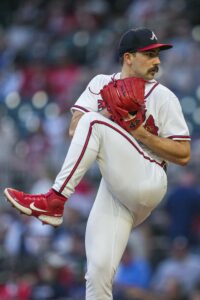
Strider, 24 later this month, will earn $1MM both in 2023 and 2024. He’ll be paid a $4MM salary in 2025 before jumping to $20MM in 2026 and $22MM in 2027 and 2028. The 2029 option comes with a $5MM buyout, which is factored into the guaranteed portion of the contract. If the Braves pick up that net $17MM option for the ’29 campaign, Strider will earn a total of $92MM over seven years.
Strider becomes the fourth young Braves star to be extended this season alone, joining first baseman Matt Olson (eight years, $168MM), center fielder Michael Harris II (eight years, $72MM) and star third baseman Austin Riley (ten years, $212MM). Atlanta, of course, had previously already signed outfielder Ronald Acuna Jr. and second baseman Ozzie Albies to club-friendly extensions. All six of those players are now under club control through at least the 2027 season, giving the Braves a level of continuity and cost certainty that is unparalleled throughout the league.
A fourth-round gem in the extremely truncated 2020 draft (five rounds), Strider skyrocketed through the Braves’ system despite a lack of minor league games in 2020, ultimately making his Major League debut late in the 2021 season. The Clemson product cracked the Braves’ Opening Day roster in 2022, initially working multi-inning stints out of the bullpen before ascending to the starting staff, where he not only found success but emerged as a bona fide front-of-the-rotation arm.
Overall, Strider broke out with 131 2/3 innings of 2.67 ERA ball and a 38.3% strikeout rate that paced all big leaguers who pitched at least 100 innings. Command was an issue at times in the minors and early in the season, but Strider markedly scaled back on the number of free passes he yielded as the season wore on, finishing out the year with an 8.5% walk rate that was scarcely north of the league average. For someone who walked 13.5% of his opponents over the first two months of the season, the improvement was as remarkable as it was rapid; from June 10 onward, Strider walked just 6.8% of his opponents.
Strider’s dominance has positioned him as one of the two favorites for National League Rookie of the Year honors, as he and teammate Harris are widely viewed as the presumptive first- and second-place finishers in an extremely strong year for rookies (both in the NL and in MLB as a whole).
The $75MM guarantee for Strider shatters any prior precedent for pitchers with such limited experience. Prior to this deal, the five-year, $35MM contract Madison Bumgarner signed with the Giants more than a decade ago stood as the record extension for a pitcher with between one and two years of service time. (Strider is currently at 1.003 years.) This new contract not only finally topples that dated mark (in decisive fashion), it also surpasses the established extension records for pitchers with two to three years of service time (Blake Snell‘s five-year, $50MM deal) and even with three to four years of service (Sandy Alcantara‘s five-year, $56MM deal).
Because extensions, more so than free-agent contracts, draw heavily from recent comparables, the Strider deal in many ways paves the way for new precedent to be established in multiple service classes. That’s not to say every pitcher with between one and four years of service time will now require $75MM+ to sign an extension, of course; Strider’s case as a Rookie of the Year frontrunner and budding ace is far from the norm.
Nonetheless, as we’ve seen with young position players in recent years, the market for these types of extensions can still advance rapidly. Back when Acuna signed his eight-year, $100MM extension, that was the largest deal ever for a position player with under a year of big league service. That mark was quickly smashed by Wander Franco (11 years, $182MM) and further surpassed this summer by Julio Rodriguez (12 years, $210MM).
With Strider’s salaries now set through the 2028 season, the Braves, incredibly, already have $76MM on the books six years down the line. That’s more than any other team in baseball. The Padres have about $57MM on the ’28 books between Manny Machado and Fernando Tatis Jr., while the Rangers have about $51MM on the books between Corey Seager and Marcus Semien. (Machado can opt out of his deal with the Friars after next year, so the Padres’ 2028 commitments may not end up being quite so large.) Obviously, $76MM in 2028 will carry less weight than $76MM in 2022, but it’s still a hefty commitment to have so far down the line.
There’s some degree of risk for the Braves in laying out such lengthy commitments, even if each looks quite team friendly in a vacuum. Injuries and regression could always push any of these extensions from “bargain” to “burden” — particularly in the later stages of the deals, when the salaries are come with more heft. Still, given the general excellence of this group, it’s impossible not to be bullish on the team’s future.
Looking more immediately down the line, the Braves already have $153MM on next year’s payroll and nearly $110MM on the 2024 payroll. That’s before considering a slate of arbitration-eligible players headlined by lefty Max Fried, who’s projected by MLBTR contributor Matt Swartz to earn more than $12MM in 2023. Atlanta would have a franchise-record payroll in 2023 even if the only moves made by the front office were to simply tender arbitration contracts to their eligible players.
Of course, that’s certainly not all the Braves will do this winter. First and foremost on the agenda will be negotiations with shortstop Dansby Swanson, who’ll be a free agent once the postseason concludes. The Braves and Swanson have publicly expressed mutual interest in a new contract, but getting something done would likely send the Braves soaring over the $200MM mark in terms of their bottom-line payroll while also pushing them into the general vicinity of the first luxury tax threshold for the first time ever. The Braves also surely are still hopeful of extending Fried, who’s controlled through the 2024 season. If they succeed in signing both Swanson and Fried, there’s virtually no path to avoiding the luxury tax.
On the one hand, while contracts like this Strider extension are cause to celebrate in the long-term, they do also create some shorter-term considerations. Strider would’ve only counted around $750K toward the luxury tax in 2023, had he not signed this extension. He’ll instead now carry a sizable $12.5MM luxury hit — the average annual value of his new contract. It’s still a win for both player and team, but the glut of long-term deals does inflate the Braves’ luxury ledger more quickly than a year-by-year approach would.
On the other hand, that’s a trivial concern when juxtaposed with the benefit of having so many high-end players signed for the next six-plus seasons. And with a World Series win in 2021 and another postseason run forthcoming, the NL East-champion Braves will no doubt see a boost to their revenues, lessening the sting of any luxury penalties that may arise in the next couple years. Atlanta already arguably boasted the best cost-controlled core of any team in baseball over the next half decade, and adding Strider to the preexisting quintet of Harris, Olson, Riley, Albies and Acuna only furthers their case. Waves of injuries can derail any team at any time, but health-permitting, the Braves are going to be good for a long, long time.