
KBO’s Kia Tigers Re-Sign Socrates Brito
The Kia Tigers of the Korea Baseball Organization announced that they’ve re-signed outfielder Socrates Brito to a one-year deal, Jee-ho Yoo of South Korea’s Yonhap News Agency reports. Brito will be guaranteed $800K and can earn an additional $300K via incentives. That’s a raise for his second season with the Tigers, after he earned a guaranteed $600K with $300K of incentives in 2022. Brito is represented by the MAS+ Agency.
Brito, 30, enjoyed a strong debut campaign in the KBO this past season when he batted .311/.354/.494 with 17 home runs, 29 doubles, seven triples and a dozen stolen bases. He walked at a tepid 6.1% clip but also struck out in only 14.6% of his plate appearances.
A longtime Diamondbacks prospect, Brito has appeared in parts of four Major League seasons. He’s managed just a .179/.216/.309 slash in 218 plate appearances between the D-backs and Blue Jays, but Brito has been much more productive with regular playing time both in the KBO and in Triple-A, where he’s a lifetime .287/.339/.467 hitter in just 1960 plate appearances. He’s played primarily right field (5126 innings) and center field (4883 innings) in his professional career, with the Tigers opting to deploy him as their primary center fielder this past season.
If Brito continues to thrive against KBO pitching and play display the ability to play a competent center field, he’s young enough that he could yet engineer a big league return, but for now he’ll focus on replicating his 2022 success next season.
Eric Hosmer Won’t Exercise Opt-Out Clause
In one of the most obvious opt-out decisions in recent memory, Red Sox first baseman Eric Hosmer will forgo his opportunity to return to the open market, tweets Jon Heyman of the New York Post. He’s now locked into the final three years and $39MM of the contract, although the Sox are only on the hook for the league minimum in each of the next three seasons. The Padres are paying the remainder of Hosmer’s salary each season under the terms of the deadline trade that sent him to Boston.
The eight-year, $144MM contract Hosmer signed with San Diego prior to the 2018 season went south almost immediately. A then-27-year-old Hosmer posted a massive .318/.385/.498 slash and swatted 25 homers for the second consecutive season in 2017 — his final year with the Royals, who originally drafted him No. 3 overall in 2008. That led to the aforementioned eight-year deal for Hosmer, but his offensive production cratered in year one with the Friars, as he hit just .253/.322/.398 in his first year with the team.
Over the first five seasons of that nine-figure contract, Hosmer has been exactly average at the plate, by measure of wRC+. He’s hit .265/.325/.409 and averaged 18 home runs and 30 doubles per 162 games played. Hosmer hasn’t necessarily been a bad hitter, but his $18MM annual salary was promised to him under the assumption that he’d continue on as a well above-average, middle-of-the-order hitter.
That simply hasn’t been the case, due in large part to the fact that Hosmer’s bloated ground-ball rate with the Royals actually got even higher with the Friars. Since signing in San Diego, 56.5% of Hosmer’s batted balls have been hit on the ground — the fourth-highest mark among 315 qualified MLB hitters in that stretch. Perhaps the limitations on infield shifts that are coming in 2023 will help Hosmer in that regard, but his repeated inability to elevate the ball will continue to suppress his power output.
The Padres traded Hosmer and a pair of minor leaguers (Corey Rosier and Max Ferguson) to the Red Sox in exchange for former first-round pick Jay Groome, agreeing to pay Hosmer’s salary down to the league minimum as part of the contract. Hosmer also was granted a full no-trade clause as part of that deal, so he’ll have the final say on whether he’ll remain in Boston through 2025 unless the Sox ultimately release him. For now, he’ll give the Red Sox a cost-effective veteran first baseman or perhaps designated hitter, dependent on when the team is ready to give top prospect Triston Casas a full-time look in the big leagues.
Anthony Rizzo Declines Player Option With Yankees
NOVEMBER 7: Rizzo has officially exercised his opt-out clause, tweets Jon Morosi of MLB.com.
NOVEMBER 4: Aaron Judge will understandably dominate most Yankee-centric headlines for the foreseeable future, but he’s not the only pinstriped slugger who’ll have the opportunity to field interest from other clubs this offseason. First baseman Anthony Rizzo‘s two-year, $32MM contract with the Yankees contained even salaries of $16MM per year and allows the longtime Cubs star to decline a 2023 player option and return to the open market if he chooses. The Athletic’s Jim Bowden writes that Rizzo is planning to do just that, which isn’t a huge surprise given the season that Rizzo put together in the Bronx.
Rizzo, 33, did post a low batting average but piled up walks and extra-base hits en route to a .224/.338/.480 batting line through 548 trips to the plate in 2022. He slugged 32 home runs, knocked 21 doubles and even chipped in a triple and six stolen bases. His 18.4% strikeout rate was his highest since 2014 but was still well shy of the 22.4% league average. Similarly, his 10.6% walk rate was a good bit higher than the league-average mark of 8.2%. All in all, wRC+ (which adjusts for his home park and league-wide offensive environment) pegged Rizzo’s bat at 32% better than an average hitter.
On the defensive side of the coin, Rizzo’s once-sterling defensive grades have taken a tumble, but not to the point where he ought to be considered a liability. He checked in with negative marks in Defensive Runs Saved (-3) and Outs Above Average (-2) but did so over the course of more than 1000 innings. Rizzo has battled back injuries the past couple seasons, which could help to explain some of the downturn with the glove. He received an epidural injection this summer and later began experiencing migraines, which cost him a couple weeks of action. Rizzo went 3-for-6 with a homer in his return contest following that IL stint.
Rizzo played in 11 fewer games in 2022 than in 2021, but at least with regard to his offensive performance, his 2022 season was better across the board. He had slightly more strikeouts but showed substantially more power (.256 ISO to .192), hitting more home runs in fewer plate appearances (32 vs. 22) and walking more often (10.6% vs. 9%). Overall, it was his best offensive showing since 2019. Though he will be another year older in 2023, the incoming ban on defensive shifts should benefit him. As a left-handed hitter without much speed, some of his grounders that were easy outs in 2022 could turn into singles going forward.
Given that this year’s production rather handily outpaced his 2021 output, there’s little reason to think Rizzo shouldn’t be able to expect at least the same type of two-year, $32MM pact he signed with the Yankees last offseason. The one scenario that might impact his earning power would be if he were to opt out and be saddled with a qualifying offer, but the $19.65MM value of this year’s QO represents a noticeable bump from the $16MM he’s scheduled to earn in 2023. Rizzo would be wise to decline the player option if only to push the Yankees to make that QO and put himself in a position to secure that raise. If they don’t make the QO, then another two- or even three-year deal could well be present for the slugger in free agency.
Bowden suggests that Rizzo would like to return to the Bronx on a longer deal. If that interest is reciprocated by the club, perhaps they could work something out even if the QO is involved. Such a scenario played out a few years ago when the White Sox gave a QO to Jose Abreu, who accepted it, but then they agreed to a three-year deal about a week later.
The Yankees have a good deal of uncertainty with their infield picture for next year, with not many players locked in. Josh Donaldson had a rough year at the plate and is about to turn 37, making it possible the Yanks look to move on from the last year of his contract. Gleyber Torres was decent at second but should see his contract rise to the $10MM range via arbitration. He’s still worth an investment like that but the club could also look to trade him and devote those resources to other parts of the roster. DJ LeMahieu should factor in here somewhere but he finished 2022 on the IL and will turn 35 next year. He’s probably best suited to a utility role as opposed to an everyday gig. Shortstop is a big mystery with Isiah Kiner-Falefa having a generally solid season with the glove but a few errors in the postseason cost him some playing time. There are youngsters available to take his job in Oswald Peraza, Oswaldo Cabrera and Anthony Volpe but none of those guys have proven themselves locks to be MLB-capable just yet.
If Rizzo does indeed trigger his opt-out, it would create one more issue for the Yankees to deal with on the dirt. If they are able to give him a contract that entices him to stay, it would be one step towards stabilizing things. If the parties can’t find common ground, the alternatives available to the Yankees on the free agent market include Abreu, Josh Bell and Trey Mancini, among others.
Carlos Correa Opts Out Of Twins Contract
TODAY: Correa officially opted out of his contract today and became a free agent, according to the MLB Players Association (via Twitter).
OCTOBER 13: From the moment Carlos Correa signed a short-term, opt-out-laden deal with the Twins back in March, it’s felt like a foregone conclusion that he’d take the first opt-out provision in that contract and return to free agency this winter. Unsurprisingly, Correa revealed in an interview with El Nuevo Dia’s Jorge Figueroa Loza that he plans to do just that. Correa, citing his age and performance with the Twins this past season, tells Figueroa Loza that exercising the first of two opt-out clauses in his contract “is the right decision.”
As he’s done on multiple occasions recently, Correa effused praise for the Twins organization and stated multiple times that his hope is to remain with in Minnesota on a long-term deal. To that end, it’s worth noting that Twins president of baseball operations Derek Falvey said just this week that there have already been conversations with Correa and agent Scott Boras (link via Megan Ryan of the Minneapolis Star Tribune). Falvey indicated a willingness to again “get creative” in order to keep Correa in Minnesota while also recognizing that they’ll likely face stiff competition in his return to the market. Correa, even in repeatedly expressing his hopes of signing a long-term deal with Minnesota, acknowledged that “what you want doesn’t always happen.”
By virtually any measure, Correa’s 2022 season was a strong one. The former Rookie of the Year and two-time All-Star slashed .291/.366/.467 with 22 home runs, 24 doubles and a triple in 590 plate appearances across 136 games. Correa’s power output was down a bit, but that was true on a league-wide scale in 2022. Both wRC+ and OPS+, which adjust for the league’s run-scoring environment and for a player’s home park, pegged Correa’s bat 40% better than league average in 2022.
Defensively, Correa didn’t replicate his 2021 Platinum Glove campaign, although it may not have been reasonable to expect him to duplicate what will likely be a career year in terms of defensive stats. His top-of-the-scale ratings dipped to merely above-average in both Defensive Runs Saved (3) and Ultimate Zone Rating (1.0). Notably, Statcast’s Outs Above Average pegged Correa as a negative defender (-3) for the first time since 2016. When taking in his defensive body of work as a whole, however, Correa is tied for sixth among all MLB players, regardless of position, with 50 DRS since 2018. His 45 OAA in that time rank seventh.
Both the Minnesota front office and manager Rocco Baldelli have praised Correa’s glovework on the whole, and also touted him as a valuable clubhouse presence and vocal team leader. Correa has also been more durable in the last three seasons than he was earlier in his career. He had brief absences in 2022 after being plunked on the hand and while spending time on the Covid-related injured list, but Correa has played in 89% of his team’s possible games since 2020.
While last year’s market didn’t produce the $330MM+ contract Correa reportedly sought, the 2022-23 market will be a different animal. He’ll be going up against three fellow star shortstops — Xander Bogaerts, Dansby Swanson, Trea Turner — rather than four this time around, and as Correa himself noted within this latest interview, he’ll be the only of the four who’s ineligible to receive a qualifying offer. (Players can only receive a QO once in their career, and Correa rejected one last November.) The upcoming offseason also won’t be impeded by a lockout as the 2021-22 offseason was — a 99-day transaction stoppage during which time Correa also switched representation, hiring the Boras Corporation.
All of that context notwithstanding, it’s still tough — albeit not impossible — to imagine Correa landing the megadeal he sought a year ago. He is, after all, a year older this time around and is coming off a strong but lesser campaign than the one he enjoyed with Houston in 2021.
That’s not to say that he can’t expect to find a lengthy and lucrative deal in free agency, just that securing a decade-long deal in the vicinity of his current annual value might not be in the cards. In all likelihood, Boras and Correa will still initially seek out that decade-long term and perhaps again take aim at Bryce Harper‘s $330MM overall guarantee — the largest free-agent deal in history — but a compromise in years and/or annual value could ultimately be required. Given that Correa is still just 28 and will play all of next season at that age, even a long-term deal might once again contain an opt-out opportunity a few years into the contract.
As for his stated desire to stay put in Minnesota, it’s feels like a long shot — albeit only in the sense that it would require the Twins, for a second time, to venture into a fiscal stratosphere that has previously been beyond ownership’s limits. Signing Correa would undoubtedly require Minnesota to handily surpass the franchise-record $184MM commitment they made to Joe Mauer, but that contract was signed 13 years ago and the team’s payroll has grown considerably since that time. The Twins trotted out a payroll around $140MM in 2022, and without Correa on the books, they’ll only have about $40MM in guarantees ($52.5MM after Sonny Gray‘s option is exercised).
There’s plenty of room for Correa on the payroll, both in the short-term and in the long-term. Beyond the 2023 season, the only commitment of any real note that’s on the books is Byron Buxton‘s contract, and his base salary pays him a reasonable $15MM annually — only escalating toward its maximum $23MM based on MVP voting. (At that point, of course, the Twins would be thrilled to pay him that loftier salary.) The question, then, is not so much whether the Twins can “afford” to sign Correa but whether doing so is the best use of their budget and whether the front office (and owner Jim Pohlad) are convinced that he’ll merit an annual salary approaching or in excess of $30MM per year for the majority of a long-term commitment.
If not the Twins, Correa will have no shortage of options on the market. Each of the Twins, Dodgers (Turner), Red Sox (Bogaerts) and Braves (Swanson) could lose a franchise shortstop and look to the market for a replacement. (It’s worth noting that in Royce Lewis, Gavin Lux, Trevor Story and Vaughnn Grissom, those four teams also all have shortstop alternatives already in-house, as well, however.) Beyond that quartet of teams, it’s widely expected that the Cubs, Phillies and perhaps the Giants will be involved in the shortstop market. The Angels, Cardinals and Orioles are candidates to seek upgrades, too, and given the caliber of names in question, it’s possible that other teams with entrenched shortstops could move their incumbent to accommodate one of these four free agents.
It’s a good time to be a free-agent shortstop, and Correa’s recent comments all but definitively indicate that, barring an extension between now and the opening of free agency (five days after the World Series ends), that’s what he’ll once again be this winter.
White Sox Name Pedro Grifol Manager
TODAY: The White Sox have officially announced Grifol’s hiring.
NOVEMBER 1: The White Sox’ managerial search has reportedly drawn its conclusion, as they’re set to hire a longtime division foe: Royals bench coach Pedro Grifol. A formal announcement is expected later this week. Changes to the coaching staff are also expected on the heels of a disappointing season, though pitching coach Ethan Katz will reportedly remain in his current role.
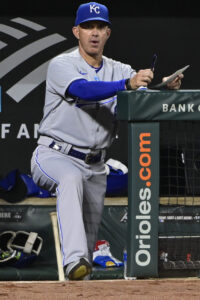
Grifol, 53 later this month, has been with the Royals organization since 2013 and has served as a quality control coach, catching coach and bench coach along the way. He’s also spent extensive time in the Mariners organization, where he spent three seasons as a minor league manager before being named the club’s coordinator of minor league instructor and, eventually, director of minor league operations.
Prior to his work with the Mariners and Royals organizations, Grifol had a nine-year playing career. Selected by the Twins out of Florida State University in the sixth round of the 1991 draft, Grifol spent five seasons as a catcher in the Twins’ system and another four in the Mets’ system. He reached Triple-A with both clubs but never cracked the Majors before ending his playing career following the 1999 season.
While this will be Grifol’s first managerial gig in the Majors, he’s long been seen as a future manager. He also interviewed with the Marlins this offseason and has previously interviewed with the Tigers in 2020, the Giants in 2019 and the Orioles in 2018. Grifol landed a pair of interviews with San Francisco during that offseason’s search and was reportedly among the finalists before the team ultimately chose Gabe Kapler. Grifol was on the Royals’ coaching staff for the organization’s consecutive World Series appearances in 2014-15 — with the latter season, of course, culminating in a World Series victory.
The Grifol hiring comes on the heels of a two-year stint that saw the White Sox bring Hall of Fame skipper Tony La Russa out of retirement to manager the club. That decision was widely believed to have been made directly by owner Jerry Reinsdorf going over the head of his front office, but the hiring of Grifol this time around likely came more directly from the front office. USA Today’s Bob Nightengale tweets that Grifol impressed all parties with the ChiSox and was viewed by Reinsdorf, executive vice president Kenny Williams and general manager Rick Hahn as the best candidate.
Skeptics of the hiring can perhaps point to the fact that Grifol was twice passed over as a managerial candidate by the Royals themselves, though the first time around it appeared as though Mike Matheny was always the clear heir-apparent to Ned Yost upon the latter’s retirement. This offseason, the Royals perhaps simply wanted a fresh voice from outside the organization after an ownership change in 2019, the dismissal of longtime president of baseball operations Dayton Moore and the aforementioned ousting of Matheny. The two clubs are also simply at different points in their competitive cycles and may thusly prefer different traits from their newly minted skippers.
While the Sox also interviewed Yankees bench coach Carlos Mendoza and Astros bench coach Joe Espada and even sat down with Ozzie Guillen about a second managerial stint on the South Side, Grifol will instead get his long-awaited first opportunity. He’ll step right into a win-now club and, given the inflated stated of the ChiSox’ payroll, likely be tasked with overseeing a similar group and coaxing better results than the team mustered in 2022. That’s not to say there won’t be any changes — longtime first baseman Jose Abreu is likely to sign elsewhere, and the Sox have potential needs at second base and in the outfield — but unlike many new skippers who step onto rebuilding clubs, Grifol should be dealt a better hand in terms of the roster he’ll inherit.
ESPN’s Buster Olney and Marly Rivera first reported that Grifol had been chosen as the White Sox’ new manager (Twitter links). Ken Rosenthal of The Athletic first reported that the Sox are expected to retain Katz but make broader-reaching coaching changes.
MLBTR Chat Transcript
Click here to read a transcript of Tuesday’s chat with MLBTR’s Steve Adams.
Chris Sale Will Not Exercise Opt-Out Clause
In one of the least-surprising opt-out decisions in recent memory, left-hander Chris Sale has informed the Red Sox that he will not exercise the opt-out clause in his five-year, $145MM contract, chief baseball officer Chaim Bloom tells Alex Speier of the Boston Globe.
There’s never been any real thought that Sale was a candidate to opt out of the remaining two years and $55MM on that ill-fated extension. He pitched just 5 2/3 innings with the Sox this season and, over the first three years of the agreement, has tallied just 48 1/3 innings through 11 starts. Sale underwent Tommy John surgery in March of 2020 and thus missed the entirety of that year’s truncated season.
The recovery from that Tommy John procedure sidelined him into August of 2021, and his 2022 season was derailed by a series of bizarre injuries; Sale was shelved for the beginning of the 2022 season due to a stress reaction in his ribcage, and he suffered a broken pinkie finger upon being hit by a comebacker shortly after returning. The Red Sox announced in early August that Sale had fractured his wrist in a bicycle accident and would miss the remainder of the season.
It’s been a nightmare start to the contract extension for the Red Sox, although this year’s slate of injuries, in particular, seem fluky in nature. To Sale’s credit, in the small amount of time he’s been healthy enough to take the mound during the first three years of the extension, he’s been excellent. In those 48 1/3 innings, Sale owns a 3.17 ERA with a strong 27.4%% strikeout rate against a tidy 6.3% walk rate. Inning-for-inning, that’s largely the type of performance the Sox were hoping for — but Sale’s body has not held up.
Looking ahead, the Sox have little choice but to hope Sale can get healthy and finally reclaim a spot near the front of their rotation. The lefty’s contract has zero trade value at present, and even if it did, Sale has full veto power over any potential trade by virtue of his 10-and-5 rights (ten years of Major League service time, including at least the past five with the same team).
The 33-year-old Sale (34 in March) is but one of many question marks for the Boston rotation. Nick Pivetta is the only largely established starting option for the Sox heading into 2023. Top prospect Brayan Bello could vie for a spot but didn’t quite seize one in this year’s rookie effort (57 1/3 innings, 4.71 ERA — albeit with better secondary marks). Righty Garrett Whitlock has obvious rotation potential but has thus far been shuttled between the starting staff and the bullpen. Fellow righties Kutter Crawford, Josh Winckowski and Connor Seabold were all hit hard as rookies in 2022.
Suffice it to say, with Nathan Eovaldi, Michael Wacha and Rich Hill all set to become free agents and Sale more or less a complete question mark, starting pitching will be one of the main focuses for the Red Sox this offseason. It won’t be their sole pursuit, however, as the Sox also potentially stand to lose Xander Bogaerts to free agency and still hope to extend slugger Rafael Devers, who is set to reach the open market following the 2023 campaign.
Including Sale’s weighty salary, the Sox have $86.72MM committed to next year’s books, although that’s counting a $20MM salary for Bogaerts, who is certain to opt out of his contract’s final three seasons. Boston also has nearly $40MM in projected arbitration salaries and is on the hook for some hefty contractual buyouts — most notably the $8MM yet owed to the since-released Jackie Bradley Jr. They’ll quite possibly be on the hook for James Paxton‘s $4MM player option, which he’ll have the ability to exercise once the Sox make the easy call to decline his two-year, $26MM club option.
Pohlad: “Totally On Board” With Re-Signing Carlos Correa
Carlos Correa will become a free agent five days after the World Series draws to a close — the date on which a decision regarding his contract’s first of two opt-out clauses is due. Correa has already made clear that he plans to opt out of the final two years and $70.2MM, returning to free agency, though he’s expressed a hope that he and the Twins can work out a long-term pact. Twins president of baseball operations Derek Falvey acknowledged last month that the team had already had some dialogue with agent Scott Boras about a potential new deal, although obviously, no agreement has been reached.
For his part, Twins owner Jim Pohlad made clear in a recent interview with Charley Walters of the St. Paul Pioneer Press that he hopes to see Correa back in the fold next season and is very open to a new contract. “I’m totally on board with him coming back,” said Pohlad. “Definitely. Absolutely. I love the guy. He’s a huge asset and benefit to the team. But I don’t know how it’s going to go.”
While some Twins fans have perhaps been holding out hope for an extension before Correa’s opt-out date is due, that’s never felt especially likely, and Pohlad himself suggested that he expects Correa and Boras to test the market. Pohlad called Boras an “aggressive” agent and noted that it’s still too early to tell what sort of offers the market might yield.
At the time of the signing, the $35.1MM annual rate on Correa’s three-year, $105.3MM deal in Minnesota was the fourth-largest AAV in Major League history. He reportedly sought more than $330MM over a deal of at least ten years last offseason, and while that might be an ambitious goal a year later and a year older, Correa will also enter the market with a new set of potential bidders and without the burden of a qualifying offer. The Dodgers, who largely sat out the shortstop market last winter due to Trea Turner‘s presence, for instance, have already been linked to Correa before free agency even commences.
Regardless of whether the record-setting free-agent deal Correa sought last winter is there in the months to come, there’s still good reason to believe he can command a lucrative, long-term arrangement. On a rate basis, Correa’s 2022 season was largely in line with his 2021 performance.
This year’s .291/.366/.467 slash compares quite favorably to last season’s .274/.366/.487 slash. By measure of wRC+, which weights for the leaguewide dip in power and a home park that wasn’t necessarily as friendly to Correa as Houston’s Minute Maid Park (and its short porch), Correa’s 2022 season was actually better: 140 to 133. Correa’s 89.9 mph average exit velocity was only a hair below 2021’s mark of 90.2 mph, and he actually improved upon his barrel rate (9.4% in 2021, 11.4% in 2022) and hard-hit rate (42.5% to 44.7%).
[Related: Minnesota Twins Offseason Outlook]
Correa’s defensive metrics took a major step back from his 2021 Platinum Glove showing, but year-to-year fluctuations in Defensive Runs Saved, Ultimate Zone Rating and Outs Above Average are fairly commonplace. That’s not to completely write off the struggles, and some teams may view them as a portent for further decline at the position. Even if that were the case, however, Statcast measures Correa’s arm as the sixth-strongest among all shortstops, averaging 88 mph per throw (and 14th among all non-first-baseman infielders). A move to third base, if ever needed, would likely be plenty feasible.
Setting aside Correa’s broader market appeal and turning back to the Twins, specifically, Minnesota has just $32.5MM in guaranteed contracts on next year’s books, plus another $36MM or so in projected arbitration salaries. Looking ahead to 2024, Byron Buxton‘s $15MM base salary is the only notable guarantee on the books. There’s room for the Twins to make a market offer if Pohlad truly feels convicted in his comments regarding Correa, but it’s a fair question whether the Twins will be willing to outbid the field with a franchise-record deal when there are plenty of other needs on the roster — particularly on the pitching staff.
Offseason Outlook: Minnesota Twins
Twins president of baseball operations Derek Falvey and general manager Thad Levine have been in place for six years now. The team has a winning record under their leadership, but the last two seasons have ended in disappointment, with the Twins missing the postseason by a wide margin despite heading into the year as projected contenders. They’ll enter the offseason with a large amount of payroll space, though that’s due partly to last winter’s marquee signing opting out of his contract.
Guaranteed Contracts
- Byron Buxton, OF: $90MM through 2028 ($15MM base salary can increase to $23MM annually based on MVP voting)
- Max Kepler, OF: $9.5MM through 2023 (includes $1MM buyout of $10MM club option for 2024)
- Jorge Polanco, 2B: $8.5MM through 2023 (includes $1MM buyout of $10.5MM club option for 2024; contract also contains $12MM club option for 2025)
- Randy Dobnak, RHP: $7.75MM through 2025 (includes $1MM buyout of $6MM club option for 2026; contract also contains $7MM club option for 2026, $8.5MM club option for 2027)*
- Kenta Maeda, RHP: $3.125MM through 2023 (can earn up to $10MM of incentives based on games started, innings pitched)
*=Dobnak is in the organization but no longer on the 40-man roster
Total 2023 commitment: $35.625MM
Total long-term outlay: $118.875MM
Option Decisions
- Miguel Sano, 1B: $14MM club option ($2.75MM buyout)
- Sonny Gray, RHP: $12.5MM club option (no buyout)
- Dylan Bundy, RHP: $11MM club option ($1MM buyout)
- Chris Archer, RHP: $10MM mutual option ($750K buyout)
Arbitration-Eligible Players (service time in parentheses; projections via MLBTR contributor Matt Swartz)
- Gio Urshela (5.127): $9.2MM
- Emilio Pagan (5.091): $3.7MM
- Tyler Mahle (5.018): $7.2MM
- Caleb Thielbar (4.131): $2.4MM
- Jorge Lopez (4.102): $3.7MM
- Chris Paddack (4.000): $2.4MM
- Luis Arraez (3.121): $5MM
- Cody Stashak (3.064): $800K
- Jorge Alcala (3.014): $800K
- Kyle Garlick (2.163): $1.1MM
- Non-tender candidates: Pagan, Stashak, Garlick
Free Agents
- Carlos Correa (announced his intention to opt out of current contract), Gary Sanchez, Michael Fulmer, Devin Smeltzer, Danny Coulombe
The Twins’ first order of business will be determining whether they have a legitimate chance to retain Carlos Correa, who’s already said he’ll opt out of the remaining two years and $70.2MM on his contract. The only long-term commitment of note on the books is Byron Buxton’s $15MM annual salary through the 2028 season, leaving plenty of room for the Twins to put forth a market-value offer with what would be the first $30MM+ annual salary in club history.
The question, of course, is whether the front office feels it’s wise to do so and whether owner Jim Pohlad will green-light that franchise-record expenditure. For his part, Correa has effused praise for the Twins since day one. He’s since said on record multiple times that his family enjoys living there and that he personally “loves” manager Rocco Baldelli and the clubhouse environment.
Pleasantries are all well and good this time of year, but Correa has also made clear that he’s seeking a long-term deal and will again become a free agent if the two parties cannot agree to an extension. Falvey has said on record that the Twins have talked contract with agent Scott Boras since the season ended, also expressing a willingness to “get creative” on a deal. Cynics would suggest that’s corporate-speak implying the Twins aren’t prepared to offer a straightforward long-term pact, but it was a somewhat “creative” offer that brought Correa to Minneapolis in the first place. He still seems likely to test the market, but the Twins have another couple weeks to convince him to stay.
If Correa indeed opts out and signs elsewhere, the Twins will be left with a hole at shortstop but also a heaping amount of payroll space. All four of their club option decisions are easy to decipher. Miguel Sano, Dylan Bundy and Chris Archer will be bought out, and all are likely to sign elsewhere. Sonny Gray’s $12.5MM club option is a no-brainer to exercise. In a scenario where Correa departs and Gray is picked up, the Twins will have around $50MM committed to next year’s books.
There are arbitration-eligible players to consider, but that’ll only add another $30MM or so to the ledger. The Twins opened the 2022 season with a payroll in the neighborhood of $142MM, but even with Gray returning and only a handful of non-tenders, they’ll clock in around $80-82MM in commitments. Even if 2022’s Opening Day mark is set as a firm ceiling — which it likely is not — the front office has a lot of financial freedom this winter.
Where can the Twins reallocate those resources? Frankly, just about anywhere. The lineup has few guarantees, though that’s generally due to flexibility afforded by key young players.
Luis Arraez spent a large chunk of time at first base this season and won a batting title in the process, but he can play second base, third base and even some left field if needed. Rookie Jose Miranda also spent time at first base, but he rose through the system as a third baseman and could man the hot corner if the Twins prefer to trade Gio Urshela and go with Miranda/Arraez at the corners. Doing so could bring back some bullpen help or a decent minor league asset and free up another $9MM or so.
If Correa doesn’t return, the Twins can turn shortstop over to former No. 1 overall pick Royce Lewis, though he’s rehabbing a second tear of his right ACL and thus shouldn’t be considered a lock to handle shortstop from the jump (if at all). Lewis is another candidate to play multiple positions at some point and could do so as soon as next year, depending on which course the Twins chart.
If Minnesota isn’t willing to pay top-of-the-market money for the marquee shortstop they already know and love, Correa, it stands to reason that fellow free agent Trea Turner will be out of their comfort zone. But both Xander Bogaerts and Dansby Swanson will be free agents this winter, and while both figure to command nine-figure contracts, they’ll likely be less expensive than Turner and Correa. Barring another splash in the deep end of the free-agent pool, the Twins could look to a shorter-term veteran like Elvis Andrus or Jose Iglesias to help ease Lewis into a larger role.
There’s similar flexibility and uncertainty in the outfield. Byron Buxton remains one of the most talented players in MLB on a per-game basis but also one of the most oft-injured. He hit 28 homers in just 92 games but missed time with a hip strain before undergoing season-ending knee surgery in September. Max Kepler has been a stalwart in right field, and his pull-happy approach could make him a beneficiary of the forthcoming limitations on infield shifts. However, Kepler has never replicated the fly-ball rates (and subsequent power output) he showed in the juiced-ball 2019 season that saw him club 36 home runs. With just one guaranteed year to go on his contract (plus an option), he could be a trade candidate as the Twins look to open space for younger players.
Among those younger options are snakebitten corner outfielders Alex Kirilloff and Trevor Larnach. Both are former first-rounders and consensus top-50 prospects in the league, but both have seen their early careers waylaid by injury. Kirilloff, who’s twice undergone wrist surgery, was particularly touted. That duo can play the corners, and Kirilloff has plenty of experience at first base as well, further adding to the aforementioned infield flexibility. Twin Cities native and former No. 39 overall draft pick Matt Wallner is another right field option who made his big league debut in 2022 and could factor into next year’s group.
If the Twins do trade Kepler, there’s an argument that they ought to bring in a different veteran to stabilize/complement the in-house group — ideally a right-handed hitter. The most wide-eyed dreamers among Twins fans can point to the payroll space and last March’s stunning Correa deal as justification for an “anything is possible” mentality, but Aaron Judge is scarcely worth a mention here. Still, a short-term veteran could at least be in play as an occasional left fielder and designated hitter, depending on what happens with Kepler.
Behind the plate, the Twins remain high on Ryan Jeffers‘ receiving and his power, but Falvey has specifically talked about bringing in another backstop to again utilize a “co-catcher” method that divides playing time more evenly than the traditional starter/backup pairing. As Falvey plainly noted, Jeffers was particularly adept against left-handed pitching.
The Twins haven’t labeled the still-25-year-old Jeffers a pure platoon option, but they’ll want someone who can help out against right-handed pitching. This year’s free-agent class isn’t a great one in that regard, though Omar Narvaez has a nice track record against righties despite a down showing in 2022. Willson Contreras, the market’s top catcher, would bolster the offense against righties and lefties alike, and the Twins at least have the payroll capacity to make them a dark-horse landing spot. The trade market will have options ranging from clear starters (Oakland’s Sean Murphy, Toronto’s Danny Jansen) to out-of-options fliers (the Angels’ Matt Thaiss).
The depth on the pitching staff is more suspect. Twins starters ranked 20th in the Majors with a 4.11 ERA and 27th with 782 2/3 innings in 2022. Some of that was by design, at least early on. For instance, Minnesota inked Chris Archer to an incentive-laden deal that allowed him to boost his salary based on games started and outings of three or more innings in length. The plan was to ease him into the year with short outings and build him up, but Archer never built up to the workload the team envisioned. Rotation-mate and fellow offseason signee Dylan Bundy had averaged under 5 1/3 innings per start from 2019-21 and averaged under five innings per start with the Twins in ’22. He likely was never viewed as a potential workhorse.
That approach placed undue stress on a bullpen that, beyond breakout arms Jhoan Duran and Griffin Jax, had few alternatives for much of the season. The Twins swung what looked like one of the better deals of the deadline, bringing in All-Star reliever Jorge Lopez from the Orioles, but Lopez struggled greatly with his command following the swap and wasn’t able to replicate his Baltimore form.
We don’t need a full breakdown of what went wrong for the Twins’ staff for the purposes of outlining the forthcoming offseason. The end-of-season results — 20th in rotation ERA/27th in innings; 15th in bullpen ERA/third in innings — are telling. For the Twins to remedy things in 2022, they’ll need more innings and more quality from the rotation and/or a deeper and more talented bullpen to help offset the lack of innings from the starting staff.
Returning to the 2022 rotation will be the aforementioned Gray and right-hander Joe Ryan, who dubiously led Twins pitchers with 147 innings. Both were strong mid-rotation arms, though Gray was hampered by hamstring injuries that limited him to 119 2/3 innings. Kenta Maeda will also be healed from Tommy John surgery, and Minnesota will hope for better health from deadline acquisition Tyler Mahle, for whom they surrendered three prospects in a deal with the Reds.
Mahle, like Gray, was an above-average starter with the Reds prior to his acquisition and was particularly effective away from the homer-happy confines of Cincinnati’s Great American Ball Park. He hit the injured list with a “minor” shoulder strain in July, returned to make two solid outings prior to the deadline, and landed in Minnesota as a hopeful rotation boost down the stretch. Instead, he twice went back on the injured list with shoulder troubles and made only four total starts as a Twin. Falvey has said since the season ended that Mahle “has been evaluated beyond the traditional MRI” and that the team believes the strain led to some weakness in Mahle’s rotator cuff. The expectation is that he’ll be healthy in 2023.
A healthy quartet of Ryan, Gray, Mahle and Maeda would be a solid start to any staff, and the Twins have some in-house options to join them. Righties Bailey Ober, Josh Winder and Simeon Woods Richardson have all pitched in the Majors — Ober extensively so, dating back to a quietly solid rookie effort in 2021. Winder missed time in 2022 due to shoulder troubles but was a top-100 prospect prior to this year’s debut and at times looked quite impressive. Woods Richardson had a promising year in the upper minors and made his MLB debut in the season’s final week. Top prospect Jordan Balazovic had a lost season, spending a month on the shelf with a knee strain and struggling for the majority of the Triple-A campaign thereafter.
Twins fans will call for the team to pursue a front-line starter, but the reality is that consecutive poor finishes makes that a far more difficult task. Veterans Justin Verlander and Jacob deGrom will likely prioritize signing with more clearly defined contenders. Lefty Carlos Rodon would be a more feasible target if the Twins are willing to dole out their first nine-figure pitching contract in franchise history, but he should clear the Kevin Gausman (five years, $110MM) and Robbie Ray (five years, $115MM) contracts — perhaps by a wide margin.
Right-hander Kodai Senga, ace of Nippon Professional Baseball’s SoftBank Hawks, will pursue MLB opportunities this offseason, too, but the competition for him will be fierce. The market does feature a number of solid second-tier options, with Chris Bassitt, Nathan Eovaldi, Mike Clevinger, Noah Syndergaard and Tyler Anderson among them.
In the bullpen, the Twins will hope Duran, Lopez and Jax can pair with lefties Caleb Thielbar and Jovani Moran to anchor the late innings. Hard-throwing righty Jorge Alcala missed nearly the whole season with an elbow issue but is expected back in ’23. It’s a talented group that looks far better than the unit they had early in 2022, but after generally eschewing veteran additions a year ago (save for a one-year flier on Joe Smith, who was released over the summer), the Twins should place more of an emphasis on adding stability. Minnesota’s lack of depth was exposed in 2022 when Tyler Duffey declined and trade pickup Emilio Pagan regularly proved unreliable, despite persistent opportunities (due largely to said lack of depth). The latter now seems likely to be traded or non-tendered following a disastrous year.
The only multi-year free agent deal the current front office has given to a reliever is Addison Reed‘s two-year, $16.75MM deal, and that was six years ago. In fact, as far as I can tell, that’s the only multi-year deal given to a free-agent reliever by the Twins since the turn of the century (though they’ve extended in-house star closers like Joe Nathan and Glen Perkins).
In other words, don’t expect this team to break the bank for Edwin Diaz. If the Twins want to break that multi-year trend, the top names with a chance at three- and two-year deals include Robert Suarez, Kenley Jansen and (more quietly) Rafael Montero. More realistically, the Twins will bide their time and wait out the market for relievers open to one-year deals. That strategy has backfired recently (Smith, Alex Colome) but paid off at times in the past (Tyler Clippard).
Few teams in baseball have as much money coming off the books as the Twins this winter, and they could further add to that stockpile of resources by trading a veteran they feel they can replace internally (e.g. Kepler, Urshela). That should give the Twins the financial latitude to pursue just about any endeavor they choose, and at least as far as the lineup goes, they’re deep in young options.
This version of the Minnesota front office has typically eschewed long-term commitments in free agency, with Josh Donaldson‘s four-year deal marking the only time they’ve signed a free agent for more than three years. Given the clean payroll outlook, a strong free-agent class and mounting pressure to return to contention in the AL Central, it’s arguable that this offseason is the time to deviate from that risk-averse approach.
David Stearns Steps Down As Brewers’ President Of Baseball Operations
10:08am: At a press conference announcing his decision, Stearns stated that he’s “not going anywhere” and will remain in Milwaukee. That, of course, doesn’t rule out pursuing opportunities in the future, but it’s a rather firm declaration that for the time being, he has no plans to join another organization. Rather, Stearns added that he’s “looking forward to taking a deep breath, spending time with my family and exploring some other interests.”
8:35am: David Stearns is stepping down as the Brewers’ president of baseball operations but will remain with the club in an advisory capacity, the team announced. General manager Matt Arnold will now oversee the baseball operations department.
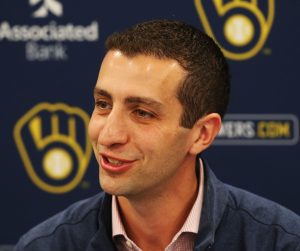
It’s a surprise shakeup atop the Brewers’ baseball operations department, as Stearns has built a reputation as one of the most widely respected baseball execs in the game since taking over the reins in Milwaukee. He’d been under contract through the 2023 season.
“This is not an easy decision for me and is something I have been wrestling with for a long time,” Stearns said in a prepared statement. “[Owner] Mark Attanasio and I have had an open dialogue and we both knew this day could eventually come. It has been a priority for both of us that any transition would take place while the organization is in a healthy position with solid leadership and a talented roster going forward. That is certainly the case today.”
“I’m very grateful to Mark and all of our staff for their support and efforts throughout my tenure with the Brewers,” Stearns continued. Matt [Arnold] and I both arrived in 2015 and he is more than ready for this next opportunity. I am committed to serving as a resource to Matt as he sees fit as the organization moves through this transition.”
Of course, the announcement will prompt immediate speculation about whether Stearns might ultimately be headed elsewhere. The team noted that he’ll serve ownership and the baseball ops department as an advisor, and Stearns himself suggests within those comments that he’ll remain with the organization for the time being to help guide Arnold and others through the transition. Nonetheless, his departure from such a prominent role could pave the way for his eventual departure altogether.
For instance, the Mets have pursued Stearns, a New York native, for their vacant president of baseball operations post in each of the past two offseasons but been denied permission to interview him. Mets owner Steve Cohen eventually landed on Billy Eppler to lead his baseball operations staff, but Eppler was given the “general manager” title, leaving the door open for a president to be appointed atop the hierarchy.
That said, Stearns could well be of appeal to a broad number of teams seeking a veteran baseball operations leader over the course of the next year. The Harvard grad has been running baseball operations for the Brewers since 2015 and, prior to that, was an assistant GM in Houston, a director of baseball operations in Cleveland (a role he shared with current Twins president of baseball ops Derek Falvey).
As for Arnold, he’ll receive autonomy over a baseball operations department for the first time in his career. Hired away from the Rays in 2015 to serve as an assistant GM under Stearns, Arnold was promoted to the title of general manager in 2020. Arnold, like Stearns, had been drawing interest from other teams in their front office search, and the bump to the GM’s chair made it more difficult for other teams to pursue him (as clubs are generally only permitted to interview other teams’ executives if they’re offering a promotion).
Despite holding the GM title for the past two years, the 43-year-old Arnold has been second on the team’s operations hierarchy until today’s announcement. He’s spent more than 20 years working in baseball ops, however, serving as Tampa Bay’s director of player personnel in addition to holding a variety of roles in scouting, player development and player analysis for the Dodgers, Reds and Rangers over his career.
That Arnold is the one now assuming oversight of the department leaves the Brewers with some more continuity than the standard changing of the guard, but the change in leadership is nevertheless a seismic shift for the Brewers. Attanasio called Stearns’ impact on the club “transformational” in his own statement today, adding that he’s “disappointed” in the decision but also “grateful” to Stearns for the past seven years.
It’s easy to see why. Prior to hiring Stearns in 2015, the Brewers had won only two division titles dating back to 1969 and had reached the postseason on just four occasions. Milwaukee won the NL Central in both 2018 and 2021 under Stearns’ leadership and reached the playoffs in four consecutive seasons, from 2018-21.
Along the way, Stearns, Arnold and their staff built out a powerhouse rotation headlined by draftees Brandon Woodruff and Corbin Burnes, as well as trade acquisitions such as Freddy Peralta, Eric Lauer and Adrian Houser. (Woodruff was drafted by the prior regime in 2014 but, as an 11th-round pick, is still a player development triumph for the organization as a whole.)
A look up and down the Brewers’ roster reveals one of the most trade-dependent clubs in the Majors. In addition to Peralta, Lauer and Houser, Stearns oversaw trades that brought Willy Adames, Rowdy Tellez, Hunter Renfroe and Luis Urias into the organization. His most infamous swaps include the lopsided Christian Yelich acquisition from the Marlins and the trade that sent Carlos Gomez and Mike Fiers to Houston in return for Houser, outfielder Brett Phillips and Josh Hader.
Stearns has drawn his share of flak for trading Hader to the Padres at this summer’s deadline despite the fact that his team was in contention for what would be a third NL Central title under his watch. The now-former Brewers president has since acknowledged that the move had a larger impact on the clubhouse than he anticipated. However, threading the needle by acquiring controllable talent in exchange for players with dwindling club control (at or near peak value) is a reality for most small- and mid-market front offices. (Hader will be a free agent next winter and has a projected $13.6MM salary in arbitration.)
In general, though, it’s fair to say that Stearns’ willingness to act boldly on the trade market has benefited the Brewers more often than it’s harmed them. Now, those decisions will ultimately fall to Arnold. It’s impossible to say for certain whether he’ll have the same affinity for aggressively attacking the trade market, but given Arnold’s roots in an ever-active Rays organization, seven years working alongside Stearns and a massive arbitration class, the Brewers are likely in for another active offseason.