
Nationals, Luis Avilan Agree To Minor League Deal
The Nationals have agreed to a minor league contract bringing veteran left-handed reliever Luis Avilan back to the organization, reports MLB Network’s Jon Heyman (via Twitter).
Avilan, 32, underwent Tommy John surgery last April and was thus limited to five innings with the Nats. He allowed an unsightly seven runs in that time, but the southpaw has a strong track record dating back to his 2012 MLB debut with the Braves. In 349 big league innings from 2012-20, Avilan worked to a combined 3.30 ERA with a 21.5% strikeout rate, a 9.4% walk rate and a strong 50.3% ground-ball rate.
As with most southpaw relievers, Avilan has been better against lefties than against righties, though he’s far from a pure specialist. Left-handed batters have posted a feeble .204/.279/.281 slash against him through 686 plate appearances, while right-handers carry a decent but hardly dominant .262/.347/.387 output through 805 trips to the plate.
Given the time of his surgery, Avilan will spend Spring Training rehabbing the injury and likely won’t be an option for the Nationals until the summer. If he’s healthy, he can give the Nats a solid lefty in the bullpen and perhaps a modestly priced trade chip if he rounds back into form prior to the end of July.
Marlins In Market For Outfielders Even After Garcia Deal
The Marlins aren’t 24 hours removed from agreeing to a four-year, $53MM contract with free-agent outfielder Avisail Garcia, but MLB Network’s Jon Heyman reports they’re still seeking offensive upgrades (all Twitter links). Outfielders appear the priority, with Heyman listing Nick Castellanos, Kyle Schwarber, Chris Taylor and Eddie Rosario among the possible targets.
Miami already guaranteed $53MM to Garcia over the next four seasons — a hefty splash by their typically modest standards. It’d be a surprise to see them follow that up by signing any of Castellanos, Schwarber or Taylor, as all three are expected to top that four-year deal landed by Garcia. Castellanos is reported to be seeking a contract of as many as seven or eight years in length, though it seems likely he’ll ultimately settle in a bit shy of that mark. Even still, there’s a good chance he’ll double the Garcia total.
Schwarber and Taylor, meanwhile, could both land larger four- or even five-year deals than Garcia signed. Schwarber parlayed a huge season between Washington and Boston into a strong free-agent stock, while Taylor has long been a steady super-utility piece for the Dodgers, He’d give Miami an option in center field for at least the first season or two of the deal — something they very much crave — and he’d give them some cover in the infield as well. That could be particularly appealing to Miami after the Marlins saw each of Miguel Rojas, Jazz Chisholm and Brian Anderson miss significant time in 2021.
Rosario, 30, seems like a more viable fit in Miami than the other names on the list — at least from a price perspective. The longtime Twins outfielder was non-tendered by Minnesota last winter, signed a one-year deal in Cleveland and found himself headed to the Braves in what amounted to a deadline salary dump. Rosario took off in Atlanta, however, returning from the injured list to slash .271/.330/.573 in his final 106 plate appearances. His heater continued into the postseason, where he won NLCS MVP honors. Even with a quiet World Series, Rosario still posted a massive .383/.456/.617 slash in 68 playoff plate appearances.
Streaky play of that nature has been the norm throughout Rosario’s career. In general, he’s a free-swinging left fielder with plenty of power but a low walk rates and dwindling defensive ratings. Dating back to the 2017 season, Rosario is a .278/.315/.484 hitter, but those numbers have tailed off in recent years. Defensive Runs Saved and Ultimate Zone Rating still peg Rosario as a decent left fielder, but not the standout defender he was in 2018. Statcast’s Outs Above Average, however, graded Rosario harshly and ranked him worst among all MLB outfielders (-18).
Both Castellanos and Taylor rejected qualifying offers, meaning they’d cost the Marlins their third-highest pick in next year’s draft. Schwarber and Rosario were ineligible to receive qualifying offers by virtue of being traded midseason (though only Schwarber would’ve commanded one).
Aaron Altherr Eyeing MLB Comeback Following Productive KBO Stint
Former Phillies, Mets and Giants outfielder Aaron Altherr, who has spent the past two seasons playing in the Korea Baseball Organization, is now a free agent and is eyeing a potential MLB comeback after a strong run overseas, MLBTR has learned. A jump to Japan’s NPB is also a possibility.
Set to turn 31 in January, Altherr spent the 2020-21 seasons with the NC Dinos as their primary center fielder, helping the club to a Korean Series championship and posting consecutive 30-homer/20-steal seasons. In a combined 1,111 plate appearances, Altherr slashed .275/.356/.528 (130 wRC+) with 63 home runs, 39 doubles, nine triples and 42 steals (in 48 attempts). Strikeouts have been an issue (27.4%), though he’s also drawn a respectable number of free passes (9.3% overall, including 10.1% in 2021).
A ninth-round pick by the Phillies back in 2009, Altherr briefly reached the big leagues in 2014, got his first extended look a year later in 2015, and at that point seemed like a potential long-term answer in the outfield. He posted a .241/.338/.489 batting line through 161 plate appearances as a rookie (124 wRC+), squarely putting himself into the team’s outfield mix. However, 2016 was largely a lost season. Altherr had wrist surgery that April, and while he made it back to the field late in the summer, his .202/.304/.293 slash showed that he clearly wasn’t at full strength.
In 2017, Altherr bounced back with a .272/.340/.516 batting line through what’s still a career-high (in MLB) 412 plate appearances. He swatted 19 home runs for the Phils that season while seeing time at all three outfield spots.
With the Phillies’ Carlos Santana signing pushing Rhys Hoskins into left field in 2018 and Odubel Herrera then entrenched in center field, Altherr found himself jostling with Nick Williams (who’d had a solid 2017 season himself) for playing time in right field. Altherr started the season in a slump and never really recovered, batting just .181/.295/.333 in 285 plate appearances.
Philadelphia’s subsequent signings of Andrew McCutchen and Bryce Harper completely eroded the path to playing time for Altherr in 2019. He was designated for assignment in early May, bouncing quickly from the Phillies, to the Giants (who gave him one plate appearance), to the Mets via waivers. Altherr struggled in 35 plate appearances with the Mets before being outrighted to Triple-A Syracuse, where he hit well but spent a notable chunk of time on the injured list.
The prospect of a guaranteed seven-figure salary lured Altherr to the Dinos, and he’s taken home more than $2.3MM during his time in South Korea. He’ll likely have interest from the Dinos and other KBO clubs in free agency, but opportunities in Japan and certainly back in the Majors could be more lucrative.
Overall, Altherr has a .219/.308/.402 batting line in 1,156 Major League plate appearances, but his .275/.356/.528 slash in the KBO at least offers the promise that he could do more with a larger opportunity than he received during his stop-and-start Phillies tenure. We’ve seen a handful of former big league bats make successful returns after starring in South Korea, including Eric Thames and Darin Ruf.
Altherr is two years younger than Ruf was at the time of his return, and given that he’s a viable center field option in an offseason where there are few available options at the position (particularly now that Starling Marte has signed), Altherr could be viewed as an interesting roll of the dice for a team seeking relatively affordable outfield help. The looming lockout surely complicates matters — teams in Japan and South Korea likely don’t care to wait on free-agent decisions while MLB is under a transaction freeze — but Altherr ought to at least have a few days to gauge interest before that wrench is thrown into the market.
Rays Sign Wander Franco To 11-Year Extension
Seventy games into his Major League career, Rays shortstop Wander Franco has agreed to an 11-year, $182MM contract extension. The contract also comes with a $25MM club option for the 2033 season (with a $2MM buyout) and a series of $3MM escalators based on MVP voting, so the deal’s maximum value sits at $223MM over 12 years. Franco is represented by agent Manny Paula.
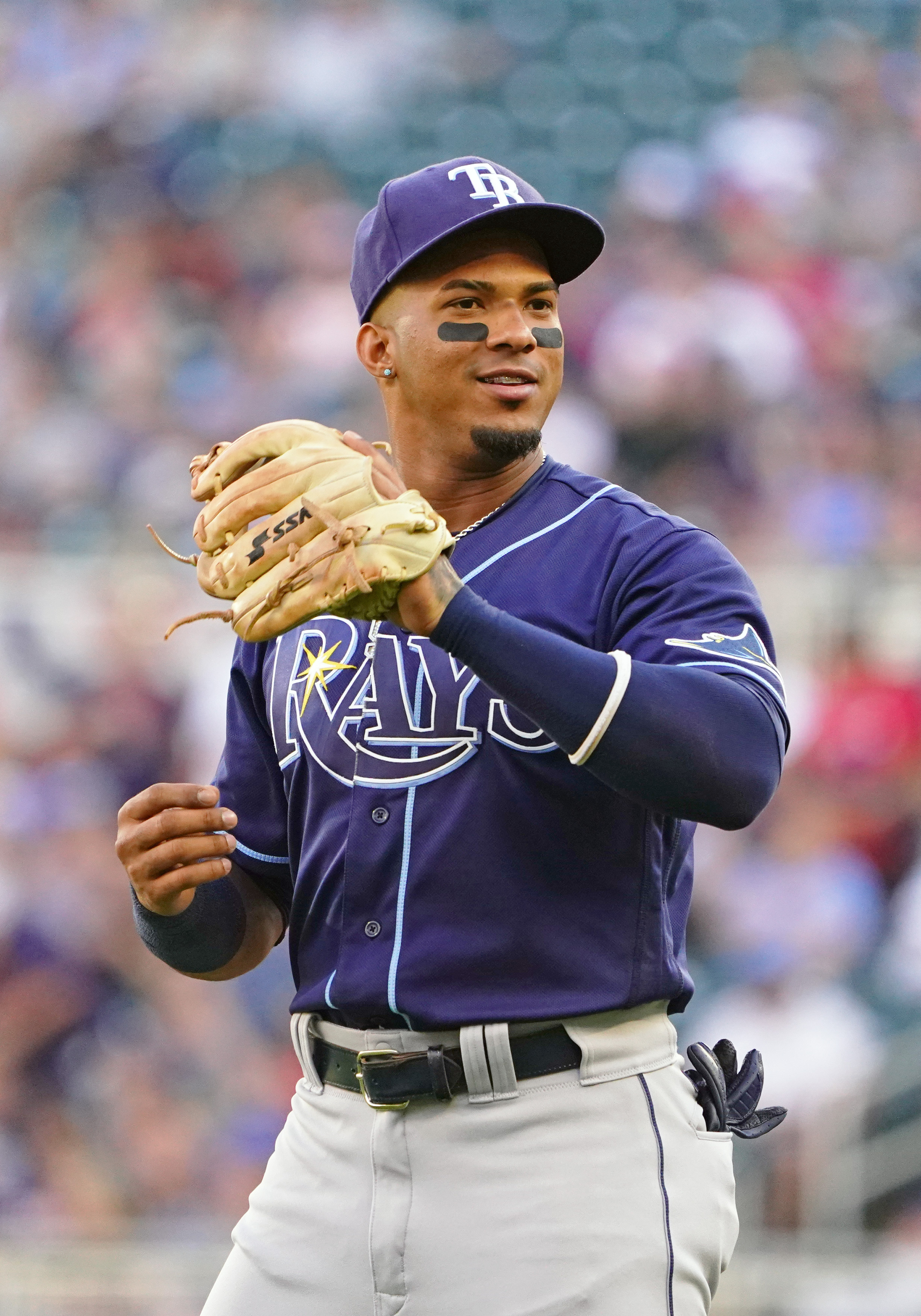
Franco’s contract is both a franchise record for the Rays, topping Evan Longoria‘s previous $100MM guarantee, and also a record for any player with less than one year of Major League service time. Ronald Acuna Jr.‘s eight-year, $100MM contract had been the largest ever signed by a player with less than a year of service, but Franco will nearly double that sum with today’s precedent-shattering agreement.
In terms of financial breakdown, Franco will receive a $5MM bonus right off the bat. The shortstop will earn $1MM in 2022, $2MM in both 2023 and 2024, $8MM in 2025, $15MM in 2016, $22MM in 2027, and then $25MM in each of the 2028-32 seasons.
Franco would receive an extra $3MM in the event of a trade, but there isn’t any no-trade protection involved in the extension. There also aren’t any provisions related to the Rays’ plan to split time between Tampa and Montreal once the team’s lease at Tropicana Field is up after the 2027 season.
Franco, who won’t turn 21 until March, ranked as the sport’s No. 1 overall prospect in each of the past three offseasons and largely justified that hype when he debuted just months after his 20th birthday. The switch-hitter slashed .288/.347/.463 with seven home runs, 18 doubles, five triples and a pair of stolen bases through 308 plate appearances.
From July 25 to Sept. 29, Franco embarked on one of the more remarkable stretches in recent memory, reaching base in a staggering 43 consecutive games in spite of his youth. During that time, he posted a combined .329/.398/.545 batting line with more walks (9.1%) than strikeouts (8.1%). Franco only appeared in 70 games this season but was impressive enough to finish third in AL Rookie of the Year voting.
Defensively, Franco received split marks for his work at shortstop, putting up six Defensive Runs Saved, average marks per Ultimate Zone Rating and a minus-3 mark in Statcast’s Outs Above Average. However, scouting reports on him have pegged him as at least an average shortstop — if not better — in addition to touting his elite hit tool, plus power and plus speed. That generally aligns with the .331/.399./535 slash he posted in his meteoric rise through 215 minor league games. Prior to Franco’s promotion, FanGraphs’ Eric Longenhagen wrote that he’d been “the best player his age on the planet since he was 14 years old” and touted him as a perennial MVP candidate. ESPN’s Kiley McDaniel, meanwhile, called him “plus at basically everything on a baseball field.” Take your pick of Franco scouting reports from the 2020-21 offseason and they’ll all generally be filled similar superlatives.
Because the Rays waited until late June to promote Franco, he was a veritable lock to fall shy of Super Two status under the current arbitration system (which could potentially change, depending on how collective bargaining talks play out). Franco wouldn’t have been arbitration-eligible until after the 2024 season and would’ve had to wait until the 2027-28 offseason to reach free agency. The 11-year length of the contract buys out all three of Franco’s pre-arbitration seasons — during which he’d likely have made under $1MM apiece — and all three arbitration years. He’s also surrendering control of six would-be free-agent seasons (though only five are fully guaranteed).
Some fans will recoil at the notion of guaranteeing $182MM to a player with just 70 big league games under his belt, but those 70 games largely confirmed what the industry has expected from Franco since he signed for a bonus of nearly $4MM as a 16-year-old: he looks the part of a budding superstar. And, a westward look toward San Diego shows what could happen by waiting to allow the player to further establish himself. Fernando Tatis Jr. didn’t sign an extension until he had accrued two years of Major League service, and his price tag ballooned to 14 years and $340MM. Franco’s price tag upon waiting would likely have extended even beyond that point and may well have become too sizable for the Rays’ typically frugal ownership.
It’s tempting to ponder just how much Franco might be “leaving on the table,” so to speak; free agent Carlos Correa has already pocketed $27MM in career salaries and is reportedly seeking a contract worth more than $300MM at the same age Franco would’ve been upon reaching free agency. Extension rumblings surrounding Juan Soto have elicited speculation of $400MM or even $500MM in total guaranteed money; Soto is 23 and has three-plus years of MLB service.
Franco would have found himself on a similar trajectory had he gone the year-to-year route, and one could certainly argue that betting on himself in hopes of setting an even more dramatic record was the more prudent path forward. That said, it’s difficult to fault anyone for accepting this type of guarantee — particularly at such a young age. Generations of Franco’s family will be financially secure because of it, and he can still take heart in knowing that he’s nearly doubled the previous precedent, thus further advancing the market for future players. Beyond that, because of his youth, Franco can still reach free agency as a 32-year-old, which is young enough to command a second substantial contract.
The possibility of “leaving money on the table” also assumes good health and continued production from Franco moving forward. Taking the extension now mitigates much of the risk associated with a career-altering injury or injuries — a danger that exists for any player. It also safeguards against Franco “merely” becoming a solid regular rather than a bona fide superstar (or, less likely, declining into a sub-par player). Promising as his beginnings were, he’d hardly be the first player to impress as a rookie before taking a few years to reach his ceiling or even stalling out entirely.
Ongoing labor talks also have to be considered. While the next collective bargaining agreement could have improved Franco’s earning power, it’s also feasible that a new CBA might have hurt him to an extent; ownership has already proposed an age-based free-agent threshold of 29.5 years, for instance, and although that particular number was a nonstarter for the players association (due to just this type of situation), the league could explore various permutations of such mechanisms. Regardless of how labor talks between MLB and the MLBPA play out, Rays president of baseball operations Erik Neander and Franco can both rest easy knowing that perhaps the most critical negotiation either will ever personally take part in has been resolved.
Any and all instances of the Rays spending money bring about the typical comments wondering how long until the player on the receiving end of the deal is traded. Such barbs are admittedly somewhat justified due to the Rays’ history of trading players — e.g. Longoria, Blake Snell, Chris Archer — in the latter stages of their extensions. But, even if that’s Franco’s ultimate fate, it’s unlikely to happen anytime soon. Extensions of this nature tend to mirror what the player would have earned absent the long-term contract; in other words, Franco may receive an up-front signing bonus, but his yearly salaries through the first six years figure are considerably lighter than they will be in the portion of his contract covering what would have been free-agent years.
In the short term, then, the Franco extension will have only minimal impact on club payroll. Tampa Bay was projected by Roster Resource’s Jason Martinez to field a payroll of around $76MM in 2021, and the Franco contract probably won’t push that mark up to even $80MM. That number still figures to drop a bit in the near future as the Rays contemplate potential trades and non-tenders related to an abnormally large arbitration class, but any trades or non-tenders of arb-eligible players in the coming days will be unrelated to Franco’s long-term pact.
At the end of the day, any contract of this magnitude involves some give and take for both sides. Any number of things could’ve gone wrong for Franco in the years to come, and the looming possibility of those pitfalls underscores the fact that the typically small-payroll Rays are taking on what is, by their standards, an unprecedented risk.
While many will be quick to declare “winners” and “losers” in Hot Stove transactions — be they trades, free-agent signings or contract extensions — there are also instances where a deal simply appears sensible for all sides. Franco receives a generational amount of money and retains the ability to reach free agency in his early 30s. The Rays secure control of a franchise cornerstone whom they hope and believe can be an all-time great. The players union surely approves of the precedent for players with under a year of service being moved forward so substantially.
Ultimately, Franco’s new contract contains positives for all parties involved — perhaps with the exception of Tampa Bay’s division rivals in the AL East who now have to wonder how to combat the emerging superstar into the 2030s.
Yancen Pujols of El Caribe reported last week that the Rays had offered a record-setting extension worth between $150-200MM. Marc Topkin of the Tampa Bay Times reported on Nov. 23 that an agreement was close, and he also had the year-to-year salary breakdown. Joel Sherman of the New York Post (Twitter link) and Hector Gomez of Z101 Sports (Twitter link) reported general parameters, and ESPN’s Jeff Passan eventually reported the specific terms of the contract (Twitter thread).
Latest On Mets’ Starting Pitching Targets
9:10 pm: Jon Heyman of the MLB Network tweeted this afternoon that the Mets seemed to be prioritizing Max Scherzer and Gausman above Ray at the top of the market, which could align with concerns about forfeiting a top 15 pick by signing a qualified free agent. Heyman notes that the Mets remain interested in Stroman, among others.
1:23 pm: Billy Eppler has only formally been the Mets’ general manager a bit more than a week, but he’s jumped right into the mix and is working to bolster the team’s starting staff. Eppler said in an appearance on MLB Network Radio on SiriusXM this week that he’s “engaged in a ton of starting pitching right now” (Twitter link, with audio).
A spotlight was shined on the Mets’ interest in the rotation market this week when owner Steve Cohen voiced frustration with Steven Matz‘s representatives after the lefty spurned his former Mets club to sign a four-year deal with the Cardinals. The Mets also attended Justin Verlander‘s showcase earlier this offseason, though he has since re-signed with the Astros.
Starting pitching is an obvious need for the Mets, who’ve already watched Noah Syndergaard reject their qualifying offer for a slightly larger guarantee with the Angels. The Mets also don’t know whether free agent Marcus Stroman will return, and they’ve already announced that Carlos Carrasco underwent surgery to remove bone fragments from his pitching elbow. The current timeline has Carrasco returning early in Spring Training, but that issue, combined with David Peterson‘s late-July foot surgery and the forearm issue that ended Jacob deGrom‘s season in early July, only serves to further muddy the outlook.
The Mets are reportedly loath to sign a free agent who’d require them to surrender a draft pick, as doing so would mean forfeiting their second-highest pick — in this instance, the No. 14 overall selection in the draft. New York also has the No. 11 pick as compensation for not signing top pick Kumar Rocker in the 2021 draft. That might take Robbie Ray off the table, but he’s the lone remaining free agent starting pitcher tied to draft compensation. (The New York Post’s Mike Puma argued this week that even that steep penalty shouldn’t necessarily dissuade the Mets from pursuing Ray.) The remainder of free agents, including Stroman, Kevin Gausman, Jon Gray and Carlos Rodon, among others, can be signed absent of draft-pick considerations.
The trade market, of course, presents myriad other opportunities. One interesting note raised by Eppler — speaking more generally and not specifically with regard to the rotation — was the Mets’ ability and openness to take on a bad contract as a means of effectively purchasing a prospect from another club. Eppler was the Angels’ general manager when they traded 2019 first-round pick Will Wilson to the Giants in order to shed the remainder of Zack Cozart‘s contract while dealing with payroll limitations from his prior ownership. Now, Eppler suggests he could be on the opposite side of such a transaction.
“There are avenues to go grab contracts elsewhere and tie prospects to them,” said Eppler. “Some teams are still doing that — most teams are not — but I think the openness and willingness to be able to say, ‘We’re going to spend a lot on this player, the contract might be a touch underwater, but we’re going to get this prospect back.’ Exploring those, and trying to push those through a little more — there’s an openness to do that here.”
There are various permutations of that arrangement. The Wilson/Cozart deal, in its simplest form, came down to the Giants effectively purchasing a prospect from the Eppler’s Angels. However, it’s also fairly common for teams to take on an underwater contract when acquiring a more desirable player, providing some salary relief in exchange for surrendering less in terms of prospect capital.
For instance, if the Mets were to make a strong push for one of the Athletics’ available starters (e.g. Frankie Montas, Sean Manaea, Chris Bassitt), offering to take on the remaining $8.25MM owed to outfielder Stephen Piscotty could persuade the A’s to settle for a lesser return. To be clear, that’s just one example — and there’s no indication the A’s are open to that specific scenario. But, that type of arrangement is another in which Eppler could leverage the Mets’ financial might in trade talks.
Whichever route the Mets ultimately take, some kind of upgrade seems inevitable. Their current rotation projects to include deGrom, Carrasco, Taijuan Walker, Tylor Megill and Peterson. It’s not at all a poor quintet if all are healthy, but for a big-market club with postseason aspirations, an additional veteran (or two) to add some dependable innings behind deGrom is a logical pursuit.
Tigers, Javier Baez Have Had Recent Contract Talks
The Tigers have and free-agent shortstop Javier Baez have discussed a contract within the past few days, MLB.com’s Jon Morosi reports (via Twitter). ESPN’s Buster Olney adds that the Tigers are currently “focused” on Baez after previously talking to both Carlos Correa and Marcus Semien. Ken Rosenthal of The Athletic also tweets the Tigers and Baez are having discussions, though he also emphasizes that there’s no deal in place.
It’s not the first time the two sides have been connected, but recent talks between the two parties are nevertheless notable — particularly given various reports and industry speculation that Baez could push to sign somewhere prior to the expiration of the collective bargaining agreement next week.
Detroit has been repeatedly linked to Correa for months now, though at least some of that stems from the fact that Tigers manager AJ Hinch knows Correa well from their time together in Houston. General manager Al Avila began the offseason by stating that his team needed both a starting pitcher and a shortstop while simultaneously emphasizing that the club would not “spend like drunken sailors.” This week, speaking at Eduardo Rodriguez‘s introductory press conference, Avila struck a similar tone (links via Evan Petzold of the Detroit Free Press and Evan Woodberry of MLive.com).
“One big splash does not win you the offseason,” Avila said, adding that there was never going to be a free agent who could singlehandedly make the Tigers into a contender.
“Obviously, we want to get into the playoffs,” Avila said Tuesday, “but we have to be careful as we move forward. … We have to make sure we can field a good 26-man roster. It’s going to be a measured process. We’re going to be very careful in how we do it.”
It’s important to note that said quotes certainly don’t eliminate the possibility of Detroit beating the market to sign Correa or fellow top free agent Corey Seager. Even with Rodriguez aboard, the Tigers have minimal long-term commitments on the books. Tucker Barnhart and Robbie Grossman are signed through 2022. Miguel Cabrera and Jonathan Schoop are signed through 2023. Rodriguez is the only Tiger signed beyond that 2023 season.
That said, if Detroit truly is focused on employing a more “measured” approach, a shorter-term deal for Baez, Semien or Trevor Story would fit the bill. The combination of Rodriguez and any one of that trio would very likely cost less than signing either Correa or Seager on his own, while still providing considerable upgrades over the 2021 roster.
It was an up-and-down season in 2021 for Baez, who’ll turn 29 the day the CBA expires. After a solid first month at the plate, he alternated between brilliant numbers (May, July, September) and awful numbers (June, August) on a month-by-month basis. Notably, he finished out the year with his hottest streak of the season: .347/.426/.554 with five homers and six doubles in 115 September/October plate appearances. Perhaps more encouraging was the fact that following his trade to the Mets, Baez walked at a 7.0% clip that would represent a career-best, while his strikeout rate dropped from 36.3% with the Cubs to a somewhat more manageable 28.5%.
The ups and downs come with the territory for Baez, who’s known as a streaky hitter, but the end result this season was a .265/.319/.494 batting line and 31 homers. That would be an overwhelming upgrade for a Tigers team that saw its shortstops combine to post an awful .201/.275/.321 batting line — and that’s before considering Baez’s status as plus defensive shortstop and plus baserunner.
Baez ostensibly has a fairly wide market in free agency, as he’s also been linked to the Mariners, Rangers, Red Sox, Yankees and the incumbent Mets — albeit to varying extents.
Alex Dickerson Placed On Release Waivers
The Giants placed outfielder Alex Dickerson on release waivers this week, per John Shea of the San Francisco Chronicle (Twitter link). Dickerson was designated for assignment Monday when the team needed to open a 40-man roster spot to finalize the re-signing of Anthony DeSclafani.
Traded from San Diego to San Francisco in June 2019, the now-31-year-old Dickerson immediately endeared himself to Giants fans with a six-RBI showing in his team debut. He proved to be a godsend for the 2019 and 2020 Giants, hitting at a combined .294/.361/.552 clip with 16 homers, 23 doubles and four triples through 341 plate appearances from the time of that June acquisition through the conclusion of the shortened 2020 campaign.
Unfortunately for both the Giants and Dickerson, the 2021 season was marred by three stints on the injured list. Dickerson missed 10 days with a shoulder issue in May, two weeks with a back strain in June and nearly three weeks with a hamstring strain in September. The extent to which those physical ailments impacted Dickerson’s production can’t be known with certainty, but this year’s .233/.304/.420 slash (312 plate appearances) was a far cry from that 2019-20 output.
The 2021 season was hardly the lone injury-plagued year of Dickerson’s career. After turning in what looked like a breakout campaign as a late-blooming, 26-year-old rookie in 2016, Dickerson missed the entire 2017 season due to a back injury that required surgery, and his 2018 season was lost to Tommy John surgery after he suffered a ligament damage in his throwing elbow. He also missed time in 2019 due to wrist and oblique strains that necessitated separate trips to the injured list.
Dickerson had been projected by MLBTR contributor Matt Swartz to earn $3MM in arbitration, but if he goes unclaimed he’ll be free to sign with a new club for any amount. Though he has five-plus years of Major League service time, Dickerson has only appeared in 326 games and tallied just 965 plate appearances thanks to those repeated injuries. For the most part, he’s been plenty productive when healthy enough to take the field — evidenced by a career .260/.330/.470 slash at the Major League level (113 wRC+).
Brian O’Grady Signs With NPB’s Seibu Lions
Former Padres, Rays and Reds first baseman/outfielder Brian O’Grady has signed with the Seibu Lions of Nippon Professional Baseball, per announcements from both the Lions and from O’Grady himself (Twitter link).
O’Grady, 29, became a free agent after being outrighted off San Diego’s roster at season’s end. The 2014 eighth-round pick (Reds) saw a career-high 61 plate appearances with the Friars in 2021, frequently operating as a pinch-hitter but also drawing a handful of starts in right field. O’Grady hit .157/.267/.333 with a pair of homers, three doubles and eight walks (13.1%).
The limited role wasn’t entirely new for O’Grady, who also saw action with the Reds in 2019 and Rays in 2020 without ever receiving an opportunity at consistent playing time. He’s a career .184/.283/.388 hitter in 114 Major League plate appearances — but those plate appearances have come over the course of 62 games.
O’Grady figures to be afforded far more opportunities in Japan, and given his career .284/.362/.551 batting line in 978 plate appearances at the Triple-A level, there’s good reason to believe he’ll find success overseas. Regardless of how he performs, he’ll quite likely be paid a guaranteed salary that handily eclipses what he’d have made in another season split between Triple-A and the big leagues. A strong season in Japan could either position O’Grady for a raise on a new contract in NPB or the KBO, and success in a foreign professional league could also prime him to return to MLB on a guaranteed contract at some point down the line.
Steve Cohen Frustrated By Steven Matz Negotiations
Lefty Steven Matz is headed to the Cardinals on a four-year deal, pending a physical — the culmination of what appeared to be a rather competitive market for his services. MLB Network’s Jon Heyman reported in the leadup to Matz’s decision that eight teams had made offers, and some details on those offers have begun to trickle out. Jon Morosi of MLB.com tweets that the Blue Jays made a three-year offer to retain Matz. Heyman lists the Jays, Red Sox, Cubs and Mets as finalists.
Grabbing the most headlines in the morning hours after Matz’s decision, however, was Mets owner Steve Cohen’s displeasure with the manner in which the free-agent bidding drew to a close. Cohen, never afraid to speak his mind on social media, blasted agent Rob Martin of Icon Sports this morning via Twitter: “I’m not happy this morning. I’ve never seen such unprofessional behavior exhibited by a player’s agent. I guess words and promises don’t matter.”
In a follow-up with Joel Sherman of the New York Post (Twitter thread), Cohen made clear that his frustration lied with the agents and not Matz himself. However, Cohen and the Mets were under the impression Matz’s camp would circle back one final time before accepting an offer elsewhere, which didn’t happen. Heyman tweets that the Mets would have matched the four-year, $44MM offer from St. Louis but were never afforded the opportunity.
“Most relationships I have had with agents have been wonderful,” Cohen tells Sherman. “The conversations have been good, they really have been. But here this was different. This was something so over the line. I can’t imagine what the agent was thinking in the context of how they reached out to us and the reasons they wanted to come back. I have ever (sic) had an agent do that before with me.”
Martin initially declined comment but eventually, as Cohen’s comments continued to mount, issued a statement of his own (Twitter link via The Athletic’s Ken Rosenthal):
“We are aware of Mr. Cohen’s tweet. It’s unfortunate that he chose to take his frustrations to Twitter. I will not do the same and instead will take the high road which is consistent with both my character and the character of our client. Steven Matz grew up a Mets fan, loved his time there, and continues to invest in the New York Community through his efforts supporting NY’s First Responders. As a result of all that, there was a strong pull to return to the Mets. But ultimately he made the decision he felt was best for him and his family. Steven is and always will be grateful to the Mets and Mets fans, but he now looks forward to his next chapter with the tremendous franchise in St. Louis.”
Some may wonder about possible long-term ramifications of the spat, but Martin tells Sherman that he called Cohen to speak to him not long after this morning’s tweet. Martin suggested that tension was lessened and that his agency and Matz hold no grudge toward the Mets organization.
Twins Release Willians Astudillo, Outright Charlie Barnes
Twins utilityman Willians Astudillo cleared release waivers and is now a free agent, per a team announcement. Left-hander Charlie Barnes, meanwhile, went unclaimed on outright waivers and has been assigned to Triple-A St. Paul. He’ll remain with the club but will no longer require a 40-man roster spot. Both players were designated for assignment Friday.
Astudillo, 30, made his big league debut with the Twins back in 2018 and has since displayed an uncommon skill set and fairly rare level of defensive versatility. “La Tortuga” has played every position on the diamond, with the exception of shortstop. Astudillo worked as a catcher and corner infielder with the Phillies in his early days as a prospect and has continued to add more positions to his defensive profile. He’s not considered a plus defender anywhere, but Astudillo embodies the “jack of all trades, master of none” profile quite well.
More interesting is Astudillo’s unorthodox skill set at the plate. As free a swinger as there is in the game, the right-handed-hitting Astudillo also possesses uncanny bat-to-ball skills. He’s struck out just 25 times in 533 career plate appearances (4.7%), but his frequent hacking has led to an even smaller 1.9% walk rate. Astudillo has a bit of raw power, but he swings so early and so often, with such high contact rates, that he rarely finds himself in position to get a pitch to drive. Since 2018 (min. 500 plate appearances), Astudillo has the third-highest swing rate (60.1%) of any player in baseball and the second-highest contact rate (91.5%) — trailing only his now-former teammate Luiz Arraez in that regard.
Astudillo was arbitration-eligible and projected by MLBTR contributor Matt Swartz to earn a $1.2MM salary in 2022. Coming off a .236/.259/.375 slash in 216 plate appearances, however, it seems the Twins preferred not to allocate those dollars or a 40-man roster spot to him — particularly with so many prospects needing to be added to the 40-man roster. (Minnesota selected six players Friday.) Astudillo can now sign with any team.
The 26-year-old Barnes is a former fourth-rounder who made his big league debut out of necessity to help soak up some innings in an injury-ruined season for the Twins. He was clobbered for a 5.92 ERA while striking out just 20 of the 175 batters he faced, however. Barnes is a strike-throwing changeup artist whose fastball averaged just 89.9 mph in the Majors. However, he did managed a solid 3.79 ERA with a 19.1% strikeout rate and a 7.4% walk rate in 76 innings at the Triple-A level. He’ll stick with the organization for now and hope for another opportunity in 2022. As it stands, the Twins have a perilously thin mix of starting options, but Minnesota is expected to add several starters this winter.