
Brett Cecil Announces Retirement
Left-handed reliever Brett Cecil took to Instagram this week to announce his retirement from baseball. In a lengthy statement, Cecil thanked his family, his representatives at ACES and both Major League teams for which he pitched: the Blue Jays and the Cardinals.
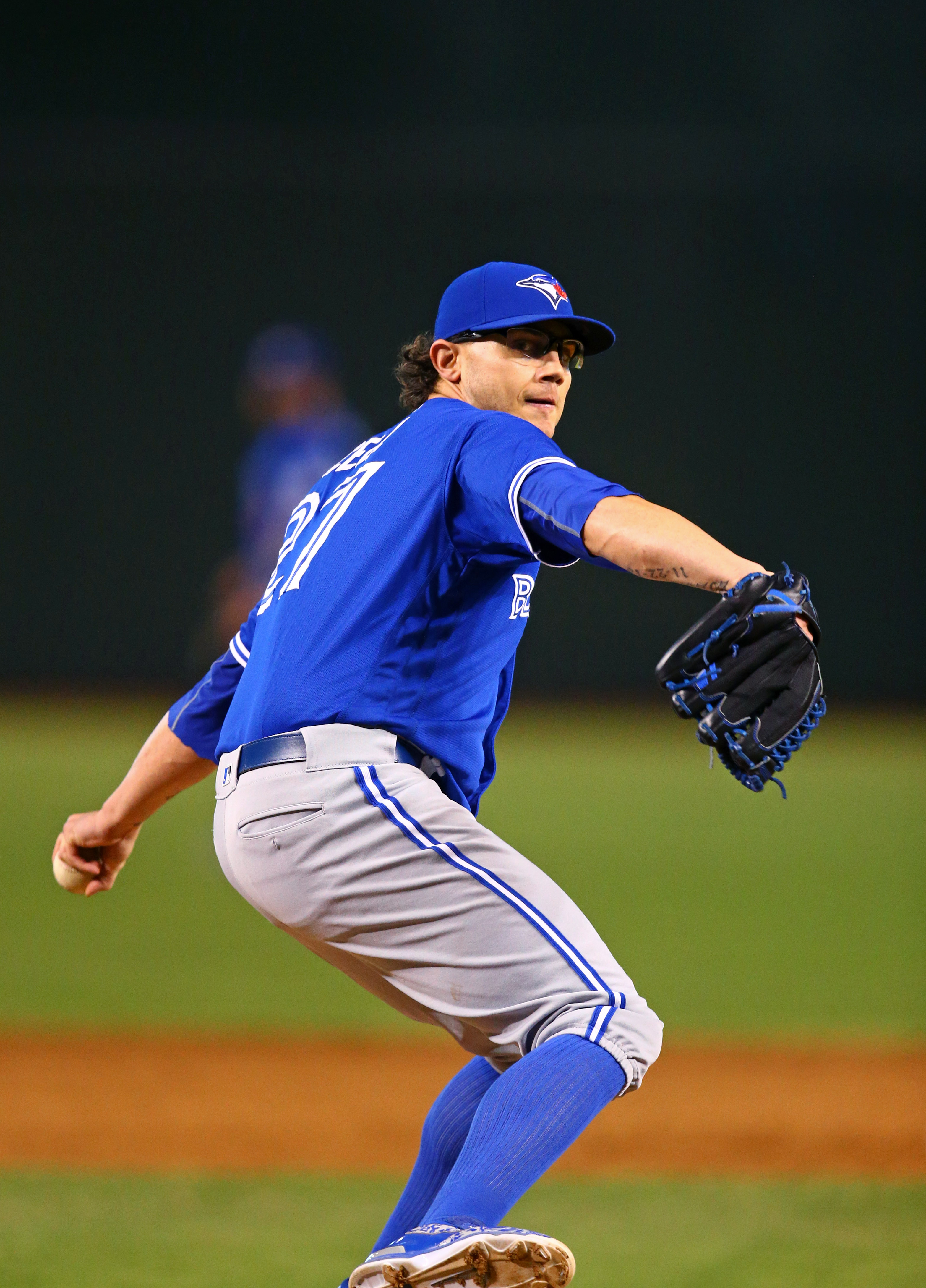
Cecil, 35, hasn’t pitched in the Majors since the 2018 season, although that’s not for lack of effort. The southpaw signed a four-year contract with the Cardinals in the 2016-17 offseason and turned in a solid first year in St. Louis before injuries completely derailed his time with the organization. A shoulder strain landed Cecil on the injured list after his first appearance of the 2018 season. He missed more than a month with that injury and spent another month on the shelf due to a foot strain later that year.
The 2019 season was a complete wash for Cecil, who underwent surgery to alleviate carpal tunnel syndrome in his pitching hand early in the year. He wasn’t able to make it back to the mound in ’19, and his 2020 season never got off the ground. Cecil suffered what the team termed a “significant” hamstring strain in Spring Training, not long before the league shutdown due to the Covid-19 pandemic. He’d made it back to the mound and was reportedly exploring a new sidearm delivery when MLB clubs began their “Summer Camp” in advance of the shortened season. The Cardinals cut him loose prior to the new Opening Day in what would have been the final season of that four-year, $30.5MM contract, however. He did not sign with a team for the 2021 season.
Cecil’s run in St. Louis clearly didn’t go as hoped, but the injury-plagued nature of that contract tends to overshadow the quality results he’d enjoyed in Toronto prior to signing that deal. Cecil had a bit of success as a starter with the Jays in 2010-11, pitching to a 4.43 ERA in 296 1/3 innings over the life of 48 starts. That two-year period even included a pair of complete games — one of them his lone MLB shutout. The left-hander’s career truly took off with a full-time move to the bullpen, however.
From 2013-16, Cecil pitched to a 2.90 ERA with a sizable 51.2% ground-ball rate, a massive 30.5% strikeout rate and a solid 8.3% walk rate. He was more effective against lefties than righties, as one would expect, but he more than held righties in check during that four-year run. Cecil posted a 3.88 ERA in his first season with the Cardinals, as his strikeout rate dipped a bit, but he remained a strong ground-ball pitcher with a terrific walk rate.
Cecil will retire from baseball with parts of 10 seasons in the Major Leagues, during which time he went 44-47 with a 4.29 ERA, 12 saves and 67 holds in 756 innings. A series of injuries cut short what looked to be a burgeoning run as one of the game’s better left-handed relievers, but two solid seasons as a starting pitcher and a five-year bullpen peak that saw him post a combined 3.14 ERA and fan 29% of his opponents from 2013-17 nevertheless makes for a fine big league career.
Minasian: Angels Hope To “Significantly Improve” Rotation This Offseason
TODAY: The Angels also have interest in Marcus Stroman, Alex Wood, and Noah Syndergaard, according to The Athletic’s Ken Rosenthal.
NOVEMBER 9, 8:58pm: Minasian reiterated his desire to land an impact starter when speaking with Alden González of ESPN this evening (Twitter link). “Frontline starting pitching is tough to acquire. It’s very difficult,” the GM acknowledged. “That being said, we’d like to significantly improve our rotation. That’s an area where we’ll definitely look for a certain type of quality.”
2:16pm: It’s become something of an offseason tradition to note that the Angels are in the market for rotation help, and that’s again the case as the 2021-22 offseason commences. Second-year general manager Perry Minasian again told reporters at this week’s GM Meetings that pitching help is his top priority — Minasian offered a similar outlook in early October — and perhaps more importantly suggested that the team isn’t operating under any payroll constraints (Twitter links via Jack Harris of the L.A. Times). Asked about the budget, Minasian simply replied he “wouldn’t rule us out of anything.”
It’s hardly a surprise to see the Angels again in the market for pitching help — especially with regard to the rotation. Halos starters ranked 26th in the Majors with just 776 1/3 innings pitched in 2021, and their collective 4.78 ERA ranked 22nd. In terms of fielding-independent metrics like FIP and SIERA, the Angels were a middle-of-the-pack club, and the same was true of their strikeout percentage. No team in baseball saw its starters walk a higher percentage of opponents than the Angels’ nine percent mark, however, and their rotation ranked 15th in hit batters despite tallying the fifth-fewest innings of any team in MLB.
Minasian confirmed to Harris and others that the team was represented at yesterday’s Justin Verlander showcase, and MLB.com’s Jon Morosi tweets that the Angels have made some early inquiries with free-agent lefties Robbie Ray and Eduardo Rodriguez. Any big-market club with a need in the rotation figures to check in with the representatives for this trio of pitchers, of course, but it’s notable that all three of Verlander, Ray and Rodriguez have received qualifying offers from their respective clubs.
If the Angels were to sign anyone from that trio, they’d need to forfeit their second-highest draft selection and $500K of their international bonus pool. For some teams, that’s a firm roadblock, but it’s at least somewhat telling that the Angels don’t seem fazed by that reality. Their early interest in this group meshes well with Minasian’s sentiment that they’re not ruling anything out as they look to address a longstanding rotation need.
In the bullpen, the Angels have made a qualifying offer of their own, extending that $18.4MM proposal to closer Raisel Iglesias. Minasian hasn’t received any indication as to whether Iglesias will accept or decline the offer — the latter seems likely — but emphasized (via Harris) that the Angels would like to have Iglesias at the back of their ‘pen again in 2022, whether he accepts or declines.
The Angels’ rotation currently projects to be headlined by MVP frontrunner Shohei Ohtani, with younger options such as Patrick Sandoval, Jose Suarez, Jaime Barria, Reid Detmers, Griffin Canning and Janson Junk among the options to round things out. It’s an inexperienced group, to say the least, so it’s likely the Angels will be in the market for multiple veteran arms to join the group in the offseason. Alex Cobb previously expressed interest in returning to the club but will at least be able to field interest from other clubs now that he’s a free agent.
From a payroll vantage point, the Angels currently owe a combined $108.95MM to five players: Mike Trout, Anthony Rendon, Justin Upton, David Fletcher and Ohtani. Add in a modest projection of $7.7MM in arbitration salaries — including a combined $2.8MM to non-tender candidates Junior Guerra and Phil Gosselin — as well as a slate of pre-arbitration players, and next year’s projected payroll jumps to somewhere in the $125-130MM range.
For a team that carried a $182MM payroll in 2021 and recently saw Albert Pujols‘ decade-long megadeal come off the books, that’s a fair bit of flexibility. And, considering further that Justin Upton‘s backloaded contract ($28MM in 2022) is off the books next winter, the outlook is a bit brighter yet. The Angels will still surely want to consider a long-term deal to keep Ohtani beyond the 2023 campaign, currently his final year of club control, but there ought to be room to bring in an arm of some note.
That said, with all of Trout, Rendon and ideally Ohtani on the books for the long haul, it might be difficult for the Angels to sign two high-end pitchers to long-term arrangements. It’s feasible that they could sign someone like Ray or Rodriguez to a long-term deal, ink another impact starter to a shorter-term arrangement — Verlander, Max Scherzer and Carlos Rodon are among the candidates for that type of deal, speculatively speaking — and then look to the trade market for another arm. The Reds, Marlins and Athletics could all look to move some starters this winter, and the Halos of have several promising young outfielders, including Jo Adell, Brandon Marsh and Jordyn Adams. Any of the previously mentioned young rotation options could also be included in a package for a more established arm.
Regardless of how things unfold, the Angels have a good bit of payroll space at their disposal for at least the next few years. The manner in which they address the rotation this winter and the outcome of their inevitable extension talks with Ohtani will dictate how things look in 2023 and beyond.
Former Nats AGM Adam Cromie Among Candidates For Mets’ GM Vacancy
WEDNESDAY, 5:08 pm: Jon Morosi of MLB.com also hears that Cromie is the frontrunner to land the position. Alderson told reporters (including Janes) that no decision has been finalized yet, however, and said multiple candidates remain.
WEDNESDAY, 11:10am: Cromie and Cohen met face-to-face Tuesday night, according to Joel Sherman of the New York Post. According to Sherman, “The expectation was that if that meeting went well that Cromie would be made an offer to be the Mets general manager.”
TUESDAY, 2:48pm: Cromie has a “real shot” to be named the Mets’ next general manager, tweets Joel Sherman of the New York Post. The team’s interest in him is “serious,” tweets SNY’s Andy Martino, though he also adds that there are still a few other candidates in the mix.
12:25pm: After weeks of courting high-profile executives to step in as president of baseball operations, the Mets are now focused on hiring a general manager, Sandy Alderson told reporters Tuesday (Twitter links via Deesha Thosar of the New York Daily News).
It’s an important distinction in terms of title, even if the end result — bringing someone into the organization to oversee baseball operations — is largely the same. Focusing on a general manager rather than a president role further signals that the Mets will be zeroing in on executives who are at the assistant GM level rather than mining other clubs in hopes of prying away an existing GM or president of baseball ops, as they’d previously sought to do. Alderson emphasized that he does not believe the Mets will get to the point where he runs baseball operations himself (Twitter link via Newsday’s Tim Healey) — a role to which he does not wish to return.
Focusing on the AGM ranks broadens the field of possibilities for the Mets, although it also means the Mets may settle on a less-experienced baseball ops leader than originally hoped. That’s not necessarily inevitable, however; there are plenty of former GMs in non-GM roles around the sport. Dodgers senior vice president of baseball operations Josh Byrnes, for instance, has been a rumored candidate and previously served as GM of two different NL West clubs (Padres, D-backs).
Alderson declined to put a timeline on the search’s outcome but did note that a managerial hire likely wouldn’t be made until a new baseball operations leader is in place. Alderson’s hope, Mike Puma of the New York Post tweets, is that they’ve already spoken to the candidate they’ll eventually hire. As for the struggles in terms of making this hire, Alderson rather candidly acknowledged that there’s been a struggle (video link via SNY).
“In some cases, we haven’t gotten permission [to interview a candidate with another organization],” Alderson said. “In some cases, I think people are comfortable where they are — whether it be a family situation or something professional. And in other cases, I think, admittedly, there’s a reluctance to come to New York — but I think it’s mostly about New York and not about [owner Steve Cohen], or the organization. It’s a big stage, and some people would just prefer to be elsewhere.”
One possible name that has recently emerged is that of former Nationals assistant GM Adam Cromie. Chelsea Janes of the Washington Post reports (via Twitter) that Cromie is “in the mix” of candidates for the vacancy. He stepped away from the Nationals and from baseball in general back in 2017 to work at a law firm in Pittsburgh, per Janes. The Post’s Barry Svrluga notes that Cromie joined the Nats out of grad school and rose through the front-office ranks while putting himself through law school in the evenings before eventually deciding to fully pursue that legal career.
Red Sox Have Made Multi-Year Offer To Eduardo Rodriguez
In addition to their one-year, $18.4MM qualifying offer to Eduardo Rodriguez, the Red Sox have also made a multi-year contract offer to the free-agent lefty, MLB Network’s Jon Heyman reports (via Twitter). Red Sox chief baseball officer Chaim Bloom said earlier this week that there was mutual interest in a longer-term deal between the two parties (via Alex Speier of the Boston Globe).
Proposed terms aren’t clear at this point, but the fact that the Sox are trying to retain Rodriguez on a multi-year pact is nevertheless of some note. We’ve seen players accept a qualifying offer and still work out a subsequent extension in the past — Jose Abreu and the White Sox, for instance — but interest in Rodriguez figures to be robust. The fact that the Sox are looking at multi-year arrangements is at least a sign of a healthy market. Rodriguez has already been loosely linked to the Angels, and MLB.com’s Jon Morosi tweets this morning that the Tigers have showed some “early interest” as well.
The 28-year-old Rodriguez was viewed by some as a surprise recipient of the qualifying offer on the heels of a 4.74 ERA this season. Beyond that mark, however, everything in the lefty’s profile looks quite appealing. Rodrgiuez posted career-best marks in strikeout rate (27.4%) and walk rate (7.0%) while effectively tying career-best marks in swinging-strike rate (11.7%), called-strike rate (16.4%) and opponents’ chase rate (33.7%).
Rodriguez was also among the very best in baseball in terms of limiting hard contact (90th percentile average exit velocity, 87th percentile hard-hit rate) and finished the season on a rather strong note. The lefty posted a 3.71 ERA and 2.89 FIP following the All-Star break, including a 2.11 ERA in his final four starts of the season. Rodriguez was pulled early in his Game 1 ALDS date with the Rays after allowing a pair of runs in 1 2/3 innings, but he came back strong in his next two starts, allowing just eight hits and punching out 13 with no walks over the course of 11 innings. In all, over Rodriguez’s past three healthy regular seasons, he carries a 4.11 ERA, 3.63 FIP and 3.95 SIERA in just shy of 500 innings.
“Healthy” seasons is a key distinction, of course. The 2020 season was completely lost for Rodriguez when he developed myocarditis in the wake of a positive Covid-19 diagnosis. Rodriguez detailed the ordeal to James Wagner of the New York Times back in May, explaining that he couldn’t even get through 10 pitches in a bullpen session at one point before debilitating exhaustion overtook him. He was eventually barred from virtually any physical activity for three months, with even minor tasks like walking his dog and going to the supermarket off the table.
Given that context, it’s somewhat remarkable that Rodriguez was able to make it back for a full slate of 32 games in 2021 (including a lone, one-inning relief stint late in his final appearance). He tallied 157 2/3 innings during the regular season and tacked on another 12 2/3 in the postseason for a total of 35 games pitched. The Sox were seemingly mindful of his per-start workload, as he averaged just north of five frames per outing — a far cry from the six innings he averaged in 2019. Still, the overall workload is quite encouraging, given where Rodriguez was a year ago at this time.
All of that will be weighed by teams as they determine how aggressively to pursue Rodriguez, as will the fact that he’s tied to draft compensation by virtue of that aforementioned qualifying offer. Rodriguez has until Nov. 17 to determine whether to accept or reject that one-year, $18.4MM offer.
Phillies Prioritizing Bullpen, Outfield Upgrades
It’s the first full offseason as Phillies president of baseball operations for Dave Dombrowski — he joined the team in mid-December last year — and he kicked things off be speaking rather candidly about his club’s needs while addressing reporters at this week’s GM Meetings in California. Notably, Dombrowski indicated that he’s received a budget from owner John Middleton that he does not “find restrictive” (Twitter link via Matt Gelb of The Athletic) and that he’s already begun to map out his offseason priorities.
“If I had to say one thing, I’d probably say I’d like to have somebody that can close a game for us, and count on it,” Dombrowski said while also labeling left field and center field as “complete necessities” (link via NBC Sports Philadelphia’s Jim Salisbury). The veteran baseball ops leader has myriad avenues to pursue upgrades at all three of those spots, though he did note a “preference” not to surrender a draft pick when signing a free agent this winter. That’s far from a hard declaration that the Phils will be out on the likes of Raisel Iglesias, Michael Conforto, Nick Castellanos and Chris Taylor, but the fact that all four of those players received a QO has to factor into the calculus when contemplating them as a fit for the Phils.
Speculatively looking to some higher-end free agents who did not receive a qualifying offer, Starling Marte makes a good bit of sense in center field, while the left field market could include Kris Bryant (a close friend of Bryce Harper), Kyle Schwarber, Avisail Garcia, Mark Canha and others. In the bullpen, Kenley Jansen, Corey Knebel and Kendall Graveman are among the top relievers who didn’t receive qualifying offers. This year’s saves leader, Mark Melancon, is also a free agent.
Of course, names like Graveman and, in particular, Melancon are somewhat questionable fits given the Phillies’ woeful infield defense in 2021. Improving the glovework around the infield ought to be a major priority for Dombrowski as well — particularly given the presence of so many ground-ball pitchers in the rotation mix (e.g. Kyle Gibson, Ranger Suarez and even ace Zack Wheeler). The Phillies ranked as one of the worst defensive units in MLB last season, which has been a recurring theme in recent years.
That segues nicely into other potential area of need for the Phillies: shortstop. While it wasn’t specifically highlighted by Dombrowski, Salisbury notes that the Phils are indeed looking for an upgrade at that position. That comes as little surprise after Dombrowski already made clear that veteran Didi Gregorius is not guaranteed the starting job next year — even in spite of the $14.5MM he’s owed in 2022 (the second season of a two-year contract). The Phils could certainly jump into the free-agent market at shortstop, but doing so would impact their ability to fill the top needs listed by their second-year president. The Athletic’s Ken Rosenthal suggests it may be something they pursue more opportunistically, in the event that a high-end shortstop’s market doesn’t materialize as hoped.
One potential in-house alternative to Gregorius comes in the form of 2019 first-rounder Bryson Stott, whom Dombrowski praised at length during yesterday’s chat with the Phillies beat (link via Matt Breen of the Philadelphia Inquirer). Phils fans, in particular, will want to check out the full slate of Dombrowski’s quotes to draw their own conclusions, but he explained that he’s already told Stott to come to Spring Training “with the mindset of trying to win a job” rather than simply being happy to be there. No promises have been made to Stott, but Dombrowski acknowledged that his presence impacts the manner in which the Phils will approach the free-agent market for shortstops.
Stott, who turned 24 shortly after the season ended, soared from Class-A to Triple-A (10 games) in 2021, hitting a combined .299/.390/.486 with 16 home runs, 26 doubles, a pair of triples, 10 steals (in 14 tries), a 22.2% strikeout rate and a 13.3% walk rate across three levels. The No. 14 overall selection in 2019 also played in this year’s Arizona Fall League and turned in a hearty .299/.446/.403 line in 92 plate appearances.
Stott could theoretically move to another spot (e.g. second base, third base) if the Phils add a shortstop or if Gregorius looks resurgent in Spring Training following an offseason elbow surgery. However, the combined presence of Stott, Gregorius, first baseman Rhys Hoskins, veteran second baseman Jean Segura and young third baseman Alec Bohm (who finished third in 2020 Rookie of the Year voting before struggling in 2021) gives the Phils more options in the infield than in the outfield or at the back of the bullpen.
The Phillies currently project to carry a payroll of about $171MM, per Roster Resource’s Jason Martinez — a lofty number but one that also sits well shy of last year’s approximately $205MM mark. Philadelphia also avoided paying the luxury tax in 2021, which could make crossing the threshold more palatable in 2022. Then again, it’s hard to glean anything about teams’ comfort level with respect to the luxury tax, as the structure of that system will be one of the most critical factors during the ongoing collective bargaining negotiations.
Athletics Appear Set For Significant Payroll Reduction
7:29 pm: Forst addressed the club’s likely forthcoming payroll cuts this evening, telling Jon Heyman of the MLB Network (Twitter link) the team is willing to field offers for any player on the roster. “This is the cycle for the A’s. We have to listen and be open to whatever comes out of this. This is our lot in Oakland until it’s not.”
10:30 am: The Athletics’ stunning decision to let manager Bob Melvin leave to sign a three-year deal as the Padres’ new manager served as a portent for a bleak winter in Oakland, only increasing prior expectations that a payroll reduction was on the horizon. General manager David Forst spoke with John Shea of the San Francisco Chronicle and others at this week’s GM Meetings, and while he didn’t outright say that the team plans to reduce its bottom line in 2022, he implied that another “step back” is certainly a possibility.
“I think right now we’re in the middle of those conversations with [ownership],” said Forst. “We don’t have exact direction yet. But you look at our history, and we have three- or four-year runs and recognize where we are makes it necessary to step back. But we have not gotten to that point yet with ownership.”
While Forst understandably sidestepped a definitive declaration on the team’s payroll direction, USA Today’s Bob Nightengale writes that a pair of MLB executives told him Oakland is expected to slash payroll to as little as $50MM. One potential wrinkle as the A’s look to cut payroll, writes Ken Rosenthal of The Athletic, is the uncertainty surrounding the collective bargaining agreement. The league’s initial offer to the MLBPA included a proposed salary floor (in exchange for a reduction of the luxury tax threshold — a nonstarter for the players’ side of negotiations). Even though the MLBPA had no interest in the specifics of that particular proposal, the eventual possibility of a salary floor could come back to haunt the A’s if they gut the payroll early in the winter.
One way or another, it seems quite likely that the current Athletics’ core is going to be broken up this offseason — the question is to what extent rather than whether it’ll happen at all. Such an outcome wasn’t exactly difficult to foresee. I explored back in early September how, based on their typical payroll levels, the A’s were unlikely to spend to keep a deep arbitration class after projected raises to the likes of Matt Olson, Matt Chapman, Sean Manaea, Chris Bassitt and Frankie Montas (among others). Retaining that group would require an increase over this season’s $83.8MM payroll — already the fourth-highest in franchise history and not far below the team record of $92MM. That increase would come before making a single addition to the 2022 roster.
When looking for trade candidates on the Oakland roster, the top of that arbitration class is the most obvious place to begin. At $12MM, Olson leads the bunch in terms of expected salary, per MLBTR contributor Matt Swartz’s end-of-year projections. Each of Manaea ($10.2MM), Chapman ($9.5MM), Bassitt ($8.8MM) and Montas ($5.2MM) is also set to account for a notable portion of the team’s payroll next season.
The A’s would surely be open to moving outfielder Stephen Piscotty (still owed $8.25MM, including a 2023 option buyout) and shortstop Elvis Andrus ($7.25MM through 2022 after accounting for the portion of his salary paid by the Rangers). Neither player has much in the way of trade value at this point, however. Oakland currently projects for a payroll just north of $85MM, per Roster Resource’s Jason Martinez. That figure includes MLBTR’s projected arb salaries, the two guaranteed contracts and a slate of pre-arb salaries to round out the roster.
Olson, Chapman and Montas all have two years of club control remaining. Manaea and Bassitt are set to become free agents next winter. While it’s possible, if not likely, that other players on the Oakland roster will also see their names pop up in trade talks, that quintet offers the best blend of productivity, affordability (for other clubs) and trade value (for the A’s). Here’s a quick, high-level look at each:
- Olson (28 next year): A 2021 All-Star and two-time Gold Glove winner, Olson leads all first basemen with 34 Defensive Runs Saved and a 22.8 Ultimate Zone Rating since 2017. He’s sixth among first basemen in Statcast’s Outs Above Average during that time. Olson swatted a career-best 39 home runs in 2021 and, most importantly, cut his once-problematic strikeout rate to an 16.8% level that is well below the league average. Olson walks at a high clip, has massive left-handed power, plays elite defense and looks to have made huge gains in his contact skills. He hit .271/.371/.540 in 2021 despite a cavernous home stadium.
- Chapman (29 next year): As with Olson, Chapman is a preternatural defender. Since 2017, the two-time Platinum Glover leads third basemen in DRS (78) and UZR (48.7) and trails only Nolan Arenado in OAA (48). Chapman has huge power, but his contact trends have gone in the opposite direction of Olson. Chapman, whose 2020 season ended early due to hip surgery, struck out at a 22.8% clip from 2018-19 but a 33.1% pace in 2020-21. The glove is still elite, and Chapman has still bashed 37 homers in his past 774 plate appearances while walking at an 11.4% clip. The current version of Chapman has huge value, but if the strikeouts decline as he further distances himself from the hip injury, he has MVP-caliber talent.
- Manaea (30 next year): Manaea’s 2018 season ended with major shoulder surgery, and he missed most of 2019 while on the mend. Since returning, he’s delivered 263 innings of 3.73 ERA ball with near-identical reviews from fielding-independent marks like FIP (3.64) and SIERA (3.78). In that time, Manaea has a 24.8% strikeout rate, a 5.2% walk rate and a 43.8% grounder rate — all strong marks. He moved from a four-seamer to a sinker this season, and the 92.2 mph average on that sinker was the best velocity on his primary offering since his four-seamer sat 93.1 mph as a rookie in 2016. He’s a one-year rental, but a good one.
- Bassitt (33 next year): A frightening injury that saw Bassitt struck in the face by a 100 mph-plus line drive in August looked like it might end his season. Bassitt, however, returned from surgery to repair facial fractures on Sept. 23 and made two appearances to close out his season (6 1/3 innings, one run allowed). Since establishing himself as a big leaguer in 2018, the late-blooming righty has a 3.23 ERA, a 23.1% strikeout rate, a 7.1% walk rate and a 42.3% grounder rate in 412 innings. This past season’s 25% strikeout rate and 6.1% walk rate were career-highs. Like Manaea, Bassitt is a free agent next winter but would make a fine rental for a contender.
- Montas (29 next year): Montas consistently averages better than 96 mph on his heater. The 2021 season was his first topping 100 innings, thanks to a combination of injuries, the shortened 2020 campaign and an 80-game PED ban. Lack of innings notwithstanding, Montas has been effective on the whole since 2018, logging a combined 3.57 ERA with above-average strikeout and walk rates. The 2021 season looked to be a true breakout, as Montas ranked ninth in MLB with 187 innings and turned in a 3.37 ERA with a career-high 26.6% strikeout rate.
The asking price on those players, and others, will vary based on expected earnings and remaining club control. It’s not a given that the A’s trade all five, of course, and it’s possible that even as they do make some changes on the roster, some of those dollars are reallocated to low-cost free agents.
In past trades of notable players, the A’s have tended to focus on upper-level prospects and young big leaguers who’ve yet to establish themselves rather than the lower-level types often targeted by teams commencing full teardowns. That’s not a guaranteed blueprint for how they’ll operate this winter, but the focus on near-term assets is part of the reason the A’s have managed to remain so competitive amid frequent “step backs,” regular roster turnover and perennial payroll constraints.
The extent of this ostensible “step back” will be partly determined by the extent to which ownership is willing to spend in future seasons, but the A’s have never embarked on the sort of lengthy, years-long rebuilds we’ve recently seen in Baltimore, Detroit and other places. Oakland has never had more than three straight losing seasons under Billy Beane and has just eight total losing records in Beane’s 24 full seasons leading baseball operations.
MLBTR Chat Transcript
Click here to read a transcript of Tuesday’s chat with MLBTR’s Steve Adams.
Verlander Showcase Draws Scouts From 15-20 Teams
Two-time Cy Young winner Justin Verlander, who has pitched just six innings since the conclusion of the 2019 season due to 2020 Tommy John surgery, held a free-agent showcase this week. Representatives from as many as 15 to 20 teams this week, tweets Joel Sherman of the New York Post, adding that Verlander’s fastball was clocked from 94 to 97 mph. He’s presently about 13 and a half months out from the surgery and will be 17 months removed from the procedure by the time Spring Training is set to begin.
As one would expect, the list of known teams in attendance at the showcase includes a blend of big-market contenders and a few rebuilding clubs looking to turn the corner and get back into competitive ball. Britt Ghiroli of The Athletic tweets that the Yankees, Rangers and Tigers were in attendance. Sherman notes that the Mets had two scouts present for Verlander’s workout. TSN’s Scott Mitchell adds the Blue Jays to the pile, and the Post’s Ken Davidoff lists the Giants as another suitor. Angels GM Perry Minasian told reporters that the Halos had someone present to watch Verlander as well (Twitter link via The Athletic’s Sam Blum).
Of course, given the stage of the offseason we’re at, it’s safe to assume that virtually any team with a modicum of 2022 postseason hope and/or any actual money to spent this offseason was at least present to gauge Verlander’s readiness. As Red Sox chief baseball officer Chaim Bloom asked rhetorically when confirming his club’s presence at the showcase (link via Peter Abraham of the Boston Globe): “Age might affect the term you consider, but if the present ability is there, why wouldn’t you be interested?”
By all accounts, the showcase went quite well. Beyond the multiple reports pegging Verlander’s velocity in the mid- to upper-90s, Sherman indicates that Verlander was able to throw all of his pitches and looked sharp across the board. Chandler Rome of the Houston Chronicle tweets that one scout offered a simple, two-word assessment of Verlander after watching his open audition: “He’s ready.”
It’s certainly worth noting that the showcase was held at the Cressey Performance Center — a facility run by Yankees director of health and performance Eric Cressey. Corey Kluber held his own showcase there last year and ultimately signed with the Yankees, but the mere location of Verlander’s workout doesn’t make a deal with the Yankees a foregone conclusion.
The Astros made a one-year, $18.4MM qualifying offer to Verlander over the weekend, but the widespread expectation is that he’ll reject that in search of a multi-year offer. Astros owner Jim Crane said last month that Verlander would likely be looking for a “contract of some length” in free agency, heavily implying at least a two-year term. Furthermore, hosting a showcase for two-thirds of the league is an obvious indicator that Verlander is interested in seeing what the market has to bear.
Verlander, 39 in February, didn’t pitch in 2021 and threw just six innings in 2020. Of course, in his last healthy season, he won the 2019 American League Cy Young Award after posting a 2.58 ERA in an MLB-best 223 innings with a huge 35.4% strikeout rate against a 5.0% walk rate. Verlander has said on multiple occasions in the past that he hopes to pitch well into his 40s.
Reds Outright Alex Blandino
Nov. 8: Blandino is now a free agent, per Bobby Nightengale of the Cincinnati Enquirer.
Nov. 4: The Reds announced Thursday that infielder Alex Blandino went unclaimed on waivers and has been assigned outright to Triple-A Louisville. He’s no longer on the 40-man roster. Cincinnati also reinstated infielder/outfielder Nick Senzel and righties Tejay Antone and Brandon Bailey from the 60-day injured list. Their 40-man roster is now at 36 players.
Blandino, 28, was Cincinnati’s first-round pick back in 2014 but has yet to produce in 279 trips to the plate as a big leaguer (.226/.339/.291). He missed a sizable chunk of the 2021 campaign with a broken hand, which surely couldn’t have helped his production in Triple-A Louisville, where he batted just .102/.289/.153 in 18 games this season. That said, Blandino did turn in a much heartier .247/.386/.379 slash in 70 Triple-A contests back in 2019.
Senzel, the No. 2 overall draft pick in 2016 and one of the top all-around prospects in the game prior to his debut, has yet to find much consistency in the big leagues. Arthroscopic knee surgery performed back in May didn’t help matters in 2021, as Senzel was limited to just 124 plate appearances and batted only .252/.323/.315 when healthy (72 wRC+). He didn’t play in a big league game after May 17 on account of a left knee injury, and the 26-year-old has just 616 cumulative plate appearances over parts of three MLB seasons.
Bailey missed the entire season recovering from February Tommy John surgery. Since Tommy John rehab processes often around fourteen months, it seems likely he’ll start next season on the IL as well. Antone underwent the same procedure in August. He’s likely to miss all of 2022 recovering.
Brewers Won’t Issue Qualifying Offer To Avisail Garcia
NOVEMBER 7: The Brewers won’t issue a qualifying offer to Garcia or any of their free agents, MLB.com’s Tim McCalvy reports (via Twitter).
NOVEMBER 5: Avisail Garcia declined his end of a $12MM mutual option with the Brewers yesterday, opting for a $2MM buyout and a return trip to the free agent market. Before he formally hits free agency on Sunday at 5pm ET, however, the Brewers will have the opportunity to issue him a one-year, $18.4MM qualifying offer. No decision on that front has been made just yet, but the Brewers are indeed considering that course of action, writes Will Sammon of The Athletic.
If Milwaukee does issue a qualifying offer Sunday, Garcia would have ten days to determine whether to accept or reject. Garcia and agent Gene Mato would be able to negotiate with other teams during that ten-day window in order to get an early sense of the market. If Garcia were to accept that $18.4MM offer, he’d be signed for the 2022 season and effectively ineligible to be traded prior to next June 15, as is the case with all free agents who sign Major League contracts.
Were Garcia to reject the offer, he’d be subject to draft pick compensation; any team that signed Garcia would do so at the cost of forfeitures in next year’s draft. The exact compensation varies from team to team. Teams that paid the luxury tax in 2021 (i.e. Dodgers, Padres) would forfeit their second- and fifth-highest picks in the draft, in addition to $1MM of next year’s league-allotted international bonus pool. Teams that received revenue-sharing would forfeit their third-highest pick in the draft. Any of the 15 other teams would forfeit its second-highest pick and see a $500K reduction in its international bonus pool. (The team-by-team breakdown of those categories can be seen in this previous piece from MLBTR’s Tim Dierkes.)
The Brewers, meanwhile, would receive a compensatory pick after the first round of the 2022 draft if Garcia signs a contract worth $50MM or more in guaranteed money. Should Garcia sign for less, Milwaukee would receive a compensatory pick after next year’s Competitive Balance Round B — typically in the No. 75 to 80 range.
On the one hand, making an offer is a risk for the Brewers. There’s at least a chance that Garcia would accept the offer in hopes of producing another strong season and returning to the open market next year, without the burden of draft compensation. Garcia accepting a qualifying offer would push Milwaukee’s projected payroll up into the $140MM range for next season — well north of the team’s current Opening Day record of about $122.5MM (from 2019).
On the other hand, Garcia’s 2021 season — .262/.330/.490, 29 home runs, 18 doubles, eight stolen bases, strong right field defense — was certainly worth that $18.4MM. Were he to accept and repeat that production, it’d hardly be an egregious overpay. And, that strong showing both at the plate and in the field has made Garcia a clear candidate for a multi-year deal in free agency. He’s not likely to secure that same $18.4MM value on an annual basis, but he could earn a much larger guarantee over a longer term. Players reject the qualifying offer more often than they accept, as most generally prefer the stability and security of a long-term deal. Longer-term pacts protect them against any injury or regression that might occur in the event of accepting the QO, and it’s eminently understandable that players with families prefer the continuity of a multi-year pact rather than moving those families around the continent on a year-to-year basis.
Market context matters, too. There’s a fair number of corner outfield options on the market this winter, with Kris Bryant, Kyle Schwarber, Nick Castellanos, Starling Marte (who can also play center), Mark Canha, Michael Conforto, Jorge Soler and Eddie Rosario among the available options. Garcia falls into the middle of that group, but his stock could be strengthened by the fact that not every team will be able to afford the very top-of-the-market options. Garcia could well be viewed as one of the more palatable options in that next tier, offering a promising blend of power, athleticism and defense.