
Padres Release Luis Perdomo
Right-hander Luis Perdomo has cleared release waivers and is now a free agent, the Padres announced this afternoon. He was designated for assignment when the team set its roster in advance of the upcoming Rule 5 Draft.
Perdomo, 27, is a former Rule 5 pickup himself. The Padres gave him 146 2/3 frames of work that Rule 5 season even as he was clobbered for a 5.71 ERA, as the team didn’t want to let go of a power sinker with such strong ground-ball tendencies. Things took a turn for the better in 2017 when Perdomo pitched a career-high 163 2/3 innings with a 4.67 ERA, a 4.40 FIP and a whopping 61.9 percent grounder rate out of the San Diego rotation. The Padres moved Perdomo to the bullpen in 2019 and saw him turn in 72 frames of 4.00 ERA/3.60 FIP ball with a diminished but still-strong 52.5 percent ground-ball rate.
Unfortunately for the organization and for Perdomo himself, he wasn’t able to sustain that output in 2020. The righty went down with a forearm injury in September after 17 1/3 ugly innings, and a month later the Padres announced that Perdomo had undergone Tommy John surgery. He’ll miss the entire 2021 season as a result. It’s possible that the Padres bring Perdomo back on a minor league pact with an eye toward getting some value out of him in 2022, but he’ll have the opportunity to see if other clubs have similar interest.
Perdomo’s career 5.19 ERA isn’t much to look at, but he has a 4.44 FIP, 4.20 xFIP and a 57.3 percent ground-ball rate in 444 1/3 innings as Major Leaguer.
Royals Sign Michael A. Taylor
The Royals announced Monday that they’ve signed outfielder Michael A. Taylor to a one-year, Major League contract. A client of the newly formed ALIGND Sports, Taylor will receive a $1.75MM base salary and another $1MM worth of available incentives, reports Tim Brown of Yahoo Sports (via Twitter). In a corresponding move, the Royals have designated left-hander Foster Griffin for assignment.
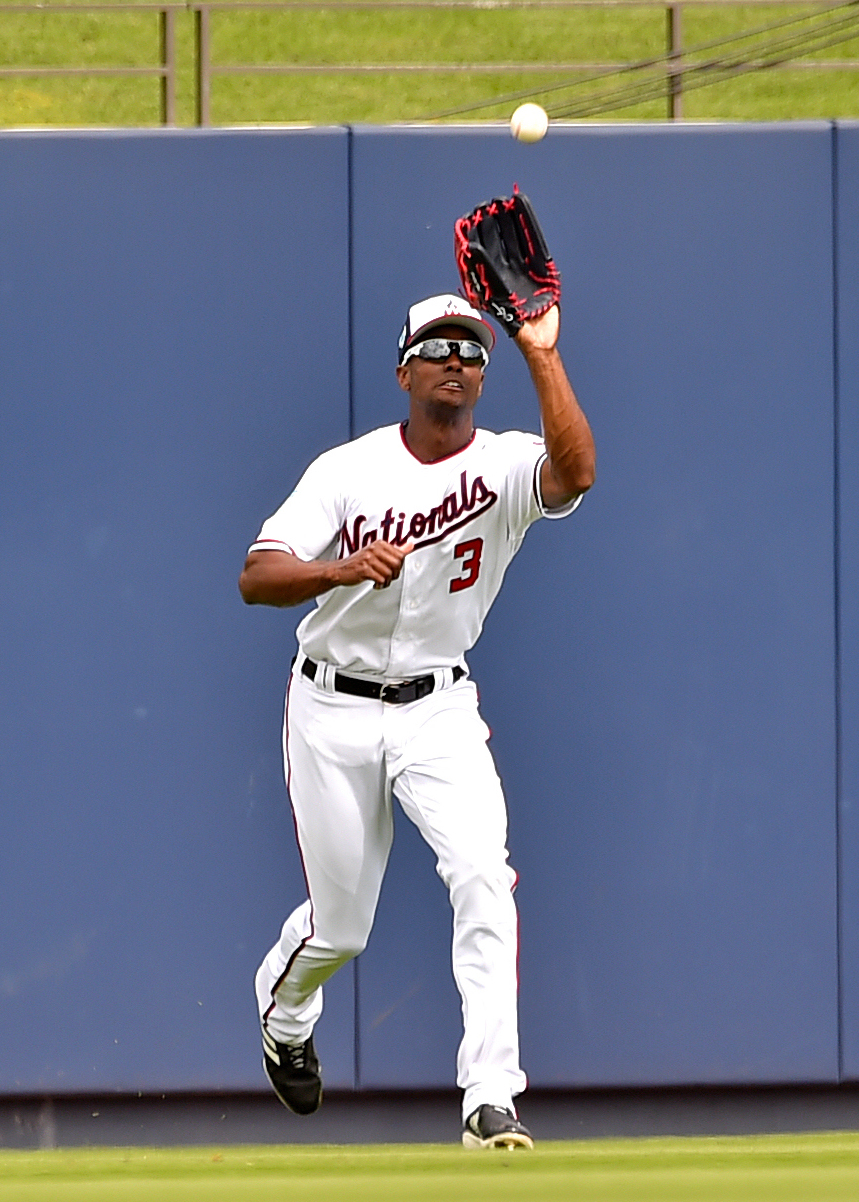
Taylor, 29, was outrighted off the Nationals’ 40-man roster at season’s end and elected free agency. He would’ve been arbitration-eligible for the final time this winter, and the Nats opted to cut him loose early rather than pay him a raise on last year’s $3.325MM salary following a rough 2020 season.
Once ranked as one of the game’s premier outfield prospects, Taylor has struggled to find his footing as a consistent contributor in the big leagues. He looked to have broken out with a very solid age-26 campaign back in 2017, when he slashed .271/.320/.486 with 19 homers, 23 doubles, three triples, 17 steals and brilliant center-field defense. Taylor played in 118 games that season and was still worth about three wins above replacement per both Baseball-Reference and FanGraphs.
Unfortunately, Taylor wasn’t able to replicate his success in 2018 or at any point thereafter. He’s logged 581 plate appearances in the three years since that time — often being shuttled between Triple-A and the Majors — while posting a tepid .225/.284/.370 output at the plate. His blend of power and speed is plain to see, but Taylor’s overall offense is limited by a sky-high 31.7 percent strikeout rate to this point in his career.
Taylor has continued to post strong defensive marks, with a superlative 26 Defensive Runs Saved and a 12.1 UZR/150 in 1984 innings as a center fielder from 2017-20. Even if his bat doesn’t recover, he should give the Royals a high-quality defender capable of playing all three outfield positions. Per Statcast, Taylor ranked in the 91st percentile of all big leaguers in terms of outfield jumps, and his 82nd percentile sprint speed speaks to the value he can add on the bases.
Taylor joins a Royals roster that was already deep in outfield-capable players, though several of them are surely to be used in the infield at times (or even regularly) in 2021. Whit Merrifield and Hunter Dozier, for instance, can each be used on the right side of the diamond or in the outfield. Dozier could be the club’s long-term first baseman, though that’s probably somewhat dependent on any decisions the club makes with Ryan O’Hearn and/or Ryan McBroom this winter. Merrifield, meanwhile, can play all across the outfield and is a strong defender at second base as well.
Beyond that versatile pairing, the Royals have Franchy Cordero, Edward Olivares, Bubba Starling, Nick Heath and top prospect Khalil Lee all on the 40-man roster. Taylor could function as a simple platoon partner for the left-handed-hitting Cordero, or if he’s able to again approach his 2017 level of play, he could earn a bigger role in an outfield mix that is still largely undefined.
Griffin, 25, was the No. 28 overall pick by the Royals back in 2014. He made his MLB debut this past season and tossed 1 2/3 shutout innings, but Griffin underwent Tommy John surgery in August and will miss the 2021 season as a result.
Beyond that, Griffin has never developed into the pitching prospect the club had hoped at the time of that lofty selection. He posted solid ERAs through the lower minors even while walking more than 3.5 hitters per nine frames, but Griffin’s results bottomed out as he further climbed the organizational ladder. He pitched to an ERA north of 5.00 in 152 2/3 frames of Double-A ball in 2018 and saw that mark increase during his 2019 stint in Triple-A Omaha.
The Royals will have a week to trade Griffin, release him or attempt to pass him through outright waivers. Because he’s a former first-round lefty with multiple minor league options remaining, another club could place a speculative claim, but it’d be tough to carry him on the roster for the remainder of the offseason knowing he won’t be able to contribute at all next season while he rehabs.
Major League Baseball Announces Formation Of MLB Draft League
Major League Baseball on Monday announced that it has teamed with Prep Baseball Report to form the MLB Draft League — a new summer league that will allow the nation’s top draft-eligible players to compete in a 68-game season beginning next year. The league will be headed up by former MLB scout Kerrick Jackson, who resigned from his post as the head coach at Southern University to take this newly created position.
Five teams, all of them former minor league affiliates, have been brought aboard as the founding five clubs in the league: the Mahoning Valley Scrappers, the State College Spikes, the Trenton Thunder, the West Virginia Black Bears and the Williamsport Crosscutters. Talks with a sixth team are in the works, per the league’s press release, with an announcement hopefully coming in the near future.
The Draft League is made possible by MLB’s previous decision to push the annual amateur draft back from early June to instead coincide with the MLB All-Star break in mid-July. Per today’s announcement, the 68-game schedule will include an annual All-Star break centered around the MLB draft, so it seems as though the idea is for play to continue once these players have been drafted. That, conceivably, could help to offset some the elimination of short-season Class-A leagues. Big league scouts will be able to watch the league in person, and the MLB adds that they’ll also be able to evaluate participants via “state-of-the-art scouting technology.”
Jackson appeared on MLB Network this morning to discuss the league and clarify some of the timing and scheduling aspects (video link). The league will commence in early June and run into August. MLB’s goal will be to attract as much top draft-eligible talent as possible, though Jackson acknowledged that some programs which qualify for postseason play will push back against sending their players to participate in the Draft League.
There are some murky areas that have yet to be defined in full. It’s not clear, for instance, whether every MLB team will want its draft signees to continue playing in the league, although that ostensibly could help to offset the loss of some Short-Season Class-A leagues. Jackson alludes to the fact that the league expects some players to pull out of the league after being drafted, noting that “after the draft, we’ll be able to take some kids — some of the seniors and some other guys looking to get those free-agent opportunities and put them in that mix.”
The initial hope is for a six-team league with 30-man rosters, per Jackson, creating 180 roster spots in the league’s first iteration. Depending on how things progress down the line, MLB may look to eventually install additional teams in the league. For the time being, it doesn’t appear as though there will be separation of college and high school talent.
Suffice it to say there are some logistics that need to be sorted out or at least clarified, but the broader takeaway is that the inception of the Draft League will ideally give teams and fans a new level of access to prospects in the days and weeks leading up to the draft. Doing so should create greater marketing opportunities and, hopefully for MLB, draw some extra eyes and attention for the draft itself. The Major League Baseball Draft has never been seen as an event on par with the NBA or NFL drafts, after all. However, there’s no getting around the fundamental difference that prospects selected in those other sports’ drafts will frequently jump directly onto the active roster of their new clubs, while virtually every player selected in the MLB draft is at least a couple of years from MLB readiness.
Chris Young Withdraws From Mets’ GM Search
Former big league pitcher Chris Young, who interviewed last week for the Mets’ GM vacancy, has now withdrawn his name from consideration, Joel Sherman of the New York Post reports. Sherman suggests that Young was indeed intrigued by the position but prefers not to move his family from Dallas to New York at this time.
Young, 41, called it quits in 2017 after a 13-year career on the mound and quickly went to work for Major League Baseball. He was first appointed as the league’s vice president of on-field operations, initiatives and strategy, wherein he oversaw “the application of playing rules and regulations, on-field standards and discipline, pace of play and other special projects.” When MLB chief baseball officer Joe Torre moved into an advisory role in early 2020, Young added “senior” to his title and took on a larger slate of responsibilities within the same realm.
There’s little clarity about the Mets’ ongoing front office search at this point. Young and former Marlins president of baseball operations Michael Hill were the two known candidates to have interviewed prior to today’s report. However, it’s not clear whether Hill was interviewing for the GM post or for the president of baseball operations vacancy that will now not be filled. Incoming president Sandy Alderson, who is returning after two years away from the team, indicated last week that he’d shifted gears and would now focus on hiring only a GM, rather than a president of baseball ops. New owner Steve Cohen acknowledged last week that he’s had some difficulty getting candidates in the door, as other clubs have denied permission to interview candidates from within their organizational ranks.
Cubs Promote Craig Breslow To Assistant General Manager
The Cubs announced a series of promotions in their baseball operations department Monday, with former big leaguer reliever Craig Breslow being elevated to assistant general manager. He joins Randy Bush (another former big leaguer) and Jeff Greenberg, who was promoted to AGM status earlier this season, in that role. Breslow has also been named the organization’s vice president of pitching.
This will be the 40-year-old Breslow’s third full season in the Cubs’ front office. He retired after the 2017 season and joined the Cubs as their director of strategic initiatives prior to the 2019 season. He spent the 2020 season as the Cubs’ director of pitching and as a special assistant to president of baseball ops Theo Epstein and GM Jed Hoyer. Greenberg has been with the Cubs since 2012, with prior titles including director of baseball operations and, more recently, director of pro scouting. With Epstein stepping away and Hoyer ascending to president of baseball ops, Breslow and Greenberg will take on a larger role in the front office.
Notably, none of today’s promotions include an appointment to general manager. Hoyer said at last week’s press conference that he expected to hire a new GM from outside the organization, emphasizing the importance of allowing for new voices, ideas and perspectives to complement the continuity elsewhere in the front office.
Some notables from the Cubs’ many other front-office promotions: Chris Moore was named vice president of research and development; Matt Dorey was named vice president of player development; Louie Eljaua was named vice president of international scouting; and Alex Suarez was named senior director of international player development and operations.
At Least Six Teams Showing Interest In James McCann
Yadier Molina has drawn the most headlines among catchers early in free agency, in part due to the willingness of both him and his agent to go on-record to discuss the veteran’s market. However, James McCann is drawing interest from a similar collection of teams, per MLB Network’s Jon Heyman (Twitter link), with the Yankees, Mets, Cardinals, Angels and incumbent White Sox among the clubs to express some interest in the free-agent backstop. The Phillies would have interest in the event that J.T. Realmuto signs elsewhere, Heyman adds.
Given that each of these clubs, with the exception of the White Sox and Phillies, has already expressed interest in Molina, it’s not much of a surprise that they’d also at least gauge McCann’s asking price. There’s been speculation about the Yankees moving on from Gary Sanchez for months, while the Mets currently lack a starting-caliber backstop on their roster. The Angels got a big year out of Max Stassi in 2020, but that was obviously a rather limited sample and Stassi’s prior track record is less impressive.
The Cardinals may raise some eyebrows, given their interest in retaining Molina, but it’s only logical that with Molina exploring other options they’d do the same. Should Molina get the two-year deal he’s seeking from another club, the Cards could pivot to McCann or simply remain in-house and turn the keys over to 26-year-old Andrew Knizner.
As for the White Sox, their interest in keeping McCann is well known, but it’s unlikely to result in a deal. The ChiSox signed Yasmani Grandal to a franchise-record four-year, $73MM contract last winter, and with three years remaining on that arrangement there’s simply no room for McCann to get everyday at-bats. McCann spoke earlier this offseason about his free agency, telling NBC Sports Chicago’s Chuck Garfien that he feels he’s earned the opportunity to be a team’s starting catcher. The White Sox can’t offer that with Grandal under contract.
It’s hard to dispute McCann’s feelings after a pair of terrific seasons with the South Siders. While he was non-tendered by the Tigers after a dismal 2018 campaign, McCann has more than bounced back in Chicago; he’s taken his game to new heights. McCann was a bit shy of a league-average bat as Detroit’s primary catcher in 2017, but he’s broken out with a .276/.334/.474 batting line in 587 plate appearances with the White Sox (116 wRC+).
He’s made strides in terms of hard-hit rate and exit velocity, supporting that offensive breakout, and McCann also improved defensively quite a bit this past season. He’s always been adept at controlling runners (career 35.8 percent caught-stealing rate), but McCann prioritized improving his pitch-framing this past offseason, and the results were strong. Statcast reflects that McCann went from one of the worst catchers in the game at framing pitches on the bottom of the zone to one of the game’s best. It’s a small sample, to be sure, but it’d be a reach to suggest that McCann simply lucked his way from getting 44.8 percent of such pitches called all the way up to 61.8 percent.
The Phillies probably aren’t the only club who view McCann as a “Plan B” to Realmuto, but there also figure to be teams that know they cannot afford Realmuto and are thus willing to act more quickly. McCann and his agents will have to determine whether they’re better served taking one of those early offers or holding out until Realmuto is off the market. The latter route could lead to increased interest, but it’s also possible some teams that are willing to act now will have already filled their need at catcher or spent the majority of their offseason budget by that point.
Stearns On Brewers’ Offseason Needs, Hader Rumors
The Brewers eked out a postseason berth in 2020 by virtue of this year’s expanded format, laying claim to the No. 8 seed in the National League despite finishing with a sub-.500 record (29-31). They’re headed back into the offseason with plenty of holes to fill thanks to last year’s slate of one-year pickups, but the infield in particular is rife with uncertainty.
In Keston Hiura, Luis Urias and Orlando Arcia, the Brew Crew has some options up the middle, but the infield corners are far less certain. That reality is all the more clear after president of baseball operations David Stearns acknowledged the deficiency in an interview with The Athletic’s Will Sammon this week when discussing the work that lies ahead between now and Spring Training.
“I think what is clear is our production at first base and third base has to improve,” Stearns tells Sammon. “That, we know. Whether that can come from internal sources or external sources are some of the questions we’re continuing to talk through, evaluate and then determine the best course of action.”
While Stearns’ comment about a need for improvement is of course accurate, it also in many ways largely undersells how dire the situation is. Milwaukee third basemen combined for an abysmal .200/.279/.295 in 2020, which translated to an MLB-worst 56 wRC+ at the position.
Things were better across the diamond, where Milwaukee first basemen batted .229/.303/.467 — good for a 101 wRC+ that ranked 17th in the Majors. However, the bulk of that production came from Jedd Gyorko, whose option was bought out at season’s end. Daniel Vogelbach was red-hot in his short time with the Brewers to end the season, but he only logged eight plate appearances as a first baseman. He could be in line for more of a look at first in 2021, but it’s not guaranteed that he’ll be tendered a contract. Vogelbach is arbitraiton-eligible and struggled enormously from the All-Star break in 2019 up until his acquisition by the Brewers. He’s more of a designated hitter than a first baseman, and the lack of clarity regarding the universal DH could lead to a non-tender.
There are plenty of external options to explore at the infield corners, although Sammon reports that the Brewers’ payroll — like the payroll of most clubs around the league — is expected to decline in 2021. The Brewers’ 2020 payroll was set to open at just shy of $98MM before the season was halted and salaries were pro-rated. They currently have about $47.5MM in guaranteed contracts plus a big slate of arbitration players who could approach roughly $26MM in salary. Several of those names are non-tender candidates, which could give Stearns & Co. some breathing room as they search for upgrades.
Trades for high-profile infielders like Kris Bryant, Nolan Arenado and Francisco Lindor can be ruled out due to the salary associated with those players. Free agents Justin Turner and DJ LeMahieu, similarly, are likely to be too expensive. But the market does have some intriguing bounceback options, with Jake Lamb and Carlos Santana among the veterans eyeing rebounds. Trade possibilities are numerous, of course, and the Brewers will see a whole new set of possible candidates join the field next week after Wednesday’s non-tender deadline. They’ll also have a firmer grasp on what they can afford to spend at that point.
One player sure to be immune from that non-tender fate is lefty Josh Hader, whose name has again popped up on the rumor circuit. Despite Stearns’ prior assertion that he doesn’t envision trading Hader, Fansided’s Robert Murray reported recently that Milwaukee is “open” to such a move. That’s a far cry from shopping Hader, of course, and Stearns again sought to downplay the possibility while instead characterizing any listening on Hader more as due diligence. The Brewers, per Stearns are in a “very similar position” with Hader as they were after the trade deadline when he initially made those comments.
“Josh remains a very large contributor to our team and he has since he got here,” Stearns says. “I don’t really anticipate that changing. And when you have really good players, you’re going to get calls on them. And I don’t anticipate that changing, either.”
Stearns, like many of today’s presidents and general managers, seems to prefer not to operate in absolutes, so it’s only natural that he’ll continue listening should teams continue to try to blow the Brewers away with an offer. And this time next year or even at the 2021 trade deadline, the situation may be different.
If Hader keeps piling up strikeouts and saves, the arbitration process will keep ballooning his salary. He’s projected by MLBTR contributor Matt Swartz to earn $5.1MM in 2021, and barring a long-term deal, that number could quickly rise beyond Milwaukee’s comfort level. If the Brewers are well out of the race next summer or carry Hader into the offseason, it might become more realistic to see a low-payroll club more aggressively solicit offers. That’s not to say that a trade this winter is wholly off the table, but at least for the time being, he appears affordable enough that Milwaukee can enjoy the benefit of a Hader/Devin Williams combo late in games to help slam the door in close contests.
Angels, Giants, Reds Among Teams Interested In Dan Straily
Right-hander Dan Straily dropped completely off the MLB radar following a dismal 2019 showing with the Orioles — a season that saw him surrender 52 earned runs in just 47 2/3 big league innings. Interest in the righty was tepid, and he opted to take a guaranteed $1MM deal with the Lotte Giants of the Korea Baseball Organization over a nonguaranteed deal with an MLB club.
That move could wind up paying dividends for Straily, who’ll turn 32 next Tuesday. Sportsgrid’s Craig Mish reports that the veteran righty is receiving interest from MLB and KBO clubs alike, with the Angels, Giants and Reds among the Major League teams to have reached out. Straily is aiming to decide between a return to the Majors and another season (or seasons) in South Korea as soon as next week, per the report.
Straily’s return to the market this winter comes under vastly different circumstances. While he was coming off the worst season of his professional career a year ago, Straily recently wrapped an outstanding debut campaign in the KBO. In 31 starts, Straily totaled 194 frames and pitched to a 2.50 ERA and 2.97 FIP, averaging 9.5 strikeouts, 2.4 walks and 0.46 home runs per nine innings pitched. It was a remarkable turnaround for the well-traveled right-hander — one that seems to have restored some confidence in his ability to navigate a Major League lineup.
The 2019 season was such a struggle for Straily that it’s easy to forget he’s not far removed from being a perfectly serviceable rotation piece in the Majors. From 2016-18, Straily pitched in 90 games for the Reds and Marlins, working to a collective 4.03 ERA with 7.8 K/9, 3.3 BB/9 and 1.49 HR/9. Fielding-independent marks were less bullish on the righty (4.83 FIP, 4.89 xFIP) due in some part to a .261 average on balls in play that was well below the league average and a 77.9 percent strand rate that was well north of average. It’s fair to say that Straily probably did benefit from some good fortune, but extreme fly-ball pitchers like him are generally able to sustain lower BABIPs; his .261 mark over that three-year term is right in line with his career .267 mark.
Also working in Straily’s favor is the simple fact that he should be affordable if he opts to return from the KBO. It’s possible he could command a multi-year pact with a modest annual salary, but many teams are likely hoping to ink him on a one-year deal, perhaps with some incentives to help boost his annual value. He’d surely be able to generate multi-year interest in the KBO or perhaps in NPB at this point, though a successful big league return is the most lucrative potential path forward.
Rangers Interested In Ha-Seong Kim
The Rangers have interest in star Korean infielder Ha-Seong Kim, MLB.com’s T.R. Sullivan reports in his latest inbox column. The Kiwoom Heroes of the Korea Baseball Organization posted the 25-year-old Kim for Major League teams earlier this week.
While Kim has primarily played shortstop to this point in his career, he also spent a good chunk of time at third base this year after the Heroes brought Addison Russell over midway through the season. Kim is also capable of handling second base. As Sullivan points out, Kim checks some boxes for the Rangers by virtue of the fact that he’s a prime-aged player with the potential to provide an offensive upgrade in the infield without necessarily being boxed into one position at the time of signing.
As noted in our Rangers Offseason Outlook, Kim’s versatility indeed seems like a good fit for a Texas club that has openly expressed a desire to get younger. A pair of roadblocks at the two middle infield positions exist in shortstop Elvis Andrus and second baseman Rougned Odor, both of whom are signed for two more seasons. Andrus struggled through an injury-marred 2020 campaign, although he was a serviceable option at his position as recently as 2019 thanks to his strong glovework. Odor’s struggles have been far more persistent, however, and the question of whether the club will move on or drop him to a bench role becomes more prominent with each passing year.
Even if Texas is intent on keeping both stalwarts in place, Kim or Isiah Kiner-Falefa could be used as a multi-position utility piece. A pursuit of Kim wouldn’t necessarily be about winning immediately in 2021 so much as acquiring a long-term contributor, so if the Rangers feel he can be an everyday option at any of third base, shortstop or second base, there’s reason for the team to make a push for him and sort out playing time down the road.
The Rangers, of course, won’t be the only team in the mix for Kim; he’s also been linked to the Blue Jays already and will surely draw broader interest. Kim is an abnormally young free agent option for MLB teams, and after a strong showing early in his career, he’s broken out as a superstar-level performer in the KBO over the past two seasons.
Even as the KBO has become a slightly more pitcher-friendly setting in recent years, Kim has improved. Since Opening Day 2019, he’s slashed .307/.393/.500 with 62 doubles, three triples and 49 home home runs through 1247 plate appearances — including 30 long balls in 2020. He’s walked 145 times to just 148 strikeouts over that same two-year stretch and also gone 56-for-62 in stolen base attempts. Over the past two seasons, he’s been 41 percent better than a league-average hitter in the KBO, by measure of wRC+.
Whichever club signs Kim to a multi-year deal will need to pay a posting fee to the Heroes. That sum is dependent on the size of Kim’s contract and is on top of whatever money he’s guaranteed. The Heroes are entitled to a fee equal to 20 percent of the contract’s first $25MM in value, 17.5 percent of the next $25MM and 15 percent of anything money thereafter. Kim’s 30-day posting window began yesterday and will run through 5pm ET on Dec. 25. He’s free to sign at any point during that period and does not need to wait until the deadline to make a decision.
Tomoyuki Sugano Will Be Posted For MLB Clubs
NOV. 26: Kohei Arihara has been posted, according to MLB Insider Jon Morosi (via Twitter). As Morosi notes, the 28-year-old has a 3.65 ERA over 882 career innings.
NOV. 25: Yomiuri will post Sugano, according to Sanspo (via Patrick Newman of NPB Tracker, on Twitter).
NOV. 2: Yomiuri Giants right-hander Tomoyuki Sugano could be posted for Major League teams this winter, Joel Sherman of the New York Post reports. It’s not yet certain that he’ll be made available, but the Giants are considering the move for one of the more accomplished pitchers in Japan given that he’ll be eligible for unrestricted international free agency next winter. Sherman adds that NPB’s Nippon Ham Fighters may post a pair of players themselves: fellow righty Kohei Arihara and outfielder Haruki Nishikawa.
Sugano, who recently turned 31, is the most prominent name of the bunch and the most relevant for MLB fans. He had a tough 2019 season, by his standards (3.89 ERA) but has otherwise posted an ERA of 2.14 or better each season since 2015. Overall, dating back to Opening Day 2015, he’s notched a highly efficient 2.20 ERA with 8.2 K/9 and 1.7 BB/9 over the course of 1015 1/3 innings out of the rotation. He’s a six-time All-Star in Japan and a two-time winner of NPB’s Sawamura Award — their league’s equivalent of MLB’s Cy Young Award.
MLB fans may remember Sugano from an impressive showing in the 2017 World Baseball Classic — one that prompted U.S. skipper Jim Leyland to offer high volumes of praise for the righty.
“I can’t tell you, for me, tonight, how impressed I was with their pitcher,” Leyland said at the time (link via MLB.com’s Joe Trezza). “I mean, I thought he was really good. Located on the ball on the outside corners, fastball. Threw 3-0 sliders. That’s pretty impressive.” Leyland plainly called Sugano a “big league pitcher” after that game. (Those interested can check out all 81 of Sugano’s pitches from that game in this YouTube clip.)
Team USA’s Andrew McCutchen also acknowledged that Sugano was impressive in that outing, during which he held a deep U.S. roster to one unearned run over six innings with six strikeouts and a walk. Sugano’s fastball averages 92-93 mph and, like his curveball, boasts a strong spin rate. Sports Info Solution’s Will Hoefer took a look at him last October, calling him at least a No. 4 starter in the big leagues, and that was after an injury-hindered campaign as opposed to the strong 2020 showing Sugano just authored.
The Giants have yet to make a formal declaration on Sugano’s status, although that’s not a surprise given that they’re still alive in NPB’s postseason format. Sherman notes that the typical window during which NPB clubs can post a player has been pushed back to Nov. 8-Dec. 12, which will buy the Giants a bit more time in making their ultimate decision. The NPB Climax Series is expected to run through late November.
Turning to the 28-year-old Arihara, he’s a former rotation-mate of Shohei Ohtani, so big league scouts have surely gotten ample looks at him over the years. Arihara spent much of the early portion of his career working to ERA marks in the mid-4.00s, but he’s seen improved results since 2019, with a 2.93 mark and a 265-to-68 K/BB ratio in 292 frames.
Hoefer also profiled him late last year, noting that Arihara’s fastball runs up to 95 mph but has a pretty wide variance in terms of its velocity. Hoefer pegged Arihara’s changeup as his lone plus offering but noted that his splitter and slider are potentially average offerings. Arihara won’t turn 29 until next August, so he’s younger not only than Sugano but than just about any MLB free-agent starter of note.
Nishikawa, 29 in April, hit .296/.419/.388 with just five homers, 15 doubles and three triples this year, although he also swiped 37 bags in 42 tries. He’s posted an OBP of .378 or better in each of the past four seasons while striking out in 16.5 percent of his plate appearances against a 14.3 percent walk rate. Nishikawa has three stolen base titles, three Gold Gloves in the outfield and a pair of All-Star nods in NPB. He made it known last offseason that he hoped the Fighters would post him for big league clubs this winter.
For those in need of a refresher or a crash course on the current posting system between Major League Baseball and Japan’s Nippon Professional Baseball, it’s a fairly straightforward process. Unlike the old blind bidding system, players posted by an NPB or KBO club are free to negotiate with all 30 clubs. So long as they’re over 25 years of age and have six-plus years of MLB service — each of Sugano, Arihara and Nishikawa do — they’re able to sign Major League contracts of any length for any amount.
In addition to the money paid to the player, his new team in MLB must also pay a release fee to the former NPB/KBO club. That fee correlates directly with the size of the contract. MLB clubs pay a sum of 20 percent of a contract’s first $25MM to the former team. The fee also includes 17.5 percent of the next $25MM and 15 percent of any dollars spent thereafter.
The release fee is on top of the actual contract for the player. So, for example, a $50MM contract would cost a team a total of $59.375MM — $50MM to the player and $9.375MM to the former club. Option years and incentives/bonuses are also factored in if they are eventually unlocked (e.g. a $10MM club option tacked on top of the previous theoretical $50MM deal would require the MLB club to pay $1.5MM to the former team once it is picked up — 15 percent of the guarantee beyond $50MM).