
Diamondbacks, Aaron Blair Agree To Minor League Deal
The D-backs are bringing one of their first-round picks back to the organization, signing right-hander Aaron Blair to a minor league contract, per MassLive.com’s Chris Cotillo (Twitter link). He’s repped by PSI Sports Managament.
Blair, 27, was a supplemental first-rounder out of Marshall University in 2013. He ranked among baseball’s 100 best prospects per Baseball America, MLB.com and Baseball Prospectus in both the 2014-15 and 2015-16 offseasons. But while Blair was a fast riser who thrived during his first extended looks at Double-A and Triple-A, his career stalled out upon reaching the Majors.
Arizona included Blair in the franchise-altering trade that also sent Dansby Swanson and Ender Inciarte to Atlanta in exchange for Shelby Miller. He made his MLB debut with the Braves in April 2016, but from 2016-17 he combined to allow 64 earned runs with a lackluster 49-to-39 K/BB ratio over the life of 73 innings.
Blair eventually underwent surgery to repair a torn capsule in his pitching shoulder in April 2018 — a procedure that wound up sidelining him for not only the 2018 season but all of the 2019 campaign as well. After pitching just 2 2/3 innings between the Majors and Triple-A over the past two seasons, Blair will face an uphill battle in pitching his way back to the big leagues, but he’ll do so in his original organization — one where he had more success than he did at any point during his Braves tenure.
Padres Claim Breyvic Valera
The Padres announced Wednesday that they’ve claimed infielder/outfielder Breyvic Valera off waivers from the Blue Jays. In order to open a spot on the 40-man roster, San Diego has placed right-hander Anderson Espinoza on the 60-day injured list. Espinoza underwent Tommy John surgery late last April.
Valera, 28, was designated for assignment earlier this week when Toronto finalized its one-year deal with reliever Rafael Dolis. Valera spent time with both the Jays and Yankees in 2019, though he appeared in just 17 games and took just 52 plate appearances. Overall, Valera has appeared in the Majors with five teams but played in just 54 games, hitting .223/.294/.298 in 138 trips to the plate.
Lack of MLB track record aside, the switch-hitting Valera is the owner of a .302/.374/.442 slash in 1550 plate appearances at the Triple-A level. Coupled with his defensive versatility –he’s played second base, third base and all three outfield positions — it’s easy to see why so many clubs have been intrigued by his skill set and taken brief looks at him. At this point, however, Valera has exhausted all three of his minor league option years, meaning he’ll need to break camp with the Padres (or another club) or else be traded or placed on waivers once again.
Yankees Sign Tony Zych To Minor League Deal
The Yankees announced Wednesday that they’ve signed right-hander Tony Zych to a minor league contract. The former Mariners reliever, a client of ISE Baseball, will be in Major League camp with the team this spring.
It’s been more than two years since Zych, 29, threw his last pitch at the big league level, as injuries have beset the righty for much of his career. Zych had surgery to repair a biceps/shoulder injury back in 2016 and was slowed by a forearm issue in 2017. He didn’t pitch at all in 2019 — an absence that stemming from 2018 thoracic outlet surgery.
Though Zych has a long line of arm troubles in his past, he’s been impressive when he’s been able to take the mound. The 2011 fourth-rounder (Cubs) has logged 72 2/3 innings in the big leagues and compiled a 2.72 ERA/3.22 FIP with 9.9 K/9, 4.2 BB/9, 0.37 HR/9 and a 49.7 percent ground-ball rate. Right-handed batters have posted an awful .216/.327/.269 batting line against him, while lefties have hit him at just a .217/.311/.370 clip. Zych has faced 203 right-handed hitters in the Majors without allowing a home run.
The track record of pitchers coming back from TOS surgery isn’t great, and the Yankees have a rather impressive bullpen mix as is. But Zych’s track record of big league success is rather impressive, so even if he doesn’t crack the Opening Day roster, he’ll be a nice piece to stash in Triple-A if his arm is back at full strength.
Nationals Sign JB Shuck, Sam Freeman To Minor League Deals
The Nationals announced a slate of minor league deals and non-roster invites to Spring Training, including previously unreported pacts with outfielder JB Shuck and left-handed reliever Sam Freeman.
Shuck, notably, is now being listed as an outfielder/left-handed pitcher. The 32-year-old journeyman began an attempt to convert to a two-way player last May after being outrighted to Triple-A by the Pirates. Shuck wound up tossing 20 innings — 19 in Triple-A and one scoreless frame in the Majors — and allowed eight runs for a combined 3.60 ERA. But while Shuck only allowed 16 hits in those 20 frames and managed to rack up 23 strikeouts, he also issued 18 walks and hit a pair of batters. Those types of control issues are fairly common for position players as they transition to the mound, and Shuck will look to improve upon them in 2020.
Turning to his longstanding role as an outfielder, Shuck is capable of playing all three slots and has batted .243/.296/.314 in just shy of 1300 plate appearances. He’s been a solid bat in Triple-A, evidenced by a career .292/.365/.392 slash at that level. It’s a long shot that Shuck is able to successfully reinvent himself as a fourth outfielder/reliever, but if he can do so, he’ll be an increasingly valuable asset in light of today’s newly implemented changes to roster construction at the MLB level. Taking a look in Spring Training, of course, won’t cost the Nats anything.
As for the 32-year-old Freeman, he finished out the 2019 season in the Nationals organization after signing a minor league deal, but he didn’t appear in the big leagues with them. Freeman pitched only two innings in the Majors last season (both with the Angels), and he was torched in 52 2/3 frames with the Halos’ Triple-A affiliate. He tossed six shutout innings with an 11-to-1 K/BB ratio with Washington’s top affiliate, though, and is still not far removed from a 2017 season that saw him log a 2.55 ERA/3.34 FIP in 60 innings with the Braves. In 228 2/3 innings at the big league level, Freeman has a 3.62 ERA with averages of 8.9 strikeouts, 5.1 walks and 0.7 homers per nine innings pitched.
Cardinals Sign Brad Miller
3:27pm: The deal is “believed” to guarantee Miller $2MM, MLB Network’s Jon Heyman tweets.
3:10pm: The Cardinals announced Wednesday that they’ve signed infielder/outfielder Brad Miller to a one-year, Major League contract. Right-hander Jordan Hicks, who is still recovering from Tommy John surgery, was transferred to the 60-day injured list to open a spot on the 40-man roster. Miller is represented by ISE Baseball.
Miller, 30, split the 2019 season between the Indians and Phillies, turning in a particularly productive showing with the latter. In an admittedly limited sample of 130 plate appearances, Miller slashed .263/.331/.610 with a dozen home runs, three doubles and a triple. With the exception of the 2017 season, Miller has been a roughly average or better bat each season dating back to 2015, by measure of OPS+ and wRC+. In that time, he’s logged a combined .241/.318/.431 line.
Defense hasn’t been Miller’s strong point, however. While he’s appeared at every spot on the diamond outside of pitcher and catcher, Miller doesn’t have particularly strong ratings at any of them. But he’s nevertheless a versatile piece to add to manager Mike Shildt’s bench — one who has been particularly impactful against right-handed pitching. The St. Louis organization has long been reported to be seeking a left-handed bat, and while Miller isn’t exactly a high-profile means of satisfying that need, he’s been solid in a platoon role each season beyond the aforementioned 2017 campaign.
MLB Announces Rule Changes For 2020 Season
Major League Baseball announced on Wednesday the implementation of several rule changes that will take place in 2020 — most notably the previously reported three-batter minimum for pitchers, the expansion of standard roster size from 25 to 26 players, a two-way player designation rule and a longer injured list/optional assignment minimum for pitchers and two-way players.
From the league’s official release:
- Three-Batter Minimum: The Official Baseball Rules have been amended to require the starting or any relief pitcher to pitch to a minimum of three batters, including the batter then at bat (or any substitute batter), until such batters are put out or reach base, or until the offensive team is put out, unless the substitute pitcher sustains injury or illness which, in the umpire crew chief’s judgment, incapacitates him from further play as a pitcher. The three-batter minimum will become effective in 2020 Spring Training beginning on Thursday, March 12th.
- Rosters through August 31st and Postseason: Active Roster limits from Opening Day through August 31st and including Postseason games shall be increased from 25 to 26. In addition, Clubs will be permitted to carry a maximum of 13 pitchers from Opening Day through August 31st (plus Postseason games).
- September Rosters: From September 1st through the end of the Championship Season (including any tiebreaker games), all Clubs must carry 28 players on the Active Roster. In addition, Clubs will be permitted to carry a maximum of 14 pitchers during this period.
- Two-Way Player Designation: Players who qualify as “Two-Way Players” may appear as pitchers during a game without counting toward a Clubs’ pitcher limitations. A player will qualify as a “Two-Way Player” only if he accrues both: (i) at least 20 Major League innings pitched; and (ii) at least 20 Major League games started (as a position player or designated hitter) with at least three plate appearances in each of those games, in either the current Championship Season or the prior Championship Season (for 2020 only, this will include 2019 as well as 2018). The Club must designate that player as a “Two-Way Player” in advance of that game. Once a Club designates a qualified “Two-Way Player” that designation will remain in effect, and cannot change, for the remainder of that Championship Season and Postseason.
- Position Players Pitching: Any player may appear as a pitcher following the 9th inning of an extra inning game, or in any game in which his team is losing or winning by more than six runs when the player enters as a pitcher.
- Extra Player Rule: The previous “26th player rule” will be replaced with the “27th player rule” for all applicable Championship Season games prior to September 1st. The 27th player shall not count toward any pitcher roster limits described above. Thus, a Club may designate 14 pitchers in games under circumstances where the Major League Rules would permit a 27th Active player.
- Injured List Reinstatements and Option Period for Pitchers: Clubs may not reinstate pitchers or Two-Way Players from the Injured List until 15 days have elapsed from the date of the initial placement for such injury – an increase from 10 days. In addition, the option period for pitchers will be lengthened from 10 days to 15 days.
- Reduction in Challenge Time: Managers will now have up to 20 seconds to challenge a play instead of 30.
Most of these rules were known in advance, but the league’s announcement today formally brings them into MLB canon. The three-batter minimum is perhaps the most controversial of the bunch, as it’ll greatly reduce the presence of left-handed relief specialists — commonly referred to as LOOGYs (“Left-handed One Out Guys”) — and place a considerably greater emphasis on relievers who lack substantial platoon splits. The usage of left-handed specialists, though, had generally decreased in recent seasons.
The newly implemented three-batter minimum is yet another “pace of play” initiative from commissioner Rob Manfred — put in place in an effort to reduce the average time of games and decrease the downtime within. To date, however, games have yet to see any meaningful decrease in average time, while walks, strikeouts and home runs are at an all-time high. Fewer pitching changes could theoretically reduce game times, but there’s no guarantee that the rule will have that effect and any reductions figure to be rather minimal. It’s certainly possible that the new rule results in fewer time-consuming pitching change and additional balls in play, but the increase of balls in play could also have an adverse impact on a given game’s overall length.
The two-way player designation — sure to be referenced as the Shohei Ohtani Rule — will impact players such as Ohtani, Michael Lorenzen and Brendan McKay while also perhaps slightly reducing the frequency with which position players appear on the mound. It’s certainly possible that additional players will eventually qualify for such designation, but few will be impacted up front.
As for the return to a 15-day IL minimum and an expanded 15-day option minimum for pitchers and two-way players, that rule has been put in place to reduce the frequency of phantom IL stints that have been used to effectively carry extra arms in the bullpen. The Dodgers have paced the game with regard to usage of that tactic, and the Giants, under former L.A. GM Farhan Zaidi, were more regularly employing the move as well.
Managers have long bemoaned the previous iteration of roster expansion, which allowed MLB clubs to carry anyone from their 40-man in the Major Leagues. It was common to see teams nearly double the size of their bullpen under that rule, thus greatly increasing the number of pitching changes and generally making it more difficult to gameplan. The new rule will still afford teams some additional flexibility — but on a much smaller scale.
Broadly speaking, today’s announcement does little to impact the fabric of the game — particularly relative to prior rule changes (e.g. the advent of instant reply) and proposed rule changes (e.g. pitch clocks, beginning extra innings with a runner on second base, etc.). It’s a further reminder, however, that Manfred and his charges aren’t afraid to implement changes they deem best for the sport. Larger-scale changes — be it the implementation of the DH in the National League, the recently reported alterations to the postseason structure, expansion to new markets or something that has yet to come to light — feel inevitable down the road.
Giants Sign Wilmer Flores
February 12: The Giants have announced the signing, adding that right-hander Reyes Moronta has been transferred to the 60-day injured list to open a spot on the 40-man roster. Moronta underwent shoulder surgery late in the 2019 season and is expected to miss substantial time in 2020.
Flores will earn $3MM in 2020 and 2021, tweets Alex Pavlovic of NBC Sports Bay Area. The 2022 club option is valued at $3.5MM and comes with a $250K buyout.
February 4, 7:00pm: Flores’ contract with the Giants is a two-year deal worth more than $6MM guaranteed, tweets MLB Network’s Jon Heyman. The Giants will also have a club option for a third season.
2:40pm: The Giants and free-agent infielder Wilmer Flores have agreed to a multi-year deal, ESPN’s Jeff Passan reports (via Twitter). The Giants will need to make a 40-man roster move in order to create space for him.
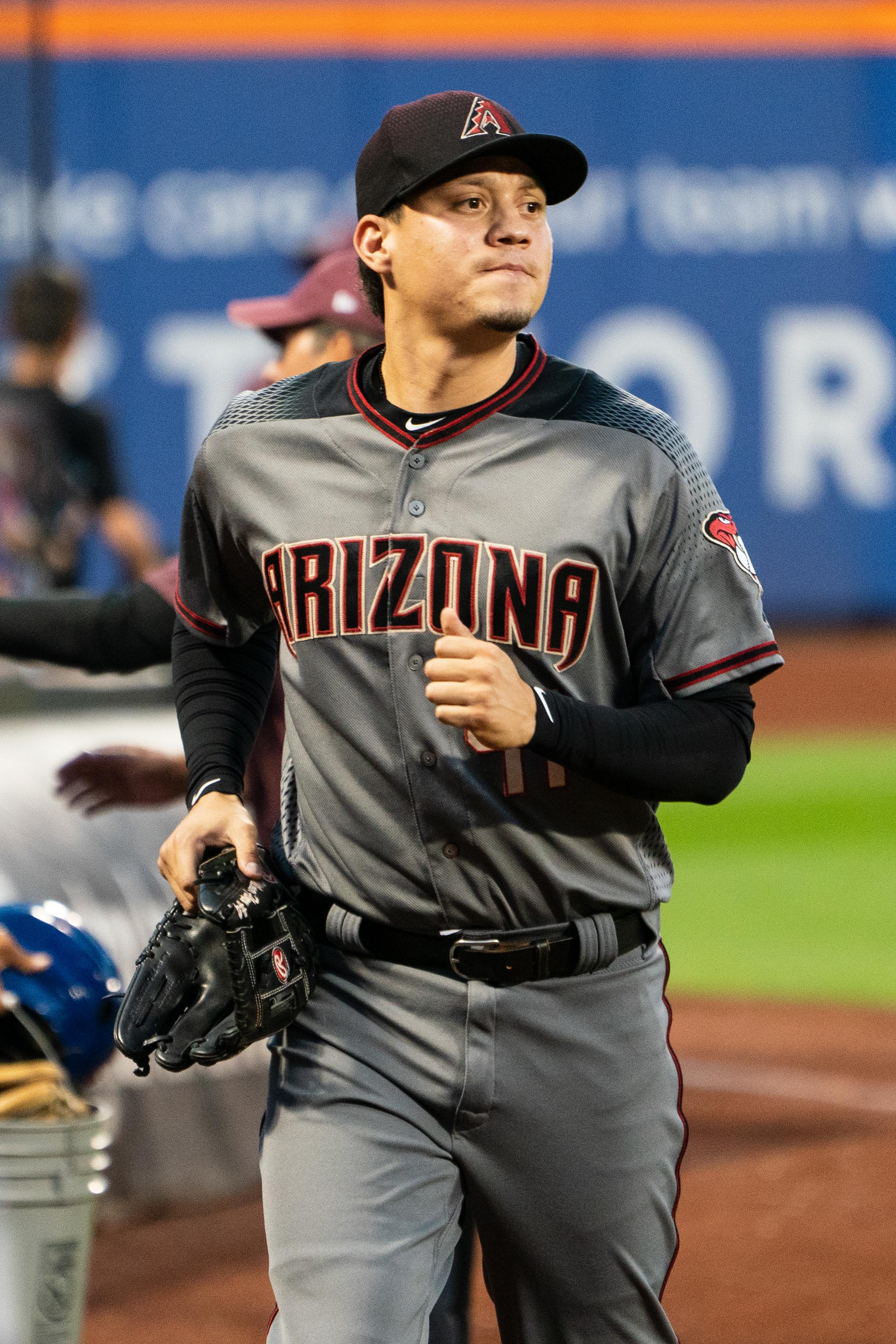 Wilmer Flores | Gregory J. Fisher-USA TODAY Sports” width=”200″ height=”300″ />
The 28-year-old Flores spent the 2019 season with the division-rival Diamondbacks but was limited to 89 games by a foot injury that sidelined him from late May until late July. When healthy, Flores turned in a strong .317/.361/.487 batting line with nine home runs and 18 doubles in 285 plate appearances. While most of Flores’ power output came against left-handed pitching (.337/.367/.615), the longtime Mets utilityman also hit for average and got on base against righties, albeit without much extra-base pop (.304/.358/.404).
The exact manner in which Flores fits into the Giants’ infield rotation isn’t clear. He can back up Brandon Belt at first base and Evan Longoria at third base, although it’s likely that non-roster invitee Pablo Sandoval will also be viewed as a backup at the corners. Flores could log semi-regular reps at second base, with Donovan Solano serving in a traditional utility role, although that doesn’t leave regular at-bats for young Mauricio Dubon at the position. Dubon, though, has been working out in the outfield and could earn himself a lengthy audition in center field, which would help to create additional playing time for Flores at second base.
Bringing Flores aboard on a multi-year agreement doesn’t bode well for 2019 Gold Glover Yolmer Sanchez, who agreed to a minor league contract with San Francisco just last week. Sanchez reportedly passed on big league offers for the chance to earn himself regular playing time at second base with the Giants, but the acquisition of Flores doesn’t help his chances any.
Looking further ahead, the Giants still have Belt, Longoria and Brandon Crawford all signed to guaranteed contracts through at least 2021, so there’s no creation of an everyday spot for Flores on the horizon. That’s nothing new for Flores, however. He’s typically appeared in more games and logged more plate appearances than your average bench bat but has also only topped 500 plate appearances once in seven Major League seasons.
Pedro Baez Wins Arbitration Hearing Against Dodgers
Dodgers right-hander Pedro Baez won his arbitration hearing against the team, MLB.com’s Jesse Sanchez reports (via Twitter). Baez will be paid at the $4MM rate submitted by agent Kelvin Nova rather than the $3.5MM submitted by the team, as shown in MLBTR’s 2020 Arbitration Tracker.
Baez, who’ll turn 32 in a month, has been one of the Dodgers’ most-frequently-used middle relief/setup pieces since debuting back in 2014. While the L.A. organization has had bullpen troubles in recent seasons, Baez’s overall results in that time and throughout his career have been steady. In 2019, he turned in 69 2/3 innings of 3.10 ERA/3.52 FIP ball with 8.9 K/9, 3.0 BB/9 and 0.78 HR/9.
Baez, who notched a career-high 25 holds in ’19, has appeared in 52 or more games in each of the past five seasons — averaging 63 appearances and 63 innings along the way. He’s never posted an ERA higher than the 3.35 mark he recorded back in 2015, and his overall body of work has perhaps quietly been terrific. In 339 innings as a big leaguer, Baez has a 3.03 ERA with 356 strikeouts (9.5 K/9) against 113 walks (3.0 BB/9).
This was Baez’s final trip through the arbitration process. As a player who currently possesses five-plus years of Major League service time, he’ll reach the free-agent market for the first time in his career next winter.
The win for Baez and Nova finally puts the players on the board in this year’s arbitration proceedings. Prior to this hearing, teams had gone 4-for-4 in arbitration hearings. The Dodgers had previously beaten Joc Pederson, while the Twins (Jose Berrios), Braves (Shane Greene) and Rockies (Tony Wolters) had also come out ahead in their own cases.
Reds Re-Sign Derek Dietrich
The Reds have re-signed infielder/outfielder Derek Dietrich to a minor league contract and invited him to Major League Spring Training, per a team announcement. He’s represented by All Bases Covered Sports Management.
It’s the second straight winter that Dietrich has inked a minors pact with Cincinnati. An injury to then-second baseman Scooter Gennett helped pave the way for him to land a spot on the big league roster last winter, and partway through the season, Dietrich looked to be one of the best minor league pickups in all of MLB. As of that early-June check-in, Dietrich had posted a stout .263/.369/.684 batting line while already establishing a new career-high in home runs through just 157 plate appearances. He was thriving both at the hitter-friendly Great American Ball Park and on the road, but the now-30-year-old slugger saw his offensive output crater shortly thereafter.
From June 7 through season’s end, Dietrich turned in one of the least-productive lines of anyone in baseball: a .102/.284/.212 slash through 149 plate appearances. He managed to the uptick in walks he enjoyed through the season’s first two months, but the rest of his offensive skill set deteriorated at a rapid rate.
In all, Dietrich is a career .246/.334/.427 hitter with 79 home runs, 106 doubles and 21 triples in 2438 plate appearances between the Marlins and Reds. He has experience playing second base, first base, third base and the outfield corners.
This time around, Dietrich will face a new series of challenges in cracking a bulked up Cincinnati roster. The Reds have added sluggers Mike Moustakas and Nick Castellanos on four-year deals this winter, and they picked up Japanese star Shogo Akiyama on a three-year pact as well. It’s possible that the injury to Eugenio Suarez will give Dietrich a chance to win a roster spot, however, as the Reds could opt to deploy Moustakas at the hot corner while giving Dietrich a look at second base — if he performs well in Spring Training.
Charlie Morton Undecided On Pitching Beyond 2020
Rays ace Charlie Morton enjoyed the finest season of his career in 2019, tossing 194 2/3 innings of 3.05 ERA ball with career-bests in K/9 (11.1) and BB/9 (2.6). No qualified starting pitcher in all of Major League Baseball surrendered home runs at a lower rate than Morton’s 0.69 HR/9 clip.
Morton is set to earn $15MM in 2020 — the second season of a two-year, $30MM deal with the Rays — and the Tampa Bay organization holds an option for a third season as well. However, Morton tells Marc Topkin of the Tampa Bay Times that he isn’t certain he’ll continue pitching beyond the upcoming season, which will be his 13th in the Majors.
“If I throw really well and I feel really good, it’s going to be a tough decision,” the two-time All-Star said. Struggling through a poor season or enduring notable injuries, it seems, would hasten the 36-year-old’s desire to walk away from the game and spend more time with his family.
This isn’t the first time that Morton has questioned his future in the game. When he initially signed a two-year, $14MM deal with the Astros that spanned the 2017-18 seasons, Morton openly wondered how long he’d continue after the completion of that deal. Looking back and candidly expressing his pessimistic nature to Topkin, Morton hints that he never expected to find the increasing levels of success he’s enjoyed in recent years, though.
The 2019 season saw Morton finish third in American League Cy Young voting and make the All-Star team for a second consecutive season … after going without an All-Star nod for the first 11 years of his career. He ranked sixth among starting pitchers in terms of fWAR (6.1), fourth in FIP (2.81), eighth in strikeout percentage (30.4%) and 10th in K-BB% (23.2%). Morton was very arguably worth the entire $30MM sum of his contract (and then some) in year one alone.
Morton’s 2021 option will be valued at $15MM so long as he spends fewer than 30 days on the injured list in 2020. He didn’t spend a single day on the IL in 2019. It’s difficult to imagine a scenario that sees Morton walk away from that type of salary on the heels of another excellent season, but it’ll surely be a family decision. Morton makes his home in nearby Bradenton and cited proximity to his family as a notable factor in opting to sign with Tampa Bay in the first place.