
Yankees Sign Rob Brantly To Minor League Deal
The Yankees have signed veteran catcher Rob Brantly to a minor league deal, per an announcement from their Triple-A Scranton/Wilkes-Barre affiliate. He’ll return to the Yankees organization and provide some depth behind the plate.
The 36-year-old Brantly was with the Marlins for most of the season. He signed a minor league deal with Miami in the winter, was selected to the major league roster in April and wound up spending a couple months on the 60-day injured list after suffering a lat strain during his brief call-up. He tallied a trio of singles in seven at-bats during his limited time with the big league club and has slashed .359/.390/.590 in a tiny sample of 41 plate appearances with the Marlins’ Triple-A club in Jacksonville this year.
Brantly has appeared in parts of 10 big league seasons but hasn’t topped 36 MLB plate appearances in a given year since 2013. He’s a .226/.286/.323 hitter in 472 big league plate appearances and has played in parts of 13 Triple-A seasons with more than 2700 plate appearances to his credit. He saw brief MLB time with the Yankees in 2021-22 and had a generally productive two years in Triple-A with the Yankees organization in that time.
The Yankees are set at catcher in the majors, with Austin Wells, J.C. Escarra and Ben Rice all on the roster. They traded catching prospects Rafael Flores and Jesus Rodriguez in respective deals to bring David Bednar and Camilo Doval into the bullpen. Brantly will help to replenish some of that lost upper-level catching depth.
Blue Jays Notes: Yesavage, Deadline, Hernandez
The Blue Jays promoted right-hander Trey Yesavage from Double-A to Triple-A, reports Keegan Matheson of MLB.com, furthering the chances that last year’s first-rounder could impact the major league club before season’s end. As Matheson outlines, the club has been particular in managing the East Carolina product’s workload and even had him come out of the bullpen in his last outing — though he still wound up working five innings of long relief.
Both manager John Schneider and GM Ross Atkins have previously suggested that Yesavage could be considered for a late promotion to the majors this season. Though he’s just in his first full professional season, Yesavage will have pitched across four minor league levels once he makes his first appearance with Triple-A Buffalo. He’s pitched 80 2/3 innings and logged a terrific 3.01 earned run average while setting down a whopping 42.3% of his opponents on strikes. His 9.5% walk rate is higher than average but not to the extent that it’s alarming.
Toronto beefed up its bullpen with deadline trades for veteran Seranthony Dominguez and controllable Louis Varland, adding a pair of impact arms to a group that had lacked some stability. Bringing Yesavage into the mix would plug in another power arm — potentially one who could pitch in high-leverage settings.
Yesavage, of course, could have been used in an entirely different manner — as a trade chip to bring in further talent at the deadline. The Athletic’s Mitch Bannon reports that the Jays were at least willing to discuss Yesavage and fellow top prospects Arjun Nimmala and Johnny King but ultimately held onto that trio. Both Yesavage and Nimmala, in particular, are consensus top-75 prospects in the sport. Yesavage ranks 26th on MLB.com’s updated list and 57th at Baseball America. Nimmala is 44th at BA and 51st at MLB.com.
Keeping Yesavage has obvious potential benefits not just in 2025 but for the 2026 rotation. He may be viewed as a bullpen option for the current campaign, but Yesavage’s long-term home will be in the rotation. With the Jays set to see Max Scherzer, Shane Bieber and Chris Bassitt all reach free agency at season’s end, Yesavage could be a prominent factor in the starting staff as soon as Opening Day 2026.
In that sense, getting a look at him versus big league opponents in 2025 takes on all the more importance. That’s especially true when considering that the Jays traded away pitching prospects Khal Stephen (Bieber), Kendry Rojas (Varland) and Juaron Watts-Brown (Dominguez) — all of whom could reach the majors in 2026. That sequence of trades noticeably bolstered the current roster but also further thinned a pitching pipeline that will be critical in the short-term. Beyond the looming departures of Bassitt, Scherzer and Bieber, the Jays will see Kevin Gausman and Eric Lauer become free agents post-2026. Jose Berrios has an opt-out opportunity following the 2026 season as well.
While that pitching situation will be a primary focus of the upcoming offseason, adding some offense to the lineup was viewed as a pivotal aspect of the 2024-25 winter. The Jays were tied to several marquee free agents and wound up landing Anthony Santander on a five-year contract that hasn’t panned out thus far, as the former Orioles slugger has been beset by shoulder troubles all season.
One alternative that the Jays pursued was a reunion with Teoscar Hernandez. A return to Toronto was very much in play — according to the outfielder himself.
“We actually came really close to a reunion so I can come back to Toronto,” Hernandez tells Shi Davidi of Sportsnet. “They were trying to do a couple of things, I’m not going to say what, but they were trying to do a couple things first.”
Though Hernandez understandably didn’t go into specifics, it seems fair to presume that one major item on the list was the eventual extension with Vladimir Guerrero Jr., who signed a 14-year deal in spring training. The Jays also wound up adding Santander on a heavily deferred five-year deal, signing Jeff Hoffman for three years, re-signing Yimi Garcia for two years and bringing Scherzer in on a one-year pact. Several of those moves have delivered less-than-ideal results, though it also bears highlighting that Lauer was a minor league signee who’s stepped in as a godsend for the pitching staff.
Hernandez, of course, ultimately re-upped with the Dodgers on a three-year, $66MM contract that — like the Santander deal — contains some deferred money. His return campaign in Los Angeles hasn’t been nearly as strong as his 2024 season. In 389 plate appearances, Hernandez is slashing .254/.289/.464 with 18 home runs.
Cherington: Pirates Expect To Pursue Infield Help In Offseason
The Pirates’ 2026 infield figures to look considerably different than the group that’s been trotted out for much of the season. Pittsburgh succeeded in shedding all of the money owed to third baseman Ke’Bryan Hayes beyond the current season when they shipped him to the Reds prior to the trade deadline, and veteran Isiah Kiner-Falefa is a free agent at season’s end. The Bucs have plenty of young infielders who could step up and get looks next year, but general manager Ben Cherington acknowledged this weekend that some offseason additions could be on the horizon (link via Kevin Gorman of the Pittsburgh Tribune-Review).
Though he didn’t make any definitive declarations, Cherington noted that he “would expect we would” add to the infield in some capacity. That comment came amid a broader discussion of Jared Triolo‘s defensive versatility. Triolo isn’t hitting at all this season but has played quality defense at first base, second base and third base while even showing the ability to handle shortstop on occasion. Cherington suggested that Triolo “at least … part of a shortstop solution” as an option the Pirates could consider.
Triolo’s ability to play anywhere at a relatively high defensive level is a nice perk, but if he’s to be a real part of the Bucs’ solution around the infield, he’ll need to show more offense. The 27-year-old instilled hope in Pirates fans with a .298/.388/.398 slash in 209 plate appearances as a rookie in 2023, but that production was propped up by a colossal .440 average on balls in play. Triolo has predictably regressed since that time, recording just a .204/.290/.304 line (67 wRC+) in a much larger sample of 641 plate appearances.
Developing hitters has been an immense struggle for Pittsburgh — a problem that spans multiple front office leaders and multiple iterations of the dugout staff. The emergence of recurring back injuries for Hayes has played a part in that, but he’s just one of several notable Pirates position prospects who simply haven’t been able to hit in the majors.
Henry Davis, Liover Peguero, Travis Swaggerty, Endy Rodriguez and Ji Hwan Bae have all struggled upon reaching the majors. Nick Gonzales has been a bit better than league average at the plate this season, which makes him one of the system’s most prominent success stories in recent years. Other top prospects like Termarr Johnson and Lonnie White Jr. have seen their stock take a major hit as their bats have slowed in recent minor league seasons.
The lack of development among the team’s young position players leaves the Pirates with glaring needs up and down the roster. Among Pirates hitters with at least 100 plate appearances this season, only Gonzales (104 wRC+) and Spencer Horwitz (102 wRC+) have provided even average offensive output. Oneil Cruz was hot earlier in the season but has fallen off considerably since early June.
It leaves the left side of the infield, in particular, wide open. Kiner-Falefa spoke to Gorman and indicated an openness to returning, perhaps with more time at the hot corner, but said he’ll leave any such discussions to his agent and Cherington in the offseason.
The Pirates do have some hope on the horizon — and meaningful hope, at that. Nineteen-year-old Konnor Griffin currently ranks as the No. 1 prospect in the entire sport over at Baseball America. Last year’s No. 9 overall pick has split the season between Class-A and High-A, hitting a combined .332/.410/.532 with 16 home runs and 53 steals in 438 plate appearances — all against older and more advance competition. It seems unlikely that he’d be pushed to the majors early next year, but later on in the 2026 season and certainly in 2027, Griffin could be an option at shortstop if he can remain healthy and if the Pirates can finish off his development in a way that’s eluded them with countless other prospects.
Pittsburgh was never going to make a play for a multi-year option at shortstop in free agency anyhow. As MLBTR’s Contract Tracker shows, the Bucs haven’t signed any free agent to a multi-year deal since giving a three-year contract to righty Ivan Nova back in December of 2016. In general, it’s a light class for free agent infielders anyhow, with Bo Bichette and Alex Bregman standing head and shoulders above the rest of the group (and, obviously, miles out of the Pirates’ financial comfort zone). Eugenio Suárez will be a free agent as well, but he’ll be well beyond the Pirates’ comfort levels.
That said, exploring the trade market will be a feasible option. The Pirates are deep in young pitching. Paul Skenes and Bubba Chandler won’t be going anywhere, but Pittsburgh also has names like Mike Burrows, Braxton Ashcraft, Thomas Harrington, Johan Oviedo, Hunter Barco and, of course, veteran Mitch Keller as options to potentially bring in some infield talent at either left-side position. Any help would be sorely needed.
Pirates shortstops this season have combined for an awful .246/.292/.315, translating to a 69 wRC+ (i.e. 31% worse than league-average at the plate) that ranks 27th in MLB. Third base has been even worse. Hayes, Kiner-Falefa and Triolo have combined to hit .229/.280/.299 while manning the hot corner. No team in baseball has a lower wRC+ from their collective group of third basemen than Pittsburgh’s 60. The Reds — the team that acquired Hayes — are next-lowest at 65.
Trade Rumors Front Office Subscriber Chat Transcript
Steve Adams
- Good afternoon! We'll get going at 2pm CT, but feel free to submit questions ahead of time if you prefer! Talk to everyone in a bit.
- Hello! Let's get underway
Dirt
- Michael Harris has gotten on track but Ozzie still isn't doing much with the bat. With Nacho Alvarez getting seasoned, do you think the Braves will pick up the option on Albies, then trade him or just let him walk? What will AA do about the starting rotation?
Steve Adams
- I don't see any scenario where the Braves just buy him out and let him walk to save what would be a net $4MM. Even if they're just done with him, a team would absolutely trade for Albies at a year and $7MM -- especially with a subsequent option for the same amount.Terrible year (well, yearS, plural) or not, Albies is a 28-year-old former All-Star 2B with multiple 30-homer seasons under his belt.Conversely, open up our Contract Tracker -- included with your subscription! -- to check out what kind of position players a year and $7MM can buy you in free agency:
- https://www.mlbtraderumors.com/contracttracker?name=&team=0&position=H...
- You're looking at bounceback shots in the dark for mid-30s veterans like AJ Pollock, Tommy Pham, Carlos Santana, Robinson Chirinos, etc. It's just not a compelling group, and it's only exacerbated in recent years as the general cost of signing free agents has increased.Add in the value the second $7MM option brings if Albies rebounds next year, and he'd still have legitimate trade value, even coming off a down year.
- That's not to say they'd get a top-100 prospect or any kind of real farm-altering prospect, but they could get something with some actual value and not just completely need to dump the money he's owed.
Who gets to The Show 1st?
- Who gets to The Show first? Bubba Chandler or Jonah Tong? When and why?
Steve Adams
-
- Chandler. He's been in Triple-A for a full year now. Tong hasn't thrown a pitch in AAA (he's being promoted there today).
- I'd imagine that after August 15, once there are few enough remaining days on the calendar that prospects who are called up can retain their rookie status heading into 2026, Chandler's developmental issues will magically be sorted out and he'll be in the majors

Unlock Subscriber-Exclusive Articles Like This One With a Trade Rumors Front Office Subscription
- Access weekly subscriber-only articles by Tim Dierkes, Steve Adams, and Anthony Franco.
- Join exclusive weekly live chats with Anthony.
- Remove ads and support our writers.
- Access GM-caliber tools like our MLB Contract Tracker
Cubs, Nicky Lopez Agree To Minor League Deal
The Cubs and veteran infielder Nicky Lopez agreed to a minor league contract over the weekend, as first indicated on the MiLB.com transaction log. Lopez opted out of a minor league deal with the Yankees last week and quickly returned for what’s now a third stint with the Cubs organization this season alone. Lopez was already back in the lineup with the Cubs’ Triple-A affiliate yesterday.
Lopez signed a minor league deal with Chicago back in February. He didn’t make the big league roster in camp and took an opt-out in his deal, after which he signed a major league pact with the Angels. That proved to be a short-lived stint, with Lopez lasting only five games before being cut loose. After clearing waivers, Lopez signed a major league deal with the Cubs and appeared in 14 games off the bench before being designated for assignment again. He’s since signed minor league deals with the D-backs and Yankees but opted out of both.
It’s been a dizzying season, transaction-wise, for the versatile Lopez. He’s signed contracts with four different organizations but tallied only 19 games and 28 plate appearances in the majors. Lopez has gone just 1-for-24 with four walks (and only three strikeouts) in that tiny sample of sparse playing time. His Triple-A work between the Cubs, D-backs and Yankees has (of course) been better than that — but still not great. In 42 games, he’s taken 178 turns at the plate and batted .259/.309/.315.
Lopez has rarely provided much help with the bat, however. He’s the consummate glove-first utility infielder. While he did post an out-of-the-blue .300/.365/.378 performance in 565 plate appearances with the 2021 Royals, Lopez has limped to a .229/.300/.283 big league batting line in parts of four subsequent seasons and carries a modest .245/.310/.311 line in 2374 plate appearances as a major leaguer.
Though he’s lacking at the plate, Lopez is a roughly average runner with a plus glove all around the infield. He’s spent more than 2300 innings at both middle infield positions and drawn high-end grades from Statcast at each position. Defensive Runs Saved isn’t as keen on his work at shortstop but grades him as an elite second baseman. Lopez hasn’t spent as much time at the hot corner (433 innings), but both Statcast’s Outs Above Average (9) and DRS (6) feel he’s been outstanding there.
The Cubs’ needs in the infield don’t look as pressing after Willi Castro was added at the deadline and now that top prospect Matt Shaw has caught fire (.328/.349/.770, seven homers in 63 plate appearances post-All-Star break). But Lopez offers some versatility and depth at multiple positions, and he could be an option to join the club when rosters expand to 28 in September, providing skipper Craig Counsell with some late-game options in terms of both pinch-running and defensive shuffling.
2025-26 MLB Free Agent Power Rankings: August Edition
While the collective baseball world — MLBTR included — eyes the final stages of the season and gears up for exciting postseason pushes, we’re also of course keeping an eye on the offseason to come. Performances both good and bad in 2025 will naturally impact the asking price of free agents this winter. We’ve done two iterations of our annual Free Agent Power Rankings series so far this year — one in April, one in late May — and it feels like a good opportunity to refresh the list once more.
As a reminder, our power rankings at MLB Trade Rumors are not a straight ranking of the best free agents in the upcoming class. There are plenty of older veterans who can make significant impact on short-term deals. Our rankings are based on total earning power, which means older vets like Paul Goldschmidt are rarely going to crack the top 10, regardless of how strong their performance is. Their age will simply limit them to a shorter-term pact that caps their earning power and leaves them with smaller guarantees than less-productive (but still quality) contributors who can more push for longer-term deals.
As we’ve seen with recent mega-deals for Juan Soto and Vladimir Guerrero Jr., age is king when it comes to unlocking the richest deals MLB has to offer. The best way a player can position himself for a monster contract is to get to free agency at as young an age as possible — and, of course, do so while turning in excellent results at the plate or on the mound.
Onto the rankings!
1. Kyle Tucker, OF, Cubs

There’s no change up top. Tucker remains the cream of this year’s free agent crop. He’s not enjoying as much production, on a rate basis, as he did last year but has been healthier than last year. Tucker’s .271/.384/.474 slash is 41% better than league-average, per wRC+, and he’s just two homers shy of a fifth straight 20-homer season. He’s averaging 90.4 mph off the bat with a 42.4% hard-hit rate and has never posted an average exit velocity under 90 mph or a hard-hit rate under 41.9%. Tucker’s 23 steals in 2025 have him on pace to top his career-high 30. He’s only been caught twice. Given Tucker’s 26th-percentile sprint speed, that’s a testament to his baserunning acumen.
Tucker will play all of next season at age 29. He’s on track for a fifth straight season where he’s at least 30% better than average at the plate and a second straight year with more walks than strikeouts. This year’s 14.4% strikeout rate is the second-lowest of his career and sits lower than his 15.2% walk rate (the second-highest of his career).
Tucker is a quality defensive right fielder with above-average arm strength and plus accuracy. Teams with needs in either outfield corner will be interested in Tucker, and he’s the type of talent for whom a team would look to create roster space via the trade market. Tucker won’t approach Juan Soto or Shohei Ohtani territory, but he’ll have a case to top $400MM and could try to take aim at Vladimir Guerrero Jr.‘s $500MM mark with a big enough finish to the regular season and/or postseason performance. He’ll receive and reject a qualifying offer, but that won’t be a deterrent of any note in his market.
2. Bo Bichette, SS, Blue Jays
Bichette has shaken off a pedestrian start to the season and, more importantly, made last year’s lack of production in an injury-ruined campaign feel like a distant memory. He’s hitting .300/.341/.468 in 508 plate appearances overall, but that jumps to a stout .306/.347/.508 when looking at his past 380 plate appearances. Bichette’s power was M.I.A. for the season’s first five weeks or so. All 15 of Bichette’s home runs this season have come since May 3. He’s been on an otherworldly tear of late, hitting .404/.449/.633 over the past month.
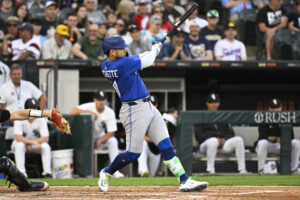
He’s still not walking much (5.3%), but Bichette’s 14.8% strikeout rate is the lowest of his career. He’s averaging 91 mph off the bat with a hearty 48.6% hard-hit rate. It’s still a swing-happy approach (hence the lack of walks), as evidenced by a 33.9% chase rate on balls of the plate. That’s about six percentage points higher than average but stands as the lowest mark of Bichette’s career. Even with those swings, however, Bichette’s contact rate is plus. That’s particularly true when Bichette zeroes in on balls over the plate; his 91.2% contact rate on balls in the strike zone ranks 19th in all of baseball.
Bichette has slowed down noticeably in recent seasons. He’s swiped just five bases this year, 20 short of his career-high 25 set back in 2021. It’s unlikely Bichette will ever return to those levels of thievery. His average sprint speed back in ’21 was 28 feet per second — faster than nearly four out of five big leaguers. This year, he’s averaging 26.2 ft/sec and sitting in just the 22nd percentile of MLB players, per Statcast.
Defense is going to be the biggest knock on Bichette in free agency. He’s never been a great defensive shortstop, and some teams will probably prefer him at second base from the jump. Both Defensive Runs Saved (-6) and Outs Above Average (-6) feel he’s been well below average with the glove this year.
Bichette can probably handle shortstop for another couple seasons, but it’s not likely that he’ll finish a long-term contract at the position. He’s not the same type of defender as well-compensated shortstops Willy Adames (seven years, $182MM), Dansby Swanson (seven years, $177MM), Javier Baez (six years, $140MM) and Trevor Story (six years, $140MM). However, he’s hitting the market earlier than any of those players did — ahead of his age-28 season. That extra year of his prime should allow Bichette, who’ll reject a qualifying offer, to land in the range of those other recent top-tier shortstops in free agency. If he sustains his absurd summer production (or anything close to it), he could push for $200MM or more.
3. Alex Bregman, 3B, Red Sox
Bregman isn’t technically a free agent yet, but barring some form of major injury in the final two months, he’s all but guaranteed to opt out of the remaining two years and $80MM on his contract. He’s not likely to secure another $40MM annual value — though you can argue that he didn’t truly get there anyhow, thanks to deferred money — but topping that remaining $80MM will be no problem.
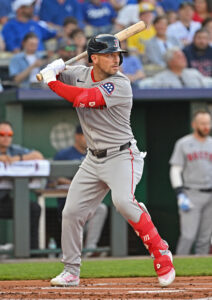
This past offseason, Bregman spurned six-year offers from his incumbent Astros and the Tigers in order to take a short-term, opt-out laden deal that could get him back to the market after a strong year.
Mission accomplished.
He missed more than a month due to a quadriceps strain, but he’s shown minimal ill effects since returning. Bregman is hitting .295/.373/.533 in 295 plate appearances. He’s popped 15 home runs and picked up 20 doubles. The uncharacteristically low 6.9% walk rate he showed last year is back up over 9%, and his perennially low strikeout rate is sitting at 16.9%. His 18.8% chase rate on balls off the plate is eighth-lowest in MLB (min. 250 plate appearances), and his 86.8% contact rate ranks 22nd.
Bregman is a plus defensive third baseman who could certainly handle second base and could likely fill in at shortstop if needed. Front offices, coaching staffs and teammates all rave about his makeup, leadership and clubhouse impact. None of that is easily quantified, but there will unquestionably be teams who value him even more than his raw numbers suggest due to that intangible profile.
Bregman’s market was relatively limited last year as he came off a mixed bag of a season and contended with a qualifying offer. That won’t be the case this time around. The Red Sox will want him back, but the Tigers, Cubs, Dodgers, Mets, Phillies and Mariners could all jump into the fray.
As MLBTR’s Contract Tracker shows, the only position players in the past decade to secure contracts of five-plus years beginning at age 32 are Lorenzo Cain, DJ LeMahieu and Freddie Freeman. LeMahieu’s contract was stretched to six years for luxury tax purposes. Freeman got six years but with deferred money. Even on a five-year deal, Bregman would have a case for $150MM or more. Six years could very well be attainable, as could $200MM. Regardless, Bregman has a chance to top Freeman’s $162MM guarantee and take home the largest free agent deal we’ve ever seen for a player starting in his age-32 season.
4. Framber Valdez, LHP, Astros
Speaking of 32-year-olds in line for prominent paydays, Valdez has left little doubt that he’s the top arm in this year’s class. He’s on his way to what would be a third sub-3.00 ERA in four years, having piled up 140 innings of 2.83 ERA ball. Valdez’s 25.4% strikeout rate would be the highest of his career in a 162-game season, and his 7.9% walk rate is better than league average for a fourth straight year (and south of 8% for a third straight).

On top of the consistency and strong strikeout-to-walk numbers, Valdez is one of the sport’s top ground-ball pitchers. This year’s 60.9% mark trails only the Angels’ Jose Soriano for the MLB lead not just among qualified starters, but among the 225 pitchers who’ve tossed at least 10 innings as a starter. He’s sitting 94.4 mph with his sinker, down from his 95.3 mph peak but up from last year’s average of 94.1 mph.
Valdez gives up more hard contact than the average starter, but so much of it comes on the ground that it’s more easily mitigated. Since moving into the Astros’ rotation full-time, he’s never allowed more than 0.86 homers per nine innings in a given season — this despite being a lefty whose home park features a short left-field porch for righty bats who hold the platoon advantage against him. And, in an era of five-inning starters and teams who are reluctant to let starters turn a lineup over for a third time, Valdez is a throwback. He’s averaged 6 1/3 innings per start not just in 2025 but over his past five seasons combined.
Were it not for the fact that Valdez will turn 32 in November, he’d be the No. 2 free agent on this ranking and comfortably projected for a $200MM contract. As it stands, he’ll be angling to become just the fourth pitcher to secure even a five-year deal in free agency beginning with his age-32 season (Contract Tracker link). A four-year deal for Valdez would surely clock in well over $100MM, but he should be expected to land five years and will have a real chance to join Zack Greinke as the only 32-year-old starter in recent memory to reel in six years. A deal in the $150-180MM range shouldn’t be a surprise, even after he inevitably rejects a qualifying offer.
5. Cody Bellinger, OF/1B, Yankees
Through a series of one-year deals and opt-out opportunities, Bellinger keeps finding his way onto MLBTR’s Power Rankings. He was just off the early-season edition of this year’s rankings but has risen to the middle of the pack due to some down years from other free agents but, more importantly, a very strong all-around performance of his own.
Bellinger looked lost at the plate from 2021-22 while returning from shoulder surgery, but this is his third straight strong year with the bat. He entered play Wednesday slashing .276/.328/.496 with 20 homers and 10 steals. Bellinger has continually whittled away at his strikeout rate in recent years, to the point that he’s now one of the toughest strikeouts in the sport, sitting at just 12.9%. He doesn’t post the type of gaudy exit velocity numbers toward which today’s front offices gravitate, but he’s been a consistently above-average hitter for three years now despite a middling quality-of-contact profile.
The Yankees have used Bellinger across all three outfield positions and at first base. He’s graded out roughly average in center but is a plus in either outfield corner. Bellinger has only played 19 innings at first base this season, but he received strong grades when he played 431 innings there for the 2023 Cubs (+5 DRS, +1 OAA).
Bellinger holds a $25MM player option for the 2026 season. It comes with a $5MM buyout that he’ll receive if he declines. Even if it were a true $25MM decision rather than a net $20MM decision, Bellinger would easily turn the option down. He can’t receive a qualifying offer this time around, and despite how many straight offseasons he’s been a fixture on the free agent market, he’ll play the bulk of next season at just 30 years of age.
Bellinger would only be 35 at the completion of a five-year deal or 36 after a six-year pact. An annual salary north of $20MM for a 30-year-old corner outfielder who’s posted a .283/.337/.481 slash in nearly 1600 plate appearances since 2023 — particularly one who can capably handle center field or first base — should be attainable, which means Bellinger has a real chance to sign for more than $100MM on the open market this time around.
6. Dylan Cease, RHP, Padres
Cease hasn’t had the season he hoped in his final year of club control. He’s still showing the durability, plus velocity and swing-and-miss arsenal that make him so appealing, but the results haven’t been there for the former AL Cy Young runner-up. In 123 1/3 innings, he’s pitched to a 4.60 ERA that would stand as the highest of his career (excluding a partial season in his 2019 MLB debut).
That said, Cease’s 97.1 mph average four-seamer is his best since the shortened 2020 season and the second-best of his career. He’s generating more chases off the plate than ever before, and this year’s 15.9% swinging-strike rate is the largest of his career. Command issues plagued him for much of his time with the White Sox, but this is now two seasons with the Padres and two seasons with a walk rate comfortably south of 10%. He may “only” have average command (perhaps a slight bit below), but Cease is a durable flamethrower who misses bats with the best in the league. He’s punched out 30.6% of his opponents. Metrics like FIP (3.52) and SIERA (3.33) feel he’s as good as — if not better than — he’s ever been.
Cease is also incredibly durable. He’s never been on the major league injured list outside of a short stay on the Covid-related list in 2021. Since 2020, he leads Major League Baseball with 165 games started and is ninth with 897 2/3 innings pitched.
Cease will be 30 in December. A five-year deal would “only” run through his age-34 season. With a big season, he and agent Scott Boras could perhaps have pushed for a seven-year contract in excess of $200MM. This year’s uneven performance presents multiple paths he could pursue. Cease will receive a qualifying offer and is almost certain to reject. If he looks to max out, he could perhaps still secure a long-term deal but probably not for close to the money he’d hoped entering the year. We’ve seen Boras clients like Carlos Rodon and Blake Snell go the short-term/opt-out route in the past, and Cease is young enough that he could still command a notable long-term deal following the 2026 season if he went that route.
Still, these rankings are based on earning ceiling, and there’s a scenario where Cease finishes strong, looks to max out and winds up with six years and a hearty annual value. For power arms who can miss bats like this, teams are increasingly willing to look past a rocky ERA.
7. Ranger Suarez, LHP, Phillies
Though not as durable as Valdez has been, Suarez pitches deep into games and keeps runs off the board just like his fellow southpaw. He allowed five runs in a 6 1/3-inning start just this afternoon, one of his worst outings of the year, but still carries a 2.94 ERA in 107 frames. He averaged 5 1/3 innings per start back in 2022, jumped to about 5 2/3 innings per start in 2023-24 and is up to nearly 6 1/3 innings per appearance in 2025.
Suarez has been consistently good along the way, with roughly average strikeout rates, good command and well above-average grounder rates. In many ways, he’s a “lite” version of Valdez. He’s fanned 21.8% of opponents since 2022, issued walks at a 7.8% clip and turned in a 51.5% ground-ball rate. Back, hamstring and elbow injuries have limited his workload in that time, keeping him to 538 innings of regular season work.
The 2025 season has been Suarez’s best in terms of results. It’s also his second straight season with notable time missed due to a back injury, however. Suarez opened the season on the injured list due to lower back pain and wound up missing more than a month. His lower back also cost him a month in 2024 and two weeks in 2022. He’s an immensely talented pitcher, but three IL stints for his lower back in a span of four years isn’t ideal — especially since he’s had other injuries mixed in (most notably a 2023 elbow strain that cost him six-plus weeks).
Suarez doesn’t throw as hard as Valdez, sitting at a career-low 90.2 mph with his sinker this season. The declining velocity and recent troubles with back injuries are limiting factors, but Suarez is a steady No. 3 starter who’ll pitch nearly all of next season at age 30. There’s no reason he shouldn’t handily top Eduardo Rodriguez‘s four-year, $80MM contract, and a five-year deal that pushes up closer to the Kevin Gausman/Robbie Ray territory of $110-115MM feels attainable.
8. Kyle Schwarber, OF/DH, Phillies
Schwarber is going to break plenty of precedent this offseason. He’s nominally an outfielder but has played 107 games at designated hitter this year. Maybe a team would plug Schwarber into left field early in a new contract, but a full-time move to DH probably isn’t too far down the road. Players with such minimal defensive value generally aren’t compensated well in free agency. Nelson Cruz and Victor Martinez got four-year deals as designated hitters … back in 2014. J.D. Martinez got five years and $110MM with the Red Sox back in 2018, but deal came with the expectation of at least some part-time outfield play. He logged 493 innings in year one of the deal and 330 in year two.
Players with negligible defensive value like this have a hard time finding big money in free agency, but Schwarber is going to be an exception. He’s not “just” a designated hitter — he’s one of the best hitters on the planet. He still strikes out more than you’d prefer (26.9% after three punchouts on Wednesday), but he’s also belted 40 homers in just 506 plate appearances — his third 40-homer effort in the past four years. (He hit “only” 38 bombs in 2024.) Schwarber has walked at a 14.8% clip as well, and he’s hitting .256/.376/.585 overall — a massive 63% better than average, by measure of wRC+.
Statcast ranks Schwarber in the 99th or 100th percentile in each of the following categories: bat speed, average exit velocity, barrel rate, hard-hit rate, expected slugging percentage and expected wOBA.
Earlier in his career, the book on Schwarber was that lefties could get him out. That’s not the case anymore — far from it. Schwarber has been well above-average against lefties dating back to 2021, including a colossal .278/.394/.656 slash (186 wRC+) in left-on-left matchups this season. He’s a .242/.341/.468 hitter in his past 1059 plate appearances versus southpaws.
On top of the gaudy on-base numbers and nearly unmatched power output, Schwarber is a beloved clubhouse presence whose teammates and coaches rave about what he brings to the team off the field. He’s going to be 33 next March, and while some teams will want to keep him to a high-AAV three-year contract, the offensive contributions have reached a point where it’s hard to envision less than four years. A fifth year isn’t even completely out of the question, even though he’ll receive and reject a qualifying offer.
9. Pete Alonso, 1B, Mets
The 2025 season has been a rollercoaster, but at the end of the day Alonso is having one of the best seasons of his career. He’s hitting .264/.352/.507 with 25 homers already, making him all but a lock to yet again top 30 homers — a feat he’s reached in each 162-game season of his career. Alonso’s walk rate is holding steady around 10%, and he’s cut a couple percentage points off his strikeout rate, which sits at 22.9%.
That’s far higher than the 14.6% clip he showed in a superhuman month of April, but it’s still right in line with the league average. Alonso did a lot of the heavy lifting for his season in March/April, but he also had a huge performance in June and is out to a nice start in August. July was his only truly bad month of the year from an offensive production standpoint.
Alonso is making more hard contact than ever (52.8%) and sporting career-high marks in average exit velocity (93.7 mph) and barrel rate (20.4%). His defensive limitations are obvious, and he’s never going to contribute much value on the bases. At the same time, he’s as reliable a source of 30-plus homers as nearly anyone in the game. Since he received a qualifying offer last winter, he’s ineligible to receive another one.
The two-year, $54MM contract Alonso signed last winter paid him $30MM this season with a $24MM player option for the 2026 campaign. If he and the Mets don’t agree to a longer-term deal between now and the time that option decision comes due, he’s a lock to turn it down and head back to the market. Much has been made of Alonso rejecting a seven-year, $158MM extension from the Mets several years ago. He’s already pocketed $50.5MM in salary in two years since turning that down, however, and bringing home another $107.5MM over the next five years doesn’t at all feel out of the question. We saw a 34-year-old Christian Walker land three years and $60MM last winter. He’s a better defender, but Alonso will play 2026 at age 31. A four-year deal worth around $25MM annually or a five-year deal in the $22-23MM range seems plausible.
10. Brandon Woodruff, RHP, Brewers
A new entrant on the list, Woodruff recently returned from a more than yearlong absence due to 2023 shoulder surgery. His velocity is down noticeably, but his results are elite and largely commensurate with his outstanding big league track record. It’s only a sample of 28 1/3 innings so far, but the 32-year-old righty has a 2.22 ERA, a 35.6% strikeout rate and just a 3.8% walk rate.
In the five seasons preceding his shoulder injury, Woodruff pitched to a combined 2.93 ERA in just under 600 innings. His strikeout and walk rates were both excellent, though not to the extent in his five-start sample this year. Woodruff averaged 96.3 mph with his fastball during that time, compared to just 93.2 mph in 2025, but it’s not unreasonable to think he could continue adding velo as he shakes off some rust. Woodruff’s four-seamer averaged 94 mph in his most recent start against the Nationals, for instance — his best in any start of 2025.
A 32-year-old who had a recent, major surgery is going to be capped in terms of contract length, but that could result in a bit of a bidding war when it comes to annual value. Nathan Eovaldi just got three years and $75MM beginning with his age-35 campaign this past offseason. Woodruff will be two years younger this offseason than Eovaldi was last winter.
This all hinges on how Woodruff finishes out the year, but if he keeps gaining velocity and/or wraps up his return campaign with an ERA in the low-to-mid 2.00s, there will be plenty of teams interested in adding a premium arm on a deal on a relatively short-term deal (three or four years). Woodruff technically has a $20MM mutual option, but he’ll receive a $10MM buyout when he declines his end in search of a long-term deal in free agency. The Brewers can then make him a qualifying offer, which he’d decline if he can sustain anything close to his current pace.
Honorable Mentions (listed alphabetically): Edwin Diaz (opt-out), Jack Flaherty (opt-out), Zac Gallen, Lucas Giolito (’26 club option becomes mutual option at 140 innings this year) Trent Grisham, Ryan Helsley, Michael King, Tyler Mahle, Munetaka Murakami (NPB), Cedric Mullins, Josh Naylor, Ryan O’Hearn, Eugenio Suarez, Robert Suarez (opt-out), Gleyber Torres, Luke Weaver
2025-26 MLB Free Agent Power Rankings: Nos. 11-15
The latest edition of MLBTR's 2025-26 Free Agent Power Rankings are out. You can check our top 10 with a full breakdown of our reasoning for free, as always. This time around, we're tacking on write-ups of the next five names and a peek ahead to their offseason market and contract expectations for Trade Rumors Front Office subscribers.
As always, it bears emphasizing that our rankings are based on how we perceive these free agents' earning power -- not necessarily a ranking of the "best" or most impactful free agents on the market. For instance, Merrill Kelly and Aroldis Chapman are both having terrific seasons ... in their age-36 and age-37 campaigns, respectively. If they posted these same numbers at age 30, they'd be locks for the top 10. As it stands, age will inherently place a cap on the length of contracts they can secure. A younger pitcher having a lesser season can still out-earn both, simply because deals of four, five and six years are available for 30-year-olds in a way they aren't for free agents in their late 30s.
Next up on our rankings are a trio of arms and two bats -- one of whom could be testing international free agency for the first time.
Unlock Subscriber-Exclusive Articles Like This One With a Trade Rumors Front Office Subscription
- Access weekly subscriber-only articles by Tim Dierkes, Steve Adams, and Anthony Franco.
- Join exclusive weekly live chats with Anthony.
- Remove ads and support our writers.
- Access GM-caliber tools like our MLB Contract Tracker
Twins’ Ryan Jeffers Also Drew Interest At Trade Deadline
The Twins shipped out nearly 40% of their roster but could’ve been even more active. Minnesota also received interest in catcher Ryan Jeffers from multiple teams, per Jon Heyman of the New York Post, though obviously nothing came together.
Whether it was a case of the Twins not receiving a satisfactory offer or simply not having time to hammer out yet another swap involving a player controlled beyond the current season, Jeffers is still the Twins’ starting catcher — at least for now. He’s controllable only through the 2026 season, so it stands to reason that he could again be a trade candidate this winter. Perhaps if the Pohlad family can complete a sale of the team in the near future, new ownership will be more intent on keeping a competitive roster together for next season. However, as things currently stand, Jeffers seems likely to be available again in a few months’ time, given the sheer magnitude of Minnesota’s still-surprising deadline teardown.
The 28-year-old Jeffers (29 next June) is enjoying a third straight productive year at the plate, hitting .260/.345/.409 with eight homers, 22 doubles, a 9.8% walk rate and a career-low 19.3% strikeout rate. Dating back to the 2023 season, he’s a .250/.333/.441 hitter — good for a 117 wRC+ that ranks fifth among all qualified big league catchers in that time. His glovework isn’t as well regarded, but Jeffers isn’t a liability from a defensive standpoint by any means. He’s earning $4.55MM this year and will likely clear $7MM next season in his final year of club control.
It’ll be a thin market for teams seeking help behind the plate this winter, so Jeffers should hold plenty of appeal if the Twins do dangle him. The top options on the free agent market will be J.T. Realmuto, ahead of his age-35 season, and Victor Caratini, who’s never really handled a starter’s workload behind the dish. (Even this year, as Caratini is on track for a new career-high in plate appearances, he’s spent 24 games at DH and 11 at first base in addition to his 39 games behind the plate.)
There will be a few other options to consider, but this offseason’s catcher class is composed primarily of mid-30s backups and younger starters who are struggling through down years. Danny Jansen is having a sub-par year for a second straight season. Gary Sanchez will end up missing roughly one-third of the year with the PCL sprain that’s currently sidelining him. Salvador Perez can technically become a free agent, but the Royals will presumably pick up his $13.5MM club option (a net $11.5MM decision when considering the option’s $2MM buyout).
As explored at greater length by MLBTR’s Anthony Franco yesterday, Jeffers and top starter Joe Ryan headline a group of several logical offseason trade candidates who remain on the Twins’ roster after that deadline purge.
Dodgers Designate Luken Baker For Assignment
The Dodgers have designated first baseman Luken Baker for assignment, per a team announcement. He’d been claimed off waivers from the Cardinals just this past Monday. Baker’s spot on the 40-man roster will go to outfielder Justin Dean, whose previously reported promotion from Triple-A Oklahoma City is now official. Outfielder Esteury Ruiz was optioned to Triple-A to open an active roster spot for Dean.
Baker, 28, is a 2018 second-rounder who’s posted some big Triple-A numbers at times but has never gotten a real look in the majors. The Cardinals gave him brief auditions each year from 2023-25, but he’s never reached 100 plate appearances in a big league season. He’s totaled 189 trips to the plate and owns a .206/.317/.338 batting line in that time.
Though this year’s minor league production is down — .197/.311/.399 in 270 plate appearances — Baker slugged 32 home runs in 108 Triple-A games in 2024. A year prior, he drilled a whopping 33 home runs in only 84 Triple-A games while batting .334/.439/.720. The Cardinals still never found much of an opportunity for him — not with Paul Goldschmidt entrenched at first base and the combination of Willson Contreras, Alec Burleson and Nolan Gorman all seeing frequent time at designated hitter (in addition to occasional time there from Goldschmidt).
Baker has immense raw power but has typically hit for low averages, even in Triple-A (excluding that Herculean 2023 performance). He’s played in parts of five seasons at the top minor league level and turned in a .249/.334/.507 slash in that time. This is Baker’s final minor league option year, so while he can be shuttled from Triple-A to the majors freely for the remainder of the year, he’d need to stick on a big league roster beginning on Opening Day next year (unless he’s passed through waivers first). The Dodgers will place Baker on waivers within the next five days.
Brewers, Julian Merryweather Agree To Minor League Deal
The Brewers and right-handed reliever Julian Merryweather are in agreement on a minor league deal, reports Curt Hogg of the Milwaukee Journal-Sentinel. Merryweather had been with the Mets but opted out of his minor league deal earlier in the week. The Warner Sports Management client will report to Triple-A Nashville for the time being.
Merryweather, 33, was a key piece of the division-rival Cubs’ bullpen back in 2023, when he posted career-bests in terms of innings pitched (72), ERA (3.38), strikeout rate (32.3%) and holds (17). He’s pitched just 33 2/3 big league frames since, due in large part to health troubles. Shoulder and knee injuries limited Merryweather to 15 MLB innings and just 6 2/3 innings of rehab work in 2024. He pitched 18 2/3 innings with the Cubs this year but turned in career-worst strikeout and walk rates while working with a fastball that was down more than two miles per hour from 2023.
The Cubs designated Merryweather for assignment and released him in May. He signed with the Mets a bit more than a week later and has since pitched 12 Triple-A innings with a 4.50 ERA, a strong 28.8% strikeout rate and an alarming 17.3% walk rate.
A former fifth-round pick by Cleveland, Merryweather stands 6’4″ and is listed at 215 pounds. He’s long possessed plus velocity and bat-missing abilities, but command and especially durability have frequently worked against him. He crossed five years of MLB service while in DFA limbo earlier this year despite having logged only 158 1/3 innings in the majors — a testament to how much time he’s spent on the injured list due to a host of ailments (including knee, shoulder, elbow, oblique, abdominal injuries). He’s still sitting 96 mph on his four-seamer this year, but that’s down considerably from 2023’s average of 98.1 mph.
Milwaukee has a track record of rehabbing relievers or even coaxing new levels of performance from previously nondescript bullpen arms. If they can get Merryweather back on track, the Brewers could control him via arbitration into next season, but for now he’ll simply be a depth option for a bullpen that sits 12th in the majors with a 3.65 ERA over the past month (and 16th overall in 2025, with a 3.97 mark).