
$5,000 Weekly Fantasy Football Contest From DraftStreet
Frozen out of your fantasy football playoffs? No problem! You can still be one of 135 people who will earn a piece of the $5,000 prize pool in our Week 15 league at DraftStreet.
DraftStreet is adding an extra $1,000 to the prize pool to help line your pockets this holiday season. It costs just $11 to join, but it's only open to the first 400 people who sign up. So get in early and win some money!
You have until Sunday at 1:00pm eastern time to create your team. You're given a $100K salary cap, and each player is assigned a price by DraftStreet. Your roster will cover these positions: 2 QBs, 2 RBs, 2 WRs, 1 TE, 2 FLEX, and 1 Defense. You get points based on how your team performs through Monday night's game. The teams with the most points get the prize money. It's extremely easy to put together a team. Below is a screenshot of my roster:
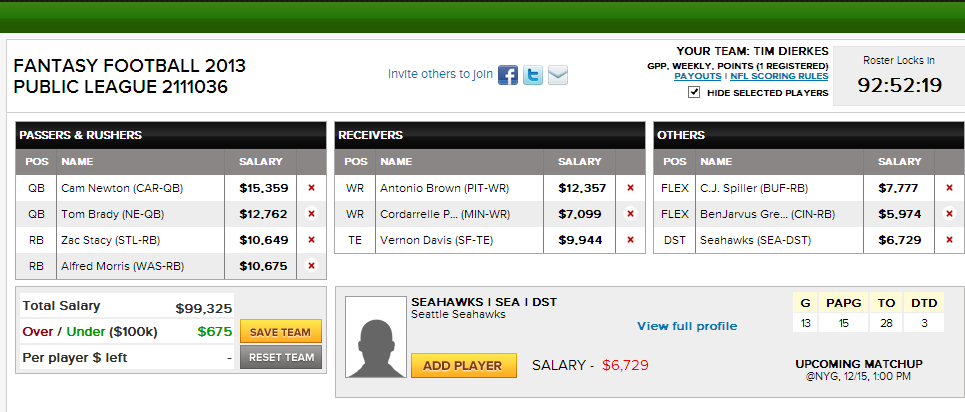
If you're interested, sign up and create a roster prior to Sunday's games (1:00pm eastern time). It's quick, easy, fun. If you enjoy the competition you can try other leagues for free and earn credits, or deposit real money.
This post is sponsored by DraftStreet.
12 Teams In On Jason Hammel
12 teams are currently in on free agent righty Jason Hammel, MLBTR has learned. Though he has yet to receive an offer, teams have discussed one-year concepts so far. There is a sense that three guaranteed years would garner serious consideration, but one year could be preferable to two.
Essentially, Hammel could be on the Scott Feldman plan. Feldman took a one-year, $6MM deal from the Cubs in November of 2012, pitched well and was traded midseason, and recently landed a three-year, $30MM deal from the Astros. The Astros still seem a logical fit for Hammel this winter even after signing Feldman, while the Indians have recently been connected.
Hammel, 31, scuffled in 2013 after a strong but abbreviated 2012 campaign for Baltimore. He earned the Orioles' Opening Day nod this year, but hit the DL in late July with inflammation in his ulnar nerve. After a cortisone injection, he returned in September, spending some time in the bullpen. Overall, he pitched to a 4.97 ERA in 139 1/3 frames, seeing his strikeout and groundball rates dip while his walk and home run rates spiked.
More Than 15 Teams Interested In Andrew Bailey
More than 15 teams have called to express interest in free agent reliever Andrew Bailey, MLBTR has learned. The 29-year-old had season-ending shoulder surgery to repair a torn labrum in his shoulder in July, and the Red Sox declined to tender him a contract earlier this month. Barring setbacks, he is expected to be Major League game ready by mid-May.
Bailey burst onto the scene in 2009, saving 26 games with a 1.84 ERA for the Athletics and winning the Rookie of the Year award. He made the All-Star team in 2009 and '10, though in 2010 he missed nearly a month with an intercostal strain. Bailey also had elbow surgery in late September that year. In 2011 he was injured in a spring training game, making his season debut on May 29th after recovering from a forearm strain. Bailey had thumb surgery in April 2012, making his season debut in mid-August.
Bailey hasn't had a completely healthy season since his rookie year. However, he still averages the same 94 miles per hour on his fastball he did then, and aside from a recent flyball tilt and a slip in control, Bailey has continued to show good skills in his limited mound time.
Astros Sign Chad Qualls
The Astros have brought reliever Chad Qualls back to Houston with a two-year deal with a club option for 2016, the team announced in a press release. The vet gets $6MM over the first two years with a potential $3.5MM for the option season, according to Ken Rosenthal of FOX Sports (on Twitter).
Qualls, 35, was drafted by the Astros in the second round in 2000 and was a quality set-up man for the team from 2005-07. After the '07 season he was traded to the Diamondbacks in the Jose Valverde trade, and the righty went on to pitch for the Rays, Padres, Phillies, Yankees, Pirates, and Marlins.
Qualls pitched to a 2.61 ERA with 7.1 K/9 and 2.8 BB/9 in 66 outings last season for the Marlins. The well-traveled veteran hasn't spent two consecutive seasons in the same city since 2008/09, but the multi-year pact might keep him in one place for a little while longer.
The Astros have shown a willingness to take a step forward early on in the offseason, striking a three-year, $30MM deal with Scott Feldman and trading for Rockies outfielder Dexter Fowler earlier this week.
For his career, Qualls owns a 3.79 ERA with 6.9 K/9 and 2.5 BB/9 across ten big league seasons. Qualls is represented by Jim Murray of Excel Sports Management, according to the MLBTR Agency Database.
Dodgers Re-Sign Brian Wilson
SATURDAY: The Dodgers officially announced Wilson's signing via press release.
THURSDAY, 9:19pm: Wilson has passed his physical, so the deal is now official, Dylan Hernandez of the Los Angeles Times tweets.
1:39pm: The Dodgers have reached an agreement with reliever Brian Wilson, tweets Yahoo's Tim Brown. It's a one-year, $10MM deal with a second year player option. Bob Nightengale of USA Today reports (on Twitter) that the option's value is $9MM, meaning that Wilson is guaranteed at least $19MM on this two-year pact. Jim Bowden of ESPN and MLB Network Radio tweets that Wilson has another $700K of incentives built into each year of the deal.
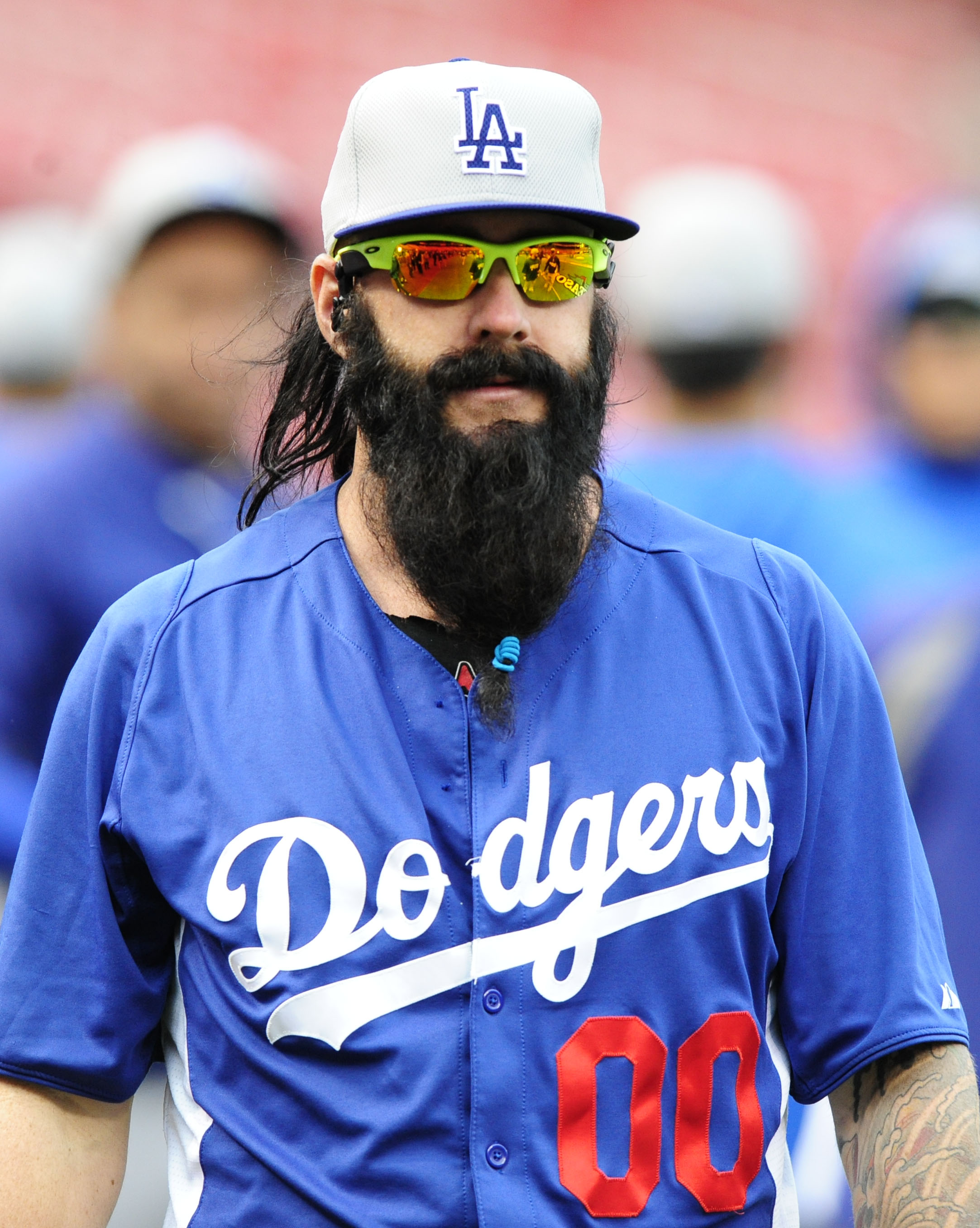
Though Wilson will be receiving closer money from the Dodgers, he's fine with setting up Kenley Jansen if that's how it works out, notes Brown. Paying Wilson closer money can be offset by the fact that Jansen will be paid more like a setup man, as he projects to earn $4.8MM in arbitration this offseason, per MLBTR's Matt Swartz.
Wilson signed a $1MM, Major League contract with the Dodgers on July 30th last year after a long recovery from April 2012 Tommy John surgery. He returned in late August in dominant fashion, yielding just one run with a 21-to-6 K/BB ratio in 19 2/3 innings between the regular season and the playoffs. His strong showing put him in line for a significant payday on the free agent market, and there was widespread interest in the bearded flamethrower. The Tigers, Mariners and Rockies were among the other teams interested in Wilson.
Wilson's player option is a nice safeguard for he and his agents at the MVP Sports Group. Should he thrive in Los Angeles as he did over his brief tenure there in 2013, he will hit the open market in the 2014-15 offseason as perhaps the top closer on the free agent market, positioning himself for a significant payday entering his age-33 season. Should he fall to injury or suffer a down season, he can simply elect to take a $9MM payday and look to cash in heading into his age-34 season, which we've seen numerous relievers do. Wilson's $10MM guarantee is slightly more than the one-year, $8.5MM guarantee that MLBTR's Steve Adams pegged him for in his free agent profile of Wilson back in late October.
Steve Adams contributed to this post. Photo courtesy of USA Today Sports Images.
Mike Napoli Talks Reach Critical Stage
11:24am: Napoli's market is picking up, and the Mariners, Marlins, Rangers and Red Sox are all involved, tweets Jon Paul Morosi of FOX Sports. Morosi adds that the Mariners have had "recent" talks with Napoli.
10:57am: Mike Napoli's free agent negotiations are at a critical stage, tweets Ken Rosenthal of FOX Sports. He says Napoli wants to remain with the Red Sox, but he has an offer from another club that Boston will need to match or exceed. Earlier, Rosenthal tweeted that the Rangers and Marlins are in on Napoli, who remains a priority for the Red Sox. The Rangers are interested even after acquiring Prince Fielder, which is seemingly made possible by the designated hitter spot.
Napoli was one of 13 players to receive a qualifying offer in November, so signing him will require forfeiture of a draft pick for teams other than the Red Sox. The 32-year-old switched to first base full-time in 2013 for Boston, hitting .259/.360/.482 in 578 plate appearances and playing in the postseason for the sixth time in eight seasons. Last offseason, Napoli's three-year, $39MM deal with the Red Sox was renegotiated down to a one-year, $5MM guarantee after his physical revealed a degenerative hip condition. With Curtis Granderson receiving four guaranteed years today from the Mets, I think Napoli has a good case for the same.
Breaking Down The Tigers’ Bullpen Situation
In signing Joe Nathan to a two-year, $20MM deal this week, the Tigers secured the best reliever on the free agent market at only 77% of the amount I projected in mid-October. There's a significant age difference between the two relievers, but I'd rather have Nathan at two years and $20MM than Joe Smith at three years and $15.75MM. The way Nathan spoke about focusing on the Tigers from the outset of free agency, it's possible they were able to leverage his enthusiasm to get him on a relatively reasonable deal given the typical save-related inflation.
In 2013 the Tigers' bullpen ranked 12th in the AL with a 4.01 ERA. That figure counts guys like Jose Valverde and Jeremy Bonderman, however, and the situation wasn't as dire by season's end as the ERA suggests. In the postseason, the Tigers' key guys were Joaquin Benoit, Drew Smyly, Jose Veras, Al Alburquerque, and Jose Alvarez. They lacked a good second lefty, but the core group of Benoit, Smyly, and Veras was strong in the regular season, as seen here.
The Tigers decided to move starter Doug Fister at what ESPN's Keith Law termed as "about 30 cents on the dollar" to presumably clear payroll space for Nathan (MLBTR's Jeff Todd looked at the Fister trade in depth here). That deal may have weakened the Tigers' rotation and bullpen, as the pen will lose Smyly but he probably won't be as good as Fister was in the rotation. The Tigers added a southpaw in the deal in 22-year-old Ian Krol, who has 31 innings of experience beyond the Double-A level. Lefty Phil Coke will also return to the team's bullpen after an underwhelming year.
In early November the Tigers declined Veras' $4MM club option in favor a $150K buyout, suggesting they did not value him at $3.85MM on a one-year deal. Benoit would be pricey to retain, with an outlay potentially topping Nathan's if he finds a three-year deal again.
It has been very surprising to see the Tigers take multiple cost-cutting measures. Were they not faced with this apparent restriction, they could have picked up Veras' option for the depth he provides, retained Fister, allowing Smyly to remain in the bullpen, and signed Nathan. Nathan would be replacing Benoit, a reasonable measure, and then GM Dave Dombrowski could have gone bullpen bargain shopping in January.
Keep in mind that the Tigers also saved $76MM in the Prince Fielder trade. Though we haven't seen this in recent years from the Tigers, it seems clear that most of this offseason's moves were driven by financial constraints. As surprising as that is, I can accept that no team has an unlimited amount of money to spend. But if you decide Fister is the piece you're going to move, and your bullpen needs tons of work, how do you trade him and not get back even one established, controllable reliever? As it stands, the Tigers do not have anyone reliable to slot in after Nathan, so Dombrowski will likely continue tinkering with his bullpen.
Phillies Sign Jeff Manship
The Phillies announced they've signed righty Jeff Manship to a minor league deal with an invitation to Major League spring training.
Manship, 29 in January, was drafted by the Twins in the 14th round in 2006 out of Notre Dame, signing an over-slot deal as a Tommy John survivor. He tallied 85 2/3 innings with the Twins from 2009-12, posting a 6.20 ERA mostly as a reliever. Several years ago, Baseball America suggested Manship's "average stuff and fringy command" would limit him to middle relief.
For the Rockies in 2013, Manship posted a 7.04 ERA, 5.3 K/9, 3.5 BB/9, 1.76 HR/9, and 45.4% groundball rate in 30 2/3 innings. He tallied another 104 frames in Triple-A.
Red Sox Sign A.J. Pierzynski
The Red Sox have prioritized landing a catcher on a short-term deal this offseason so as not to block the paths of prospects Blake Swihart and Christian Vazquez, and they accomplished that goal by landing A.J. Pierzynski. Boston officially announced a one-year deal for Pierzynski today. Pierzynski, who is represented by agent Steve Hilliard of Octagon, will reportedly receive an $8.25MM guarantee on his one-year pact.
 Terms are not yet known on Pierzynski's contract, but it's fair to suggest he could find two years with Carlos Ruiz getting three and Dioner Navarro getting two. Pierzynski, 37 later this month, signed a one-year deal with the Rangers last offseason and went on to hit .272/.297/.425 with 17 home runs in 529 plate appearances. As MLBTR's Steve Adams mentioned in Pierzynski's free agent profile, he offers good power for the position and has displayed perhaps the best durability behind the dish in baseball. Pierzynski will be paired with David Ross in Boston. The contract represents the first free agent deal of the offseason for the World Champion Red Sox, who still need to address first base at the least with Mike Napoli a free agent. The Twins and Blue Jays were reportedly among the other teams showing interest in Pierzynski this offseason.
Pierzynski is already the seventh catcher to sign a Major League deal, following Brian McCann (Yankees), Carlos Ruiz (Phillies), Dioner Navarro (Blue Jays), Jose Molina (Rays), Brayan Pena (Reds), and Francisco Pena (Royals). Saltalamacchia now appears the only starting option on the free agent market, though it's possible the newly non-tendered J.P. Arencibia could get significant playing time with a new team in 2014. In addition, the Reds seem likely to trade Ryan Hanigan.
Jon Heyman of CBS Sports first reported the agreement. Sean McAdam of Comcast Sports Net New England reported that it was a one-year deal (via Twitter), and ESPN's Buster Olney reported the $8.25MM value (also on Twitter).
Steve Adams contributed to this post. Photo courtesy of USA Today Sports Images.
Mets’ Talks With Granderson Intensify
9:48am: The Mets are moving forward with Granderson, and their interest in Nelson Cruz has cooled, according to Ken Rosenthal of FOX Sports (Twitter link).
7:00am: Talks between the Mets and Curtis Granderson's agent intensified late Tuesday, a source tells Adam Rubin of ESPNNewYork.com. Nothing is imminent, a second source told Rubin. The two sides are discussing a three-year deal, though the Mets could concede a fourth guaranteed year to get the deal done, Rubin hears.
Granderson met Sunday with Mets GM Sandy Alderson, which the player later described to reporters as "conversation, a Q-and-A kind of thing" during which he enjoyed some salmon. Granderson, 33 in March, hit .229/.317/.407 in 245 plate appearances for the Yankees in 2013, missing significant time due to being hit by two separate pitches. Since Granderson turned down a qualifying offer from the Yankees, the Mets would have to forfeit their second-round pick to sign him. Plus, four years would be a reach for a player his age unless agent Matt Brown compromises greatly on the average annual value. MLBTR's Steve Adams suggested a $15MM AAV on a three-year deal in his September profile.