
Diamondbacks Release Rod Barajas
The Diamondbacks released catcher Rod Barajas, tweets Nick Piecoro of the Arizona Republic. The D'Backs had signed Barajas to a minor league deal in February, but they've decided to go with Wil Nieves as Miguel Montero's backup behind the dish. And, they avoid paying Barajas a $100K retention bonus.
Barajas, 37, hit .206/.283/.343 in 361 plate appearances for the Pirates last year, throwing out only six of the 99 attempted basestealers. His 136 career home runs rank fifth among active catchers.
Tigers Retain Rights To Lobstein; Outright Him To Double-A
The Tigers retained the rights to Rule 5 selection Kyle Lobstein by trading catcher Curt Casali to the Rays, the team announced. Additionally, Detroit outrighted the contract of Lobstein to Double-A Erie.
Lobstein, a 23-year-old southpaw, was chosen by the Mets from the Rays with the tenth pick in December's Rule 5 draft, and immediately traded to the Tigers for cash considerations. After evaluating him over a dozen spring innings, it seems the Tigers didn't want to stash him all year in their big league bullpen but did find him worth retaining. Last year in Double-A, Lobstein posted a 4.06 ERA, 8.1 K/9, 4.3 BB/9, and 0.75 HR/9 in 27 starts. Baseball America ranked him 19th among Tigers prospects, noting "the craftiness to pitch in the Majors."
Casali, 24, hit .270/.365/.427 in 385 plate appearances across A and High-A ball last year. BA wrote that he "profiles as a solid backup catcher at the Major League level."
Offseason In Review: Washington Nationals
The Nationals signed the best available reliever, re-signed their slugging first baseman, and made strong choices for center field and their rotation.
Major League Signings
- Rafael Soriano, RP: two years, $28MM. $14MM vesting option for 2015.
- Adam LaRoche, 1B; two years, $24MM. Mutual option for 2015 with a $2MM buyout.
- Dan Haren, SP; one year, $13MM.
- Zach Duke, SP; one year, $500K.
- Total Spend: $65.5MM
International Signings
- Neivy Pilier ($225K)
Notable Minor League Signings
- Chris Young, Will Ohman, Micah Owings, Delwyn Young, Mike Costanzo, Brian Bocock, Bill Bray, Fernando Abad, Carlos Maldonado, Jeremy Accardo.
Traded and Claims
- Acquired SP A.J. Cole, RP Blake Treinen and PTBNL (Ian Krol) from Athletics for OF Mike Morse.
- Acquired OF Denard Span from Twins for SP Alex Meyer.
Notable Losses
- Mike Morse, Edwin Jackson, Sean Burnett, Mike Gonzalez, Tom Gorzelanny, John Lannan, Alex Meyer, Mark DeRosa
Needs Addressed
In November, the Nationals agreed to a new contract with manager Davey Johnson. It seemed an easy choice for both parties, after Johnson guided the Nats to the playoffs in 2012.
The Nationals wisely made a qualifying offer to first baseman Adam LaRoche, ensuring they'd receive a draft pick if he signed elsewhere. Perhaps the team also anticipated that the attached draft pick would cause difficulty for LaRoche on the open market. It took until January, but ultimately GM Mike Rizzo was able to retain the 33-year-old on his terms: a two-year, $24MM deal. With Mike Morse under contract, Rizzo was able to remain patient with LaRoche.

Rizzo did not extend a qualifying offer to Edwin Jackson, preferring not to get locked in (presumably, Rizzo thought there was some chance Jackson would accept the one-year, $13.3MM proposal). This decision surprised me, because it seemed unlikely Jackson would pass up a chance to find his deserved multiyear deal for the second consecutive offseason. As it turned out, Rizzo was saving his money for Haren, who signed in December. In November, the Cubs had nearly acquired Haren from the Angels, with the intent of exercising his $15.5MM club option and unloading ineffective reliever Carlos Marmol. The Cubs reportedly killed the deal over concerns with Haren's health. Rizzo did not share those concerns, and Haren (pictured) seems hellbent on returning to his innings-eating days. The Nationals were thinking big for their rotation vacancy, and were willing to spend much more on Haren than teams spent on other one-year deal starters like Scott Baker, Scott Feldman, Joe Saunders, and Brett Myers.
It was thought the Nationals would make a push for a free agent center fielder such as Michael Bourn or B.J. Upton, but instead they swung a deal with the Twins for Span. Rizzo found an established center fielder who can get on base and play the position well, and can be under contract affordably for three seasons. He surrendered a quality pitching prospect in Alex Meyer, but creating assets to trade for Major Leaguers is one purpose for the farm system of a contending club. The Nats had not yet re-signed LaRoche at the time of the trade, which further reduced the first baseman's leverage against them.
Once Span and LaRoche were both in tow, Rizzo was free to trade Morse. He chose to restock his farm system, acquiring Cole, Treinen, and Krol. Having drafted Cole in 2010 and sent him to the A's in the Gio Gonzalez deal, Rizzo was happy to get the pitching prospect back into his organization. It seems a solid return for a year of Morse, who has his warts.
The Nationals non-tendered Gorzelanny and lost Burnett and Gonzalez to free agency. The trio of lefties had accounted for a third of the team's bullpen innings at a 2.74 ERA, so the Nats saw a match with closer Rafael Soriano still available in mid-January (more on that later).
Questions Remaining
Considered one of the most complete teams in baseball, the Nationals are light on question marks. They've got a righty-heavy bullpen, but that's not necessarily a concern.
The Nationals signed arbitration eligible players Ian Desmond and Jordan Zimmermann to one-year deals. It's always nice to lock up young talent and grab a few free agent years in the process, but it's not clear what the players were seeking.
Deal of Note
Soriano seemed to have few suitors entering the new year, but Scott Boras is tight with Nationals' ownership and brokered a two-year, $28MM deal with heavy deferrals and a vesting option. It's top dollar for a reliever, but the term is short, and Soriano is very good when he's healthy. The Nationals also had to surrender their first-round pick, which would have become the 28th overall. At this stage in the team's competitive cycle, it makes sense to swing the pendulum toward Major League talent over prospects or draft picks.
Overview
It's plain to see why the Nationals are often named the best team in baseball. The entire roster just seems to be overflowing with talent and depth, phenoms and veterans. It'll be fun to see if the World Series predictions come true, but for now, the Nationals have assembled a potential juggernaut.
Photo courtesy of USA Today Sports Images.
Minor Moves: Kvasnicka, Koyie Hill
Today's minor moves:
- The Twins acquired 24-year-old right fielder/catcher Mike Kvasnicka from the Astros, tweets La Velle E. Neal III of the Minneapolis Star-Tribune. Kvasnicka, a Minnesota native, was drafted by the Twins out of high school but attended the University of Minnesota and was taken 33rd overall in the 2010 draft by Houston. Prior to the 2012 season, Kvasnicka was ranked 25th among Astros prospects by Baseball America. The Astros received 21-year-old righty reliever Gonzalo Sanudo in the deal.
- The Marlins signed catcher Koyie Hill to a minor league deal, tweets MLB.com's Joe Frisaro. Hill, 34, spent most of 2012 at Double and Triple-A, posting a .190/.251/.275 line in 221 plate appearances. Needless to say, he's a glove-first backstop.
Why I Chose My Agency: Jamey Carroll
Twins infielder Jamey Carroll owns a .354 career on-base percentage, sixth in baseball history among those who have played at least 200 games each at second base, shortstop, and third base. The 11-year veteran is represented by Jonathan Maurer and Mike Montana of Millenium Sports Management, and he recently spoke to MLBTR about his agency.
On when he first came into contact with Maurer and Montana:
I believe it was when I was in Triple-A, because I was rooming with a teammate named Scott Mitchell, who was with Jonathan at the time. I didn't have an agent, and he wanted to know if I needed anybody, and at the time I wasn't sure. I didn't feel like I was the type of player that needed somebody. A lot of these players are prospects, the guys that need it. I met him and he was willing to accept me into his management company, and I didn't really know what I had that was going to be helpful or to offer him. He took me in when I was in a situation in my career where I wasn't sure where I was really heading. Nobody's knocking down the door of a utility guy in Triple-A that's 27 years old, to represent him.
On why he chose to go with MSM:
They both seemed to have that faith in me, so it became a no-brainer. They weren't a big group, I felt like there was a lot of personal one-on-one. They were open to being around and offering their time whenever we need it. I liked the family-oriented atmosphere, not in it for the numbers, but more for the right people and the right types of players. I like that small, close-knit-type family feeling.
On the role his agents filled for him, prior to contract negotiations:
They were into finding out who I was in the [Montreal Expos] organization, what the organization felt about me, and where I fit and what my chances were to keep getting opportunities. I think that's one of the most important things, where you sit within the organization. How they view you and what goals they have for you, I think those are tough questions to ask and they were able to do that for me. I was at a time where I had quite a few years in the minor leagues and wasn't sure what my future held. To me that was more important than worrying about contracts and shoe deals and stuff like that.
On his involvement in contract discussions:
My wife and I are extremely involved. It helps that my wife is a negotiator for a living [formerly a recruiter for the Gap corporation], so we were able to have good insight and anticipate how the progress goes and ask questions. Having her in my corner to know kind of questions to ask. I enjoyed it, I think it's an interesting process. I wanted to know everything that was involved in it.
On how the free agent process worked:
The first time through, it was a lot of, "When somebody calls, please call." But then I think the second time through, a certain point in the day you'd have your phone call and see what had happened, see what teams were involved, what the thought process of the teams were, where you think that you fit. You wait to a certain point, gather all the information, and start filing through. I'd get a certain team that was interested, I would then go and look at the team myself, see what the roster is like, and see where I thought that I would fit as far as playing time with that team.
On whether he's recommended his agents to other players:
It's ultimately an atmosphere, especially at this level, where everybody has their agent. Most of the time, if somebody's having an issue, that's when you hear about somebody who has changed agents. I keep an open ear for it, but at the same time, it's a tough atmosphere when it comes to that. A lot of people are in a situation like I am now, they've had an agent for some time. If the opportunity arises, I definitely will throw my two cents in.
Check out our other interviews in the Why I Chose My Agency series with Ted Lilly, Ryan Ludwick, Cody Ross, Aramis Ramirez, Adam Wainwright, Jeremy Affeldt, David Wright, Jay Bruce, and Matt Holliday.
2014 Free Agent Power Rankings
With the regular season less than a week away, it's time for another entry in our 2014 Free Agents Power Rankings series. One contender for our top ten was eliminated earlier this month, as 27-year-old Scott Boras client Carlos Gomez surprisingly inked a three-year, $24MM extension with Milwaukee.
The full list of players who will be eligible for free agency after this season can be found here.
1. Robinson Cano. Cano remains atop the list, despite the Yankees making what GM Brian Cashman termed "a significant offer" when talking to reporters in late February. Cashman's mention of the team's offer seemed to be something of a public relations move. It would be a big surprise if Cano does not make it to the open market.
2. Adam Wainwright. Talking to Derrick Goold of the St. Louis Post-Dispatch, Cardinals GM John Mozeliak acknowledged that "time's ticking" on a potential Wainwright extension. The Cards and Wainwright's agent Steve Hammond made progress last week, but the 31-year-old righty is set to take the hill a week from today in Arizona. Negotiations may cease at that point.
3. Josh Johnson. By all accounts, Johnson has looked sharp this spring. So far, he's met his spring goal of allowing no walks. He's maintaining his spot for now.
4. Jacoby Ellsbury. The Red Sox and Ellsbury are being careful to preserve the center fielder's health. The speedster hasn't attempted any steals this spring, and he was removed early from yesterday's game with an ankle injury. The injury seems to be day-to-day, but Ellsbury will need to play in 140+ games this year to shake some of his injury-prone reputation.
5. Shin-Soo Choo. With Choo moving up a spot, Boras now represents three of my top five 2014 free agents. Choo missed six games this spring with back spasms, but he seems fine now. Choo is not without his flaws, but he gets on base and could score a lot of runs atop the Reds' lineup this year. His willingness to play center field has to be viewed as a plus.
6. Roy Halladay. If my fantasy baseball drafts are any indication, folks are down on Doc this year. As MLB.com's Todd Zolecki put it, Halladay "has had a rough month, struggling in starts because of dead arm, lethargy and illness, respectively." The righty has worked at 87-89 miles per hour recently, but his most effective seasons have been in the 91-92 range. The bell rings for Halladay April 3rd in Atlanta, at which point we can start evaluating him more seriously.
7. Hunter Pence. Pence jumps an impressive three spots, more by virtue of the struggles of those around him on this list than by his strong spring. Earlier this month Pence told Jim Bowden of MLB Network Radio and ESPN that he'd prefer to sign an extension with the Giants rather than test free agency. I imagine the Giants will need to see a few months of production first.
8. Brian McCann. It was revealed recently that McCann will not be cleared to begin his minor league rehab assignment before April 16th, after his October shoulder surgery. GM Frank Wren said McCann wasn't behind or ahead of schedule. Previously, though, there had been talk of a mid-April return to the Braves. If McCann misses all of April, that hurts his stock a bit. For insight into the injury and McCann's relationship with the Braves, check out Ken Rosenthal's FOX Sports article from earlier this month.
9. Tim Lincecum. Lincecum at least appears healthy, but his spring hasn't been encouraging. If he repeats his lackluster 2012 season, Lincecum will be off this list. Wrote ESPN's Keith Law earlier this month, "His stuff was about where it was late last year, but I think the concerns about him having difficulty pitching off that fastball in a starting role are legitimate."
10. Matt Garza. Garza will start the season on the DL due to a strained lat muscle, after being shut down last year in July due to elbow issues. With a possible mid-May season debut, Garza will need to come on strong and stay healthy thereafter to maintain a spot in our top ten.
A few players on the fringes of the list, such as Curtis Granderson and Corey Hart, will also begin the season on the DL. That could leave an opening for others like Nelson Cruz, Phil Hughes, Hiroki Kuroda, Jason Hammel, and Chase Utley to muscle their way into the picture.
Feliciano Strongly Considering Opting Out From Mets Contract
Lefty reliever Pedro Feliciano is strongly considering opting out of his contract with the Mets and signing elsewhere, reports Adam Rubin of ESPNNewYork.com. The Mets informed the 36-year-old he would not be making the Opening Day roster, and they'd like him to spend a month in Triple-A to build arm strength. Feliciano will confer with his agent, but believes he's Major League ready now and may look to continue his comeback elsewhere. If Feliciano does go to the minors for the Mets, he'll receive a $100K retention bonus.
While pitching for the Mets, Feliciano led MLB in appearances in 2008, '09, and '10. After he signed a two-year, $8MM deal with the Yankees, he failed to make a big league appearance for his new club and had rotator cuff surgery in 2011.
This spring, Feliciano missed time when a rare heart condition was diagnosed, and as of a few days ago was working in the 82-83 miles per hour range. The pitcher contends that "velocity don't mean nothing." His spring results were acceptable in 4 1/3 innings. When he last pitched in the Majors, Feliciano worked at about 87 miles per hour.
Ben Nicholson-Smith To Join Sportsnet.ca
After more than four years and thousands of perfectly-crafted posts for MLB Trade Rumors, Ben Nicholson-Smith is joining Sportsnet.ca as their new baseball editor. Sportsnet has hired one of the industry's best up-and-coming journalists. Ben's professionalism, hard work, and top-notch writing will be sorely missed here at MLBTR, and we wish him the best. He's made my job much easier over the years. If you've enjoyed Ben's work here, give him a follow on Twitter. Though this is Ben's last day at MLBTR, we'll surely be proudly linking to his work for Sportsnet.ca.
Why I Chose My Agency: Ike Davis
Mets first baseman Ike Davis bashed a career-best 32 home runs in 2012. Today I spoke with him about his relationship with his agent, Lou Jon Nero of Octagon.
On his first agent:
The first guy we ever met was Gregg Clifton, he was with Octagon at the time. My dad [former MLB pitcher Ron Davis] knew Clifton and he was like "Alright, whatever, we'll try you out for a little while." It wasn't like they could do much then because it was advisors. I hadn't been drafted or played my senior season yet. I started talking to him for a little bit, and personality-wise it wasn't a great fit. Before the season I met Lou Jon and we put him through the grinder a couple of times, made him come to the house for three or four dinners, and had dad question him. I was there, and I obviously didn't know much about what you're looking for at that time, being so young. It was just a personality test to make sure you're with good people. We don't like slimy people in the Davis family. He passed the test with flying colors, and we told him we'd like him to represent us, and I've been with him almost ten years.
On Octagon's acquisition of the baseball divisions of CSMG in 2008:
They were CSMG back in the day, when I first met them. CSMG said they were selling basketball and football, and our whole baseball office is going to Octagon.
Was that acquisition a concern?
Not really, because you don't go for the company. You go for the agent, the guy that is representing you. Companies will have four or five different agents and you have to find the one that you can communicate with, that understands what makes you tick and what to do and how to do things to keep you at your best level of play.
On how he decided he clicked with Lou Jon:
We spent a lot of time together. He's a young guy, he's not old school. He never made me feel like I didn't know what I was talking about. He never made me feel like I was inferior. He's kind of hip. He's around my age, and we like the same stuff. He's really up-to-date with technology, he's on top of all the things that I'm not always on top of. He's fun to hang out with, he's very family-oriented which I like. He doesn't have slicked-back hair, nice suits, a $100,000 watch — he's homey, kind of like I am. I don't like the shiny look on the agents, it's kind of freaky.
On considering signing when he was drafted out of high school by the Devil Rays in 2005:
It was about money, and what it would take to not go to college. Lou Jon basically said, "You're not going to go unless it's over a million dollars." At that time I was like, "You're crazy man, $700,000 is a lot of money." He said, "Don't worry about it, you're going to get money, you'll be in a better position." I got drafted, and I think the most they could probably come up with was maybe half a million or something like that. It was a lot of money to turn down at 18, but Lou said, "Don't worry, you've got three years of being in Tempe, Arizona [at Arizona State University], three years of the best time of your life, and you'll be drafted way higher when you're done. It's a win-win for you." He was letting me know, "Everything's fine dude, you're going to be great." He always had the right path in mind for me, which is really cool.
On the 2008 draft, in which he was taken 18th overall by the Mets:
That's actually pretty crazy, because the draft's a weird thing. The teams don't really know, the agents really can't tell you much unless you're the first or second pick. When you're after the first five or six picks, it's kind of like, "Who knows." One team might have you fourth on the board, one might have you 19th. It's different. I knew that I was going to get drafted in the top two rounds, didn't know yet if it was going to be by the Dodgers, who wanted me to pitch, or a team that wanted me to hit. Basically what I told every team was if you draft me, I was going to sign. I was like, "I'm going to sign if you draft me, so draft me."
Did that hurt your leverage?
No…one thing I like about Lou Jon is that we know what we're worth and what we're not. We're not trying to get crazy money out of people. You know that when you're drafted 19th you're not going to get $8MM. We know where we stand. We don't make people upset and we don't get upset because we're not asking for an unfair amount of money. The slot was like $1.4MM and I ended up getting $1.575MM. If Lou Jon was throwing out $3MM, then things might not happen. I probably wouldn't get drafted in the first 20 picks.
On what an agent does after a draft pick signs:
Off-the-field stuff like card signings and deals with equipment, and how not to get trapped into long-term deals with equipment when you could make the big leagues in a year, and you're in a three-year Nike deal, or a three-year deal with anybody, and instead of making that $10-12K a year, you're still making $500 a year. Say you're in the minor leagues and you really want to be with Under Armour, and they're like, "We'll give you all your cleats and we'll give you $500 in merchandise a year, but here, sign this five or six-year deal." You sign the deal and in a year and a half you're in the big leagues in New York, and you're this up-and-coming rookie that's making a big splash, you're going to have a chance to make over $20K a year instead of being on that $500 deal.
On his involvement in negotiations for his first-year arbitration salary in 2013:
I was pretty involved. My agency had come up with a booklet the size of the Yellow Pages, with all different players that were similar that I could be compared to. It's more for knowledge of why we think I should get the money. We came up with a number together, looking at all the people that have gone before me, this is the number that should be fair for a first year of arbitration. We said this number we're going with, we're not going any less, period. If they want to go less, then we go to arbitration. The biggest thing is sticking to your guns. We made a fair number, and this is what we deserve. We talked to MLB to make sure they thought it was a fair number, and they agreed.
We said [to the Mets], "We can end it right now simply if you just give us this, we'll sign that day." We started talking three or four days before that date. They came in at 2.8 [million], and we were like, "No, we want 3.125 and we're good." The good thing is we had quick communication. They said 2.8, we said no, 3.125. They said 3, we said 3.125. They said 3.1, we said 3.125. They said 3.120, we said 3.125. That day was over and it was past the date. The next day they go, "Here's the 3.125." The good thing is, we weren't asking for $4MM. We didn't have to go to arbitration and have potential to lose $800K or $1MM because we have a poor number.
On going year-to-year versus signing long-term:
I like being with Lou Jon because we're pretty open about what it will take and what's a good deal. We go over what is a fair deal to do. We're not asking crazy amounts, we just want what's fair, what I have proved on the field and what I deserve. If that comes to where the Mets do offer me an extension or want to extend me, me and Lou Jon will come up with a number that we think is a fair number — not a number that's not fair or we're pushing the envelope. If whoever doesn't want the fair number then obviously we'll go year-to-year and me and Lou Jon have no problem doing it, but guaranteed years and security is always nice. Lou Jon has a lot of confidence in me to go year-to-year and be fine if that's the case.
Has the team thrown anything out there to date?
No. We have not. The first thing I ever even heard about it was a couple of days ago, but there was no conversation, it was just a random passerby asked me if I knew they were thinking about extending me, and I was like, "Nah, I haven't heard of anything." I guess Sandy had said something to somebody that they were thinking about it, something like that.
Would you be open to giving up a free agent year or two to get that guarantee now?
I'm open to a conversation about anything. The free agency years are obviously the tough ones, because those are the years that you have the potential to sign a bigger contract for a longer term. As for arbitration, I wouldn't mind a three or four-year deal where it takes arbitration out of it. We're more inclined to take care of the arbitration years. They always say your first deal, it's mutual, but it's team-oriented, and your free agency is obviously player-oriented. Me and Lou Jon are up for anything, but it has to make sense.
On whether he's recommended Lou Jon to other players:
Me and Lou Jon are really good friends now. We've known each other for ten years, I know his whole family and we spend a lot of time together. He comes over, we'll go to hole-in-the-wall food places, my brother hangs out with him, he's around a lot. But I also hang out with baseball players. I don't like pressuring people into doing stuff. That's another reason Lou Jon's really cool, is that he never pressures my friends, asking questions about how they feel about their agents. He knows that if they were looking for an agent, they would ask him about it.
On whether a larger agency offers an advantage over a small one:
For sure. When I was with CSMG with Lou Jon, it was a good-sized agency, but it was small. Once they moved to Octagon, there's just more people reaching out trying to improve your brand, getting more opportunities and more business ventures. There's more connections and more hands that are working on stuff.
Check out our other interviews in the Why I Chose My Agency series with Ted Lilly, Ryan Ludwick, Cody Ross, Aramis Ramirez, Adam Wainwright, Jeremy Affeldt, David Wright, Jay Bruce, and Matt Holliday.
Offseason In Review: Philadelphia Phillies
The Phillies addressed their outfield, third base, and late-inning relief concerns without making a major free agent splash.
Major League Signings
- John Lannan, SP: one year, $2.5MM.
- Delmon Young, OF: one year, $750K.
- Mike Adams, RP: two years, $12MM. $6.5MM vesting option for 2015.
- Carlos Ruiz, C: one year, $5MM. Club Option Exercised.
- Chad Durbin, RP: one year, $1.1MM. Club option for 2014.
- Total Spend: $21.35MM.
Minor League Signings
- Yuniesky Betancourt, Joe Mather, Matt Tolbert, Brian Bass, Aaron Cook, Rodrigo Lopez, Andres Blanco, Josh Fields, Michael Martinez, Zach Miner, Pete Orr, Humberto Quintero, Cesar Jimenez.
Trades and Waiver Claims
- Acquired IF Michael Young from Rangers for RP Josh Lindblom and RP Lisalverto Bonilla.
- Acquired OF Ben Revere from Twins for SP Vance Worley and SP Trevor May.
- Acquired 1B Art Charles from Blue Jays for RP Michael Schwimer.
- Claimed RP Mauricio Robles off waivers from Mariners.
- Claimed OF Ender Inciarte from Diamondbacks in Rule 5 draft.
Notable Losses
- Placido Polanco, Ty Wigginton, Juan Pierre, Nate Schierholtz, Jose Contreras, David Herndon, Josh Lindblom, Vance Worley, Michael Schwimer, Trevor May, Lisalverto Bonilla.
Needs Addressed
The Phillies' needs were clear at the beginning of the offseason. GM Ruben Amaro Jr. addressed the outfield, third base, and the bullpen without doling out any large contracts.
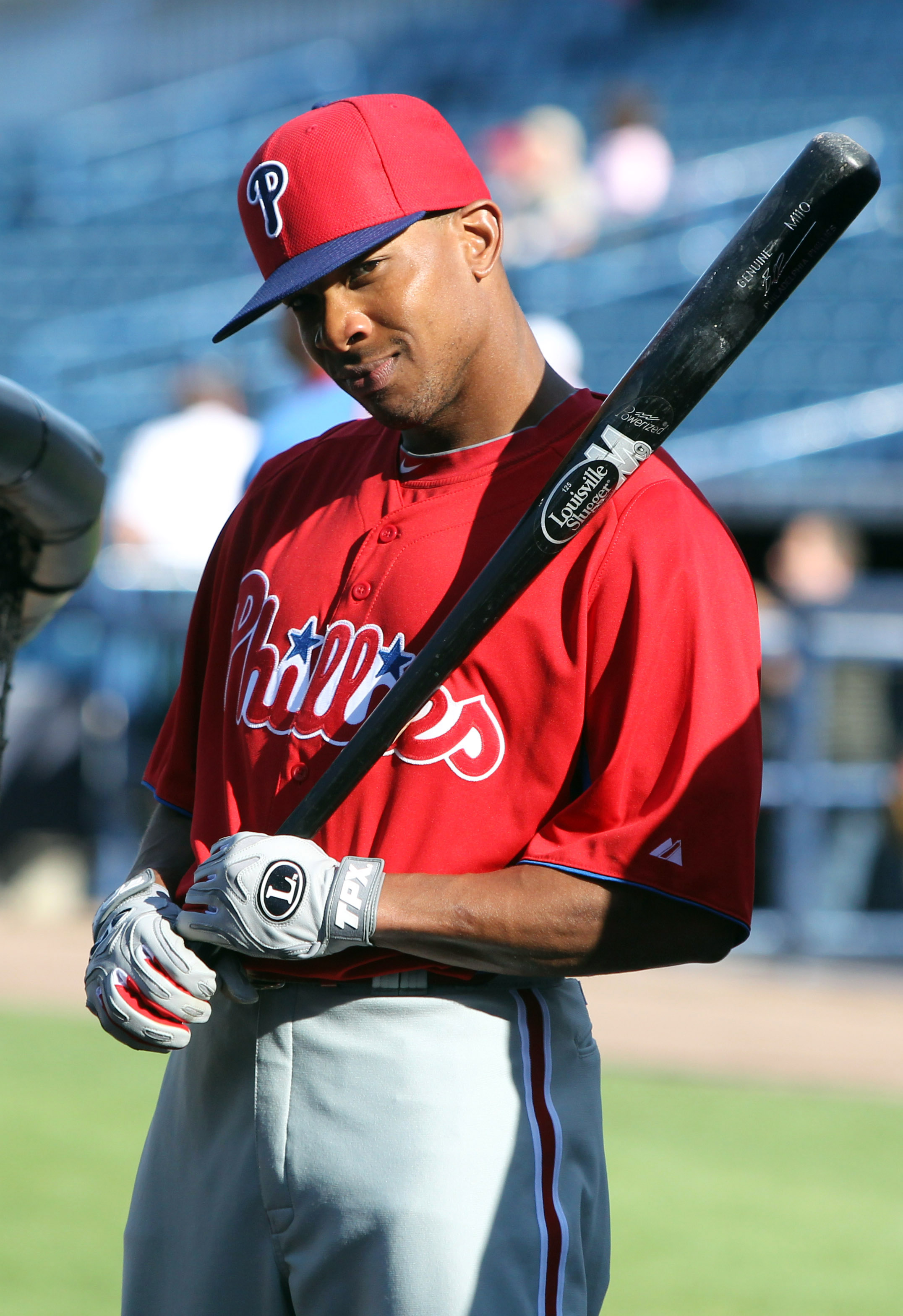
The Phillies explored all avenues in center field. They were linked to free agents such as B.J. Upton, Michael Bourn, Josh Hamilton, and Angel Pagan, but Amaro chose to acquire 24-year-old former first round pick Ben Revere from the Twins for a useful big league starter in Vance Worley and a respectable pitching prospect in Trevor May. Credit Amaro for making a push for Revere (pictured) when many thought he'd be unavailable, since the Twins had already dealt Denard Span. Revere, who is not yet arbitration eligible, is under control through 2017. Revere will have to provide value to the team with his glove, as he doesn't possess power and doesn't draw walks. The departure of Worley created an opening in the rotation, which Amaro addressed by signing Lannan as a free agent.
The free agent market for third basemen was shallow, so Amaro went the trade route there as well by acquiring Young. The 36-year-old is coming off his worst season in the last decade, though prior to 2012, he'd been a consistent three-win contributor. Young escapes the trade rumors and lack of position that plagued his final years in Texas, and some level of bounceback seems probable. Plus, he has a reputation as a good clubhouse guy. The Phillies effectively have to contribute $7.2MM toward Young's salary, and they surrendered some bullpen depth in Lindblom and a decent relief prospect in Bonilla.
Adams was signed at top of the market setup man dollars to be the new bridge to closer Jonathan Papelbon. At 34 years old with a significant injury history and slipping peripherals, Adams represents a gamble by Amaro. At least the Phillies didn't have to guarantee a third year. Durbin, signed at an affordable price, restores the depth lost by dealing Lindblom.
The Phillies chose an interesting route to filling right field, signing Delmon Young dirt cheap. Young, the first overall pick in '03, had one decent season back in 2010. He'll have a sub-par on-base percentage unless he hits near .300, since he doesn't draw walks. Young will likely cost the team runs on defense, especially coming off November microfracture surgery on his ankle. The Phillies will have to hope Revere can pick up Young's slack defensively, and Young stays out of trouble and pops 20 home runs. The whole idea of Young as a productive regular seems unlikely to pan out, but the cost was barely above the league minimum.
Questions Remaining
Will the Phillies' new-look outfield provide any offense? The best bet for usefulness is Domonic Brown, the former top prospect who was pegged as a breakout candidate by ESPN's Keith Law. The infield offers a bit more offense, but it's an aging group.
The other looming question is what to expect out of Roy Halladay, who finally looked mortal last year. If Doc shakes off the spring velocity concerns and musters up 225+ innings of sub-3.00 ERA ball, the team's trio of aces should keep them in contention all year. Otherwise, the Phillies' rotation depth will determine whether they can even play .500 ball in 2013.
Deal of Note
Lannan, a 28-year-old southpaw, spent most of 2012 languishing with the Nationals' Triple-A club before reaching free agency via non-tender in November. Since Lannan only has four years of Major League service, his arbitration eligibility after 2013 effectively serves as a club option. At $2.5MM, the Phillies didn't have to invest much in a pitcher they mostly just need to take the ball every fifth day and not embarrass himself.
Overview
The Phillies are not going to be a trendy playoff pick for 2013, with the Nationals and Braves both looking strong. But don't forget 2011, when the same trio of ace starters led them to 102 wins. If Cole Hamels, Cliff Lee, Halladay, Papelbon, and Adams are healthy and effective, this team will be very tough to beat 60% of the time.
Photo courtesy of USA Today Sports Images.