
Injury Notes: Treinen, Nelson, Severino, Britton
The Dodgers have been without reliever Blake Treinen for much of the season, as shoulder issues have kept him on the injured list. The right-hander was out of action between mid-April and early September, and his return to the active roster this month lasted just two appearances. Treinen went back on the IL with shoulder tightness on a placement retroactive to September 7. While he’ll be eligible to return from that stint tomorrow, manager Dave Roberts informed reporters Treinen’s shoulder hasn’t responded to a Monday bullpen session as hoped (via David Vassegh of AM 570 LA Sports and J.P. Hoornstra of the Southern California News Group).
Roberts indicated there’s some concern Treinen may not be available in time for the postseason, which kicks off just over two weeks from now. Los Angeles is assuredly going to get a bye past the first-round Wild Card series, which will afford Treinen a bit more time to try to work his way back. If they could get the 34-year-old back in the fold, it’d go a long way towards improving their playoff bullpen. While he’s been limited to just five appearances this year, Treinen was one of the sport’s best late-game weapons a season ago. He worked to a 1.99 ERA with a 29.7% strikeout rate while inducing grounders on over half the batted balls he allowed through 72 1/3 frames in 2021.
Some other injury notes from around the game:
- The Diamondbacks placed rookie starter Ryne Nelson on the 15-day injured list this afternoon, recalling southpaw Tyler Holton from Triple-A Reno in his place. The right-hander is dealing with scapula inflammation that’ll end his season a few weeks early. Manager Torey Lovullo didn’t sound especially concerned about the issue long-term, telling reporters (including Nick Piecoro of the Arizona Republic) the club was proceeding with an excess of caution with the season winding down. Lovullo indicated Nelson should be in the mix for a spot in next year’s season-opening rotation, hardly a surprise given his prospect pedigree. Baseball America’s #96 overall farmhand entering the 2022 campaign, Nelson struggled with the longball in a hitter-friendly Triple-A environment but impressed in his first three big league starts. He allowed only four runs (three earned) with 16 strikeouts and six walks in 18 1/3 innings to kick off his MLB career.
- The Yankees reinstated Luis Severino from the 60-day injured list this afternoon, as expected. New York already had a vacancy on the 40-man roster, and they optioned Miguel Andújar to Triple-A Scranton/Wilkes-Barre to open a spot on the active roster. Severino, who missed two months after suffering a lat strain in mid-June, returned with five innings of one-run ball in a win over the Pirates. The righty tossed 64 pitches and figures to progressively build his pitch count with each start in preparation for a potential role in the playoff rotation. New York is also likely to soon welcome back reliever Zack Britton, who hasn’t thrown an MLB pitch since undergoing a UCL repair last September. Joel Sherman of the New York Post was among those to relay that Britton has reported to the major league club after making eight appearances on a rehab stint. While he’s not yet been formally reinstated from the 60-day injured list, that seems likely to occur in the coming days.
Six Teams Set To Pay Luxury Tax In 2022
Six teams are set to pay penalties under the newly restructured competitive balance/luxury tax for their 2022 payrolls, per a report from the Associated Press. Each of the Mets, Dodgers, Yankees, Phillies, Padres and Red Sox is currently over the threshold. That marks just the second time since the luxury tax’s inception that six teams will pay the tax.
This will be the second straight year paying the tax for both Los Angeles and San Diego. Each of the other four clubs was under the threshold in 2021 and thus counts as a first-time luxury tax offender.
The 2022-26 collective bargaining agreement not only saw the tax thresholds increase by a relatively significant margin — it also implemented a newly created fourth tier of penalization. For a reminder, the new thresholds are as follows:
- Tier One: $230-250MM (teams pay a 20% overage)
- Tier Two: $250-270MM (32%)
- Tier Three: $270-290MM (62.5% for first-time payors; 65% thereafter)
- Tier Four: $290MM+ (80%)
For second-time payors (i.e. Dodgers, Padres), those rates jump to 30%, 42%, 75% and 90%, respectively.
While those sound like substantial penalties at first glance, the actual amounts to be paid by most teams in excess of the luxury tax is relatively minimal. Those clubs are only taxed on dollars over the threshold, leading to often trivial sums of money (by the standards of a Major League franchise, anyhow). The Padres, for instance, are less than $3MM over the threshold, per the AP, so even with an increased 30% tax rate they’re only set to pay a bit more than $800K. The Red Sox are roughly $4.5MM over the threshold, putting them in line to pay about $900K in fees. The Phillies ($2.6MM) and even the Yankees ($9.4MM) are also looking at generally small sums, relative to their annual payroll marks.
The only two teams set to pay substantial sums are the Dodgers, who fall just shy of the fourth tier of penalization, and the Mets, who exceeded that tier by nearly $9MM. The Mets are in line to pay as much as $29.9MM in taxes, per the AP, while the Dodgers check in just slightly behind that sum at $29.4MM.
What the AP’s report does not delve into, however, are the other penalties associated with the luxury tax — which some teams view as more detrimental than the fiscal penalizations. Any club that exceeds the first tax threshold by $40MM or more will see its top pick in the following year’s draft pushed back 10 slots, for instance. With regard to the 2023 draft, that applies to both the Mets and the Dodgers.
Tax payors are also subject to stiffer slaps on the wrist when signing free agents who have rejected a qualifying offer and to diminished returns when losing such free agents. CBT payors who sign a “qualified” free agent stand to lose their second- and fifth-highest selections in the draft as well as $1MM from their league-allotted bonus pool for international free agency (which typically represents anywhere from roughly one-sixth to one-quarter of the total pool). That’s in contrast to revenue-sharing recipients, who forfeit only their third-highest pick, and to non-revenue sharing recipients/non-CBT-paying teams, who lose their second pick and $500K from that international pool.
More interesting with respect to this year’s group of luxury payors is the fact that a CBT-paying club who extends a qualifying offer to a free agent only stands to gain a compensatory pick after the fourth round of the 2023 draft. For a team that does not receive revenue sharing and does not pay the CBT, that pick would fall after Competitive Balance Round B — roughly 60 picks higher.
For a team like the Red Sox, who exceeded the tax by just $4.5MM, that means they’ll see their potential compensation for Xander Bogaerts — a lock to receive and reject a qualifying offer — shrink considerably. It also lessens the incentive to extend a qualifying offer to a more borderline candidate like Nathan Eovaldi, who’s been shelved for more than a month due to shoulder inflammation.
It also further welcomes scrutiny of Boston’s decision to hang onto veterans such as Eovaldi, Rich Hill and J.D. Martinez at the trade deadline. It’s certainly commendable that the club sought to remain in the Wild Card mix, but the Sox sent some mixed signals by trading Christian Vazquez (and to a much lesser extent, Jake Diekman) while simultaneously acquiring Tommy Pham and a paid-down-to-league-minimum Eric Hosmer. The Red Sox didn’t really commit to shattering the threshold in the name of an all-out postseason push in 2022 but also didn’t take the necessary steps to maximize their return in the event that Bogaerts departs in free agency. The result could be that their compensation for losing Bogaerts, a four-time All-Star who’s received MVP votes in four different seasons, will be a single draft pick somewhere in the 135 to 140 vicinity next summer. That’s not necessarily a franchise-altering outcome, but it’s also far from ideal.
At one point, the Padres might have faced similar considerations with regard to their own free agents, although they’ve sorted themselves out more organically. Joe Musgrove‘s extension keeps him in San Diego and renders moot any considerations regarding a qualifying offer, though. Meanwhile, fellow starters Mike Clevinger and Sean Manaea looked like potential QO candidates at the time of the trade deadline but have struggled considerably in the second half, lessening the likelihood they’d receive a QO in the first place.
That diminished draft compensation, while not a deterrent for the Mets with regard to their roster construction, will be a reality they face this winter. With as many as four potential QO recipients — Jacob deGrom, Edwin Diaz, Chris Bassitt and Brandon Nimmo — they stand to see the return for those potential departures undercut in a meaningful way. Ditto the Dodgers, who’ll assuredly make a QO to Trea Turner and could at least ponder one for Tyler Anderson. The Yankees, too, have a slam-dunk QO recipient in their lineup (Aaron Judge) and borderline call in their rotation (Jameson Taillon). The Phillies don’t have much to consider with regard to potential qualifying offers.
All told, the six teams in question will pay a combined total of about $73MM in luxury fees, with the Mets and Dodgers accounting for the vast majority of that sum. The luxury tax will hit the Mets the hardest both in terms of actual dollars paid and in terms of return for recipients of the qualifying offer. Both the Padres and Dodgers were content to pay the tax in consecutive seasons, and given the extent by which the Mets exceeded the threshold this year, that’ll likely be the case for them in 2023 as well. Time will tell whether San Diego and Los Angeles are willing to incur an even steeper set of tax penalties as a third-time offender, and it’s certainly plausible that any of the Red Sox, Yankees and/or Phillies could look to dip back under the first tier of penalization next season, when the first-tier threshold increases to $233MM.
Maury Wills Passes Away
The Dodgers announced today that three-time World Series champion Maury Wills has passed away. He was 89 years old.
Wills had an incredibly impressive career, spanning 14 different big league seasons. He debuted as a shortstop with the Dodgers in 1959 at the age of 26. He played in 83 games that season and then six more in the World Series, with the Dodgers hoisting the trophy after defeating the White Sox. In 1960, Wills’ got to play a full season for the first time, stealing 50 bases. That was the first of what would eventually wind up as a six-year run as the top basestealer in the National League, with at least 35 in each year of that period and a whopping 104 in 1962. That 104 mark was the modern era single-season MLB record at the time, which stood until Lou Brock swiped 118 in 1974. It wasn’t just the running game that was impressive that year. Wills also batted .299, hit 13 doubles, 10 triples, six long balls and scored 130 runs. He was voted the National League Most Valuable Player that year, just ahead of Willie Mays.
Wills was with the Dodgers through the 1966 season, winning two more titles in 1963 and 1965. He also grabbed Gold Glove awards in 1961 and 1962 and played in seven All-Star games over five seasons, as there were two games in each of 1961 and 1962. He then went on to play two season for the Pirates, before being selected in the expansion draft for the newly-formed Montreal Expos. He was traded back to the Dodgers in June of 1969 and stuck with them through the end of the 1972 season.
After his playing days were over, Wills spent some time as a broadcaster before trying his hand as a manager. He was hired to manage the Mariners partway through the 1980 season, though his time as skipper was not very successful and ultimately brief. The M’s went 20-38 over the remainder of the 1980 campaign and then started 6-18 in 1981. He was fired at that point and wasn’t given another shot in the dugout, leaving him with a managerial record of 26-56.
Ultimately, Wills will surely be remembered for his incredible base stealing prowess. Across 1,942 career games, he stole 586 bases, a mark that puts him 20th on the all-time list of basestealers. He also scored 1,067 runs and notched 2,134 hits, including 177 doubles, 71 triples and 20 home runs. He earned three World Series rings, seven All-Star appearances, two Gold Glove awards and an MVP award. MLBTR sends our condolences to his family, friends and loved ones.
David Price To Decide On Future After 2022 Season
3:27PM: Price hasn’t yet made a decision about retirement, telling reporters (including Jack Harris of the Los Angeles Times) that he’ll make the call after the season. For now, he is focused on recovering from his wrist injury and getting back to the Dodgers before the season is over.
12:16PM: Former Cy Young winner, and two-time runner-up, David Price plans to retire after the 2022 season, announced by Bob Nightengale of USA Today. Price stated that “It’s just time,” and that “Everything on my body hurts.”
Price, now 37, was originally drafted in the 19th round of the 2004 MLB draft by the Los Angeles Dodgers, but chose to attend the baseball factory Vanderbilt University. As a junior, he recorded an 11-1 record with a 2.63 ERA in 133 1/3 innings, striking out 194 batters in the process and earning college baseball’s top honor, the Dick Howser Trophy.
After his dominant college career, he was drafted first overall in 2007 by the Tampa Bay Devil Rays (now known as the Tampa Bay Rays) and given a six-year, $11.25MM contract, with a then second-largest signing bonus in MLB history of $5.6MM. Price quickly rose through the minor league ranks, and made his Major League debut in September of 2008, helping the Rays make the postseason and, interesting trivia alert, earning a postseason win before a regular-season win.
Price would then spend his next five and a half seasons tormenting the American League with the Rays, pitching to a dominant 3.19 ERA over 1129 2/3 innings with an 82-48 record and helping Tampa Bay reach the playoffs in 2010, 2011, and 2013. During this stretch Price was a three-time All-Star (2010, 2011, and 2012), finished second in 2010 for Cy Young against Félix Hernández, and edged out Justin Verlander in 2012 for the AL Cy Young award — pitching to a 2.56 ERA in 211 innings with a 20-5 record, garnering some MVP votes in the process.
However, at the 2014 trade deadline with the team below .500, the Rays opted to trade Price to the Detroit Tigers in a three-team deal that brought back Drew Smyly, Nick Franklin, and Willy Adames and sent Austin Jackson to the Seattle Mariners. This Tigers team, headlined by three current Cy Young winners in Justin Verlander, Max Scherzer, and Price, and accompanied by future Cy Young winner in Rick Porcello, barely took the AL Central from the Royals and was swept by the Baltimore Orioles in the 2014 ALDS.
After the 2014 season, Price and the Tigers avoided arbitration and agreed on a $19.75MM salary for the 2015 season, setting a record for the largest one-year deal for an arbitration-eligible player. Price showed he was worth every penny, continuing his dominance in 2015 with a 2.53 ERA in 146 innings and earning a trip to his fifth All-Star Game in his seven-year career. Nevertheless, the Tigers fell flat in 2015 and decided to flip Price at the trade deadline to the Toronto Blue Jays for Daniel Norris, Matt Boyd, and Jairo Labourt. With the Blue Jays, Price continued to bully batters, pitching to a 9-1 record with a 2.30 ERA in 74 1/3 innings – ending the year making a combined 32 starts across both teams, with a 2.45 ERA in 220 1/3 innings and finishing runner up to Dallas Keuchel in that year’s Cy Young voting.
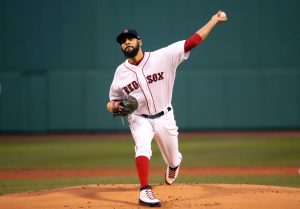 Although still without much playoff success, Price spun his great career and commanding contract-year performance into a massive seven-year, $217MM contract with the Boston Red Sox and bolding stating that he “was just saving all my postseason wins for the Red Sox.” His first year with Boston was rough, with Price posting a then-career worst ERA of 3.99 in 230 innings, a far cry from the 2.90 ERA he had posted during the 2012-2015 seasons. However, Price did make 35 starts, the highest market for a pitcher since Chris Carpenter in 2010. Price then battled with various elbow injuries in the 2017 season, starting the season on the injured list and returning to it in late July before returning in mid-September as a reliever to help the Red Sox’s playoff run. Nevertheless, Price returned relatively healthy in the 2018 season, posting a 16-7 record in 176 innings (30 starts) with roughly career average strikeout and walk rates, 24.5% and 6.9%, respectively, en route to his first World Series ring. Most notably, Price was able to shake off his substandard playoff performance moniker, pitching to a 3.46 ERA in 26 innings (5 starts), striking out 23 and only walking 12 as the Red Sox won the World Series for the fourth time in 15 seasons.
Price once again dealt with injuries in the 2019 season, first with left elbow tendonitis and later with a left wrist triangular fibrocartilage cyst that ended his season early. However, when healthy, Price provided solid back-of-the-rotation support, pitching to a career-high 4.28 ERA in 107 1/3 innings. Importantly, Price began to lose effectiveness against right-handed hitters, with righties slashing .257/.314/.460 for a .773 OPS in 2019 compared to a slash line of .234/.293/.402/.695 in 2019. After the 2019 season, new Chief Baseball Officer Chaim Bloom shocked the baseball world by sending Price and former MVP Mookie Betts to the Los Angeles Dodgers in what was largely considered a cost-cutting move. The trade brought Alex Verdugo, Connor Wong, and Jeter Downs to the Red Sox.
Finally a Dodger, Price opted out of the COVID-shortened 2020 season before returning in a primarily bullpen role for the first time since 2008. He pitched to a palatable 4.03 ERA in 73 2/3 innings, appearing in 39 games. However, he posted a career-low K% of 17.8% as well as a career-high BB% of 8.0% — seeing his average fastball velocity drop to 91.9 MPH. Additionally, while righties continued to square up the ball, posting a combined .270/.330/.432 slash line good for .762 OPS, lefties also began hitting Price, resulting in a .276/.353/.419 slash line with a .772 OPS – a far cry from the .210/.291/.381/.672 slash line Price gave up to lefties in the 2018 season (his last full season).
The 2022 season has been a strong rebound bullpen year for Price, with the southpaw posting a 2.58 ERA in 38 1/3 innings with a 23.3 K% and 5.0 BB%. With the Dodgers recently securing a postseason berth, Price can look to chase one more coveted ring before walking off into the sunset on his terms.
Price retires as a 5-time All-Star, Cy Young winner, and World Series Champion. For a five-to-six-year period, he was among the best pitchers in the sport. MLBTR congratulates him on his excellent run and successes, and wishes him the best in retirement.
Image courtesy of USA Today Sports.
NL West Notes: Gonsolin, Belt, Bryant
Dodgers hurler Tony Gonsolin is continuing to work his way back from a right forearm strain, having been placed on the 15-day injured list on August 29. Gonsolin’s rehab hasn’t moved as quickly as the team had initially hoped, but Jack Harris of the Los Angeles Times relays that he’s responded well to a bullpen session earlier this week. Gonsolin’s role with the Dodgers upon his return is not set in stone, with Gonsolin revealing that he and manager Dave Roberts have discussed “different routes” for his role when he returns.
In his first full season starting, Gonsolin has been nothing short of remarkable, pitching to a 2.49 ERA, 23.7 K%, 7.2 BB% in 128 1/3 innings (23 starts). These impressive numbers propelled him to his first All-Star game, but he has already surpassed his previous max innings pitched, 128, set in 2018. Additionally, after dealing with a forearm strain, it makes sense why the Dodgers may be hesitant in pushing their young, controllable starter before their upcoming playoff run.
Elsewhere around the division…
- Giants stalwart Brandon Belt is entering free agency coming off his third surgery on his right knee, but he told Andrew Baggarly of The Athletic this week that his knee “feels great” roughly two weeks after surgery. Belt says that he feels “like a brand-new person,” while adding that he knows there is “a lot more left in me” and explaining he has already shed his crutches. Belt also added that he has roughly four weeks of rehab before he will be back to normal – plenty of time for a normal offseason preparation. Belt expressed interest in returning to San Francisco but indicated he’d be willing to play elsewhere if the team were “ready to move on.” The 34-year-old did not categorically rule out the idea of retiring, stating that “it needs to be the right situation for me to keep going” and that it doesn’t make sense to “go play for nothing” while stating he wouldn’t accept a minor league contract. Although Belt put forth a disappointing 2022 season, slashing .213/.326/.350 for a .676 OPS, he is less than a year removed from posting back-to-back .900+ OPS seasons and is a career .261/.356/.458 hitter.
- The Rockies have still yet to officially shut down third baseman Kris Bryant for the season. However, there’s still no timetable for Bryant’s return to the field. In a chat with reporters (including The Athletic’s Patrick Mooney) this afternoon, Bryant stated that the Rockies want him “to feel really good going into the offseason” and that he wants an “offseason that’s as close to normal as possible.” With those sentiments, it appears likely that the 30-year-old will not take the field again this season with the Rockies destined to miss the playoffs for the fourth season in a row. Overall, Bryant is in the first year of a seven-year, $182MM contract, but has only appeared in 42 games with the Rockies while being placed on the injured list three times for a strained lower back and plantar fasciitis in his left foot. Nevertheless, when healthy he performed at a high standard, slashing .306/.376/.475 for a .851 OPS, albeit in a hitter-friendly environment.
Dodgers Activate Tommy Kahnle, Designate Heath Hembree
The Dodgers announced they’ve designated reliever Heath Hembree for assignment. The move clears active and 40-man roster space for Tommy Kahnle, who was reinstated from the 60-day injured list.
Hembree signed a minor league deal with L.A. this summer after being let go by the Pirates. He made the big league roster a couple weeks back and went on to make six appearances as a Dodger. Hembree was hit hard, surrendering six runs (five earned) on nine hits and three walks while fanning five. It was the continuation of early-season struggles in Pittsburgh, where he was tagged for a 7.16 ERA with more walks than strikeouts through 16 1/3 innings.
The 33-year-old will hit the waiver wire in the next few days. He has more than enough service time to refuse an outright assignment, so it’s likely he’ll return to the open market if he passes through waivers unclaimed. Hembree is playing this season on a $2.125MM salary after signing with the Pirates during Spring Training. Pittsburgh remains on the hook for the majority of that sum, with the Dodgers only paying him the prorated portion of the $700K league minimum for the few weeks he spent on their roster.
Kahnle is back for the first time in nearly four months. The right-hander landed on the injured list in May due to inflammation in his throwing arm. That came on the heels of 2020-21 seasons almost completely lost to arm issues, including Tommy John surgery. Since the conclusion of the 2019 season, Kahnle has pitched in only five MLB games — one with the Yankees in 2020 and four with Los Angeles this May.
On the bright side, Kahnle averaged a solid 95.3 MPH on his heater and was generating plenty of whiffs on his changeup during his brief look earlier in the year. He’d been an excellent high-leverage arm at times during his stint in the Bronx, making him an intriguing option for manager Dave Roberts as the Dodgers turn their attention to the postseason. Kahnle worked seven innings of three-run ball on a rehab stint with Triple-A Oklahoma City, striking out seven against a pair of free passes.
Dodgers Place Blake Treinen On 15-Day Injured List
The Dodgers have placed right-hander Blake Treinen on the 15-day injured list, retroactive to September 7. Right-hander Andre Jackson has been called up from Triple-A to take Treinen’s spot on the roster.
Treinen is dealing with tightness in his throwing shoulder, which is an ominous diagnosis considering that Treinen has missed most of the season due to shoulder problems. As Treinen told MLB.com’s Juan Toribio and other reporters last week, he was initially advised to get surgery to repair a partial tear in the front capsule of his shoulder, but instead chose a non-surgical recovery option. This allowed the right-hander to make it back for two more appearances after being activated from the 60-day IL, but Treinen has now been sidelined again.
It’s probably safe to assume that Treinen will again try to make it back without going under the knife, especially with the postseason nearing. Whether he’ll be able to return after a minimum 15 days is another question, and it is possible Treinen has already thrown his final pitch of the 2022 season. It might be that surgery is inevitable to fully correct his shoulder issues, and such a procedure might now potentially threaten his readiness for at least the start of the 2023 season.
In the midst of his IL stint, Treinen and the Dodgers agreed to a contract extension back in May that guaranteed his 2023 salary at $8MM, which was the total of a club option Los Angeles already held on his services. Another club option for 2024 was also added, worth between $1MM-$7MM depending on Treinen’s health and other benchmarks. With Treinen still plagued with shoulder problems, this extension might already look like a misfire on the Dodgers’ part, especially if he ends up having to miss a portion of the 2023 season. While $8MM isn’t a huge amount to a big-payroll team like L.A., that number could certainly impact the luxury tax number for a club that figures to be in tax territory once again next year.
Edwin Jackson Announces Retirement
Former All-Star Edwin Jackson took to Instagram this evening to officially announce his retirement from Major League Baseball. The right-hander pitched parts of 17 seasons in the majors, getting to the highest level every year between 2003-19. Jackson suited up for 14 different MLB teams, setting the all-time record for most uniforms donned.
“19 years ago today I was blessed with an opportunity to tie up my laces and step on the field to make my debut with the Los Angeles Dodgers,” Jackson wrote. “Today I am happily hanging up my cleats and closing a 22-year baseball career.” Jackson went on to thank his wife, parents, sisters, children and the rest of his family before expressing his gratitude to various coaches, trainers and doctors who assisted him. “This game has taught me many life lessons and allowed me to evolve into the person I am today! I will forever have memories that will live within me from the game I love and dedicated my life to. Thank you baseball for an amazing life experience I will never forget,” he concluded.
A sixth-round draftee of the Dodgers out of a Georgia high school in 2001, Jackson emerged as one of the sport’s best pitching prospects not long thereafter. He broke into the big leagues exactly 19 years ago on his 20th birthday, starting three of four appearances down the stretch. He bounced on and off Los Angeles’ active roster for the next couple seasons before being traded to the then-Devil Rays over the 2005-06 offseason.
Jackson worked primarily as a reliever for his first season in Tampa Bay, but he took a full turn of starts by the 2007 campaign. That kicked off a stretch of seven consecutive seasons in which he surpassed 30 starts and 160 innings. Jackson pitched in Tampa Bay through 2008 before being dealt to the Tigers for outfielder Matt Joyce. He tossed a career-best 214 innings the next year, posting a 3.62 ERA. Jackson earned an All-Star nod with a 2.52 mark through that season’s first half.
The next offseason, his nomadic career continued. Detroit flipped Jackson to the Diamondbacks as part of a three-team blockbuster that netted Detroit Max Scherzer and sent Curtis Granderson to the Yankees. His stint in the desert was rather brief — he’d wind up traded again at that summer’s deadline — but it provided one of the more memorable moments of his career. On June 25, 2010, he tossed a no-hitter against his former team at Tropicana Field. He threw a staggering 149 pitches in the outing, striking out six but issuing eight walks. Then-manager A.J. Hinch stuck with Jackson despite his high pitch count, and he completed one of the more remarkable single-game performances by a player in recent memory.
Not long after, the last-place club dealt Jackson to the White Sox in a trade that landed Arizona Daniel Hudson. Jackson pitched well in 11 starts down the stretch, and he got off to another solid start in 2011. The White Sox fell out of contention the latter season, though, and he was on the move again. The Blue Jays acquired Jackson from the White Sox on the morning of July 27, but his stint in Toronto lasted only a few hours. Toronto promptly flipped him to the Cardinals in a deal that sent Colby Rasmus north of the border.
Jackson played in St. Louis for the second half, pitching to a 3.58 ERA through 12 starts. He made four starts in the postseason, and while his playoff numbers weren’t great, the Cardinals secured the World Series title in a dramatic series win over the Rangers. Fresh off winning a title, Jackson signed with the Nationals during his first trip through free agency. He spent the 2012 campaign in the Nats rotation, helping Washington to their first playoff appearance since moving to D.C.
The next winter, Jackson inked a four-year, $52MM pact with the Cubs. He continued to soak up innings but didn’t post especially strong numbers in Chicago. After two and a half seasons, he was released. That kicked off an even more rapid trip around the league, as Jackson suited up with the Braves, Marlins, Padres, Orioles, Nationals (again), A’s, Blue Jays and Tigers (again) over the next four years. He alternated between the rotation and the bullpen throughout that time, generally serving as a depth option.
While Jackson signed a minor league deal with the Diamondbacks in 2020, he didn’t make it back to the majors. He did appear on the U.S. Olympic team last summer and expressed a desire to get back to the big leagues, but he didn’t get another opportunity with an affiliated organization.
Altogether, Jackson pitched in 412 major league games. He tossed 1960 innings with a 4.78 ERA, striking out a bit more than 1500 batters and winning 107 games. According to Baseball Reference, Jackson banked upwards of $66MM in earnings and incredibly logged some action for almost half the league. MLBTR congratulates Jackson on his lengthy, accomplished career and wishes him all the best in retirement.
The Dodgers’ Latest Free Agent Breakout
Each offseason, the Dodgers are mentioned as at least a speculative favorite for seemingly every top-tier free agent. They’re willing to pursue elite players even in the absence of a true positional need, and they annually sport one of the league’s highest payrolls. This winter should be no exception, with headlines eventually linking the Dodgers to the best free agent shortstops, including their own impending free agent Trea Turner, and top-of-the-market starting pitching.
Los Angeles doesn’t just pursue established superstars in the Freddie Freeman mold, though. President of baseball operations Andrew Friedman, general manager Brandon Gomes and the rest of the front office also leverage their payroll flexibility in another way. While it’s not as visible or exciting, the Dodgers roll the dice on plenty of mid-tier free agents. They signed nine players to major league deals last offseason alone, seven of whom inked a one-year guarantee. It was a blend of high-upside players who carried injury or performance risks with more stable, lower-variance veterans to round out the roster.
Tyler Anderson seemed to fall into the latter bucket. He’s been a durable back-of-the-rotation arm for much of his career. Anderson lost chunks of the 2017 and ’19 seasons with left knee issues, but he started a full slate of 32 games in 2018 and hasn’t gone on the injured list at any point in the past three years. That kind of reliability appealed to a Dodgers team that opened the season with Dustin May on the IL, Clayton Kershaw coming off a season-ending arm issue and Andrew Heaney (another lower-tier free agent pickup) seeking a rebound after a dismal 2021 campaign.
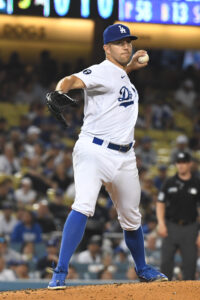
Reliable as he was in taking the ball every fifth day, Anderson didn’t look like a potential impact arm. He’d only once posted an ERA below 4.00 in a season, and that was in his 2016 rookie campaign. The southpaw had the tough task of pitching his home games at Coors Field for his first four years, but he also had mixed results in a 2021 season split between two more pitcher-friendly settings. Anderson played the year with the Pirates and Mariners, combining for a 4.53 ERA over 167 innings. A nine-run clunker during his third-to-last start of the season inflated that number, but he carried an ERA hovering around 4.00 for much of the season.
Featuring a fastball that averages under 91 MPH, Anderson looked the part of a back-end arm who throws strikes and keeps teams in a ballgame for five innings. That netted him an $8MM guarantee from L.A. in Spring Training. That would’ve been a generally worthwhile investment if Anderson had merely replicated his 2021 numbers over another full season. Instead, he’s posted easily the best showing of his career to date.
Through 26 appearances, the former first-round pick has worked 154 2/3 innings of 2.73 ERA ball. He’s neither striking batters out nor generating ground-balls at a particularly robust clip, with his respective 19% and 39.7% rates each checking in below the league averages. Yet Anderson has improved upon the aspect of his game in which he’d already been most effective: getting opponents to offer at pitcher’s pitches.
Despite not having eye-popping raw stuff, Anderson has always been adept at inducing chases on pitches outside the strike zone. Opponents went after 37.2% of offerings he threw outside the zone last season, well above the 31.5% league average for starters. He’s pushed that already impressive rate further, getting hitters to chase a personal-high 38.9% of pitches this year.
That ability to get hitters to swing at bad pitches drives two key aspects of Anderson’s success. It’s helped him avoid free passes, with this season’s 4.9% walk rate among the best in the game. Anderson has always been adept at pounding the strike zone, and his combination of plenty of pitches within the zone and ability to get hitters to swing at would-be balls keeps him frequently in advantageous counts. It’s also worked to avoid especially damaging contact, with opponents having a hard time squaring him up. Anderson ranks among the league’s top starters in suppressing hard contact, thus far allowing him to avoid home run issues that have plagued him in the past.
The Dodgers have already received more than they could’ve expected from a reasonably low-cost acquisition. He could have a hard time cracking a playoff rotation that’ll certainly feature Julio Urías, Kershaw, May and (if healthy) Tony Gonsolin, but he’s likely to be on the mound for some high-leverage innings this October in some capacity. Anderson also looks to have set himself up for a better payday on his return trip to the open market, although how robust the interest will be depends on how much teams buy into his ability to sustain this year’s elite results.
His lack of premium velocity or swing-and-miss stuff gives him a thin margin for error. Even modest regression in his ability to induce bad swing decisions could lead to results more akin to a back-of-the-rotation arm than this year’s All-Star form. After all, it’s not as if Anderson’s success has come completely out of the blue. He’d already been above-average at getting batters to chase and make weak contact in seasons where his overall output was roughly league average.
The 32-year-old has made tweaks to his repertoire this year that probably helped push his game forward. He’s taken some speed off his changeup, which is getting more downward depth. Batters are swinging through it more often as a result, and given the alterations to his changeup, it’s probably not a coincidence he’s faring better than ever against right-handed batters. That’s a promising improvement, but like the other gains he’s made this season, it’s a rather subtle one.
Put all the changes together, and Anderson looks as if he’s better now than he has been. Is he a true talent 2.73 ERA pitcher who’ll be an annual All-Star? Probably not. His future level likely falls somewhere in between this year’s outstanding numbers and the pedestrian 4.49 mark he posted from 2020-21. Yet even if Anderson allows around three and a half to four earned runs per nine innings moving forward, he’s a valuable pitcher — particularly if he can continue to stay healthy and take the ball every fifth day.
As MLBTR’s Mark Polishuk noted last month, the Dodgers will have to at least consider the possibility of tagging Anderson with a qualifying offer this offseason. It still seems they’d opt against making an offer that, in recent seasons, has sat in the $18-19MM range, but that it’s even a worthwhile consideration is a testament to his strong year. At the very least, Anderson looks to have pitched his way into the first multi-year contract of his career when he returns to free agency.
Image courtesy of USA Today Sports.
Injury Notes: Carpenter, Gonsolin, Kopech, Lowe
The miraculous Matt Carpenter comeback was put on pause last month when the infielder/outfielder for the Yankees fractured his foot. On August 10, it was reported that he would need surgery and be reevaluated in a month, with the club hopeful he could return in 6-8 weeks. Here we are almost a month later and Carpenter has made progress but not much. Bryan Hoch of MLB.com reports that Carpenter underwent some X-rays that showed healing but it isn’t enough to get him out of his protective walking boot. He’ll be reevaluated again in 10-14 days, says manager Aaron Boone.
That essentially eliminates any chance of Carpenter returning at the short end of that 6-8 time frame and even puts the longer end of it in doubt. By the time that next evaluation rolls around, it will already have been six weeks since the injury. Even if Carpenter gets good news at that point, he will surely need some kind of rehab assignment to get him back into game shape after such a long layoff. That could also be a challenge if the injury lingers, as most minor league teams will be winding down their seasons in the coming weeks. The Triple-A Scranton/Wilkes-Barre RailRiders are the Yankee affiliate that goes the latest, though their last scheduled game is September 28, three weeks from today.
Prior to the injury, Carpenter was on an absolute tear, hitting 15 home runs in 47 games and slashing .305/.412/.727 for a wRC+ of 218. It’s all the more remarkable given that Carpenter was hitting at a below-average rate in the previous three seasons. The club has seemingly missed that hot bat, going 10-13 since August 10. They have a 4 1/2 game lead over the Rays and a six game cushion on the Blue Jays in the AL East race.
Some other tidbits from around the league…
- Dodgers righty Tony Gonsolin was placed on the IL due to a forearm strain August 29, but since the move was retroactive to August 26, he’s eligible to come off in a few days. Gonsolin has been playing catch in recent days, which is perhaps a sign that he’s not far from returning. However, it’s not all good news, with Juan Toribio of MLB.com relaying word from manager Dave Roberts that Gonsolin isn’t progressing as quickly as they initially hoped for. The Dodgers are virtually guaranteed a bye through the first round of the playoffs and can take their time with Gonsolin, though it’s at least noteworthy that the plan isn’t on schedule so far. The righty had enjoyed a tremendous breakout season, throwing 128 1/3 innings with a 2.10 ERA, 23.7% strikeout rate, 7.2% walk rate and 43.2% groundball rate.
- White Sox righty Michael Kopech landed on the IL August 23 due to a knee strain but was activated today after a minimum stint. After missing all of 2019 and 2020, Kopech threw 69 1/3 innings last year and has already jumped up to 110 2/3 here in 2022, coming into today’s action. He’s fared well overall on the season, registering a 3.58 ERA, though his 21.4% strikeout rate and 12% are both a bit worse than league average, with a .228 BABIP likely helping him keep that ERA down. The club will be looking for a strong finish from Kopech and the team overall, as they are currently three games back of the Guardians in the Central and 7 1/2 out of a Wild Card spot.
- The Rays have reinstated infielder Brandon Lowe from the IL, per Marc Topkin of the Tampa Bay Times. Lowe landed on the shelf due to a right triceps contusion but has now returned after a minimum stay. It was the second IL stint of the year for Lowe, who also missed about two months due to a back issue. Despite the multiple ailments, he’s still hitting .234/.319/.405 on the season for a wRC+ of 114. That’s a bit of a drop-off from his previous seasons but still 14% above league average. Tampa is in the thick of all the American League action, sitting 4 1/2 games behind the Yankees in the East while grappling with the Mariners and Blue Jays for the top Wild Card spot.