
Should The Cardinals Shop Dustin May?
The 2026 Cardinals committed to a youth movement in an offseason defined by trades of veteran players. They dramatically cut payroll and mostly sat out free agency, spending a total of $18MM via four one-year contracts.
More than two-thirds of that money went to Dustin May, whom the Cardinals picked up on a $12.5MM deal. He’s making a $12MM salary and will collect a $500K buyout when his $20MM mutual option is declined at the end of the season. The reclamation flier has worked out pretty well, as May takes a 4.30 ERA with solid underlying numbers into tonight’s start at Truist Park.
May struggled in the season’s first month but has been the team’s best starter since then. He owns a 3.74 ERA while striking out 26% of opponents over his past nine starts. A nine-strikeout, one-hit shutout against a bad San Diego offense was the highlight, but he has pitched well enough in all but three appearances. May has nine quality starts in 15 games, one shy of last year’s total across 23 outings.
Derrick Goold of The St. Louis Post-Dispatch chatted with May on Tuesday about some of his offseason adjustments. The righty has raised his arm angle back to where it was earlier in his career, as it had dipped on the heels of multiple injuries. He’s mixing in a few more four-seam fastballs and cutters after he’d gotten very reliant on his sinker/sweeper pairing last year. It hasn’t suddenly turned May into an ace — he has a league average 22.5% strikeout rate and gives up a decent amount of hard contact — but he’s pitching like someone who could start the third or fourth game of a playoff series.
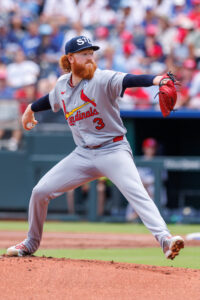
Will that opportunity come with the Cardinals? St. Louis surely hoped when they signed May that’d he pitch well enough to be a deadline trade chip in a year where they’re focused mostly on the development of young players. They’ve played better than anticipated and hold a 44-39 record more than halfway through the schedule. Milwaukee appears to be pulling away in the NL Central again, but a Wild Card berth is a clear possibility. The Cards currently hold the Senior Circuit’s final playoff spot with a percentage-point advantage over the Marlins.
President of baseball operations Chaim Bloom said last fall that the organization would prioritize the future if they need “to choose between short-term gratification and our bigger goal of contending consistently.” They’ve mostly stuck to that messaging this summer without abandoning hope of competing.
“Obviously, I sat here in the fall and I’ve said it a number of times since, that we have pretty ambitious goals,” Bloom said last week (link Brenden Schaeffer of MLB.com). “We want to make sure that we have a good plan to get there and that we don’t get distracted from the things that need to happen in order for us to reach those goals.”
Chairman Bill DeWitt Jr. downplayed the possibility of making a big splash on the trade front. “When the trading deadline comes up, teams have a tendency to [think] ‘Well, if I get one more guy, I’ll give them two (prospects), then I can make the playoffs.’ That’s kind of not our model,” DeWitt said last week. “We’ll obviously engage at the deadline, but it will not be for a two-month hopeful.”
That’s not the messaging of a team that expects to be in the Tarik Skubal bidding, but it doesn’t mean they’ll sell either. They could stand pat or make modest additions (e.g. middle relief) without surrendering significant prospect capital. Goold writes that the Cardinals are still expected to field interest on May, but that’s typical operating procedure for any bubble team. Their motivation to move him, or lack thereof, will obviously depend on their place in the standings a month from now and what kind of offers are on the table.
MLBTR’s Steve Adams examined the prospect value that the Cardinals could expect for May in a mailbag for Trade Rumors Front Office subscribers last week. If they don’t trade him, they’d need to weigh whether they’re interested in a multi-year extension and/or issuing an approximate $23.1MM qualifying offer.
There’s a chance May would accept a QO and lock in a nearly doubled salary for his age-29 season, though that’ll hinge on how he finishes out the season. St. Louis doesn’t have much on the 2027 books, but ownership has significantly pulled back spending since their local broadcast deal collapsed. MLBTR contributor Ethan Hullihen estimates the Cardinals’ 2026 payroll to be around $104MM, putting them in a similar range as the Twins and Pirates. If that’s going to remain their spending range, the front office may not want to risk tying up more than 20% of the payroll in a qualifying offer for May.
The Cardinals have managed to keep their starters remarkably healthy for the past two seasons. They got through the 2025 season with essentially six starters. It has been a five-man group for basically all of this year. Hunter Dobbins has made two spot starts. It has otherwise been their regular rotation of May, Matthew Liberatore, Andre Pallante, Michael McGreevy and Kyle Leahy.
May had some lower back tightness that led them to skip his most recent turn. A postponement meant they could stay on their five-man schedule. It’s a middling rotation overall, but they could swap in Dobbins if they trade May and everyone else stays healthy. Dobbins is a ground-ball specialist who has a 4.02 ERA in 78 1/3 career innings. It’s a similar profile to the rest of the St. Louis staff, which doesn’t miss bats yet plays well in front of one of the game’s best middle infield tandems in Masyn Winn and JJ Wetherholt.
Maybe the next month will make this decision easy for the front office. It’s a tougher call if they’re still holding the final playoff spot or just a game or two off the pace. If their place in the standings doesn’t change dramatically between now and August 3, how should the Cardinals approach this?
What should the Cardinals do with Dustin May?
-
Take the best trade offer available. 63% (1,466)
-
Listen to offers but only trade him for an overwhelming return. 28% (639)
-
Hold him and make a qualifying offer. 6% (148)
-
Hold him and let him test free agency without the QO. 3% (62)
Total votes: 2,315
Image courtesy of William Purnell, Imagn Images
Dustin May Is Boosting His Free Agent Stock
On Monday night at Busch Stadium, Dustin May made the most impressive start of his major league career. The right-hander was perfect through six and finished with a one-hit, one-walk shutout. He threw 101 pitches. He struck out nine. If it weren’t for Jacob Misiorowski’s 15-strikeout tour de force last Friday, this might have been the best-pitched game of the season.
With that gem, May brought his ERA under 4.00 and moved into the NL’s top 10 in quality starts and FanGraphs WAR. He owns a 3.38 xERA and a 3.75 SIERA. Only two qualified pitchers in either league have a lower home run rate, a lower walk rate, and a higher strikeout rate this season: Cam Schlittler and Cristopher Sánchez.
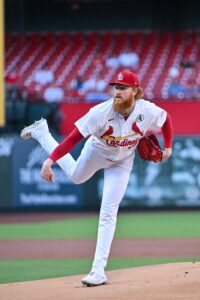
A shutout will juice anyone’s numbers, and not everything May is doing right now is sustainable. His home run-to-fly-ball ratio won’t stay so low forever. It’s currently less than half his rate from 2019-25. At the same time, his BABIP is significantly higher than his career average, while his strand rate is markedly lower. That means he’s run into some bad luck to balance out his good fortune. The result is a matching 3.75 ERA and SIERA. Baseball Prospectus agrees that his “deserved ERA” is 3.77, while the ZiPS projection system forecasts a 3.78 mark for him over the rest of the season. The PitchingBot model suggests the quality of his arsenal translates to 3.85 earned runs per nine. All of those metrics use disparate methods to reach their conclusions, but when it comes to May, they end up at the same one: He has earned his success so far in 2026.
May was an honorable mention on MLBTR’s last Top 50 Free Agents ranking. The $12.5MM guarantee he secured from the Cardinals was surprisingly high to some, but it wasn’t a mistake to leave him off the top 50; in terms of total salary, his contract was the 51st largest of the offseason. This winter, May could be much higher on the list. Not only is he healthy and pitching well, but the 2026-27 free agent class is notably thin. It’s so thin that Michael Soroka was one of five players who just missed the top 10 on MLBTR’s latest Free Agent Power Rankings.
Soroka isn’t just catching strays here. I bring him up because he’s a shockingly apt comparison for May. Watch them pitch this year, and you won’t see many similarities between the two. May leads with a sinker that touches 99 against righties and a four-seam that touches 99 against lefties. Soroka’s max velocity is three ticks slower, and his primary pitch is an 80-mph slurve. Yet, the two right-handers, born 33 days apart in 1997, are more alike than you might realize.
Their stories are two chapters from the same book. Once star prospects, May and Soroka lived up to the hype in their debut seasons, only for a series of injuries to derail their careers. Finally, in 2025, they both made double-digit starts for the first time since their rookie campaigns. They proceeded to sign one-year contracts (with mutual options for 2027) in free agency. Here are the career numbers through 2025 that earned them those deals:
- 3.86 ERA, 4.25 SIERA, 21.9% K rate, 8.3% BB rate, 46.6% GB rate
- 3.85 ERA, 4.29 SIERA, 21.8% K rate, 8.0% BB rate, 47.1% GB rate
The first bullet point is May, and the second is Soroka, but I left them unlabelled to drive home the message. For all intents and purposes, the stats are identical. Soroka has thrown more innings in his career, but May has thrown more recently. And on a per-inning basis, these two were pretty much the same pitcher for the first six seasons of their respective careers.
Through their first 14 starts in 2026, May ranks ninth in the National League in FanGraphs WAR. Soroka is one spot ahead, with a lead so small that a rounding error could wipe it out. Soroka has the better ERA, but May has the edge in xERA. Soroka has the lower walk rate, but May has induced more ground balls. SIERA favors Soroka, but most of the major pitch models prefer what May brings to the table. ZiPS projects nearly identical performance from each of them for the rest of the season.
So, if Soroka is on track to be one of next winter’s top 20 free agents, May belongs in that conversation as well. Soroka is a bigger name, thanks to the All-Star appearance, Rookie of the Year runner-up finish, and down-ballot Cy Young votes on his resume. All of that is impressive, but all of that was seven years ago. If either of these two still has an All-Star ceiling, it might be May instead. He throws harder and boasts an even deeper arsenal, with six pitches that he throws at least 5% of the time. In 2026, only three starting pitchers (min. 50 IP) have thrown six different pitches at least that often with an average fastball harder than May’s: Dylan Cease, Sandy Alcantara, and Eury Pérez. There’s more to being an ace than high velocity and a diverse pitch mix, and Pérez is all the proof you need. Nonetheless, those are valuable traits – perhaps even valuable enough to engender a bidding war among teams that think they can get the most out of them. Just last winter, the Blue Jays gave Cease $210MM because they saw the blueprint for a more consistent ace. So far, it’s looking like they were right. May won’t command anything close to nine figures, but that only increases the number of teams that might be interested in his services.
It’s far too soon to start writing May’s blurb for the top 50 list. When the last Free Agent Power Rankings came out, he still had a 4.59 ERA. That was less than two weeks ago. Things can change quickly. May also has to stay healthy, which is far from a given. This is a pitcher who has already torn his UCL twice. The elbow neuritis he suffered last September proved to be minor, and the esophageal tear that ended his 2024 season had nothing to do with baseball activities. Still, he has never topped 24 starts or 150 innings in a season, at the major or minor league level. But this could be the year that changes.
All he needs to do is stay on the field and keep pitching the way he has. If he can pull that off, Dustin May will be a name to watch this winter. That might be an indication of a weak free agent class, but it would also be a huge accomplishment for a pitcher who has dealt with more than his fair share of setbacks. With every start he makes in 2026, May can boost his free agent stock.
Images courtesy of Jeff Curry, Imagn Images.
2026-27 Club Options: NL Central
In recent weeks, MLBTR has looked forward to next winter’s option classes. We’ll move now to the NL Central, where the Cubs have a number of low-cost options to weigh.
Previous: AL East, AL Central, AL West, NL East
Chicago Cubs
- Matthew Boyd, LHP: $15MM mutual option ($2MM buyout)
Mutual options are essentially never exercised, so Boyd will be paid the $2MM buyout and return to free agency next winter. That’ll conclude a two-year, $29MM free agent deal that worked out well. Boyd’s 3.21 ERA over 31 starts a year ago essentially paid for the contract on its own.
The second season isn’t going as planned. Boyd missed a couple weeks in April with a biceps strain and suffered a more significant meniscus injury in his left knee earlier this month. He underwent surgery that’ll keep him out into late June at the earliest. The Cubs probably aren’t keen on their end of the option.
- Hunter Harvey, RHP: $8MM mutual option ($1MM buyout)
Chicago added Harvey on a one-year, $6MM deal in December. The talented but oft-injured reliever only pitched four times before landing on the injured list with triceps inflammation. Further testing this month revealed a stress reaction that’ll keep him down for a while. This will be an easy pass for the team.
- Carson Kelly, C: $7.5MM mutual option ($1.5MM buyout)
Kelly has outperformed his two-year, $11.5MM deal signed in December 2024. Initially brought in as a veteran complement to Miguel Amaya, the 31-year-old Kelly has earned the majority of the playing time. He’s a .261/.344/.421 hitter with 19 homers over his season-plus in Chicago. He’s fourth among primary catchers this season with a .381 on-base percentage. Kelly has a strong case for another two-year contract at a better annual rate than the option price, so his camp should have an easy time passing.
- Colin Rea, RHP: $7.5MM club option ($1MM buyout)
Rea, a 35-year-old swingman, is in the second season of his second stint with the Cubs. He’s clearly a favorite of skipper Craig Counsell, who also managed him in Milwaukee in 2021 and ’23. Rea pitched pretty well last season, managing a sub-4.00 ERA while starting 27 of 32 games. The Cubs had a $6MM team option for 2026, but the sides agreed to a restructured extension that guaranteed Rea $6.5MM in exchange for the righty tacking on a similarly priced club option for 2027.
Injuries again quickly pushed Rea from long relief into a back-end rotation spot. He hasn’t performed as well as he did last season, allowing nearly five earned per nine across 47 frames. Rea had consecutive quality starts against the Phillies in mid-April but has surrendered a 7.04 ERA over his past five times out.
Rea’s strikeout, walk and home run rates are all virtually identical to last season’s. There haven’t been any meaningful changes to his pitch mix or velocity. He’s essentially the same pitcher, with this year’s ERA spike mostly due to a higher average on balls in play. That’s always a risk for a pitcher like Rea who pounds the strike zone but doesn’t have overpowering stuff.
The Cubs will presumably look for a rotation upgrade or two in July that can push him back into a relief role. A buyout seems likelier than them picking up the option, though it wouldn’t be a surprise if they try to bring him back a slightly lower price given his flexibility in usage.
- Caleb Thielbar, LHP: $6MM mutual option ($500K buyout)
Chicago brought back Thilebar on a $4.5MM deal after he worked 58 innings of 2.64 ERA ball in 2025. The southpaw is making $4MM this year and will earn a $500K buyout at season’s end. He missed just under a month with a left hamstring strain and has been limited to 12 appearances. Thilebar has recorded 11 punchouts while allowing four runs (three earned) across 9 2/3 innings. The Cubs will probably pass on their end but could have interest in keeping Thielbar around for his age-40 season at slightly less money.
- Jacob Webb, RHP: $2.5MM club option (no buyout)
The Rangers surprisingly non-tendered Webb after he turned in 66 innings with an even 3.00 earned run average. Chicago signed him to a $1.5MM free agent deal that includes a $2.5MM team option for 2027. The righty has been a nice addition to Counsell’s middle relief corps, striking out a quarter of opponents with a 3.05 ERA over 20 2/3 innings. He’s getting swinging strikes and chases off the plate at career-best rates.
Webb has allowed right around three earned runs per nine in three straight seasons. His market has never really materialized, but a $2.5MM option is cheap enough that the Cubs would very likely bring him back if he keeps this pace all year.
The Cubs hold a $3.3MM club option on RHP Javier Assad. He’ll remain eligible for arbitration through at least 2028 even if the option is declined.
Cincinnati Reds
- Pierce Johnson, RHP: $8MM mutual option ($1.5MM buyout)
Cincinnati picked up Johnson on a one-year, $6.5MM deal after the Braves bought him out. The veteran righty has allowed eight runs over 19 1/3 innings with league average strikeout and walk numbers. His 9.3% swinging strike rate is a career low. Johnson is an MLB-caliber arm but more of a middle reliever than a setup man at age 35. An $8MM option price is too rich on the Reds’ end.
- Eugenio Suárez, DH/3B: $16MM mutual option
Cincinnati brought Suárez back on a one-year, $15MM deal late in the winter. It looked like a nice bargain pickup for a team that needed offense. Suárez’s age evidently tamped down long-term interest, but he hit 49 home runs a year ago. The return has started slowly, as he hit .231/.300/.363 through 100 plate appearances before sustaining a left oblique strain that sent him to the injured list. He began a rehab assignment with Triple-A Louisville yesterday.
The Reds will also pay a $3MM buyout to released infielder Jeimer Candelario.
Milwaukee Brewers
- Luis Rengifo, 3B: $10MM mutual option ($1.5MM buyout)
Milwaukee bought low on Rengifo with a $3.5MM deal in Spring Training. He’s making a $2MM salary and due a $1.5MM buyout on a $10MM mutual option. They haven’t gotten anything close to the desired bounce back. The switch-hitting utilityman carries a .199/.262/.257 line without a home run over 150 plate appearances. Third base feels like a priority for the Brewers at the deadline, at which point they could move on from Rengifo entirely.
- Gary Sánchez, C: Mutual option
The terms of Sánchez’s mutual option were never reported. He signed a $1.75MM guarantee to return to Milwaukee as a backup catcher/part-time DH. Although Sánchez is only hitting .198, he has walked 20 times and hit five home runs in 108 plate appearances. The Brewers will eventually want a look at prospect Jeferson Quero, but William Contreras will be an offseason trade candidate with free agency looming after 2027. They could look to keep Sánchez around as a cheap #2 catcher.
Milwaukee holds a $14.5MM club option on C William Contreras for his final season of arbitration. He’ll remain under team control if Milwaukee declines.
Pittsburgh Pirates
- Marcell Ozuna, DH: $16MM mutual option ($1.5MM buyout)
Pittsburgh added Ozuna late in the offseason on a $12MM deal. It didn’t make much sense at the time since it locked all of Ryan O’Hearn, Brandon Lowe and Spencer Horwitz into defensive spots without a fallback at designated hitter. Ozuna was also coming off a mediocre second half and playing in one of the toughest home parks for right-handed power.
Ozuna had an atrocious April. He’s at least drawing a lot of walks in May, but his season .179/.275/.305 line isn’t cutting it. It goes without saying that the Pirates aren’t exercising a $16MM option. The bigger question is whether they’ll keep Ozuna on the roster all year.
St. Louis Cardinals
- Dustin May, RHP: $20MM mutual option ($500K buyout)
May commanded a surprisingly strong $12.5MM guarantee despite coming off a 4.96 ERA season between the Dodgers and Red Sox. He’s making a $12MM salary and will collect a $500K buyout on the $20MM mutual option at season’s end. May has stayed healthy and taken all nine turns through the rotation, but he’ll take a 4.81 ERA into today’s start against the Pirates. His strikeout and whiff rates are well below average despite his 97 mph fastball. While May’s power stuff and early-career success have continued to intrigue teams, the recent performance has been that of a fifth starter. The Cardinals aren’t signing up for a $20MM option.
- Ryne Stanek, RHP: $6MM club option (no buyout)
St. Louis added the hard-throwing Stanek on a $3.5MM deal in January. They wanted an experienced leverage arm who could compete for the closing role and potentially be a midseason trade asset. Riley O’Brien seized the ninth inning, leaving Stanek alongside JoJo Romero and George Soriano in the setup group.
Stanek continues to sit around 98 mph and generate above-average strikeout and whiff rates. His already problematic control has pushed even further, though, and he’s walking nearly 18% of opposing hitters. It’s the third-highest mark among pitchers with at least 20 innings. The free passes have resulted in a 6.30 ERA over 23 appearances. Teams are inclined to bet on pitchers with this kind of stuff, but Stanek will need a better second half to convince the Cardinals (or a potential midseason trade partner) to bring him back for $6MM.
- Ramón Urías, 3B: $4MM mutual option ($500K buyout)
St. Louis added Urías on a $2MM free agent deal during Spring Training. He’s making $1.5MM in salary and will be paid a $500K buyout. Urías limped to a .158/.279/.316 start over 25 games before landing on the injured list with tennis elbow.
Cardinals Outright Matt Koperniak
December 19th: The Cards announced that Koperniak has cleared waivers and been sent outright to Triple-A Memphis.
December 17th: The Cardinals announced that outfielder Matt Koperniak has been designated for assignment. That’s the corresponding 40-man move for right-hander Dustin May, whose signing is now official.
Koperniak, 28 in February, has been with the Cards since signing with them as an undrafted free agent in 2020. From 2021 to 2023, he produced pretty solid results as he climbed the minor league ladder. Across those three seasons, he stepped to the plate 1,399 times. His 10.1% walk rate and 16.1% strikeout rate were both solid figures. He produced a combined line of .293/.375/.441, which translated to a wRC of 112, indicating he was 12% better than league average at the plate.
He seemed to find a new gear in 2024, his first full season at Triple-A. He hit 20 homers and slashed .309/.370/.512 for a 128 wRC+. That may have been a bit fluky, as he got some help from a .351 batting average on balls in play, but the Cards seemed to believe in him. They added him to the 40-man roster in November of that year to keep Koperniak out of the Rule 5 draft.
He spent 2025 back at Triple-A on optional assignment and his results backed up. His home run tally dropped to 14, despite taking 23 extra plate appearances. His BABIP dropped to a more average-ish .283. He finished the season with a .246/.317/.382 line and 85 wRC+.
The Cards are rebuilding and will be giving playing time to younger players in 2026 but Koperniak wouldn’t have been at the front of the line after that performance. He’s instead been bumped off the roster and into DFA limbo. The Cards will now see if there’s any trade interest in him. If not, he’ll be put on waivers. He does still have a couple of options remaining and is considered a strong defensive outfielder, with experience at all three spots. If some club out there likes him, they could acquire him and keep in Triple-A as depth as they hope for a bounceback at the plate.
Photo courtesy of Sam Navarro, Imagn Images
Cardinals Sign Dustin May
December 17th: The Cards officially announced May’s signing today. May will make $12.5MM in 2026 and the mutual option is worth $20MM, per Passan. It’s a $12MM salary and a $500K buyout on the option, per Jeff Jones of the Belleville News-Democrat.
December 13th: The Cardinals are expected to sign right-hander Dustin May, reports Jeff Passan of ESPN. It’s a one-year deal with a mutual option for 2027. May spent last season split between the Dodgers and Red Sox.
May was sent to Boston at the trade deadline for James Tibbs and Zach Ehrhard. After scuffling through 19 appearances with L.A., he battled injuries and poor performance with the Red Sox. May set career highs in innings (132 1/3) and games (25) last season, but posted an unsightly 4.96 ERA with an xFIP and SIERA in the mid-4.00s.
St. Louis was in desperate need of rotation depth after trading Sonny Gray to Boston and watching Miles Mikolas hit free agency. The club also lost swingman Steven Matz, who signed with Tampa Bay. May is set to join holdovers Andre Pallante and Michael McGreevy in the rotation. May’s former teammate on the Red Sox, Richard Fitts, will likely be in the mix after coming over in the Gray trade. The Cardinals are considering converting Kyle Leahy into a starter to round out the staff.
The Dodgers spent a third-round pick on May in 2016. He emerged as one of the top pitching prospects in a system typically stocked with elite arms. May made his MLB debut in 2019, working largely out of the bullpen. He spent the majority of the shortened 2020 campaign in the rotation, making 10 starts. It would be the only time he would reach double-digit starts until this past season. Injuries capped May to just 20 games from 2021 to 2023. He missed all of 2024 due to flexor tendon surgery.
May stayed healthy for the first time in 2025, making 19 appearances for the Dodgers. He stumbled to a 4.85 ERA over 104 innings. Despite the performance, May still netted LA an intriguing prospect in Tibbs, a first-round pick in 2024 (by San Francisco). The veteran righty made just six appearances with the Red Sox before right elbow neuritis cut his season short.
The Cardinals are betting on May pairing the flashes of solid production he’s shown in prior seasons with the improved health from 2025. The 28-year-old recorded a sub-3.00 ERA in 2020, 2022, and 2023, albeit in abbreviated campaigns. While he did go down with the elbow issue in September, he still destroyed his previous career bests in terms of workload. May had totaled 101 innings over four seasons before putting up 132 1/3 frames last year. It was the first time in his six-year career that May showed the ability to stay on the mound for any kind of extended stretch.
May has a perplexing pitching profile. He has a GIF-worthy arsenal headlined by a high-spin sweeper and a fastball in the mid to upper-90s. Oddly, the repertoire hasn’t generated whiffs or strikeouts for much of his career. May spiked a 37.6% strikeout rate over five games in 2021, but he’s been at best an average strikeout pitcher in every other season. He posted a middling 21.1% mark between L.A. and Boston last year. May has a modest 8.8% swinging-strike rate for his career. None of his five pitches has a standout whiff rate.
Jon Heyman of the New York Post was first to report that the contract was for one year. MassLive.com’s Chris Cotillo was first to note the deal included a club option for 2027.
Photo courtesy of Paul Rutherford, Imagn Images
Dustin May “Fully Back To Normal” After Elbow Injury
Free agent right-hander Dustin May says that he is “fully back to normal” and that his elbow feels great, according to Christopher Smith of MassLive. May went on the injured list on September 9 with right elbow neuritis and did not pitch for the rest of the regular season or during the Wild Card Series.
May split the year between the Dodgers and the Red Sox, with a 4.96 ERA in 132 1/3 innings across 25 appearances (23 starts) along with a 21.1% strikeout rate and a 9.6% walk rate. He made 19 appearances (18 starts) with the Dodgers through July 31, recording a 4.85 ERA in 104 innings, although he did post a slightly above average groundball rate at 43.8%. That production declined after he was traded to the Red Sox. In six appearances (five starts) in Boston, May posted a 5.40 ERA in 28 1/3 innings and saw a slight uptick in walks while striking out just 19.5% of hitters. His expected metrics, including a 6.26 xERA and a 5.39 FIP following the trade, were in line with that performance.
Injuries have unfortunately been a theme of May’s career. He underwent Tommy John surgery in 2021 and only made six starts upon his return in 2022. He then made just nine starts in 2023 while he dealt with a right forearm strain, although he did post a solid 2.63 ERA in 48 innings in those starts. The next year, he suffered an injury to his esophagus which required surgery, causing him to miss the entire season. His 132 1/3 innings in 2025 were actually a career high. Before that, May had maxed out at 56 innings in 2020. Though the esophagus tear was obviously not baseball-related, it’s clear the injuries have taken a toll on May’s raw stuff. His sinker, which he used 33.6% of the time in 2025, fell to 94.5 mph after sitting at 96.6 mph in 2023. His four-seamer and cutter saw similar declines in velocity. While his sweeper was a plus pitch with above-average break, all three of his fastballs were negatives according to Statcast’s run value metric.
Still, May has enough of a big-league track record to garner interest as a free agent this offseason. He has a 3.86 ERA in 324 career innings along with a 46.6% groundball rate, a 21.9% strikeout rate, and an 8.3% walk rate. The groundball rate will be intriguing for teams in need of back-end depth, while the strikeout and walk rates are serviceable. He earned $2.135MM in his final year of arbitration in 2025 and will pitch most of next year at age 28.
Photo courtesy of Paul Rutherford, Imagn Images
Red Sox Promote Connelly Early, Place Dustin May On Injured List
5:50pm: Early’s promotion is official. May lands on the 15-day IL, retroactive to September 6, with elbow neuritis. Boston created the necessary 40-man spot by recalling infielder Vaughn Grissom from Triple-A and placing him on the 60-day injured list. Grissom’s season is over due to plantar fasciitis.
10:46 am: The Red Sox will promote pitching prospect Connelly Early to make his major league debut tonight versus the A’s, as first reported by Foul Territory. Katie Morrison-O’Day of MassLive.com noted earlier in this week that Early, a 2023 fifth-round pick, was scratched from his start at Triple-A Worcester because the Sox wanted him to be ready if the big league club had a need this week. MassLive’s Chris Cotillo wrote yesterday that Early was “very much in play” to make his MLB debut within the next couple of days.
Early isn’t on the 40-man roster, so Boston will need to make corresponding transactions to open space on both the active and 40-man rosters. Righty Dustin May will head to the injured list to open an active roster spot, per Foul Territory and Cotillo.
The 23-year-old Early has thrived in both Double-A and Triple-A this season, combining for 100 1/3 innings with a 2.60 earned run average, a huge 31.9% strikeout rate and a 9.7% walk rate. The 6’3″, 195-pound lefty is sitting 93.4 mph on his four-seamer, complementing the pitch with a deep variety of secondary offerings including a slider, changeup, sinker, cutter and curveball (listed in descending order of usage rate). He’s kept the ball on the ground at a strong 50% clip and has thus far posted an excellent 14.3% swinging-strike between Double-A and Triple-A.
Early entered the season ranked tenth among Boston prospects at Baseball America but has climbed to sixth, even after the draft added several new entrants to the top tiers of every system in the sport. Scouting reports at BA, FanGraphs and MLB.com tout Early’s changeup as a plus offering. There’s a wider range of opinions on his slider, but the general consensus is that it at least has the potential to be an above-average, if not plus offering. The Virginia product will join fellow rookie Payton Tolle as a fairly high-profile September addition who could not only help into and throughout the postseason but could very well be auditioning for a 2026 rotation spot.
Although Early wasn’t on the 40-man roster on Sept. 1, he’ll still be eligible for postseason play. Players only need to be in the organization to have eligibility. The Sox will technically need to petition to have Early added to their postseason roster as an injury replacement, but teams do that every year. Depending on May’s timetable, he could simply be added as a replacement for the same pitcher he’s replacing on the active roster today.
There was at least one scenario where the Red Sox wouldn’t have had Early as an option to call up. When speaking with the Diamondbacks about Merrill Kelly and Zac Gallen prior to the trade deadline, Early was of interest to Arizona’s front office, Alex Speier and Tim Healey of the Boston Globe report. The Sox were willing to discuss lefty Brandon Clarke but deemed Early too steep a price to pay in those talks, per the Globe duo. Kelly went to the Rangers for a package of three pitching prospects. Gallen stayed in Arizona and will likely receive a qualifying offer.
As for May, it’s not yet clear exactly what type of injury he’s facing. Boston acquired him from the Dodgers at the trade deadline, sending 2024 first-round pick James Tibbs III (whom they’d acquired from the Giants for Rafael Devers) back to Los Angeles in return.
That trade hasn’t gone at all as the Red Sox hoped. May has made six appearances, five of them starts, and pitched to an ugly 5.40 ERA with a lower strikeout rate (19.5%) and higher walk rate (9.8%) than he’d logged in what was already a shaky season with Los Angeles (4.85 ERA). He’s a free agent at season’s end and doesn’t necessarily have a spot on the postseason roster set in stone, so if May needs even three weeks on the injured list, it’s at least feasible that his Red Sox tenure is effectively over. Certainly, both he and the organization will hope he can get back in minimal time and pitch his way into postseason consideration, but time will tell whether that’s plausible.
MLBTR Podcast: Sifting Through The Trade Deadline Deals
The latest episode of the MLB Trade Rumors Podcast is now live on Spotify, Apple Podcasts, and wherever you get your podcasts! Make sure you subscribe as well! You can also use the player at this link to listen, if you don’t use Spotify or Apple for podcasts.
This week, host Darragh McDonald is joined by Steve Adams and Anthony Franco of MLB Trade Rumors to go over the various deadline dealings, including…
- The Padres acquiring Mason Miller, JP Sears, Ryan O’Hearn, Ramón Laureano, Nestor Cortes, Freddy Fermin and Will Wagner, while not trading Dylan Cease nor Robert Suarez (1:20)
- The Athletics sending out Miller and Sears, getting a pile of prospects, headlined by Leo De Vries (25:20)
- The Twins trading a bunch of rentals but also Jhoan Durán, Griffin Jax, Louis Varland and Carlos Correa (31:50)
- The Astros taking on Correa despite previously trying to avoid the competitive balance tax (50:05)
- The Phillies’ deadline (58:25)
- The Mariners acquiring Josh Naylor and Eugenio Suárez from the Diamondbacks (1:00:40)
- The Diamondbacks trading Merrill Kelly but not Zac Gallen (1:07:45)
- The Rangers’ deadline (1:16:00)
- The Mets acquiring various relievers, including Tyler Rogers from the Giants (1:19:05)
- The Yankees acquiring Camilo Doval, David Bednar and Jake Bird (1:25:45)
- The Pirates holding several trade candidates but they did trade Ke’Bryan Hayes to the Reds (1:35:15)
- The Blue Jays acquiring Shane Bieber and Varland (1:43:40)
- The Red Sox acquiring Dustin May from the Dodgers (1:54:20)
- The underwhelming deadlines of the Cubs and Tigers (1:59:40)
Check out our past episodes!
- Megapod Trade Deadline Preview – listen here
- David Robertson, Trade Chips For The O’s and A’s, And What The Rangers Could Do – listen here
- Rays’ Ownership, The Phillies Target Bullpen Help, And Bubble Teams – listen here
The podcast intro and outro song “So Long” is provided courtesy of the band Showoff. Check out their Facebook page here!
Photo courtesy of Chadd Cady, Imagn Images
Red Sox Acquire Dustin May
The Red Sox announced the acquisition of right-hander Dustin May from the Dodgers for minor league outfielders James Tibbs and Zach Ehrhard. May will step into the back of Boston’s rotation after the Sox optioned Richard Fitts earlier in the week.
May, 27, has had a middling season. He carries a 4.85 earned run average across 19 appearances. His 21.5% strikeout rate and 9.5% walk percentage are right around league average. May hasn’t missed as many bats or gotten as many ground balls as he did earlier in his career. The former top prospect once looked like a potential top-of-the-rotation starter, but he’s unfortunately never been able to stay healthy. He underwent Tommy John surgery in 2021 and missed most of that season and the next. He suffered another forearm strain upon his return in ’23, then missed all of last season after requiring emergency surgery after rupturing his esophagus.
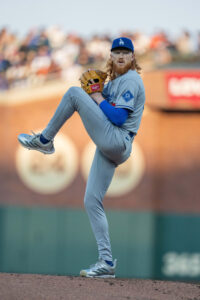
This year’s 104 innings are by far the most of his career. May’s velocity has held all season, but he has allowed an ERA of 4.45 or higher in each month since April. The Dodgers seemingly were on the verge of kicking him to the bullpen. GM Brandon Gomes told reporters (including J.P. Hoornstra of Newsweek) that May preferred to start. Gomes stated that May did not demand a trade but suggested the Dodgers were open to accommodating him by dealing him to a team that’d give him a rotation spot if a deal presented itself.
They not only found that team but got a strong return out of it. Tibbs was the Giants’ first-round pick last summer. San Francisco sent him to Boston alongside Kyle Harrison in June’s Rafael Devers blockbuster. His production tanked immediately after the trade, as he hit .205/.321/.268 with only one home run in 29 games for Boston’s Double-A affiliate. Tibbs had put together a much more impressive .246/.379/.478 line in High-A before the trade.
The Red Sox evidently soured on his future extremely quickly. Not only has May not had a particularly good year, he’s an impending free agent. He’s only playing on a $2.135MM salary because the injuries tamped down his arbitration earnings. Still, two months of a fifth/sixth starter isn’t a particularly valuable trade asset. If the Red Sox valued Tibbs anywhere near as highly as they did when they included him in the Devers trade, they would not have made this deal.
Ehrhard was Boston’s fourth-rounder last season. He’s a righty-hitting corner outfielder with a .270/.371/.434 line and 23 steals in 88 games between High-A and Double-A on the year. Baseball America slotted him 29th in the Boston farm system. He has a tweener profile but could be a fourth or fifth outfielder on the strength of his hitting ability.
ESPN’s Jeff Passan first reported the Red Sox were acquiring May. FanSided’s Robert Murray had Tibbs’ inclusion, while Christopher Smith of MassLive reported that Ehrhard was in the deal. Jon Heyman and Joel Sherman of the New York Post previously reported that the two sides were in talks on a deal involving May. Image courtesy of Neville E. Guard, Imagn Images.
Dodgers Notes: Snell, Ohtani, Rotation, Miller, Treinen
Blake Snell threw 76 pitches in a rehab start with Triple-A Oklahoma City on Saturday, and it would appear as though this fourth rehab outing will also be the left-hander’s last. Dodgers manager Dave Roberts told reporters (including Bill Plunkett of the Orange County Register) that Snell will be activated from the 60-day injured list this week, and the club will move to a six-man rotation.
It has been a long road back for Snell, who appeared in just two games for L.A. before shoulder inflammation put him on the shelf in the first week of April. Some renewed soreness in the later part of April led to both an injection in Snell’s shoulder and a shutdown from throwing, which led to this lengthy stint on first the 15-day and eventually the 60-day IL.
The lingering shoulder problem is the latest setback in Snell’s checkered injury history, adding to his reputation as something of an all-or-nothing pitcher. When Snell is healthy and available, there are few (if any) better pitchers in the game, as evidenced by Snell’s two Cy Young Awards and his tendency to catch fire in later in the season. As we saw just last season with the Giants, Snell battled injuries and ineffectiveness in the first three months of the 2024 campaign before delivering an absurd 1.23 ERA in his final 14 starts and 80 1/3 innings of action.
Time will tell if Snell can deliver anything close to that in his return to the Los Angeles rotation, but his impending return should be a nice boost to a Dodgers pitching staff that has been crushed by injuries all year. The move to the six-man rotation reflects this improved rotation health, and the club’s desire to manage everyone’s innings in an attempt to preserve the starters’ arms over the rest of the season and through October. If all goes well, the staff will consist of Snell, Yoshinobu Yamamoto, Clayton Kershaw, Tyler Glasnow, Shohei Ohtani, and one of Dustin May or Emmet Sheehan.
This isn’t the first time the Dodgers adopted a six-man rotation, and the ragged nature of the team’s pitching health has already led to a pretty irregular deployment of the starters. There’s also the Ohtani factor, as the two-way star is still slowly building up his innings. Ohtani has tossed three frames in each of his last two starts, with May and Sheehan working as piggyback starters in support.
Ohtani is now expected to pitch four innings for his next two starts, Roberts said, so the team will be setting aside the piggyback plan for now. This doesn’t mean Ohtani is going to be viewed as a regular starter per se, as Roberts explained. “We’re not going to have the reins off where we’re going to say, ‘Hey, you can go 110 pitches.’ I don’t see that happening for quite some time,” the skipper said. “So I think that staying at four [innings] for a bit, to then build up to five and we’ll see where we go from there.”
Ohtani’s next two starts will come on Wednesday against the Reds, and then on August 6 against the Cardinals. Notably, the Dodgers don’t play on either of the days following Ohtani’s two scheduled starts, as Roberts said the intent is to give Ohtani some built-in recovery time following his pitching outings before returning to his usual DH duty.
There is still plenty of fluidity in the six-man rotation plan, so Roberts didn’t want to commit to stating which of May or Sheehan could be remaining in the rotation and which might be moved to bullpen duty. Describing the Dodgers’ pitching depth as a surplus is probably misleading given how more injuries could arise at any time, yet Los Angeles is addressing its number of starters at the Triple-A level by moving Bobby Miller from rotation duty to a relief job.
Fabian Ardaya of The Athletic reported yesterday about Miller’s role change, and Roberts confirmed the plan today. “I think that this might be something that unlocks him. Going hard for a shorter period of time, to get some confidence for him, which could help us here,” Roberts said.
Selected 29th overall by the Dodgers in the 2020 draft, Miller posted a 3.76 ERA over 22 starts and 124 1/3 innings in his 2023 rookie season, but that promising beginning gave way to an 8.85 ERA in 61 big league innings since Opening Day 2024. Shoulder problems cost Miller two months of the 2024 season but his struggles have continued into this year, including a 5.58 ERA at Triple-A Oklahoma City and continued control issues. Miller’s walk rate (15.4%) is almost as high as his strikeout rate (17.9%) over his rough 69 1/3 Triple-A frames this year.
Returning to the Major League bullpen mix, the Dodgers welcomed Blake Treinen back from the 60-day injured list today. Left-hander Justin Wrobleski was also called up from Triple-A, while righties Edgardo Henriquez and Will Klein were optioned to Oklahoma City.
Treinen posted a 3.38 ERA over eight relief innings for Los Angeles before right forearm tightness led to almost three and a half months on the sidelines. While the veteran’s health is still a concern given his significant injury history, Treinen was a major bullpen weapon for the Dodgers as recently as last year, when he posted a 1.93 ERA over 46 2/3 innings in the regular season, and then a 2.19 ERA in 12 1/3 postseason frames. His return won’t halt the Dodgers’ plan to acquire more high-leverage bullpen help at the deadline, but Treinen could help the club fulfill part of that need from within.