
Royals Activate Brady Singer For Debut
Tyler Zuber made his debut out of the Kansas City Royals bullpen last night in a week that will see quite a number of newly-minted big-leaguers dirty their cleats on major-league soil for the first time in their careers. Count highly-touted Royals’ prospect Brady Singer among them. The 18th overall selection of the 2018 draft is slated to start tonight’s game against the Indians. The Royals activated Singer earlier today, moving Ronald Bolanos to the taxi squad, the team announced on Twitter.
It’s not the ideal debut in that Singer’s friends and family won’t be able to be in attendance, but after just 26 professional starts, the Royals and Singer both are eager to see the 6’5″ righty against the game’s top competition, per Lynn Worthy of the Kansas City Star. Said Singer, “Obviously, the difference between the Futures Game and your first big-league start is much different. I feel like the Futures Game you’re kind of just showing what you’ve got and getting through that inning. But (Saturday) is day one. Locking in for as many games as I can go. Absolute huge game plan and studying tonight and figuring out what to do.”
If there were a Triple-A season, it stands to reason that Singer would be making his debut there this season given that he only just reached Double-A in 2019. Still, the Royals would not put him in the majors if they felt he were not ready to handle that level of competition. In his only full season of professional ball, Singer went 12-5 with an eye-catching 2.85 ERA across 26 starts between High-A and Double-A in 2019. Singer notched 8.4 K/9 versus 2.4 BB/9 for an overall 3.54 K/BB as a 22-year-old last season. He’s the #4 ranked prospect in the Royals’ system by both Baseball America and Fangraphs.
Tres Barrera Receives 80 Game Suspension
Washington Nationals catcher Tres Barrera has been suspended 80 games as part of MLB’s PED testing program, per Jared Diamond of the Wall Street Journal. Barrera tested positive for Dehydrochlormethyltestosterone.
Per Mark Zuckerman of MASNsports.com, Barrera’s said through a statement that he “…never, and will never knowingly use a banned substance.” Barrera lost his appeal and will begin serving his suspension, despite his insistence that he does not know how the banned substance got into his system.
Interestingly, Barrera has gone so far as to reach out on Twitter to the lead investigator on the BALCO case. Further, there’s some debate about the particular substance for which Barrera tested positive. Turinabol is a bit of an outdated substance, and it would be surprising for someone in such a public testing protocol to chose it over more modern drugs that leave the bloodstream more quickly, per T.J. Quinn of ESPN (via Twitter). Even if Barrera wasn’t actively seeking PEDs, there’s still some potential culpability depending on how it was the drug entered his system. Still, there is at least some reason to hold off on judgment of Barrera until we know more.
If there’s a positive side to this for Barrera, it’s that he knows that this brand of suspension is not a death knell for his career. Raudy Read served a similar 80-game suspension last season and returned to his slot ahead of Barrera in the organizational depth chart.
Barrera, 25, made his major league debut last year with a pair of at-bats at the end of September. He figured to serve as catching depth on the 40-man roster behind Yan Gomes, Kurt Suzuki, and Read. Still, there was a decent chance that Barrera saw some major league action this year. With Welington Castillo opting out, Barrera’s suspension saps them of further catching depth. The major-league club should be okay with Gomes, Suzuki, and Read, but the suspension will likely push the Nats at add another catcher to their 60-player pool, if nothing else.
The Nats selected Barrera in the sixth round of the 2016 draft out of Texas. He was their regular catcher in Double-A last season, which rostered many of the Nats’ eventual call-ups because of the geographical distance of their Triple-A club. The Texas-native is a defensive-minded catcher whose glove has generally trended ahead of his bat. He authored a triple-slash of .249/.323/.381 across 403 plate appearances.
Blue Jays To Play Home Games In Buffalo
The Blue Jays will play their home games for the 2020 season at their Triple-A site in Buffalo, reports Dan Connolly of The Athletic (Twitter link). The Jays have been searching for a home site since government regulations in Canada ruled out Toronto’s Rogers Centre. They thought they’d reached a deal with the Pirates to utilize Pittsburgh’s PNC Park, but the Pennsylvania Department of Health quashed that plan. The Blue Jays also explored the possibility of playing at Camden Yards in Baltimore, which the Orioles reportedly approved, but that arrangement was also pending government approval in Maryland.
All the while, the Jays have reportedly been working to upgrade their facilities at Buffalo’s Sahen Field, bringing the clubhouses lighting up to par with MLB standards (or at least as close as possible). The organization’s strong preference has been to play its home games at a Major League facility, but it seems they’ll instead settle in a familiar setting for many of the club’s young players.
The Jays have since officially confirmed the report, issuing a statement which indicates they’ll stage the “majority” of its 2020 home games in Buffalo. Said president and CEO Mark Shapiro within the release:
“This process has no doubt tested our team’s resilience, but our players and staff refuse to make excuses – we are determined to take the field on Opening Day today, and for the coming months, with the same intensity and competitiveness that our fans expect.”
MLB Playoff Field Expands To 16 Teams For 2020 Season
6:58pm: MLB has officially announced the 16-team playoff format and best-of-three Wild Card Series for 2020.
4:36pm: The league’s owners have ratified the agreement, Sherman tweets. Sixteen teams will make the playoffs this season.
3:27pm: ESPN’s Buster Olney reports that the top two teams in each division will qualify for the postseason under this format. The seventh and eighth teams in each league will be chosen based on the best overall records of the remaining teams. The Athletic’s Jayson Stark adds that all three first-round games of a series would be played at the higher seed’s home park, thus eliminating the need for a travel day.
3:00pm: Just hours before the first pitch of the 2020 season, Major League Baseball and the MLB Players Association have reached an agreement on an expanded postseason field. ESPN’s Marly Rivera reports that the union has agreed to the proposal, which now needs only to be ratified by the owners. Joel Sherman of the New York Post suggests that will indeed happen (Twitter link), and USA Today’s Bob Nightengale tweets that there’ll be 16 teams as well as a best-of-three first round series (rather than a sudden-death Wild Card setting). The agreement covers only the 2020 season, per both Rivera and Sherman.
The postseason expansion comes with a $50MM player pool for the players, Nightengale further reports. That’s particularly notable given that in a traditional season, player postseason shares are derived solely from gate revenue and not from television ratings. Previous estimates on additional television revenue in an expanded postseason field suggested between $200-300MM could be generated by expanding to 16 teams, and ownership has agreed to share some of that windfall with the players’ side.
The potential ramifications here are broad reaching. It’s easy to envision this serving as a litmus test of sorts for future postseason expansion. The league has previously sought to push to 14 to 16 teams due to that considerable added revenue — the aforementioned revenue boost referenced only television money — and introducing it as a sort of experiment in an already anomalous season is perhaps a more palatable way of normalizing the change.
From a team vantage point, the impact this has on the trade deadline could be enormous. There have been plenty of questions regarding just how much clubs will be willing to surrender in order to acquire rental players in a 60-game season — particularly if the likeliest postseason scenario included a sudden-death Wild Card game. Now, clubs will at least be assured of a three-game series. Paired with the expanded number of fringe contenders a six-team expansion of the field, that could embolden some teams to be more aggressive buyers.
The greater number of postseason clubs not only widens the field of potential buyers but also narrows how many teams will be pure sellers. That could serve to up the demand for the trade assets on the few teams who are committed to selling off pieces. And it could lead to some dramatic last-minute decisions for teams that are on the cusp. Today’s brand of methodical, analytical GMs don’t make the emotional and even irrational plunges into transactions that once proliferated deadline season, but there’s a good chance we’ll again see some creative swaps of unexpected players. Complicated three-team trades have become prominent in recent years, and a radical change to the playoff format should only encourage creativity.
And what of the teams with trade candidates who have multiple seasons of club control remaining? At a time when clubs are reluctant to part with high-end talent to acquire 30-some games of a rental, a player controlled into 2021, 2022 or beyond becomes eminently more appealing. Matthew Boyd, Caleb Smith, Jon Gray, Francisco Lindor, Nolan Arenado and other controllable names who’ve been kicked about the rumor circuit in recent years will again be in demand. Depending on the status of those players’ teams at the halfway point of the season, the motivation to make a deal could increase. It’s worth reminding that only players in a team’s 60-man pool can be traded, so there are some clear restrictions in play, but the ripple effect here could be considerable.
Juan Soto Tests Positive For COVID-19
6:37pm: The team tested Soto on multiple occasions Thursday, and the results came back negative, Jesse Dougherty of the Washington Post tweets. But in order to return, Soto will still need two negative lab tests 24 hours apart.
1:35pm: General manager Mike Rizzo confirmed to reporters that Soto has tested positive, though thankfully, Soto is asymptomatic (Twitter link via Mark Zuckerman of MASNsports.com). The left fielder tested negative consistently in recent weeks but was positive on his most recent test, per the GM.
1:25pm: Nationals star Juan Soto has tested positive for COVID-19 and will miss tonight’s season opener against the Yankees, ESPN’s Jeff Passan reports (via Twitter). The team announced its roster shortly after the report, and Soto indeed is not listed with the club’s outfielders.
Soto, still just 21, missed the early portion of Summer Camp while quarantining after being exposed to someone who’d tested positive, but he was cleared to return to Nats camp a week ago today. It’s not known when the positive test occurred or whether he is symptomatic, but Soto will need a pair of negative tests before he is able to return to the Nationals’ roster.
The Nationals’ roster listed Victor Robles, Adam Eaton, Michael A. Taylor, Andrew Stevenson and Emilio Bonifacio as its five outfield options. Robles and Eaton will line up in center and right field, respectively, on the regular, so it seems that some combination of Taylor, Stevenson and Bonifacio will shoulder the bulk of the load in left field during Soto’s absence.
The obvious hope here is that Soto, one of baseball’s most exciting young stars, will remain asymptomatic and return as expeditiously as possible. But the positive test serves as a reminder that this sort of storyline will likely continue throughout the season. Players aren’t being tested daily, and we’ve already seen multiple instances of erratic and inconsistent positive/negative results that have delayed some in getting back to the field.
Dodgers Place Clayton Kershaw On Injured List, Recall Dustin May
The Dodgers announced that they’ve placed scheduled Opening Day starter Clayton Kershaw on the injured list and recalled right-hander Dustin May from their alternate training site. The team has termed Kershaw’s injury as “back stiffness” and will surely provide more details in the near future. Kershaw had been slated to take the hill against the Giants just under four hours from now. May will take the ball in place of Kershaw tonight.
Kershaw incurred his current injury in the weight room earlier this week, manager Dave Roberts tells reporters, adding that right now he’s unsure as to when the left-hander will be able to return (Twitter links via Ken Gurnick of MLB.com). May was made aware of the possibility of this switch last night, per the manager.
With Kershaw suddenly and unexpectedly shelved, the Dodgers’ rotation will now consist of May, Walker Buehler, Ross Stripling, Julio Urias and Alex Wood. It’s still a talented group with plenty of intriguing option in reserve — Tony Gonsolin, Mitchell White and Josiah Gray among them — but it’s clearly a thinner group than anticipated just a few weeks ago when both Kershaw and David Price were still in the picture. That said, the ability to cultivate this type of depth is one of the reasons that the Dodgers have been so successful under the current front office regime.
In turning the ball over to the 22-year-old May, Los Angeles will entrust the season’s first start to one of MLB’s premier pitching prospects. The 6’6″ May made his big league debut in 2019, pitching to a 3.63 ERA with a 32-to-5 K/BB ratio in 34 2/3 frames before adding 3 1/3 innings of one-run ball in the NLDS. A third-round pick back in 2016, May notched a combined 3.38 ERA between Double-A and Triple-A in 2019, including a 2.30 ERA in 27 1/3 frames in a supercharged Triple-A offensive environment.
May is widely regarded to be one of the game’s 25 best overall prospects, so it’s not as though the Dodgers are simply crossing their fingers and hoping that a minor league call-up can hold his own while filling in for an injured star. May is expected to be a key part both of the team’s future and its success in 2020, although he’ll obviously be asked to contribute sooner than the organization had initially anticipated.
Braves Place Cole Hamels On 45-Day Injured List
The Braves placed left-hander Cole Hamels on the 45-day injured list in order to open 40-man space for their previously announced selections of Matt Adams and Tyler Matzek, David O’Brien of The Athletic tweets. The move can only be backdated three days, so Hamels will be out of action until at least early September while dealing with a triceps issue.
Certainly, that’s not the outcome the Braves had in mind when they signed Hamels to a one-year, $18MM contract over the winter. Hamels’ salary will be prorated to a bit north of $6.6MM under the terms of the March MLB/MLBPA agreement that stipulated prorated salaries for players in 2020.
With Hamels sidelined for more than half the truncated regular season, the Atlanta rotation unquestionably looks a bit less secure. Mike Soroka and Max Fried give the Braves a pair of high-end young talents to front the group, and both Mike Foltynewicz and Sean Newcomb have at times shown themselves capable of pitching at high levels as well. Both, however, have been inconsistent in recent years.
The Braves inked veteran righty Jhoulys Chacin to a one-year deal earlier this week and also have a bevy of intriguing young arms in their player pool, including Kyle Wright, Ian Anderson, Patrick Weigl and Bryse Wilson. Wright made the Opening Day roster and could begin the season as the team’s No. 5 starter, depending on the plan for Chacin, who largely replaces righty Felix Hernandez after the longtime Mariner opted out of the 2020 season.
Impressive depth aside, a healthy Hamels would’ve been a clear boon to the starting staff. Although he struggled late in the 2019 season, Hamels has acknowledged that he rushed back from an injury. And prior to his DL placement last June, he’d given the Cubs 29 starts and 176 innings of 2.91 ERA ball since being acquired at the 2018 trade deadline. In a best-case scenario now, the Braves would get a few weeks of starts out of Hamels and hope to lean on him throughout a postseason run if he shows well.
White Sox Designate Carson Fulmer For Assignment, Sign Ryan Goins To Minor League Deal
The White Sox set their Opening Day roster Thursday, announcing that they’ve designated former top-10 pick Carson Fulmer for assignment. Chicago also signed old friend Ryan Goins to a minor league deal and assigned him to its alternate training site and selected the contracts of four players: infielder Cheslor Cuthbert, outfielder Nicky Delmonico, left-hander Ross Detwiler and right-hander Codi Heuer. Additionally, veteran utilityman Andrew Romine was released by the organization.
Sox fans will surely be glad to see Yoan Moncada activated from the injured list and placed on the Opening Day roster after previously being out with Covid-19. The White Sox also called up right-hander Jimmy Lambert and catcher Zack Collins from their alternate site.
It’s a disappointing outcome for the Sox and Fulmer alike. The former Vanderbilt star was at one point considered during his junior year to be a possible No. 1 overall pick, but he’s simply never put it together in the Majors. I explored the Fulmer conundrum at length during the league’s shutdown, looking at the right-hander’s lengthy history of struggles in the Majors and upper minors. Fulmer was touted as one of the surest big leaguers in that year’s draft, as even his critics felt he was a high-probability late-inning bullpen piece. Those with reservations about taking him at the top of the draft weren’t so much worried that he’d bust completely but that he’d thrive “only” as a reliever rather than a starter.
Fast forward a half decade, and Fulmer is an out-of-options righty with a career 6.56 ERA in the Majors and 5.39 ERA in Triple-A. As detailed in the previously linked piece on him, there are plenty of positive indicators in his arsenal, and I personally have wondered how he might fare working at the top of the zone with his four-seamer, but the win-now White Sox clearly didn’t feel he was among their 30 best options. Perhaps his struggles will be pronounced enough that he’ll clear waivers, but one can also imagine a non-contender rolling the dice on his once touted arm.
Of the players selected to the 40-man roster today, Delmonico and Detwiler have both appeared for the Sox in the past. Delmonico will give them a left-handed bench bat with sparse MLB success, while Detwiler can soak up some innings if need be — either as a spot starter or long reliever. Cuthbert was once a high-end Royals prospect but has never hit much in five MLB seasons. Heuer, meanwhile, was Chicago’s sixth-round pick in 2018 and posted dominant numbers in the minors last year. He has long-term bullpen potential for them, and the Sox are surely excited to get a glimpse of how he’ll fare against MLB opposition.
As for Goins, he’ll return to the organization for a second season after hitting .250/.333/.347 in 52 games with the Sox last year. The longtime Blue Jays infielder doesn’t have much of a track record at the plate — he’s a career .230/.279/.335 hitter — but he can play all over the infield and is generally considered a strong up-the-middle defender.
Dodgers Extend Mookie Betts
7:24pm: Betts’ contract includes a massive $65MM signing bonus, Joel Sherman of the New York Post reports (via Twitter). The Athletic’s Ken Rosenthal adds that the contract contains $115MM in deferrals, and the salaries are backloaded such that Betts will be paid $17.5MM in 2021 and 2022. There are no opt-outs in the deal, which does not come with a no-trade clause, per Rosenthal.
4:01pm: Mookie Betts is a Dodger for the long haul. The team announced this afternoon that Betts has signed a 12-year extension through the 2032 season. It’ll reportedly guarantee him a whopping $365MM in new money on top of this year’s $27MM salary (which has been prorated to $10MM due to the shortened 2020 season). Betts is represented by the VC Sports Group.
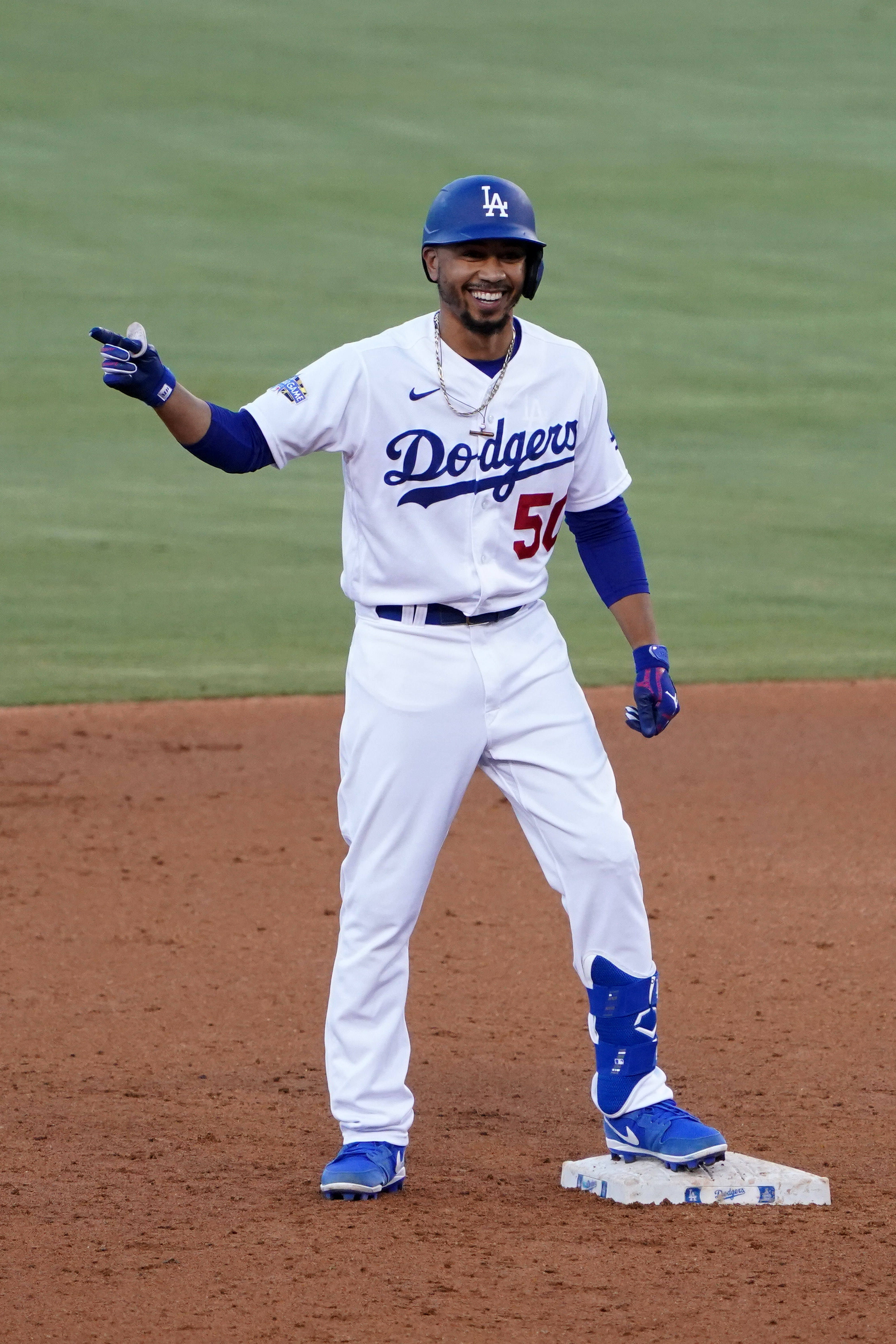
The contract represents the largest amount of new money ever promised to a Major League player on an extension or free-agent signing, topping Mike Trout‘s previous highwater mark of $360MM (over a shorter 10-year term). Trout was already signed at two years and $66.5MM, so his total of 12 years and $426.5MM tops Betts’ 13-year, $392MM figure, but the $365MM new-money benchmark is a notable record nevertheless.
The Betts extension, somewhat remarkably, marks the first time that the Dodgers have guaranteed in excess of $100MM to a player under president of baseball operations Andrew Friedman. Though the team is known for its enormous — at times seemingly limitless — spending capacity, the Friedman regime has worked diligently to shed some prior undesirable commitments and creatively limbo underneath the luxury-tax bar. Doing so paved the way for the Dodgers to issue a historic contract to a premium talent.
After missing out on a free-agent pursuit of Gerrit Cole this winter, the team shifted its focus to acquiring Betts, who came to L.A. alongside David Price in a blockbuster trade that sent Alex Verdugo, Jeter Downs and Connor Wong to Boston. There was plenty of talk about the team’s hope for extending Betts, but he’d been outspoken about his desire to test the open market. Paired with the economic uncertainty stemming from this year’s unprecedented revenue losses, there was real reason to wonder whether a deal would get done.
Perhaps that economic turmoil made Betts more amenable to taking a deal now rather than testing the market, or perhaps he was simply willing all along to sign if a team exceeded Trout’s new-money guarantee. His exact thinking likely won’t ever be fully known, but the end result is that Betts now appears poised to spend the remainder of an already excellent career in Dodger blue.
Still just 27 years of age, Betts has produced at star-caliber levels since a 52-game MLB debut back in 2014. A career .301/.379/.519 hitter, Betts is already a four-time All-Star, a three-time Silver Slugger winner, a former American League MVP and batting champion, and a four-time Gold Glove winner. He’s clubbed 139 home runs and swiped 126 bases in 794 Major League games, showing off an impressive blend of power and speed, and his 13.5 percent walk rate over the past two seasons is nearly the same as his paltry 14.5 percent strikeout rate. Add in that Betts is regarded as an otherworldly defender — he’s third among all players in Defensive Runs Saved since 2015, regardless of position — and it’s easy to see why Betts is regarded among the game’s elite players.
The Dodgers already boasted at least one of those elite talents: reigning NL MVP Cody Bellinger. Betts and Bellinger will pair to form what could be baseball’s best one-two punch for at least the next four seasons, as Bellinger is controlled through at least the 2023 season. Out-of-nowhere slugger Max Muncy is also inked through the ’23 campaign on a highly reasonable three-year, $26MM pact, so that trio should continue thriving in the heart of the order for the foreseeable future. The hope is that rising young talents like infielder Gavin Lux and catcher Will Smith will add to that long-term core. Looking shorter-term, the Dodgers are stacked with above-average contributors, including Corey Seager (controlled through 2021), Justin Turner (through 2020), Chris Taylor (through 2021) and Enrique Hernandez (through 2020).
From a payroll and luxury-tax standpoint, the Dodgers can afford to both sign Betts and still pursue a megadeal with Bellinger, should they see fit. Betts’ contract comes with a $30.4MM annual luxury hit (or $30.1MM, if they roll it into the current deal), which is sizable but still only represents about a seventh of next year’s $210MM luxury cap. (That number could well rise in 2021 CBA negotiations, too.) Los Angeles already has more than $152MM in luxury commitments on the 2021 books, including this new deal for Betts, but that number plummets to $73MM in 2022. Betts is the only Dodger on a guaranteed deal for the 2023 season (although Bellinger, Walker Buehler and Julio Urias will all be arbitration-eligible).
With today’s agreement, Betts, Bellinger and Buehler look like the long-term faces of the Dodgers franchise, though the club has boundless young talent, a knack for high-profile trades and as previously noted, plenty of money to spend even with Betts pulling in more than $30MM on an annual basis. The Dodgers have won seven straight NL West titles, and the Betts deal is a strong step toward continuing that trend. That, of course, won’t be enough to satisfy Betts, though. As the star put it during today’s introductory press conference: “I’m here to win some rings.”
WEEI’s Lou Merloni reported earlier today that Betts was closing in on an extension worth more than $300MM. ESPN’s Jeff Passan reported the agreement and the terms just prior to the team’s announcement (Twitter thread).
Marcus Stroman “Week To Week” With Calf Injury
The Mets announced that they’ve placed right-handers Marcus Stroman and Robert Gsellman on the injured list. Stroman, who was said to be experiencing tightness in his calf earlier today, has been now diagnosed with a tear of some extent in that ailing calf muscles. Gsellman is experiencing some discomfort in his right triceps.
The IL placement for Stroman and the announced muscle tear are more ominous than this afternoon’s report of mere tightness in his calf. It should be noted that even a Grade 1 strain indicates some stretching or minor tearing, so it’s still possible that his absence won’t be substantial. Manager Luis Rojas tells reporters that Stroman will not require surgery (Twitter link via Anthony DiComo of MLB.com), but the skipper also referred to Stroman’s injury as a “week to week” situation, which isn’t a great outlook in a season that’ll barely span nine weeks from start to finish.
The loss of Stroman is a brutal hit for the Mets, who were already without right-hander Noah Syndergaard for the entire season due to Tommy John surgery. Two-time Cy Young winner Jacob deGrom will still head up the team’s rotation, but he’ll now be followed by Steven Matz, Rick Porcello, Michael Wacha and a to-be-determined fifth starter. Non-roster veteran Erasmo Ramirez could be one option, and 2017 first-round pick David Peterson is also in the Mets’ player pool. Right-hander Walker Lockett was placed on the IL this week with a back injury.
On a personal level for Stroman, the injury is about as poorly timed as possible. Already facing a shortened platform season prior to his first foray into free agency this winter, missing multiple weeks could give Stroman fewer than 10 starts to demonstrate his health and effectiveness for interested clubs. Given the potential for teams to be stingier than usual on mid-range free agents following this year’s revenue losses, the calf issue could prove particularly costly for Stroman, who posted a 3.22 ERA with better than a strikeout per inning in 184 1/3 frames last year.
As for Gsellman, it seems there’s lesser concern. DiComo tweets that his IL stint is expected to be back-dated the maximum three days, and a return to the bullpen in early August doesn’t appear to be out of the question. In two years since converting to full-time relief role, the now-27-year-old Gsellman has a 4.45 ERA with 8.1 K/9 against 3.2 BB/9 in 143 2/3 innings.