
Yan Gomes Out Six To Eight Weeks With Knee Injury
An MRI today revealed a sprained MCL in the right knee of Indians catcher Yan Gomes, which will sideline the standout backstop for six to eight weeks, Cleveland has announced.
The injury to Gomes is a significant blow to the Indians, who are expected by many to contend for the AL Central title this season but will now be without one of their most valuable players for up to two months. In the interim, Roberto Perez figures to step into an everyday role behind the plate, and Carlos Santana can serve as a backup in the near-term. However, it wouldn’t be a shock to see Cleveland pursue upgrades from outside the organization.
Gomes, 27, has established himself as one of the game’s better catchers over the past season and a half, batting a combined .284/.325/.476 with 32 homers in 223 games from 2013-14. He’s also an excellent defender, grading very well in terms of both pitch-framing metrics and shutting down the running game. Gomes has caught 35 percent of opposing base stealers in his big league career, while the league-average rate in that time has been 27 percent. Both Fangraphs and Baseball-Reference pegged Gomes’ value at roughly 4.5 wins above replacement last year.
Jenrry Mejia Receives 80-Game Suspension
6:30pm: The suspension will save the Mets $1.2MM per Mike Puma of the New York Post (tweet).
Rubin tweets that Mejia will not be eligible for the postseason roster if the Mets qualify for the playoffs.
6:20pm: Mejia is the fourth pitcher in the last 15 days to test positive for Stanozolol, reports Adam Rubin of ESPN New York. In addition to Santana, Mariners pitcher David Rollins and Braves pitcher Arodys Vizcaino are serving suspensions after failing a drug test. Three of the four players are Dominican, which might provide a clue as to how or where the drug is being disseminated. Like Mejia, Santana also claimed that he had no knowledge of how the drug entered his system.
As a reminder, days on the disabled list count towards the suspension, so Mejia will simply be out longer than expected, tweets Matt Ehalt of The Record. Per Ehalt, Mejia will not appeal the suspension. He is eligible to return on July 7 against the Giants (Twitter).
Andy Martino of the New York Daily News adds (on Twitter) that the Mets won’t pursue an external option like Rafael Soriano. They’re satisfied with their current depth.
4:37pm: Mets closer Jenrry Mejia has received an 80-game suspension without pay after testing positive for Stanozolol, MLB has announced. Stanozolol is the same performance-enhancing drug Ervin Santana was suspended earlier this month for using.
“We were disappointed when informed of Jenrry’s suspension for violating Major League Baseball’s Joint Drug Prevention and Treatment Program,” say the Mets in a statement. “We fully support MLB’s policy toward eliminating performance enhancing substances from the sport. As per the Joint Drug Program, we will have no further comment on this suspension.”
“I know the rules are the rules and I will accept my punishment,” says Mejia, seemingly suggesting he will not appeal the suspension. “[B]ut I can honestly say I have no idea how a banned substance ended up in my system. … I’m sorry to the Mets organization, my teammates and the fans, as well as my family.”
Mejia had not pitched in 2015 due to elbow inflammation. An MRI showed no structural damage, so he likely would have returned at some point fairly soon if not for the suspension. Mejia racked up 28 saves in 2014 while carrying a relatively heavy workload for a closer, pitching 93 2/3 innings with a 3.65 ERA, 9.4 K/9 and 3.9 BB/9. Jeurys Familia will likely get most save opportunities in his absence. Mejia was set to make $2.595MM in his first arbitration year in 2015, but now the Mets will only have to pay him about half that amount.
Hiroshima Carp Sign Outfielder Nate Schierholtz
The Hiroshima Carp of Japan’s NPB have signed outfielder Nate Schierholtz to a one-year, $1.16MM contract, reports the Japan Times. Schierholtz is expected to join the team as soon as April 21. He opted out of his minor league contract with the Rangers on March 28.
Schierholtz struggled to a .195/.243/.309 line in 383 plate appearances last season. However, he turned in a useful 2013 campaign with the Cubs that included 21 home runs and a .251/.301/.470 slash. The left-handed hitter is also a career .253/.302/.419 hitter against right-handed pitchers.
Cubans Heredia, Gutierrez Nearing Free Agency
Two of Cuba’s most intriguing remaining prospects — outfielder Guillermo Heredia and righty Vladimir Gutierrez — appear to be nearing free agency, according to a report from Jesse Sanchez of MLB.com (Twitter links).
The 24-year-old Heredia has established residency in Mexico and on Monday will submit his application to MLB to be declared a free agent. Baseball America’s Ben Badler rated Heredia just outside his top-ten list of Cuban prospects last fall, though he notes that the outfielder has been eclipsed by some other players since. Though he has at least one big power season to his credit in Cuba, Heredia’s calling cards are his defense in center and on-base ability.
Gutierrez, 19, is just days away from residency in Mexico, per Sanchez, and will presumably make his own application for free agency in short order thereafter. He has been training in Mexico since creating a stir by leaving his club during the Caribbean Series. Badler credits Gutierrez with a projectable frame and advanced curve, making him one of those players that has gained on Heredia in recent months.
Heredia will be exempt from international bonus limits, and he could field wide interest. The younger Gutierrez, meanwhile, will fall within the parameters of the spending limits, meaning that he will be off limits for those clubs that are currently serving two-year signing bans and that whichever club signs him will have to stay within its pool allocation or face a hefty overage tax and signing timeout.
Derek Holland To Be Shut Down For Four To Six Weeks
Rangers starter Derek Holland will not pick up a baseball for the next four to six weeks after being diagnosed with a sub-scapular strain, the club told reporters including Jeff Wilson of the Fort Worth Star-Telegram (via Twitter).
Holland left his start today after the first inning, continuing a nearly unimaginable string of pitching injuries for the club. Fortunately for Holland, surgery is not on the table, Anthony Andro of FOX Sports Southwest tweets. He’ll undergo a scan in a month, with the course of action determined from that point.
Texas did just sign veteran lefty Wandy Rodriguez to provide an additional option, and he figures to be the most likely candidate to join the big league rotation in the short term. Of course, the club may prefer not to begin paying out Rodriguez’s available incentives (which could reach $1.8MM), though his salary will be at the league-minimum rate.
Holland was not the only casualty in today’s action. The Rangers also saw outfielders Shin-Soo Choo and Ryan Rua leave with injuries — back spasms and a sprained ankle, respectively — and could be left scrambling to fill in its lineup as well.
Heyman’s Latest: Kimbrel, Howard, Perez, Salty, Soriano, Cueto
Jon Heyman of CBS Sports has penned a lengthy column that’s chock full of Hot Stove related items as the season gets underway. First and foremost, he chronicles the Braves‘ trade of Craig Kimbrel at length. Heyman spoke to president of baseball ops John Hart, who candidly told Heyman that the team took a hard line of refusing to trade Kimbrel unless Melvin Upton Jr. was involved in the deal. “We were not going to separate Kimbrel and trade him by himself,” Hart told Heyman. Atlanta reached out to the Cubs, Astros, Dodgers and Padres, among others, this winter in an effort to move Upton, and despite the Dodgers’ bullpen needs, they weren’t willing to add Upton’s contract to that of Carl Crawford and Andre Ethier, having already shed Matt Kemp‘s contract. The Padres trade didn’t heat up until about four days before it was agreed upon, Heyman writes, with Hart even remaining in Orlando to finish negotiations rather than fly with the team to Miami at the end of Spring Training. Hart credited assistant GM John Coppolella for doing much of the legwork and his creativity in getting the trade finalized.
More highlights from Heyman’s article (though the entire piece is well worth your time)…
- While some reports late in Spring Training indicated that the Phillies would be willing to eat up to $50MM of the remaining $60MM on Ryan Howard‘s contract, two GMs tell Heyman they hadn’t heard that figure. One of those GMs was of the belief that the Phillies’ top offer was to pay about $35MM, which, Heyman speculates, may have been a large reason that the Royals opted to sign Kendrys Morales for two years and $17MM rather than pursue a Howard trade.
- Speaking of the Royals, Heyman hears that the team is open to pursuing a second extension with catcher Salvador Perez and would be happy to make him a Royal for life. Heyman notes that some in the organization even have some sympathy for Perez, whose five-year, $7MM contract is widely considered the most team-friendly deal in all of baseball. Perez’s deal contains three startlingly low club options valued at $3.75MM, $5MM and $6MM for the 2017-19 seasons — two of which would have been free-agent seasons beginning at the age of 28.
- The Marlins tried to trade Jarrod Saltalamacchia this winter after the catcher’s first season on a three-year, $21MM pact was a struggle, but his salary was too great a deterrent. The Marlins presumably feel that top prospect J.T. Realmuto could step into the catcher’s role in the not-too-distant future.
- The Tigers are believed to be at least monitoring Rafael Soriano‘s workouts at the Boras Sports Training Institute in Miami, per Heyman. However, Soriano has seen his stock suffer not only due to ineffective innings late int he 2014 season but also due to perceptions about his personality and negative clubhouse impact. At least one club that was taking a hard look at late-inning relievers ruled out Soriano entirely due to that perception, Heyman reports.
- The Reds felt the odds of extending Johnny Cueto prior to Opening Day were so slim that it’s not even clear if they made a formal offer, writes Heyman. Cueto is seeking a figure in the range of $200MM following Max Scherzer‘s mammoth contract this offseason, he adds. Heyman also opines that David Price would probably be selling himself short if he took much less than $200MM from the Tigers at this point as well.
- Anecdotally, Heyman tells the story of how Cody Ross‘ career began when he was sold to the Marlins from the Reds in exchange for “cash considerations” of precisely one dollar. Former Reds GM Wayne Krivsky spoke to Heyman about the deal, explaining that they didn’t have room on the Cincinnati roster back in ’06 but genuinely wanted to get Ross into the best possible position to have a chance at a Major League roster spot. Ross has gone on to earn more than $52MM in the game of baseball.
Projected Super Two Cutoff
The projected cutoff for players to achieve “Super Two” status this year will be two years, 140 days of Major League service time (commonly written as 2.140), according to Ryan Galla of CAA Baseball (Twitter link). Super Two status can have significant financial implications for teams and players, but before we delve into which players stand to benefit and which will be harmed by this year’s projected cutoff, here’s a quick refresher for those who have forgotten or are unfamiliar with the Super Two distinction.
The most common way for MLB players to become eligible for arbitration is simply to accrue three years of Major League service time. A full year of Major League service is defined as spending 172 days on a 25-man roster or on the Major League disabled list.
However, the top 22 percent of each year’s class of players with between two and three years of service time that also spend at least 86 days (half a year of MLB service) on a 25-man roster or on the Major League DL are also deemed eligible and referred to as “Super Two” players. These players will be eligible for arbitration prior to reaching their third year of service and commonly go through the arbitration process four times, as opposed to the standard three.
Among the current Major League players that would qualify for this distinction upon collecting a full year of service in 2015 are Dan Jennings (1.171 years of service), George Kontos (1.171), Justin Grimm (1.170), Dan Otero (1.169), David Lough (1.169), Avisail Garcia (1.167), Jurickson Profar (1.167), Didi Gregorius (1.159), Danny Farquhar (1.158), Nolan Arenado (1.155), Jean Machi (1.154), Seth Maness (1.154), Marcell Ozuna (1.153), Scott Van Slyke (1.151), Tyler Thornburg (1.146), Evan Scribner (1.142) and Alex Torres (1.141). It remains possible that not all of the names listed here will accrue the necessary service time to cross the 2.140 threshold, so not all of these names are locks to receive Super Two status.
There are also a number of players who could be recalled from the Minor Leagues and achieve Super Two distinction, presuming they’re on a roster for the required 86-plus days. Brandon Barnes (2.058), Steve Clevenger (2.058), Chris Parmelee (2.058) and Scott Diamond (1.161) are just a few examples of such players that began the season in the Minor Leagues but could end up as Super Two players. (Of course, with enough service time, the players with two-plus years could also hit three years of MLB service, bringing them a year closer to free agency and reducing the minimum number of trips through arbitration to three.)
This year’s cutoff projects to be a bit higher than it has been in recent years:
- 2014: 2.133
- 2013: 2.122
- 2012: 2.140
- 2011: 2.146
- 2010: 2.122
- 2009: 2.139
If the 2.140 cutoff holds, a few players that looked likely to end up as Super Twos will instead fall just shy of eligibility. T.J. McFarland (1.138), Zach Putnam (1.135), Oswaldo Arcia (1.132), Kole Calhoun (1.130), Anthony Rendon (1.130) and, to a lesser extent, Kirk Nieuwenhuis and Alex Wood (1.123) all stood a chance at reaching Super Two status based on previous cutoffs but appear to be on the outside looking in at this point.
It should also be noted, though, that last year’s April projection of 2.128 wound up falling a bit shy of the actual 2.133 cutoff, leaving Drew Hutchison, Eduardo Escobar and D.J. LeMahieu worse for the wear, financially speaking. Of the players currently on the bubble, Torres would be the most susceptible to missing in this fashion. We’ll have a clearer picture of the firm cutoff date later in the year, as MLBTR’s Tim Dierkes reported the 1.133 figure late last September.
One player of particular note in all of this is Tampa’s Chris Archer. While Archer is already signed to a long-term deal, his contract calls for different base salaries depending on whether or not he’d have otherwise qualified as a Super Two. It seems like a virtual lock that he’d have qualified at this point (and that was the expectation all along), as Archer entered the season with 1.156 days of service. Archer’s deal guaranteed him $20MM at least, but the guarantee is $25.5MM if he would otherwise qualify for Super Two status. Archer earns $1MM in 2015 regardless, but he will earn $2.75MM in 2016 (as opposed to $1MM), $4.75MM in 2017 (vs. $3MM), $6.25MM in 2018 (vs. $4.75MM) and $7.5MM in 2019 (vs. $7MM) thanks to his presumed Super Two status. His $9MM and $11MM club options for the 2020 and 2021 seasons remain unchanged.
Pirates Extend Josh Harrison
The Pirates have announced a four-year extension for infielder/outfielder Josh Harrison. Pittsburgh will guarantee the super-utility man $27.3MM over the next four seasons and will also hold two club options that could bring the deal’s total value to $50.3MM.
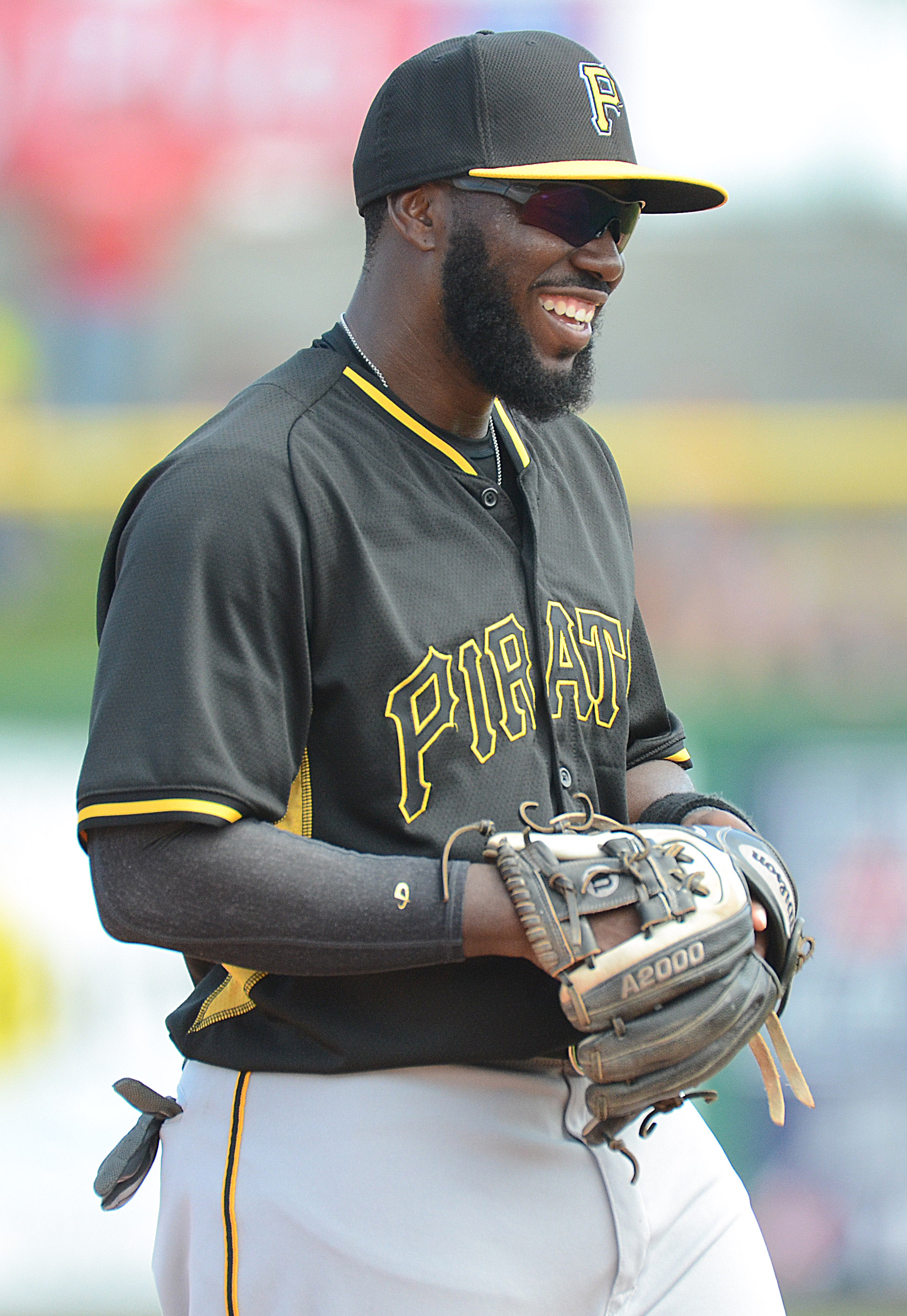
Harrison, who is represented by MSM Sports, will take home a $1MM signing bonus. After earning his previously agreed-upon $2.8MM salary this year, he will earn $5MM (2016), $7.5MM (2017), and $10MM (2018). The options are worth $10.5MM ($1MM buyout) and $11MM ($500K buyout). The options can each increase by up to $1MM depending upon escalators based upon MVP voting, accounting for the rest of the achievable value.
Harrison, 27, broke out last year for the Bucs after several years shuttling between the big leagues and upper minors. Despite previously carrying a sub-.700 OPS, Harrison slashed .315/.347/.490 in 550 plate appearances in 2014, adding 13 home runs and 18 stolen bases.
Playing excellent defense at multiple infield and outfield positions not only helped enhance Harrison’s overall productivity, but makes him a highly versatile piece moving forward. In the aggregate, Harrison posted 5.3 rWAR and 5.0 fWAR last year.
That elite contribution came at an opportune time, as it landed Harrison a $2.8MM contract in his first year of arbitration eligibility. In exchange for promising away the rest of his arbitration years and three seasons of free agent eligibility (two via options), Harrison now pockets an additional $24.5MM in guaranteed money.
MLBTR’s Steve Adams took a look at Harrison as an extension candidate back in September. After a detailed breakdown of his surprising emergence, Steve explained the difficulties that the two sides might encounter in valuing a new contract. A new factor was introduced when the Bucs landed Korean infielder Jung-ho Kang.
But with Harrison showing no signs of slowing down over a solid spring, team and player were able to bridge any differences and find common ground. In the end, Pittsburgh will commit slightly more than the Indians did last year for Michael Brantley but will pick up an additional season of control in the second option. The club will now enjoy the wide flexibility that Harrison offers in planning their next several offseasons, while hoping that his contract pays off as much as Brantley’s has.
Detractors will note that Harrison benefited from a .355 BABIP last year. But he has traditionally carried a high mark in the minors and still would have had plenty of value on offense — to say nothing of the other elements of the game — had that number been lower. If Harrison can remain even a slightly above-average hitter, he ought to justify his contract and then some.
All links to Twitter: Jon Heyman of CBSSports.com first reported the total value of the deal. Ken Rosenthal of FOX Sports reported details while Rob Biertempfel of the Pittsburgh Tribune-Review also reported financial details and Bill Brink of the Pittsburgh Post-Gazette added the deal’s escalator clause.
Photo courtesy of USA Today Sports Images.
Huston Street, Angels Still Open To Extension
APRIL 7: Street is still interested in an extension with the Angels, but he told MLB.com’s Alden Gonzalez (Twitter links) and other reporters that he’s re-hired former agent Alan Hendricks to handle the bulk of the negotiations now that the season has started. “We are close enough that I’m still engaged,” said Street.
APRIL 6: Angels GM Jerry Dipoto tells reporters, including MLB.com’s Alden Gonzalez (Twitter link), that an extension with closer Huston Street is “still possible.” Negotiations have remained “friendly,” he adds,’ noting that “Opening Day was never a deadline.”
Talks have been well-publicized, with the self-represented Street making clear that he knows what kind of deal he wants to give up the right to free agency after this season. The sides have not seemed to be close on numbers this spring, Mike DiGiovanna of the Los Angeles Times tweets.
Street, 31, does not have the kind of obscene strikeout numbers that the game’s best relievers tend to carry. Nevertheless, he has produced impeccable results, even though ERA estimators suggest he has outperformed his true contributions. Since leaving the Rockies for less hitter-friendly environs after the 2011 season, Street has thrown 155 innings of 1.97 ERA ball with 8.7 K/9 against 2.3 BB/9.
Valuing Street as an extension candidate or free agent remains challenging, however. Aging relievers with a fair bit of mileage are notoriously fickle investments, and Street has missed some time over the years with shoulder and lower-leg issues (among other things). Then again, he has never relied on velocity and still throws as hard as ever (high 80s).
Athletics To Sign Cody Ross
The Athletics will sign outfielder Cody Ross once he officially clears release waivers tomorrow, reports Ken Rosenthal of FOX Sports (on Twitter). Oakland will be responsible for the pro-rated portion of the league minimum in terms of Ross’ salary, while the D-Backs, who released him this weekend, will be on the hook for the remainder of his $8.5MM salary and $1MM option buyout.
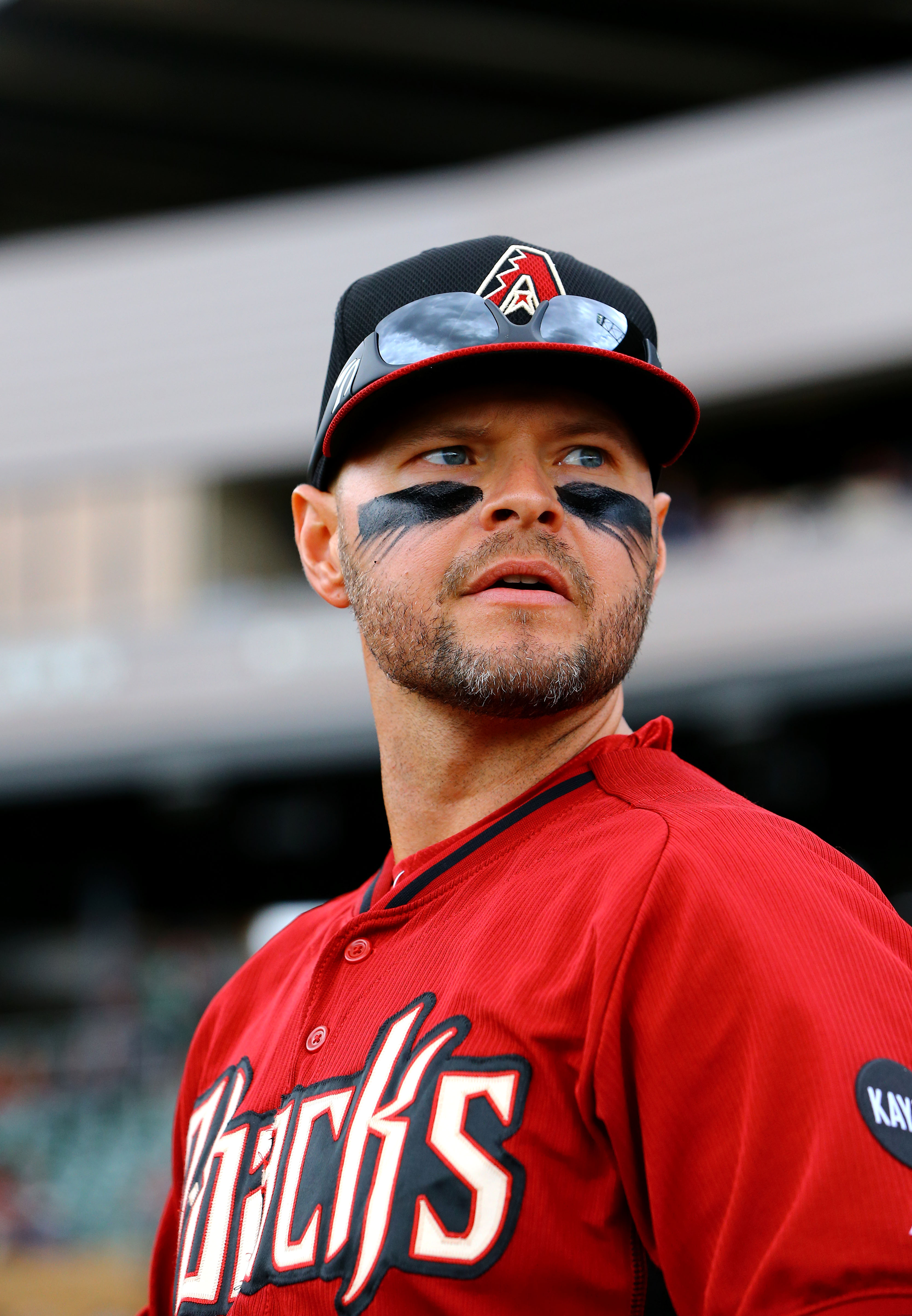
Last night, Susan Slusser of the San Francisco Chronicle reported that the A’s were on the hunt for veteran outfielders in the wake of surgery that will sideline Coco Crisp for up to two months, and Oakland clearly acted quickly upon that interest, reaching an agreement with Ross’ agents at Relativity Baseball.
Ross, 34, signed a three-year, $26MM contract with the D-Backs in the 2012-13 offseason that proved to be a bust, due largely to injuries. A .267/.326/.481 batting line and 22 homers with the 2012 Red Sox earned him that sizable deal, but Ross batted just .268/.322/.378 in 177 games (570 plate appearances) over the past two years in Arizona. Calf injuries and hip surgery limited his ability to stay on the field, and the presence of A.J. Pollock, David Peralta, Ender Inciarte, Mark Trumbo and Yasmany Tomas in the D-Backs organization left Ross without a spot on the roster.
Oakland figures to deploy Ross primarily in left field, as a platoon of Craig Gentry and Sam Fuld will handle center field, and Josh Reddick will be the primary right fielder once he is activated from the disabled list. Speedster Billy Burns and Rule 5 pick Mark Canha seem to be the likeliest candidates to be squeezed out of playing time, but the A’s regularly rotate a mix of players throughout various positions on the diamond, with many players serving in more of a part-time role than in true full-time capacities.
Ross is particularly effective against left-handed pitching, having authored a .294/.360/.557 batting line when holding the platoon advantage over the duration of his 11-year Major League career. From a defensive standpoint, he’s experienced at all three positions, but he hasn’t seen significant time in center field since 2010. He’s graded out as a plus corner outfielder in his career, per Defensive Runs Saved and Ultimate Zone Rating, though his marks in the eyes of those metrics have been skewed by the aforementioned injuries to his lower half in recent years.
Photo courtesy of USA Today Sports Images.