
Extension Candidate: Josh Harrison
Asked to create a list of candidates for the 2014 NL batting title five months ago, few would have seriously suggested Pirates utilityman Josh Harrison. However, it’s September 11th, and the .318 mark that Harrison carried into the day paced the National League. A decline in performance for Pedro Alvarez and an eventual season-ending injury for the slugging third baseman have opened the door for Harrison to serve as the club’s everyday option at the hot corner down the stretch — an opportunity on which he has capitalized. Though the 27-year-old Harrison had never even topped 276 plate appearances prior to this season, he’s tallied 472 and should finish the season well north of 500.
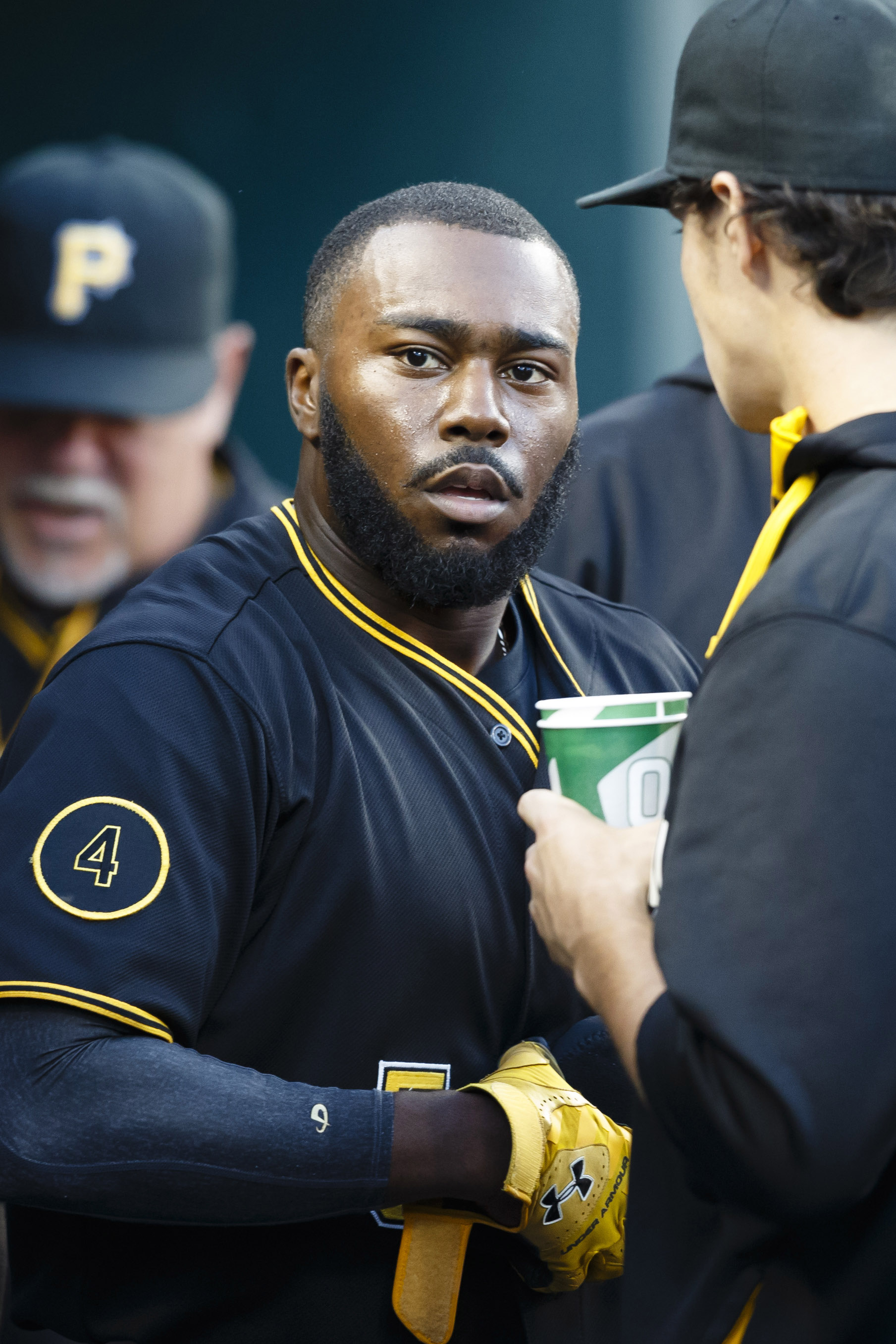 The Pirates acquired Harrison with little fanfare in the 2009 trade that sent Tom Gorzelanny and John Grabow to the Cubs and watched him produce steady batting average and on-base percentage marks as he ascended the minor league ranks. However, while his glovework graded out favorably heading into the season, he also carried a career slash line of just .250/.282/.367 into 2014.
Harrison hasn’t drastically changed his approach at the plate — his swing and contact rates are similar to his previous marks — but he’s slightly increased his walk rate, cut down on his pop-ups and laced line drives at a career-high rate. On top of that, Harrison has found some power despite never hitting more than six homers in a minor league season. He’s swatted 13 long balls and posted a .196 isolated power mark even though he plays at PNC Park, which is known to significantly diminish right-handed pop. The end result has been an outstanding .318/.351/.514 batting line to go along with those 13 homers, 17 steals and strong defensive marks.
Harrison has cleared three years of Major League service time now and will be eligible for arbitration this offseason. Clearly, an NL batting title, 15 or so homers and 20 or so steals will help his agents at Millennium Sports Management make a strong case. However, first-time arb salaries are based on a player’s entire career to that point, unlike second- and third-time arb salaries which are based more on a player’s most recent season. With the agents likely touting an elite platform season and the team likely pointing to earlier seasons to drive the cost down, a multi-year contract might be worth examining. Pittsburgh would get cost certainty, while Harrison would receive financial security in the event that he does not replicate his brilliant 2014.
Of course, from the Pirates’ point of view, they may look at Harrison as a player whose most consistent attributes are defense and baserunning — two aspects that, while valuable, are not highly rewarded in arbitration. While he does have a career-high in homers, the Pirates could also look to Harrison’s average fly-ball distance of 279.98 feet — 136th in the Majors according to BaseballHeatMaps.com — and the fact that seven of his 13 homers fall into the “just enough” category on ESPN’s Hit Tracker. Those two stats suggest that he may have difficulty sustaining this level of power, which would subsequently deflate his arb prices in future cases. A low-payroll team like the Pirates may express hesitancy at over-committing in the event that his power numbers won’t stay this high.
As such, Harrison and the Pirates may have trouble reaching common ground should either side look to pursue a long-term deal that buys out free agent years. The Pirates will cite Harrison’s short track record and reliance on defense and baserunning to provide value. Harrison’s agents, meanwhile, will likely position him as a breakout player and could point to five- or six-year pacts signed by other infielders in the past year or so. However, even a similar late bloomer like Matt Carpenter had an excellent 2012 season and a fourth-place MVP finish in 2013 before signing his six-year, $52MM contract. Harrison has just one elite season.
While Harrison isn’t the first player to jump from utility player to All-Star (though the feat certainly isn’t common), few, if any players have found themselves in his situation and his service bracket and ultimately inked a long-term deal. A look at extensions for infielders with three to four years of service time shows few deals that serve as comparables. Pablo Sandoval signed a three-year, $17.5MM to buy out his arb years at the same stage of his career, but he had a much better offensive profile at that point. Elvis Andrus‘ original three-year, $14.4MM extension was signed when he had an even three years of Major League service. He lacked an offensive season in the vein of Harrison’s excellent 2014, but he had a longer track record of providing value.
The Pirates are one of baseball’s most cost-conscious teams, and as such there would seem to be some benefit to securing Harrison’s arbitration paydays, and for a player with no track record prior to 2014, I’d think that holds some appeal to him as well. Perhaps the two sides could work out a three-year deal in the $15-16MM range to provide Harrison with a lifetime of financial security but still position him to hit free agency at a relatively young age in search of a significant payday. While Pittsburgh would undoubtedly have interest in adding a club option that could push the total value of the contract into the Michael Brantley range (four years, $25MM) if exercised, that doesn’t seem to be a worthwhile trade-off for player and agent, even if the buyout was fairly significant.
Beyond Harrison’s three arbitration years, the situation feels to this writer like one in which the team’s lack of margin for error (due to payroll constraints) makes betting on Harrison’s surprise breakout a bit too risky to pay him like the late-blooming star he could very well be. Of course, there’s risk for the team to pass on a long-term deal as well; if Harrison is capable of sustaining something close to this level of production, his price tag on a long-term deal a year from now could exceed that of Carpenter.
Photo courtesy of USA Today Sports Images.
Red Sox Preparing For Major Free Agent Spending
Red Sox chairman Tom Werner said today in an appearance on WEEI’s Dennis & Callahan (via WEEI.com’s Jerry Spar) that his club is prepared to spend a significant amount of money on the upcoming free agent market. “[W]e are determined to get back to being in first next year,” said Werner.
Citing the “extreme flexibility” that the club was able to achieve in the famous 2012 August blockbuster with the Dodgers, Werner said that the organization is prepared to open the pocketbook this winter. “I wouldn’t say that we have limitless money, but we’ve got a lot of money to spend and we’re determined to go into the free agent market and improve the team.”
Indeed, after entering this year with about $156MM in MLB payroll, about $20MM off of the team’s 2012 high water mark, Boston has just under $106MM committed for 2015 and does not have any high-dollar arbitration cases to account for. But the team’s true flexibility is all the more evident looking further into the future: it has annual guarantees of no more than about $37MM on the books past next year.
So how will the team look to allocate its future resources? In part, it seems, the organization may have added motivation to invest in established players to ensure a quality product. (Werner called this season “a nightmare,” and noted that late-season games are “just not a good experience for the fans.”) Boston went into this season hoping to make another World Series run on the back of repeat performances from veterans and steps forward for younger players. “I know it’s always difficult to break a few rookies into your lineup,” acknowledged Werner. “… But I think we probably put too much stock in the replacements that we expected to come out and perform.” Nevertheless, Werner said that he and the rest of the organization remains confident that youthful contributors like Xander Bogaerts and Mookie Betts will play an important role in the immediate future.
Immediate priorities will, of course, be dictated in part by the team’s recent actions. Dealing away free agent-to-be Jon Lester, rather than extending him, created space at the top of the rotation but also brought in Yoenis Cespedes for at least one full season at Fenway. Likewise, Allen Craig provides a veteran bounceback candidate in the outfield. And the recent signing of Cuban free agent Rusney Castillo also adds to the crowded mix of outfield options.
That leaves the obvious area of immediate focus on pitching. “We know we have to add some front-line talent,” said Werner. “We spent some time over the last few weeks talking about exactly what we can do to improve. I think that our trades at the end of July attacked the fact that we had a lack of offense. … But we know we need some front-line pitching talent.” It is worth noting that, in addition to parting with veteran starters Lester and John Lackey, the club will also need to replace (or bring back) key relievers such as Koji Uehara and Andrew Miller (among others).
Reds Acquire Shackelford, Astin To Complete Broxton Trade
The Reds announced that they have acquired right-handers Kevin Shackelford and Barrett Astin from the Brewers to complete the Jonathan Broxton trade. Cincinnati originally sent Broxton to Milwaukee in exchange for a pair of players to be named later on Aug. 31 — the last significant deal before the deadline for newly acquired players to be eligible for postseason play.
Shackelford and Astin ranked 21st and 22nd, respectively, among Brewers prospects heading into the 2014 season, according to Baseball America. However, neither player cracked Milwaukee’s top 20 list on MLB.com’s midseason list.
The 25-year-old Shackelford is the more advanced of the two prospects, as he reached Double-A this season and posted a combined 3.69 ERA with 5.2 K/9 and 2.7 BB/9 in 70 2/3 relief innings between that level and Class-A Advanced. BA felt that he should have reached Triple-A, if not the Majors, this season in their preseason scouting report, but Shackelford’s Double-A struggled (4.86 ERA in 50 innings) may have held him back. BA noted that he can touch 97 with his fastball and gets whiffs on his slider, making him a potential late-inning reliever. They did, however, note that the slider can be inconsistent — something he’ll likely look to improve upon in 2015. However, the fact that he’ll turn 26 next season and has yet to reach Triple-A suggests that Shackelford is far from a sure thing to end up as a consistent piece in the Cincinnati bullpen.
Astin, 23 next month, was the Brewers’ third-round pick in 2013. He served as Arkansas’ closer as the team pushed to the College World Series, and BA noted that while he may not be durable enough to remain a starter, he could move quickly as a reliever. Indeed, Astin posted a 5.55 ERA as a starter this season in 96 2/3 innings, but he turned in a terrific 2.27 ERA in 26 relief innings. Overall, he posted a 4.96 ERA with 6.0 K/9 and 2.7 BB/9 in 121 1/3 innings at Class A.
While neither prospect is particularly highly regarded, GM Walt Jocketty picked up a pair of arms that could potentially help his bullpen within the next two years, and he shed more than $11MM in salary in the process. To this point, Broxton has done his job for the Brewers, firing four shutout innings with four strikeouts and no walks, helping to bridge the gap to closer Francisco Rodriguez.
Mets Notes: Payroll, Roster, Fences, Lawsuit
While the Mets look to have primed themselves for a potential run next year, the organization’s expectation is that payroll will remain in the low-to-mid-$80MM range, reports ESPN.com’s Buster Olney (Insider link). A major portion of that (just over $54MM) is already promised to veterans David Wright, Curtis Granderson, Bartolo Colon, and Jon Niese. And several players — including Daniel Murphy, Bobby Parnell, Dillon Gee, and Lucas Duda — will be in line for sizeable salaries through arbitration. GM Sandy Alderson said recently that the team will “have some flexibility,” Olney says it seems likely that the front office will need to look for buy-low options to fill its various areas of need.
Here’s more from New York:
- The Mets face a fairly significant upcoming roster crunch, writes Adam Rubin of ESPNNewYork.com. Players like Wilmer Flores, Jenrry Mejia, Kirk Nieuwenhuis, Andrew Brown, and Cesar Puello will be out of options for the first time. And the 40-man will remain full heading into the fall since the team has only two free agents (Daisuke Matsuzaka and Bobby Abreu) and needs to accomodate returns from the 60-day DL (Matt Harvey and Bobby Parnell). Creating roster space for new additions and Rule 5 protection will require some tough, early choices for New York.
- With no indication from the Mets that a large payroll expansion is coming, the club may hope for a production boost from a combination of internal improvements and shortened fences, writes Newsday’s Marc Carig. Though bringing in the fences again would obviously impact opponents as well — and has been in the works for some time — Carig notes that there could be some home-team benefits. In particular, reeling in a spacious right-centerfield might result in some additional home runs, given that several of the club’s best hitters thrive hitting to that alley. And if the team’s own rotation can reach its potential, the corresponding benefit to the opposition may not match the Mets’ own yield. For his part, Alderson emphasizes that the changes to dimension are designed solely to enhance the fan experience at Citi Field.
- As it looks to transition back into contention, the club is facing a potentially difficult and embarrassing legal situation, as Selim Algar of the New York Post reports. Former head of marketing and ticket sales Leigh Castergine — the organization’s first-ever female senior vice president, per the report — has sued the club and COO Jeff Wilpon (son of owner Fred Wilpon) for allegedly firing her based on moral opposition to her becoming pregnant without being married. The suit apparently includes numerous specific details that, if proven, could conceivably have important implications for the team’s front office structure.
Yasmani Tomas Cleared By OFAC, Still Awaiting Free Agency
24-year-old outfielder Yasmani Tomas has been cleared to sign by the United States Office of Foreign Assets Control (OFAC), MLB.com’s Jesse Sanchez reports on Twitter. Tomas, who is aiming to be the latest high-dollar Cuban ballplayer, still requires a grant of free agency from MLB before he can agree to a contract.
Ranking Tomas seventh among prospective free agents, MLBTR’s Tim Dierkes wrote recently that the intriguing talent could draw wide and varied interest around the game. As Ben Badler of Baseball America explained in reporting his defection, Tomas projects as a power-hitting corner outfielder with below-average speed. Though he may not be quite ready to appear immediately in an MLB lineup, the consensus seems to be that he is at least very nearly big league-ready.
Ultimately, Tomas offers the promise of a unique combination of power and age for a market in which both are treasured commodities. Given his age and experience, Tomas will not be subject to international spending limits, meaning that he will be a true free agent when he receives his designation from the league.
Two of Tomas’s countrymen — Rusney Castillo and Jose Abreu — recently landed deals guaranteeing better than $10MM a year over seven and six years, respectively, though both players were considered slightly more polished while also being older. Earlier Cuban ballplayer signings included younger, high-upside outfielders like Yasiel Puig (seven years, $42MM) and Jorge Soler (nine years, $30MM).
Tomas, of course, is a different player, with an overall profile that shares some attributes with each of those rough comparables. If nothing else, though, the steady rise in spending on Cuban emigres — related, in some part, to the remarkable MLB success of the above-listed and other Cuban players — shows that clubs are not hesitating to plunk down big dollars for international talent.
2015 Vesting Options Update
The state of next year’s free agent class will be impacted by whether or not players with vesting options in their contracts achieve the necessary playing time to trigger those conditional options. As we near the end of the season, here’s a rundown of these players and their progress toward triggering their options …
- Nick Punto, Athletics: Punto has a $2.75MM club option that will automatically vest if he spends fewer than 30 days on the disabled list, assistant GM David Forst told reporters at the time of the signing. Though Forst did add that there are other ways for Punto’s option to vest, the health route is no longer available. Punto was only activated yesterday — ten days into the September active roster expansion — after going on the DL on August 3rd. If the option doesn’t vest, the A’s have the choice of picking him up at $2.75MM or buying him out for $250K.
- Rickie Weeks, Brewers: Weeks has an $11.5MM option that won’t be vesting, as he would have needed to total 600 PA in 2014 or 1,200 PA in 2013-14 and finish the season healthy. He has just 255 PAs on the season, so he’ll fall well shy of that mark. Weeks will also fall shy of reaching 400 PAs, which would have entitled him to a $1MM buyout of his option.
- Jimmy Rollins, Phillies: Rollins’ option vested earlier this year when he reached 1,100 plate appearances over 2013-14. (He has also made 600 trips to bat in 2014, an independent basis for triggering the provision.) That clause, however, also required that he not finish the year on the disabled list, and Rollins left yesterday’s game with a hamstring injury. Word is that Rollins should be able to return, but with just three weeks left even a minor setback could well end his season. Nevertheless, Philadelphia would need to go out of its way to place him on the DL at this point, with active rosters expanded. And, in any event, the option would still vest if a mutually agreed-upon doctor deemed Rollins ready to start the 2015 season.
- Dan Haren, Dodgers: Haren needs 180 innings to trigger a $10MM player option for the 2015 season. Heading into his scheduled outing this evening, he has already notched 162 frames. Haren should be in line for at least three more starts (including tonight’s) before the end of the month, and maybe another depending upon how the club approaches the last few games of the year. Having averaged 5.79 innings per start on the year, it will be incumbent on Haren to pitch his way to the option — especially in the midst of a playoff race and backed by a well-stocked bullpen.
- Mike Adams, Phillies: Adams’ $6MM club option for 2015 would have vested with 60 innings pitched in 2014, but he’s obviously not going to get there with just 17 2/3 innings in the tank. Adams has thrown just 42 2/3 innings in his season-and-a-half with the Phils, and it seems highly unlikely that the team will pick him up at $6MM given his injury troubles. He should, however, be an attractive buy-low candidate given his general success when on the field.
- Rafael Soriano, Nationals: Soriano’s $14MM club option vests with 120 games finished over 2013-14. While that always seemed a longshot, any realistic hope was snuffed out when Soriano lost his closing gig to Drew Storen, the man he replaced when he signed on with Washington. Whether or not Soriano makes it back into the 9th inning role over the next few weeks, he now sits at 104 games finished over the last two seasons, making it all but impossible for him to trigger the vesting provision. With the Nationals all but certain to decline their club option on Soriano, he should make for an interesting free agent to watch.
- Kyuji Fujikawa, Cubs: The Cubs hoped that Fujikawa, one of the best relievers in Japanese history, would help to fortify their bullpen when they signed him to a two-year, $9.5MM contract in the 2012-13 offseason. Instead, both player and team received a hefty dose of bad luck when Fujikawa needed Tommy John surgery after just 12 innings last season. He has a vesting option based on games finished, but the 33-year-old has made it back for only 10 1/3 innings in 2014 and surely won’t be crossing that (unreported) threshold.
- Sean Burnett, Angels: Burnett’s $4.5MM club option vests if he appears in a total of 110 games between 2013-14, but like Fujikawa, he’s been plagued by injury and has no chance of that happening. Burnett has appeared in just 16 games total over the past two seasons and underwent Tommy John surgery earlier this year. The Halos will certainly be paying the $500K buyout on his club option.
- Scott Downs, White Sox: Downs had a $4MM vesting option that would have vested with 55 appearances, as MLBTR’s Tim Dierkes reported in June (via Twitter). Though he appeared to be headed in that direction earlier in the year, the White Sox cut bait with Downs and his then-6.08 ERA. He owns a 3.55 mark over 12 2/3 innings with the Royals — who signed him to a separate, minor-league deal — and has now thrown in 53 games, but the vesting clause is now a moot point.
Rosenthal On Braves, Martin, McEwing, Smyly
After Braves CEO Terry McGuirk told Jeff Schultz of the Atlanta Journal-Constitution that “everyone is accountable” in Atlanta, Ken Rosenthal of FOX Sports wonders if General Manager Frank Wren and manager Fredi Gonzalez could be in trouble. Gonzalez oversees an offense that often looks lost and is next-to-last in the National League in runs per game. Wren, meanwhile, gave contracts to second baseman Dan Uggla (who has since been released) and center fielder B.J. Upton that didn’t pan out.
While anything is possible given their recent struggles, people in the industry would be surprised if the Braves made major changes, unless tension is building underneath the surface that people aren’t aware of. Wren is close with McGuirk, major league sources say, and Gonzalez was Wren’s hand-picked choice to replace Bobby Cox. Here’s more from today’s column..
- The Pirates want to keep Russell Martin, but the veteran’s price in free agency could be too rich for their blood. The 31-year-old will be the best and youngest catcher on the market by far and even though catchers historically don’t cash in in free agency, he won’t be had for another two-year, $17MM bargain. He won’t garner something like Miguel Montero‘s five-year, $60MM extension but he should at least beat the three-year, $26MM free-agent deal that the Carlos Ruiz signed last winter entering his age 35 season. Pittsburgh could try to keep Martin with a one-year, ~$15MM qualifying offer, but as Rosenthal notes, they didn’t do that with A.J. Burnett last winter. Martin ranked ninth in Tim Dierkes’ most recent Free Agent Power Rankings for MLBTR. Dierkes suggested Martin could receive a four-year deal north of $50MM.
- Rosenthal wouldn’t be surprised if Joe McEwing winds up as the next manager of the Diamondbacks. Even if he doesn’t land with Arizona, White Sox officials say McEwing’s intelligence and energy will make him a strong candidate for other jobs.
- Drew Smyly is benefiting from the Rays‘ focus on analytics. Upon joining the team, the Rays gave the 25-year-old some keen instruction and asked him elevate his fastball more. Those tips have led to some great work by Smyly in Tampa Bay and Rosenthal wonders why the Tigers didn’t pick up on some of the same things.
- The Orioles lost catcher Matt Wieters, but the makeshift combination of rookie Caleb Joseph and Nick Hundley, acquired from the Padres in May, has proven quite adequate. The two have combined for an OPS right around the American League average at catcher.
- While the Mets like second baseman Dilson Herrera, Rosenthal says that doesn’t mean they should trade Daniel Murphy. No team will give the Mets comparable offensive talent for Murphy and the smart move would be to instead sign him to an extension.
Wily Mo Pena Seeks MLB Return For 2015
Slugger Wily Mo Pena is hoping to land an MLB contract for the 2015 season, MLBTR’s Tim Dierkes reports on Twitter. Soon to turn 33, Pena — who last saw MLB action in 2011 — has received interest from at least three clubs to date.
Since leaving North American baseball behind before the 2012 season, Pena has become one of the better power hitters in Japan. After a strong performance in his first season, he struggled in limited action last year. But Pena has rebounded to post a .260/.360/.514 slash with 28 home runs over 472 plate appearances in 2014. More impressively, perhaps, he has brought his strikeout-to-walk ratio (98 K against 56 BB) down to career-best levels.
Pena was said to have had options for playing in the states over the offseason, but chose instead to join Nippon Professional Baseball’s Orix Buffaloes. (His first two years in Japan were spent with the Fukuoka Softbank Hawks.) Despite his impressive power, Pena never firmly established himself as an everyday player at the MLB level. He has seen action in eight campaigns, swatting 84 long balls and slashing .250/.303/.445 across 1,845 turns at the plate.
Free Agent Stock Watch: Asdrubal Cabrera
Indians-turned-Nationals middle infielder Asdrubal Cabrera will finish his eighth year of MLB action at just 28 years of age, presenting a rare youthful free agent option. He can hit and play up the middle. Yet he left Cleveland as something of a disappointment, and has not generated nearly as much hype as was once expected heading into his first crack at free agency. Once expectations are moderated for reality, however, it is apparent that Cabrera remains a rather intriguing player to watch on the coming market.
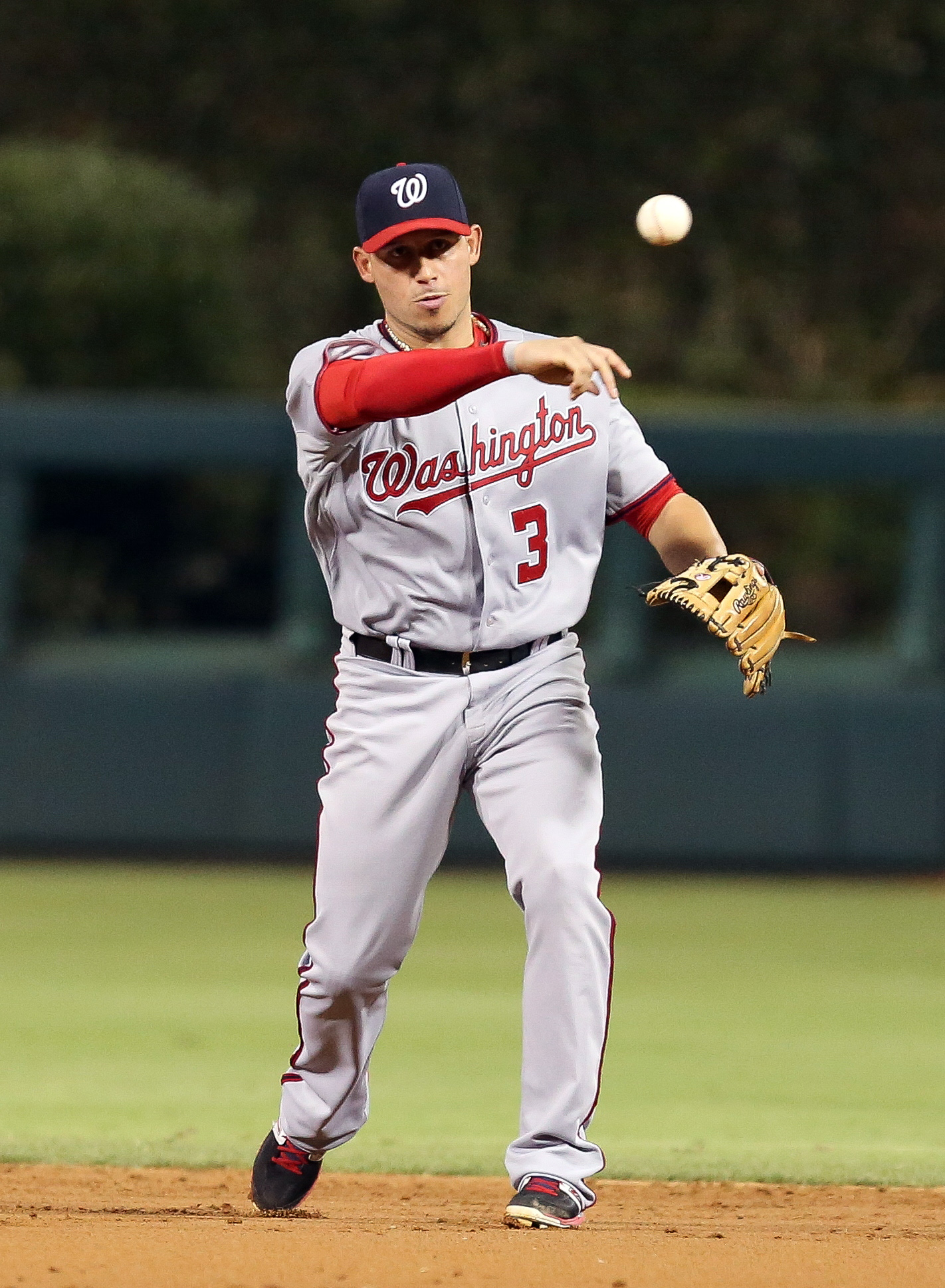
Cabrera’s free agent case remains difficult to figure. Over the 2007-12 period, he slashed .279/.342/.416 while manning an up-the-middle defensive spot (mostly, shortstop). Though advanced metrics never viewed him as even an average fielder, Cabrera delivered some value on the basepaths and was at least a solid, above-average regular in the aggregate.
That account of Cabrera took something of a turn, however, more recently. Over 978 plate appearances with Cleveland since the start of 2013, Cabrera’s OPS fell beneath the .700 level, making for a below-average bat that significantly reduced his overall appeal.
Nevertheless, in need of a veteran infielder down the stretch, the Nationals made a move to acquire Cabrera at the trade deadline. Notably, the Indians agreed to pay all of Cabrera’s salary in the deal, while acquiring an interesting but little-hyped prospect in Zach Walters. On a busy deadline day, the swap looked like a relatively low-impact, gap-filling move for Washington.
Since heading to the NL East-leading Nats, however, Cabrera has looked energized. He owns a .252/.341/.443 slash in the first 133 National League plate appearances of his career, including five home runs and two stolen bases. His resulting 115 OPS+ looks much more like the marks he was putting up in his heyday. Nearly as importantly, perhaps, Cabrera has looked comfortable at second, racking up 284 errorless innings at the position.
Without question, Cabrera’s late-season run of success at the plate will have a positive impact on his free agency. He has at least suggested the possibility that he is still capable of being the hitter of old; whether he’s convinced scouts, of course, remains to be seen.
The defensive returns, on the other hand, are somewhat more ambiguous. To be sure, proving that he is capable of solidly handling the keystone is a nice feather in Cabrera’s hat. At the same time, misplays have not been the major knock on his glove. Range is the primary concern, and he’s continued (obviously, in a short sample) to receive well-below-average marks in that respect.
So, where does Cabrera fit into the middle-infield market? Things are somewhat more crowded over at shortstop, where J.J. Hardy probably sets the standard and Jed Lowrie and Stephen Drew also present possible starting-caliber options. And that assumes that Hanley Ramirez is pursued primarily as a third baseman; if enough serious bidders look at him as a shortstop, the market would look even more crowded.
But Cabrera is perhaps best positioned to benefit from a lack of options at second, given his arguably superior bat (to all but Ramirez, at least) and recent experience at the keystone. Clubs looking to add a new second bagger will find limited possibilities on the market; as things stand, Emilio Bonifacio is probably the most appealing candidate.
Cabrera also has added appeal given that he will not turn 29 until the offseason, making him the youngest shortstop-capable player available to the highest bidder. That holds significant value, particularly when viewed alongside the fact that he does not have any significant recent injury history. Cabrera will also come free and clear of draft compensation, as his mid-season trade ensures that Washington will not be able to make him a qualifying offer. Particularly given the down years at the plate from Hardy (at least in terms of power production), Lowrie (who has been better in the second half), and Drew (who has been awful since his mid-season signing), Cabrera stacks up reasonably well.
In the aggregate, though Cabrera may never take the final step forward to become a truly premium ballplayer, he has shown the ability to produce at his earlier levels and should draw fairly significant and potentially broad interest. Depending on his performance down the stretch and in the post-season, he still has some capacity to climb up free agent boards and become a sought-after asset heading out of the 2014 season.
Angels Designate Ryan Wheeler For Assignment
The Angels have designated corner infielder Ryan Wheeler for assignment, Jeff Fletcher of the Orange County Register reports (Twitter link). The move created a 40-man roster spot for right-hander Jairo Diaz, whose contract was purchased by the Halos in corresponding move.
A fifth-round pick of the Diamondbacks in the 2009 draft, Wheeler was dealt to the Rockies in exchange for southpaw Matt Reynolds in November 2012 and then was claimed off waivers by the Angels last month. Wheeler has a .233/.280/.335 slash line and three homers in 225 career PA with Arizona and Colorado and hit well for the Angels’ Triple-A affiliate, slashing .326/.373/.402 in 102 PA at Salt Lake.
Wheeler joins fellow Angel Michael Kohn in “DFA Limbo,” and the MLB Trade Rumors DFA Tracker tells us that four other players (the Royals’ Blake Wood and Chris Dwyer and the Blue Jays’ Matt Hague and Darin Mastroianni) are also awaiting resolution.