
Trey Mancini Opts Out Of Marlins Contract; Curt Casali Won’t Make Roster
Veteran first baseman/outfielder Trey Mancini has opted out of his minor league deal with the Marlins, manager Skip Schumaker told the Miami Herald’s Jordan McPherson and other reporters. Catcher Curt Casali has also been told that he isn’t making the Opening Day roster, but Casali has yet to decide on whether or not to exercise his own standard opt-out clause as an Article XX(B) free agent.
Mancini joined the Cubs on a two-year, $14MM free agent contract last offseason, and since the Cubs waived him last August, any team that uses Mancini on a big league roster is only obligated to pay him a minimum salary (with Chicago still on the hook for the rest of his $7MM salary for 2024). This made Mancini even more of a flier than your standard minor league signing, though the Marlins didn’t see enough in Mancini’s Spring Training performance to give him a roster spot. Mancini hit an unspectacular .257/.333/.371 over 39 plate appearances this spring.
After missing the 2020 season due to a battle with colon cancer, Mancini made a triumphant return in 2021 and won Comeback Player Of The Year honors while batting .255/.326/.432 over 616 PA with the Orioles. His longtime tenure in Baltimore ended when the O’s dealt Mancini to the Astros at the 2022 trade deadline, and while Mancini earned a World Series ring with Houston, he didn’t contribute much at the plate during the regular season or in the playoffs. The struggles continued with the Cubs in 2023, as Mancini hit only .234/.299/.336 over 263 PA.
Mancini just celebrated his 32nd birthday earlier this week, and now again finds himself at something of a crossroads in his career. His track record and reputation as a clubhouse leader should land him another minor league deal in another organization, though Mancini’s most recent results aren’t particularly encouraging.
Casali was another minor league signing for the Marlins this offseason, brought in as catching depth behind Miami’s planned tandem of Christian Bethancourt and Nick Fortes. Since that isn’t exactly a proven set of backstops, Casali might well choose to pass on his opt-out decision and stay at Triple-A in the hopes of receiving a call-up at some point. That said, any number of teams could have catching vacancies opening up due to injuries or end-of-spring cuts, so Casali find be able to find a more preferable opportunity elsewhere.
A veteran of 10 MLB seasons, Casali has hit .220/.314/.380 in 1454 PA. Casali has been a few impressive years at the plate as a part-timer with the Reds and Rays, but the 35-year-old hasn’t hit much in the last three seasons and is generally known more for his defense and game-calling prowess.
Phillies Acquire Zac Houston From Rays
The Phillies have acquired right-hander Zac Houston from the Rays in exchange for cash considerations, Marc Topkin of the Tampa Bay Times reports (X link). Topkin describes the trade as a side effect of the Rays’ crowded Triple-A pitching staff, as Houston was apparently squeezed out by the team’s desire to give more innings to younger pitchers.
The 29-year-old Houston is a career minor leaguer, beginning his pro career as an 11th-round pick of the Tigers in the 2016 draft. (Phillies president of baseball operations Dave Dombrowski had already parted ways with the Tigers almost a year before Houston’s draft date.). Working almost exclusively as a reliever, Houston has a 3.18 ERA over 305 2/3 career innings in the minors, though he has only a 4.81 ERA over 101 frames of Triple-A action.
Houston has a whopping 35.46% strikeout rate, but an equally large 12.86% walk rate across his minor league career. The righty’s control problems have existed since the start of his pro career, and his walk problems have ticked upwards as Houston has moved up the minor league ladder. The obvious strikeout ability makes him an interesting project for the Phillies’ pitching development staff, as Houston could be a very useful bullpen weapon if he can pair his knack for missing bats with even average control.
White Sox Release Jesse Chavez
The White Sox announced that veteran reliever Jesse Chavez has been released. Chavez inked a minor league deal last month, but as per his status as an XX(B) free agent, the White Sox had until yesterday to add Chavez to the Opening Day roster or else the right-hander could opt out.
Kevin Pillar and Mike Moustakas were in similar situations prior to being released yesterday, and as with Chavez, it isn’t clear if any of these players actually triggered their opt-outs or if the White Sox simply released them since none were slated for the 26-man roster. The result is effectively the same, as Chavez now re-enters the free agent market as he looks to extend his career into a 17th Major League season.
Chavez is still pitching well beyond his 40th birthday, as he posted a 1.56 ERA over 34 2/3 innings with the Braves in 2023. The righty’s 51.7% grounder rate combined with some good batted-ball luck (.273 BABIP) to help deliver that outstanding ERA, yet Chavez’s 27.1% strikeout rate and 33.3% hard-hit ball rate were also above average. It wasn’t all positive for Chavez, however, as he spent over three months on the injured list after he was hit in the leg with a comebacker.
Chavez said in an interview last month that 2024 is “probably” going to be his last season as a player, as he will then look to stay in the game in a coaching capacity. Given how well Chavez has pitched in each of the last three seasons, it seems almost a lock that another team will sign him to another minor league deal, and another return to the Braves would certainly seem like a possibility. Chavez has already had four separate stints with Atlanta, including three in the last three years alone and a World Series ring as part of the Braves’ 2021 championship team.
Nationals Release Luis Perdomo
The Nationals released right-hander Luis Perdomo earlier this week, as indicated on the team’s official MLB.com transactions page. Perdomo was in Washington’s camp on a minor league contract.
Things seemed to be going swimmingly for Perdomo in his first four spring outings, as he allowed only two hits over four scoreless innings of work. Unfortunately, Perdomo’s fortunes then turned for the worse, as he was charged with six earned runs over his next three appearances and innings pitched, resulting in an overall 7.71 ERA in seven innings. Since the Nationals are in full cut-down mode as they decide their Opening Day roster, Perdomo didn’t make much of a case for himself to crack the 26-man.
Perdomo has a 5.12 ERA over 468 career innings, with all but 23 2/3 of those frames coming with the Padres from 2016-20 when he worked as a starter, reliever, and a mix of both roles as a swingman on the San Diego pitching staff. The groundball specialist missed all of 2021 recovering from Tommy John surgery, and Perdomo then had a 3.80 ERA over 23 2/3 innings with the Brewers in 2022. Milwaukee opted to non-tender Perdomo after the season, and he left MLB entirely to pitch in Japan with the Chiba Lotte Marines in 2023.
Perdomo had an impressive 2.13 ERA over 50 2/3 innings in NPB, which helped pave the way for his return to North American baseball even if he had to settle for a minors deal. He could continue to look for minor league contracts with another team (or even a reunion with the Nats), or Perdomo might again consider a move to an international league.
Marlins To Include Max Meyer On Opening Day Roster
Right-hander Max Meyer will be part of the Marlins’ Opening Day roster, the Miami Herald’s Craig Mish reports (via X). Meyer “has the inside track” to win the fifth starter’s job, Mish writes, which would line the rookie up to face the Angels on April 1 in what would be Meyer’s third career MLB start.
Meyer’s first two big league outings took place in July 2022, with the second appearance ending after just two-thirds of an inning due to some elbow pain. That discomfort was revealed to be a UCL tear, and the subsequent Tommy John surgery kept Meyer sidelined for the rest of the 2022 season and the entirety of the 2023 campaign. Returning to the mound this spring, Meyer has looked very sharp in seven scoreless Grapefruit League innings, with only four hits and a walk allowed.
While Meyer has done well to earn his return trip to the majors, it is fair to say that this opportunity wouldn’t have been available if the Marlins weren’t dealing with a spate of injuries within their projected rotation. Eury Perez (elbow inflammation), Edward Cabrera (shoulder impingement), and Braxton Garrett (shoulder soreness) all look to be starting the season on the injured list, and ace Sandy Alcantara was already ruled out for 2024 due to a Tommy John surgery of his own. Manager Skip Schumaker said last week that “everyone’s on the table” in terms of potential fill-in starters, including Meyer, who had already been optioned to Miami’s minor league camp.
Bryan Hoeing seemed to be the favorite for fifth starter work considering how Meyer and other pitchers were optioned out of the big league camp, yet now it seems like the Marlins will give Meyer a look. Jesus Luzardo, A.J. Puk, Trevor Rogers, and Ryan Weathers will seemingly act as the top four in Miami’s rotation, with Meyer slotting in as the fifth man. It seems possible that Meyer and Hoeing could be paired up in a piggyback type of scenario, if the Marlins wanted to be cautious about limiting Meyer’s innings after such a long layoff.
Despite Meyer’s lost 2023 season, Baseball Prospectus (86th) and Baseball America (89th) still included the 25-year-old on their preseason lists of the top 100 prospects in the sport. Meyer drew a lot of hype coming out of the University of Minnesota, and he lived up to predictions that he would ready for the majors in pretty short order. Meyer posted a 2.77 ERA over 172 career innings in the minors, along with an impressive 28.67% strikeout rate and an 8.79% walk rate that is a little on the high side. The right-hander also had pretty strong grounder rates over his relatively brief time in the minors.
Pirates Release Chase Anderson
TODAY: The Pirates have agreed to release Anderson, Alexander reports (via X), and the veteran righty is now free to sign with any team.
MARCH 22: Right-hander Chase Anderson is expected to trigger an out clause in his minor league contract with the Pirates, reports Ari Alexander of KPRC 2 (on X). If the Bucs don’t add him to the MLB roster, he’d become a free agent.
Anderson is among a host of veterans who faced opt-out decisions on Friday. He’s one of 31 players who had an automatic opt-out right in a minor league deal. That’s a CBA provision for Article XX(B) free agents — typically those with over six years of service time who finished the preceding season in the majors — who sign a non-roster pact more than 10 days before the start of the season. Anderson closed last season with the Rockies before inking a minor league deal with Pittsburgh in February.
The 36-year-old had been competing for a spot at the back of the rotation or as a long reliever. Pittsburgh called him out of the bullpen for three of his four outings this spring. Anderson has fared reasonably well, tossing 11 innings of three-run ball with nine strikeouts and three walks. However, the Bucs have a number of players competing for similar jobs.
Eric Lauer, Domingo Germán, Wily Peralta and Michael Plassmeyer all inked deals with non-roster invites to camp. Prospect Jared Jones might have pitched his way to the top of that group, while the Bucs have a few out-of-options arms (e.g. Roansy Contreras, Bailey Falter, Josh Fleming) who could block the path to middle relief reps.
Anderson tossed 86 1/3 innings at the major league level last season, his highest workload since 2019. Most of that came in Colorado, where he held a rotation spot for the second half. Anderson allowed a 5.75 ERA with a middling 17.5% strikeout rate while pitching his home games at Coors Field.
Mets Designate Phil Bickford For Assignment
The Mets have designated right-hander Phil Bickford for assignment. The move opens up roster space for J.D. Martinez, whose one-year contract with New York is now official.
Bickford came to Queens at last year’s trade deadline, acquired with Adam Kolarek from the Dodgers as a way of restocking a Mets bullpen thinned out by other deals. Over 67 1/3 total innings with L.A. and New York last season, Bickford posted a 4.95 ERA and an above-average 25% strikeout rate, though he allowed a lot of hard contact and his 12.8% walk rate ranked in the bottom fifth percentile of all pitchers.
The Mets brought a ton of new relievers into camp on guaranteed and minor league contracts, making Bickford something of a borderline candidate to make the Opening Day roster. Bickford doesn’t have any minor league options remaining, so the Mets had to go the DFA route in order to remove him from the 40-man roster and potentially send him to Triple-A (if he remains in the organization altogether).
Bickford is set to earn $900K this season after winning an arbitration hearing with New York, though the Mets would only owe 45 days’ worth of termination pay if they released Bickford prior to Opening Day. In some echoes of the Giants’ recent release of J.D. Davis, Bickford’s salary would’ve been fully guaranteed as an arbitration-eligible player if he had reached an agreement with the Mets prior to a hearing, yet going to a hearing meant that Bickford’s salary wasn’t guaranteed unless he made the team’s big league roster.
The Davis situation created some controversy around the league, and it remains to be seen if Davis might yet attempt to file a grievance. As per the CBA clause concerning this transactional tactic, “failure to exhibit sufficient skill or competitive ability” gives a team some leeway in releasing a player who went to an arb hearing, and the Mets might have more of an argument in Bickford’s case since the righty had a 5.79 ERA over 4 2/3 innings in Spring Training this year.
Of course, Bickford could still get his full $900K if another team simply claims him off waivers from the Mets. Clubs might prefer to wait until Bickford clears waivers in order to lessen the financial commitment, though any number of scenarios are possible as teams finalize their rosters in advance of Opening Day. With bullpen depth always at a premium, Bickford is bound to land somewhere on a new deal, whether a guaranteed MLB contract or a minor league pact.
Mets Sign J.D. Martinez
TODAY: The Mets officially announced Martinez’s signing.
MARCH 22: Martinez has given his consent to open the 2024 season in the minors, reports Joel Sherman of the New York Post. He’ll spend about 10 days either in extended spring training or in Triple-A to ramp up and get at-bats before joining the big league club early in the season.
MARCH 21: The Mets are in agreement with J.D. Martinez on a one-year, $12MM contract, reports Jon Heyman of the New York Post (X link). The deal, which is pending a physical, has a net present value that will come in below $12MM on account of deferrals.
Andy Martino of SNY reports (on X) that the Mets will only pay $4.5MM of the salary this year. The remaining $7.5MM will be paid in $1.5MM annual installments between 2034-38. Martinez is a client of the Boras Corporation.
Martinez, 36, was the best unsigned offensive player. After signing a $10MM free agent deal with the Dodgers last offseason, he earned his sixth All-Star nod amidst a 33-homer campaign. That was his highest home run total since 2019, while his .271/.321/.572 batting line was also his best overall offensive production in four years. Martinez hadn’t been a bad hitter over the intervening three seasons, but last year’s work was a step up from the cumulative .269/.336/.469 slash he had posted in his final three seasons with the Red Sox.
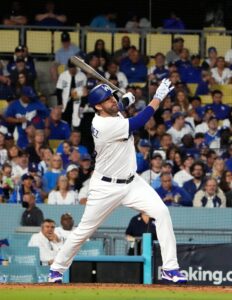
Strong as that production was, it didn’t come without red flags. Martinez’s pure contact skills regressed as his profile became more dependent on power. He struck out in more than 31% of his plate appearances, the highest rate of his career. Martinez made contact on a below-average 67.5% of his swings, the first time that he whiffed on more than 30% of his cuts.
That’s not a problem so long as he continues to destroy the ball when he does make contact. Martinez certainly did that last season. More than 54% of his batted balls came off the bat at 95+ MPH. That’s his best hard contact percentage since Statcast began tracking in 2015. The huge exit velocities manifested in Martinez’s slugging production.
While the bat speed remains intact, the increase in whiffs seemed to lead to some trepidation around the league. His profile is entirely built on offense. Martinez was never a great defender, but he’s almost exclusively a designated hitter at this point. He has started one game on defense over the last two seasons, logging 12 innings in the corner outfield overall.
The lack of a position was perhaps the main reason Martinez spent much time in free agency at all. On the surface, he’d have been a reasonable candidate for a $20.325MM qualifying offer from the Dodgers. Los Angeles decided not to risk that early in an offseason in which they would (successfully) pursue Shohei Ohtani, though. Martinez doesn’t come attached to draft compensation as a result.
That kicked off four and a half months on the open market for the three-time Silver Slugger winner. The Giants reportedly made an offer in the $14-15MM range at one point this offseason, but his camp turned that down. It’s not known if San Francisco’s proposal would have included any deferrals, but the ultimate deal which Martinez accepted comes in south of that previous offer before considering the delayed payments.
For the past few weeks, his free agency has seemed to be a staring contest between his camp and the Mets. Teams like the Angels and Marlins reportedly showed late interest, but no club was more consistently tied to him than New York. Ultimately, Martinez’s ask dipped to a place where the Mets felt compelled to jump and plug him into the middle of the batting order. He’ll join Pete Alonso as a scary duo of righty power bats for opposing pitchers.
The Mets didn’t get much out of the designated hitter position a year ago. Their DH group hit .217/.309/.391 with 27 homers. They finished in the bottom third of the league in all three slash stats. Martinez should be a clear step up even if he continues to strike out at an elevated clip. New York has maintained they still expect to hang in the Wild Card mix this year despite viewing the 2025 season as the start of their next true contention window.
Part of that balancing act was figuring out how much trust to put in their young hitters, namely Brett Baty and Mark Vientos. They entered camp with Baty penciled in as the primary third baseman and Vientos set for the majority of at-bats at DH. Adding Martinez closes off the latter path to playing time. Baty and Vientos could now compete for work at third base. Baty hits left-handed, while Vientos bats from the right side. That could allow first-year skipper Carlos Mendoza to play match-ups if they’re each on the roster, although both players have an option remaining and could be sent to Triple-A without landing on waivers.
The Mets are subject to the highest luxury tax fees possible under the CBA. They’re past the $297MM mark that’s the highest penalization threshold; they’ve paid the CBT in three consecutive years. As a result, they’re charged a 110% fee on future expenditures. The deferred money reduces the net present value of Martinez’s contract, so it’s not yet clear precisely how much the Mets will owe in CBT commitments.
A one-year, $12MM deal without any deferred money would’ve come with $13.2MM in luxury taxes. RosterResource’s Jon Becker estimates that the NPV of Martinez’s deal will land just under $9MM. That’d come with a little less than $10MM in luxury obligations.
Image courtesy of USA Today Sports.
Braves Release Charlie Culberson
The Braves have released Charlie Culberson, as per the team’s official MLB.com transactions log. Culberson rejoined the Braves on a minor league deal back in January, and was attempting to transition to pitching after 17 pro seasons (including 11 in the majors) as a utilityman.
This doesn’t appear to be the end of the line for Culberson’s career, as he told Justin Toscano of the Atlanta Journal-Constitution that he will continue to seek out more playing opportunities. Culberson turns 35 next month, though he indicated in another interview with Toscano last month that he wasn’t yet leaning towards retirement.
Culberson has a .248/.294/.386 slash line over 1312 career plate appearances, and he has played for five different teams at the MLB level since making his debut with the Giants back in 2012. This includes 231 games over what is technically six different stints with the Braves, since Culberson has signed four separate minor league contracts with Atlanta over the last year. The Braves twice designated Culberson for assignment and he chose free agency rather than an outright assignment, though Culberson quickly rejoined the organization on a new contract.
The transactional shuffles were part of an odd year overall for Culberson, who played in only 27 games with Triple-A Gwinnett and in exactly one game at the Major League level. Atlanta’s tendency to rarely rest its star players meant that Culberson simply didn’t have much opportunity to get playing time, despite several months on the Braves’ active roster. This made 2023 a “tough” season for Culberson, as he told Toscano, and it partially inspired his decision to try pitching as a different way of providing value to a big league roster.
Culberson has made eight mop-up appearances (totaling 7 1/3 innings) as a pitcher over the years, in addition to his much lengthier resume at all four infield positions, as a left fielder, and a handful of games in right field. He has topped 100 plate appearances in only six of his 12 Major League seasons, though Culberson did get 271 PA and 90 appearances as recently as 2021 when he playing for a rebuilding Rangers team.
Over three Spring Training appearances this year, Culberson made three appearances on the mound and was charged with six earned runs over two innings of work. Obviously there were going to be some bumps in the road for Culberson as he pursued his new position, and it remains to be seen if he’ll continue to experiment with a pitching career or if he might return to his familiar utility role if another team needs some position-player depth. While another contract with the Braves wouldn’t be a surprise if the Georgia native wants to stay close to home, Culberson’s desire to actually play seems to be clashing with Atlanta’s loaded roster.
Offseason In Review: Tampa Bay Rays
The Rays typically make at least one significant trade that sends out a veteran player to reduce spending and acquire controllable talent. Tampa Bay did that again in a major deal with the Dodgers, but it was otherwise a relatively quiet winter at the Trop.
Major League Signings
- RHP Phil Maton: One year, $6.5MM (including buyout of 2025 club option)
- SS Amed Rosario: One year, $1.5MM
- RHP Chris Devenski: One year, $1.1MM (including buyout of 2025 club option)
2024 spending: $8.75MM
Total spending: $9.1MM
Option Decisions
- None
Trades and Claims
- Traded minor league C Blake Hunt to Mariners for minor league C Tatem Levins
- Traded minor league RHP Michael Mercado to Phillies for minor league RHP Adam Leverett
- Claimed LHP Tyler Alexander off waivers from Tigers
- Traded RHP Calvin Faucher and 2B Vidal Bruján to Marlins for minor league INF Erick Lara, minor league RHP Andrew Lindsey and a player to be named later (announced as minor league OF Jake Mangum)
- Traded RHP Tyler Glasnow, CF Manuel Margot and $4MM to Dodgers for RHP Ryan Pepiot and LF Jonny DeLuca
- Acquired SS José Caballero from Mariners for RF Luke Raley
- Acquired LF Richie Palacios from Cardinals for RHP Andrew Kittredge
- Traded CF Greg Jones to Rockies for minor league LHP Joe Rock
Notable Minor League Signings
- Garrett Acton (two-year deal), Rob Brantly, Yu Chang, Alex Jackson, Francisco Mejía, Jake Odorizzi, Erasmo Ramírez, Burch Smith, Edwin Uceta, Naoyuki Uwasawa, Jacob Waguespack (later selected to 40-man roster)
Extensions
- Signed LHP Shane McClanahan to two-year, $7.2MM deal to avoid arbitration (remains eligible for arbitration through 2027)
Notable Losses
- Jalen Beeks (lost on waivers), Christian Bethancourt (lost on waivers), Bruján, Cooper Criswell (non-tendered), Jake Diekman, Faucher, Josh Fleming (lost on waivers), Glasnow, Tristan Gray, Kittredge, Margot, Raley, Robert Stephenson, Cole Sulser, Raimel Tapia
It’s a near annual tradition that the Rays face two big questions going into each offseason. How will they keep their spending in check, and will they lose anyone from a key leadership position on the coaching staff or in the front office?
This winter, the seemingly inevitable front office departure came first. General manager Peter Bendix, who had worked as Erik Neander’s top lieutenant in baseball operations, left the organization to serve as president of baseball ops for the Marlins. The Rays didn’t immediately name a new #2 executive, instead divvying up Bendix’s former responsibilities among assistant GMs Will Cousins, Chanda Lawdermilk, Carlos Rodriguez and Kevin Ibach (the latter of whom was promoted to that role in January).
While the Rays lost Bendix, they’ve solidified their main leadership duo of Neander and manager Kevin Cash. Each signed contract extensions in February that run at least beyond the 2028 season. Terry Francona’s retirement means Cash is now the longest-tenured manager in MLB as he enters his tenth year at the helm. Neander has been at or near the top of baseball operations for even longer, as he’d taken on a lead role in the front office around Andrew Friedman’s departure in October 2014.
Neander and his staff entered the winter with a slate of payroll commitments that seemed lofty by organizational standards. They had just shy of $77MM in guaranteed contracts and an arbitration class projected for upwards of $45MM. A few obvious cuts (e.g. Raimel Tapia, Jalen Beeks, Josh Fleming, Cole Sulser and Christian Bethancourt) reduced the arbitration outlay, but it seemed as if the Rays would again need to turn to the trade market to cut spending. Tampa Bay had opened the 2023 season with around $73MM in player commitments. Even with that number going up, ownership was never going to be comfortable matching the payroll projection from the beginning of the offseason.
Tyler Glasnow was set for a $25MM salary that would’ve been the largest in franchise history, thus making him the most apparent trade candidate. Yet, that was complicated by Glasnow’s strong relationship with Rays’ higher-ups and, more meaningfully, an uncharacteristically thin rotation mix. Tampa Bay lost Shane McClanahan and Jeffrey Springs to Tommy John surgeries last season. Drew Rasmussen underwent a flexor repair and will miss a good portion of 2024.
Aside from Glasnow, the Rays were down to Zach Eflin and ’23 deadline pickup Aaron Civale as their only healthy, proven big league starters. Taj Bradley is a recent top prospect but struggled to a 5.59 ERA over 23 appearances as a rookie. Zack Littell had shown signs of becoming the Rays’ next successful reliever-to-starter conversion, yet that only really kicked into gear in the final two months of last season. Shane Baz would face workload restrictions in his first season back from a 2022 Tommy John procedure. Eflin and Civale, while currently healthy, have had injury concerns in the past.
That presumably made a Glasnow trade difficult even for a front office accustomed to making those kinds of tough decisions. Ultimately, it proved the clearest way for Tampa Bay to get their payroll closer to a typical level while bringing back two controllable MLB players. The Rays and Dodgers agreed to a deal sending Glasnow and veteran outfielder Manuel Margot (who was set for a $10MM salary in the final year of his contract) to L.A. for righty Ryan Pepiot and outfielder Jonny DeLuca.
Neither Pepiot nor DeLuca have reached arbitration. Pepiot is under club control for five seasons, while the Rays control DeLuca for six years. Tampa Bay kicked in $2MM on Margot’s salary and agreed to pay the $2MM buyout on his 2025 mutual option. The deal saved them around $33MM this year. Glasnow agreed to a four-year extension with the Dodgers as a condition of the trade. (Los Angeles later flipped Margot to the Twins in February.)
Pepiot won’t match Glasnow’s ace-level ceiling, but he’ll step directly into the rotation. The Butler product owns a 2.76 ERA over 17 MLB appearances. He’s regarded as a potential mid-rotation arm thanks to a mid-90s fastball and excellent changeup. Pepiot may well have established himself as a key piece of the Dodger rotation last year had he not suffered a significant oblique strain at the end of Spring Training. That kept him under 65 innings between the majors and Triple-A in 2023. The Rays may need to keep an eye on Pepiot’s workload, but he slots in behind Eflin and Civale in the starting staff.
DeLuca, meanwhile, is a replacement for Margot. They’re each right-handed hitting outfielders with good contact skills and the ability to play all three outfield positions. DeLuca only has 24 games of major league experience but is coming off a .294/.390/.566 line in the upper minors. He was on track for a fourth outfield spot before breaking his hand this spring, so he’ll likely be on the injured list until the early part of the summer.
Glasnow and Margot turned out to be the highest-profile players whom the Rays would move. There were a few rumors about other stars who are into their arbitration years, namely Randy Arozarena and Isaac Paredes. There’s nothing to indicate the Rays ever got close to trading either.
It’s a bit surprising they didn’t deal righty-hitting DH/corner bat Harold Ramírez, who is making just under $4MM and is down to two seasons of club control. Ramírez, a good but not elite hitter with defensive limitations, is the kind of player whom the Rays typically shop as their arbitration prices climb. The Athletic’s Ken Rosenthal reported in January that Tampa Bay had floated him on the trade market, but they apparently didn’t find an offer to their liking. Barring a surprise move in the next five days, he’ll open the season as their top option at DH.
While they didn’t trade Ramírez, the Rays did flip one player from their corner outfield mix. Tampa Bay sent Luke Raley to the Mariners in a one-for-one swap to bring in versatile infielder José Caballero. Raley has yet to reach arbitration so this deal didn’t have anything to do with the payroll, but Tampa Bay added some roster balance in swapping offense for a more valuable defensive player.
Caballero appeared in 104 games for Seattle as a rookie. While he hit a modest .221/.343/.320 over 280 plate appearances, he stole 26 bases and rated as a plus defender at second base. Seattle didn’t have much shortstop time to offer him thanks to the presence of J.P. Crawford. The Rays have already declared Caballero their expected starter at short, forming a middle infield tandem with Brandon Lowe. Defensive stalwart Taylor Walls will begin the year on the IL as he works back from last fall’s hip surgery.
(The Rays still haven’t provided any update on Wander Franco. MLB and the team are awaiting results of a criminal investigation in the Dominican Republic after multiple minors accused Franco of sexual abuse. He remains on the roster but will very likely be placed back on administrative leave once the regular season begins.)
On the same day as the Caballero trade, the Rays partially back-filled the outfield depth lost by dealing Raley when the team Bay acquired lefty-hitting Richie Palacios from the Cardinals for reliever Andrew Kittredge. Palacios was available in a DFA trade as recently as last June but turned some heads with a .258/.307/.516 showing in 32 games for St. Louis late last year. His major league track record is limited, but Palacios has posted an excellent strikeout and walk profile in the upper minors. He has hit well this spring and could break camp, although a remaining minor league option affords the front office roster flexibility. Neither Caballero nor Palacios has reached a full year of service time. They’re both controllable for at least six seasons.
The rest of Tampa Bay’s trades were relatively minor, as they moved on from a pair of former top prospects who haven’t clicked. The Rays shipped Vidal Bruján alongside reliever Calvin Faucher to the Marlins for a trio of minor leaguers in November. They made a similar move just yesterday, sending speedster Greg Jones to the Rockies for non-roster southpaw Joe Rock. Tampa Bay also dealt Blake Hunt and Michael Mercado (to the Mariners and Phillies, respectively) after determining they weren’t going to add them to the 40-man roster to prevent them from reaching minor league free agency.
While most of the Rays’ roster maneuvering always comes via trade, they did make a trio of low-cost free agent pickups. The Rays brought back swingman Chris Devenski on a $1.1MM deal with a club option early in the offseason. That was their only major league free agent acquisition until February, when they jumped on a pair of players whose prices came in south of expectations.
Reliever Phil Maton inked a one-year, $6.5MM pact that includes a team option for 2025. He generates plenty of whiffs and soft contact behind a high-spin curveball that enables his 89 MPH fastball to play beyond its velocity as his “secondary” pitch. Maton doesn’t have the traditional power arsenal that gets relievers paid in free agency, yet he’s coming off a career-low 3.00 ERA and has run above-average strikeout rates in four straight years. The Rays’ preference for building a bullpen comprising pitchers with varying arm angles and repertoires has been well-chronicled in recent seasons. More often than not, it works.
While it was a little surprising that Maton couldn’t secure a two-year pact, the Rays’ other February free agent signing was very unexpected. Amed Rosario isn’t coming off a good season, but few would’ve anticipated he’d settle for a $1.5MM guarantee. He’d been a durable and roughly league average performer for Cleveland in 2021-22 before his defensive grades tumbled last year.
Rosario reportedly turned down a $4MM offer from the Yankees because the Rays presented a clearer path to everyday reps at shortstop. That might be the case throughout the season given Caballero’s inexperience, although Cash stated after the Rosario signing that the latter would begin the year in a multi-positional role off the bench.
That rounds out the MLB position player mix for now, although there’s at least one move coming before Opening Day. After placing Bethancourt on waivers, the Rays dropped to one catcher on the 40-man roster. They’ve stuck with that arrangement throughout the offseason. René Pinto is their clear #1 option after hitting six homers in 39 games. The Rays will obviously need to make another move to add a backup.
For now, it seems that minor league signee Alex Jackson, who has played all of five MLB games in the last two seasons, is the favorite to grab that job. That’s despite a .143/.194/.179 batting line this spring. Jackson’s longstanding strikeout troubles at least open the door for old friend Francisco Mejía, who returned on a non-roster pact after being released from a minor league deal with the Angels. There’s clear room for an upgrade from outside the organization. The Rays should evaluate the catching market as veterans opt out of minor league deals over the next few days. Former top prospect Joey Bart has long stood as a speculative trade possibility, as he’s out of options and has been kicked down the depth chart with the Giants.
Caballero, Lowe and Rosario should see the bulk of the work in the middle infield. Paredes is back at third base, while Yandy Díaz is in line for the majority of the first base reps. Curtis Mead could play a bat-first role throughout the infield. That would’ve also been the case for Jonathan Aranda, but he broke his finger this week and is headed to the IL. Top third base prospect Junior Caminero looms in the upper minors but will begin the season in Triple-A.
Arozarena is back as one of the game’s best left fielders. Jose Siri will get the bulk of the playing time in center field. Josh Lowe should be the starter in right field when healthy, but he’s also going to begin the year on the shelf rehabbing an oblique issue. That could open right field reps for Ramírez or Palacios. The DeLuca injury could create a bench spot for Jake Mangum, who has impressed this spring. A college standout at Mississippi State, the 28-year-old Mangum was the third piece in the return from the Marlins for Bruján and Faucher. He’s a potential fifth outfielder.
There’s a fair bit of position player talent, as is customary for an organization that annually runs a strong prospect pipeline. The aforementioned lack of rotation depth is probably the biggest question mark. A pectoral strain is sending Bradley to the IL. There’s an opening for the #5 starter behind Eflin, Civale, Pepiot and Littell. The Rays are stretching Devenski and waiver claim Tyler Alexander out as multi-inning options who could contribute as abbreviated starters. They brought back Jake Odorizzi and added former NPB righty Naoyuki Uwasawa on minor league deals.
Any of Devenski, Alexander or even Odorizzi could also find themselves in the bullpen. Minor league signee Jacob Waguespack has already earned a 40-man roster spot, putting him in a good spot to secure a middle relief role. They’ll need a few other arms to bridge the gap between the rotation and the likes of Maton, Pete Fairbanks and Jason Adam in the late innings.
Cot’s Baseball Contracts projects the Rays to enter the season with a $98.4MM player payroll. That’s both easily a franchise high and firmly in the bottom third of the league. They face their ever-present challenge of going against bigger spenders in the Yankees, Blue Jays and Red Sox, as well as a Baltimore team awash in young talent that chased the Rays down to win the AL East a year ago. The division is always an uphill battle, but the Rays typically find ways to overcome it.
How would you grade the Rays' offseason?
-
C 45% (542)
-
B 28% (343)
-
D 16% (195)
-
F 6% (76)
-
A 5% (55)
Total votes: 1,211