
Braves Open To Exceeding Luxury Tax Threshold
Much attention this offseason has been paid to the Braves spending outlook. Atlanta boasts one of the league’s top rosters but currently faces a major question at shortstop. Dansby Swanson has hit the open market as one of the top players available, and the Braves have to determine whether to make another significant investment to keep the Gold Glove winner in the fold.
Retaining Swanson would surely involve pushing the club’s spending beyond the base competitive balance tax threshold. That figure is set at $233MM for 2023. Roster Resource presently forecasts Atlanta for around $228MM in luxury tax obligations. That includes projections for arbitration-eligible players Max Fried, A.J. Minter and Dennis Santana, which come with small error bars until those salaries are finalized. Still, one can estimate the team is at least within $10-15MM of next year’s base tax threshold before trying to retain Swanson or further augment the roster in left field or at designated hitter.
Justin Toscano of the Atlanta Journal-Constitution writes that the Braves are giving internal consideration to surpassing the luxury tax in the right situation. That’s hardly a surprising development. Atlanta brass has already gone on record about their affinity for Swanson, and they reportedly offered him a deal in the $100MM range during the season. An offer in that realm would push the Braves into luxury tax territory if accepted, and Swanson’s widely expected to beat that figure fairly handily. MLBTR predicts he’ll receive a seven-year, $154MM deal. If Swanson’s contract winds up falling in that area, it’d tack on somewhere in the neighborhood of $22MM annually to the signing team’s ledger.
A team’s competitive balance tax number is calculated by adding the average annual values of a club’s commitments, in addition to player benefits. For CBT purposes, there’s no difference between backloaded, frontloaded or evenly-distributed contracts. That reduces (but doesn’t entirely eliminate) teams’ ability to creatively structure deals around the tax. Yet for most teams it puts the club’s luxury tax number above their actual payroll for the upcoming season. That’s particularly true of the Braves, who have signed a number of players to early-career extensions with salaries that escalate later in the deal. For example, the Spencer Strider deal contains a $12.5MM tax hit, but he’ll actually make just $1MM next season.
Roster Resource projects Atlanta’s actual 2023 spending just under $196MM at the moment. Toscano writes the organization is placing a greater emphasis on that figure than on their current CBT number. While it seems there’s still some room to maneuver from that perspective, the Braves are already projected well above their previous franchise record. They opened this past season with a payroll just south of $178MM, per Cot’s Baseball Contracts. That was an organizational high, and they’re nearly $20MM above that for 2023 before considering Swanson or any outside additions.
One would certainly expect payroll to rise on the heels of five straight division titles, including their 2021 World Series. Much has been made of multiple members of the Liberty Media ownership group suggesting the organization planned to eventually have a top five payroll, but as MLBTR’s Steve Adams explored in October, they’re not far off that pace as is. It’s also difficult to identify ways for Atlanta to trim payroll without subtracting key contributors from the MLB roster. The team could probably find a taker for most or all of the $4.5MM owed to third catcher Manny Piña. They’d have a harder time shedding much of the $9MM they owe Eddie Rosario after the left fielder’s rough year, and they surely won’t find other clubs eager to assume much (or any) of the $37MM due to Marcell Ozuna over the next two seasons.
With the franchise already in uncharted waters, it’s difficult to glean from the outside how much flexibility is at hand for president of baseball operations Alex Anthopoulos and his staff. If the Braves wind up paying the luxury tax in 2023, the penalties they’d face would be relatively minor. They’d be taxed at a 20% rate for every dollar spent between $233MM and $253MM. That’d be followed by a 32% tax on spending between $253MM and $273MM, and they’d face stiffer penalties in the unlikely event they pushed beyond that second tier of penalization.
Finishing with a CBT number between $233MM and $253MM –which would be viable even if they re-signed Swanson — would come with a maximum of $4MM in additional fees. For a team that would already be spending upwards of $200MM on player payroll, that’s a relatively modest additional sum. Financial penalties escalate for teams that exceed the CBT threshold in multiple consecutive years, but the Braves are slated to see roughly $55MM in guaranteed commitments come off the books at the end of next season.
Rays To Sign Zach Eflin To Three-Year Deal
The Rays are dipping into the free agent pitching market, agreeing to terms with right-hander Zach Eflin on a three-year deal. It’s reportedly a $40MM guarantee for the O’Connell Sports Management client. Eflin will make $11MM in each of the next two seasons, followed by an $18MM salary in 2025. The deal is pending a physical.
Eflin had spent his entire big league career with the Phillies. Originally drafted by the Padres, the Orlando native was dealt to the Dodgers and Phils during his time as a minor leaguer. He reached the majors by the middle of the 2016 campaign, bouncing on and off the MLB roster for the first couple seasons. Eflin struggled during his early big league looks, but he’d settled in as a capable mid-rotation arm by 2018.
That season, he made 24 starts and worked to a 4.36 ERA across 128 innings. That kicked off a remarkably consistent stretch of results. In each of the five seasons between 2018-22, Eflin posted an ERA between 3.97 and 4.36. Aside from a spike in strikeouts during the abbreviated 2020 season, he achieved those 3rd/4th starter results in a similar manner every year. He’s proven an excellent strike-thrower who misses bats at a slightly below-average level but keeps the ball on the ground at a solid clip.
Between 2019-21, Eflin worked to a 4.12 ERA with a slightly below-average 21.4% strikeout rate but a stellar 5.7% walk percentage. He’d been on a similar path to begin this season, posting a 4.37 ERA with a 19.6% strikeout percentage and a 5.3% walk rate through his first 13 starts. At the end of June, he landed on the injured list with a right knee contusion. That cost him over two months. By the time he was ready for reinstatement in early September, the Phils had limited time to build him back to a starter’s workload before year’s end. They expedited his return to the majors by plugging him in short relief. Eflin made seven appearances out of the bullpen during the regular season, then tossed 10 2/3 frames over 10 outings as a high-leverage arm during the Phils’ run to a National League pennant.
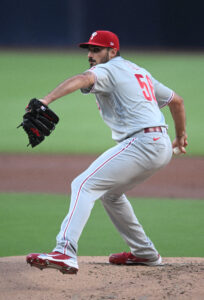
While Eflin doesn’t miss many bats, his blend of stellar control and a solid five-pitch mix allowed him to find a fair amount of success in Philadelphia’s hitter-friendly home environment. Against right-handed hitters, he leans primarily on a sinker in the 92-93 MPH range, but he turned to a four-seam fastball more often against lefties. Eflin mixes in a cutter and curveball as his usual secondary offerings, occasionally deploying a slider against righties as well. He rarely turns to a changeup, however, and he’s had his share of issues with left-handed batters. Southpaws have hit Eflin at a .274/.335/.492 clip since the start of 2018, but he’s stifled same-handed hitters to a .255/.291/.398 mark.
Tampa Bay surely has designs on plugging him back into the rotation after a healthy offseason. He’ll step in behind Shane McClanahan and Tyler Glasnow in the pecking order, joining Drew Rasmussen and Jeffrey Springs in what looks to be the season-opening starting five. The Rays have one of the sport’s top pitching prospects, Taj Bradley, waiting in the wings after a great season in the upper minors. Shane Baz was expected to seize a rotation job himself, but he’s likely to miss all of next season after undergoing Tommy John surgery in September. Luis Patiño, Yonny Chirinos and Josh Fleming are on hand as rotation or multi-inning relief options for what should again be a strong Tampa Bay pitching staff.
If healthy, Eflin fits nicely into the middle of that group. At the same time, the Rays are placing a bet on a pitcher with a concerning injury history. The knee contusion that cost Eflin a couple months this year was the latest in a line of joint issues that have plagued him since before he began his career. He underwent a pair of surgeries to repair the patellar tendons in both his knees in the summer of 2016. At the time, Eflin acknowledged he’d battled chronic knee pain dating back to adolescence (link via Todd Zolecki of MLB.com). He avoided any worrisome injuries for the next few seasons, but he went back under the knife in September 2021 to again repair the patellar tendon in his right knee. That cut his year short, meaning he’s lost chunks of three of the past six seasons to knee issues. There’s real risk in investing in a pitcher who has only once topped 130 MLB innings in a season.
The Rays were willing to look past that to add a pitcher who’s typically effective when healthy. Eflin’s also one of the younger arms available in free agency. He won’t turn 29 until next April, and a pitcher with his age and statistical track record may well have found four years on the open market if not for injury concerns. Tampa Bay wasn’t the only team that valued Eflin in this range, as Bob Nightengale of USA Today tweets the Red Sox had made him the same offer. Eflin elected to join the Rays instead, signing closer to home and avoiding state income tax.
With an $11MM salary for next season, Eflin becomes the highest-paid player on the Tampa Bay roster. He’ll lose that title in 2024, when Glasnow’s salary spikes to $25MM, but he’ll count for a significant portion of a Rays payroll that typically ranks among the league’s lowest. The Rays are now up to around $78MM in projected commitments for 2023, not far off their franchise-record $83MM mark from this past season. The overall $40MM guarantee represents the largest free agent investment in Rays history.
It also easily tops MLBTR’s pre-offseason projection of two years and $22MM for Eflin. The deal narrowly beats the three-year, $39MM guarantee Tyler Anderson received from the Angels last month. Anderson had rejected a qualifying offer and cost the Halos a draft choice. The Phils elected not to qualify Eflin. Philadelphia won’t receive any compensation for his departure, while the Rays won’t lose any picks to add him. To find Eflin’s replacement, Philadelphia can dip into a free agent rotation market that offers a number of options beyond the top trio of Jacob deGrom, Carlos Rodón and Justin Verlander. Players like Chris Bassitt, Kodai Senga, Jameson Taillon, Nathan Eovaldi, Noah Syndergaard, Andrew Heaney, Taijuan Walker and Sean Manaea all remain on the market as strong candidates for multi-year deals.
Jeff Passan of ESPN was first to report the Rays and Eflin had agreed to a three-year deal. Joel Sherman of the New York Post first reported the guarantee at $40MM. Marc Topkin of the Tampa Bay Times reported the specific financial breakdown.
Image courtesy of USA Today Sports.
Red Sox Interested In Mitch Haniger
The Red Sox have expressed interest in free agent outfielder Mitch Haniger, reports Jon Morosi of MLB.com (Twitter link). Boston joins the Dodgers, Rangers, Giants, Angels and incumbent Mariners among the clubs known to have checked in with his representatives.
Haniger is one of a handful of mid-tier corner outfielders available in free agency. The outfield market is topped by Aaron Judge and, after a significant gap, Brandon Nimmo. There’s another drop to the third tier, a mix that includes Andrew Benintendi, Jurickson Profar and bounceback types like Cody Bellinger and Michael Conforto alongside Haniger.
While Haniger isn’t in the same boat as Bellinger or Conforto, he’s also looking to rebound from a relatively down year to match pre-2022 heights. He lost a good chunk of this past season with a high ankle sprain. That kept him to 57 contests and 247 plate appearances, in which he hit .246/.308/.429 with 11 home runs. That’s still above-average offensive production once one accounts for the pitcher-friendly nature of Seattle’s T-Mobile Park, but it marked a somewhat disappointing follow-up to a 2021 campaign that saw him land some down-ballot MVP votes. Haniger connected on 39 homers with a .253/.318/.485 line over 157 games that year.
Various injuries have nagged the Cal Poly product throughout his MLB tenure, and he’s only twice exceeded 100 games in a season. When healthy, however, he’s typically provided a strong source of power from the righty batter’s box. Haniger owns a .244/.315/.469 line dating back to the start of 2019, and he’s mashed opposing left-handed pitchers to the tune of a .274/.355/.536 showing. His production against same-handed arms is closer to average, but he’s certainly playable against pitchers of either handedness. He typically rates as a solid defender in the corner outfield but isn’t an option for work in center.
The Red Sox have a fairly clear use for corner outfield help. Jarren Duran hasn’t performed at the major league level the way many had expected after he broke out as a prospect. He’s now 26 years old and owns a career .219/.269/.354 line at the MLB level. Duran hasn’t earned much consistent work against big league pitching and a win-now Boston club would be hard-pressed to rely on him for an everyday role. Alex Verdugo has played well at times but posted overall numbers around league average for the past two seasons. Haniger would be an upgrade on either player, and Boston also has an uncertain DH mix with the free agency of J.D. Martinez.
Nationals Sign Franklin Barreto To Minors Deal
The Nationals have signed infielder Franklin Barreto to a minor league deal, according to Jon Heyman of The New York Post.
Barreto, 27 in February, was an international amateur signing of the Blue Jays but was traded to Oakland as part of the 2014 Josh Donaldson trade. A highly-touted prospect, Barreto was featured on Baseball America’s list of the top 100 youngsters in the game for four straight seasons beginning in 2015.
Unfortunately, Barreto has struggled as he’s reached higher levels of competition, particularly in terms of strikeouts. From 2017 to 2020, he got into 101 big league games but struck out in 42.2% of his plate appearances. For reference, this year’s league average was 22.4%, barely half of Barreto’s rate. Overall, he’s hit just .175/.207/.342.
Oakland moved on from him in 2020, trading him to the Angels for Tommy La Stella. He underwent Tommy John surgery in May of 2021 and was outrighted at the end of the year. The Astros signed him to a minor league deal for 2022, but he hit just .162/.259/.274 in 73 Triple-A games while striking out 37.2% of the time.
It’s been a pretty rough stretch for Barreto, to say the least. That being said, there’s little harm in the Nats taking a look at him in Spring Training. They were the worst team in baseball in 2022 and aren’t likely to suddenly emerge as contenders in 2023, meaning they’re among the teams best suited to take fliers on faded prospect stars. Barreto is still young enough that he could take a step forward in his age-27 season and make good on his previous pedigree. If he does, the Nats can keep him around fairly cheaply for a few more years via arbitration since he has just over three years of MLB service time.
Nationals Outright Yasel Antuna, Josh Palacios
The Nationals announced they have outrighted outfielders Yasel Antuna and Josh Palacios. Jesse Dougherty of The Washington Post reported Antuna’s outright prior to the official announcement. There had been no public indication that the players had been designated for assignment, but the club evidently passed them through waivers in recent days. Their 40-man roster count is now 38.
Antuna, 23, was selected to the club’s 40-man roster two years ago, in order to protect him from being selected in the 2020 Rule 5 draft. Unfortunately, his development has slowed in recent years. Last year, he played 106 games at High-A and hit just .227/.307/.385, wRC+ of 88. This year, splitting his time between High-A and Double-A, he walked in an incredible 17% of his plate appearances but still produced a tepid batting line of .215/.352/.338, 97 wRC+. He did steal 27 bases on the year but also got caught eight times. Previously a shortstop, he transitioned to a corner outfield role this year, which increases the pressure on him to provide value with the bat. He’ll stick in the organization as depth but without taking up a spot on the 40-man roster.
Palacios, 27, was a Blue Jays draftee who made his MLB debut with them last year but came to the Nats on a waiver claim at the start of 2022. Between the two clubs, he’s gotten into 42 big league games with a meager .207/.267/.232 batting line so far. In 82 Triple-A games in 2022, he fared much better with a batting line of .294/.379/.439, 121 wRC+.
As noted by Dougherty, the Nationals have the first pick in next week’s Rule 5 draft, due to having the worst record in baseball in 2022. They had recently filled up their 40-man roster by signing Jeimer Candelario and Stone Garrett. It seems that they feel they can find better players than Antuna and Palacios in the draft, since they took the risk of placing them on waivers in order to free up some roster spots.
Jameson Taillon Drawing Strong Interest In Free Agency
Starting pitcher Jameson Taillon has been taking Zoom meetings with clubs and his market is “gaining steam,” according to Mark Feinsand of MLB.com.
It’s hardly surprising that teams are interested in Taillon, given that just about every club is looking to bolster its rotation at this time of year. The starting pitching market is headlined by aces like Jacob deGrom, Justin Verlander and Carlos Rodon, with those guys looking for hefty contracts that only certain teams will be willing to pay. Taillon, however, is generally considered to be part of the next tier of serviceable mid-rotation arms, which means his contract will be lesser than those aces but his market wider.
The Pirates selected Taillon with the second overall pick back in the 2010 draft and he was a highly-touted prospect during his time in the minors. However, his big league debut was delayed by both Tommy John surgery and testicular cancer, but Taillon eventually got through both of those ordeals and made it to the big leagues in 2016.
Over this first three years, he established himself as a solid big league arm, tossing 428 2/3 innings by the end of 2018, with a 3.63 ERA, 21.7% strikeout rate and 6.1% walk rate. Unfortunately, he was limited to just seven starts in 2019 before requiring flexor tendon surgery and a second Tommy John. That wiped out the remainder of his 2019 and kept him sidelined for all of 2020.
Taillon never suited up for the Pirates again, as he was traded to the Yankees going into 2021. It was a risky move for the Yanks, given Taillon’s uncertain injury situation. But he has stayed healthy the past two years outside of a brief IL stint for an ankle injury late in 2021. He still made 29 starts that year and 32 in 2022, producing a combined 4.08 ERA over the past two seasons along with a 21.9% strikeout rate, 5.7% walk rate and 37.1% ground ball rate.
Those aren’t elite numbers but they’re certainly good enough for Taillon to upgrade most pitching staffs around the league. However, the Yankees didn’t issue him a $19.65MM qualifying offer, evidently unwilling to pay that Taillon at that rate. MLBTR predicted Taillon to secure himself a contract of $56MM over four years, an average annual value of $14MM, though Feinsand reports that Taillon is expected to beat that figure. The starting pitching market has seemed robust so far, with Tyler Anderson getting $39MM over three years while Mike Clevinger and Matt Boyd signed strong one-year deals worth $12MM and $10MM, respectively, despite injury concerns for both of them. If starters continue to be highly valued by clubs this winter, it wouldn’t be a shock if Taillon does indeed surpass projections.
Royals Hire Brian Sweeney As Pitching Coach
The Royals announced two additions to their coaching staff today, with Brian Sweeney being named pitching coach and José Alguacil named infield coach.
Sweeney, 48, is a former big league pitcher, having thrown for the Mariners and Padres over 2003-2006. He went to Japan for three seasons from 2007 to 2009 and came back to the Mariners in 2010. He played a few more seasons in the minors but that was his last stint in the big leagues.
Prior to the 2015 season, he took a pitching coach job in the minor league system of the Phillies. He joined Cleveland’s coaching staff at the big league level going into 2018 and has served as their bullpen coach for the past three years. He’s now been poached by Cleveland’s division rival and will come to Kansas City to serve as the pitching coach. Jeffrey Flanagan of MLB.com reports that Royals’ owner John Sherman, who used to be a minority owner of the Guardians, has been “extremely involved” in the process of filling out the coaching staff.
Getting better results from the pitching staff will surely be a primary area of focus for the Royals, as many of their young pitchers have disappointed in recent years. Daniel Lynch, Kris Bubic and Jackson Kowar have all struggled in their MLB time so far, despite being first-round draft picks. Those disappointing results have helped lengthen the club’s rebuilding period, with their last season above .500 coming with their World Series victory back in 2015.
They’ve made many changes to try to turn their fortunes around going forward, including firing president of baseball operations Dayton Moore, manager Mike Matheny and pitching coach Cal Eldred. General manager J.J. Picollo is now in charge of the front office while Matt Quatraro is now the bench boss. Sweeney will jump onto Quatraro’s staff to replace Eldred.
As for Alguacil, 50, he spent 15 years in the Giants’ organization, taking on various roles including first base coach at the MLB level from 2017 to 2019. He spent last year as a minor league infield coordinator with the Nationals but will now return to the big leagues with the Royals.
Ken Rosenthal of The Athletic reported Sweeney’s hire prior to the official announcement.
Brewers, Mike Brosseau Avoid Arbitration
12:15 pm: Mark Feinsand of MLB.com reports that Brosseau will make $1.4MM.
12:10 pm: The Brewers announced that they have signed utility player Mike Brosseau to a one-year contract, avoiding arbitration. His salary is not yet publicly known.
Brosseau, 29 in March, made his MLB debut with the Rays in 2019. Over that year and the shortened 2020 campaign, he got into 88 contests and seemed to cement himself as a valuable player. He hit 11 home runs and produced a batting line of .284/343/.500, leading to a wRC+ of 130. He also provided defensive versatility, playing the three non-shortstop infield positions as well as the outfield corners. Unfortunately, he struggled in 2021 and wound up splitting his time between the majors and the minors. In 57 MLB games, he hit .187/.266/.347 for a wRC+ of 73.
The Rays traded Brosseau to the Brewers a year ago and he seemed to get back on track after the switch. Milwaukee primarily used him in platoon fashion, as 105 of his 160 plate appearances came against lefties. For his career, Brosseau has a 127 wRC+ against southpaws but just an 84 the rest of the time. That was largely true in 2022 as well, though he strangely walked much more against righties in his small sample. That led his wRC+ totals to come out pretty even at 117 and 119, despite a .274 batting average against lefties and a .217 against righties. On the whole, he finished the season with a .255/.344/.418 batting line and a 118 wRC+.
He surpassed three years of MLB service time this year, qualifying for arbitration for the first time. Though it’s not yet known what salary he agreed to, MLBTR contributor Matt Swartz projected $1.2MM. Whatever the number, Brosseau has locked that money in. Under the previous collective bargaining agreement, teams could cut arbitration players in Spring Training and only pay a portion of the salary. However, the new CBA dictates that players will receive full termination pay so long as they don’t go to a hearing.
The Brewers currently have a number of lefties who project to get at least somewhat regular playing time, including Christian Yelich, Rowdy Tellez, Kolten Wong, Jon Singleton and Garrett Mitchell. Given Brosseau’s defensive versatility and penchant for hitting lefties, he should be able to plug himself into semi-regular platoon duty, as well as occasionally pinch-hitting and serving as a defensive replacement.
Guardians, Anthony Gose In Agreement On Two-Year Minor League Deal
The Guardians and left-hander Anthony Gose have agreed on a two-year minor league deal, reports Robert Murray of FanSided. Gose will make $1MM per season if in the big leagues.
The reason for the two-year deal is that Gose is unlikely to pitch at all in 2023 after undergoing Tommy John surgery in September. At the end of the year, he was non-tendered by the club but will stick around without taking up a spot on the 40-man roster. He will presumably make a lesser salary while rehabbing this year and hope to get back onto a big league mound in 2024 with a salary a bit above the league minimum.
Prior to that surgery setback, Gose was on one of the more unique baseball journeys. He had spent much of his career as an outfielder, playing for the Blue Jays and Tigers from 2012 to 2016. However, he hit at a below-average rate, producing a career slash line of .240/.309/.348.
A two-way star in high school, Gose then tried a return to the mound. He often struggled with command, but still showed impressive stuff overall, including a triple-digit fastball. He made it back to the big leagues with Cleveland last year and has thrown 27 2/3 innings so far. The control is still not ideal, as his 13.8% walk rate is definitely on the high side. But he’s also struck out 31.9% of batters faced and posted a 3.90 ERA.
Gose got over three years service time this year and would have been arbitration eligible. MLBTR contributor Matt Swartz projected a salary of $800K, just above next year’s minimum salary of $720K. Given that he’s likely to miss the entire season, the Guardians non-tendered him, but they clearly still like his chances of being useful for them in time. Gose is currently 32 years old, turning 33 in August. If he returns to health in 2024, the Guardians could retain him via arbitration for future seasons as well.
NPB’s Hanshin Tigers Post Shintaro Fujinami
The Hanshin Tigers of Japan’s Nippon Professional Baseball have officially posted right-hander Shintaro Fujinami, according to Yakyu Cosmopolitan.
It was reported back in October that the Tigers planned to post Fujinami. Now that it’s been made official, he and his representatives will have 30 days to secure a major league contract. If a deal is reached, the signing team will also owe money to the Tigers, with that amount being relative to the size of the contract given to Fujinami. Any big league team that signs him would owe the Tigers a fee equal to 20% of the contract’s first $25MM, 17.5% of the next $25MM and 15% of any dollars thereafter. If he does not reach an agreement with an MLB team, he will return to the Tigers for 2023.
It’s possible that Fujinami will find that there’s a wide variance in the level of interest he gets from major league teams, given the inconsistency he’s shown thus far in his career. He was a highly-touted young arm in his high school days, often compared to Shohei Ohtani as the top names in their draft class. In 2013, he was thrown into the Tigers’ rotation despite being just 19 years old at the time. He ended up throwing 137 2/3 innings with a 2.75 ERA, 126 strikeouts, 44 walks and a couple of hit batters. He continued producing strong results over the next two seasons, tossing 163 innings in 2014 with a 3.53 ERA and then 199 frames in 2015 with a 2.40 ERA.
From that point on, however, control issues put a damper on his performance. He walked 70 batters in 169 innings in 2016 and then gave out 45 free passes in only 57 innings in 2017, getting sent down to the minors. He’s been shuttled between the farm and the big leagues since then, struggling to show enough improved command to keep a regular job. That was still the case in 2022, as he made 25 appearances on the year but only 16 of them were at the NPB’s top level. In those 16 appearances for Hanshin, he logged 66 2/3 innings with a 3.38 ERA, striking out 65 while walking 21 batters. He faced a total of 276 batters, meaning his walk rate was 7.6%, which is actually respectable. For reference, this year’s MLB average was 8.2%. That’s a huge improvement over 2021, where he walked 40 out of 238 batters faced for a rate of 16.8%.
Taking all this into consideration, the 30 MLB clubs will likely be able to reach different conclusions of Fujinami’s value. The most bullish teams can point to his early career success and 101 mph fastball. Despite his long tenure in NPB, he’s just 28 years old, turning 29 in April. He also showed some improved control this season. For those who take the pessimistic side, they could point to the fact that Fujinami hasn’t been able to maintain a consistent level of performance for years.
There’s little doubt that Fujinami has some skills to bring to the table. The question will be how much major league teams believe they can use their tools to harness Fujinami into a useful pitcher in North America. It makes him an intriguing wild card addition to the offseason and we will see how his market plays out over the remainder of the year.