
Mets To Meet With Carlos Rodón
The Mets have a rotation to rebuild and are interested in lefty Carlos Rodón. Jon Heyman of The New York Post reported yesterday that the club had been in contact with the free agent, while Andy Martino of SNY reports today that the two sides will be meeting this week. Joel Sherman of The New York Post reports that the two sides will have a Zoom meeting today.
Rodón, 30 next month, is coming off an excellent two-year run and is one of the top free agent pitchers this offseason, alongside Jacob deGrom and Justin Verlander. After missing most of 2019 and 2020 due to injuries, Rodón bounced back in 2021 by posting an ERA of 2.37, along with a 34.6% strikeout rate, 6.7% walk rate and 37.7% ground ball rate. He did spend some time on the injured list and only logged 132 2/3 innings on the year, which was concerning enough for the White Sox to decide against issuing him a qualifying offer.
He signed on with the Giants for 2022 and pushed the injury question marks even farther behind him, getting up to 178 innings with a 2.88 ERA, 33.4% strikeout rate, 7.3% walk rate and 34.1% ground ball rate. His two-year deal with the Giants allowed him to opt out after the first year if he tallied 110 innings, which he did with ease. He made the easy decision to opt out and then decline the qualifying offer that the Giants extended. Even with that QO attached, MLBTR predicted Rodón for a contract of $140MM over five years, an average annual value of $28MM.
The interest from the Mets is quite understandable, given the uncertainty in their rotation. deGrom, Taijuan Walker and Chris Bassitt all reached free agency recently, leaving the club with Max Scherzer and Carlos Carrasco as their two remaining incumbents. They have some internal candidates to fill the backend of their rotation, such as Tylor Megill and David Peterson, but they are naturally looking to improve that overall picture before Opening Day rolls around. They appear to be casting a wide net in their efforts, as they have already been connected to Verlander, Andrew Heaney, Kodai Senga and Jameson Taillon, in addition to trying to keep deGrom in Queens.
The Mets’ payroll for 2023 is current around $235MM, per the calculations of Roster Resource, with a competitive balance tax number of $247MM. It’s unclear exactly how high the club plans to push their payroll but a ballpark figure of $300MM has been floated, per Heyman. That gives the club plenty of room for now, but some of their pursuits are potentially looking for deals around $30MM or even $40MM. Given that the club is also looking into outfielders, such as bringing back Brandon Nimmo, and even their high-spending ways will start to reach their limits eventually.
The Mets certainly won’t be alone in their pursuit of Rodón either, as he’s already been connected to the Rangers, Dodgers, Twins and Yankees, with the Giants interested in bringing him back to San Francisco as well.
Angels Sign Jonathan Holder To Minor League Deal
The Angels have signed right-hander Jonathan Holder to a minor league deal, according to his transactions tracker at MLB.com (hat tip to Sam Blum of The Athletic.) Holder will presumably be invited to major league Spring Training, though no official announcement on that matter has been made. He’s been assigned to the Triple-A Salt Lake Bees for the time being.
Holder, 30 in June, saw major league action in five straight seasons from 2016 to 2020, all with the Yankees. He racked up 176 2/3 innings in that time, posting a 4.38 ERA, 21.7% strikeout rate, 7% walk rate and 36.8% ground ball rate. He was non-tendered prior to 2021 and signed with the Cubs but a shoulder issue limited him to just two innings that year.
He settled on a minor league with the Cubs for 2022 but didn’t get into a game until late July. He ended up pitching 21 innings in the minors with an 8.57 ERA but better peripherals. He struck out 21.9% of batters while walking 11.4%, as a .424 batting average on balls in play and 58.3% strand rate surely made his ERA look much worse than he deserved. FIP pegged his season at 4.66, not super exciting but around half of his ERA.
The Angels have been one of the busier teams so far this offseason, signing Tyler Anderson to their rotation while trading for infielder Gio Urshela and outfielder Hunter Renfroe. They’ve also bolstered their bullpen depth with minor league deals for Jacob Webb and Chris Devenski in recent days, now adding Holder into the mix as well.
Tigers Re-Sign Four Players To Minor League Deals
The Tigers have re-signed four players, according to their transactions tracker at MLB.com (hat tip to Evan Woodbery of MLive.com and @ebajek85.) The four players are infielder Jermaine Palacios, infielder/outfielder Brendon Davis, catcher Michael Papierski and right-hander Miguel Diaz. They have all been assigned to Triple-A Toledo and will presumably get invitations to major league Spring Training.
All four of these players are being re-signed since they were with the Tigers in 2022, but none of them have lengthy histories with the club. Diaz signed a minor league deal coming into 2022, while the other three all joined the organization on waiver claims this year. All four lost their roster spots earlier this month but will stick with the club and try to earn their way back on.
Diaz, 28, got into 72 games with the Padres over the 2017-2021 stretch before getting into three games with the Tigers this year. In 65 Triple-A innings this year, he posted a 4.29 ERA but with a 24.2% strikeout rate, 10.5% walk rate and 52.3% ground ball rate. A low strand rate of 62.4% led to a higher ERA than he likely deserved with FIP giving him a 3.91.
Papierski, 27 in February, bounced around quite a bit this season. He started the year with the Astros, got traded to the Giants, before going to the Reds and Tigers on waiver claims. He got into 39 MLB games and hit .143/.228/.187 there but hit .232/.329/.363 in the minors.
Davis, 25, only got into three MLB games this year, spending most of the season in Triple-A. In 139 games at that level, he hit 20 home runs and slashed .235/.340/.423 for a wRC+ of 99.
Palacios, 26, made his MLB debut this year with the Twins but struggled in his 30 games in the show. In 102 Triple-A games, he hit 14 home runs and slashed .283/.341/.462 for a wRC+ of 112. Both Davis and Palacios played all four infield positions this year as well as the outfield corners, with Davis also getting a brief look in center. Since Diaz is a pitcher and Papierski is a catcher, these four moves collectively bolster the depth all over Detroit’s roster.
Pirates To Sign Carlos Santana
November 29: The Pirates have officially announced the deal.
November 25: The Pirates have agreed to a one-year deal with veteran first-baseman Carlos Santana pending a physical, according to Jeff Passan of ESPN. It’ll pay the Octagon client $6.725MM, per Jon Heyman of the New York Post. It’s the largest guarantee the Pirates have given to a free agent since inking Daniel Hudson to a two-year, $11MM deal before the 2017 season.
It’s an intriguing move for the Pirates as they look to slowly work their way back to contention after a lengthy rebuild. Santana is the third first-base/DH option they’ve acquired this off-season, following their trade for Ji-Man Choi and claim of Lewin Diaz.
Santana, 36, spent last year with the Royals and Mariners, slashing a joint .202/.316/.376 with 19 home runs over 506 plate appearances for a wRC+ of 102, a couple of ticks above league average. While the numbers certainly don’t leap off the page, Santana did post the lowest BABIP of his career and hasn’t seen much shift in his walk or strikeout rates. Santana could also be one of the biggest benefactors of the shift restrictions that’ll come into play next season, as no one faced a shift more often than he did (98.3% of the time).
It’ll be the fifth major league team Santana has suited up for. He debuted for Cleveland back in 2010, the first of eight seasons he’d initially spend with the franchise. Santana regularly posted 20+ home run totals, combining power with strong on-base skills. His best year was 2013, when Santana finished 15th in AL MVP voting on the back of .268/.377/.455 line.
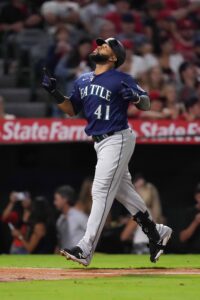
Santana inked a three-year, $60MM deal with the Phillies prior to the 2018 season, but after just a year Cleveland re-acquired him via a ten-day stint in Seattle. His return to Cleveland proved successful, as Santana hit 34 home runs, won a Silver Slugger and earned his first trip to the All Star game.
That was his last dominant campaign though, and his final year in Cleveland in 2020, and the following seasons in Kansas City and Seattle have brought about wRC+ marks of 99, 82 and 102. While his average has taken a huge dip in recent years, he’s continued to walk at a strong rate and post solid power numbers. His HardHit% and exit velocity remain in line with his peak numbers, so there certainly seems to be enough to suggest Santana could experience a bit of a bounce back in 2023.
That’s certainly what the Bucs will be hoping for, but it won’t take much for them to improve their first-base output in 2023. Pittsburgh first-basemen combined for -3.0 fWAR in 2022, so the addition of Choi and Santana addresses that. Santana was worth three Outs Above Average at first in 2022, with Choi worth two and the pair will likely split time there and at DH in 2023. Choi’s struggles against left-handed pitching could mean he sits in those matchups while Santana mans first and Pittsburgh gives another hitter a game at DH.
Beyond his production at the plate, Santana will be a valuable veteran presence in a young clubhouse. The Pirates have brought through a number of prospects they hope will form the foundation of their next contending team in recent years, including Ke’Bryan Hayes, Oneil Cruz and Roansy Contreras. There’s plenty of young talent there with more expected to crack the big leagues in 2023, so having a veteran mentor in Santana around can only help the Bucs’ young core.
The $6.725MM guarantee is modest by MLB standards, but significant for Pittsburgh. It makes Santana the third highest paid Pirate for 2023, behind Hayes and Bryan Reynolds, and takes their projected 2023 payroll to $54MM, per RosterResource. That falls about $5MM shy of their 2022 mark and it’ll be interesting to see where the final figure lands for next season. A veteran starter on a similar deal to Jose Quintana‘s last season seems likely, while the team could do with a low-cost catcher to bridge the gap until top prospects Endy Rodriguez and Henry Davis are ready to debut.
Photo credit: USA Today Sports.
Guardians Made Three-Year Offer To Jose Abreu
Yesterday, the Astros and first baseman Jose Abreu agreed to a three-year, $58.5MM contract, but it seems a surprising club was close to Houston in the bidding for Abreu’s services. Paul Hoynes of the Cleveland Plain Dealer reports that the Guardians made a three-year offer, but that the $60MM range was “beyond their reach.”
The Guardians are usually one of the lowest-spending clubs in the league, so the fact that they didn’t sign a costly free agent isn’t exactly shocking. However, it could perhaps be an indication that they have a greater willingness to spend this offseason than usual. The largest free agent contract in the history of the franchise is the $60MM over three years given to Edwin Encarnacion prior to the 2017 season, coincidentally very similar to the deal Abreu just signed. The Guardians did give José Ramírez $129MM over seven years, though that was an extension and not a free agent deal.
Though many fans will remain skeptical of “at least we tried” reports of teams just missing on free agents, there are reasons to think the Guards might actually have some money to work with this winter. The club ran out a roster full of rookies and other young players in 2022, and it worked tremendously. They went 92-70 and finished atop the American League Central despite a very modest payroll. Roster Resource currently pegs their 2023 spending around $72MM, with no individual player set to earn more than the $14MM Ramírez will get. $9MM of that number is the projected arbitration salary of shortstop Amed Rosario, a name frequently mentioned in trade rumors. That $72MM figure is already a slight upgrade over last year’s Opening Day figure of $68MM, per Cot’s Baseball Contracts, but they got as high as $135MM in 2018.
Now that the club is a few years removed from the lost revenues of the pandemic and just got a boost from a surprise postseason run, it’s possible that they are willing to push spending back up near their pre-pandemic levels. It would also make sense from an on-field perspective to build around their bevy of young and talented players while they are still paid at arbitration or pre-arb levels.
If there is some money to be spent, the first base/designated hitter part of the roster is a sensible place to put it. The club has Josh Naylor penciled in as their first baseman but Franmil Reyes flamed out as the designated hitter in 2022 and eventually got put on waivers, going to the Cubs. There would have been an opening for Abreu to step in and split the first base and designated hitter duties with Naylor. It also would make sense to add some extra thump to a lineup that succeeded in 2022 largely by making contact and avoiding strikeouts. The club hit 127 home runs this year, which was 29th in the majors, ahead of only the Tigers. Abreu’s power actually took a step back in 2022, but he still hit 15 home runs and has frequently been a 30-homer bat in the past.
If the Guardians are still willing to pursue this market, there are other options available to them. There are some part-time or role players available such as Trey Mancini or Yuli Gurriel, but the top option is Josh Bell. On MLBTR’s Top 50, he was projected for a $64MM contract over four years. That guarantee is beyond what Abreu got, but at a lower average annual value of $16MM. Since Bell is only 30 years old compared to Abreu’s 36, he will likely require a lengthier commitment, but that lower salary might better suit the Cleveland checkbook. Like Abreu, he would add some thump to the lineup, having hit 17 home runs last year and getting as high as 37 in previous seasons. He also isn’t likely to throw off the club’s low-strikeout style either, as he’s never posted a rate above 19.2% outside of the shortened 2020 season. For context, this year’s league average rate was 22.4% and the Guardians struck out at a collective 18.2% clip.
The Guardians will surely have competition in a pursuit of Bell or any other first basemen they decide to go after. The Padres, Cubs and Marlins were all reported to have been interested in Abreu and they will likely start thinking about the next options on their lists. One other team on that list is the Red Sox, as Jon Heyman of The New York Post reports that Abreu was their top free agent target and they met with him as soon as free agency began.
The Red Sox already have something of a cluttered mix of players for their first base and designated hitter spots. Youngsters Triston Casas and Bobby Dalbec are on the 40-man roster along with veteran Eric Hosmer, picked up in a deadline deal with the Padres last year. However, there’s no real reason for them to be especially committed to Hosmer, as the Padres agreed to pay down all of his remaining contract except for the league minimum. Since joining the Padres prior to 2018, he’s been essentially a replacement level player, producing a wRC+ of 100 and 0.3 fWAR. As for Dalbec, he showed some potential in 2020 and 2021 but struggled greatly in 2022, hitting just .215/.283/.369 for a wRC+ of 80 while striking out in 33.4% of his plate appearances.
We can’t know for sure what subsequent moves the Red Sox would have made if they had signed Abreu, but it seems possible they could have looked to trade Hosmer or simply released him if he used his no-trade clause to block a deal. Dalbec could have also found himself on the trading block but he also has options and could have been retained as minor league depth in case Casas, who has just 27 MLB games under his belt, struggled in 2023. He hit five homers in that short sample and walked a bunch but didn’t hit for much average, leading to a lopsided batting line of .197/.358/.408.
The first base market has been quite robust in the early days of the offseason, as Anthony Rizzo already re-signed with the Yankees, the Pirates traded for Ji-Man Choi and Carlos Santana, followed by Abreu signing with the Astros. With several teams seemingly still interested in upgrading their rosters at first, the remaining free agents might see their phones lighting up very soon.
Free Agent Prediction Contest Leaderboard Now Available
5,966 people submitted entries in MLBTR’s annual free agent prediction contest! The contest leaderboard is now available.
The goal of the contest has always been to see who can do the best at predicting where MLB free agents sign – a very difficult endeavor. However, in the past I have always allowed for freebies – if a player signs during the week or so that the contest is open, you were able to change your pick to the correct team, and it would count as correct. Typically this has only been for a couple of players.
Though some people like the freebie simply to reward diligence, that’s not why I’ve done it that way in the past. Instead, I’ve left signed players in the contest because we didn’t have the technical resources to alter the leaderboard midstream. Now, we have that person, and removing the six signed (or in the case of Clayton Kershaw, close to a deal for three weeks) players from the contest was easy. Six would have been an abnormally high number of freebies, as well, so it served as a tipping point for me.
Additionally, some contest participants do not receive the confirmation email from Google Forms that allows them to modify their picks, so those people were missing out on freebies for a technical reason I was not able to solve.
I changed my mind on freebies because I think it’s better this way, and always doing something a certain way isn’t a good reason to continue. While this change is going to lower batting averages for all participants (including participating MLBTR staff!), nine prognosticators still maintain a perfect batting average after the signings of Mike Clevinger and Jose Abreu.
MLBPA Executive Director Tony Clark Given Five-Year Extension
The Major League Baseball Players Association has voted to extend the contract of executive director Tony Clark, according to Evan Drellich of The Athletic. His previous extension was set to expire at the end of the year, but he will now stay on through 2027. Since the new collective bargaining agreement expires after the 2026 season, Clark is now set to remain at the table to be involved in negotiating the next CBA.
Clark, 50, spent 15 years in the majors as a player, from 1995 to 2009. As detailed by Drellich in a lengthy profile, Clark then became a protege of Michael Weiner, the previous head of the union. Weiner had only taken over the job in 2009 but received tragic news of a terminal cancer diagnosis in 2012. When he passed away in 2013, Clark was voted to take over the position, just a few years after concluding his playing career.
At the time, MLB and the MLBPA seemed to be on relatively good terms, as there had not been a work stoppage since the 1994-1995 strike. However, the first CBA negotiated under Clark in 2016 was almost universally panned as being too skewed to the owners’ interests. Though the union did earn some modest gains on things like the minimum salary and changes to the schedule, the most significant changes saw increased penalties for teams that went over the competitive balance tax line and a hard cap on signings of international amateur free agents.
Despite the poor reception of that CBA, Clark was given an extension in November of 2018. At that time, work was already being done to prepare for the next round of negotiations. The MLBPA hired Bruce Meyer in August of 2018 with the title of senior director of collective bargaining & legal. Meyer brought years of experience to the table, having previously worked for the NHLPA and having provided outside counsel to the NBA and NFL unions.
Clark’s time since signing that extension has been quite active, to say the least. Before even getting to the next round of CBA negotiations, the league was trying to purchase licensing rights from the union. The MLBPA didn’t like the offer and instead joined with the NFLPA to form OneTeam Partners alongside RedBird Capital in 2019. OneTeam reached an exclusive deal with the trading card company Fanatics and the Wall Street Journal gave the company a $2 billion valuation last year.
Then the MLBPA had to deal with the COVID pandemic disrupting the 2020 season. Though a shortened 60-game season was eventually played, it was clear that the relationship between the league and the union was at a low ebb with just one year remaining in the CBA. Negotiations didn’t lead to a deal and MLB locked out the players on December 1 of 2021, the first work stoppage in over 25 years.
The lockout would eventually drag on for 99 days, resulting in a new CBA being agreed to on March 10 of 2022. By all accounts, Clark and the union did much better this time around. The lowest threshold of the CBT jumped $20MM, from $210MM to $230MM, the largest single-year jump in its history. It will reach $244MM by the end of the agreement. A notable jump in the minimum salary was secured, in addition to a pool of $50MM to be distributed among pre-arbitration players. Concerns over service time manipulation were addressed by creating incentives for teams who promote top prospects on Opening Day, while those who debut later can still earn a full year of service time based on awards voting. In order to achieve these goals, the players gave the league new revenue sources, including extra playoff games and advertising on uniforms.
That’s not to say that everything is sunshine and rainbows for the MLBPA. The union represents over 1,000 players who are at different stages of their careers and will naturally have different ideas about the priorities of the union. The MLBPA’s executive board voted 26-12 in favor of the new CBA, but all eight members of the executive subcommittee were in those 12 votes against. I think we accomplished a lot,” catcher Jason Castro tells Drellich. “There were things that we could have still kept fighting for, hence the ‘no’ vote for me. But at the end of the day, we were representing a large number of guys, and the priorities aren’t necessarily there. … You’re not going to get everything all at once, unless you’re just happy with sitting out and not playing. Which I mean, some guys were definitely for.” Bruce Meyer framed the situation similarly. “We said, ‘Here’s the deal. We think it’s a good deal. We think it’s the best deal we could have negotiated at this point without missing games. If we miss a bunch of games, it’s possible that we could do better, but can’t guarantee it.’ And based on that, the majority of the players approved it. But it was not in any sense a rebuke of the union.”
Beyond the work done in the CBA, the MLBPA also took the monumental step of unionizing minor league players, something that had never been done in the long history of Major League Baseball. The minor leaguers will have their own separate bargaining unit under the MLBPA umbrella and a minor league CBA will be negotiated independently of the one that applies to those in the majors. A minor league CBA is not yet in place but the negotiations have begun, which could potentially lead to progress on longstanding issues for younger players like substandard pay and housing conditions. The MLBPA has also joined the AFL-CIO, opening opportunities for players to access further benefits.
Time will tell whether the new CBA has paid off for the major league players but the early returns seem to be positive for the MLBPA. Six teams went over the luxury tax line in 2022, with the Mets going over the new fourth threshold, while prospect promotion seems to have increased. One prospect who missed the start of the season due to injury, Adley Rutschman, ended up earning a full year of service time by coming in second in Rookie of the Year voting, meaning he will reach free agency one year earlier than he would have under the previous CBA. Based on those positive signs, Clark has earned himself another extension. His salary is not public at this time but will be revealed later as the union continues to publish its financial reports. He made $2.25MM in 2021.
In other MLBPA news, Drellich also noted on Twitter that a new executive subcommittee has been voted on. Scherzer, Castro, Andrew Miller, Zack Britton, James Paxton and Gerrit Cole are out, being replaced by Jack Flaherty, Lance McCullers Jr., Ian Happ, Austin Slater, Lucas Giolito and Brent Suter, with Marcus Semien and Francisco Lindor the two holdovers.
The Opener: Astros, First Basemen, Free Agent Prediction Contest Leaderboard
With the Winter Meetings now less than a week away, the hot stove seems to be heating up. Here are some things we’re keeping our eyes on today…
1. Are The Astros And Verlander Moving On From Each Other?
The Astros just won the World Series but they’re not resting on their laurels. Despite parting ways with general manager James Click and not hiring a replacement, the club has been one of the most aggressive so far this offseason. They re-signed Rafael Montero to a three-year deal and yesterday poached Jose Abreu from the White Sox on another three-year deal. Next on the agenda seems to be their pursuit of a left-handed hitting outfielder, with the club connected to Michael Conforto and Cody Bellinger in recent days. One area where the club appears to be less focused is starting pitching. A couple of weeks ago, reports indicated that Justin Verlander was looking for a deal similar to the three-year pact Max Scherzer got from the Mets, but that the Astros and owner Jim Crane weren’t willing to go to that level. Since that time, Houston has turned to other players while Verlander has met with the Mets and then also reportedly met with the Dodgers yesterday. Does this mean that his time in Houston, which began in 2017, is coming to an end?
2. Will The Run On First Basemen Continue?
The first base market has been surprisingly active so far this winter, as the Yankees re-signed Anthony Rizzo, the Pirates traded for Ji-Man Choi and signed Carlos Santana, and then Abreu landed with the Astros yesterday. For teams that still need help at first, the options are starting to dwindle. Josh Bell, Trey Mancini, Yuli Gurriel, Brandon Belt, and Luke Voit are some of the free agents still available, while Rowdy Tellez could potentially be available in a trade. The Padres, Cubs, Marlins and Guardians were all connected to Abreu in some fashion but will now need to move on to backup plans. The Rays, Twins and Giants are also teams that could pursue upgrades. As options come off the table, will those clubs act quickly before it’s too late?
3. Free Agent Prediction Contest Leaderboard
The leaderboard for the MLB Trade Rumors Free Agent Prediction Contest will be unveiled later today. As players sign, you’ll be able to track your predictions and compare yourself to other contestants, including MLBTR employees. We decided to make one change this year compared to years past, removing the “freebies.” That means that Anthony Rizzo, Clayton Kershaw, Rafael Montero, Joc Pederson, Martin Perez, and Tyler Anderson will be removed from the results and batting average calculation since they signed while the contest was open.
Astros Sign José Abreu To Three-Year Contract
The Astros have found their new first baseman, announcing agreement Monday evening on a three-year deal with José Abreu. He’ll reportedly receive $19.5MM per season, bringing the total to $58.5MM. The salary will be paid out evenly, and the deal also contains various incentives based upon awards voting and All-Star appearances. Abreu is represented by ISE Baseball.
Abreu, 36 in January, has spent his entire big league career with the White Sox thus far, but it seemed likely as the season was winding down that they were ready to let him switch jerseys in 2023. With many other first base/designated hitter candidates on the roster, such as Andrew Vaughn and Eloy Jimenez, the thinking was that they would let Abreu walk and dedicate their resources elsewhere, which now appears to have come to pass.

Though the Sox were apparently willing to let him walk away, he continues to have excellent results at the plate. In 2022, he seemingly gave up a bit of power for a more contact-oriented approach, but still to great effect. His 15 home runs were the lowest of his career but so was his 16.2% strikeout rate. The result was a .304/.378/.446 batting line that was 37% better than league average, as evidenced by his 137 wRC+.
That was his ninth MLB season, with Abreu posting a wRC+ of 114 or higher in each of them. He got as high as 164 in 2020, winning Most Valuable Player in the American League in that shortened season. Despite the downturn in power this year, he’s been one of the best hitters in the league over the past decade or so. Since his debut in 2014, he has a 139 wRC+ for his career, with only 11 hitters posting a higher such number in that timeframe. Given his generally solid work at the plate but relatively older age, MLBTR predicted him to secure a contract of $40MM over two years, or $20MM per season. He was ineligible to receive a qualifying offer since he had already been given one earlier in his career.
The Astros were excellent in 2022, winning 106 regular season games and then storming through the playoffs to their second World Series title. First base was actually one of the few weak spots on the roster, as Yuli Gurriel suffered through a down year at the plate. After hitting .319/.383/.462 in 2021, he slumped down to .242/.288/.360 this year. The club acquired Trey Mancini at the deadline to try to bolster the position but it didn’t really work out as he hit just .176/.258/.364 after the deal. Both players reached free agency at season’s end, leaving a vacancy for Abreu to step into. This signing potentially brings Gurriel’s tenure in Houston to an end after seven seasons, unless he’s willing to return in a lesser role as a pinch hitter and occasional designated hitter.
The Astros recently parted ways with general manager James Click amid reported disagreements between him and owner Jim Crane. It seems Crane is in no rush to replace Click, taking over the baseball decisions and seemingly content to continue doing so into the new year. Despite the unusual front office situation, they’ve continued to be quite active, re-signing reliever Rafael Montero and now adding Abreu, both on three-year deals.
Turning to the financials, the Astros currently have a 2023 payroll around $163MM and a competitive balance tax figure around $178MM, per Roster Resource. Their Opening Day payroll figure was $175MM last year and $188MM in 2021, per Cot’s Baseball Contracts. Assuming Abreu’s contract is in the predicted range of about $20MM per season, that would push their payroll up above $180MM and their CBT number close to $200MM. Though they’re getting close to their previous highs in spending, it stands to reason that they can push it a little bit this winter on the heels of a Championship run and all the extra revenues that go along with that. As for the CBT, the lowest threshold for 2023 will be $233MM, leaving them with plenty of remaining space even if they plan on avoiding going over.
For the White Sox, this marks the end of an era that lasted almost a decade. Vaughn is a natural first baseman whose attempts to move to the outfield went poorly. He produced -16 Outs Above Average on the grass in 2022, the lowest mark of any outfielder in the league this year. His -10.5 Ultimate Zone Rating was also the lowest for an MLB outfielder on the season while his -14 Defensive Runs Saved was among the bottom five. However, he hit .273/.323/.433, producing a wRC+ of 115 while just 24 years old. The Sox surely hope that he can produce even better results as he continues to acclimate to MLB pitching, especially without having to bother with worrying about his outfield defense in the future. Nonetheless, the club will be looking to improve on an 81-81 season while letting their best hitter depart, which won’t be an easy task.
For the Astros, their lineup was already extremely potent, featuring the likes of Jose Altuve, Alex Bregman, Yordan Alvarez and Kyle Tucker. They’ve now added one of the best hitters in the league as they look to defend their World Series title in the year to come.
Bob Nightengale of USA Today first reported that Abreu and the Astros were finalizing a deal, as well as the three-year term (Twitter links). Jon Heyman of The New York Post first relayed that the salary would be around $20MM per season. Mark Berman of Fox 26 reported that it would actually be $19.5MM per year. Heyman was first with the specific salary structure.
Image courtesy USA Today Sports.
Latest On Nationals’ Sale Negotiations
Hanging over the past seven months of Nationals business has been the Lerner family’s efforts to find a buyer for the franchise. Ted Leonsis, whose Monumental Sports & Entertainment owns the NBA’s Wizards, NHL’s Capitals and WNBA’s Mystics, had emerged as the favorite in those discussions in recent weeks.
While that might still be the case, the Talk Nats blog reported over the weekend the sides remain divided on a price point. Talk Nats suggests there’s some pessimism about the possibility of Leonsis finalizing a purchase of the franchise imminently, if at all. To be clear, there’s no suggestion the Lerners and Leonsis are on the verge of calling off talks, but it seems there’s still a notable gap to bridge in negotiations.
The primary stumbling block, as has been the case throughout the sale process, seems to be the franchise’s uncertain TV rights outlook. As part of the relocation efforts to move the franchise from Montreal to Washington nearly two decades ago, MLB (which owned the Expos/Nationals at the time) agreed to tie its local broadcasting rights to the Mid-Atlantic Sports Network. MASN is jointly owned by the Nats and Orioles, but the Orioles’ ownership share is roughly 77% while the Nats own around 23%. That agreement, a condition of the franchise’s relocation into the Orioles’ geographic territorial rights, caps the Nationals’ TV revenue by making it impermissible for them to sell broadcasting rights to a regional sports network.
Leonsis owns NBC Sports Washington and would almost certainly prefer to broadcast Nationals games on that network if he took control of the franchise. Doing so would require negotiating a way out of the MASN contract with the Orioles, though, and it’s not clear whether the Baltimore organization has any interest in doing so. MLB has gotten involved in an attempt to broker a settlement between the franchises, but there’s no indication they’ve made progress to this point.
Hanging over the potential negotiations is an acrimonious past between the Orioles and Nats that hasn’t been resolved. Disputes about the Nationals’ share of TV rights led to litigation that has been pending for nearly a decade. In 2019, an arbitrator ruled the network owed the Nationals around $105MM in unpaid rights fees. MASN appealed that decision, and the appeal has still yet to get on the docket for the New York Court of Appeals.
While Leonsis purchasing the franchise still seems well within the range of possibilities, it doesn’t appear a resolution is coming in the near future. The Washington Post wrote in August the organization was hopeful of completing the sales process by November. That certainly isn’t going to happen, and it seems an open question whether a solution will be known by the time the calendar turns to 2023. It’s hardly an ideal situation for general manager Mike Rizzo and his staff to construct their roster this offseason, although the Nats look likely to be relatively quiet regardless after firmly committing to a rebuild with the Juan Soto trade over the summer.