
Rangers Select Tim Federowicz, Transfer Joey Gallo To 60-Day IL
The Rangers have selected the contract of catcher Tim Federowicz from Triple-A Nashville, the team announced (Evan Grant of the Dallas Morning News was first to report the move). They transferred slugger Joey Gallo to the 60-day injured list to create 40-man roster room for Federowicz. Gallo, on the IL since July 24 with a fractured right hamate bone, might be done for the season.
The 32-year-old Federowicz joined the Rangers in a June trade with the Indians. He then totaled 79 plate appearances and posted a subpar .169/.224/.366 line with four home runs in Texas before the team booted him from its 40-man roster on the last day of July. Federowicz wasn’t any better as a member of the Rangers’ Triple-A affiliate, with whom he batted .140/.190/.193 and hit a single homer in 63 attempts, but the well-traveled veteran did put up a playable line with the Indians’ top minor league club prior to the trade (.278/.353/.411, two HRs in 103 PA).
Brad Peacock Could Return Sunday
The Astros’ pitching staff received great news Friday when standout reliever Ryan Pressly came back from injury. In yet another welcome development for the club, fellow right-hander Brad Peacock isn’t far from rejoining Pressly and the rest of Houston’s pitchers. Manager A.J. Hinch told Brian McTaggart of MLB.com and other reporters Peacock could return from the injured list as early as Sunday. Peacock hasn’t pitched since Aug. 27.
Shoulder issues have limited Peacock throughout the summer, as he sat out all of July and most of August before a brief comeback and another IL placement. Peacock felt a “sharp pain” in his shoulder in his most recent appearance, leading the Astros to put him back on the shelf. The 31-year-old’s latest shoulder discomfort stemmed from nerve damage in his neck, but the Astros are confident he has moved past it, Chandler Rome of the Houston Chronicle writes.
If he truly is healthy, Peacock should be a boon to the Astros’ cause as they go for their second World Series title since 2017. The club leads the majors with a 100-53 record, putting it in the driver’s seat in the American League West, and is trying to fend off the 100-54 Yankees for homefield advantage in the AL.
Peacock was a competent member of the Astros’ rotation earlier in the year, but he worked out of their bullpen upon his initial return from the IL and seems likely to do so again for the duration of the campaign. In 20 appearances (15 starts) and 88 2/3 innings this year, Peacock has pitched to a 4.06 ERA/4.30 FIP with 9.54 K/9 against 2.94 BB/9.
Ketel Marte Done For Season
A dream season for the Diamondbacks’ Ketel Marte has come to a premature end. The club has shut down the second baseman/outfielder on account of a stress reaction in his back, Nick Piecoro of the Arizona Republic reports. The injury doesn’t figure to affect Marte going forward, as general manager Mike Hazen said he won’t need surgery and should be ready for a full spring training.
At 78-75, the Diamondbacks have put up a valiant fight this year, but it’s clear a playoff berth won’t be in the cards. As such, it likely wasn’t an overly difficult decision for the team to shut down Marte, who has emerged as a franchise-caliber player this season.
Marte, who joined the D-backs in a whopper of a trade with the Mariners in 2016, turned into one of baseball’s elite all-around players in 2019. Not only did the switch-hitting 25-year-old slash an exemplary .329/.389/.592 with 32 home runs and 10 stolen bases in 628 plate appearances, but he was an asset on the defensive end. Marte combined for 5 Defensive Runs Saved and a 4.5 Ultimate Zone Rating among second, shortstop and center field (primarily the latter). His overall output was worth a jaw-dropping 7.1 fWAR/6.9 bWAR.
Back in 2018, Marte signed a team-friendly extension that could possibly run through 2024. The deal has gone about as well as possible for the club thus far, and it appears Marte’s on his way to being one of the faces of the Arizona organization for the foreseeable future.
Padres’ Andy Green Reportedly On Hot Seat
Even though the Padres made a huge splash in free agency last winter with the signing of Manny Machado for $300MM over 10 years, only a select few pegged them as playoff contenders entering 2019. Now, with the season nearing a conclusion, the Padres own a 69-84 record and will miss the playoffs for the 13th straight campaign. Their latest failings could lead to the end of manager Andy Green’s tenure in San Diego, as Dennis Lin of The Athletic (subscription link) writes that the 42-year-old’s seat “is unmistakably hot.”
Green’s close to ending his fourth season with the Padres, who hired the former professional utilityman, minor league manager and Diamondbacks third base coach to oversee their dugout entering 2016. The Padres have gone a woeful 274-365 since then, though it wouldn’t be fair to judge Green solely on win-loss results. After all, Green joined an organization in the throes of a significant rebuild. The Padres were impressed enough with Green’s initial work to award him an extension through 2021 back in August 2017, so they’d have to eat an undisclosed amount of money in moving on from him.
The Green-led Padres fared better than most though they would over the first few months of this season, as they owned an even 45-45 record going into the All-Star break. The second half of 2019 has been forgettable, though, with San Diego having gone 24-39 to plummet from the National League wild-card race. Relatively disappointing performances from Machado, first baseman Eric Hosmer and outfielder Wil Myers – the Padres’ three highest-paid players, who are on contracts worth a combined $527MM in total value – haven’t helped matters. And the fact that phenom Fernando Tatis Jr., a shortstop who spent a large portion of the season looking like one of baseball’s premier rookies, went down for the year Aug. 13 with a back injury only added to the Padres’ problems.
Whether Green or someone else manages the club in 2020, it’s obvious GM A.J. Preller has his work cut out for him heading into the winter. Thanks in large part to their collection of young talent, the Padres look to be on the upswing. However, they’ve got plenty to address on the big league roster if they’re going to make a run at a playoff berth next season.
Luke Voit Switches Agencies
Yankees first baseman Luke Voit has switched representation and is now a client of Excel Sports Management. Agent Casey Close will represent him, MLBTR’s Tim Dierkes reports.
This is a high-profile hire for Voit, who’s on the verge of wrapping up his first extensive season in the majors. Voit debuted with the Cardinals back in 2017, but the 22nd-round pick from 2013 has truly blossomed since the Yankees acquired him from the Redbirds just over a year ago.
Now 28 years old, Voit has slashed .273/.385/.482 with 21 home runs in 470 plate appearances this season. The hulking Voit has given New York that prolific production for a minimal salary, and barring an extension, he won’t be eligible for arbitration until after the 2020 campaign.
In the event a new deal doesn’t come together before Voit’s first arbitration trip, he’ll try for an even better (and healthier) 2020 campaign. Voit has missed a fairly significant amount of time this year with core injuries, which have hurt his counting stats and will also prove detrimental to his cause during arbitration. That archaic process places a great deal of importance on home runs, runs batted in and plate appearances.
MLBTR has already noted Voit’s agency change in our Agency Database. If you see any notable errors or omissions, please let us know via email: mlbtrdatabase@gmail.com.
Latest On Edwin Encarnacion, Gary Sanchez
Despite the litany of injuries they’ve dealt with this season, the Yankees earned their 100th victory of the season and clinched the American League East on Thursday. Now, with the playoffs looming, they’ve got a couple of injured sluggers on the way back. Designated hitter/first baseman Edwin Encarnacion should rejoin the team on a season-ending road trip that runs from Sept. 24-29, per manager Aaron Boone, while catcher Gary Sanchez could be ready for the Yankees’ Division Series matchup (via Bryan Hoch of MLB.com).
Encarnacion hasn’t played since he suffered an oblique strain on Sept. 12. Those injuries often require players to sit for several weeks (as was the case with Yankees right fielder Aaron Judge earlier this season, for instance), but it appears Encarnacion will come back from his in relatively short order. One of the game’s most prolific sluggers in recent memory, Encarnacion has slashed a respectable .249/.325/.531 with 13 home runs in 197 plate appearances since the Yankees acquired him from the Mariners back in mid-June. He has, however, battled multiple injuries since he first donned the pinstripes, including a right wrist fracture that shelved him from Aug. 4-Sept. 3. The Yankees have rotated Luke Voit, DJ LeMahieu, Gleyber Torres and Giancarlo Stanton at DH during Encarnacion’s current absence.
Like Encarnacion, injuries have hampered Sanchez on more than occasion this season. He hasn’t played since Sept. 12 because of a left groin strain – the same issue that shelved him for two weeks earlier in the summer. The powerful Sanchez has enjoyed a productive season when healthy, as his .233/.318/.531 line with 34 home runs in 440 PA shows, and is far and away the most talented offensive catcher the Yankees have. Backup Austin Romine has held his own with the bat this month, but the Yankees would obviously prefer to have Sanchez back in the fold come playoff time.
Astros Activate Ryan Pressly
The Astros have one of their best pitchers back from the injured list. Barely four weeks after Ryan Pressly underwent an arthroscopic knee procedure, he’s been reinstated from the IL, the team announced. A four- to six-week timeline was projected at the time of the surgery.
Pressly, 30, returns to the ‘Stros with enough time left on the calendar to get into a few games as a tuneup for the postseason. He’ll rejoin a bullpen that is currently without teammates Brad Peacock and Collin McHugh, each of whom remains on the injured list. McHugh’s throwing program was recently shut down due to renewed elbow discomfort, while Peacock is trying to work back from shoulder trouble that has hindered him throughout the season.
Given those injuries, a healthy Pressly is all the more important. Since being acquired from the Twins at the 2018 trade deadline, he’s morphed from an above-average reliever to a virtual juggernaut, pitching 78 2/3 innings of 1.94 ERA ball with 104 strikeouts against 17 walks between the regular season and last year’s playoff run. Pressly made his first All-Star team in 2019, and he’s currently tied with Sergio Romo for the MLB lead among qualified relievers in terms of opponents’ chase rate (40.9 percent) while sitting 11th in swinging-strike rate (17.3 percent).
Pressly would’ve been a free agent following the 2019 season were it not for the two-year, $17.5MM contract extension he signed prior to Opening Day. The Astros now control him for both the 2020 and 2021 seasons, and his deal also includes a vesting/club option for the 2022 campaign as well.
Blue Jays Claim Breyvic Valera, Designate Ryan Dull
The Blue Jays announced that they’ve claimed infielder Breyvic Valera off waivers from the Yankees and, to create room on the 40-man roster, designated right-hander Ryan Dull for assignment. Toronto claimed Dull himself off waivers from the Yankees just two days ago. He’d yet to pitch in a game for the Jays.
The Yankees claimed Valera, 27, off waivers from the Giants back in May. He appeared in a dozen games for New York and hit .219/.324/.313 in a small sample of 37 plate appearances. The well-traveled Valera has appeared with four different big league teams in the past three seasons, having also spent time with the Orioles, Dodgers and Cardinals in addition to his minor league time with the Giants organization. He was one of the five players the Dodgers sent to Baltimore in last summer’s Manny Machado blockbuster, though it was clear even at the time that Valera wasn’t considered a vital piece for that trade, in which outfield prospect Yusniel Diaz was the headliner.
Dull, 29, has bounced from the A’s, to the Giants, to the Yankees and the Blue Jays via waivers in the past six weeks alone. The righty hasn’t had success in the Majors or in Triple-A this season, but he’s only a few seasons removed from looking like a quality bullpen piece in Oakland. While Dull has been tagged for 17 earned runs through just 11 1/3 innings in the big leagues this year and also has a 5.29 ERA across three Triple-A affiliates, he was one of Oakland’s best relievers back in 2016. That year, he tossed 74 1/3 innings of 2.42 ERA ball with nearly a strikeout per frame and just 1.8 BB/9. He’s since been hampered by shoulder and knee problems, but Dull has some MLB success and a minor league option remaining, so he could still land elsewhere via yet another waiver claim. If not, he’ll be able to elect free agency at season’s end.
Marlins Extend Miguel Rojas
Marlins shortstop Miguel Rojas will be reaching free agency a bit later than initially projected, as the organization formally announced a two-year contract extension for the 30-year-old defensive standout Friday. Rojas, a client of the Beverly Hills Sports Council, will reportedly be guaranteed $10.25MM in total. The contract also comes with a vesting option that’d take the deal north of $15MM, if triggered.
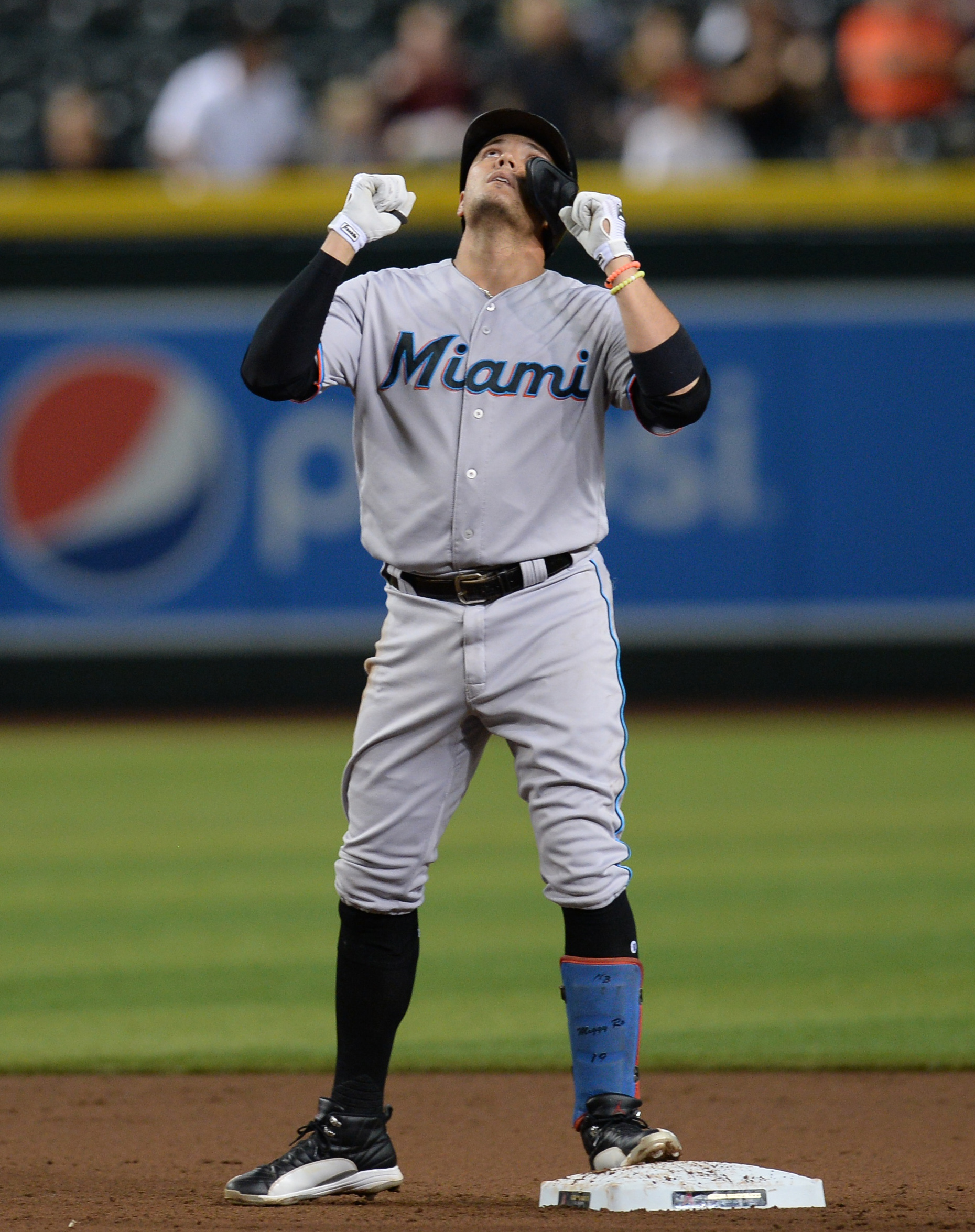
The new contract buys out Rojas’ final season of arbitration, guarantees one free-agent season and gives Miami an option for what would be the second free-agent season for Rojas, who’ll turn 31 in February. Rojas earned a $3.155MM salary in 2019 and would’ve been eligible for arbitration for the final time this winter — although his relatively timid offensive profile would’ve prevented him from cashing in on a substantial raise.
The timing of the contract talks are a bit unusual, but the Miami organization is no stranger to September extensions. The Marlins previously worked out a three-year, $40MM extension for Martin Prado as well as a much smaller one-year extension with Greg Dobbs in the final month of a season (not that either deal panned out particularly well for them). Beyond that, MLB.com’s Joe Frisaro tweeted this week that Rojas has “made it clear” to the Marlins that he wants to stay in Miami. The two sides apparently preferred to skip the potentially contentious arbitration process and proactively work out a multi-year arrangement.
Rojas has quietly become a versatile and fairly valuable player in South Florida, logging time at all four infield positions over the past few seasons while proving to be a difficult strikeout at the plate. He’s currently hitting .288/338/.388 with five homers, 27 doubles, a triple and eight steals in 2019, and he’s put together a serviceable (albeit still below average) .274/.327/.368 slash through 1316 plate appearances dating back to 2017. In that time, he’s punched out in only 12 percent of his plate appearances.
Though he’s spent the bulk of his time at shortstop over the past two seasons, Rojas grades out as an above-average defender all over the diamond. He’s generated elite numbers at the shortstop position, where he’s been credited with +26 Defensive Runs Saved and a +14 Ultimate Zone Rating dating back to 2017, which has helped to offset his lack of power and limited on-base skills.
Looking ahead, Rojas now appears poised to serve as the Marlins’ primary shortstop in both 2020 and 2021 — depending on the timeline of prospect Jazz Chisholm. For now, Rojas will likely be joined on the left side of the diamond by continually improving Brian Anderson, with well-regarded prospect Isan Diaz the favorite at second base. Garrett Cooper will likely round out the 2020 infield, although trades and free-agent acquisitions can certainly impact that composition. Rojas had previously been a somewhat under-the-radar trade asset, but a multi-year deal quite likely takes him off the market — at least in the short term.
MLB Network’s Jon Heyman first reported the deal (Twitter links). Barry Jackson and Jordan McPherson of the Miami Herald added some financial context, and Heyman tweeted final details.
Justin Smoak’s Strange Season
Justin Smoak‘s time with the Blue Jays is all but certain to come to an end when Toronto plays its final game this season. The rebuilding Jays will want to get a look at Rowdy Tellez, who has already begun to cut into Smoak’s playing time, and Smoak is set to become a free agent for the first time in his career.
As far as contract seasons go, Smoak surely can’t be thrilled with his results. He’s hitting .206/.342/.398 with 21 home runs on the year. At a time where seemingly everyone in the league has morphed into a power hitter, Smoak has cleared the fences 17 fewer times than he did in his 38-homer 2017 season. Waning playing time and a brief stint on the injured list have impacted that total, but the overall results aren’t ideal with free agency looming.
Smoak’s season, though, is also among the stranger you’ll come across when sifting through this year’s class of free agents. No one likes a .206 batting average, of course, but there’s also quite a bit to like about Smoak’s 2019 campaign. His 16.1 percent walk rate is the highest of his career by a long shot and is the sixth-highest of any qualified hitter in baseball. Smoak’s strikeout rate (21.1 percent) is down more than five percent from its 2018 level and is the second-best mark of his career. Only eight qualified hitters in baseball — Mike Trout, Alex Bregman, Mookie Betts, Joey Votto, Carlos Santana, Shin-Soo Choo, Tommy Pham and Daniel Vogelbach — have chased fewer pitches outside the strike zone than Smoak and his 22.9 percent clip. He ranks in the top 30 in terms of pitches per plate appearance (4.10). He’s been extremely disciplined at the plate.
A notable portion of Smoak’s struggles could be tied up in the fact that he’s had some poor luck on balls in play (.220). When looking into particularly egregious BABIP erosion, it’s common to see some trends that would portend to fewer balls dropping for hits — an uptick in infield flies, for instance, or for a player with Smoak’s skill set, perhaps a sharp increase in ground-balls. That hasn’t been the case, though. Smoak’s seven percent infield-fly rate is the second-lowest of his career, and his 36.9 percent ground-ball rate is actually down nearly three percent from 2018. His line-drive rate, correspondingly, is up nearly three percent. His fly-ball rate is right in line with his past four seasons.
So perhaps Smoak simply isn’t making good contact anymore? Not the case. Smoak’s overall percentage of balls hit at 95+ mph is down from 41.9 percent last year to 38.9 percent in 2019, but he’s upped his average exit velocity, improved his launch angle and very slightly improved his barrel rate, per Statcast. Smoak’s expected batting average of .242 and his expected slugging percentage of .472 (also via Statcast) dwarf his actual output. Among hitters with at least 100 plate appearances, the -.041 difference between Smoak’s actual wOBA (.325) and his expected wOBA (.366) is the ninth-largest. Put another way: Statcast considers Smoak among baseball’s unluckiest hitters in 2019. Not great timing for a player who’s about to hit free agency.
Of course, a poor season can’t be entirely blamed on rotten luck. Some of the struggles in terms of batting average are tied to aggressive shifting against Smoak — particularly when he hits left-handed (where he’s vastly better than from the right side). Smoak is MLB’s fourth-most shifted player when he bats lefty, and teams are shifting him 12 percent more often than in his monster 2017 season. As such, it’s barely been worth the effort for him to leave the box when he puts the ball on the ground. (I joke for the sake of hyperbole — run out your grounders, kids!)
Smoak is hitting .139 on grounders as a lefty and a ghastly .105 from the right side. Shifts are becoming more aggressive, more universally adopted and more precise; that’s going to hurt your plodding first basemen of the world, and Smoak is no exception. He’s already top-25 among qualified hitters in terms of fly-ball rate, but it’s easy to argue that he should strive to elevate even more. It’s also worth noting that Smoak is hitting .583 on line-drives, which sounds nice but is substantially south of the league average (.686) and his career rate (.711). Shifting likely plays a role there as well — but to a lesser extent. That’s one area where he seems likely to improve moving forward.
Given the leaguewide uptick in shifts over the past few years and Smoak’s decreasing speed, he’s probably never going to hit .270 like he did in 2017 (.270/.355/.529). But Smoak is also still making good contact and is more patient at the plate than he’s ever been before. He’s only been narrowly above replacement level this year by measure of wins above replacement, but there’s good reason to expect his bat to bounce back in 2020. The free-agent market has been particularly harsh for first base/DH types in recent winters, which could lead to someone getting themselves a nice bargain on Smoak.