
Yankees Designate Kyle Davies, Sign Joel De La Cruz
The Yankees have designated righty Kyle Davies for assignment, the club announced. Just as occurred yesterday when he was added to the active roster, Davies will cede his spot to another player who was signed to a big league deal — in this case, righty Joel De La Cruz.
Davies tossed 2 1/3 scoreless frames last night in his first major league outing since 2011. Last year, working at Triple-A for the Indians, he posted 154 1/3 innings of 3.91 ERA ball. Of course, Davis had plenty of big league experience coming into the season. Over parts of seven seasons with the Braves and Royals, he had thrown 770 1/3 innings with a 5.59 ERA with 6.4 K/9 against 4.3 BB/9.
De La Cruz, 25, worked to a 4.44 ERA in 121 2/3 minor league innings last year, split between Double-A and Triple-A. That was rather an impressive showing, given that he had made just six starts over his prior minor league career, most all of which had been spent in relief.
Braves Designate Juan Jaime For Assignment
The Braves announced that they have selected the contract of right-hander Sugar Ray Marimon and designated fellow righty Juan Jaime in order to clear room on both the 40-man and 25-man rosters.
Jaime, 27, made the Braves’ Opening Day roster in part because he’s out of Minor League options. The 6’2″, 250-pound righty appeared in two games for Atlanta this season and has totaled 13 2/3 innings for them dating back to 2014, totaling a 5.93 ERA with 19 strikeouts and an unsightly 13 walks in that time. Big strikeout totals and troublesome control are nothing new for Jaime, who has averaged 12.9 strikeouts and 6.1 walks per nine innings in the Minors. He’s averaged 96.1 mph on his fastball in his limited big league work, which, paired with his swing-and-miss stuff, may be enough that another team has interest in the big righty.
Dodgers Release Ryan Webb
The Dodgers announced that they have released recently acquired right-hander Ryan Webb. With this move, it becomes relatively clear that L.A.’s incentive in making the swap was simply to acquire the Competitive Balance draft pick that Baltimore included in order to get the Dodgers to assume all of Webb’s $2.75MM salary — a strategy that was examined in depth last night by MLBTR’s Charlie Wilmoth.
The 29-year-old Webb will now be free to sign anywhere he chooses, and as a player with five-plus years of service time, he is entitled to reject his outright assignment and force the club to trade or release him (with pay). As such, interested parties will only be on the hook for the pro-rated portion of the league minimum on a big league deal, with the Dodgers owing the remainder of his salary. That’s not necessarily a bad outcome for Webb, who is still guaranteed his money and is now free to choose a club that presents him the clearest path to a role to his liking.
As Charlie noted in last night’s analysis, that Webb’s $2.75MM salary is apparently viewed as exorbitant is a bit puzzling in its own right. While he’s not a shutdown reliever, Webb’s never posted an ERA+ lower than 99 and has been better than that in recent years. He’s served as a reasonably effective reliever with the Padres, Marlins and Orioles to this point, working to a 3.38 ERA with 6.3 K/9, 3.0 BB/9 and a 56.1 percent ground-ball rate in his career. While it’s true that he doesn’t fit the mold of the hard-throwing power relievers that are proliferating today’s game — his 92 mph fastball is notably tamer than the 95 he averaged in his first two seasons — Webb has still shown the ability to retire big league hitters.
As I noted at the time of the trade, the Dodgers will add not only the No. 74 pick in the draft, but also the money that comes along with it. That pick comes with a slot value of $827K, which will be subtracted from Baltimore’s draft pool and added to that of the Dodgers. The Orioles’ draft pool will drop from $7,677,400 to $6,850,400, while the Dodgers’ pool will rise from $6,954,700 to $7,781,700. And it should, of course, be noted that the Dodgers do come away with Minor League catcher Brian Ward. While he’s not an elite prospect, Ward ranked as the Orioles’ best defensive Minor League catcher (per Baseball America) prior to the 2013 season, so the Dodgers will at the very least add some depth and a strong defender to their ranks, even if Ward has never hit much.
Central Notes: Mesoraco, Iglesias, Harrison, Hunter
Reds catcher Devin Mesoraco did not travel with the team and instead remained in Cincinnati to undergo an MRI on his hip, tweets John Fay of the Cincinnati Enquirer. Catcher Kyle Skipworth will fill in for the time being, as he’s had his contract selected from Triple-A, the Reds announced. (A corresponding 40-man move will happen prior to tonight’s game.) The Reds entered the season with quite a few injury question marks, but Mesoraco was not thought to be one. Clearly, losing Mesoraco for any significant amount of time would be crushing for a Cincinnati team that many have already picked to struggle in the NL Central, though it’s too early to tell exactly how great the level of concern surrounding Mesoraco should be.
A few more notes from baseball’s Central divisions…
- Fangraphs’ Craig Edwards breaks down Raisel Iglesias‘ debut against the Cardinals yesterday, noting that while the start didn’t alleviate concerns about Iglesias’ ability to work deep into games, he showed enough to suggest that he can get big league hitters out on a consistent basis, even if it ultimately has to come in a relief role. With Homer Bailey nearing a return from the DL, the Reds will have to make a decision between Iglesias and veteran righty Jason Marquis. For the time being, that’s been solved by optioning Iglesias to Louisville, but Edwards wonders if it’d be a better decision to eventually let Iglesias develop at the highest level — a move that would seemingly force Marquis into the bullpen or off the Cincinnati roster.
- Bill Brink of the Pittsburgh Post-Gazette spoke to Pirates GM Neal Huntington about the decision to pursue a long-term contract with Josh Harrison. “When you believe in the person and you believe in the abilities of that person, and it aligns with where you want to go, you’re able to find the common ground, it makes all the sense in the world,” Huntington told Brink. As Brink points out, not all deals of this nature work out — he uses Jose Tabata as a particularly regrettable deal for the Pirates — but the cost certainty they provide is valuable. Brink notes that the Bucs will be on the hook for $42.25MM in 2017 — the last guaranteed year of the Andrew McCutchen and Francisco Liriano contracts — for the combined salaries of Harrison, McCutchen, Liriano and Starling Marte.
- Torii Hunter told reporters prior to today’s home opener that the Royals, Mariners, Rangers and Orioles were all interested in him before he made the decision to sign with the Twins, tweets the St. Paul Pioneer Press’ Mike Berardino. The Royals, in particular, seemed to tantalize Hunter, per Berardino: “Those guys going to the World Series, that was very appealing,” Hunter added.
Minor Moves: Jimenez, Tuiasosopo, Schlereth, Jones
Matt Eddy of Baseball America has released the latest installment of his Minor League Transactions roundup, which contains several yet-unreported moves, as usual. All transactions in today’s Minor Moves post are via Eddy, unless otherwise noted…
- The Phillies have announced that left-hander Cesar Jimenez has cleared outright waivers and accepted an assignment to Triple-A Lehigh Valley. Jimenez was outrighted over the weekend to clear a roster spot for right-hander Sean O’Sullivan, but he’ll accept a third outright assignment from the Phillies and hope to get another look in the big league bullpen soon. Jimenez did have the option to reject the outright in search of other employment, but he elected to remain with the organization.
Earlier Moves
- The White Sox have added utility man Matt Tuiasosopo on a Minor League deal after he was released by the Orioles earlier this month. The 28-year-old infielder/outfielder hasn’t appeared in the Majors since posting a solid .244/.351/.415 batting line in 191 plate appearances with the Tigers. Those numbers are significantly better than Tuiasosopo’s career numbers in the bigs, and he batted a less convincing .240/.357/.379 in 487 PAs between the Triple-A affiliates of the White Sox and Blue Jays in 2014.
- Daniel Schlereth‘s name is among a slew of farmhands released by the Tigers. Detroit inked Schlereth to a Minors deal back in January (without a camp invite), but he didn’t pitch in a game in Detroit’s system before being released. Schlereth was a useful member of Detroit’s bullpen back in 2010-11 after being included in the Max Scherzer/Ian Kennedy/Curtis Granderson three-team blockbuster, but shoulder injuries have derailed his career.
- The Orioles have re-signed right-hander Devin Jones on a Minor League pact, which is of particular note due to the fact that Jones was the pitcher traded to the Padres in exchange for righty Brad Brach. The 24-year-old Jones made 25 starts between the Class-A Advanced and Double-A levels of Baltimore’s system in 2013, but he pitched just 37 1/3 innings with the Friars’ Double-A affiliate last year, working to a 7.23 ERA with an unsightly 20-to-12 K/BB ratio.
Marlins Notes: Alvarez, Realmuto, Phelps
The Marlins announced that right-hander Henderson Alvarez has been placed on the 15-day disabled list due to right shoulder inflammation. Earlier today, Jon Morosi of FOX Sports tweeted that the team was more concerned with Alvarez’s shoulder than his elbow heading into an MRI. While the length of time that Alvarez will miss is yet to be determined, the news is certainly troubling, as shoulder issues are often more problematic than elbow issues for pitchers, in the long-term. Miami is already without ace Jose Fernandez, who had Tommy John surgery last May, and offseason acquisition Mat Latos was shelled in his first outing. He’ll look to rebound tonight, but he’s shown diminished velocity that has led to concern in some scouts as well.
A couple more Marlins notes…
- The Marlins also announced that top catching prospect J.T. Realmuto has been recalled from Triple-A and will join the team in Atlanta. (Andy Slater of 940-AM first tweeted that Realmuto would definitively be recalled, and the Miami Herald’s Clark Spencer called the move expected last night.) Realmuto and Reid Brignac will replace Jeff Mathis and Don Kelly, who bizarrely suffered the same injury — a broken right ring finger — six innings apart from each other. Realmuto’s presence is significant, given the struggles of Jarrod Saltalamacchia since signing in Miami. Entering the season, the 24-year-old Realmuto ranked 70th among prospects, per MLB.com, 72nd per ESPN’s Keith Law and 76th per Baseball America. Realmuto repeated Double-A in 2013 and saw his OPS soar from .663 to .830, and most scouting reports feel that his glove has taken a significant step forward as well. Saltalamacchia has batted just .217/.317/.364 as a Marlin, exhibiting his usual struggles to control the running game and well-below-average framing skills. He’s owed $7MM this year and $8MM in 2016, but if Realmuto thrives, it’s conceivable that Saltalamacchia could find himself on the back burner in Miami.
- David Phelps is a leading candidate to step into Miami’s rotation, MLB.com’s Joe Frisaro noted yesterday when speculating about the possibility of Alvarez landing on the disabled list. Phelps was a somewhat unheralded component of the offseason’s Martin Prado trade, but he did soak up 113 innings for an injury-plagued Yankees roster in 2014. Phelps worked to a 4.38 ERA in that time, averaging 7.3 strikeouts and 3.7 walks per nine innings pitched. As a pitcher who generates a fair amount of fly-balls, Phelps seems likely to benefit from the Marlins’ spacious park and excellent outfield defense.
- It’s also worth noting that Aaron Crow will land on the 60-day DL to clear a 40-man roster spot for Brignac, and that right-hander Carter Capps will take Alvarez’s roster spot. Capps, 24, is the pitcher that the Marlins received in exchange for Logan Morrison in a December 2013 trade with Seattle. He pitched quite well for Miami in 2014 before an elbow sprain cost him most of the season.
Indians May Pursue Backup Catching Options
Though the Indians will be without Yan Gomes for up to eight weeks, the team will not pursue starting catcher alternatives, reports Ken Rosenthal of FOX Sports (on Twitter). Cleveland believes that Roberto Perez can fill in as an everyday option behind the dish, according to Rosenthal. However, they may look to acquire a backup catching option that they consider to be an upgrade over Brett Hayes, who currently will fill the role with Perez’s playing time increasing.
The 31-year-old Hayes has seen Major League playing time in each of the past six seasons, though in some cases the sample was smaller than 20 plate appearances in a season. Despite the fact that Hayes is a pretty light-hitting option — as evidenced by his career .209/.252/.353 batting line — he’s still logged 175 games and 428 plate appearances in the Majors. He’s been roughly average in terms of catching base-stealers (25 percent) and has added some value with his ability to block pitches, though he does grade out as a below-average framer.
Earlier today I speculated that Dioner Navarro may be a fit in Cleveland, as he’d have an everyday role in Cleveland for the next couple of months (something both Navarro and Blue Jays GM Alex Anthopoulos have hoped to find), but it seems that GM Chris Antonetti and his staff will pursue moves on a smaller scale.
Looking at the free agent market, there isn’t much presently available, at least not in terms of players who accumulated notable Major League action in 2014. J.P. Arencibia, 29, was released by the Orioles last week, and veteran switch-hitter Ryan Doumit didn’t sign a contract this offseason. However, Arencibia’s batting average and on-base percentage have continued a downward spiral over the past few seasons, and Doumit’s glove behind the plate has never drawn strong reviews.
Looking to the trade market, the Yankees may be willing to part with the recently outrighted Austin Romine, though they were likely happy to sneak him through waivers given his former top prospect status. Baltimore has a few viable options, most notably Steve Clevenger, whose agent has recently hinted that a trade may be more preferable than further time at the Triple-A level. The White Sox also have quite a bit of catching depth, with five backstops on their 40-man roster — Rob Brantly, Adrian Nieto and Kevan Smith are all in the Minors — and veteran George Kottaras at Triple-A as well. Colorado’s Wilin Rosario was known to be available for much of the winter, but he’s a poor defender behind the plate and likely qualifies as a higher-profile acquisition than Cleveland hopes to make.
AL East Notes: Rays, Saunders, Navarro, Webb, Davies
Following the promotion of former first-round pick Mikie Mahtook to the Majors, Marc Topkin of the Tampa Bay Times looks back at what the Rays hoped would be a franchise-altering 2011 draft. Tampa had 10 of the first 60 picks in that year’s draft, but as Topkin points out, a significant number of the picks haven’t panned out. Infielder Brandon Martin and outfielder James Harris have both been released, while surgeries have slowed the careers of several others. Pitchers Taylor Guerrieri and Grayson Garvin have both undergone Tommy John surgery, right-hander Jeff Ames‘ 2014 season was cut short by thoracic surgery, and infielder Jake Hager will miss 2015 following a knee operation.
Here’s more from the AL East…
- Blue Jays general manager Alex Anthopoulos is hopeful that outfielder Michael Saunders will be healthy enough to join the roster on the team’s upcoming 10-game homestand, writes Sportsnet’s Shi Davidi. However, Anthopoulos stressed that the team isn’t going to “force a timeline” on Saunders’ return. The GM said that the team needs to be convinced that Saunders is able to play nine innings at a time five days in a row, though he won’t necessarily be required to do that on his rehab assignment before activation. Saunders played five innings in the outfield on Saturday and took just one at-bat as a DH on Sunday before being pulled with a tight hamstring, though that decision was a precautionary move, Davidi writes.
- Anthopoulos also briefly addressed Dioner Navarro‘s trade situation, David notes. “If we have any trade discussions on anybody, that’s not something we’re going to advertise,” said Anthopoulos. “But like I said, if there’s an opportunity to get him an everyday job we’ll look to do that, same thing we said in spring training.” It’s pure speculation on my behalf, but I do wonder if the Indians would have interest in Navarro with Yan Gomes out for up to two months. Navarro would eventually be reduced to a reserve role, but he’d likely accumulate more at-bats over the next six to eight weeks in Cleveland than in Toronto.
- Orioles executive VP/general manager Dan Duquette joined MASNsports.com’s Steve Melewski on 105.7 The Fan yesterday, and the two discussed the Ryan Webb trade as well as Chris Tillman‘s contract status. Melewski asked if it’s more difficult to trade player that has already been designated for assignment, as was the case with Webb, but Duquette revealed that trade talks with the Dodgers were already fairly advanced when Webb was designated. “In other situations, I wouldn’t designate the player and then continue down the track with a trade,” said Duquette. “I had a good sense that we could make a deal with the Dodgers and get back a couple of players that we liked.” Duquette also acknowledged that there won’t be any continuation of extension talks for Tillman during the season but said that the team had several good talks with Tillman’s representatives about his 2015 contract. He didn’t specify how much, if any, progress was made on a longer-term deal. MLBTR’s Charlie Wilmoth took an in-depth look at the unique nature of the Webb trade last night.
- Kyle Davies‘ return to a Major League mound as a member of the Yankees marks the culmination of three years spent recovering from shoulder surgery, writes MLB.com’s Bryan Hoch. Coincidentally, last night’s appearance forced Davies to face the final hitter he faced in his last Major League appearance in 2011 — David Ortiz (Ortiz grounded out each time). After the outing, Davies spoke with Hoch about the feeling of returning to the Majors. “This is why you come to work and you still do it,” said Davies. “This is why you did all that stuff and rode the buses in [Class A] and Double-A two years ago. It’s pretty cool.”
Offseason In Review: Boston Red Sox
The Red Sox weren’t quite able to land all of their offseason targets, but they were still one of the winter’s busiest teams. They look to ride a rebuilt pitching staff and one of the game’s best lineups back to the playoffs.
Major League Signings
- Pablo Sandoval, 3B: Five years, $95MM ($17MM club option for 2020, $5MM buyout)
- Hanley Ramirez, SS/LF: Four years, $88MM ($22MM vesting option for 2019)
- Koji Uehara, RP: Two years, $18MM
- Justin Masterson, SP: One year, $9.5MM
- Craig Breslow, RP: One year, $2MM
- Alexi Ogando, RP: One year, $1.5MM
- Total spend: $214MM
Pool-Eligible International Signings
- Yoan Moncada, IF: $31.5MM signing bonus (plus $31.5MM in overage taxes)
Notable Minor League Signings
Trades And Claims
- Acquired SP Rick Porcello from Tigers for OF Yoenis Cespedes, RP Alex Wilson and SP Gabe Speier
- Acquired SP Wade Miley from Diamondbacks for SP Rubby De La Rosa, SP Allen Webster and IF Raymel Flores
- Acquired C Ryan Hanigan from Padres for 3B Will Middlebrooks
- Acquired RP Anthony Varvaro from Braves for RP Aaron Kurcz and cash considerations
- Acquired SP/RP Zeke Spruill from Diamondbacks for SP/RP Myles Smith
- Acquired RP Robbie Ross Jr. from Rangers for SP Anthony Ranaudo
- Acquired C Sandy Leon from Nationals for cash considerations
- Acquired SP Daniel Rosenbaum from Nationals for C Dan Butler
- Acquired IF Marco Hernandez from Cubs as player-to-be-named-later in the Felix Doubront trade of July 2014
- Acquired cash considerations from Royals for SP/RP Jandel Gustave (Rule 5 Draft pick)
Extensions
- Rick Porcello, SP: Four years, $82.5MM
- Wade Miley, SP: Three years, $19.25MM ($12MM club option for 2018, $500K buyout)
Notable Losses
- Cespedes, Middlebrooks, David Ross, Burke Badenhop, Jonathan Herrera, Ryan Lavarnway, De La Rosa, Webster, Jason Garcia (Rule 5 Draft), Ryan Dempster (retirement)
Needs Addressed
The Red Sox moved quickly to snag the two biggest free agent bats on the market, signing both Pablo Sandoval and Hanley Ramirez before the end of November. The switch-hitting Sandoval addresses both Boston’s need for more lineup balance (most of the top Sox batters hit from the right side) and the need for a third baseman, as Will Middlebrooks’ struggles became too pronounced to ignore.
It stands to reason that the Sox might’ve originally explored signing Ramirez to play third base, though his willingness to switch positions led to Ramirez taking over as Boston’s regular left fielder. Putting Ramirez in left freed up room for Sandoval to play third and star prospect Xander Bogaerts to get another shot as the everyday shortstop.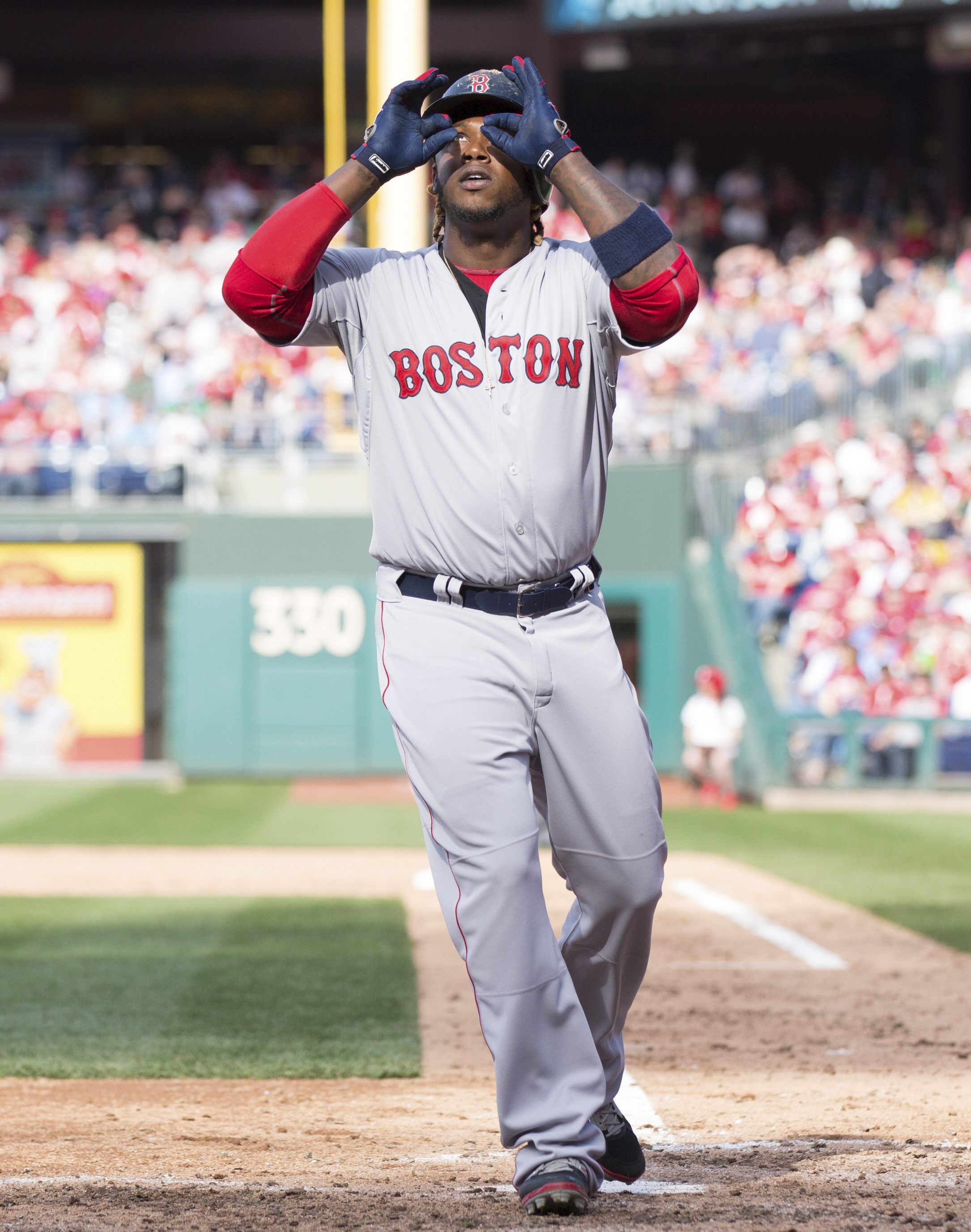
In the short term, acquiring both Sandoval and Ramirez leads to a bit of an overloaded roster for the Red Sox since they’re one of the few teams who can’t easily rotate players through the DH spot (as David Ortiz is still as productive as ever). In the big picture, however, the Sox were content to load up on as much hitting talent as possible and worry about how position battles shake out later. The Sox will have quite a bit of roster depth in 2015 at almost every position, which was one of GM Ben Cherington’s primary offseason goals after injuries and underperforming young players hampered last year’s team.
Moving Ramirez to left only further deepened Boston’s outfield glut, though the club lessened their load slightly by trading Yoenis Cespedes to the Tigers as part of a package that brought Rick Porcello to the Sox rotation. Porcello was scheduled for free agency after the 2015 season before the Sox made a firm commitment to the right-hander by signing him to a four-year, $82.5MM extension.
On paper, Porcello is the kind of pitcher that will fit right in at Fenway Park, as his 52.2% career ground ball rate will help counter the stadium’s notoriously hitter-friendly dimensions. While Porcello has only posted an ERA better than league-average twice in his six seasons, advanced metrics like xFIP and SIERA paint a friendlier pitcher of his performance in recent years. The Sox clearly believe Porcello can build on his impressive 2014 campaign, and now they’ve locked up a durable 26-year-old arm through his prime seasons.
The Red Sox acquired and extended another durable innings-eater in Wade Miley, picking up the 28-year-old from the Diamondbacks in exchange for two less-proven starting pitchers in Rubby De La Rosa and Allen Webster. Boston also turned to the free agent market to sign Justin Masterson to a one-year, $9.5MM deal as the veteran tries to rebound from a tough 2014 season. Like Porcello, both Miley and Masterson are noted ground-ball pitchers, as are incumbent starters Clay Buchholz and Joe Kelly. Of the five hurlers, Miley’s 48.6% career grounder rate is actually the lowest of the bunch, so Boston is clearly putting a premium on keeping the ball in the park.
The Red Sox re-signed closer Koji Uehara and lefty reliever Craig Breslow, and added a couple of young arms to the bullpen by trading for righty Anthony Varvaro and lefty Robbie Ross Jr. in deals with the Braves and Rangers, respectively. Alexi Ogando was also signed for a relief or swingman role depending on his health, and if the right-hander is fit after battling several injuries in recent years, he’ll be a boost to the pitching staff in either capacity.
Parting ways with Middlebrooks brought the Sox catcher Ryan Hanigan in a trade with the Padres. This trade was somewhat overshadowed by Boston’s many other headline-grabbing winter moves, though it has increased in importance now that Christian Vazquez has undergone season-ending Tommy John surgery. Hanigan will now be Boston’s regular starter, with the newly-acquired Sandy Leon serving as the backup.
While obviously this wasn’t Boston’s ideal situation behind the plate, there might not be much of a dropoff from Vazquez/Hanigan to Hanigan/Leon. Vazquez was seen as an excellent defensive catcher whose ability to hit at the MLB level was still in question, and Hanigan/Leon are similarly defense-first catchers who either haven’t hit well in a couple of seasons (Hanigan) or have barely seen any time in the bigs (Leon). There’s also a good chance you’ll see top catching prospect Blake Swihart make his Major League debut this season, as he might just need a bit more Triple-A seasoning before Boston is comfortable calling him up to the Show.
Beyond just adding pieces for 2015, however, the Red Sox also obtained a major future asset by signing Cuban phenom Yoan Moncada to a minor league deal with a $31.5MM bonus, by far the highest bonus ever given to an international amateur prospect. The Red Sox had already exceeded their signing pool limit for the 2014-15 international signing period and will be limited to $300K-or-less bonuses for the next two signing periods as punishment, so as long as they were comfortable paying the 100% overage on the deal (bringing Moncada’s cost up to $63MM), it was logical to bring in a big international talent now before the penalties take effect.
While $63MM is a steep price for a 19-year-old, it could be worth it given how scouts have raved about Moncada’s ability, comparing him to the likes of Robinson Cano and Chase Utley. Boston is so deep in infield and outfield talent that they don’t even have an immediate need for Moncada, though since he’ll need at least a season in the minors to develop, at least one position is sure to open up over time.
Questions Remaining
The two biggest pitching names attached to the Red Sox this winter were Jon Lester and Cole Hamels, neither of whom actually ended up in Boston’s rotation. In Hamels’ case, the Phillies have insisted on at least one of Swihart or Mookie Betts in any deal for the star left-hander, while the Red Sox have been just as adamant that neither top prospect will be moved.
The Sox look even less likely to deal either now given that Betts is the regular center fielder and Swihart could have a more immediate role with Vazquez injured. While Boston has a deep minor league system, the Phillies have received (and will continue to receive) enough interest in Hamels that it’s hard to see them settling for anything less than an elite young player like Betts or Swihart.
Missing out on Lester has to be a bitter pill for the Sox and their fans considering how the southpaw has been a cornerstone for the franchise for the better part of a decade. Boston made a six-year, $135MM offer to Lester that was topped by the Cubs’ $155MM offer, and one wonders if Lester would still be wearing the red today had the Sox initially proposed more than their infamous four-year, $70MM extension offer last spring. Lester has even hinted that five years/$120MM might’ve been enough to keep him had such a deal been offered last spring.
The fact that Boston pursued Lester this winter shows that their stated desire to avoid paying big money to pitchers in their 30’s isn’t quite rock-solid, yet that strategy is on display in regards to their 2015 rotation. None of the five starters are on guaranteed money beyond their age-30 seasons, giving the Sox flexibility if other options become available or if one of the starters underachieves.
Flexibility for the future, however, could mean uncertainty in the present. There has been quite a bit of criticism directed at the Sox for the lack of a “true ace” atop their rotation. Porcello, Miley, Buchholz, Kelly and Masterson combined for only 6.6 fWAR in 2014, and while injuries (particularly for Kelly and Masterson) played a role in that low total, Porcello was the only one who showed any front-of-the-rotation stuff last year.
A staff of innings-eating groundballers might actually be enough to contend given Boston’s solid defense and powerful lineup, though it’s hard to argue that the rotation wouldn’t look better with a Hamels/Lester-caliber pitcher as the No. 1 starter. If the rotation struggles, expect even more “why didn’t the Sox get an ace?” talk from the Boston fans and media. In that scenario, the front office will very likely intensify its search for a top-shelf hurler before the trade deadline.
While the Red Sox may give pause before giving a major contract to a pitcher in his 30’s, they clearly have no problem in doing so for a big hitter, which speaks to both the lack of elite hitting talent on the market and the team’s belief that Sandoval and Ramirez will both produce in Fenway Park. Both players come with some notable baggage; Sandoval’s weight and conditioning was long an issue with the Giants, and Ramirez has averaged only 116 games per year since 2011 due to a variety of injuries.
Putting Ramirez in left is something of a curious move for the Sox, though it might not be a bad one given how he has struggled defensively at both shortstop and third base in recent seasons. Still, losing Cespedes and adding Ramirez did nothing to alleviate Boston’s outfield surplus. As the season begins, Ramirez, Betts and Shane Victorino are the starters with Allen Craig, Daniel Nava and super-utilityman Brock Holt as the backups. Rusney Castillo and Jackie Bradley Jr. have begun the season in the minors, not the ideal place for either a $72.5MM contract or a youngster who entered last year as one of the top prospects in the bigs.
It’s possible this situation could take care of itself, either via injuries (Ramirez, Victorino and Craig are all health question marks) or some of these players simply under-performing. Castillo and Betts are unproven over a full season, while Nava struggled last year and Bradley has thus far been completely unable to hit Major League pitching. Also, if one of the infielders gets hurt, that could open the door for Ramirez or Betts to move back to the infield and create playing time for a backup outfielder.
That said, outfield is the still most logical area of surplus for the Red Sox to use as trade bait later this year. Craig and Victorino are the most probable candidates to be moved, though both will need several weeks of healthy and productive play to prove they’ve recovered from their 2014 injuries. One would think that Bradley is also likely on the trade market — despite his highly-touted prospect status and excellent glove, the fact that Boston has signed Castillo and shifted Betts to center would indicate that the club has already moved on from Bradley as its center fielder of the future.
Deal Of Note
The Red Sox re-signed Uehara to a two-year deal before free agency even opened, an aggressive move since there were a few whispers that the club could potentially look elsewhere given how Uehara struggled down the stretch in 2014. In making a two-year commitment to a reliever who just celebrated his 40th birthday, however, the Sox clearly believe Uehara’s late-season slump was largely due to some nagging injuries and not a sign of a decline.
Of course, Uehara hasn’t exactly proved his health to date, as he has begun the season on the DL with a strained hamstring. If Uehara were to have an extended DL stint or another bout of ineffectiveness during the year, that would be a major blow to a Red Sox bullpen that could already be facing some extra work this year given the shaky rotation. Uehara’s emergence as an elite closer was one of the planks of Boston’s World Series run, and while nobody expects him to duplicate his phenomenal 2013 numbers, he’s definitely being counted on as the bullpen leader.
Overview
One tends to forget that the Red Sox were actually a last-place team in 2014, given the amount of talent that already existed on the roster and the notable new names that have been added this winter. Their trip to the bottom of the AL East seems more like a trivial quirk (“Hey, who was the only franchise to go from last place to World Series champions to last place again over a three-season stretch?”) than it does a reflection of a big mountain to climb back to contention — after all, they climbed that mountain just two seasons ago.
Stockpiling all of this position player depth will help the Sox prevent against the inevitable injuries and slumps that will befall at least a few players over the course of 162 games, and it would be a surprise if Boston wasn’t one of the league’s best offenses by season’s end. After posting an uncharacteristically low team OBP (.316) and slugging percentage (.369), the Sox are looking to get back to their traditional strategy of grinding down opposing pitchers and making them pay with the long ball.
The major question is whether the rotation can hold up its end of the bargain. If the staff exceeds expectations, the Red Sox could be World Series contenders again. If the staff is even just average or slightly-below average, that still might be enough for a division run given the big bats and one of the league’s better defenses. If the starters can’t get on track, however, that will put a lot of pressure on the bullpen and on the lineup to win slugfests every night. While there don’t seem to any standout rotations within the AL East, Boston can’t afford to be the fifth of five middle-of-the-road pitching staffs.
Personally, I’d be very surprised if the Sox didn’t acquire at least one “proven ace” by midseason just because the rotation seems like such a notable weakness. It could be Hamels, it could be free agent-to-be Johnny Cueto if the Reds are out of contention, or it could be a starter suddenly made available by a surprise non-contender (similar to how the Red Sox shopped Lester last summer).
Boston has made enough solid acquisitions that the team should be back in the thick of things in the AL East. To fully complete their attempt at worst-to-first-to-worst-to-first again, however, they may still be one move away.
Photo courtesy of Bill Streicher/USA Today Sports Images
How The Dodgers Bought A Draft Pick
The Dodgers outrighted Ryan Webb today, continuing a string of strange transactions for the veteran reliever. First, he cleared outright waivers. Then the Orioles designated him for assignment. Then Baltimore shipped him to the Dodgers with catcher Brian Ward and a Competitive Balance Round B draft pick for pitcher Ben Rowen and catcher Chris O’Brien. Then, the Dodgers outrighted him today.
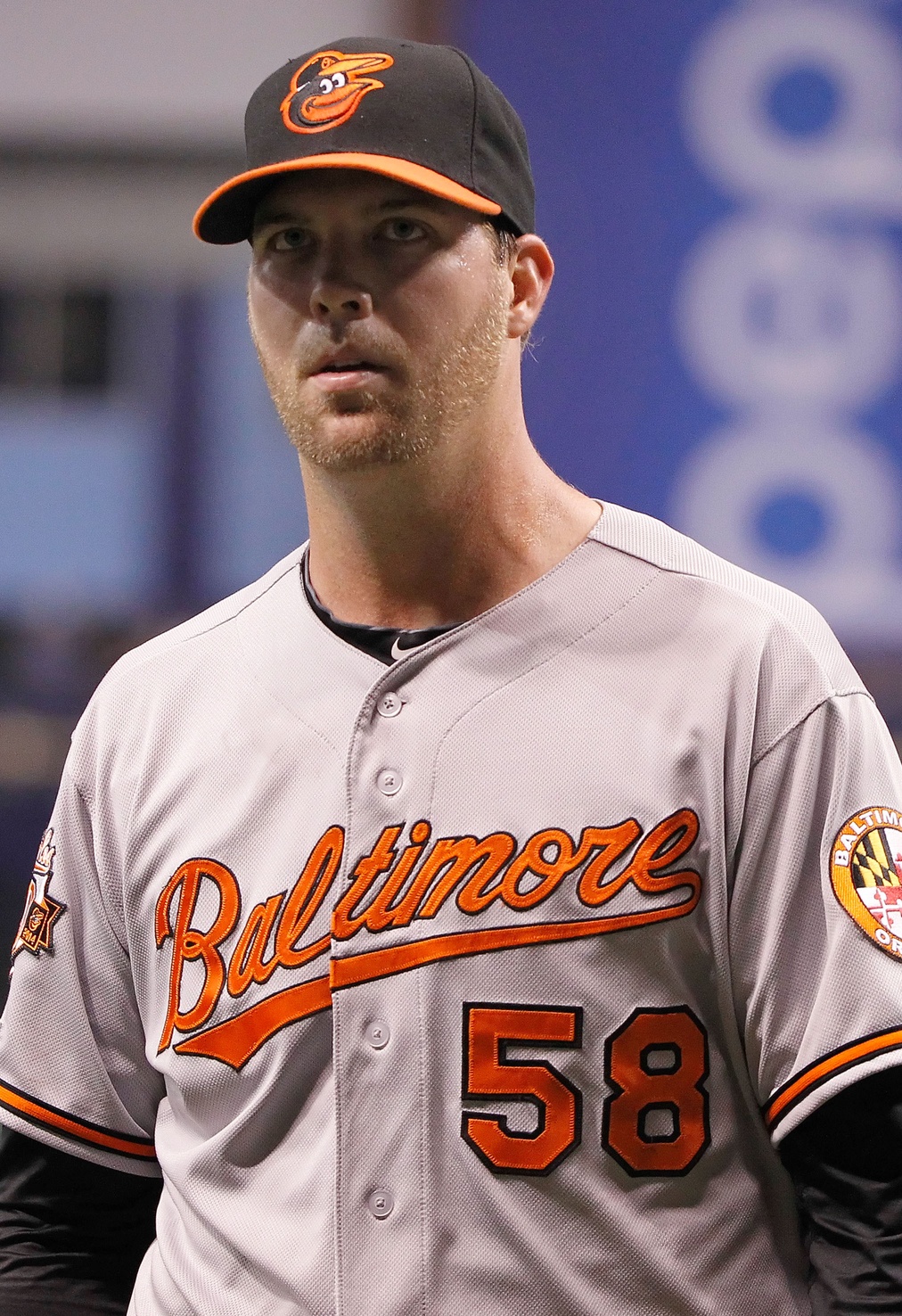 The guiding factor behind this string of moves was, it seems, Webb’s $2.75MM salary in 2015, the second season of a two-year, $4.5MM deal he signed with the Orioles. The Orioles didn’t want to pay it, and judging from the fact that they were able to outright Webb in the first place, other teams didn’t either. That, in itself, was perhaps a bit strange — Webb has never been an outstanding reliever, but he’s been relatively durable and effective in all of the past five seasons. Perhaps the lesson of the outright is that when selecting right-handed relievers, teams increasingly prefer pitchers who light up radar guns, of which there are many. Righties like Webb, who once sat in the mid-90s but whose velocity has slipped a bit in the last few years, get overlooked.
But the trade of Webb to the Dodgers was even stranger. The Dodgers were the ones receiving the big-league player, but they clearly had little interest in him and they also received what might have been the most valuable property in the trade — the draft pick. Other than Webb, the players in the deal appear to be mostly window dressing. Ward is 29 and has never been on a 40-man roster. Rowen pitched briefly for the Rangers last season, but Texas designated him for assignment and then released him in December after no one claimed him. The Dodgers signed him to a minor-league deal a month later. O’Brien will be 26 in July and has never played above Double-A.
As one might expect, the Orioles say they like the players they received. They were reportedly interested in Rowen this offseason, and it’s possible his ability to generate ground balls could one day make him a contributor, especially given the Orioles’ strong infield defense. (Webb also has ground-ball tendencies, although, of course, he had to be on the Orioles’ 40-man roster, whereas Rowen does not.) Some experts, meanwhile, believe O’Brien has a chance to stick as a backup catcher. The Orioles’ return appears, however, to be marginal, and from the Dodgers’ perspective, they didn’t give up much more than a bit of minor-league depth they didn’t really need.
Since the Dodgers have already outrighted Webb, then, the deal could quickly boil down to this: The Dodgers purchased a draft pick from the Orioles. They agreed to pay the salary of a player they didn’t need, and the Orioles gave them a pick in return. As the Los Angeles Times’ Bill Shaikin tweeted, “Moneyball with big money: Dodgers buy draft pick for $2.75MM.”
This is new. Teams have only been able to trade Competitive Balance picks for a few years, and never has there been a trade that amounted to a dollars-for-draft-pick swap the way this one seems to. Here are all the draft pick trades that have taken place since teams have been allowed to deal them.
- The Pirates sent a 2013 pick to the Marlins in a deal for Gaby Sanchez, who played for them for two and a half seasons.
- The Marlins and Tigers also swapped 2013 competitive balance picks to even the scales in the Anibal Sanchez trade.
- The Astros got a 2014 pick from the Orioles in the Bud Norris deal.
- The Pirates received a 2014 pick from the Marlins when they traded Bryan Morris.
- The Diamondbacks got a 2014 pick when they sent Ian Kennedy to San Diego.
- The Braves will receive a 2015 pick from the Padres as part of their recent trade of Craig Kimbrel. They’ll get another from the Diamondbacks for prospect Victor Reyes.
- The Astros received a 2015 pick when they traded Jarred Cosart to the Marlins.
- The Red Sox got a 2015 pick from the Athletics (which they’ve since forfeited) in the Jon Lester deal.
In all draft pick trades before the Webb deal, there are convincing cases that the teams trading picks parted with those picks in large part because they got talent they liked, and not primarily to shed salary. In the Webb trade, in contrast, Webb’s salary was clearly a key component of the deal.
So does the trade make sense for the Dodgers? The pick they will receive in this year’s draft is No. 74. A 2013 study found that the net value of a pick in the No. 61-100 range was $2.58MM, very close to the prorated portion of Webb’s $2.75MM salary the Dodgers are taking on. Add in that No. 74 is closer to the top of that range and add a bit of salary inflation since then, and the value of the pick is likely high enough for the trade to make financial sense for the Dodgers, even if we assume it’s possible that Rowen and O’Brien will provide a bit of value (and if we assume the Dodgers need to think about their budget the way other teams do). The Dodgers also receive a bit of draft pool flexibility with the acquisition of the pick, which could help them lure tougher-to-sign players.
Whether MLB would want deep-pocketed teams like the Dodgers essentially buying draft picks is a different question, although for now, the effects of them doing so are fairly minimal. Teams are currently only allowed to trade Competitive Balance picks, so a draft pick can only make a small impact on a trade, since Competitive Balance picks occur after most marquee talents are off the board. If teams were allowed to trade all draft picks and a big-market team were allowed to take on a larger amount of salary for, say, a top-ten pick, there would probably be controversy.
Photo courtesy of USA Today Sports Images.