
MLB Mailbag: Burnes, Soto, Brewers, Dodgers, A’s, Astros
Today's mailbag gets into where Corbin Burnes might go, why we write about players' salaries, whether Juan Soto will opt out, how the Brewers might sort out their outfield, chances of the Dodgers signing various free agents, and what's next for the A's.
Please note that this mailbag was initially published shortly before news of the Cody Bellinger trade broke. I'm sure we'll get into that trade in the next mailbag, but since some of the Bellinger material in the mailbag was usurped by the trade, I've added several bonus Astros questions and answers to the end.
Joel asks:
Why is there not even a shred of a suggestion anywhere that the Mets have interest in Corbin Burnes? If they were willing to pay dinosaurs like Scherzer and Verlander, why not pay Burnes? Otherwise, they'll lose a lot of games 7-5.
Tony asks:
Corbin Burnes will sign with ?
Bud asks:
As a Giant fan it’s a little concerning hearing the rumors of Corbin Burns nearing a deal with the team and then a week or more of quiet. I was hoping for more moves…
Neil asks:
Will Giants sign Burnes or will it be another pitcher?
David Stearns was the GM of the Brewers when the team drafted Burnes in the fourth round out of Saint Mary's College of California in 2016. With the Mets needing three starters this winter, it was natural to expect Stearns to be interested. While it's true Stearns topped out at $15.5MM for a free agent starter with the Brewers (Jhoulys Chacin in 2016), it's also true that the Mets have way more money than the Brewers.
Even a comparison to Stearns' 2023-24 offseason would not be fair, because that was, as my colleague Darragh McDonald wrote, "a sort of bridge year." Hence the relatively affordable additions of Sean Manaea, Luis Severino, and Adrian Houser.
To date, the Mets have made the ownership-driven decision to sign Juan Soto to a record-shattering contract, while Stearns has added Clay Holmes and Frankie Montas on two-year deals (if Holmes uses his opt-out) to help fill out the rotation. Kodai Senga barely pitched this year, and David Peterson's 21 starts matched a career high. Paul Blackburn is a back of the rotation type who has battled injuries, including October back surgery. The rotation lacks reliability, which would likely be solved by Burnes.
Stearns seems more interested in the trade market of late, showing interest in Garrett Crochet and Luis Castillo this month. Speculatively, they could go after Dylan Cease as well. On December 7th, Ken Rosenthal and Will Sammon of The Athletic wrote that the Mets had interest in Manaea, Nathan Eovaldi, Walker Buehler, Jack Flaherty, and Nick Pivetta. Around that time, Tim Healey of Newsday wrote that the Mets were not in on Max Fried and are not expected to land Burnes. It would seem that Stearns simply does not like the return on investment of huge pitching contracts (at least for the players available this winter) and does not want to spend $250MM+ on Burnes.

Unlock Subscriber-Exclusive Articles Like This One With a Trade Rumors Front Office Subscription
- Access weekly subscriber-only articles by Tim Dierkes, Steve Adams, and Anthony Franco.
- Join exclusive weekly live chats with Anthony.
- Remove ads and support our writers.
- Access GM-caliber tools like our MLB Contract Tracker
Yankees Acquire Cody Bellinger
The long-awaited Cody Bellinger trade has arrived. The Yankees and Cubs announced a trade sending Bellinger and cash considerations to the Bronx in exchange for right-hander Cody Poteet. Chicago is reportedly paying down $5MM of the $52.5MM remaining on Bellinger’s contract. They’ll pay $2.5MM of next season’s $27.5MM salary and send another $2.5MM in 2026 — either covering a portion of his $25MM salary for that season or paying half of the $5MM buyout if he opts out of his contract next winter. New York reportedly plans to use Bellinger as a center fielder.
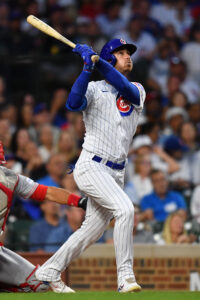 Bellinger heading to the Bronx is a logical fit and it has been in plenty of rumors recently. At the start of the offseason, the Yankees lost Juan Soto, Alex Verdugo and Anthony Rizzo to free agency, opening up two holes in their outfield and one at first base. Since Bellinger has played both the outfield and at first, the 29-year-old was seen as a possible fit for their 2025 plans in various ways. The Yanks pursued Soto for a long time but he eventually landed with the Mets, pushing the Yankees to several backup plans. They have since signed left-hander Max Fried and acquired right-hander Devin Williams to upgrade their rotation and bullpen.
For the Cubs, Bellinger has seemed expendable for a few reasons. On the one hand, Pete Crow-Armstrong emerged as a viable glove-first center fielder in 2024, which was Bellinger’s primary spot the year before. Michael Busch also took over the first base spot. With Ian Happ and Seiya Suzuki in the outfield corners, Bellinger was a bit squeezed. The Cubs only compounded the problem when they acquired Kyle Tucker from the Astros.
However, beyond the roster crunch, the Cubs were also likely motivated to move Bellinger due to his decline in performance. After some rough years with the Dodgers while recovering from shoulder surgery, the Cubs took a bounceback flier on Bellinger in 2023. After being non-tendered by the Dodgers, the Cubs gave Bellinger a $17.5MM guarantee on a one-year pact, hoping he could get over his injury woes and return to being the player that won Most Valuable Player in 2019.
He didn’t get all the way back to that level but was still great value for that investment. He stole 20 bases and hit 26 home runs. He only struck out 15.6% of the time. The reviews of his center field defense were mixed but were mostly close to league average. He also moved to first base on occasion. He slashed .307/.356/.525 for a 136 wRC+ and produced 4.4 wins above replacement, in the eyes of FanGraphs.
Perhaps the Cubs would have been happy to walk away at that point. They gave Bellinger a qualifying offer and didn’t seem to have a very high motivation to re-sign him, but nor did any other clubs, as Bellinger remained unsigned through late February. Eventually, he and the Cubs agreed to a three-year, $80MM deal with opt-outs after each season.
On that kind of deal, the best case scenario for the club is that the player performs well and then opts out. If the player doesn’t opt out, it means he doesn’t like his prospects in free agency, which likely means he got hurt or underperformed.
Bellinger’s production did indeed slip relative to 2023, though it wasn’t disastrous. He stole nine bases and hit 19 home runs. His strikeout rate held steady at 15.6%. He slashed .266/.325/.426 for a wRC+ of 109. His center field defense was still graded as around league average but he spent less time there due to the aforementioned emergence of Crow-Armstrong. He produced 2.2 fWAR, half of the year before.
Going into the offseason, it was a borderline call as to whether Bellinger would opt out or not. He could have taken the $2.5MM buyout and taken his chances, leaving a $52.5MM guarantee on the table. While he may have been able to beat the $50MM difference this winter, he decided to stay, perhaps due to the way the current contract is allocated. He will make $27.5MM in 2025 with a $5MM buyout on his $25MM for 2026. There’s a best-case scenario for him personally where he plays better in 2025 and then takes the second opt-out, returning to the open market with greater earning power, pocketing $32.5MM in the process. He decided that was more attractive than opting out this year.
It seems fair to conclude that the Cubs would have rather he opted out. Trade rumors surrounding Bellinger have been flying all offseason and now the Cubs have moved on from him, mostly for salary relief. By taking on the majority of that salary, the Yankees haven’t had to give up much, though there is financial risk and the deal has more downside than upside.
If Bellinger plays especially well in 2025, he will trigger that opt-out. That will leave the Yankees having paid him $27.5MM for one year, which is the best-case scenario for them at this point. Though if he doesn’t play well or finishes the upcoming season with a notable injury, he will stay on their books for 2026, with the Yanks on the hook for $22.5MM of his $25MM salary.
The Yankees are also repeat luxury tax payors, which will add to what they are paying Bellinger. If they end up above the highest threshold as they did in 2024, then they are slated for a 110% tax on spending over the top line, so any new additions to the roster effectively cost double. That compounds the risk they are taking with Bellinger but the same would be true if they had instead opted to sign a free agent or acquire another player making a notable salary.
Bellinger has been a very streaky player in his career, so it’s anyone’s guess which of those outcomes is more likely in the upcoming year. As mentioned, he’s shown MVP upside but followed that up with a stretch so bad that he was non-tendered. He roared back in 2023 but dipped a bit in 2024.
All that being said, it’s understandable why the Yankees would be interested in taking this risk. The free agent market features outfielders like Teoscar Hernández and Anthony Santander, but they will likely end up with larger guarantees than Bellinger. Santander is reportedly looking for a five-year deal and Hernández three, each likely hoping for an average annual value of $20MM or more.
They are also both bat-first guys with poor defense, whereas Bellinger is capable of being a strong defender in an outfield corner or perhaps passable in center. The Yanks played Aaron Judge in center a lot in 2024 while using Verdugo and Soto in the corners, though it seems that Judge is now slated to return to right field. That’s a sensible pivot since Judge’s marks were poor this year and he’s about to turn 33, meaning the long-term toll on his body would have to be considered. The Yankees may have continued to have Judge up the middle if they had re-signed Soto but after he signed with the Mets, it was reported the the club was planning to move Judge back to right and have Jasson Domínguez get a crack at the center field job.
Now that they have landed Bellinger, it seems he is Plan A for center. As mentioned, the advanced metrics have been a bit split on his viability there. In over 4,000 innings, he has been credited with 10 Defensive Runs Saved. However, most of that positive value came earlier in his career with the Dodgers. He’s been average or below for four straight years now. Outs Above Average, however, is far more bullish. That metric has given Bellinger a grade of +19 in his career, having him at par or better in every season of his career.
Perhaps there’s a scenario where Domínguez seems like the better option and pushes Bellinger to a corner, but there’s no guarantee he will be a capable big leaguer in 2025 at all. He tore through the minors and then debuted with a splash in 2023, but he then required Tommy John surgery late that year, which put him on the shelf for a decent chunk of 2024. He then missed more time this year due to an oblique strain and has only appeared in 26 big league games at this point. He will likely still get a shot at taking the left field job next to Bellinger and Judge but isn’t guaranteed anything, with guys like Everson Pereira and Spencer Jones around to give him some competition.
The Yanks didn’t have many other options if they wanted to find a solution for center field. The free agent market is arguably led by glove-first Harrison Bader, who they weren’t likely to sign anyway after a bad experience trading for him in 2022. The trade market has other options such as Luis Robert Jr., though all reports have indicated the White Sox are setting a high asking price even though Robert is coming off yet another injury-marred season.
It’s also possible that they change their plans, depending on how the rest of the offseason plays out. They reportedly have interest in various first base options, such as trade candidates Josh Naylor or Nathaniel Lowe, as well as free agents Pete Alonso, Christian Walker, Carlos Santana and Paul Goldschmidt. But if they can’t complete a deal they like there, they could always pivot back to Hernández and/or Santander or some other outfielder, sending Bellinger to first base in that scenario.
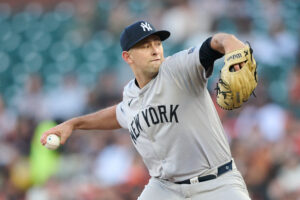
For the Cubs, they are likely happy to get the majority of Bellinger’s salary off their books but also take a flier on Poteet. The 30-year-old has 83 innings of major league experience at this point between the Marlins and Yankees, missing the 2023 season while recovering from Tommy John surgery. He returned to the mound in 2024 but also missed about three months due to a right triceps strain.
He tossed 24 1/3 innings in the majors this year over four starts and one relief appearance. He allowed 2.22 earned runs per nine with a 16.7% strikeout rate, 8.3% walk rate and 42.3% ground ball rate. He also made ten Triple-A starts with a 3.92 ERA, 27.2% strikeout rate, 8.3% walk rate and 40.7% ground ball rate.
The Cubs already have a solid rotation mix consisting of Justin Steele, Shota Imanaga, Jameson Taillon, Matthew Boyd and Javier Assad. They’ve been connected to Jesús Luzardo in recent rumors and also have Jordan Wicks, Ben Brown and Cade Horton in the mix. Poteet still has options and can slot in as Triple-A depth for the Cubs.
Financially, RosterResource now has the Cubs with a competitive balance tax calculation of $192MM, almost $50MM shy of the $241MM base threshold. They went a bit over the line in 2024 but it’s unclear if they are willing to do so again in 2025. It’s also unclear if they have any other big moves planned now that they have added Tucker and Boyd. The bullpen could certainly use some upgrades but the club has generally shied away from big splashes there.
RR puts the Yankees at a $270MM payroll and a luxury tax calculation of $292MM. They had a payroll around $300MM last year and therefore still have a bit of wiggle room for other moves if they are willing to get to a similar level next year. The top tier of the tax starts at $301MM next year, so they are not far from getting up to that 110% tax rate, but are already at a 95% rate at their current level.
They are still on the lookout for help at the infield corners, with Jazz Chisholm Jr. likely slated to be moved from third to second base, though adding a second baseman and keeping Chisholm at third is also a possibility. Perhaps a trade of Marcus Stroman could help in multiple ways, as he is making a notable salary and arguably surplus to requirements in the rotation.
Jeff Passan of ESPN first reported that Bellinger and cash were going to the Yankees for Poteet. Jack Curry of YES Network first had the $5MM total. Jesse Rogers of ESPN reported that it was split into $2.5MM per year while Passan added that the second half would be coming regardless of the opt-out decision. Bob Nightengale of USA Today reported that Bellinger has been told he’ll be playing center field for the Yanks.
Latest Developments In Rays’ Stadium Situation
On Tuesday evening, the Pinellas County Commission voted by a 5-2 margin to approve roughly $312.5MM in public funding for the proposed $1.3 billion project to construct a long-term stadium for the Rays. However, the tension between the organization and county officials is far from resolved. Colleen Wright of the Tampa Bay Times and Kate Payne/Curt Anderson of The Associated Press were among those who covered the news.
The Rays did not attend the meeting. Team president Matt Silverman released a statement after the vote that read:
“It was unsurprising to see the Commissioners acknowledge how important the Tampa Bay Rays and our stadium development agreement are to this community and its citizens. As we have made clear, the County’s delay has caused the ballpark’s completion to slide into 2029. As a result, the cost of the project has increased significantly, and we cannot absorb this increase alone. When the County and City wish to engage, we remain ready to solve this funding gap together.”
The dispute stems from the county’s decision to delay previous votes on the stadium bonds, which were initially scheduled for October 29. At the time, the county was in the immediate aftermath of the consecutive hurricanes which devastated the area. The storms ripped the roof from Tropicana Field, necessitating significant repairs to the Rays’ current home. Between the storm damage and a changed council membership after November’s elections, the county decided to postpone the vote on multiple occasions.
Last month, the Rays released a statement criticizing the delays. According to the organization, the postponements made it unfeasible to have the park constructed for the 2028 season. The team wrote that constructing a stadium for ’29 “would result in significantly higher costs,” which the team does not want to fully absorb. The stadium deal had been agreed upon between the county and the Rays in July, with the bonds expected to be rubber stamped at October’s vote. The July deal left the responsibility for all cost overruns on the Rays.
While the team has not publicly stated how much more expensive it believes construction will be, one county official said (via Wright) that the team has privately put that number around $200MM. County officials have expressed skepticism about that sum, arguing that a delay of less than two months could not cause such significant expenditures.
In any case, the ball is back in the Rays’ court. The Tampa Bay Times writes that the Rays have the ability to withdraw from the deal via a termination letter. The organization must meet various benchmarks by March 31, 2025, or the deal will automatically become void. The Rays seem likely to push for more negotiations to try to unlock additional public funding in the coming months. County commissioners and St. Petersburg mayor Ken Welch have stated they’re not willing to commit more public money beyond what was approved on Tuesday, according to The Tampa Bay Times.
Brewers Hire Julio Borbon As First Base Coach
The Brewers announced their 2025 coaching staff on Tuesday morning. Milwaukee hired former MLB outfielder Julio Borbón as first base coach.
Borbón takes over the position from Quintin Berry, who departed to take the third base coaching job with the Cubs in October. Like Berry, the 38-year-old Borbón was best known for his speed during his playing days. He stole 47 bases over 294 games in a big league career that spanned parts of five seasons. Most of that time came with the Rangers between 2009-11. Borbón made brief appearances with the Cubs and Orioles in later years.
After retiring as a player in 2019, Borbón jumped into coaching in the Yankees’ system. He had a brief managerial run with New York’s rookie ball affiliate before moving into a player development capacity with the Twins in 2022. Borbón spent three seasons with Minnesota and now gets his first job on an MLB coaching staff.
The rest of Pat Murphy’s second staff in Milwaukee is as follows: associate manager Rickie Weeks, lead hitting coach Al LeBoeuf, hitting coaches Eric Theisen and Connor Dawson, pitching coach Chris Hook, assistant pitching/strategy coach Jim Henderson, bullpen coach Charlie Greene, third base coach Jason Lane, field coordinator Néstor Corredor, assistant coach Daniel De Mondesert, and infield coach Matt Erickson.
Adam McCalvy of MLB.com notes that the “strategy coach” element of Henderson’s title is a new development. The former closer has been on staff as an assistant pitching coach for three seasons. He’ll take on a bit more responsibility in game planning after run prevention coordinator Walker McKiven left to become Will Venable’s bench coach with the White Sox.
Blue Jays Have Shown Interest In Nick Pivetta
The Blue Jays are involved in the market for Nick Pivetta, reports Jon Heyman of the New York Post. They’re one of a handful of teams that has been linked to the 6’5″ righty. The Reds, Mets and incumbent Red Sox have also been linked to Pivetta this offseason.
Pivetta, who is a native of British Columbia, is one of the better unsigned starting pitchers. He’s one of three pitchers — alongside Corbin Burnes and Sean Manaea — who remain free agents after declining the qualifying offer. There was some surprise that the Red Sox risked the $21.05MM QO, but that proved a prescient decision in what has been a bullish market for starting pitching.
The 31-year-old (32 in February) has been an innings eater in the middle of the Boston rotation for the past few seasons. Pivetta struggled early in the 2023 campaign and was briefly demoted to the bullpen, but he excelled late in the year to earn his way back to the starting five. He took the ball 27 times this past season, working to a 4.14 ERA across 145 2/3 innings. Pivetta missed some time early in the year with a flexor strain. That was the first non-virus injured list stint of his MLB career, though, and he returned without issue by the middle of May.
Pivetta has never posted a sub-4.00 ERA season. His run prevention has landed in the low 4.00s in consecutive seasons, and he carries a 4.09 mark in 288 1/3 frames since the start of 2023. Pivetta’s strikeout and walk rates have always been more intriguing than the ERA might suggest. He has punched out 30% of opponents with a solid 7.3% walk percentage over the past two seasons. The swing-and-miss ability has been somewhat undercut by Pivetta’s longstanding issue keeping the ball in the park. He has allowed a higher than average home run rate in all seven seasons of his MLB career.
There’s value in the durability and solid run prevention marks that Pivetta has provided the Red Sox. Some teams could still view him as a potential #2 or high-end #3 starter based on the stuff and swing-and-miss ability, feeling they can make some tweaks to help him more effectively stay off barrels. Speculatively speaking, his camp could look to beat the three years and $67MM which Luis Severino recently secured from the Athletics.
The Jays have shown some level of interest in virtually every free agent of note. They’ve yet to pull off an especially significant free agent move. Their only signing is a two-year, $15MM deal to bring back reliever Yimi García. Toronto took on the final five years and $97.5MM on Andrés Giménez’s contract via trade with the Guardians at the Winter Meetings. That’s a significant expenditure, but the front office surely continues to juggle multiple free agent pursuits.
Toronto is among the three teams (alongside Boston and San Francisco) most frequently mentioned as landing spots for Burnes. They’re certainly not going to bring in Burnes and Pivetta, so the latter is potentially a fallback target who’d allow them to devote more money into one or two lineup upgrades. The Jays have looked for a starter to join Kevin Gausman, José Berríos, Chris Bassitt and Bowden Francis in the Opening Day rotation. That’d allow them to use Yariel Rodríguez in relief, indirectly upgrading a bullpen that remains a huge weakness despite the García pickup.
The Blue Jays are believed to have cut their payroll narrowly below the luxury tax threshold at the end of the ’24 season. That reduces the penalty they’d pay to sign Pivetta or any other free agent who rejected the QO. Toronto would forfeit its second-highest pick of the 2025 draft plus $500K from the ’26 bonus allotment for international amateur players.
Jed Hoyer Discusses Kyle Tucker, Corner Infield Plans
The Cubs pulled off a huge deal last week, acquiring outfielder Kyle Tucker from the Cubs in exchange for third baseman Isaac Paredes, right-hander Hayden Wesneski and prospect Cam Smith. President of baseball operations Jed Hoyer spoke to members of the media today (including Meghan Montemurro of the Chicago Tribune, Bruce Levine of 670 The Score and Maddie Lee of the Chicago Sun-Times), addressing Tucker and the club’s corner infield options.
While Tucker is a big upgrade for the 2025 team, he is set to be a free agent after that. That means he doesn’t currently provide the Cubs any value beyond the upcoming season, apart from the extra draft pick they would receive if he rejects a qualifying offer at season’s end and then signs elsewhere.
The Cubs could always change that future by signing Tucker to an extension, something that Hoyer touched upon a bit. “I don’t know what the future holds,” he said. “But obviously Chicago sells itself really well. And so, I’m excited to bring him in for this year, and we’ll see where it goes beyond that. But clearly this was the kind of player that we lacked.”
It’s fair to assume that the Cubs would love to have Tucker beyond just the one year. They clearly value the player highly, based on the strong package of talent they gave up just for that one season, plus the aforementioned QO compensation. Tucker himself also spoke today (per Levine) and said he’s open to having talks before he hits the open market.
While it’s nice that Tucker is open to having talks, agreeing on a price point might be a challenge. Tucker has been one of the better players in baseball in recent years and is slated to hit free agency ahead of his age-29 season. To get a really good player to sign an extension just before hitting free agency ahead of his 30th birthday isn’t cheap, as shown in MLBTR’s Contract Tracker. Some recent examples include $365MM for Mookie Betts, $341MM for Francisco Lindor and $313.5MM for Rafael Devers.
It’s a somewhat similar situation to the one that just played out between Juan Soto and the Yankees. He was acquired from the Padres with one year remaining before hitting free agency, said he was open to contract talks at any time, but ultimately became a free agent and signed a mega deal with the Mets.
With the Cubs, it’s arguably even less likely to get done. Tucker’s earning power isn’t as high as Soto’s but the Cubs have never given out deals even to that Betts/Lindor/Devers level. Jason Heyward‘s $184MM deal is still the largest in franchise history, even though it’s almost a decade old at this point. Since Hoyer took over, the club’s largest deal has been $177MM for Dansby Swanson, the only time he’s gone higher than $85MM. Perhaps they are willing to break that pattern for Tucker, who they clearly like, but it would likely require them to effectively double the Heyward/Swanson deals.
Hoyer also addressed the third base situation at Wrigley, as trading Paredes created an opening there. It has been expected that the club would be willing to give prospect Matt Shaw to take that spot. Hoyer seems to be open to that coming to pass, saying that Shaw would get a “long look”, though he wouldn’t just call it a done deal. “He has to earn that job,” Hoyer said. “I’m not going to gift him that on a conference call in the middle of December.”
That’s a fair position to take. Though Shaw has performed very well in the minors, even the best prospects can struggle when first called up to the majors, so nothing can be taken for granted. Selected 13th overall last summer, Shaw has slashed .303/.384/.522 so far in 159 minor league games across different levels. That includes a line of .298/.395/.534 in 35 Triple-A games to finish his 2024 season, so there’s definitely an argument for him cracking the majors to start 2025.
But since there’s no guarantee he will hit the ground running, the Cubs will need to have backup plans. The Cubs had six players spend at least 85 innings at third this year, but Miles Mastrobuoni is the only one of the six left on the roster. As mentioned, Paredes was in the Tucker deal. The Cubs traded Christopher Morel to the Rays in order to acquire Paredes in the first place. Nick Madrigal and Patrick Wisdom were non-tendered at season’s end. David Bote was outrighted off the roster in August.
Infielder Gage Workman was just grabbed from the Tigers in the Rule 5 draft, so he has a roster spot for now, but he doesn’t have any major league nor any Triple-A experience. Ben Cowles and Luis Vázquez are other multi-positional infielders currently on the 40-man. Perhaps the Cubs will look at adding to that group by signing a veteran utility man, whether that’s to a modest major league deal or a minor league pact.
One thing that is apparently not under consideration is moving Michael Busch across the diamond. The club had an outfield logjam but Cody Bellinger can play first, so it was theoretically possible for them to open that spot for Bellinger by moving Busch to the hot corner, a position where he has 99 1/3 innings of major league experience. But Busch got strong grades for his first base defense this year and Hoyer suggested their focus would be keeping him there. Bellinger was traded to the Yankees after Hoyer’s comments this afternoon.
Unrelated to Hoyer’s comments, there was another Cubs tidbit of note this week. Patrick Mooney and Sahadev Sharma of The Athletic report that the club has considered the possibility of stretching out right-hander Nate Pearson as a starter.
There’s some merit to the plan but it may be difficult to pull off. Pearson was a starting pitching prospect of note with the Blue Jays before injuries pushed him into a relief role. As recently as July, he expressed an interest in returning to a rotation role, shortly before he was traded to the Cubs.
Bullpen-to-rotation conversions have been all the rage lately. Some recent success stories have included Michael King, Seth Lugo, Reynaldo López, Garrett Crochet and others. It doesn’t always work, with the A.J. Puk experiment one attempt that didn’t pan out, but clubs seem to be warm to the idea. The Mets have signed Clay Holmes with a plan of stretching him out next year and there have been some reports suggesting Jeff Hoffman might get a rotation gig next year as well.
With Pearson, it’s tough to see a path next year. The Cubs already have Shota Imanaga, Justin Steele, Matthew Boyd, Jameson Taillon and Javier Assad in the rotation, with reported interest in Jesús Luzardo of the Marlins as well. They also have Jordan Wicks, Ben Brown, Cade Horton and other potential starters around, so all those guys might not leave a lot of room for Pearson to get big league starts. As such, Mooney and Sharma admit that Pearson is most likely to stick in a relief role next year.
Royals, Taylor Clarke Agree To Minor League Deal
The Royals agreed to a minor league contract with right-hander Taylor Clarke last week, according to the MLB.com transaction log. The 31-year-old returns to the organization after spending one season in the Milwaukee system. He’s represented by the Ballengee Group.
Clarke, a former Diamondbacks draftee, pitched with Kansas City in 2022 and ’23. The former was the best season of his career. Clarke turned in a 4.04 earned run average with stellar command across 49 relief innings. He struggled in his follow-up campaign, allowing nearly six earned runs per nine over 59 frames. The Royals dealt him to the Brewers last offseason for a pair of minor leaguers. Clarke suffered a meniscus injury in his right knee during Spring Training.
That required surgery, leading Clarke to begin the season on the minor league injured list. He struggled in Triple-A upon his return and lost his spot on Milwaukee’s 40-man roster in July. Clarke spent the entire season with their top affiliate in Nashville before qualifying for minor league free agency.
The Brewers used Clarke mostly out of the rotation in the minors. He started 15 of 22 outings, tallying 68 frames of 4.90 ERA ball. He’d pitched exclusively as a reliever or opener over his two seasons in Kansas City (and in his final year in Arizona). The Royals have more need for bullpen depth than they do for a starter, so they’re presumably targeting Clarke as a candidate for middle innings work.
Clarke has strong command and posted roughly average strikeout rates over his two seasons in K.C. He sat in the 95-96 MPH range with his heater in short stints. That dropped to around 93-94 in Triple-A this year, which is to be expected since he was working deeper into games. Clarke has struggled with the home run ball throughout his five MLB seasons, the biggest reason his career ERA sits narrowly above 5.00.
Yankees, Colten Brewer Agree To Minor League Deal
The Yankees have agreed to a minor league deal with righty Colten Brewer, reports Robert Murray of FanSided. The ISE client will be back for a second stint with the Yankees and will receive an invite to big league camp next spring.
Brewer, 32, pitched 8 1/3 innings with the Yankees in 2023 and spent the bulk of that season with their Triple-A affiliate. He spent the 2024 campaign with the Cubs, pitching 20 2/3 innings with a grim 5.66 ERA but a more encouraging 23.2% strikeout rate versus a 9.5% walk rate. The 6’4″ righty has pitched in parts of six big league seasons for four teams, compiling 120 innings of 5.10 ERA ball.
Though Brewer doesn’t have a standout MLB track record, he’s been solid in parts of seven Triple-A seasons, working 164 2/3 innings with a 4.10 ERA, a 26.6% strikeout rate and a 9.5% walk rate. He averaged 94.3 mph on his heater this past season and, like many Yankees pitching targets, has shown a repeated penchant for inducing ground-balls. Just over half the batted balls put into play against Brewer in his big league career have been grounders (50.1%).
With the exception of an uncharacteristic six homers in 25 2/3 innings in 2020, Brewer has done a good job of both keeping the ball in the yard and avoiding hard contact. He yielded just a 31.9% hard-hit rate in Triple-A this past season and an even stingier 28.3% mark with the Yankees in 2023. Overall, Brewer was excellent with Scranton/Wilkes-Barre in 2023, recording 20 2/3 innings of 1.80 ERA ball for the Yankees’ top affiliate that year. He parlayed that success into a run with the Hanshin Tigers in Japan but returned stateside this past season.
Obviously, Brewer’s minor league deal is far from the most impactful Yankees news of the day. However, he’ll give the Yanks an experienced reliever with a nice Triple-A track record and plenty of grounders to stash in the upper minors. Brewer has pitched in six of the past seven MLB seasons — 2022 being the lone exception — and ought to be in line for a call should the Yankees need an extra arm in the event of injuries and/or a stretch that heavily taxes the big league bullpen.
White Sox Acquire Matt Thaiss From Cubs
The Chicago teams have lined up on a minor trade. The White Sox acquired catcher Matt Thaiss from the Cubs for cash, the teams announced. The Sox had an opening on the 40-man roster, so there was no corresponding move.
Thaiss was only an offseason acquisition for the Cubs. They landed him from the Angels in a cash trade last month. He had a path to backup job behind Miguel Amaya at the time. That’s no longer on the table. Chicago signed Carson Kelly to a two-year free agent deal last week. Amaya and Kelly will split the catching reps at Wrigley Field.
Kelly’s signing made a Thaiss move all but inevitable. He’s out of options, so the Cubs couldn’t send him to the minors without putting him on waivers. Teams rarely carry three catchers on the active roster for an entire season. The Cubs could have carried Thaiss into Spring Training as injury insurance, but they’d likely have been squeezed into a roster move if their top two catchers were healthy on Opening Day.
Trading Thaiss now gives him some clarity and opens a spot on the Cubs’ 40-man roster, which had been at capacity. Thaiss has a decent chance at breaking camp on the South Side. Korey Lee had a .210/.244/.347 showing in a career-high 394 plate appearances this past season. Chuckie Robinson, who has 51 MLB appearances and turned 30 this week, was the only other catcher on the 40-man roster.
The Sox have a pair of highly-regarded catching prospects, Kyle Teel and Edgar Quero, who aren’t far off major league readiness. They were each the headliners of recent trades. Teel led a four-prospect return from the Red Sox in last week’s Garrett Crochet deal, while Quero was the big piece in the 2023 deadline deal that sent Lucas Giolito and Reynaldo López to the Halos. Both players should make their big league debuts next season, though they might each open the season at Triple-A Charlotte.
Thaiss, a left-handed hitter, brings more on-base ability than Lee provides. He’s a career .208/.313/.342 hitter who posted a .204/.323/.299 slash across 186 plate appearances with the Angels this year. Thaiss takes plenty of pitches, which allows him to work a lot of walks but contributes to lofty strikeout rates. He has never graded as a particularly strong defender, which led the Angels to move him from catcher to first base early in his minor league career. He moved back behind the dish in 2022 but grades as a below-average pitch framer with subpar arm strength.
Diamondbacks, Ildemaro Vargas Agree To Minor League Deal
The D-Backs are in agreement with infielder Ildemaro Vargas on a minor league contract, reports Aram Leighton of Just Baseball. The 33-year-old will get an invite to MLB camp.
Vargas has spent the last two and a half seasons in Washington. The switch-hitting utilityman has played in a bit more than half of the Nationals’ games since the start of the 2023 campaign. Vargas puts the ball in play but rarely walks and has very little power. He hit .257/.302/.354 across 785 plate appearances with the Nats. Washington outrighted him off their 40-man roster at the end of the season, essentially non-tendering him in lieu of a $1.8MM arbitration projection.
Before this recent run in Washington, Vargas had spent the majority of his career with the Diamondbacks. He debuted with Arizona in 2017 and remained with the organization into 2020. Arizona traded him to the Twins during the shortened season but brought him back in a minor trade with the Pirates the following year. That ended up being a brief stint, as Arizona waived him at the start of the 2021-22 offseason.
Vargas has evidently made a positive impression on team brass. They’ll bring him back for a third stint in a non-roster capacity. Arizona has a decent amount of infield depth. Blaze Alexander and Tim Tawa are on hand as potential utility options behind the presumptive starting infield of Pavin Smith, Ketel Marte, Geraldo Perdomo and Eugenio Suárez. Top prospect Jordan Lawlar will probably open the season in Triple-A but could get his first extended MLB look next season. Vargas is stretched at shortstop but grades as a capable defender at both second and third base.