
Rangers Acquire MacKenzie Gore
The Nationals have sent left-hander MacKenzie Gore to the Rangers for a package of five prospects, per announcements from both clubs. The five players are shortstop Gavin Fien, right-hander Alejandro Rosario, first baseman/outfielder Abimelec Ortiz, infielder Devin Fitz-Gerald and outfielder Yeremy Cabrera. Gore and Ortiz were the only players with 40-man spots, so the deal is 40-man neutral and no corresponding moves were required.
 Gore, 27, has been one of the more obvious trade candidates of this offseason. Back at the start of November, MLBTR’s list of the top trade candidates of the winter had him in the #1 spot. That was partly due to Gore’s appeal as a potential budding ace and also the team’s situation.
The Nationals have been stuck in a rebuild for quite a while now. They won the World Series in 2019 but haven’t finished above .500 since then. They traded players like Max Scherzer, Trea Turner, Kyle Schwarber and Juan Soto in 2021 and 2022. It was hoped that Washington could be back to relevance by now but the rebuild stalled out. Things dragged to such a degree that heads rolled. President of baseball operations Mike Rizzo and manager Dave Martinez were both fired during last season.
Paul Toboni, previously an assistant general manager with Boston, was hired to replace Rizzo as the front office leader. The general expectation in the industry is that he will get some time to turn the ship around and get the Nats into contention again, as opposed to having the pressure of trying to win immediately. Gore is only two years away from free agency, making him a trade candidate in those circumstances. As a Boras Corporation client, a contract extension was probably going to be hard to put together.
On top of all that, there’s Gore’s track record and affordability. He was once a top prospect, getting selected third overall by the Pades in 2017. He was flipped to the Nats as part of the aforementioned Soto trade. Gore hasn’t quite lived up to his potential yet, with a 4.19 earned run average in 532 1/3 innings. However, he looked on the verge of a huge breakout for most of 2025.
Last year, Gore made 19 starts for the Nats through the All-Star break. He logged 110 1/3 innings in those with a 3.02 ERA. His 7.7% walk rate was a bit better than average and his 30.5% strikeout rate was quite strong. That strikeout rate was behind just four other qualified pitchers in baseball at that time. Tarik Skubal led the pack at 33.4%, followed by Zack Wheeler, Garrett Crochet and Hunter Brown.
Unfortunately, Gore wasn’t able to stick the landing. He went on the injured list at the end of August due to shoulder inflammation. He was reinstated about two weeks later but then returned to the IL late in September due to a right ankle impingement. Around those IL stints, he tossed 49 1/3 innings with a 6.75 ERA. That bumped his season-long ERA to 4.17.
Despite the poor finish, Gore remained an enticing player. The strong run to the All-Star break showed his ceiling and it’s an appealing arsenal. He averaged over 95 miles per hour with his four-seamer last year while mixing in a curveball, slider, cutter and changeup. He’s also quite affordable. He’s going into his second of three arbitration seasons and will be making $5.6MM this year. He’ll be due another raise in 2027 before he’s slated to reach free agency.
The trade market for starting pitching has been robust this winter. The Orioles sent four prospects and a draft pick to the Rays for three years of Shane Baz. The Cubs sent three players, including their top prospect, to the Marlins for three years of Edward Cabrera. Last night, the Mets sent two of their top prospects to the Brewers for one year of Freddy Peralta.
Gore’s track record of success isn’t quite as long as Peralta’s but Gore offers an extra year of control. Baz and Cabrera offered one extra year compared to Gore but haven’t shown the same kind of ace upside and both have checkered injury histories. Given the difficulty in evaluating the future outcomes of prospects, it’s impossible to say which package will provide the most long-term value.
For the Rangers, it’s understandable that they would prefer the trade route to free agency this winter, as there have been signs that money is tight. The team and manager Bruce Bochy parted ways at the end of last year with the club’s financial uncertainty cited as playing a role in that break-up. Pitching coach Mike Maddux departed for the Angels, with some suggestion that may have been financially motivated as well.
In terms of the roster, the Rangers traded three years of Marcus Semien to get five years of Brandon Nimmo, with Nimmo making less annually. Various reports from December suggested that the club couldn’t even afford mid-market free agents like J.T. Realmuto or Luis Arráez.
But upgrading the rotation was still on the to-do list. The club saw Merrill Kelly, Jon Gray, Patrick Corbin and Tyler Mahle all depart via free agency at season’s end. They went into the winter with a strong one-two of Jacob deGrom and Nathan Eovaldi, but a drop-off after that. Jack Leiter seemed to earn himself a rotation job with a 3.86 ERA last year but his strikeout and walk rates were only average-ish. Jacob Latz had a good season in a swing role but hasn’t been a full-time big league starter yet. Kumar Rocker is a former top prospect but hasn’t put it together in the majors yet.
Gore immediately upgrades the group, especially if he can get back to his first-half performance from 2025. He slots into the front three with deGrom and Eovaldi, bumps Leiter to a back-end role for now and perhaps creates a competition for a fifth spot between Latz, Rocker and others. There is a cliff over the horizon as Eovaldi and Gore are both slated for free agency after 2027. deGrom’s deal has a club option for 2028, with the value conditional on Cy Young voting and inning tallies, though he’ll be 40 by then. But for the next two years, the rotation has a strong core three.

To get that rotation upgrade while avoiding the free agent market, the Rangers have had to part with a notable pile of prospects. Fien appears to be the headliner here. The Rangers just took him 12th overall in the 2025 draft. They gave him a $4.8MM bonus to get him to forgo a commitment to the University of Texas. Still just 18, turning 19 in March, he’s a long-term play.
Baseball America lists him as the #3 prospect in the Texas system. He gets high praise for his offense but with bigger questions about his defense. Most evaluators expect him to be moved off shortstop in the long run, with third base or the outfield corners potential outcomes.
Kiley McDaniel of ESPN writes that the Red Sox really wanted Fien in last year’s draft but they didn’t pick until 15th, three spots behind Texas. Toboni was running Boston’s draft as assistant general manager at the time. Now that he is running his own front office, he apparently made Fien a priority and has used Gore as a means of getting his guy.
Fitz-Gerald, Rosario and Cabrera are a few spots behind Fien on BA’s list, coming in at #8, #13 and #14 respectively. Fitz-Gerald is a 20-year-old infielder who was drafted in the fifth round in 2024. He got into 41 games between the Complex League and Single-A last year, slashing .302/.428/.482. A left shoulder strain prevented him from taking on a bigger workload. He seems to do a decent amount of stuff well without a standout tool. BA suggests a future as a multi-positional player with a bit of pop and speed.
Rosario, 24, was a fifth-round pick in 2023. He had a strong season in 2024, posting a 2.24 ERA between Single-A and High-A, but has been on the shelf since then. He missed 2025 due to an elbow injury and is soon set to undergo Tommy John surgery, so he’ll miss the entire 2026 season as well. His strong 2024 campaign made him a top 100 prospect, with BA having him at #49 going into 2025, but he’ll be a long-term question mark after two entirely missed seasons. He’ll be Rule 5 eligible this coming December.
Cabrera, 20, was an international signing out of the Dominican Republic. He spent last year in Single-A with a strong walk and strikeout profile but only eight home runs. He’s considered a strong defender in the outfield and he stole 43 bases last year.
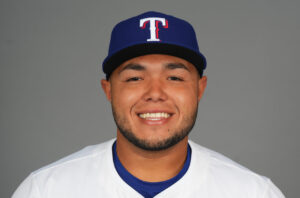
Ortiz, 24 next month, has the least prospect hype of this group but is the one closest to impacting the major league club. He split last year between Double-A and Triple-A, hitting 25 home runs and walking in 11.7% of his plate appearances. He had a combined line of .257/.356/.479 and a 124 wRC+. He was added to the Texas 40-man roster a couple of months ago to keep him out of the Rule 5 draft.
Though his numbers in the minors look good on the surface, he has a propensity to chase breaking balls. Evaluators fear that will limit him to being a platoon bat in the majors. He’s also not a strong defender or baserunner, so he needs to hit to carry the profile. Washington has a pretty wide open first base/designated hitter mix, so he can force his way in there if he hits. He also has three option years and can be kept in the minors if he doesn’t.
With four of the five players being long-term plays, it would appear that Washington is just trying to grab whichever players it considers the most talented, as opposed to trying to rush a move towards contending in the near term. Perhaps that was isolated to this deal of their biggest trade chip but it could perhaps indicate that the club is generally operating with a long lens. For the Rangers, losing most of these players won’t hurt them in the short term but it does cut into the system more broadly. As of August, BA ranked them 26th in the league in terms of overall system talent.
CJ Abrams has also been floated as a trade candidate for Washington but with less certainty than Gore as he has three years of club control remaining. The Nats could now pivot to marketing him but his stock is also down a bit due to a poor finish to his most recent season, and in 2024 as well. Perhaps they will hold him for another season to see if he can raise his trade value.
It is clearly an offseason about loading up on future talent for the Nats. They also traded reliever Jose A. Ferrer to the Mariners for catcher Harry Ford and right-hander Isaac Lyon. This deal adds five more intriguing young players to the pipeline.
It also opens up more rotation chances for their other pitchers. As of now, they project to have Cade Cavalli, Foster Griffin, Josiah Gray, Brad Lord, Jake Irvin and Mitchell Parker in the mix for starts. Arms like Jake Eder, Luis Perales, Riley Cornelio and Andrew Alvarez will be looking to push in there as well. Perhaps the Gore deal with be followed by the Nats signing a veteran to eat some innings but they could also leave space for the guys in that group.
Due to Gore’s appeal, he reportedly drew interest from half the teams in the league. Some of those clubs moved on to other trade candidates or signed free agents. For those still on the hunt for starting pitching, the market is drying up but they may still have options. As mentioned, a lot of the trade candidates have already changed hands. The Red Sox may have enough depth after their Ranger Suárez signing to flip someone else. The Royals may be willing to part with someone. Free agency still has Framber Valdez, Zac Gallen, Chris Bassitt and a few others.
Jon Heyman of The New York Post first reported Gore was headed to Texas. Jeff Passan of ESPN first laid out the five-for-one framework. Evan Grant of the Dallas Morning News first reported Fien’s inclusion. Spencer Nusbaum of The Washington Post first mentioned Rosario. Grant then reported Ortiz and Fitz-Gerald, followed by Andrew Golden of The Washington Post adding Cabrera.
Photos courtesy of Brett Davis, Eric Hartline, Kevin Jairaj, Joe Camporeale, Imagn Images