
Mike Adams & Michael Wuertz
Mike Adams was never going to match the 0.73 ERA he posted for the Padres in 2009, but his 2010 season hasn't been bad at all. In a career high 63 appearances, Adams has a 1.79 ERA and he's striking out more than a batter per inning. If the Padres choose to extend Adams this offseason, they could model a deal after one signed by another right-handed setup man who strikes out tons of batters without the benefit of an upper-nineties fastball.
When Michael Wuertz signed an extension with the A's last offseason, he had similar career numbers to the ones Adams has now. Adams has a lower ERA than Wuertz did and he walks fewer batters, but he hasn't pitched as much as Wuertz had. As the table below shows, Adams is now in a similar position to the one Wuertz found himself in a year ago.
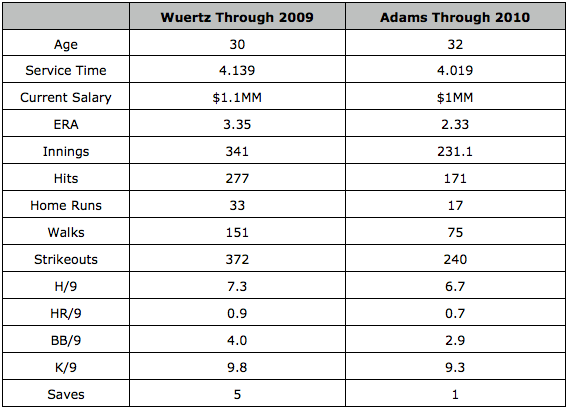
Wuertz ultimately signed a two-year $5.25MM extension that covered his remaining two arbitration seasons. The Padres could look to buy out Adams' remaining two arbitration seasons for a similar amount this winter. Given the pitchers' remarkably similar rate stats, service time and salaries, a two-year deal worth $5MM or so would be fair value for both sides.
D’backs Notes: Padres, Maddux, Towers
New Arizona GM Kevin Towers told reporters yesterday that he intends to get to know the existing D'Backs front office within the next couple of weeks. But after decades in the game, he has lots of connections of his own and some of them could end up in Arizona. Here's the latest on which former Padres people Towers may add to the Diamondbacks front office:
- Towers has targeted Padres scout Bill Bryk and assistant GM Fred Uhlman Jr, according to Tom Krasovic of AOL FanHouse.
- Towers told Bob Nightengale of USA Today that he'd like to hire Greg Maddux as the team's next bench coach or pitching coach. "I told Greg two years ago as soon as you want to be on the field please make me the first call," Towers said. The bullpen will be a priority for Towers, who signed Maddux as a free agent twice.
- MLB.com's Fred Claire says the GM-manager combination of Kevin Towers and Kirk Gibson provides the D'Backs with the "detail-oriented, passionate" leadership the organization needs. I'm willing to take Claire's word for it, since he was Gibson's GM in Los Angeles and worked opposite Towers as Dodgers GM early in Towers' tenure with the Padres, from 1995-1998.
Odds & Ends: Stairs, Diamondbacks, Blue Jays, Nats
Links on a very rainy evening in the Bronx..
- Matt Stairs nearly retired this winter but now he tells Corey Brock of MLB.com (via Twitter) that he wants to play for another year or two.
- The Diamondbacks will decide interim manager Kirk Gibson's fate soon, writes MLB.com's Steve Gilbert.
- Toronto could give their entire staff a makeover upon hiring a new manager, writes Shi Davidi of The Canadian Press.
- Stan Kasten told Thomas Boswell of the Washington Post that he's still not sure if he'll return to the Nats next season.
- The Mets may already have their 2011 second baseman in Daniel Murphy, writes Adam Rubin of ESPNNewYork.com.
- The Reds won't be auditioning Yonder Alonso for a potential deal as Joey Votto is set to return to action on Friday, tweets John Fay of the Cincinnati Enquirer.
- Mets GM Omar Minaya told Anthony DiComo of MLB.com (via Twitter) that he's not concerned about speculation over his job security.
- It's a good time for ex-Mariners managers, tweets Larry Stone of the Seattle Times.
Towers To Prioritize Bullpen, Bench
Kevin Towers says he’d like to see next year’s Diamondbacks team surprise people just like this year’s Padres team did. But only two clubs have lost more games than the Diamondbacks this year, so the new Arizona GM has some work to do. And Towers knows which areas of his new club he'll be targeting first.
“The focus will probably be primarily on the bullpen this winter, as well as the bench,” Towers told reporters via conference call.
That isn’t to say that the entire ‘pen will be turned over, but the Diamondbacks will consider every possible avenue as they look to improve upon an MLB-worst 5.82 bullpen ERA. Towers said he’ll explore major league free agency, minor league free agency, international options and the Rule 5 Draft in search of better production.
Towers gets credit for assembling the Padres bullpen, which has an MLB-best 2.85 ERA this year. Replicating that success in the desert “really boils down to good scouting and good evaluations,” Towers said. In particular, Towers’ scouts will be instructed to look for big pitchers (potentially starters who fit best in the ‘pen) with good fastballs and “plus” secondary pitches.
The Diamondbacks will also look to acquire starting pitching depth this winter; until then, Towers is familiarizing himself with the team and his new staff. After 14 years in San Diego, Towers has many connections in the Padres front office and didn’t rule out the possibility that he might bring some of his former Padres employees to Arizona.
Odds & Ends: Sandberg, Nationals, Padres, Bautista
On this date in 1978, the Pirates purchased Cito Gaston from the Braves and the outfielder went on to play his last two major league games in a Pirates uniform (believe it or not, future managers Ken Macha, Phil Garner and Jim Fregosi also played on that Pirates team). When this season ends, Gaston will step down as Blue Jays manager, but he'll do so with a pair of World Series rings and at least 885 wins to his name. Here are today's links…
- Ryne Sandberg is a candidate for the Blue Jays' managerial opening, according to Jon Paul Morosi of FOX Sports (on Twitter).
- Later this week the Nationals will likely announce that they're retaining manager Jim Riggleman in 2011, according to MLB.com's Bill Ladson.
- The Padres will at least look outside of the organization for infielders, according to MLB.com's Corey Brock (on Twitter). The Padres lost some depth when Jerry Hairston hit the disabled list again.
- The Mets won't discuss deals with prospective free agents like Jose Reyes and Pedro Feliciano until after their front office is more settled, according to Adam Rubin of ESPNNewYork.com.
- ESPN.com's Jerry Crasnick looks back at this year's moves from the ones that have worked out (the Roy Oswalt deal) to the ones that haven't (the Manny Ramirez claim).
- The Pirates lost Jose Bautista because they "reacted rashly to a rather innocuous situation," according to Dejan Kovacevic of the Pittsburgh Post Gazette.
- The Red Sox claimed Bautista when the Blue Jays put him on waivers last summer, according to Alex Speier of WEEI.com.
- One MLB executive tells Nick Cafardo of the Boston Globe that Red Sox bench coach DeMarlo Hale is on at least two short lists of managerial candidates.
- Dave Bush is open to returning to the Brewers and curious about the offers he'll see as a free agent, according to MLB.com's Adam McCalvy.
Astros Claim Cesar Carrillo
The Astros claimed Cesar Carrillo from the Padres, according to Zachary Levine of the Houston Chronicle. The Astros confirmed the move via press release and announced that Carrillo will not be joining the big league team.
This marks the second time this month that the Padres have lost the pitcher to a waiver claim after designating him for assignment. The Phillies claimed Carrillo on September 9th, but the Padres re-claimed him only to designate him for assignment a second time.
This time the Astros pounced on the 2005 first rounder. In 27 Triple A starts this year (all in the Padres organization), Carrillo had a 5.60 ERA with 5.7 K/9 and 3.4 BB/9. The 26-year-old debuted on last year’s Padres team but has not returned to the majors in 2010.
The Astros designated Edwin Maysonet for assignment to make room for Carrillo. Maysonet, a 28-year-old middle infielder, has not appeared in the major leagues this year and he has a .637 OPS in the minors.
Olney On D’Backs, Hinch, Martin, Werth
Now that the Diamondbacks have hired Kevin Towers to be their new GM, their priority is to assemble an improved bullpen, according to ESPN.com’s Buster Olney. Olney says it’s likely that the Diamondbacks will part ways with one or two of their hitters this offseason, because their lineup strikes out so much. Here are the rest of Olney’s rumors:
- Former Diamondbacks manager A.J. Hinch joined the Padres scouting department because he believes they have a “good pro scouting staff in place with some building to do.”
- Rival GMs believe Russell Martin will have some trade value if the Dodgers decide to move him (Twitter link).
- Multiple talent evaluators tell Olney that they see Jayson Werth as a distant second to Carl Crawford among free agent outfielders (Twitter link).
Non-Tender Candidate: Scott Hairston
As we discussed on the weekend, the four-player January trade between the Athletics and Padres included at least one 2010 non-tender candidate, in Kevin Kouzmanoff. For their part though, the A's gave up a player who appears even likelier to be non-tendered this offseason: Scott Hairston.
When the Padres re-acquired Hairston last winter, he was coming off one of his finest seasons in the bigs. Splitting time between San Diego and Oakland, who traded for him last July, Hairston hit .265/.307/.456 overall, with the better half of his season coming in San Diego (.299/.358/.533). Unfortunately for Hairston and the Padres, his second stint with the club hasn't been as successful. The 30-year-old battled a hamstring injury earlier in the season, and has hit just .215/.298/.353 in 329 plate appearances. Hairston's struggles can't be blamed on his pitcher-friendly home park either; he has an ugly .193/.283/.320 slash line on the road.
Hairston is earning $2.45MM this year and has seen the Padres' outfield get a little more crowded with the acquisition of Ryan Ludwick. Both players will enter their final season of arbitration eligibility in 2011, and Hairston's chances of being tendered a contract might depend in part on what the Padres do with Ludwick. Given Ludwick's larger 2010 salary ($5.45MM) and the fact that his production for the Padres (.239/.330/.368) hasn't been much better than Hairston's, it's conceivable that the team could decide to part ways with the former Cardinal.
Even with Ludwick out of the picture, however, Hairston would be lucky to be tendered a contract. The Padres may prefer to turn to a cheaper outfield option rather than spending $2.5MM+ to retain Hairston for another year. Click here to vote on the Padres' decision, and click here to view the results.
Padres Hire A.J. Hinch
Just two and a half months after being fired by the Diamondbacks, former manager A.J. Hinch has landed a position with one of Arizona's division rivals. According to Corey Brock of MLB.com (via Twitter), the Padres have hired Hinch to be their vice president of professional scouting.
Hinch, a former catcher for the Athletics, Royals, Tigers, and Phillies, took over as the Diamondbacks' skipper in May 2009, replacing Bob Melvin. He led the club to an 89-123 record before being fired, along with GM Josh Byrnes, on July 1st of this year. Prior to becoming their manager, Hinch was employed in Arizona's front office as the director of player development.
Behind The Scenes Of An MLB Trade
Andy MacPhail and Jed Hoyer tell MLBTR what happens before a trade becomes official.
In late July, when trading is at its busiest and multiple deals are completed each day, headlines like this one don’t captivate us for long.
“Padres Acquire Miguel Tejada.”
It’s a familiar story: a veteran on the brink of free agency is exchanged for a prospect (but not a blue-chipper). In the frenzied week leading up to the July 31st trade deadline, when so many established players are heading to contenders and so many minor leaguers are on the move, no single deal preoccupies baseball fans for more than a few hours.
But it takes substantially longer than that to orchestrate the trades. Before the Padres sent 24-year-old pitching prospect Wynn Pelzer to Baltimore for Tejada, both Orioles president of baseball operations Andy MacPhail and Padres GM Jed Hoyer had to take everything possible into consideration. And whether you’re in the AL or the NL, whether you’re selling or buying, whether you were a major league general manager before Wynn Pelzer was born, like MacPhail, or you’re a rookie GM, like Hoyer, there's no shortage of angles to consider.
“You go down a mental checklist starting with the player’s recent performance from a scouting standpoint, going through their health background, going through their future earnings,” Hoyer said.
But before teams start looking at scouting reports, medical records and contract language, it all has to start somewhere. So where do the ideas come from?
“I think like any idea, it starts with a need,” MacPhail said. “What do they say? Necessity is the mother of invention.”
In Conversation
Once a team has established its needs, the front office is that much closer to engaging other clubs. And since teams are constantly connected to one another each summer and again each winter, it isn’t hard to spark trade talks.
“You’re always in contact, whether it’s through a friendly conversation or bumping into guys at the ballpark,” Hoyer said. “But those specific times of year, there’s a lot of frequency and you try to be in touch with clubs as many times as you can within a given week.”
‘Being in touch’ can mean a lot of things, and it’s not always GM to GM. But whether it’s a conversation between general managers, front office employees or scouts, baseball people generally use the same methods as fans.
“Different GMs are comfortable with different mediums,” MacPhail said. ”There’s some GMs that like to talk over the phone, or some that will generally text and there are others that will e-mail and others that will do a combination of the three.”
MacPhail uses e-mail and text messaging regularly, but, like Hoyer, he relies on the phone.
“You can learn a lot about their tone, how they say it, what they don’t say,” MacPhail said. “I think in most cases, you’re better off exploring things over the phone with a GM.”
If MacPhail doesn’t glean everything he needs to know from a phone conversation, he can always check the local papers or go online to read about the latest news and rumors.
“One of the things that your website has done, in my view, is sort of changed the GM’s job,” MacPhail said. “You have a better idea of supply today than maybe we did before that technology existed.”
The Background Work
When the GM has an idea for a possible deal, other members of the front office get involved. Assistant GMs will discuss potential trades, pro scouts will go watch players, others will examine video and consider stats and medical history.
Clubs can work their way down that checklist within a couple of days for a player in the last year of his contract, like Tejada. The stakes aren’t as high when a player only has to stay healthy for two months. But when discussing a trade for someone who doesn’t hit free agency for a while, the process slows down.
“For example,” MacPhail said, “if it’s a young player that someone’s going to have control over for four of five years, I mean that’s something we’re going to completely vet.”
Since the Orioles play in the American League East, they work to determine how trade targets will perform against the Yankees, Red Sox, Rays and Blue Jays. MacPhail admits it might be hubris on his part, but the AL East is no ordinary division.
The Padres acquired Tejada and Ryan Ludwick for the same reason: to provide enough thump to emerge from the NL West and reach the playoffs. But Ludwick’s under team control through 2011, so the Padres approached that acquisition knowing that any deal would impact next year’s team, too.
“Theoretically the shorter amount of time you have the player, the more likely teams are to take on all that risk,” Hoyer said. “The more you’re making a deal for the long-term, the more it complicates things because you want to be that much more sure.”
It can all come down to an economic principle for MacPhail.
“It’s really just a simple case of supply and demand,” he said. “What your demand is, what you think that supply is and then make an evaluation whether you’re better off making that deal or not.”
And, though dozens of deals do happen, they’re the exception, not the rule.
“There are so many ways things can fall apart that only a very, very small amount of the total number of ideas actually come to fruition,” Hoyer said.