
Cardinals Sign Matt Wieters
FEB. 28: Wieters would earn $1.5MM in the majors and can opt out on March 22nd, per Mark Saxon of The Athletic (via Twitter).
FEB. 27: The signing has been announced. It includes an invitation to MLB camp.
FEB. 26: The Cardinals have agreed to a minor-league deal with veteran catcher Matt Wieters, per Derrick Goold of the St. Louis Post-Dispatch (via Twitter). Salary terms are not yet known.
While he held out in hopes of securing a MLB commitment, the 32-year-old Wieters will settle instead for a chance to serve as a backup to Yadier Molina. The competition is fairly limited. Francisco Pena seemingly held the edge at the outset of camp after re-joining the organization on a minors pact. Joe Hudson is the only other backstop in camp with MLB experience.
Wieters can still put the ball over the fence, and posted career-best plate discipline marks in 2018, but he has not been very productive with the bat of late. Since the start of the 2016 season, he’s producing at only a .235/.303/.376 rate through 1,200 trips to the plate. That’s a far cry from the .254/.317/.436 output that Wieters managed over the prior half-decade.
Wieters isn’t generally regarded as a high-quality overall defender at this stage of his career, and fares poorly in particular in pitch-framing metrics, but does still block, throw, and manage a staff well. It’s possible there’s still some hope that he’ll restore some of his lost luster with the bat, making this a nice low-risk move for the St. Louis organization.
For the Cards, the addition deepens the catching unit as Molina closes in on his 37th birthday and works to recover from an offseason knee procedure. The switch-hitting Wieters has historically performed better against right-handed pitching, as has Molina, but neither carries significant career platoon splits. If Wieters can beat out Pena for the job, he seems like a potentially solid mate for Molina.
Dodgers To Sign Brad Miller
The Dodgers have inked infielder Brad Miller to a minor league deal, Bill Shaikin of the Los Angeles Times reports on Twitter. He’ll join the MLB side of Spring Training once the deal is finalized.
Miller, 29, has generally been a solid offensive performer, with an overall track record of .239/.313/.409 hitting through 2,505 plate appearances in six MLB seasons. He delivers notable pop for a player capable of playing the middle infield, with a lifetime .170 isolated power mark and one thirty-homer season under his belt (2016). A left-handed hitter, Miller has typically found quite a bit more success against right-handed pitching, with a 46-point platoon split in his lifetime wRC+ figures.
It’s hard to characterize Miller otherwise, as his offensive profile has shifted over the last few seasons. His follow-up to his power surge was a 2017 season in which he lept to a 15.5% walk rate but managed only a .201 batting average and career-low .136 ISO.
It was also in 2017 that Miller began to strike out with greater frequency. That issue truly came to the fore last year, when he went down on strikes in nearly a third of his plate appearances. Otherwise, though, Miller turned in a relatively balanced campaign that mostly reflected his career mean, with a .248/.311/.413 slash and seven home runs through 254 plate appearances.
The shapeshifting hasn’t prevented Miller from typically turning in plenty of offense for a shortstop. But he hasn’t been asked to line up there since ’16, when metrics distinctly soured on his glovework. Miller hasn’t graded as a positive on the right side of the infield, either, but he can probably be trusted with at least some innings anywhere on the dirt.
Making the Dodgers roster out of camp will likely be a tall order for Miller, though his versatility and platoon-friendly offensive profile certainly suit the club’s mantra. Miller will look to follow in the footsteps of several other recent utilitymen — including former Mariners shortstop competitor Chris Taylor and 2018 breakout performer Max Muncy — in finding new form in Los Angeles. Muncy’s own presence on the roster is what makes Miller seem like a particularly tough fit at this point, though any number of developments could leave Miller with an opening to stake a claim to a job.
Rockies, Nolan Arenado Agree To Extension
Nolan Arenado‘s days as the face of the Rockies franchise will continue beyond the 2019 season. Arenado, who had been slated to reach free agency next winter, has instead inked an eight-year contract extension that adds seven years and $234MM in new commitments. The Wasserman client’s new contract reportedly contains an opt-out clause after the third season in 2021, which would allow him to become a free agent in advance of his age-31 campaign, as well as full no-trade protection.
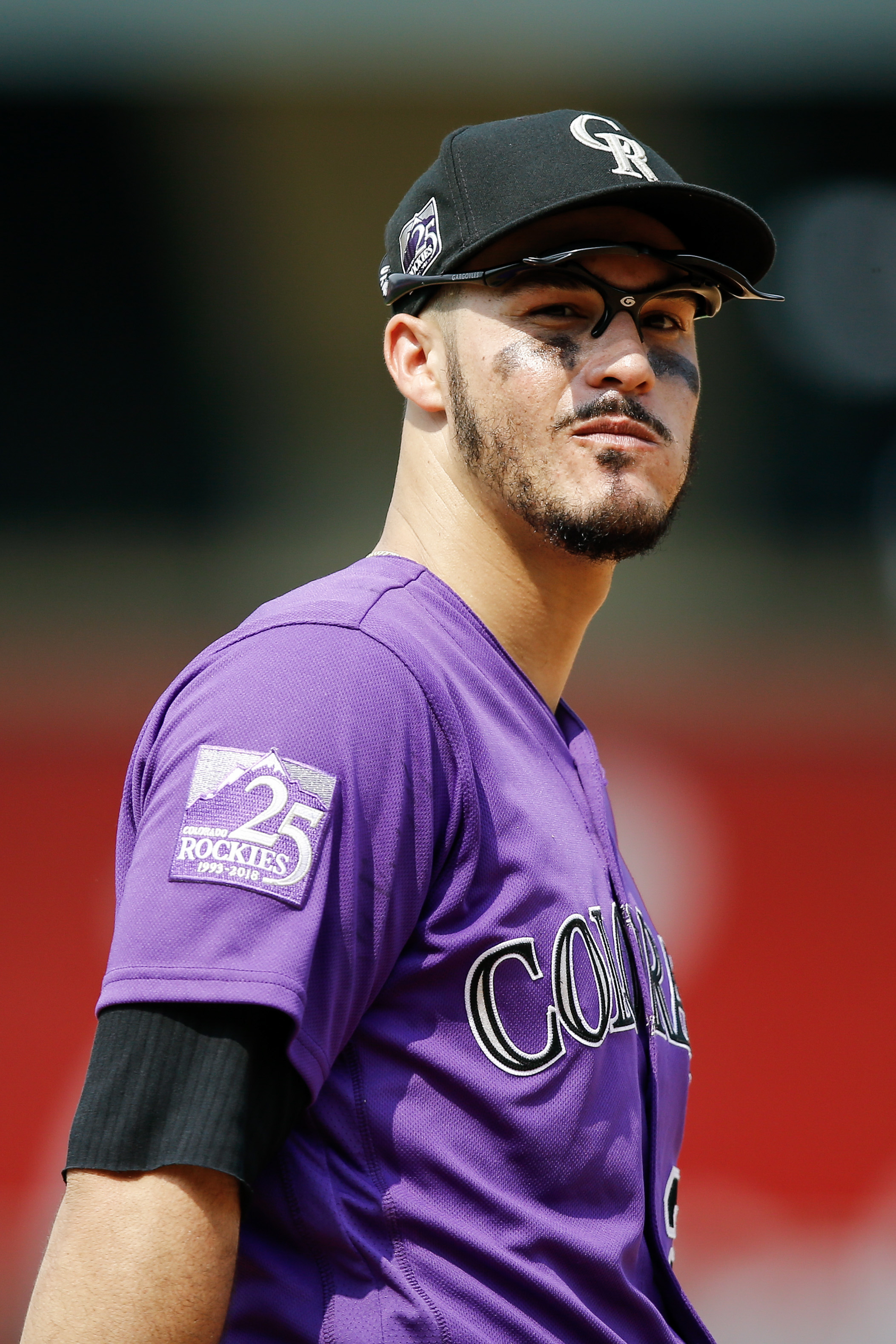
The newly agreed upon contract will leave in place the one-year, $26MM contract to which Arenado had already agreed for 2019. He takes down $35MM annually over the next five seasons before receiving $32MM and $27MM salaries in the final two years.
Arenado is promised $260MM in total money over an eight-year term. Whether calculated cumulatively ($32.5MM annually) or in reference only to the seven new seasons ($33.4MM), the new contract establishes a new record annual salary for position players, topping Miguel Cabrera‘s prior mark of $31MM. In terms of overall average annual salary (AAV), Arenado’s contract trails only Zack Greinke‘s $34.4MM mark for the largest in MLB history. It’s the fourth-largest deal ever in terms of total guarantee, trailing only Giancarlo Stanton (13 years, $325MM), Manny Machado (10 years, $300MM) and Alex Rodriguez (10 years, $275MM).
Arenado, 28 in April, has won a Gold Glove in all six of his Major League seasons to date, pairing that hardware with Silver Sluggers in each of the past four seasons. He’s made four consecutive All-Star teams and finished in the top five of National League voting in three straight seasons. Over the past four years, Arenado has led the National League in home runs on three occasions and posted a combined .297/.358/.573 batting line with 158 homers, 159 doubles and 19 triples.
Detractors point to Arenado’s home/road splits in suggesting that his value is inflated by Coors Field, and while it’s surely true that he benefits from that hitter-friendly setting, he’s also slashed a robust .267/.329/.502 on the road over the past four years (with many of those games coming in pitchers’ parks in San Francisco, San Diego and Los Angeles). And park-neutral metrics like OPS+ (129) and wRC+ (127) feel that even after adjusting for his home park advantages, Arenado’s bat has been 27 to 29 percent better than that of a league-average hitter since 2015. By measure of wRC+, he’s among the game’s 35 best hitters in that four-year span and, when combined with his premier defense at the hot corner, he ranks inside the top 10 in overall wins above replacement among position players, per Fangraphs.
In all, there’s little denying Arenado’s place among the game’s legitimate superstars, and he carries perhaps more value to the Rockies than he would with any other organization given his existing connection with the fan base and within the Denver community. He’s nearly two years older than the current offseason’s two star free-agent bats, Bryce Harper and Manny Machado, so it’s not a surprise to see Arenado heading for a slightly shorter-term deal than either of his highly touted peers. But in terms of annual rate, the new contract already tops Machado’s annual salary and could potentially be higher than the AAV to which Harper will eventually agree.
Arenado is the second would-be 2019-20 free agent to take an extension rather than test an open market that has become increasingly slow for top-end talent. (Aaron Hicks signed a seven-year deal with the Yankees yesterday.) Had he hit the open market, it stands to reason that deep-pocketed teams like the Dodgers and particularly the Yankees would’ve made a push to land his services, but the presumptive top free agent on next year’s market will instead take his record-setting payday a year early in order to remain with the only organization he’s ever known.
For the Rockies, the new contract means that Arenado will play out at least the next three seasons alongside Trevor Story, cementing one of the game’s most productive left-side infield tandems for the foreseeable future. That duo’s presence likely means that uber-prospect Brendan Rodgers is ticketed for second base when he eventually does force his way up to the big league level. Should his future outlook stall for any reason, the Rox have plenty of other infield talent on the rise, most notably including Ryan McMahon and Garrett Hampson. Beyond that grouping, veteran Daniel Murphy signed a two-year contract to play first base this winter and will be entrenched in the heart of what should be a formidable batting order.
From a payroll vantage point, the Arenado contract will further push the Rox into franchise-record territory. The $137MM mark at which they opened the 2018 season was already an all-time high for the team, but Arenado’s new deal — depending on how the dollars are distributed — will likely bring Colorado’s Opening Day payroll beyond $155MM (as outlined by Roster Resource’s Jason Martinez). In terms of luxury taxation, the Rockies are still nearly $40MM shy of having anything to worry about in 2019, and their luxury tax ledger plummets to just north of $129MM next winter, which would place them nearly $80MM shy of incurring any penalties.
USA Today’s Bob Nightengale first reported that the Rockies had made a record-AAV offer to Arenado and added he annual breakdown on Twitter. ESPN’s Jeff Passan reported that the two sides were closing in on an eight-year deal worth more than $255MM with an opt-out (Twitter link). Ken Rosenthal of The Athletic reported the exact salary terms, while Joel Sherman of the New York Post first reported the agreement to be in place (Twitter links).
Cardinals To Extend Miles Mikolas
4:25pm: Mikolas will receive a $5MM signing bonus and $15.75MM annual salaries, Bob Nightengale of USA Today tweets. The deal also includes $2MM in escalators and full no-trade protection, Heyman reports (Twitter links).
12:55pm: The contract does not overwrite Mikolas’ 2019 salary but runs from 2020-23, per The Athetic’s Ken Rosenthal (on Twitter). That’ll give the Cardinals control of Mikolas through his age-34 season.
12:50pm: MLB Network’s Jon Heyman tweets that Mikolas will be guaranteed a hefty $68MM over a four-year term on his new contract. That deal lines up identically with the four-year pact inked by postseason hero Nathan Eovaldi with the Red Sox earlier this winter. The deal, Heyman adds, can reach a total of $70MM in value.
12:45pm: The Cardinals and right-hander Miles Mikolas have agreed to terms on a contract extension, reports Derrick Goold of the St. Louis Post-Dispatch (via Twitter). The two sides had expressed mutual interest in completing such an arrangement back in January. Mikolas is represented by Octagon.
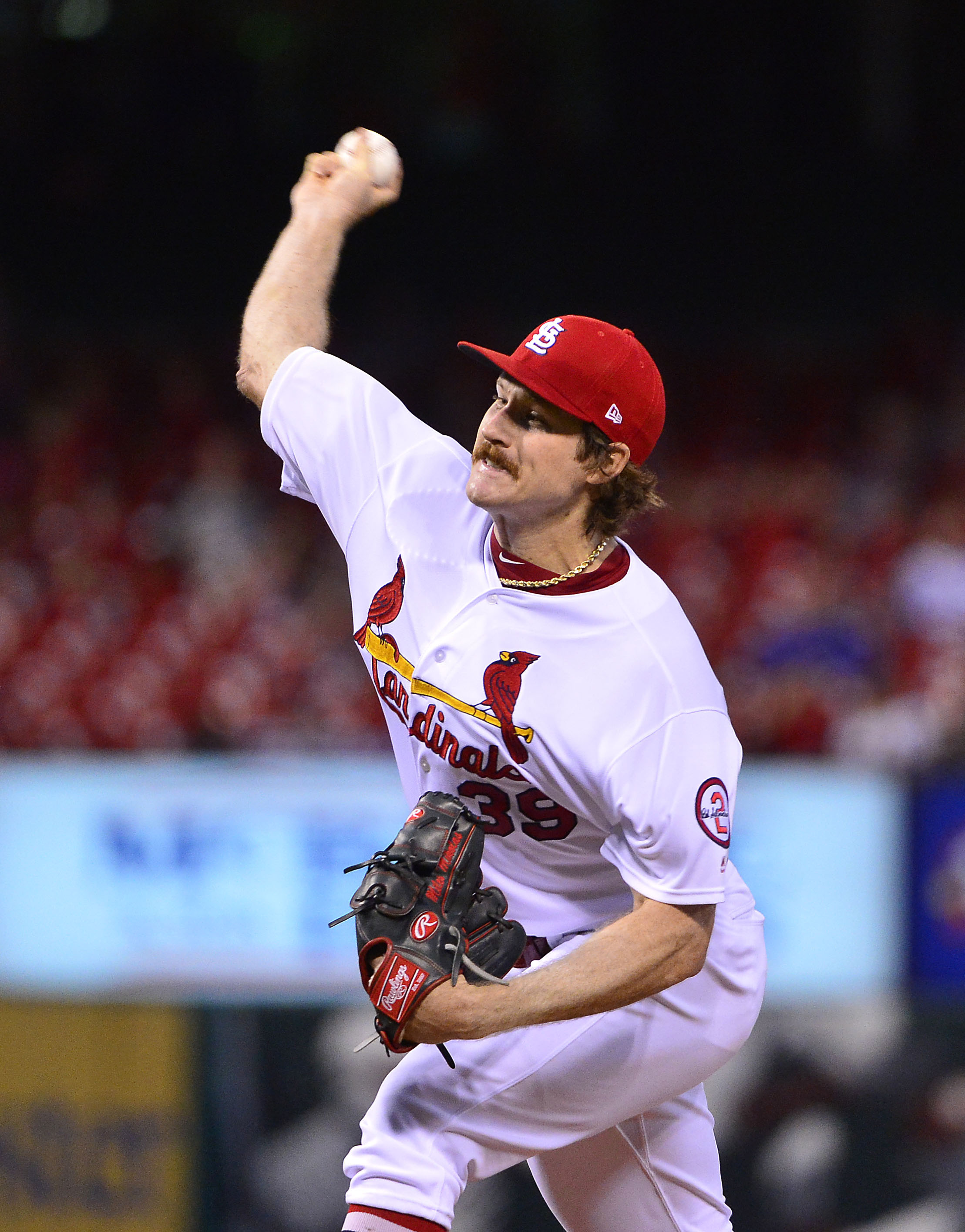
This time one year ago, Cardinals fans were unsure what to think of Mikolas, the team’s primary rotation addition last winter. At the time, Mikolas was a 29-year-old who’d never established himself in the Majors but put himself firmly on MLB radars with a brilliant three-year run for the Yomiuri Giants of Japan’s Nippon Professional Baseball. Adding Mikolas on a two-year contract worth a guaranteed $15.5MM was met with a fair bit of skepticism.
Mikolas, however, proved his doubters wrong in emphatic fashion. In 32 starts for St. Louis, he totaled 200 2/3 innings with a pristine 2.83 ERA, 6.5 K/9, 1.3 BB/9, 0.72 HR/9 and a 49.3 percent ground-ball rate. Among qualified MLB starters, only Patrick Corbin and Jacob deGrom induced swings on pitches out of the strike zone at a higher clip than Mikolas’ brilliant 36.6 percent mark. Statcast pegged Mikolas in the 92nd and 90th percentiles, respectively, in terms of opponents’ exit velocity and hard contact allowed on a league-wide basis. Furthermore, no pitcher in baseball posted a better BB/9 mark than Mikolas, whose 3.28 FIP and 3.67 xFIP largely supported the notion that he was a quality big league starter.
Mikolas doesn’t need to replicate last season’s showing to the decimal point in order to justify the organization’s considerable expenditure — the value he provided was worth far more than $17MM last season — but he’ll need to settle in as a viable mid-rotation piece for the next few years in order to make good on the commitment. There’s little reason to doubt his ability to do so, however; as noted previously, virtually any metric agreed that Mikolas was a legitimate big league starter, and he finished the year as strongly as he started — if not more so.
For the Cardinals, locking up Mikolas now gives them some long-term solidity in a rotation that had previously stood to lose not only Mikolas but also Michael Wacha and Adam Wainwright at season’s end. Between those impending departures, ongoing concerns surrounding Carlos Martinez‘s shoulder and the perennial lack of durability from wunderkind Alex Reyes, the Cardinals had a deceptively uncertain long-term outlook in terms of starting pitching. Mikolas will now team with Jack Flaherty in comprising the St. Louis rotation for years to come, and the organization certainly has hopes that some combination of Martinez, Reyes and Dakota Hudson can work to round out the starting staff in the foreseeable future.
With this deal in place, the Cardinals now have more than $101MM committed to their 2020 roster (assuming even distribution of the salary) — though that number will drop substantially in 2021 when the contracts of Yadier Molina, Matt Carpenter and Brett Cecil come off the books. The deal shouldn’t have any bearing on St. Louis’ 2019 payroll, which currently projects at just under $162MM — a slight increase over last year’s franchise-record Opening Day payroll of $159.7MM.
Rangers Sign Logan Forsythe To Minor League Deal
10:40am: Forsythe would earn a $2MM base salary upon making the big league roster, tweets MLB Network’s Jon Heyman.
10:08am: The Rangers announced that they’ve signed veteran infielder Logan Forsythe to a minor league contract. The PSI Sports client will be in Major League camp and compete for a roster spot moving forward.
Forsythe, 32, split a disappointing 2018 season between the Dodgers and Twins, hitting a combined .232/.313/.291 with just two home runs through 416 plate appearances. That marked a second straight season of declining offensive output following a terrific two-year stretch in which he hit .273/.347/.444 in nearly 1200 plate appearances with the Rays from 2015-16. Forsythe did show better on-base skills with the Twins following a trade from Los Angeles, but his power outage only worsened in his brief stint with Minnesota.
One would imagine that a move to the hitter-friendly Globe Life Park in Arlington could help to restore some of Forsythe’s missing pop, but he’ll first have to earn his way onto the club in what would presumably be a bench role. The Rangers traded Jurickson Profar to the division-rival Athletics this winter but still project to have a full infield with Rougned Odor at second base (Forsythe’s most frequent position), Elvis Andrus at shortstop and offseason pickup Asdrubal Cabrera at third base. Outside of Patrick Wisdom and backup catcher/infielder Isiah Kiner-Falefa, however, Texas doesn’t have much in the way infield alternatives on the 40-man roster at present, giving Forsythe a decent chance at making the roster.
At his best, Forsythe and his right-handed bat are a menace to left-handed pitching. The switch-hitting Cabrera struggled against lefties last season, and Odor has also typically been much stronger against right-handed pitching, which could help Forsythe carve out a role on the Rangers’ bench.
Indians Sign Hanley Ramirez To Minor League Deal
Feb. 26: The Indians have formally announced the signing.
Feb. 24: Ramirez will earn $1MM in guaranteed salary if he makes Cleveland’s roster, Paul Hoynes of the Cleveland Plain Dealer tweets, with some more money available in incentives.
Feb. 23: The Indians have agreed to a minor league deal, pending a physical, with free-agent first baseman Hanley Ramirez, Ken Rosenthal of The Athletic reports.
Cleveland’s the first team for the 35-year-old Ramirez since Boston unceremoniously released him last June 1. Ramirez drew little reported interest after the Red Sox cut ties with him, owing to back-to-back seasons of subpar production at the plate and an inability to add value in the field or on the base paths. Formerly a superstar with the Marlins and a quality player with the Dodgers, Ramirez combined to hit a meager .245/.318/.421 (91 wRC+) with 29 home runs and minus-0.7 fWAR in 748 plate appearances from 2017-18.
Ramirez was an easily above-average hitter as recently as 2016, but that was his lone productive year with the Red Sox, who signed him to a four-year, $88MM deal prior to 2015. The contract was a bust for Boston, with which Ramirez contributed a microscopic 0.9 fWAR over 1,798 PAs. He also left much to be desired in left field and at first base during his Red Sox tenure, though he did earn playable marks from Defensive Runs Saved and Ultimate Zone Rating at the latter position in a combined 358 innings from 2017-18.
There was obviously considerable risk for the Red Sox when they signed Ramirez, whereas the Indians are buying low on him now and hoping to land a solid contributor for a nominal fee. It’s possible the right-handed Ramirez will catch on with the Indians in a first base/designated hitter platoon, as their projected starter at the former spot – Jake Bauers – is a lefty. Bauers struggled versus same-handed hurlers in 2018, but Ramirez pulverized southpaws last year and owns a lifetime .896 OPS against them.
Rob Whalen Announces Retirement
In a statement released via Twitter, right-hander Rob Whalen announced his retirement from the game at just 25 years of age. He says he feels “God has other plans in store.”
Whalen cites his “battle with depression/anxiety over the last 2 years” as an underlying factor in his decision. Those interested in learning more about Whalen’s path can find his story here, as told to David Laurila of Fangraphs.
Drafted in the 12th round of the 2012 draft by the Mets, Whalen was eventually a part of two trades: the 2015 deal that sent Kelly Johnson and Juan Uribe from the Braves to the Mets and the swap in the 2016-17 offseason in which Alex Jackson went to Atlanta. In both deals, Whalen was traded along with another young right-hander (John Gant in the former and Max Povse in the latter).
Whalen earned his way to the majors in 2016 with a strong showing in the upper minors, throwing 120 innings of 2.40 ERA ball with 8.4 K/9 and 3.3 BB/9. Things have not gone well since, however, due in no small part to Whalen’s struggles with depression and anxiety. Ultimately, he saw action in each of the past three MLB seasons, pitching to a cumulative 5.75 ERA in 36 innings.
In his statement, Whalen says that he has “learned that [he] can have a fulfilling life outside of baseball.” MLBTR wishes him good fortune in doing just that.
Twins Designate Zack Granite For Assignment
The Twins have designated outfielder Zack Granite for assignment in order to open a spot on the 40-man roster for newly signed Marwin Gonzalez, Dan Hayes of The Athletic tweets.
Granite, 26, forced his way onto the Twins’ big league roster with a .338/.392/.475 showing in Triple-A in 2017, though that output was buoyed by a .371 average on balls in play. His time in the Majors didn’t prove quite as fruitful, as he slashed just .237/.321/.290 in 107 trips to the plate. Granite struggled through a dismal .211/.282/.245 batting line in an injury-shortened 2018 season in Triple-A Rochester and, in the process, saw himself leapfrogged on the organizational depth chart by fellow outfielder Jake Cave, whom the Twins acquired from the Yankees last spring.
While Granite has elite speed and a strong defensive skill set, he’s largely devoid of power, never having totaled more than six home runs in a season (which came in 2017 between the Twins and Triple-A). But, as a career .282/.348/.360 hitter in the minors with a 10.2 percent strikeout rate, an 8.5 percent walk rate and a minor league option remaining, he could certainly hold appeal to another club in need of outfield options. A team thin in the outfield could look to give Granite a chance at regular reps, but his speed and defense would also make him a viable fourth outfielder o a team with an already set mix of starters.
Yankees Extend Aaron Hicks
Aaron Hicks won’t be testing the open market next winter after all. The Yankees announced on Monday that they’ve signed Hicks, a client of CAA Baseball, to a seven-year contract extension that supersedes his previous one-year, $6MM contract for the 2019 campaign. The new pact will reportedly guarantee Hicks $70MM and come with a club option for an eighth season, meaning Hicks is now controlled by the Yankees through his age-35 season.
Hicks will reportedly receive a $2MM signing bonus in addition to a $6MM salary in 2019 before earning $10.5MM annually from 2020-23 and $9.5MM in 2024-25. The club option is said to be valued at $12.5MM (with a $1MM buyout), and while Hicks doesn’t have any no-trade protection on the deal, he’d receive a $1MM assignment bonus upon being traded.
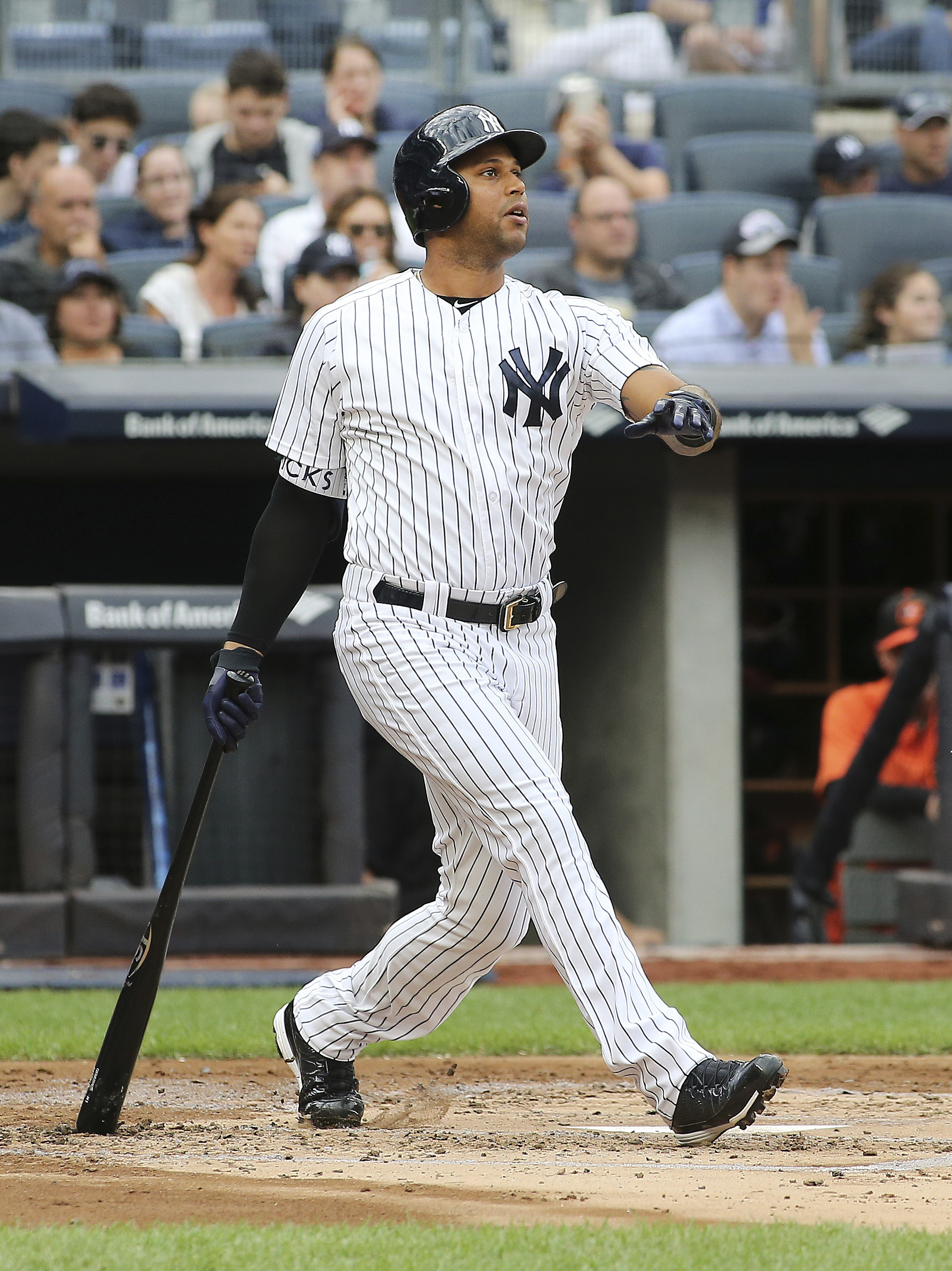
Hicks, 29, has quietly emerged as one of the game’s more underrated players over the past couple of seasons. The former first-rounder, acquired in a lopsided deal that sent catcher John Ryan Murphy to the Twins, struggled in his first season with the Yankees but has since hit .255/.368/.470 with 42 home runs, 36 doubles, three triples and 21 stolen bases in 942 plate appearances. Hicks has generally graded out as a quality defensive center fielder in his career at the MLB level and provides plenty of value on the basepaths beyond his raw stolen base totals, as well.
Over the past two seasons, only five players in baseball (min. 900 plate appearances) have drawn walks at a higher clip than Hicks’ 15 percent mark, and his 18.9 percent strikeout rate in that time checks in below the league average. His 21.5 percent chase rate on pitches outside the strike zone in that time is tied with teammate Brett Gardner for the ninth-lowest in baseball in that same span.
For the Yankees, the agreement with Hicks locks them into a long-term mix featuring sluggers Giancarlo Stanton (signed through 2027) and Aaron Judge (controlled through 2022) for the foreseeable future. That trio will be joined by Gardner in 2019 and, if healthy, by Jacoby Ellsbury, who is signed through 2020. Outfield prospect Clint Frazier, meanwhile, looms in the upper minors. Fellow prospect Estevan Florial is likely still two years from being a factor in the Majors.
Because Hicks was already signed for the 2019 season at a $6MM rate, today’s agreement is effectively a six-year, $64MM extension. For luxury tax purposes, though, it’ll be treated as a seven-year deal that comes with a $10MM annual luxury hit. The Yankees were already over the luxury tax line, albeit in the lowest penalty tier after resetting their tax right by dipping under the threshold last season. The Hicks contract adds another $4MM to their luxury ledger for the season, which will cost them an additional $800K in penalties.
Not many position players sign an extension by the time they reach five-plus years of service and are within a year free agency, making Hicks’ case somewhat of a rarity. But, as shown in MLBTR’s Extension Tracker, Charlie Blackmon does stand out as one recent player to have done so, although as a more established hitter, he received a larger sum over a shorter term than Hicks secured with today’s agreement. Prior to that pair, the last position player in this service class to ink an extension of five or more years was Andre Ethier back in 2012.
By signing the deal, Hicks will forgo what has become an increasingly shaky free-agent market for players. Unlike the others who have recently signed extensions, however, Hicks could’ve tested the market as soon as next winter. It’s certainly possible that with another big season at the plate, he’d have been poised to top the money afforded to him by this contract — certainly on an average annual value basis. However, he’ll instead sacrifice a bit of that long-term earning power in exchange for the security of an immediate payday. It’s fair to wonder if other 2019-20 free agents will look at recent market trends and do the same over the next several weeks. Given the slow pace of free agency and the disappointing deals that many middle-tier free agents have taken over the past two seasons, Hicks could be the first of multiple would-be free agents to go this route.
Jack Curry of the YES Network first reported the extension and the terms of the deal (on Twitter). Marc Carig of The Athletic tweeted that there was an option for an eighth season, and Joel Sherman of the New York Post reported the contract breakdown (Twitter links).
Twins Sign Marwin Gonzalez
The Twins have announced the signing of free-agent infielder/outfielder Marwin Gonzalez. Gonzalez, who is represented by the Boras Corporation, receives a two-year, $21MM deal that will pay him $12MM in 2019 and $9MM in 2020.

Gonzalez, 30 in March, emerged as one of MLB’s most versatile utility pieces over the past two seasons and played a major role in bringing the Astros to the 2017 World Series. The switch-hitter’s terrific .303/.377/.530 batting line that year regressed to .247/.324/.409 in 2018, though it’s worth noting that his 2018 results were weighed down by a sluggish start. Gonzalez carried a .612 OPS into June but rebounded to the tune of a .266/.343/.462 slash over the final four months, during which time he clubbed 12 of his 16 home runs. Overall, he’s posted a healthy .274/.349/.467 line with 39 homers, 59 doubles and three triples over his past 1067 plate appearances.
Known as much for his defensive versatility as anything else — agent Scott Boras dubbed him “Swiss G” early in the offseason — Gonzalez logged 150-plus innings at first base, second base, shortstop and in left field last year. He’s logged significant innings at all four infield spots over the past two seasons and has tallied more than 1000 innings in left field as well. He’s drawn plus marks for that work in left (+7 Defensive Runs Saved, +5.5 Ultimate Zone Rating, +2 Outs Above Average) and has generally drawn solid marks for his glovework at first base, second base and third base in recent years (with defensive metrics being less fond of his defense at shortstop).
While Gonzalez won’t be in line to man one singular position on a regular basis, it’s likely that the Twins will mix him into the lineup on a near-regular basis over the next couple of seasons. He’ll provide the club with a high-quality means of keeping first baseman C.J. Cron, second baseman Jonathan Schoop, shortstop Jorge Polanco and third baseman Miguel Sano fresh. Gonzalez also seems likely to log some time in the outfield, and given that all three of Minnesota’s current outfielders — Eddie Rosario, Byron Buxton and Max Kepler — can play all three outfield slots, Gonzalez could be the first in line to get some outfield work when any of that trio is out of the lineup. In short, he’ll provide rookie manager Rocco Baldelli with an enormous amount of flexibility when mapping out his daily lineups. And, with Schoop a free agent at season’t end, Marwin could potentially give the Twins a regular option in 2020 if prospect Nick Gordon doesn’t adequately rebuild his stock this year.
The addition of Gonzalez will cost one of Ehire Adrianza or Willians Astudillo a spot on the active roster and potentially puts Adrianza’s spot on the 40-man roster in jeopardy. Like Gonzalez, Adrianza is a switch-hitting utility piece who played all over the infield and in left field last year, though his bat has never approached Gonzalez’s 2017-18 levels. Minnesota also has Ronald Torreyes on the 40-man roster under a non-guaranteed, split contract, though Torreyes has one minor league option remaining.
Entering the offseason, MLBTR pegged Gonzalez as a candidate to receive a four-year contract (at a lower annual rate of $9MM) given the fact that his versatility figured to create no shortage of demand throughout the league. Many pundits at the time — myself included — were surprised that Houston didn’t issue a $17.9MM qualifying offer to Gonzalez; while that’d be a huge price to pay for one season of his services, the thinking at the time was that he’d comfortably out-earn that sum on a three- or four-year pact, thus making him a safe bet to reject the deal and net the Astros a compensatory draft pick. In retrospect, the Astros’ decision not to do so looks quite prudent.
From a broader perspective, Gonzalez’s contract is in some ways indicative of the changing market landscape that has served as a source of consternation for both players and agents this winter. While his $10.5MM annual salary is quite large for a super-utility player, to be sure, Gonzalez’s ultimate guarantee was for half the length and under 40 percent of the total dollars the Cubs pledged to Ben Zobrist as he entered his age-35 season just three years ago. While Zobrist was a more established hitter and predicting that type of money for Gonzalez seemed overly aggressive even at the outset of free agency, few would’ve predicted such great disparity between their contracts. Gonzalez is roughly a half decade younger than Zobrist was at the time of his deal, after all.
While Gonzalez’s contract falls shy of what virtually any publication predicted for him entering the winter, that $10.5MM annual value is nonetheless robust, and he’ll have the chance to re-enter free agency at a relatively youthful age. A four-term deal at that point will be even less likely, but he’d certainly be a candidate to receive another strong annual value on a two- or possibly three-year pact if he maintains his recent level of production.
For the Twins, Gonzalez will join offseason newcomers Schoop, Cron and Nelson Cruz to a revamped lineup that figures to be more productive than it was in 2018. If the Twins are able to coax bounceback seasons out of some combination of Schoop, Byron Buxton and Miguel Sano, their offense will be among the more formidable groups in the American League. The team’s pitching staff could certainly use further augmentation, and it’s worth noting that a pair of prominent free-agent arms — Dallas Keuchel and Craig Kimbrel — remain unsigned. The extent to which the Twins are interested in either at present isn’t known, though they’ve at least been linked to Kimbrel in the past month.
Whether they ultimately come to terms with either (or acquire another pitching upgrade), it’s clear that Minnesota at least has the financial means to do so. The Twins’ payroll will still be shy of last year’s $128MM Opening Day mark, and they have fewer than $25MM committed to the 2020 roster.
Jon Heyman of MLB Network (Twitter links) first had the deal and some contract terms. ESPN’s Jeff Passan reports (via Twitter) had the years and dollars. Dan Hayes of The Athletic first connected the two sides.
Photo courtesy of USA Today Sports Images.