
Free $1000 Fantasy Football Contest From DraftStreet
Looking to show off your fantasy football genius this week? Try DraftStreet, where you can put together a new fantasy team each week and compete against other users for real money.
Right now DraftStreet has an NFL freeroll for MLB Trade Rumors readers, meaning you can take a shot at a chunk of the $1000 prize pool for free, with no strings attached. The large prize pool has me excited to follow along, and the top 100 get paid. Here's how it works.
The NFL freeroll begins Sunday at 1:00pm eastern time, so you have until then to create your team. You're given a $100K salary cap, and each player is assigned a price by DraftStreet. Your roster will cover these positions: 2 QBs, 2 RBs, 2 WRs, 1 TE, 2 FLEX, and 1 Defense. You get points based on how your team performs through Monday night's game. The teams with the most points get the prize money. It's extremely easy to put together a team. Below is a screenshot of my roster in progress:
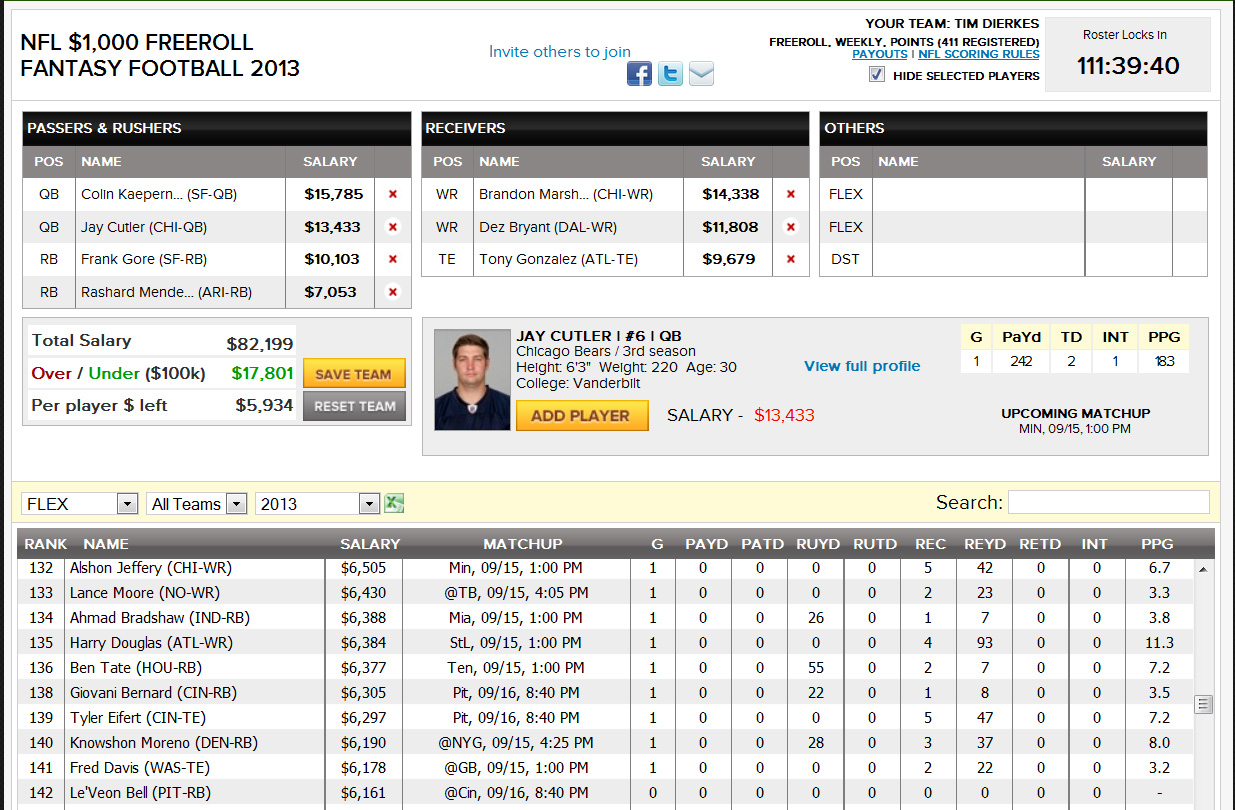
If you're interested, sign up and create a roster prior to Sunday's games (1:00pm eastern time). It's quick, easy, fun, and the MLBTR league gives you a free chance to win some of the $1,000 prize pool. If you enjoy the competition you can try other leagues (college football, for example) for free and earn credits, or deposit real money.
Top 34 Free Agent Starting Pitchers
Sometimes, there's just not a $100MM free agent pitcher out there. C.J. Wilson benefited from a weak free agent starting pitching class after the 2011 season, nabbing $77.5MM to lead the group. In the upcoming offseason, the top end of the starting pitcher segment is similarly uninspiring. Here are my early rankings, which are subject to change. I'd love to hear your thoughts in the comment section or on Twitter.
- Matt Garza – In terms of pure free agent starters, I think Garza will receive the largest contract this offseason. He's ineligible to receive a qualifying offer because he was traded midseason, which boosts his value. He may have quieted health concerns by making all of his starts since his May 21st big league season debut and averaging nearly seven innings per start.
- Masahiro Tanaka – Tanaka, a righty with the Rakuten Golden Eagles, is not technically a free agent but belongs here since he can be obtained by bidding the most (assuming he is posted). I don't want to give too much credit to the unknown, but there are some who would take Tanaka over Garza, especially since Tanaka will pitch next year at age 25.
- Ervin Santana – A quality arm whose stock will be damaged by a qualifying offer, if he turns one down and reaches the open market.
- Hiroki Kuroda – He'll play next season at age 39, but in feedback on early drafts of this list, most thought he should be this high.
- A.J. Burnett – Burnett said in March he wouldn't want to play anywhere but Pittsburgh, and I imagine the team's success this year only solidifies that stance.
- Tim Lincecum – I had Lincecum ranked better in earlier versions of the list, as a case can be made he's at least equal to Santana, if you're willing to look past ERA. Like Santana, a qualifying offer could suppress his market.
- Ricky Nolasco – I'd want to pay Nolasco like a 4.00 ERA guy, despite a 2.07 mark since joining the Dodgers in a July 6th trade. He doesn't have to worry about a qualifying offer, and could sign a new deal with the Dodgers during the exclusive signing period.
- Bronson Arroyo – He's not flashy, and he'll pitch at 37 next year, but he supplies innings and avoids the free pass. Arroyo spoke recently about wanting a multiyear deal, but turning down a qualifying offer from the Reds could put him in a bind on the market. I don't expect the Reds to chance it.
- Dan Haren – Haren will likely avoid a qualifying offer from the Nationals, as they won't want to risk giving him a raise on this year's $13MM. Despite a 5.23 ERA, Haren's K/BB ratio remains sparkling, and I still think there's hope for a sub-4.00 ERA given a few more groundballs and BABIP and HR/flyball swinging back his way.
- Scott Feldman – Ineligible for a qualifying offer, Feldman is in line for a multiyear deal. He's re-established himself as a solid mid-rotation arm, and he'll pitch at 31 next year.
- Paul Maholm – Maholm started his season with 20 1/3 scoreless innings, after which he's posted a 5.09 ERA in 120 1/3 frames. He also missed a month with a wrist contusion, and may have to settle for another one-year deal.
- Roberto Hernandez – I like Hernandez more than most. Though he hasn't done it since 2010, I see the skills of a sub-4.00 ERA pitcher. His combination of a decent strikeout rate and big-time groundball rate is rare, but among the flyballs he has allowed, a whopping fifth of them have left the yard.
- Scott Kazmir – There's a lot to like about Kazmir, who I originally had inside my top ten. He's still young, he's got strikeout stuff from the left side, and he's sporting the lowest walk rate of his career. But he should finish the season with around 160 innings, a total he last reached in 2007. The Indians signed Kazmir to a minor league deal in December; MLBTR's Steve Adams covered his rise and fall in a June post. I think he could find a multiyear deal.
- Ubaldo Jimenez – He has the second-best strikeout rate in this free agent class, behind Burnett. If he can push his walk rate back under four per nine innings, as it was with the Rockies, he'd be close to the front-rotation hurler the Indians thought they acquired at the 2011 trade deadline. Some feel he's among the ten best in this free agent class, and he will be able to score a multiyear deal.
- Bartolo Colon – I reluctantly pushed Colon up to 15th, as over 300 innings of 3.22 ball since 2012 can't be ignored. Colon's career, elbow, and shoulder were resurrected in an April 2010 stem cell procedure, and he was later suspended 50 games for a positive PED test in August of last year in an apparently unrelated incident. He'll pitch most of next season at 41, and is succeeding with a subpar strikeout rate.
- Josh Johnson – Johnson's final start of the year came on August 6th in Seattle, and at least that one outing was reflective of what we used to say about him: he pitches well when he's on the field. His final injury was a strained forearm that will not require surgery, but unlike years past, Johnson did not pitch well while on the field this year, with a 6.20 ERA in 16 starts. His downfall was a fluke in theory, in that his strikeout and walk rates were solid while his BABIP and HR/flyball went through the roof. A qualifying offer is unlikely — Johnson would probably accept, and that would not be a good deal for the Blue Jays.
- Phil Hughes – Hughes was demoted to the Yankees' bullpen earlier this month. He had a respectable 2.85 K/BB ratio in 26 starts, but the extreme flyballer also allowed 23 home runs. There's a 4.00 ERA pitcher in there somewhere, especially away from Yankee Stadium, where he allowed 17 of those longballs. Hughes won't turn 28 until June next year, and as the youngest free agent starter, the former phenom should be a popular one-year deal reclamation project target.
- Jason Vargas
- Chris Capuano
- Roy Halladay - The former ace had labrum and rotator cuff surgery in May, returning to make a few starts this month.
- Tim Hudson - Hudson was pitching well before his season ended in July with an ankle fracture.
- Jason Hammel
- Wandy Rodriguez
- Andy Pettitte
- Joe Saunders
- Jake Westbrook
- Ryan Vogelsong (club option)
- Edinson Volquez
- Chad Gaudin - Gaudin has been quietly solid in a dozen starts for the Giants, with a 3.53 ERA.
- Mike Pelfrey
- Shaun Marcum
- Scott Baker
- Colby Lewis
- Randy Messenger - The 32-year-old is a sleeper MLB deal candidate this offseason, with a 2.83 ERA as a starter for the Hanshin Tigers from 2011-13.
Jon Lester, Jorge De La Rosa, and James Shields were excluded from this list, under the expectation their club options will be exercised.
MLBTR Apps, Features, Functions
An explanation of the many ways to enjoy MLB Trade Rumors:
- Be sure to pick up the MLBTR apps for the latest news and rumors, for iPads, iPhones, and Android devices.
- If you want only the hard news in the form of transactions, our transactions page is the ticket. You can also get only the transactions via Twitter or RSS.
- To return to the main page at any time, just click on the title or the Home button on the navigation bar below the title.
- The navigation bar will cover many of your needs. Use the About dropdown to learn about this site or any of its writers.
- The Contact button takes you to a page where you can write an email message to the MLBTR writers. If you have a link to a rumor we've missed, please send it in through the Contact page! Also use the Contact page to inquire about advertising on MLBTR.
- The Archives dropdown shows you 15 months worth. If you need to go back further, click on Site Map at the very bottom of the page. Site Map also lists out every MLBTR post category, including players, teams, and features.
- The Tools dropdown takes you to a number of different places. The MLBTR Widget allows website owners to easily add a constantly updated box with all of MLBTR's headlines to their sites.
- Also under the tools tab is our Transaction Tracker, which enables you to search about anything and everything to do with baseball trades, signings and extensions.
- Our DFA Tracker helps you monitor the many players who are designated for assignment throughout the year.
- We also have an Extension Tracker, with details on all contracts that include at least one arbitration year.
- MLBTR's Agency Database lets you know which agencies represent which players. It's searchable by team, agency or player, so be sure to check it out.
- Follow Teams is a very useful dropdown. Hover over it to see all 30 teams. Click on the team name to bring up a page of every post containing information about that team, with the latest on top. These are the same pages you'll find if you go to the Rumors By Team section on the sidebar and select A's Rumors, Angels Rumors, etc.
- Also under the Follow Teams dropdown, you'll find RSS and Twitter buttons. Those links allow you to follow a single team's rumors via RSS or Twitter. Did you know we have a separate Twitter account for each of the 30 teams? For example you can follow @mlbtrtigers, where you would get the latest Tigers updates.
- You can also follow Tim Dierkes on Twitter for more MLBTR content.
- On the far right of the Navigation bar, you'll see buttons for Twitter, Facebook, and RSS. MLBTR has over 301,000 Twitter followers, over 79,000 Facebook fans, and over 61,000 RSS subscribers. Sign up for these and you'll be the first to receive all of our posts.
- Be sure to check out your favorite team's MLBTR page on Facebook so you can receive and comment on the latest rumors.
- On to the sidebar. It begins with a list of our Top Stories, which our writers update any time major hard news occurs. Go here for a quick update on the most important stories. Below that is the site's Search Box, where you can type in any player's name and get the latest on him.
- MLBTR Features has all kinds of goodies, including our free agent lists. Many of the MLBTR Features are constantly updated by our writers, so be assured that our free agent lists are always fresh.
- Below Features you've got headlines for all the Recent Posts, in case you'd rather not scroll to see all the headlines. Then there's a box for our Mailing List, where you can sign up to receive a daily email containing MLBTR's posts. Use this option if you don't need the news as soon as possible.
- Next we have Featured Posts, where you'll find original work from MLBTR writers we consider noteworthy.
- If the main site doesn't load perfectly on your cell phone, try the more mobile-friendly mlbtraderumors.mobi. It's a simple page that shows you just the headlines and lets you click through to what you want to read.
- MLBTR is available on the Kindle as well.
Recent September Extensions
In Chase Utley and Ryan Raburn, we saw a pair of two-year extensions last month that aren't uncharacteristic for this time of season. In recent years, the later months of the season — particularly September — have served as a time for many general managers to lock down free-agents-to-be to affordable short-term extensions. Using MLBTR's Transaction Tracker, let's take a look back at some of the contracts that have been signed in September recently…
2012
- Padres sign Chris Denorfia to a two-year, $4.25MM extension – Denorfia's contract is a steal given the numbers he's posted this season. The 33-year-old has a .273/.329/.384 slash line with nine homers and eight steals. He's been worth 2.7 fWAR and 2.8 rWAR thanks to his outstanding defense and baserunning skills.
- Rangers sign Colby Lewis to a one-year, $2MM extension — Lewis underwent flexor tendon surgery last summer, so his season was already over when he signed this low-risk contract. It clearly didn't pan out for Texas, as Lewis missed this season as well due to setbacks in his rehab, but the gamble was well worth it for a pitcher of his ability (113 ERA+ from 2010-12 with Texas).
2011
- Cardinals sign Chris Carpenter to a two-year, $21MM extension — Carpenter had averaged 222 innings of 3.02 ERA ball over the previous three years and led the Senior Circuit in innings the year he signed his deal. However, since that time, he's thrown just 17 big league innings due to a host of injuries. It's hard to blame the Cardinals for the contract, but it clearly hasn't worked out.
- Cardinals sign Lance Berkman to a one-year, $12MM extension — Puma was unable to repeat the outstanding .301/.412/.547 triple-slash line he posted in 2011 due to knee injuries in 2012. He tallied just 97 plate appearances in his second campaign with the Cardinals, who nearly went to the World Series even with lost seasons from Berkman and Carpenter.
- White Sox sign Sergio Santos to a three-year, $8.25MM extension — Santos' contract was unlike the others on this list, as it bought out a pre-arbitration year and two arb seasons, and it also contained three more club options. The White Sox got what appeared to be a bargain at the time and could still be one, even if it's not in Chicago. Santos was flipped for prospect Nestor Molina, and his first two seasons with the Jays have seen him total just 21 1/3 innings so far. However, he'll still earn just $3.75MM next season, so there's time for him to start earning his salary.
- Marlins sign Omar Infante to a two-year, $8MM extension — From 2012-13, Infante has batted .291/.318/.432 with plus defense at second base. He also helped the Marlins to obtain a trio of solid prospects from the Tigers when the Fish dealt him and Anibal Sanchez for Jacob Turner, Brian Flynn and Rob Brantly.
- Mets sign Tim Byrdak to a one-year, $1MM extension — Byrdak only threw 30 2/3 innings in 2012, but he held lefties to a paltry .154/.260/.277 batting line in the process, so it's hard to say he didn't meet and exceed the expectations set by his modest salary.
MLBTR Seeking Comment Moderators
MLBTR is looking for additional moderators to read through comments and make sure that they're not in violation of our commenting policy. We're looking for people to contribute throughout the week, including on weekends.
It's not a paid position, but it will keep you connected to the latest trade and free agent rumors. If you're a frequent MLBTR commenter who can help us keep the comment section clean, send a short e-mail to mlbtrmods@gmail.com with the following: your username, the email (or other) account you use to comment on MLBTR, your availability, and a short explanation as to why you'd be a good fit. If you're responsible, respectful and interested in contributing at MLBTR, we want to hear from you.
Hardest-Throwing 2014 Free Agents
Earlier in the season, Tim Dierkes looked at the hardest throwers in this year's free agent class. A lot has changed since that list, and with just over a month of the season remaining, the current numbers should serve as a good indicator as to who the market's top flamethrowers will be. Using the 2014 Free Agent Leaderboards that I created using Fangraphs, here's an updated look at the hardest-throwing starters and relievers…
Starting Pitchers
- Josh Johnson and Matt Garza— 92.8 mph
- Jason Hammel — 92.7 mph
- Jon Lester — 92.6 mph ($13MM club option)
- Phil Hughes, Ervin Santana and A.J. Burnett — 92.4 mph
- Edinson Volquez and Scott Kazmir — 92.3 mph
- Mike Pelfrey — 92.2 mph
- James Shields — 92.1 mph ($12MM club option)
- Roberto Hernandez — 91.6 mph
- Ubaldo Jimenez and Roy Oswalt — 91.5 mph
- Hiroki Kuroda — 91.3 mph
Relief Pitchers
- Fernando Rodney — 96.3 mph
- Matt Lindstrom — 95.0 mph ($4MM club option)
- Joba Chamberlain — 94.8 mph
- Jesse Crain — 94.5 mph
- Matt Thornton — 94.2 mph
- Joaquin Benoit and Chad Qualls — 94.0 mph
- Boone Logan — 93.6 mph
- Grant Balfour, Jose Veras and Matt Albers — 93.4 mph ($3.25MM club option for Veras)
- Carlos Marmol and Manny Parra — 93.3 mph
- Mark Lowe — 92.9 mph
I didn't include Joel Hanrahan's 96.6 mph heater with the relievers, as it remains to be seen when he will be able to pitch in 2014 following Tommy John and flexor tendon surgeries. Major League starters are currently averaging 91.2 mph on their fastballs, while relievers average 92.5 mph.
For those who are interested, I also updated the list of free agents with the highest ground-ball rates last week. Pitchers who appear on both lists are Burnett, Hernandez, Volquez, Kuroda, Santana, Qualls, Lindstrom and Rodney.
MLBTR Regular Features
If you're a regular MLBTR reader, you'll be familiar with our chats, Week In Review posts and Baseball Blogs Weigh In feature. Here's some more detail on when you'll see our weekly features and exactly what to expect from them:
- MLBTR Chats - Join Tim Dierkes every Tuesday at 2pm CDT to chat about the latest trades, signings and rumblings around the Major Leagues.
- Baseball Blogs Weigh In - Every Friday, I feature some of the best writing from baseball blogs around the web. Whether it's opinion, stats or something else entirely, you can connect to the best of the blogosphere once a week on MLBTR. If you want to submit a post of yours, you can reach me at zachbbwi@gmail.com.
- Week In Review - It's remarkable how much happens in seven days. Every Sunday night, MLBTR summarizes the week's biggest stories in our Week In Review posts.
- MLBTR Originals - Edward Creech gathers all our original analysis and reporting in one place every Sunday night.
Highest Ground-Ball Rates Among 2014 Free Agents
Earlier in the season, I took a look at the highest ground-ball rates among free agent pitchers. That came several months ago, and over the course of the season the numbers have changed a bit. With nearly a full season under their belts, let's see which qualified pitchers out of this year's crop of free agents has done the best at keeping the ball on the ground (keeping in mind that the league-average ground-ball rate is currently 44.6 percent)…
Starting Pitchers
- A.J. Burnett — 56.3 percent
- Tim Hudson — 55.8 percent
- Roberto Hernandez — 52.9 percent
- Joe Saunders — 49.9 percent
- Scott Feldman — 49.4 percent
- Edinson Volquez — 48.2 percent
- Hiroki Kuroda — 48 percent
- Ervin Santana — 47.7 percent
- Jorge De La Rosa — 47.4 percent
- Andy Pettitte — 46.4 percent
Relief Pitchers
- Chad Qualls — 66 percent
- Matt Albers — 62.8 percent
- J.P. Howell — 57.4 percent
- Matt Lindstrom — 54.7 percent ($4MM club option)
- Jamey Wright — 52.7 percent
- Matt Belisle — 51.4 percent ($4.25MM mutual option)
- LaTroy Hawkins — 49.7 percent
- Fernando Rodney — 49.6 percent
- Darren Oliver — 48.7 percent
- Jason Frasor — 48.5 percent
Pitchers with strong ground-ball rates will often appeal to teams in smaller ballparks, and oftentimes a lofty ground-ball rate can get a pitcher paid in spite of mediocre strikeout rates. Santana figures to sign the biggest contract of this bunch due to his age and performance, but De La Rosa has quietly enjoyed a 3.1 fWAR season and should be in line for a solid payday as well as he enters his age-33 season.
Jake Westbrook (56.1 percent), Jason Marquis (52.3 percent) and Paul Maholm (50.7 percent) all deserve mention as well, but they don't have enough innings to qualify for the ERA title. Marquis also has little free agent value, as he recently underwent Tommy John surgery.
Introducing MLBTR’s DFA Tracker
MLB players are designated for assignment regularly. The transaction, often abbreviated DFA, removes the player from the team's 40-man roster, giving the club ten days to trade, release, or outright him to the minors. Players who are designated for assignment can be placed on waivers within the first seven days, and the best ones are traded or claimed and added to another team's 40-man roster.
Today we're happy to introduce a new way to monitor these players: MLBTR's DFA Tracker. The tracker, which will be updated moving forward, lists the player's name, team, date designated, and the date by which a resolution is expected. A player is assigned one of five statuses: DFA Limbo, Claimed, Outrighted, Released, or Optioned. Designated players all begin in what we like to call DFA Limbo, where they're off the 40-man roster and awaiting a resolution. All players will have their status updated from DFA Limbo to one of the other four when appropriate. Within the tracker, the player name is linked to his original MLBTR DFA post. You can search for players, filter by teams and/or status, and search within date ranges.
You can find the DFA Tracker here, and the link has also been added to the righthand sidebar under MLBTR Features. Speaking of which, check out our list of players who have cleared waivers, reverse standings, 2014 free agent list, transaction tracker, and agency database as well.
Would An August 15 Deadline Have Made A Difference?
We're now two weeks removed from a quiet July 31 non-waiver trade deadline. As it became clear that there wasn't going to be much activity, many commentators suggested that the second Wild Card was to blame. A few writers, including FOX Sports' Jon Morosi, proposed that MLB move its non-waiver deadline, perhaps to August 10 or August 15.
Of course, it may be that quiet trading deadlines aren't a bad thing, and therefore aren't a problem that needs to be solved. Maybe it's better for the game if non-contending teams act like they care for the entire year, not just through July. Maybe we don't want guns-for-hire changing teams right before the home stretch, rendering successful teams unfamiliar and unsuccessful teams irrelevant. Perhaps what happened this year is just fine.
Now that August 15 has come and gone, though, it's worth revisiting Morosi's suggestion. What we find is that it's far from clear that the second Wild Card had any more than a minor impact this year, and that it's unlikely that moving the non-waiver deadline would have had much of an effect on this year's lack of activity.
Here are the standings as of July 31. In the National League, the Braves, Pirates and Dodgers led their respective divisions, just as they do now. The Cardinals and Reds remained safely ahead of all other teams in the Wild Card race, just as they are now. And the only other team with a significant shot at the playoffs was the Diamondbacks. That's still the case.
In the American League, the Red Sox and Tigers led their divisions and still hold those positions. In the AL West, the Athletics and Rangers have switched positions, but both remain in strong contention for playoff spots. The Rays remain in line for a Wild card spot, just as they did two weeks ago. The Orioles and Indians remain on the fringes of the Wild Card race, and the Yankees aren't any further out of it now than they were then. And despite their much-ballyhooed surge, the Royals are now 5.5 games out of the last playoff spot, only a half a game closer than they were two weeks ago.
In other words, in the last two weeks, there have been few changes in the playoff picture that would suggest a large impact on teams' willingness to trade. Also, the second Wild Card doesn't appear to be much of a factor — it didn't matter much at the deadline, and it wouldn't have if the deadline had been August 15. Since no team is currently running away with the top Wild Card spot in either league, and no team was running away with either of those spots as of July 31, it's hard to imagine the extra Wild Card had much impact on teams' thinking, particularly given that many of the outside-looking-in teams, both then and now, were or are in the running for division titles as well as Wild Card berths. A one-Wild-Card playoff system would have altered the playoff hopes of the Orioles, Rangers, Yankees and Indians to varying degrees at different times, but probably not enough to make any of them sellers, and it would have had virtually no impact on teams' playoff chances in the National League.
This isn't to say that Morosi's proposal was a bad one. It's possible that, in some future season, the second Wild Card really will cloud the playoff picture, and a later deadline really might provide clarity. But those things did not, or would not have, mattered much this season.
So what was the real explanation for the lack of activity at the deadline this year? Shortly before the deadline, MLBTR outlined some reasons why sellers weren't motivated, including the proliferation of long-term contracts for young players and changes to rules governing compensation draft picks. Perhaps the most compelling, though, is that, for business reasons, it didn't make much sense for some non-contenders to give up on their seasons, particularly when the likely reward for trading was minimal.
The Phillies provide a good case study. In prior seasons, a team like the Phils might have sold, but this year, they didn't. In the past few weeks, the Phillies have attempted to make a splash, signing Chase Utley to an extension and reaching a deal with Cuban righty Miguel Alfredo Gonzalez (an agreement that now appears to be in jeopardy). The merit of the Phillies' decision to hold on to their players is, perhaps, somewhat debatable, but based on their trade chips' contracts (Cliff Lee, Jimmy Rollins, Jonathan Papelbon) or performance (Michael Young, Carlos Ruiz) or both, it would have been hard for the Phillies to get much in return. If you're a big-market team with lots of money, there isn't that much value in trading veterans for prospects who might top out as average players.That's especially true if, as in the cases of Lee, Rollins and Utley, the players you have to offer are big-name stars.
The Phillies' situation typified much of what happened at the trade deadline this year. The issue was that they were a big-market team given the unappetizing choice of trading big-name players for what would amount to very little.
Throughout baseball, teams merely shrugged at the deadline, not because of playoff races, but because being active really didn't benefit them. Two of the Giants' main trade chips, for example, were Tim Lincecum and Hunter Pence. Both those players are candidates to receive qualifying offers after the season, but they would lose that staus if they were traded. And so the Giants, who won the World Series last year and stood to benefit, from a P.R. perspective, from basking in its glow as long as possible, stood pat.
The Mariners, too, might have been sellers, but most of their tradable veterans (Kendrys Morales, Mike Morse, Raul Ibanez) had little defensive value and didn't fit well with other contenders. So, with little to gain from trading, they too stood pat. The Royals should benefit from pursuing their first winning season since 2003, and so they actively became buyers despite their playoff chances at the deadline being dubious at best.
Since the non-waiver deadline, there have been several trades, the highest-profile of which was the Rangers' deal for Alex Rios. But buyers have been remained circumspect, as shown in Jeff Todd's list of players who have cleared waivers. The list includes players like Dan Haren, Justin Morneau and Matt Lindstrom, who are in the last years of their contracts and would appear to offer at least some chance of helping a contender down the stretch. Haren and Morneau aren't nearly the players they once were, but to claim them and assume the remainder of their contracts would only have cost contending teams only a few million dollars per player. No team bit. That Lindstrom passed through waivers might be even more surprising, since he's owed less than $1MM for the rest of the year, plus a $500K buyout. While he isn't having his best year, he's a perfectly functional big-league reliever who gets ground balls and throws in the mid-90s. And yet no one wanted him.
So what's going on here? This year, teams that traditionally would have been sellers had other priorities — keeping the team together, pursuing a winning season, and so on. Teams that traditionally might be buyers were circumspect, guarding their prospects and, in some cases, their wallets. Maybe the conditions that shape the market will change next year. Having so many bigger-market teams, like the Phillies, Giants, Mets and Mariners, out of the running probably didn't help this season, for example. But the second Wild Card wasn't much of a factor in 2013, and moving the deadline to mid-August probably wouldn't have changed much, either. It doesn't matter when you schedule the dance if no one wants to go.