
Trade rumors have swirled around both Aaron Sanchez and Marcus Stroman for months, though teams considered the Blue Jays’ asking price for either young right-hander to be “uncomfortably high” during the offseason. The Jays were thought to still be looking for a premium return in any deal, despite the fact that both Sanchez and Stroman were coming off inconsistent, injury-shortened seasons. The prevailing wisdom was that the Jays would be counting on both pitchers to be healthy and effective in the first half of 2019, paving the way for the duo to become prime trade chips at the July 31st deadline.
For Stroman, it’s been all systems go in amassing a 3.04 ERA over 100 1/3 innings, including his six shutout frames against the Red Sox today. For Sanchez, however, his first 16 starts have only led to more frustration. Sanchez has managed only a 5.49 ERA over 78 2/3 innings this season, with ERA indicators (5.48 FIP, 5.30 xFIP, 5.43 SIERA) and hard-contact numbers (a .355 xwOBA just slightly below his .359 wOBA) providing evidence that Sanchez’s struggles are far removed from simple bad luck.
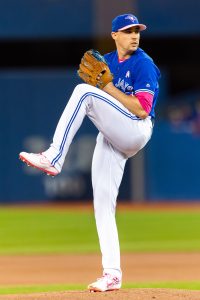
Counting his abbreviated 2017 season, Sanchez is now in his third straight year of issuing at least five walks per nine innings. While he has a 50% grounder rate, 16.4% of the fly balls he has allowed have left the yard, leading to an unimpressive 1.4 HR/9. Never a big strikeout pitcher even at his peak in 2016, Sanchez has a 7.44 K/9 this season.
Speaking of Sanchez’s 2016 season, that excellent year stands out as the most recent bit of evidence that the right-hander has be a front-of-the-rotation type of starter, as Sanchez has since been consistently hampered by a variety of finger problems. Between cracked and removed fingernails, surgery to repair a right index finger injured after being caught in a suitcase, and constant blister problems, Sanchez has been fraught with the type of hard-to-diagnose yet persistent injury concerns that would give any team pause.
As Sanchez told The Athletic’s John Lott (subscription required) last winter, the finger problems led to mechanical issues, as Sanchez tried to adjust for a new grip on the baseball. This led to a steep increase of Sanchez’s use of a changeup in 2018 that has continued into this season, and Sanchez’s curveball usage has also spiked to a career-high 22.7% this season (his previous high was 16.6% in 2017).
Though Sanchez is averaging 94mph on his fastball, he has only been throwing it 58.3% of the time in 2019 due to a lack of effectiveness. As per Fangraphs’ fastball runs above average metric (wFB), Sanchez has gotten less than his heater (-12.1 wFB) than all but two other qualified pitchers in baseball. Lott noted back in January that Sanchez’s sinker was a plus pitch for him in 2016, yet it has become an increasingly smaller part of the righty’s arsenal — after throwing it 54.9% of the time in 2016, that total dropped to 37.9% last season and 36.3% this year.
With all this in mind, Sanchez would need a big turn-around over the next four weeks to merit the type of return that the Blue Jays want for a young (Sanchez turns 27 on July 1) pitcher who is controlled through the 2020 season. Controllable arms have enough value in baseball that the Jays would surely still get some type of decent offers for Sanchez, especially if there’s a team out there that believes it has a fix for Sanchez’s grip problems.
The trouble is, a “decent” offer would still be seen as a big disappointment for a rebuilding Jays team that hasn’t been able to maximize its return on several of its veterans. Josh Donaldson would’ve been the Blue Jays’ biggest trade chip of 2018 yet shoulder and calf problems kept the third baseman off the field for much of the season, leaving the Jays forced to settle for just one prospect coming off Tommy John surgery (Julian Merryweather) in a trade with Cleveland. J.A. Happ was dealt at last year’s trade deadline for Brandon Drury and Billy McKinney, neither of whom have done much for the Jays this season. Roberto Osuna was sent to Houston last July for a three-pitcher package that included current closer Ken Giles, though Osuna surely would’ve netted more were it not for his off-the-field legal issues.
A case can be made that Toronto could opt to just hang onto Sanchez to see if he can ever get on track either after July 31st or in the first few months of the 2020 season. Sanchez is earning only $3.9MM this year and will only get a modest raise on that salary in his final season of arbitration eligibility, plus the Blue Jays will still need some kind of veteran rotation help next year.
There’s nothing stopping the Jays from continuing to explore trades for Sanchez over the winter, though then the team runs the risk that his rebound performance simply never comes around (or simply won’t come in a Toronto uniform if a change of scenery is required). The Jays face an increasingly tough decision leading up to the trade deadline, as the team will have to weigh whether settling for a modest trade return for Sanchez now might be preferable than getting even less, or nothing at all, for Sanchez down the road if his underwhelming 2018-19 performance represents his new normal.
Photo courtesy of USA Today Sports Images
Sanchez and Stroman. Just keep them so you don’t raise prospects up into a big time loser culture. Neither of these guys has big trade value because there are so many teams who are sellers and have better assets.
Sanchez isn’t doing anything for a “winning” culture. He’s been very bad. Stroman has plenty of value and will net the Jays a top prospect. They may be better off holding onto Sanchez if they think they can fix him but they’ve been trying for 3 years now.
Sanchez is a great 8th inning arm. Everyone who knows the jays can’t understand why he haven’t been put into the bullpen already. When he was the 8th inning guy in 2015 you knew the game was over
Agreed. I guess his 2016 season is just too tempting to give up on him as a starter though. Personally, I think he could be a nice replacement for Giles once he’s moved. Maybe one year from now he’s a prime bullpen target that could have value.
100 percent agree. was great out of the pen a few years back. they just keep hoping for that one season he had a few years back as a starter but the blisters and stamina just aren’t there.
He wasn’t even that good as a reliever in 2015 though. He fluked his way into a good season that year. Incredibly low strikeout rate for as hard of a thrower as he is to go with a high walk rate and unsustainable BABIP. 2016 was a legitimately good season though and that’s why they’re hesitant to move him back to a place where his only success has been luck based.
So, no strikeouts means bad reliever? Thanks Yu, Yu Lose. I’ll take a 0.873 WHIP from a reliever, any season any time.
His point is that low WHIP was bolstered by a crazy low BABIP that isn’t likely to continue.
Based on numbers rather than actually watching baseball. Considering Sanchez nearly won a Cy Young the following season says his good play DID continue. Tough to know baseball behind a computer with no video.
If the numbers don’t back your opinion, your opinion isn’t valid because it isn’t based on anything factual
Tough to know good baseball when it’s based on nothing but personal bias and romanticism…
Or, Petrie, you can get off your step-father’s recliner to check the numbers yourself. Sanchez’s numbers proved me right. Why would you back the side of re-writing history? Are you that angry with me calling you out for incompetence and a lack of humor? Don’t answer that, the numbers would suggest that you are.
Again, your effort is noted. But try not to swing outside your weight class.
You posting like a 12 year does little to add value to your opinions. Just makes you look like a 12 year old
And you kind of haven’t been proven right because Sanchez hasn’t gone on to a successful relief career… he’s seen his numbers tank since then. So the number geeks seem to have been on to something
But really, if you still think opinions based on data are somehow less accurate than those based on nothing, there’s no point in arguing until they finish that cure for stupid
Rattled much, Petriedish?
The data was based on 2015. In 2016 Sanchez contends for a Cy Young. Data refuted, as both dummies forgot to look at the 2016 season and Yu called it luck.
So now that we are keeping score: data proved nothing, luck cannot be proven properly. I guess being a Cy Young contender takes no skill according to you, the other two dummies and the rest of the neanderthals that would rather look at numbers than watch games. In short, you’re a no-nothing. But we already knew that.
Sanchez has had 3 injury-riddled seasons, and prior to this season’s injury he was pitching quite well. You can fudge whatever numbers you like, the truth is he started off well.
Are you done?
Are you ever going to start?
You’re in an article openly questioning whether Sanchez has any trade value arguing you were right that his unsustained numbers were proven sustainable…
Are you tragically stubborn or just laughably dumb? He’s been ineffective when healthy for 2 straight seasons, so your eye test is decidedly myopic if you think anything about his actual performance validates your inane rantings
You literally have to ignore 2 and a half seasons worth of data to prove your point. Go away and let the adults talk baseball.
Sanchez was a good reliever. 2015 he only allowed 2 XBH and only walked 7 in 26.1 innings. His horrible bottom line and FIP numbers came from when he was starting. He walked 37 in 66 innings and his WOBA was nearly a .150 points higher than it was as a reliever. He’s not a strikeout artist in either role but that does not mean he can’t be successful. FIP is not a very relevant metric for Sanchez if he’s generating nearly 65% of his balls in play on the ground as he was doing in 2014/2015 in a relief capacity.
He was very good then. Maybe he could find that success again. He hasn’t found that success in the rotation since 2016 but like Zack Britton if he can generate that many groundballs out of the bullpen there is potential for a dangerous weapon. GB pitchers do not need hefty K rates.
I think these Jays fans are absolute correct in their assessment. I hadn’t delved into those numbers but if he’s able to generate groundballs and throw strikes in a shorter capacity they’ll have a useful piece. And he absolutely did prove himself in the past as a reliever.
But obviously he’d have to be able to generate those groundballs and throw strikes in shorter bursts. That in itself is no guarantee but it’s a much easier task than asking to do it for an entire start.
His numbers the first time through the order are much better this year but he’s still walked 22 in 31 innings and that’s completely unacceptable. His GB rate is only around 50% the last 2 years as well. So there is no guarantee that’s the magic solution either. However, given his prior success there with numbers to support it, it’s a reasonable suggestion that Toronto should try it.
Petrie, his value is shot BECAUSE OF HIS INJURIES.
Nobody wants an injury-prone pitcher. Period.
He was a very good reliever when he was in the bullpen. I watched him take the ball against the very best hitters the AL had to offer and he answered the call. Then you and your mental midget stat geeks decided to start a losing argument. And you lost. Again. JBigz even said Sanchez was a good reliever, and he’s never on my side.
Goodbye.
Winning culture happens behind the scenes. Is created when veterans with good attitudes come to work everyday and walk the walk it takes to have sustainable MLB success. Stroman and Sanchez do this. They will have good, not great season many more years. Prospect is prospect.
Stroman is at the very top of the trade board. The rest of the market shouldn’t have any impact on him. Especially since there isn’t a team in the race that couldn’t use a pitcher in their rotation.
Name 5 better starting pitching assets on sellers’ teams than Stroman? Not sure you can. Of course, your reference to a “loser culture” suggests this isn’t really a serious comment.
Mad Bum. Greinke. Boyd. Anibal Sanchez. Beiber. Baurer. Ray. Etc.
With current baseball theme, all teams 5 games out and not in big market have firesale plan.
And Stroman is just not worth much on market for contender. Ace? No. Long cheap control? Nope.
His biggest value is veteran presence. Continue to grind as example for youngster.
Bieber? Sanchez? You’re really reaching here. Even the Arizona arms are far from available since they’re in the race still. Most teams probably couldn’t afford Greinke anyways. As it stands now, Stroman is the most valuable pitcher on the market for both this year and next. There’s no two ways about it. Someone will give up a nice package to acquire him.
I’ll take Bieber over Stroman given his years of control. And maybe just overall because I think Bieber is a solid pitcher but that doesn’t
make him available. He isn’t.
Solid mid-rotation pitchers are very valuable for teams with championship ambitions. Realistically you need 4 starting pitchers to carry you through the playoffs. They don’t need to be aces, you just need a 3-4 better than the other guys 3-4
So even without long term control, I think you seriously undervalue Stroman right now.
I’m not comparing Stroman and Bieber value wise. There’s just no way he is available. No idea why he was included in that other list.
I was responded by to ejemp, if that wasn’t clear
Yawn,,,,what a predictable article,,,,,slow week on the news front?
what in God’s name would possess u to make a comment like this? u have a screw loose. get help
They’re reporting the news not making it. I suppose they should fabricate something just for you. Don’t you have a yelp review to get too?
I heard Clint Frazier might get traded!
Extend Stro Show and move Sanchez to set-up Giles.
move Sanchez to setup. see if he can close if you move Giles. trade stroman.
The title states the obvious. The obvious was stated because most Jays fans refuse to believe it. The best part was the paragraph outlining the Blue Jays front office’s blunders over the last two years. Again, obvious to some.
For the blind sheep believing this rebuild is a success; who in AA or AAA have torn it up to make a strong case for themselves as impact players? I’m talking about current minor leaguers. Just Nate Pearson. That’s about it. And that’s not good.
How long has the rebuild been going on? One season? I’m pretty sure they were gunning for the playoffs at the beginning of last season.
They weren’t “gunning” for the playoffs last season. No real baseball fan would believe that. Then again….
Bo?
I said strong case. Bo would be incorrect. For now.
Why just cut it off in AA and AAA? They already have Guerrero, Biggio, Gurriel, and Thornton performing well in the majors. Jansen and Pannone may eventually be in that picture as well. That also leaves out a few of their top prospects as well who are in the lower minors. They’ll be the reinforcements coming up or the ones traded for when they are ready to compete. They are a huge part of the rebuild. I don’t think they can just be discredited to say their rebuild isn’t going well.
This “rebuild” is the worst in MLB history. The farm isn’t replenished as some people on this blog say. Shapiro and Atkins have destroyed the organization built by Beeston and AA, and Rogers seemingly doesn’t care. Atkins will end up trading Stroman, Sanchez, Giles and Smoak for utility-type players with low ceilings, setting back the franchise another ten years… Stroman -who loves Toronto – should be resigned, Sanchez moved to a setup role in the pen, and keep Giles at closer and Smoak for his leadership. Bring in more major league level talent in CF, RF and to the rotation and the team might actually be competitive by next year as Vlad Jr, Biggio and Gurriel Jr, who seems to have found a home in LF, start driving the franchise. And fire Shapkins, they are destructive losers.
Dipoto – how many guys in Single-A and below will make the jump to the majors this year or next? Exactly.
If you think there are reinforcements coming up, you aren’t paying attention to the minor leagues. You mentioned players already in the major leagues for a big chunk of time.
For a top ranked farm system they are not living up to it’s hype. That cannot be refuted. They will need to fleece a team for Stroman and Giles to turn it around.
I believe Patrick Murphy before his delivery was announced illegal was having a stellar year.
Murphy is dwindling in AA, and really should have been in AAA given the garbage pitching Buffalo has had. He’s already 24 and hasn’t been given a real shake. Regardless, his numbers aren’t close to good.
sanchez has had less then great value foe a while now. he’s never healthy, yet does it despite playing on neither of the Mets or Angels.
Can’t wait for people to push the narrative that they blew trading him when he had value, even though the last time that was the case was the 2016 offseason.
Not sure who would come up with that idea. No way Sanchez could have been traded. A near-Cy Young 2016 and 3 injury seasons. Don’t see any chance of a trade, and anyone suggesting it is out of their mind.
I know. But it happened with EE, it happened with Bautista, it happened with Travis. A year or two after Sanchez is out of the organization those same people will do it again.
Yes I’ve seen those short-sighted thoughts float on these boards. I still maintain June 2017 should have been the start of the exit plan, looking at the AL East landscape.
With that said, EE was gone, Travis was hurt (or about to be, and part of the future), and Bautista, well, what return could a 36-37 year old past his prime with a $17.5 mil contract get? Close to zilch with the Jays eating salary.
I think the logical thing to do is trade stroman now while his value is high, keep sanchez and hope he builds some value. If that means moving him to a late inning role next season, then do it. Can’t imagine his value will drop much if at all next season.
Cash in Stroman, Giles and Smoak this year and see what Sanchez can get you next season
he is reliever. he also has personality issues. Might as well keep him. he and boros will be in for a shock if expect anyone to offer him anything to start. relief maybe as setup man . starter he is at best a fifth starter on a good team.. clearly jays bet wrong keep him traded Syndergaard.
I looked at the Pirate prospect list to see what I’d be willing to part with for Sanchez…
#15 40 FV SS Stephen Alemais
Guessing that would disappoint Jays fans, yes.
Maybe…maybe toss in Geoff Hartlieb.
Not sure why the Pirates would want Sanchez. Pirates should be soft selling as we speak.
Sanchez to the bullpen. Trade Giles and see if Sanchez can close. He has an elite arm and needs to be given this opportunity.
Bring Sanchez to the Rays. Work on his stuff, get him into the bullpen or work him into the opener rotation.
Sanchez to me should be a non tender candidate.
For the modest salary (relatively speaking of course) I wouldn’t non-tender him. As many have also said, I’d move him to the pen and see how he does. He has the potential to be quite good in short bursts as we’ve seen before. I think the only reason that they haven’t done so already is due to the injuries to other starters (Shoemaker, Borucki and Buchholz) and lack of starting depth in Buffalo.
So non-tender Sanchez by a team willing to give Japan material Derek Law and AAA material Nick Kingham a chance to pitch on a big league roster? Yeah, no chance of that.
Unfortunately Sanchez’ days as a starter are over. Deal Giles and hand the closer reigns to Sanchez and see what he does the last two months.
I forgot about the suitcase mishap. Heh.
I’m pretty sure y’all mean ‘sinker’ and not ‘slider’ in the article. Aaron never threw one of those
A career 3.74 era. No injuries to shoulders or elbows. Just the blister issues. Post season experience. He could be a real find to a team willing to take a chance.
…next two starts should be telling.
I wonder if Toronto would part with Sanchez for a big prospect who’s lost some promise in recent years. A guy like Kevin Maitan or, to a lesser extent, Jam Jones fit that bill and the Halos could use another arm
The Angels could use 4-5 arms.
The Blue Jays should just call the Pirates. I’m sure they’re more than willing to deal their top 3 prospects for Sanchez.
Should have just gave us Sanchez instead of cash for kingham lol