
Jordan Westburg Undergoes Tommy John Surgery
TODAY: Orioles president of baseball operations Mike Elias confirmed that Westburg underwent Tommy John surgery on Wednesday (video from Matt Weyrich of The Baltimore Sun). The goal is to have Westburg return as a full-time infielder “in the early part of 2027,” though Elias acknowledged the timeline is pretty vague at this point.
May 15: Orioles infielder Jordan Westburg will undergo elbow surgery and miss the rest of the season, reports Andy Kostka of The Baltimore Banner. Westburg is already on the 60-day injured list and will stay there for the rest of the campaign.
It’s a disappointing but unsurprising result. Westburg was diagnosed with a partial tear of his ulnar collateral ligament back in February. He and the O’s initially tried for a non-surgical approach, as he was given a platelet-rich plasma injection at that time. Earlier this month, some continued discomfort in his elbow led to him being shut down from throwing. Now it seems the surgical path could no longer be avoided.
Some observers may wonder why he didn’t just undergo surgery in the first place. Generally speaking, surgeries require long recovery timelines, so players and teams usually try to explore the alternatives first. The player often ends up going under the knife in the long run, but there are some cases where the alternate possibilities are effective, allowing the player to return sooner. In this case, perhaps Westburg had a path to helping the Orioles late in 2026 if all went well.
That best-case scenario won’t happen but the O’s likely haven’t lost anything by trying. UCL surgeries for pitchers often take a year or so to recover but position players can come back sooner than that. It’s possible Westburg could return for the start of 2027, which would have been the outcome if he had surgery back in February anyway.
Though the outcome isn’t shocking, it’s likely deflating for Westburg and the Orioles regardless, as injuries have become a big storyline in his career and the team’s season. For Westburg personally, he had a breakout season in 2024, though that was limited to 107 games by a hand fracture which put him on the shelf for over a month. In 2025, he made trips to the IL for a hamstring strain and an ankle sprain, only appearing in 85 games. Now he’s going to miss the entire 2026 campaign. While spending this year on the 60-day IL, Westburg will cross three years of service time and qualify for arbitration. He can be retained through 2029.
For the O’s, Westburg is one of 13 players currently on the IL. That includes five position players. In addition to Westburg, Jackson Holliday, Dylan Beavers, Ryan Mountcastle and Heston Kjerstad are on the shelf.
With no Westburg and no Holliday so far this year, Baltimore has had to go to backup plans on the infield. Gunnar Henderson has been at shortstop and Pete Alonso at first base but Westburg was the planned third baseman and Holliday supposed to be the second baseman. Coby Mayo has been the main guy at the hot corner this year but he has produced a dismal .174/.242/.321 line. Jeremiah Jackson has mostly covered second. His .238/.259/.400 line is better than Mayo’s but still subpar. Blaze Alexander has contributed at both spots but has hit just .244/.299/.289.
With all the injuries, the O’s have started slow, currently sporting a 20-24 record. Their season is still salvageable since so many other teams in the American League are also scuffling. That losing record is good enough for the club to be just a game and a half out of a playoff spot at the moment. They will try to stay in the race in the coming months but Westburg won’t be a part of the solution, so other guys will have to step up. The Orioles could look for infield help ahead of the trade deadline if the incumbent guys aren’t delivering.
Photo courtesy of John Jones, Imagn Images
AL Injury Notes: O’Hoppe, Raleigh, Madden
Angels catcher Logan O’Hoppe left last night’s game against the Dodgers with left wrist irritation, according to a team announcement. O’Hoppe sustained the injury in the top of the fourth inning on a pitch in the dirt from starter Jack Kochanowicz. The pitch ricocheted off O’Hoppe’s left wrist, and he was visited by trainers after the play. O’Hoppe remained in the game through the fifth inning before being replaced by Sebastián Rivero behind the plate.
O’Hoppe just returned tonight from a nearly three week absence due to a left wrist fracture. According to manager Kurt Suzuki (via Rhett Bollinger of MLB.com), O’Hoppe was removed from the game as a precaution and did not require post-game X-rays. That bodes well for his wrist health, though it wouldn’t be unreasonable for the Angels to hold O’Hoppe out of the lineup tomorrow anyway. The 26-year-old is LA’s clear top choice behind the plate, with Travis d’Arnaud (currently on the injured list) as his usual backup. Meanwhile, Rivero has a 15 wRC+ in 134 scattered plate appearances from 2021-26, so he would be unplayable as a starter if O’Hoppe went on the IL again.
For his part, O’Hoppe says his left wrist is “just uncomfortable” (link via Michael Huntley of the Orange County Register). “It’s uncomfortable walking around. It’s uncomfortable doing anything but we’ll treat it and keep going,” O’Hoppe said after the game. That may give cause for optimism among Angels fans, though the club will continue to monitor the situation in the coming days.
A couple other injury notes from the Junior Circuit:
- Mariners catcher Cal Raleigh is being shut down for a week, according to Ryan Divish of the Seattle Times. He will be reevaluated at that point. Divish adds that Raleigh’s most recent MRI came back better than his previous one. Raleigh went on the 10-day injured list on May 14th with a right oblique strain, which he admitted he’d been playing through for two weeks. On its own, the oblique strain puts Raleigh out for more than the minimum stint, and that’s even more certain now that he’s been shut down. Raleigh was out to an uncharacteristically poor start at the plate, with a line of 161/.243/.317 (63 wRC+) through his first 181 plate appearances. That’s a far cry from his 60-home run, 161 wRC+ performance last year, though the oblique injury explains at least some of the downturn. With a longer-than-minimum absence in store for Raleigh, Mitch Garver and Jhonny Pereda will continue to split time behind the plate for Seattle.
- Tigers right-hander Ty Madden was struck by a comebacker in the second inning of yesterday’s 3-2 victory against the Blue Jays. Yohendrick Piñango lined a 2-2 pitch off Madden’s forearm, which Madden fielded but did not attempt to throw to first. Madden, who was intended to serve as a bulk reliever, left the game without attempting a warm-up pitch. The 26-year-old has effectively been covering the rotation spot of Casey Mize, who is currently on the injured list with an adductor strain but is expected to be activated for Sunday’s start, per Ben Nicholson-Smith of Sportsnet. Madden missed all of last year with a right shoulder strain and was making just his third appearance in the Majors since returning from that injury. Per Jason Beck of MLB.com, initial tests on Madden revealed no fracture, but he’ll undergo further evaluation regardless. If he needs to miss time, it could be a simple swap of Madden going on the IL and Mize being activated.
Photo courtesy of William Liang, Imagn Images
Clay Holmes Has Fractured Fibula, Will Be Out “For A Long Time”
Mets right-hander Clay Holmes sustained a fractured right fibula in tonight’s 5-2 loss to the Yankees, according to Mike Puma of the New York Post. Manager Carlos Mendoza told Anthony DiComo of MLB.com and others that Holmes will “be down for a long time.” He has not been placed on the injured list yet, though a move is inevitable given Mendoza’s comments.
Holmes sustained the injury in the top of the 4th inning. Yankees outfielder Spencer Jones hit a liner that deflected off Holmes’ right leg and resulted in an infield single (video courtesy of MLB.com). Holmes was visited by trainers after the play but remained in the game, eventually departing after 4 1/3 innings. He underwent X-rays after the game, which revealed the fracture.
The impending loss of Holmes is a massive blow to the Mets, who are already struggling en route to one of the worst records in baseball at 18-26. Holmes is arguably the Mets’ most important starting pitcher this side of Nolan McLean. Including tonight’s game, in which he allowed four earned runs, Holmes has an excellent 2.39 ERA in 52 2/3 innings this year. Although his strikeout rate is slightly below average, Holmes excels by keeping the ball on the ground. His 56.0% groundball rate puts him in the Top 10 of qualified starters and is on par with last year’s 55.8% figure. Losing that production for any amount of time would be devastating, even more so with Holmes figuring to be out for months rather than weeks.
As a whole, the Mets’ rotation has been middle-of-the-pack in 2026. The group’s 3.93 ERA entering play today ranked 11th in the Majors, while their 14.7% strikeout to walk differential ranked 10th. Meanwhile, the group’s 3.67 expected ERA ranks fifth in the league and suggests the Mets’ starters have been slightly unlucky in that performance. The rotation has also had to weather poor injury luck, as Kodai Senga (lumbar spine inflammation) has been down for two weeks and Justin Hagenman (rib fracture) has been on the injured list since Spring Training.
Obviously, the Mets’ rotation injuries don’t account for all of the team’s struggles. The offense has a terrible 85 wRC+ and is tied for second-worst in the Majors in that regard. In contrast, the bullpen is tied for fourth-best in the Majors with a 1.8 combined fWAR. As mentioned, the rotation is middle-of-the-pack, and that’s despite poor performances from David Peterson (8.10 ERA in five traditional starts) and Senga (9.00 ERA in five starts pre-injury). Overall, the pitching staff is the Mets’ strong suit amid their offensive struggles, making Holmes’ injury sting even more.
In Holmes’ absence, McLean, Peralta, and Christian Scott are the remaining starters. Peterson has provided bulk innings out of the ‘pen in his last two appearances and should remain in that role. If the Mets are comfortable having two spots for openers or bullpen games, they could use Sean Manaea as another bulk arm alongside Peterson. Manaea, who has been a starter for most of his career, threw between 41 and 74 pitches in all six of his relief appearances this April. He’s been used in short relief in May but could feasibly be stretched out to a larger workload again. If the team prefers a more traditional starter, No. 2 prospect Jonah Tong could be recalled from the minors.
Photo courtesy of Vincent Carchietta, Imagn Images
Mets Outright Andy Ibáñez
TODAY: The Mets have sent Ibáñez outright to Triple-A Syracuse, according to his transactions tracker at MLB.com. That indicates that Ibáñez cleared waivers after being designated for assignment and accepted the outright rather than forgo his guaranteed salary.
May 12: The Mets announced Tuesday that infielder Andy Ibáñez has been designated for assignment. His spot on the 40-man roster goes to top prospect A.J. Ewing, whose previously reported selection to the major league roster is now official.
New York claimed the 33-year-old Ibáñez off waivers from the A’s late last month. He appeared in only three games as a Met, going 0-for-6 with a pair of sacrifice flies in eight trips to the plate. Between brief stints with the Athletics and Mets, Ibáñez has taken 26 plate appearances this season and gone 2-for-23 with a walk, three strikeouts and that pair of sac flies.
It’s an obviously poor start to the season, though Ibáñez has a longer track record in the big leagues, specifically against left-handed pitching. He’s a career .250/.301/.383 hitter in 1246 plate appearances as a big leaguer but has solid .272/.316/.437 slash (108 wRC+) in 572 career plate appearances versus southpaws. During his time in Detroit, Ibáñez was a go-to option for skipper A.J. Hinch. From 2023-24, Hinch plugged Ibáñez into 272 plate appearances versus left-handers and was rewarded with a .278/.331/.480 batting line.
Ibáñez’s production against lefties dipped to about league average last year, however, prompting Detroit to non-tender him. He signed with the Dodgers in free agency, but L.A. was clearly hoping to ink him on a reasonable one-year deal then pass him through waivers to stash as depth in the upper minors. The A’s threw a wrench into that gambit by claiming him in February, just two weeks after he signed with the Dodgers in the first place.
On the defensive side of things, Ibáñez is both versatile and effective. He’s drawn above-average grades for his work at second base, third base and first base in his big league career. He’s also made brief cameos at shortstop (eight innings) and in the outfield corners (171 innings). No team is going to install him as a semi-regular option at shortstop, but he can handle the position in a pinch and can bounce just about anywhere else on the diamond. Ibáñez isn’t a burner on the basepaths, but his sprint speed sits in the 55th percentile of big leaguers, per Statcast, so he could be a late pinch-running option for a plodding slugger if need be.
Ibáñez is earning $1.2MM this season. Any team that claims him or acquires him in a trade would be on the hook for the remaining $897K of that sum (though the Mets could include some cash in a deal in the seemingly unlikely event that another club is willing to offer up a lower-tier prospect). Ibáñez is out of minor league options, so he’d need to go right onto a new club’s major league roster. If he passes through waivers unclaimed, he has enough service time to reject an outright assignment in favor of free agency, but doing so would mean forfeiting the rest of his guaranteed salary. As such, he’d likely accept an assignment to Triple-A and stay on hand as a depth option for the Mets.
Blue Jays Notes: Berríos, Kirk, Barger
Among the many Blue Jays starters currently on the injured list, José Berríos‘ health situation might be the most perplexing at the moment. Berríos suffered a stress fracture in his throwing elbow during intake physicals for the World Baseball Classic, and that injury flared up again during a minor league rehab stint. Although an update was expected yesterday on Berríos’ condition, there was no clear answer on the current severity of the stress fracture.
If anything, the picture is even murkier now. Ben Nicholson-Smith of Sportsnet relays comments from manager John Schneider, who says that “surgery is on the table” for Berríos. Schneider doesn’t believe there is any ligament damage, but there may be “loose bodies” in Berríos’ elbow in addition to the stress fracture, according to Keegan Matheson of MLB.com. The latter injury comes with a range of outcomes for recovery. The Braves’ Spencer Schwellenbach and Hurston Waldrep both underwent surgery to remove loose bodies in the spring. Schwellenbach is on the 60-day injured list and hasn’t thrown yet, while Waldrep avoided the 60-day IL. In the last month, Tarik Skubal and Edwin Díaz have also undergone surgery for loose bodies, and they’re expected to miss two to three months.
It’s difficult to predict a timeline for Berríos from that range of outcomes. Given his long layoff and the lingering stress fracture, the Jays will understandably proceed with caution. At the moment, that leaves a four-man rotation of Dylan Cease, Trey Yesavage, Kevin Gausman, and Patrick Corbin. That obviously won’t hold up long-term, and it’s further complicated by the Jays’ hectic schedule in the next two weeks. The team does not have an off day until June 1st, with 17 games between now and then, including tonight. Schneider has said the club will use a spot starter tomorrow, leaving three additional turns through the rotation that need to be covered by a spot starter or bullpen games.
As hectic as their rotation seems, the Jays’ offense got some positive injury updates today. Alejandro Kirk is progressing in his rehab and has responded well to catching, per Nicholson-Smith. According to MLB.com’s injury report, Kirk will catch injured starter Shane Bieber‘s next bullpen session. That bodes well for the health of Kirk’s left thumb, which fractured on April 3rd on a foul tip and necessitated surgery a few days later. At the time, he was projected for a six-week recovery timeline. It remains to be seen how Kirk will fare against live pitching, but for now, the signs point to him being back within or not too far beyond that time frame.
In Kirk’s absence, Toronto’s offense has been a bottom 10 unit in the Majors. Entering play today, the team ranks 23rd with a 93 wRC+. Kazuma Okamoto and Vladimir Guerrero Jr. are hitting 15-20% better than average by wRC+. However, Andrés Giménez, Davis Schneider, and George Springer are all hitting at least 11% below average. Meanwhile, Kirk has a 110 career wRC+ and an 11.5% career strikeout rate. His eventual return will add a tough out to the lineup and lengthen the group overall. If the Blue Jays elect to keep Brandon Valenzuela on as Kirk’s backup catcher, that could also benefit the offense by limiting playing time for the weak-hitting Tyler Heineman.
Nicholson-Smith also provides an update on Addison Barger. Schneider feels that Barger is “doing better” and will ideally be hitting and throwing by next week. If all goes well, Barger could be back “pretty soon” after that. This current IL placement is Barger’s second of the year, as he previously missed a month due to an ankle sprain. He played one game before injuring his elbow on May 11th and landing back on the IL.
The Jays may understandably be concerned after that succession of injuries, though it’s perhaps a good sign that Barger can be back pretty soon after hitting and throwing drills. Barger has only had 28 plate appearances this year, but he had a 107 wRC+ in 502 plate appearances last year. His underlying metrics suggest that performance is sustainable. Barger’s average exit velocity and hard-hit rate were in the 86th and 91st percentiles, respectively. Assuming he stays healthy this time, Barger would add depth to Toronto’s lineup, albeit not as impactfully as Kirk.
Photo courtesy of Brian Fluharty, Imagn Images
Padres Place Matt Waldron On 15-Day Injured List, Recall Alek Jacob
The Padres are placing right-hander Matt Waldron on the 15-day injured list, per a team announcement. Righty Alek Jacob is being recalled from Triple-A in a corresponding move.
Some kind of move involving Waldron has seemed likely for a while now. The Padres have been doing a bit of musical chairs in their rotation this year, working around various injuries. Waldron himself began the season on the injured list while recovering from a hemorrhoid procedure. By the time he was ready to come off the IL in mid-April, the Friars had lost Nick Pivetta to the IL, where he joined Joe Musgrove and Griffin Canning.
Shortly after Pivetta’s injury, the Padres signed Lucas Giolito. He agreed to be optioned to the minors for a few tune-up starts. At that time, the San Diego rotation consisted of Waldron, Michael King, Randy Vásquez, Walker Buehler and Germán Márquez. Canning came off the IL in early May, but then Márquez went on the shelf at the same time.
It was reported earlier this week that Giolito would be coming up to the big leagues this weekend, meaning someone would have to give way. Waldron seemed like the logical guy to bump out, since he posted a 9.28 earned run average through his first five appearances this year. The fact that he pitched two mop-up innings out of the bullpen yesterday only further signaled that he had been bumped out of the rotation.
Waldron’s placement on the injured list spares him from being designated for assignment for the moment. That said, Waldron himself acknowledged his performance and out-of-options status earlier this week. “Safe to say my ERA and my numbers aren’t too attractive right now,” he said a few days ago. “And I have no options, so I mean, yeah, that’s where I’ll leave it. I’m smart enough (to know).” The Friars kept him in the rotation for about a month, but as mentioned, Waldron pitched a couple of relief innings yesterday. With Giolito set to be activated soon, it’s entirely possible that Waldron’s IL placement has only stalled the inevitable, and he might still be off the roster in some form when he returns from the IL.
As for Jacob, he returns to the Majors as an extra arm in the Padres’ bullpen until Giolito is activated. Jacob, 28, has a 3.91 ERA in 53 big league innings from 2023-26. He threw 33 1/3 innings in the Majors last year, and the resulting 5.13 ERA and 15.0% strikeout rate were unimpressive. Jacob hasn’t had much success at Triple-A either. He’s thrown 98 2/3 innings at that level since the start of 2024 with a 5.20 ERA. Jacob has just over one year of service time and one option remaining, so he can be optioned when Giolito debuts in the next couple of days.
Photo courtesy of Eric Hartline, Imagn Images
Dodgers To Place Blake Snell On Injured List
The Dodgers are placing left-hander Blake Snell back on the injured list, according to Fabian Ardaya of The Athletic. Lefty Charlie Barnes is being recalled in a corresponding move, according to Maddie Lee of the Los Angeles Times. Snell, whose placement is backdated to May 12th, reportedly has “loose bodies” in his throwing elbow.
Snell was only just activated from the injured list on May 9th, so this unfortunately makes for a quick return. He had missed the first month of the season with left shoulder fatigue. Snell then made two rehab starts at Single-A and one final start at Triple-A, in which he lasted four innings. The Dodgers somewhat surprisingly activated Snell despite previously wanting him to be stretched out to five innings in his rehab stint. In the end, Snell only made one start in the Majors before landing back on the injured list, and it didn’t go particularly well, with Snell allowing five runs (four earned) in three innings on the 9th against the Braves.
According to manager Dave Roberts, Snell felt something “in the back of” his left elbow during a game of catch yesterday (link via Ardaya). That led to the discovery of the loose bodies. Ardaya adds that there is no set plan right now as to whether Snell will require surgery. Notably, Snell underwent arthroscopic surgery in July 2019 to remove loose bodies from the same elbow, and he ended up missing six weeks. While this new injury isn’t a re-aggravation of Snell’s shoulder troubles, the mention of loose bodies in his elbow is equally troubling. A precise timeline will hopefully be known in the next few days, but the expectation is that Snell will return before the end of the season, according to Alden González of MLB.com and others.
The loss of Snell is a big hit to the Dodgers’ rotation. Tyler Glasnow went on the injured list a week ago with lower back spasms. The team had been using a six-man rotation to protect the health of their starters, particularly Shohei Ohtani, who is aiming for a full season as both a pitcher and a hitter for the first time since 2023. With Glasnow and Snell both out of the picture, the rotation is a five-man group consisting of Yoshinobu Yamamoto, Ohtani, Emmet Sheehan, Justin Wrobleski, and Roki Sasaki. Sasaki has a 5.88 ERA through 33 2/3 innings and is the clear weak spot in the rotation. He might have been demoted if Snell simply took Glasnow’s spot, but with both injured, Sasaki’s spot appears safe for now.
The Dodgers have a few options to replace Snell, but they each come with risks. River Ryan was just activated at Triple-A after missing a month with a hamstring injury. He is only “a slim possibility” to eventually join the big league rotation, according to Roberts (via Bill Plunkett of the Orange County Register). Left-hander Jackson Ferris is the club’s No. 8 prospect according to MLB.com. He’s only made six starts at Triple-A with a 7.43 ERA, so he’d be over-exposed in the Majors. Among non-prospects, Barnes might be the fallback option. FanGraphs has him as the long man in the Dodgers’ bullpen for now, but Barnes has been a starter for nearly all of his career in MLB and the Korea Baseball Organization. He could take a few turns through the rotation as a temporary stopgap, which would preserve the Dodgers’ six-man rotation.
Photo courtesy of Gary A. Vasquez, Imagn Images
The Brewers’ Unrelenting Pitching Pipeline
It's become almost a time-honored tradition. Fretting about the Brewers' pitching depth -- or lack thereof -- only to immediately be made to feel foolish for ever doubting our pitching development overlords. Milwaukee traded Freddy Peralta this offseason. Quinn Priester opened the season on the injured list. Brandon Woodruff's Opening Day status was up in the air for much of the spring. He made six starts, saw his average fastball dip from 92.5 mph to 85.4 mph in the last of them, and is now on the injured list alongside Priester.
With Woodruff and Priester on the injured list, the Brewers have two starters on the 40-man roster with more than a year of big league service time. They have ... zero ... with two full years of major league service. Surely a reckoning is coming. Or at least you'd think.
Instead, the Brewers are humming right along. Thursday's 7-1 drubbing of the Padres bumped them to 24-17. They're second in the NL Central behind the Cubs. Milwaukee has a firm grip on a Wild Card spot, and with the Cubs' own pitching staff increasingly decimated by injuries, the Brewers are gaining ground. Chicago just snapped a four-game losing streak. Milwaukee has won six of its past seven games and nine of its past dozen.
The recent surge isn't due to any sort of juggernaut offense. Milwaukee hadn't scored more than six runs in a game this month prior to Thursday. They're a league-average offense, per measure of wRC+. They're last in the majors with 27 home runs. Oh, and they're also allowing 2.18 runs per game this month -- 24 runs in 11 contests. The Brewers rank third in Major League Baseball with a 3.35 ERA. That includes a 3.27 ERA from the rotation, despite the injuries and lack of experience.
How are they getting it done, and are the key contributors pitching in a sustainable way? Let's take a deeper look.

Unlock Subscriber-Exclusive Articles Like This One With a Trade Rumors Front Office Subscription
- Access weekly subscriber-only articles by Tim Dierkes, Steve Adams, and Anthony Franco.
- Join exclusive weekly live chats with Anthony.
- Remove ads and support our writers.
- Access GM-caliber tools like our MLB Contract Tracker
The Yankees’ Other Young Ace In The Making
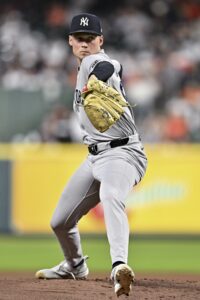
If you weren’t familiar with Cam Schlittler before this season, I’m sure you are now. The 25-year-old owns an AL-leading 1.35 ERA across nine starts. The Yankees are 7-2 in his outings, and opposing batters are hitting .176 against the righty and his devastating three-fastball mix. With Tarik Skubal on the shelf, Schlittler has emerged as an early frontrunner to start for the AL All-Stars this summer in Philadelphia. Some might tell you he’s the Cy Young favorite, too. But Schlittler isn’t the only reason the Yankees’ starting staff has exceeded expectations in 2026.
Will Warren, 27 next month, has a 3.42 ERA through nine starts of his own. With 59 strikeouts, he’s tied with Schlittler for fourth-most in the American League. His 5-1 record also matches Schlittler’s, as does New York’s 7-2 record in his starts. Under the hood, the numbers are just as impressive. Warren ranks among the AL’s top 10 qualified arms in xERA and FIP, while his xFIP and SIERA put him into the league’s top five. The only AL pitchers ahead of him in all four metrics are Schlittler, Dylan Cease, and Jacob deGrom.
One thing all of those “ERA estimators” appreciate is the significance of strikeouts, walks, and their relationship to one another. Warren’s strikeout rate is up from 24.1% in 2025, his first full season, to 29.8% in 2026. His walk rate has dropped by nearly one third, from 9.1% to 6.1%. Accordingly, his 23.7% K-BB% (strikeout rate minus walk rate) is more than 10 percentage points higher than the league average for a starting pitcher. K-BB% is a stat that stabilizes relatively quickly. It’s also one of the strongest predictors of future run prevention. Warren still needs to prove he can pitch this well over a full season, but his much-improved K-BB% is a powerful indicator that his early success is more than smoke and mirrors. Schlittler is turning heads with a 24.8% K-BB% after 202 batters faced. As far as strikeouts and walks are concerned, Warren has been almost equally excellent in a similar-sized sample.
It isn’t hard to see that Warren has been pitching better than he was last year. It’s a little harder to understand how and why. His strikeouts are up and his walks are down, but he isn’t throwing substantially more pitches in the strike zone or generating more swings. His swing-and-miss rate is middle of the pack, while his chase rate is well below league average. Even more curiously, his strikeout and whiff rates are down on his sweeper, which was widely considered his bread and butter in his prospect days. When Warren put up a 4.44 ERA in 33 starts last season, many were quick to note that he did so despite opponents hitting .336 with a .569 slug against his supposed “best pitch.” Instead of being a weapon, it was the least effective sweeper in the game, with a run value of -10, per Baseball Savant. So, it would have made perfect sense to presume that Warren needed to harness his sweeper if he was going to take the next step.
It would have made perfect sense, and yet… the explanation for his success isn’t that simple. Warren throws his four-seam fastball, sinker, and sweeper each about one third of the time against right-handed batters. When he doesn’t have the platoon advantage, he also mixes in a changeup and a curveball to keep lefty batters on their toes. All five of those offerings have above-average (or better) raw stuff this year, according to models like Stuff+ and PitchingBot at FanGraphs.
However, most of his pitches had good stuff last year too. What Warren has really improved in 2026, according to those models, is his command, specifically on his four-seam, sweeper, and changeup. Indeed, a glance at his heat maps will confirm that he’s been hitting his spots with those pitches more frequently. He isn’t letting his four-seam fastball drift to the sides, he’s wasting fewer sweepers, and he’s punishing opposite-handed hitters with his changeup low and away. The righty might not be throwing more pitches in the zone, but he’s throwing pitches where he needs to throw them to earn more strikes.
Just as consequential as where Warren is throwing his pitches is when and where he’s throwing them in relation to one another. In other words, all five of his pitches work in tandem. His changeup works because it plays off his sinker. His sinker works because he pairs it with his four-seam. They all work because his sweeper gives him such a different look. His arsenal is more than the sum of its parts.
To that point, Stuff+ and PitchingBot give Warren strong scores for the stuff and location of each of his individual pitches, but his overall scores – scores that take into account physical pitch characteristics, pitch locations, and situational usage for his entire arsenal – are nothing short of elite. His 118 Pitching+ (a sister metric to Stuff+) ranks third among qualified arms across MLB, trailing only stuff god deGrom and stuff prodigy Jacob Misiorowski. Warren’s overall PitchingBot score is even better, leading all 79 qualified pitchers in the major leagues. It may be just one metric, but it’s a metric that puts him ahead of names like deGrom, Skubal, Skenes… and Schlittler. Pitching+ and PitchingBot aren’t stats you hear about every day, but they’re powerful tools for predicting rest-of-season runs allowed in smaller samples. When all is said and done, what matters is preventing runs and winning ballgames. The pitch models tell us that Warren has the skills to do exactly that.
Gerrit Cole has been out all season. Carlos Rodón only just returned. If Clarke Schmidt pitches at all this year, it won’t be until the latter half of the schedule. Luis Gil is hurt too, and even before he landed on the Triple-A injured list, he was pitching like something was wrong. Those four pitchers made up the Yankees’ rotation as recently as the 2024 World Series. Yet, even without meaningful contributions from any of them, New York’s starters lead the Junior Circuit in wins, xERA, and FanGraphs WAR. Their 3.14 ERA ranks second, and their 16.5% K-BB% ranks third. Not all of that is Warren’s doing – he’s had plenty of help from Schlittler, Max Fried, and Ryan Weathers – but it would be hard to overstate how much he has meant to his team so far in 2026. Cole, Fried, Rodón, and now Schlittler are much bigger names, but Warren is looking like another future ace for New York.
Photos courtesy of Maria Lysaker, Imagn Images.
Rockies Place Chase Dollander On IL With Elbow Sprain
The Rockies announced a series of roster moves today. Most notably, right-hander Chase Dollander has been placed on the 15-day injured list due to a right elbow sprain. (The Rockies initially said it was a strain but later issued a correction.) Left-hander Sammy Peralta has been recalled to take his spot on the roster. The Rockies also placed infielder/outfielder Tyler Freeman on the paternity list. Outfielder Sterlin Thompson has been recalled for Freeman and will be making his major league debut as soon as he gets into a game.
To this point, not a lot of details have been made public regarding Dollander, but the signs are a bit ominous. Dollander departed yesterday’s start in the second inning, with the team providing a vague diagnosis of arm tightness. Quickly placing him on the IL might not necessarily be any kind of flag, since it makes sense that they would be cautious with their prized young righty. But a sprain, by definition, means there is some degree of tearing or stretching involving a ligament.
Perhaps the team will have more information on his status later. At the very least, they will be proceeding without Dollander in the rotation for the next couple of weeks. Dollander has technically been working as a reliever for the most part this year, but his relief outings have seen him pitch multiple innings behind an opener, effectively a starter’s workload. Four spots in the rotation are taken by Kyle Freeland, Michael Lorenzen, Jose Quintana and Tomoyuki Sugano. They don’t have an off-day until May 28th, so some kind of solution will be needed for the fifth spot.
Tanner Gordon has been pitching three- and four-inning stints out of the bullpen, including four frames following Dollander yesterday, so he is perhaps the simplest guy to slot in. Ryan Feltner is currently on the IL and doesn’t appear close to a return, though he could be a factor down the line. In Triple-A, the Rockies have Gabriel Hughes, Carson Palmquist, Valente Bellozo and Blas Castaño, who are all on the 40-man roster, so one of them could be recalled.
Thompson, 25 next month, was drafted 31st overall in 2022. He has since been climbing the minor league ladder. The Rockies added him to their 40-man roster in November of last year, to keep him out of the Rule 5 draft.
He has a tremendous .344/.491/.496 line in Triple-A this year. That’s surely a bit misleading since he’s been playing in the hitter-friendly Pacific Coast League and also has an unsustainable .419 batting average on balls in play. Still, his 18.6% walk rate is massive and higher than his 17.4% strikeout rate. However, the offensive part of his game has never really been the concern. Some evaluators think he’ll be a below average defender, even in an outfield corner. That means he’ll really have to hit to provide value.
It’s possible this will just be a brief call for Thompson. Stints on the paternity list last for one to three days, so Freeman should be back relatively quickly. The Rockies have Mickey Moniak, Jake McCarthy, Brenton Doyle and Jordan Beck getting playing time in their outfield at the moment. If Thompson doesn’t have a path to regular at-bats, it makes sense for him to go back down when Freeman returns, but he can get a taste of big league life now.
Photo courtesy of Ron Chenoy, Imagn Images