
Cardinals Reportedly Declined Offer Of Marcus Stroman For Nolan Arenado
Earlier this offseason, the Cardinals declined an offer from the Yankees that could’ve sent Marcus Stroman to St. Louis for Nolan Arenado, according to a report from Mark Feinsand, John Denton and Bryan Hoch of MLB.com. It’s unknown whether Arenado would have approved that trade. MLB.com reports that the Cardinals never brought it to the star third baseman because they were uninterested in acquiring Stroman.
That’s not to say that talks between the clubs on Arenado are finished. The Yankees still have needs at both corner infield positions. Feinsand, Denton and Hoch report that they’re showing increased interest in Paul Goldschmidt at first base. They write that signing Goldschmidt might make Arenado more likely to waive his no-trade clause to join his former teammate as a corner infield tandem in the Bronx.
Various reports have tied the Yankees to Goldschmidt throughout this week. It seems they’ll turn to one of the short-term free agent options to upgrade first base. Ken Rosenthal of the Athletic reported on Thursday that the Yankees were increasingly likely to pursue a more affordable first baseman than to spend at the top of the market for Pete Alonso or Christian Walker. Walker, whom the Yankees had reportedly preferred to Alonso, has subsequently come off the board on a $60MM deal to Houston.
Interestingly, Goldschmidt’s asking price could itself prove a sticking point. Most predictions, MLBTR’s included, assumed he’d sign a one-year deal as he enters his age-37 season. Feinsand, Denton and Hoch report that Goldschmidt is seeking multiple years. That doesn’t guarantee he’ll find a two-year deal, of course, which would be a lofty ask coming off a middling season.
Goldschmidt hit .245/.302/.414 with 22 homers during his final year in St. Louis. He posted career-worst strikeout and walk rates with overall offense that measured exactly league average. Goldschmidt had a better second half after a dismal start to the season, but the overall numbers are worrisome given his age. MLBTR felt he’d secure $15MM on a one-year deal.
Money is also a complicating factor on Arenado. Even if the Yankees signed Goldschmidt and Arenado were willing to play there, they’d still need to find an agreeable return with St. Louis. The Cardinals owe the eight-time All-Star $64MM over the next three seasons, while the Rockies are on the hook for another $10MM between 2025-26. (Colorado’s obligations would carry over in the event of a trade.) $12MM of the Cardinals’ $64MM is deferred. MLB.com writes that the net present value of what St. Louis owes is around $60MM.
The Cardinals are trying to shed at least the vast majority of that deal. Katie Woo and Chandler Rome of The Athletic reported that the Astros would’ve absorbed around $45MM had Arenado not vetoed the proposed trade to Houston earlier this week. ESPN’s Jeff Passan reported differently, writing that Houston would have taken $59MM. In either case, the Cardinals would have shed most of the money.
Derrick Goold of the St. Louis Post-Dispatch wrote this afternoon that the extent of the Yankees’ interest in Arenado depends on how much of the deal the Cardinals would cover. While it’s not known how much the Yankees want St. Louis to eat, their proposal of Stroman would’ve been a financial counterbalance. The righty will make $18MM next season and would trigger a matching player option for 2026 if he throws 140 innings. An Arenado/Stroman swap would’ve gotten the Cardinals off the hook for the former’s salaries in 2026-27, but it would not have represented a significant cut next season.
Arenado has a $32MM salary next year, $5MM of which is Colorado’s responsibility. Another $6MM is deferred, so the immediate savings for St. Louis would only have been $3MM. The Cardinals could have tried to flip Stroman themselves. The righty is coming off a 4.31 ERA over 154 2/3 innings. His salary is above market but not egregiously so, but it doesn’t seem the Cardinals had any interest in that sequence of moves.
A player’s competitive balance tax number resets if they’re traded. Assuming the NPV on Arenado’s contract is around three years and $60MM, he’d carry an approximate $20MM luxury tax hit for an acquiring team if the Cardinals did not eat any money. RosterResource calculates New York’s luxury tax number around $287MM. Signing Goldschmidt or taking most of Arenado’s contract would push them beyond the $301MM final tax tier. Doing both would vault them well beyond $301MM, which comes with a 110% tax on every dollar spent from that point.
Yankees, Reds Swap Jose Trevino For Fernando Cruz
The Yankees and Reds finalized a trade on Friday night that sends catcher Jose Trevino to Cincinnati for reliever Fernando Cruz and non-roster catcher Alex Jackson.
Trevino is on the move for the second time in his career. The Yankees landed him from the Rangers shortly after Opening Day 2022 in a deal that sent reliever Albert Abreu to Arlington. That was a win for the New York front office, as Trevino developed into a quality defensive catcher in the Bronx. Abreu, on the other hand, pitched seven times with the Rangers before they lost him on waivers.
The 2022 season has been Trevino’s best. He appeared in a career-high 115 games, hitting .248/.283/.388 through 353 plate appearances. Trevino led all catchers with 21 Defensive Runs Saved that season, earning an All-Star selection and a Gold Glove.
Trevino has opened each of the past two years as New York’s primary catcher. His playing time and offensive production have dropped, though he continues to grade very highly for his receiving skills. Trevino has only appeared in 129 games over the past two years. In 2023, that was largely the result of a ligament tear in his right wrist that necessitated season-ending surgery in July.
The 32-year-old stayed mostly heathy this past season. He missed a month between the All-Star Break and the middle of August because of a quad strain. Trevino was otherwise on the active roster but fell into a depth role. Rookie of the Year finalist Austin Wells is a superior offensive player who grades as an elite receiving catcher in his own right.
Trevino was limited to 62 starts behind the plate overall. He’d basically become a non-factor by the end of the year, as he appeared in just 14 games between his return from the injured list on August 15 and the end of the regular season. He only got two starts during the Yankees’ run to the World Series. He took 234 trips to the plate and hit .215/.288/.354 with eight home runs.
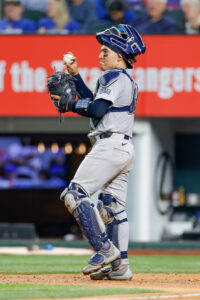
Part of the dip in playing time has been attributable to Trevino’s difficulty controlling the running game. According to Statcast, only Yasmani Grandal had a higher average pop time (throw time to second base on stolen base attempts) than Trevino’s 2.07 second mark. Opponents swiped 57 bases out of 70 attempts in his 544 1/3 innings. Trevino continues to grade exceptionally highly for his framing skills and blocking ability, so he remains a valuable defender, but the subpar arm strength has become an issue.
The Reds evidently placed a lot of value on those receiving skills. Trevino should back up Tyler Stephenson, who hit .258/.338/.444 with a career-high 19 homers this past season. Stephenson started 112 games and tallied a little more than 1000 innings. He didn’t play any first base in ’24 but has played there sporadically in prior seasons. Cincinnati could give Stephenson a few more modified rest days at first base or designated hitter if they’re comfortable with Trevino logging 70+ starts behind the dish.
Trevino has over five years of service time. MLTBR contributor Matt Swartz projects him for a $3.4MM salary during his last trip through the arbitration process. Taking that on pushes the team’s projected payroll to $104MM (courtesy of RosterResource). The Reds ended the ’23 campaign with a payroll around $100MM and have indicated they’re comfortable matching or exceeding that number.
Stephenson had been the only catcher on Cincinnati’s 40-man roster. They obviously needed to acquire a veteran backup, but it’s still surprising to see the Reds relinquish Cruz for one year of Trevino’s services. Cruz has been a fixture in Cincinnati’s bullpen for the last two years. He has scattershot command but elite bat-missing ability.
Cruz, a native of Puerto Rico, was drafted as an infielder back in 2007. He flamed out as a hitter and was out of affiliated ball entirely between 2016-21. Cruz converted to pitching in 2012 and continued to plug away, however, eventually catching the attention of Reds’ scouts in the independent ranks. He dominated Triple-A opponents in 2022 and earned his first major league call as a 32-year-old that September.
Typically, players who don’t reach the majors until they’re in their 30s are quickly dropped from the roster. Cruz pitched well in his late-season cameo, however, and the Reds kept him on their 40-man. He has topped 65 innings in each of the past two seasons, building from middle relief in 2023 to become one of David Bell’s more frequent leverage options in front of closer Alexis Díaz.
The bottom line results have not been great. Cruz has allowed nearly five earned runs per nine in both seasons. He owns a 4.52 ERA across 147 1/3 career innings. ERA estimators like FIP and SIERA find him significantly more interesting than the actual run prevention would suggest — a testament to his gaudy swing-and-miss numbers.
Cruz has fanned over 35% of opponents in each of the last two seasons. He carries a cumulative 36.5% strikeout rate over that stretch. Among pitchers with 100+ innings, only Josh Hader and Aroldis Chapman have posted a better mark. Spencer Strider, Kirby Yates, Garrett Crochet, Jeff Hoffman, Bryan Abreu, Paul Skenes and Tyler Glasnow round out the top 10. Cruz is similarly dominant on a per-pitch basis. His 16.7% swinging strike rate ranks fifth among that group — trailing Strider, Hader, Andrés Muñoz and Ryan Helsley.
Pitching isn’t solely about strikeouts, of course, but most pitchers who miss bats at those rates are impact arms. Cruz holds himself back to some extent by issuing too many free passes. He walked 12.2% of batters faced this year and has given out free passes to 11.4% of opponents in his career. That’s a concern, but it’s easy to see why the Yankees identified him as an upside play.
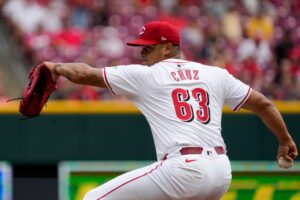
Cruz’s calling card is a low-80s splitter, which is one of the most effective pitches in the sport. Cruz used the offering a little more than 40% of the time this year. Opponents only made contact around 40% of the time they swung at it. Batters hit .116 against it. Cruz used it as the finishing pitch for 88 of his 109 strikeouts.
Exceptional as the splitter was, opponents teed off on his other two offerings — a 94 MPH four-seam fastball and a cutter that sits in the high 80s. Cruz has preferred to mix all three pitches rather than fully unleashing the splitter. Whether that’s because of his own comfort or the preference of Cincinnati’s coaching staff isn’t clear, though it wouldn’t be a surprise if the Yankees pushed him to lean more frequently on that pitch. New York allowed Tommy Kahnle to abandon his fastball and throw essentially all changeups for his entire playoff run, for instance.
Cruz has just over two years of big league service. He’s under club control for four seasons. The extended control window isn’t a huge factor for a pitcher who’ll turn 35 in March. It’s a boost in the short term, though, as the Yankees can plug him into the bullpen for around the league minimum salary in 2025.
Jackson, who turns 29 on Christmas, rounds out the return to backfill the catching depth. He signed a minor league contract with Cincinnati last month and will not occupy a 40-man roster spot. Jackson appeared in a career-high 58 games for the Rays last season, hitting .122 over 159 plate appearances. He’s a career .132/.224/.232 hitter over parts of five campaigns. Jackson should get a Spring Training invite, where he can compete with 29-year-old J.C. Escarra — who is on the 40-man roster but hasn’t appeared in the majors — for the backup job behind Wells.
Jon Heyman of the New York Post first reported that Trevino was being traded to Cincinnati. The Post’s Joel Sherman was first with the entire trade. Images courtesy of Imagn.
Nine Teams Exceeded Luxury Tax Threshold In 2024
Major League Baseball finalized its luxury tax calculations for 2024. ESPN’s Jesse Rogers was first to report the list of payors, while Ronald Blum of the Associated Press reports the details. A record nine teams surpassed the $237MM competitive balance tax threshold. In a separate post, The Associated Press lists the finalized CBT numbers for all 30 teams.
The payments are as follows:
- Dodgers: $103MM
- Mets: $97.1MM
- Yankees: $62.5MM
- Phillies: $14.4MM
- Braves: $14MM
- Rangers: $10.8MM
- Astros: $6.5MM
- Giants: $2.4MM
- Cubs: $570K
Teams pay escalating penalties for exceeding the threshold in consecutive seasons. The Dodgers, Mets, Yankees, and Phillies have all paid the tax in at least three straight years — subjecting them to the highest escalator fees. Texas and Atlanta are second-time payors. Houston, San Francisco, and the Cubs did not exceed the threshold in 2023 and are marked as first-time payors.
The Dodgers ($353MM), Mets ($348MM), and Yankees ($316MM) all had CBT numbers above $277MM, which marked the third tax bracket. All three teams will see their first-round pick in the 2025 draft dropped by 10 spots. Considering they each advanced at least as far as the LCS and the Dodgers won the World Series, those clubs won’t have any regrets about that penalty. Atlanta narrowly stayed below the $277MM threshold to avoid any impact on their draft.
Teams that paid the CBT are entitled to the lowest level of compensation for losing free agents who declined a qualifying offer. They receive a draft choice after the fourth round for each qualified free agent who walks. They’re charged the heaviest penalty — their second- and fifth-highest picks in 2025 and $1MM from their ’26 international bonus pool — for signing a qualified free agent from another team.
The Mets (Juan Soto), Yankees (Max Fried), Giants (Willy Adames), and Astros (Christian Walker) have already signed or agreed to terms with qualified free agents. The Mets (Luis Severino), Yankees (Soto), and Braves (Fried) have lost qualified free agents. Houston is likely to see Alex Bregman walk. The Mets (Pete Alonso, Sean Manaea) and Dodgers (Teoscar Hernández) still have unsigned qualified free agents of their own.
The top eight luxury payors were all clearly above the base threshold, while the three biggest spenders blew beyond every surcharge marker. The only source of CBT intrigue late in the season concerned the Cubs and Blue Jays, both of whom were hovering right around the tax line.
When it became clear that neither team would make the playoffs, they each attempted to dip below $237MM by shedding money via waivers. The Cubs were unsuccessful and landed around $239.9MM; Toronto dropped just below $234MM. The tax impact for the Cubs is negligible — a $570K bill is less than the cost of one player on a league minimum salary — but it places a higher penalty for signing qualified free agents and could incentivize them to stay under the threshold in 2025 to reset their status. Six of the nine payors made the postseason. Texas, San Francisco, and Chicago were the exceptions.
Last year, a then-record eight teams surpassed the CBT threshold. The Padres are the only team that was above the line in 2023 and got below it this year. San Diego finished with an approximate $228MM mark that ranked 11th in the majors — behind the nine payors and the Blue Jays. The Red Sox, Diamondbacks, Cardinals, and Angels were the other teams above the median in payroll. On the other side of the equation, the five bottom spenders were as follows: Athletics ($84MM), Rays ($107MM), Tigers ($110MM), Marlins ($122MM), and Pirates ($123MM).
The teams that exceeded the threshold have until January 21 to pay MLB. The first $3.5MM will be used to fund player benefits. Half the remaining money goes to players’ retirement accounts, while the other half is used for revenue sharing distribution from MLB to teams. Next year’s base threshold climbs to $241MM.
Dodgers, Julian Fernandez Agree To Minor League Deal
The Dodgers are in agreement with righty reliever Julian Fernández on a minor league contract, reports Fabian Ardaya of the Athletic. The 29-year-old receives an invitation to MLB Spring Training.
Fernández is working to return to the majors for the first time since 2021. He made six appearances for the Rockies that year, allowing eight runs across 6 2/3 innings. That remains his only big league experience. Colorado outrighted him off the 40-man roster in June 2022. Fernéandez spent time in Triple-A with the Blue Jays the following year.
The Dominican Republic native was out of affiliated ball in 2024. Fernández spent the year in Mexico. He had an excellent season with Veracruz, turning in a 1.82 earned run average through 34 2/3 frames. He struck out 32.1% of opposing hitters. Fernández has given up eight runs across 11 2/3 innings in the Dominican Winter League, but Dodger evaluators evidently remain intrigued by his stuff.
During his brief big league stint, Fernández flashed huge velocity. He averaged 99 MPH with his four-seam fastball. That hasn’t actually translated to many whiffs in the affiliated ranks. He has an average 24% strikeout rate and has walked nearly 11% of batters faced over parts of four Triple-A campaigns. Fernández has a 6.05 ERA in 80 1/3 innings at that level.
Rangers Sign Hoby Milner
The Rangers announced the signing of lefty reliever Hoby Milner to a one-year contract. Texas designated former top prospect Owen White for assignment to open a spot on the 40-man roster. Milner, a client of MVP Sports Group, is reportedly guaranteed $2.5MM. He can earn another $500K in incentives — $100K each for reaching 35 and 45 appearances, followed by $150K bonuses at 55 and 65 games.
Milner is a Dallas native who attended the University of Texas. The former Longhorn began his career with the Phillies, who selected him in the seventh round of the 2012 draft. Milner had brief MLB stints with the Phillies, Rays and Angels before finding his way to Milwaukee on a minor league contract after the 2020 season.
The low-slot southpaw had a solid four years with the Brew Crew. He posted interesting strikeout and walk numbers in 2021, so the Brewers retained him despite a 5.40 earned run average. That was a wise call, as Milner was a key piece of Craig Counsell’s bullpen between 2022-23. He combined for a 2.79 ERA across 129 innings over that stretch. Only 30 relievers around the league logged a heavier workload. Milner fanned a solid 23.5% of opponents while limiting his walks to a 5.3% rate. His arm angle flummoxed left-handed hitters, who managed a .199/.259/.284 line across 223 plate appearances.
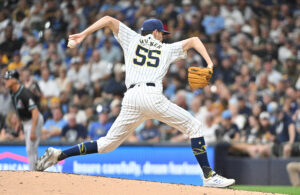
Milner’s results regressed in 2024. He was tagged for a 4.73 ERA while lefties had a markedly improved .286/.290/.467 slash over 109 trips to the plate. Yet Milner ran an impressive 27:1 strikeout-to-walk ratio while he held the platoon advantage.
His peripherals more broadly remained strong. He punched out nearly 24% of batters faced and kept the ball on the ground more than half the time that opponents made contact. He tied his career high with 64 2/3 innings. The ERA jump was a result of a huge spike in opposing hitters’ average on balls in play, as well as a significant drop in the number of runners Milner left on base.
The Brewers nevertheless decided to move on instead of tendering him an arbitration contract at a projected $2.7MM salary. That worked out reasonably well for Milner, who finds a guaranteed contract at nearly the same rate with his hometown team for his age-34 season. It’s the second bullpen pickup for the Rangers in as many weeks. They added Jacob Webb, who had somewhat surprisingly been non-tendered by the Orioles, on a $1.25MM pact. GM Chris Young and his staff need to add multiple arms to a ‘pen that could lose each of Kirby Yates, David Robertson, José Leclerc and José Ureña to free agency. They’ll start with a pair of affordable veterans who can work in the middle innings.
Mark Feinsand of MLB.com was first to report Milner was signing with Texas on a one-year deal. Evan Grant of the Dallas Morning News reported the $2.5MM guarantee. The Associated Press reported the incentive structure.
Image courtesy of Imagn.
Phillies Sign Max Kepler
The Phillies announced Friday that they’ve signed outfielder Max Kepler to a one-year deal. It’s a reported $10MM deal for the VC Sports Group client. Philadelphia already had an opening on the 40-man roster.
Kepler changes uniforms for the first time in his career. The German-born outfielder had spent a decade and a half with the Minnesota organization. He signed with the Twins as a teenager and reached the big leagues late in the 2015 season. Kepler appeared in parts of 10 big league campaigns with Minnesota, stretching beyond the six-year control window after signing a $35MM extension in February 2019.
For most of that run, Kepler was an above-average right fielder. He looked as if he might on the cusp of stardom after a 36-homer showing in 2019, but that proved to be an outlier in a season that was played with the juiced ball. Outside of that year, Kepler has typically been a 15-20 homer threat with decent on-base skills.
Kepler, 32 in February, is coming off his least productive season. He battled injuries in both knees and only appeared in 105 games. Kepler was limited to a career-low eight home runs while posting a middling .253/.302/.380 line across 399 plate appearances. The free passes plummeted alongside the power. Kepler walked at a career-low 5.5% clip, posting his lowest on-base percentage in the process.
The Phillies are hoping that a healthy offseason could allow him to return to his prior form. Kepler had one of his best years as recently as 2023. He hit .260/.332/.484 with 24 longballs (the second most of his career) across 491 plate appearances that season. Kepler set personal highs in average exit velocity (91.9 MPH) and hard contact percentage (47.6%). His hard contact rate dropped by 11 points this year, suggesting that he was playing at less than full strength.

Much of Kepler’s diminished production came late in the season. He carried a league average .256/.309/.394 slash line into the All-Star Break. That dropped to .246/.287/.352 in the second half. The Twins resisted putting him on the IL for a while as they tried to hang onto a Wild Card berth, but his numbers tanked so far in August that he had to land on the shelf. Minnesota’s September collapse meant that he was unable to return for a possible postseason push.
While it ended on a down note, Kepler had a productive run in the Twin Cities. He appeared in more than 1000 games, hitting .237/.318/.429 with 161 homers and just over 500 runs batted in. There wasn’t much doubt that Minnesota would go in another direction this offseason, though. Ownership isn’t giving the front office much financial leeway, so an eight-figure contract to retain Kepler after an injury-plagued season was never in the cards.
At his peak, Kepler was one of the sport’s best defensive right fielders. If not for sharing the Target Field outfield with Byron Buxton, he probably would’ve gotten more consistent run in center field early in his career. Kepler’s defensive grades are still solid but not as strong as they’d been in his 20s. Defensive Runs Saved graded him as a league average right fielder in a little over 800 innings this past season. Statcast credited him with two runs above average.
Better health could help him rebound on defense as well. Kepler fell below league average in Statcast’s sprint speed measurement for the first time. That’s not a surprise considering he was playing through knee pain. On both sides of the ball, the Phillies are hoping that this year was a health-related blip rather than the sign of a sharp decline in his early 30s.
Kepler figures to play mostly left field at Citizens Bank Park. That’s a position he’s never played in the majors, though most right fielders can kick over to the opposite corner without much issue. Kepler hasn’t started a game in center field since 2021, so he’s probably no more than an emergency option there. Johan Rojas and Brandon Marsh are each likelier to handle center field work.
While there shouldn’t be much issue about the positional transition, Kepler’s handedness makes him something of an odd fit. The Phils had sought to find a rotational outfielder who could cut into the playing time for Rojas and/or Marsh. A right-handed hitter would have been the most straightforward solution, allowing the Phils to shield Marsh from lefty pitching. Philadelphia hoped Austin Hays would address that as a deadline pickup, but he spent most of his tenure on the injured list and was non-tendered last month.
Kepler doesn’t fit that need. Like most left-handed hitters, he’s much better against righties. Kepler has a career .243/.326/.452 line versus right-handers. He’s a .221/.292/.363 hitter in more than 1000 plate appearances against southpaws. If the Phils are going to platoon Marsh, he’d probably pair with the righty-hitting Rojas in center field. That’d put the onus on Kepler to stay healthy enough to play regularly in left field.
Marsh could always move back to left if Kepler lands on the IL, yet that’d leave the Phillies with the same middling outfield upon which they’re trying to upgrade. They’d certainly love to offload the remaining two years and $40MM on the Nick Castellanos deal, which would enable them to put Kepler in right field and add another outfield bat. Shedding a notable chunk of the Castellanos money is much easier said than done after he hit .254/.311/.431 this year.
It seems the Phils preferred the price point on Kepler over the asking price for the top righty-hitting outfielders available. Matt Gelb of the Athletic reports that Philadelphia had shown interest in Teoscar Hernández but apparently balked at the ask. MLB.com’s Mark Feinsand reported earlier this week that Hernández was looking for a three-year deal exceeding $60MM.
Signing Kepler pushes the Phils’ salary commitments to roughly $280MM, according to the RosterResource calculations. They’re up to $299MM in competitive balance tax obligations. The Phils went into the offseason with their CBT number already into the third tier of penalization. They’ve paid the tax in three consecutive seasons, so they’re subject to the highest set of escalator surcharges. Their spending between $281MM and $301MM is taxed at a 95% clip, meaning they’re on the hook for $9.5MM in taxes on Kepler. This represents a near-$20MM overall commitment on ownership’s part.
Once they go beyond the $301MM mark, they’ll be taxed at the maximum 110% rate on further spending. The Phillies were a virtual lock to exceed the third tier regardless of whether they signed Kepler. That’ll drop their top draft choice in 2026 by ten spots (unless they miss the playoffs and draw into the top six in the lottery). Signing Kepler and Jordan Romano to one-year deals addresses two of their biggest questions on relatively affordable terms.
Todd Zolecki and Mark Feinsand of MLB.com first reported Kepler and the Phillies were progressing on a one-year contract. ESPN’s Jeff Passan confirmed the agreement and reported the $10MM salary. Image courtesy of Imagn.
Mets Meet With Roki Sasaki
December 20: The Cubs are going to be meeting with Sasaki today, reports Bruce Levine of 670 The Score.
December 19: The Mets had a meeting with Roki Sasaki on Thursday, reports Andy Martino of SNY. They’re the second team that has been publicly revealed to meet with the NPB star. Yankees general manager Brian Cashman told reporters (including MLB.com’s Bryan Hoch) on Wednesday that Sasaki had scheduled an in-person meeting with the club. It’s not clear when that will take place.
Virtually every team would love to land Sasaki. It stands to reason that most, if not all, clubs have at least prepared a pitch they can make to the 23-year-old righty. Sasaki and his representatives at Wasserman presumably don’t intend to meet with every team over the next few weeks, though.
Agent Joel Wolfe spoke with media (including MLBTR’s Tim Dierkes and Steve Adams) at the Winter Meetings. Wolfe indicated that Sasaki would speak with teams in person at a central location in the United States throughout this week. He’s slated to return to Japan for the holidays but could come back to the U.S. to view the cities of the finalists thereafter.
This is only the first run of presentations. Many people consider the Dodgers or (to a lesser extent) the Padres to be the favorites, though Wolfe vehemently denied last month that there was any kind of handshake agreement with Los Angeles already in place. Wolfe suggested at the Winter Meetings that Sasaki could benefit from landing in a city that doesn’t have a large media contingent, though he stressed that was solely his opinion and that he and Sasaki had yet to discuss that in great detail.
Sasaki’s posting window opened on December 9. He must sign with an MLB team by January 23 but cannot sign until after next year’s international amateur period opens on January 15. He could reach an unofficial verbal agreement before that point, however. Sasaki’s bonus will be hard capped by MLB’s amateur signing limitations.
Teams can acquire up to 60% of their bonus allotment via trade. Those trades cannot begin until the 15th. Sasaki’s maximum potential bonus would be $12.0888MM. He’ll likely sign for a fair bit less than that, since it’d require a team with the highest initial pool (one of Milwaukee, Seattle, Tampa Bay, Minnesota, Miami, Cincinnati, Detroit, or the Athletics) to trade for the maximum amount and commit their entire pool to Sasaki. The Yankees and Mets each have just under $6.2616MM in their starting pool. If they traded for 60% more space, they’d be able to offer just over $10MM.
Front Office Subscriber Chat Transcript
MLBTR’s Anthony Franco held a live chat today, exclusively for Front Office subscribers!

Unlock Subscriber-Exclusive Articles Like This One With a Trade Rumors Front Office Subscription
- Access weekly subscriber-only articles by Tim Dierkes, Steve Adams, and Anthony Franco.
- Join exclusive weekly live chats with Anthony.
- Remove ads and support our writers.
- Access GM-caliber tools like our MLB Contract Tracker
Blue Jays Receiving Trade Interest In Bo Bichette
The Blue Jays are taking trade calls on Bo Bichette, writes Ken Rosenthal of the Athletic. While Rosenthal cautions that Toronto is not actively shopping their shortstop, he reports that the Jays are willing to deal Bichette if another club meets a lofty asking price.
That’s a change from last month. At the GM Meetings in early November, general manager Ross Atkins told Jon Morosi of the MLB Network that any trade calls regarding Bichette would be “an easy no.” When a GM publicly shoots down trade rumors regarding a player to that extent, they rarely reverse course.
The biggest exception in recent years came when Juan Soto was a National. Washington GM Mike Rizzo said in June 2022 that the team was “not trading” the outfielder. Two months later, Soto was a Padre. Circumstances changed in the interim, as Soto rejected a $440MM extension offer a couple weeks before the deadline. (That decision proved wise considering the amount of money he landed in free agency two and a half years later.)
Toronto’s circumstances have also changed since Atkins said he wouldn’t consider a Bichette deal. The Jays acquired Andrés Giménez from the Guardians last week, taking on nearly $100MM on his five-year contract to do so. Giménez is the game’s best defensive second baseman. He has won the AL Gold Glove award at the keystone three years running. He came up as a shortstop prospect and didn’t fully move off that position until 2023.
Giménez has elite range, sure hands, and above-average arm strength. He could probably handle shortstop and may well remain a plus defender there. That seemed like Toronto’s long-term plan when they acquired him. Giménez would play second base for his first season with the Jays, then kick over to shortstop once Bichette hit free agency next winter.
That still seems the likeliest outcome. However, Rosenthal notes that the Jays could deal Bichette while signing Alex Bregman to pair with Giménez on the left side of the infield. Toronto has come up empty on its pursuit of top-tier free agents thus far. They’re among four to six teams that are reportedly in the mix on Bregman, who is easily the best unsigned position player. To be clear, Rosenthal didn’t characterize a Bichette trade as being conditional on the Jays signing Bregman. He simply floated that as one potential sequence of outcomes.
The Jays have Vladimir Guerrero Jr., Giménez, and Bichette lined up at three infield spots. Third base is less settled. Toronto has a collection of upper level infielders who are either light on MLB experience or project as utility types. Ernie Clement would probably get the bulk of the playing time. Orelvis Martinez, Addison Barger, Will Wagner and Leo Jiménez could also vie for reps.
That’s not a group that’d stop the Jays from adding Bregman. They’d have room on the roster for the star third baseman even if they hold Bichette. Dealing their shortstop would open spending room for the upcoming season while potentially bringing back MLB-ready outfield or pitching talent. Bichette is under contract for $16.5MM in his final year of club control.
At the same time, teams could be reluctant to package significant talent after the worst season of Bichette’s career. He’s coming off a dismal .225/.277/.322 showing over 336 plate appearances. He landed on the injured list three times and only appeared in half the team’s games. A pair of right calf strains were the biggest issue. He also broke his right middle finger late in the year and required minor surgery.
That terrible season came out of nowhere. Bichette has otherwise been one of the league’s best middle infielders since he debuted in 2019. He’d hit above .290 and reached 20 homers in each of his first three full seasons. Bichette went into the ’24 campaign with a career .299/.340/.487 slash line in more than 2300 plate appearances. He garnered down ballot MVP votes each year between 2021-23.
Teams don’t know which version of Bichette they’ll get in 2025. That’s also true of the Jays, who are wary of selling low on a star talent. Toronto has never seemed optimistic about their chance of signing him beyond next season, but they’re going into ’25 with the hope of competing. Trading a potential All-Star shortstop for prospects wouldn’t align with that goal. If they fall out of the race, they could market him at the deadline. The best scenario (short of an extension) would be a rebound year from Bichette that helps to keep Toronto in contention and allows them to make a qualifying offer next winter.
The Jays’ willingness to hear teams out on Bichette — even if an offseason trade remains unlikely — boosts a very thin shortstop market. Willy Adames was the top free agent. He went to the Giants, the team with the clearest combination of positional need and payroll flexibility. Ha-Seong Kim, who is recovering from labrum surgery that’ll force him to begin the season on the injured list, is the only other potential regular on the open market. There aren’t many obvious trade candidates. The Braves stand out as the contender with the biggest question at shortstop. The Tigers, Angels, Mariners, Padres and Pirates could also stand to upgrade at least one middle infield position (though the final three clubs might each balk at the $16.5MM price point).
Where Can The Orioles Turn For A Top-End Starter?
The Orioles made one necessary rotation upgrade this week, signing Tomoyuki Sugano to a $13MM deal on Monday. That should be the first of multiple starting pitching acquisitions. Sugano projects as a back-of-the-rotation arm at this stage of his career. The O's need for an ace persists.
Baltimore addressed that last winter via trade. The O's acquired one year of control over Corbin Burnes for Joey Ortiz and DL Hall in what was GM Mike Elias' boldest trade to date. Burnes pitched as well as the O's could've expected, turning in a 2.92 ERA across 32 regular season starts to earn a fifth-place finish in Cy Young balloting. He fired eight innings of one-run ball in his lone postseason appearance. Unfortunately, the offense cratered down the stretch and scored a grand total of one run in their two playoff games. The Royals swept them by respective 1-0 and 2-1 margins.
Burnes is a free agent, leaving Elias and his staff on the hunt for another top-end arm. Where could they turn?
Unlock Subscriber-Exclusive Articles Like This One With a Trade Rumors Front Office Subscription
- Access weekly subscriber-only articles by Tim Dierkes, Steve Adams, and Anthony Franco.
- Join exclusive weekly live chats with Anthony.
- Remove ads and support our writers.
- Access GM-caliber tools like our MLB Contract Tracker