
Bo Bichette’s Slow Start
Mets infielder Bo Bichette had zero extra-base hits in May entering this week. He popped a home run and a double on Monday against the Nationals, then followed it up with a two-homer game on Tuesday. Bichette came into the series against Washington with just two long balls this season. He’s more than doubled that mark in two games, while also pushing his OPS above .600 for the first time since May 1.
The move to Queens hasn’t gone as planned for Bichette after the Mets inked him to a hefty three-year, $126MM deal. The veteran had the ninth-lowest wRC+ among qualified hitters before Monday’s big night. He’s slashed .224/.277/.332 through 48 games. Those numbers looked eerily similar to Bichette’s 2024 campaign (.225/.277/.322), a year ruined by multiple injuries. The 28-year-old got back on track in 2025, a well-timed rebound ahead of his first crack at free agency. He’s slipped back into concerning habits this year.
Bichette’s approach has never been geared toward power. He makes hard contact, but sprays the ball to all fields and prioritizes line drives over fly balls. Even when Bichette was regularly reaching 20 home runs, he was doing it with a ground ball rate near 50% and a pulled air rate in the low teens. It’s an elite batting average profile, and league-leading hit collection is the main reason Bichette has been worth at least 3.5 wins (per Baseball Reference) in four of the previous five seasons.
The batted ball distribution this season is concerning, even for Bichette. His groundball rate is up to a career-high 51.2%. He’s pulling the ball in the air just 6.9% of the time, nearly half of his career norm (12%). Bichette is hitting line drives on just 23.1% of batted balls, which is below league average. Even in his difficult 2024 season, he hit line drives at a more than 30% clip.
Bichette has also taken a step back in terms of contact quality. He’s posted a 43.8% hard-hit rate, a 5% decline from 2025. He’s barreling the ball at a 5.6% rate, more than 3% below his career average. The only year Bichette has had a barrel rate below league average was 2024, when he stumbled to a 4.5% mark. Bichette still ranks in the 64th percentile for hard-hit rate. He’s in the 80th percentile for xBA at .280. For his profile to work, though, he’ll likely need to be closer to the league leaders in those categories. Bichette was in the 98th percentile with a .298 xBA in 2025. He finished second in the AL batting title race, behind only Aaron Judge.
The expectations of a significant contract, plus joining a new team, can weigh on a player. There’s also the New York factor. But if Bichette is pressing, the plate discipline doesn’t show it. He’s striking out just 16.3% of the time. His chase rate (38.1%) is up a bit from last season, but it’s more or less in line with his career mark of 36.8%. Bichette’s 7.3% swinging-strike rate is a career low. He’s making contact on pitches outside of the zone more than ever, which could explain some of the decline in contact quality. He might be better off swinging and missing a bit more often.
The most surprising aspect of Bichette’s stat line is the defense. The Mets signed him to play third base after he graded out as one of the worst shortstops in the league during his final year in Toronto. Injuries to Francisco Lindor and Ronny Mauricio forced Bichette back to shortstop, and he’s played fine there. He’s been neutral in terms of both Defensive Runs Saved and Outs Above Average at the position. Bichette’s recorded -1 DRS and +1 OAA at third base. Unremarkable numbers with the glove are a huge improvement for Bichette, and likely part of the reason he’s performed at replacement level (-0.1 bRef WAR) despite the poor offensive contributions.
Like most hitters, Bichette has had tough months at the plate, even during strong seasons. He had a .687 OPS in June last year. His groundball rate jumped over 52% during that stretch. Bichette then turned around and hit .357 with 12 doubles and 18 RBI in July. There’s plenty of time for him to get back on track at the plate. And getting passable defense at multiple spots is a big win for the Mets, even if it’s not worth $42MM a year.
Photo courtesy of Rafael Suanes, Imagn Images
Mets Notes: Rotation, Shortstop
The Mets’ rotation — and roster at large — has underwhelmed thus far in 2026. Mets starting pitchers rank 19th in the majors with a 4.24 ERA and are tied for the game’s sixth-highest walk rate at 10%. In particular, struggles from Kodai Senga and David Peterson have set them back. New York turned to Christian Scott for his first big league start since 2024’s Tommy John surgery yesterday against the Twins, but he walked five of the 10 hitters he faced and plunked a sixth before being lifted from the game in the second inning.
Will Sammon and Tim Britton of The Athletic report that at least for now, the plan is for Scott to make another start next week. The Mets have Peterson, Sean Manaea and Tobias Myers all pitching out of the bullpen right now and will work to keep them all stretched out, given the uncertainty in the rotation. If they end up needing a fresh arm — Peterson and Myers both threw 40-plus pitches in long relief yesterday — it’s possible Scott could instead be optioned to Triple-A Syracuse. Any of those more veteran options in the ‘pen could then step in for a start in Scott’s place.
Scott and young ace Nolan McLean are the only two members of the Mets’ rotation who can be optioned. The latter, of course, isn’t going anywhere. In the bullpen, only Myers and Huascar Brazobán can be optioned. The lack of flexibility, coupled with the Mets’ injured and underperforming lineup, prompts Britton and Sammon to wonder whether president of baseball operations David Stearns might eventually explore the trade of a pitcher to help bolster the offense.
Trades of any real significance are rare this early in the season, but there are a handful of notable April or May deals in recent history. The Brewers picked up Quinn Priester from the Red Sox last April, for instance. A year prior, the Marlins shipped Luis Arraez to the Padres in early May. As The Athletic duo points out, when Stearns was running things in Milwaukee, he acquired Willy Adames from the Rays in a May trade.
The Mets aren’t going to get a hitter of any note for Manaea or Senga with their contracts underwater. They could perhaps try to swap either for a hitter with a similarly undesirable contract, but that sort of player isn’t going to help turn the lineup around. The best version of the Mets would have McLean and Freddy Peralta atop the rotation, and the Mets parted with multiple top prospects to get Peralta this winter, so he’s not an early candidate to move. Clay Holmes‘ opt-out opportunity at season’s end tamps down his value.
Speculatively speaking, Peterson feels like the most logical candidate to move in that type of scenario. He’s a free agent at season’s end, earning $8MM, and currently working in the ‘pen. The 30-year-old lefty had a tough run of three starts before being moved into a long relief role, but he started 30 games last year and finished the season with a 4.22 ERA, 20.7% strikeout rate and 9% walk rate in 168 2/3 innings. He’s allowed one run over his past two appearances — a total of seven innings. He’s not going to net a controllable, established hitter, but the Mets could try to swap him out for a veteran bat with similar service time.
There’s no indication at this point that the Mets are actively seeking to ship out a pitcher and/or bring in another bat via trade, to be clear, but it’s worth keeping in mind as the season progresses. That’s especially true with star shortstop Francisco Lindor hitting the injured list due to a calf strain this week.
In place of Lindor, it’ll be just-recalled Ronny Mauricio getting most of the reps at shortstop, writes Anthony DiComo of MLB.com. The Mets could slide Bo Bichette over to shortstop on occasion, but DiComo notes that the club has been pleased with Bichette’s move to third base so far. Bichette has been charged with a pair of throwing errors through his first 210 frames at the hot corner but has generally corralled anything hit in his direction. Metrics like Defensive Runs Saved (0) and Outs Above Average (1) feel he’s been perfectly adequate during his foray into a new position.
Shortstop is a familiar spot on the diamond for Mauricio. The 25-year-old, who ranked as a top-100 prospect for years before injuries (namely a torn ACL) set him back, has logged nearly 3900 professional innings at the position. He’s healthy now and was playing all over the diamond in Syracuse prior to his recall, though he did spend more time (seven games) at shortstop than at any other position. Even if Lindor hadn’t suffered an injury, pressure to recall Mauricio was mounting. He’s bludgeoned Triple-A pitching so far in 2026, raking at a .293/.349/.638 pace (150 wRC+) with six homers and five stolen bases through 63 turns at the plate.
It’s not clear just how long Mauricio’s runway will be. The Mets haven’t given a timetable for Lindor’s return, with manager Carlos Mendoza telling reporters only that Lindor will “be down quite a bit here.” He’s looking at more than a minimum stint, but the Mets haven’t specified whether Lindor is looking at an absence of three to four weeks or something more appropriately measured in months. Regardless, the injury gives Mauricio a rare everyday opportunity with the Mets — something that’s generally eluded him in recent years as he’s sought to establish himself in the majors.
Mets Place Francisco Lindor On Injured List
3:05pm: Mendoza said reporters, including Joel Sherman of The New York Post, Lindor’s strain is worse than Soto’s and he will therefore miss a decent amount of time. Mendoza added that Mauricio will get the majority of shortstop time while Lindor is out.
2:13pm: The Mets announced that shortstop Francisco Lindor has been placed on the 10-day injured list with a left calf strain. Infielder Ronny Mauricio has been recalled in a corresponding move. Francys Romero of BeisbolFR reported on Mauricio’s call-up prior to the official announcement. They also announced their previously-reported recall of Christian Scott, with righty Austin Warren optioned as the corresponding move.
It’s a symbolic gut punch for the Mets. With Juan Soto on the IL for the past few weeks, they endured a 12-game losing streak. Last night, they got Soto back and finally snapped that streak with a win, but they lost Lindor in the process.
Lindor appeared to be in discomfort during the game and was removed after four innings. The team later announced that his departure was due to left calf tightness. Manager Carlos Mendoza later told reporters, including Mike Puma of The New York Post, that Lindor would undergo an MRI. Around the same time, Romero reported on Mauricio’s recall, making it seem likely that Lindor was bound for the IL.
It’s an unsurprising move given the events of last night but it’s unusual in the grander scheme of things, as Lindor has been very rarely hurt in his career. In the nine full seasons from 2016 to 2025, he played in at least 125 games in each. Only once was he below 143 and only twice did he come in under 152. This is his first trip to the IL since 2021.
Due to Lindor’s iron man nature, the Mets have been operating without a proper backup for most of this season. Third baseman Bo Bichette, who was primarily a shortstop prior to this year, has been Lindor’s emergency backstop and covered the spot after Lindor was removed last night. Brett Baty came off the bench to cover third.
Lindor is out to a slow start this year, with a .226/.314/.355 line, but in a small sample of 105 plate appearances. In that sample, his walk and strikeout rates are good but he is being held back by a .264 batting average on balls in play. His much larger career track record shows he’s an above-average hitter, defender and baserunner who is usually good for five to eight wins above replacement annually. It’s possible his somewhat slow start is due to a fractured hamate he suffered in February, which he recovered from in time to crack the Opening Day roster.
It’s unclear if the Mets plan to have Bichette cover short now. He wasn’t a great defender at that spot earlier in his career and he finished last season battling a knee injury. As a free agent in the most recent offseason, it didn’t seem as though many clubs had interest in signing him to play that spot. In the end, the Mets won the bidding and have had him at third. His third base defense appears to be about average so far in a small sample, but he’s off to a rough start at the plate, currently sporting a .220/.255/.290 line for the year.
It’s possible the club could keep him at third most of the time, since he’s still getting acclimated to the position, though that would mean playing Mauricio at short pretty much every day. Mauricio has a strong .293/.349/.638 slash in Triple-A this year but hasn’t hit in the majors yet, currently sitting on a career .234/.294/.359 line.
Playing Bichette at short would open up more line possibilities for the club, as Baty or Mark Vientos could cover third base. Neither of those two are hitting well this year but each has shown better form in the past. It’s also possible the Mets don’t firmly commit to one lane or another, as they could make in-game substitutions depending on the situation, opting for Bichette at short when hoping for more offense and moving him to third when prioritizing defense.
However the playing time gets sliced up, it’s not ideal for the Mets to lose a player of Lindor’s caliber. That’s especially true in light of their rough start. Though they snapped the losing streak last night, they are 8-16 on the year and tied with the Phillies for last in the National League. They just endured Soto’s absence and now will try to climb out of that hole without Lindor.
Photo courtesy of Kamil Krzaczynski, Imagn Images
2026-27 Player Option/Opt-Out Preview: April Edition
At the end of each season, certain players will have to decide whether to stick with their current contracts or become free agents. These contract provisions are sometimes referred to as opt-outs and sometimes as player options. Despite the different terminology, they are effectively the same, with the player being the one making the call.
Naturally, the player’s health and performance leading up to the decision will impact which way the player leans. Which players have that decision looming after the 2026 campaign? MLBTR takes a look, in alphabetical order. Player ages in parentheses are for the 2027 season.
- José Berríos (33): can opt out of remaining two years, $48MM
The Blue Jays and Berríos agreed to a seven-year, $131MM extension back in November of 2021. The Jays had just acquired Berríos from the Twins a few months earlier, when he had a year and a half of club control remaining. A few months later, with that control window down to one year, they locked him up to keep him around. He could opt out of the final two seasons of the deal, giving him a chance to hit the open market after his age-31 season, when another long-term deal would still be theoretically possible.
Back then, Berríos was a front-of-rotation workhorse who could be banked on for 3-5 WAR per year. He hasn’t been getting as many strikeouts lately, making him feel more like a veteran innings-eater type. From 2022 to 2025, he posted a 4.14 ERA with a 20.7% strikeout rate, 6.9% walk rate and 41.7% ground ball rate.
Even that has been undercut by some injury concerns in recent months. He finished 2025 on the injured list due to elbow inflammation and has started this year on the IL as well, again due to elbow inflammation. The issue doesn’t appear to be major and he could be back with the Jays in the near future. He would have to come back healthy and pitch really well in the next few months for this opt-out to even be a consideration.
- Bo Bichette (29): can opt out of remaining two years, $84MM, taking a $5MM buyout
Bichette’s recent trip to the open market was an interesting case. He wasn’t the first notable free agent to settle for a short-term deal, but we do know that he could have taken a more traditional long-term pact. The Phillies reportedly offered him a seven-year deal worth around $200MM. That was pretty close to the eight-year, $208MM deal that MLBTR predicted at the beginning of the offseason.
Instead, Bichette went another way. The Mets offered a much higher average annual value on a short-term deal with opt-outs after each season. Bichette can collect $42MM from the Mets for his age-28 season. If he decides to return to free agency, he can take a $5MM buyout on his way out the door, going into his age-29 season.
He would be walking away from a big salary but another $200MM deal might be out there for him if he has another typical Bichette season. Perhaps he would look to lock that in but we have already seen him opt for the bigger salary once. Maybe he would do so again. On the other hand, it’s theoretically possible he can garner better long-term offers this coming offseason. Last time, he had question marks due to his knee injury and uncertain future position. This time, it’s possible he’ll be healthy and have some proof of concept as a third baseman.
Bichette will need to turn things around to even make this a discussion, as he’s off to a .228/.262/.263 start as a Met, but that’s in a small sample size of 61 plate appearances. He has lots of time to heat up.
- Corbin Burnes (32): can opt out of remaining four years and $140MM ($44MM deferred)
Burnes was a free agent after the 2024 season and few expected him to land in Arizona, but the Diamondbacks signed him to a six-year, $210MM deal, with $64MM deferred. The deal gave Burnes the chance to opt out after two seasons, which would be his age-30 and age-31 seasons.
The deal has not worked out as hoped so far. Burnes did give the club 11 good starts last year, posting a 2.66 ERA, but then required Tommy John surgery in June. He will be on the shelf for at least half of the 2026 season, if not more.
It is theoretically possible for Burnes to beat the remaining money on his deal. Blake Snell was going into his age-32 season in 2025 when the Dodgers gave him a five-year deal worth $182MM. A couple of years prior, Jacob deGrom did better at an even older age. He was going into his age-35 season when he got a five-year, $185MM deal from the Rangers.
For Burnes to make this a conversation, he’ll probably need to come back and shove for at least a few weeks. One or two starts in September won’t do it. It’s also worth considering that Burnes seemingly turned down larger offers from other clubs because he and his family live in Scottsdale. Even if he thinks there’s a chance of slightly more money out there, he might be happy where he is.
- Kyle Freeland (34) – $17MM player option for 2027 if 170 innings pitched in 2026
Freeland and the Rockies signed a five-year, $64.5MM extension back in April of 2022. The deal runs through 2026 but Freeland can unlock a $17MM player option by getting to 170 innings pitched this year. He hasn’t done that in a while, with 2022 being the last time he hit that mark. Even a minor injury that puts Freeland on the IL for a few weeks would quickly take this off the table.
Presumably, the Rockies don’t want him to trigger this. The deal was signed under the previous front office regime. Even at the time, it was a bit of a head-scratcher. Since it has been signed Freeland’s ERA has mostly been hovering around 5.00. That’s not so bad for a pitcher who plays his home games at Coors Field but the Rockies are now rebuilding and don’t seem likely to be in contention next year.
On the other hand, even without a real eye on contention, they have considered it worthwhile to invest in making the rotation more respectable. After losing 119 games last year, the new front office invested almost $20MM to sign Michael Lorenzen, Jose Quintana and Tomoyuki Sugano. Each of those guys got $8MM or less. Deals like that are probably preferable to spending twice as much on Freeland but it’s not as though that would be back breaking. Freeland is making $16MM this year, so it would be a modest raise.
- Ryan Helsley (32) – $14MM player option
Helsley became a free agent after last year and a pillow deal seemed likely. He had been so dominant at his best but was coming off a poor platform. From 2022 to 2024, he posted a 1.83 ERA with a 34.6% strikeout rate. But in 2025, his ERA jumped up to 4.50. It was an even worse 7.20 for the Mets, who had acquired him from the Cardinals at the deadline. He only struck out 23.2% of batters faced after the deal. There was some talk that he may have been tipping his pitches, as his stuff seemed the same.
The Orioles gave him a two-year, $28MM deal, with even $14MM salaries in each season. Ideally, Helsley would return to form. That would give the O’s a lock-down closer without a lengthy commitment, while Helsley could return to free agency and get a bigger payday.
The early results are mixed. Helsley has thrown 4 1/3 innings for the O’s. His 30.4% strikeout rate is a nice uptick but he has also walked 17.4% of batters faced in that small sample. He still has lots of time but the sooner he locks in, the more it will help him in the coming offseason.
- Clay Holmes (34) – $12MM player option
Holmes spent most of his career as a reliever until he hit free agency, when he drew interest as a starter. The Mets gave him a three-year, $38MM deal and stretched him out. That deal contained an opt-out after two years. That would give Holmes a chance to return to free agency with some proof of concept as a starter, while the Mets would hope to at least get a couple of decent seasons from him.
So far, so good. Holmes is striking out fewer batters as a starter but is still getting plenty of ground balls, leading to good results on the whole. He has thrown 178 1/3 innings as a Met with a 3.38 ERA. His 18.2% strikeout rate is well below his work as a reliever, when he was usually above 25%, but Holmes has induced grounders at a 56.4% clip. He has had a bit of luck from a .273 batting average on balls in play and 75% strand rate, but his 4.09 FIP and 4.39 SIERA suggest he would be a competent back-end starter even with more neutral luck.
A decent starting pitcher can beat $12MM these days, even one in his mid-30s. In the most recent offseason, Nick Martinez got $13MM from the Rays for his age-35 season. Chris Bassitt got $18.5MM from the Orioles for his age-37 season. Merrill Kelly got two years and $40MM from the Diamondbacks starting at age-37. Adrian Houser got two years and $22MM from the Giants beginning with his age-33 campaign, even though he had to settle for a minor league deal a year prior.
Holmes hasn’t been getting as many strikeouts as Kelly or Bassitt but he was comparable to Martinez and Houser last year, with far more grounders than anyone in that group. He’s not an ace but there could be a path to something better than what will be left on his deal.
- Tatsuya Imai (29) – can opt out of remaining two years, $36MM
Imai is just making his major league debut. Coming from Japan at the end of last season, there seemed to be big divisions in how he was viewed by major league teams. Some saw him as a viable mid-rotation guy but others felt his future would be as a leverage reliever.
Some, including us, thought that a team would bet on the upside. MLBTR predicted Imai to land a six-year deal worth $150MM. It seems no club was willing to go to that length, at least not yet. Imai signed a three-year, $54MM deal with the Astros. Opt-outs after each season give him a chance to return to free agency, ideally with a track record of success as a major league starter. He is still relatively young, turning 28 in May, so he should still be able to secure a long-term deal in the future if the results are there.
It has only been two starts but the numbers have been mixed. Imai has a huge 35.1% strikeout rate but a massive 18.9% walk rate. That lack of control is one of the worries with Imai. He got his walk rate down to 7% in his final NPB season but was above 11% from 2019 to 2023. Beating two years and $36MM would be easy if he’s a 29-year-old mid-rotation starter but he will probably stay if he doesn’t quite cement himself or gets pushed to the bullpen.
- Michael King (32) – can opt out of remaining two years, $58MM for a $5MM buyout
Not too long ago, King looked to be on his way to a nine-figure deal. He got a rotation chance with the Yankees late in 2023 and made the most of it. The Padres acquired him and put him into their starting group. King responded with an excellent 2024. He kept that going into 2025 until some injury issues popped up. From August 24th of 2023 until May 18th of 2025, King tossed 267 2/3 innings with a 2.72 ERA, 28.4% strikeout rate and 8.1% walk rate. FanGraphs credits him with 6.7 WAR for that span. The only six pitchers ahead of him on that leaderboard are Tarik Skubal, Chris Sale, Zack Wheeler, Logan Webb, Cole Ragans and Dylan Cease.
But King wasn’t able to carry that all the way into free agency. A pinched nerve in his shoulder sent him to the IL for a while. He returned but then quickly went back on the IL with left knee inflammation. He made a few starts in September but wasn’t as dominant as before.
Due to that unimpressive finish, he seemed likely to get a short-term deal with opt-outs, and that indeed came to pass. The Friars brought him back with a three-year deal worth $75MM. It’s a bit backloaded, a team preference since the Padres have been working with some payroll restrictions. King gets a $12MM signing bonus, $4MM annually, but he’ll get all of that even if he opts out. It’s a $5MM salary in the first season and then a $5MM buyout if he walks. Then there’s a $28MM salary in 2027 and $30MM for the final season.
He can easily beat that if he’s back in top form. As mentioned, he was pitching like an ace a year ago and was on a path to something well over $100MM. Even with the injuries, he almost got to nine figures. Through three starts, he has a 3.24 ERA. His 22.1% strikeout rate and 11.8% walk rate aren’t amazing but it’s a very small sample size.
- Yuki Matsui (31) – can opt out of remaining two years, $13.5MM
After years working as a closer in Japan, Matsui came over to North America ahead of the 2024 season. The Padres signed him to a five-year, $28MM deal. That pact allowed him to opt out after three years, as long as he didn’t have a major injury in the first two.
Matsui stayed healthy and has generally given the Padres solid relief work. He made more than 60 appearances and logged more than 60 innings in both 2024 and 2025. On the whole, he has a 3.86 ERA in 126 innings thus far. However, his 11.3% walk rate is high and his 24.6% strikeout rate is only about two ticks above average for a reliever. He hasn’t really been in a leverage role, with just one save and 12 holds. He began the 2026 season on the IL with a groin strain.
Two years and $13.5MM isn’t a massive amount of money in baseball terms but Matsui won’t beat that if he’s a low-leverage reliever. Those types of guys usually get one-year deals worth a few million. He would have another chance to opt out after 2027.
- Emilio Pagán (36) – $10MM player option
Pagán’s profile is well known at this point. He gets a lot of strikeouts but also allows lots of home runs. That leads to big swings in his ERA, depending on how many fly balls are leaving the yard. He had a 4.43 ERA with the Twins in 2022, then dropped that to 2.99 in 2023. The Reds signed him to a two-year deal with an opt-out. His ERA spiked to 4.50 in the first season and he decided to stay. He then had a 2.88 ERA in 2025.
He returned to free agency and the Reds re-signed him to basically the same deal as before. The first was $16MM over two years. The second deal gave him a slight bump to $20MM. Pagán has already allowed two home runs through 7 1/3 innings this year, leading to a 6.14 ERA. This one literally depends on which way the winds will be blowing this summer.
- Wandy Peralta (35) – $4.45MM player option
Peralta got a four-year, $16.5MM deal from the Padres going into 2024, with the final three seasons all being player options. That was a surprise at the time but the Friars like deals like this, seemingly because of their financial situation. The extra years lower the average annual value and therefore the hit to the competitive balance tax. If the player has a good season and opts out, that’s a loss to the roster but the Padres get him off the books.
With Peralta, he has mostly been a ground ball specialist in his career, getting opponents to pound the ball into the dirt at a 53.8% clip. His 19.1% strikeout rate is below average but he’s still been able to have some good seasons. His first two campaigns in San Diego were fine but weren’t enough for him to trigger either of his first two opt-out chances. He had a 3.99 ERA in 2024 and a 3.14 ERA last year. He has a 3.60 ERA in the early going in 2026.
$4.45MM isn’t a ton of money but veteran relievers can sometimes get squeezed. Andrew Chafin keeps having to settle for minor league deals, for instance. Peralta should probably just stick with San Diego for 2027 unless he has a surprisingly dominant season.
- Nick Pivetta (34) – can opt out of remaining two years and $32MM
The Padres signed Pivetta to a four-year, $55MM deal ahead of the 2025 season. Due to San Diego’s aforementioned payroll crunch, they backloaded the money. Pivetta got a $3MM signing bonus and $1MM salary in 2025. He is making $19MM this year, followed by two player options worth $14MM and $18MM. The 2027 option becomes a club option if Pivetta misses 130 days for a major injury.
The first season of the deal was the best of Pivetta’s career. He took the ball 31 times and posted a 2.87 ERA, though that may have been a bit fluky. His strikeout and walk rates held fairly steady compared to prior seasons. He went into 2025 with a 15.5% home run to fly ball rate but only 9.7% of his fly balls went over the fence last year. If his home run rates revert back to previous levels, his ERA would likely jump back to his usual range of the low 4.00s.
Two years and $32MM is beatable as a decent 34-year-old. Sonny Gray and Nathan Eovaldi both got three-year deals worth $75MM in recent years. Eovaldi was actually one year older, going into his age-35 campaign. Bassitt got three years and $63MM from the Blue Jays a few years back. Yusei Kikuchi got the same deal from the Angels. As previously mentioned, Kelly got $40MM over two years going into his age-37 season.
- Luis Severino (33) – $22MM player option
Severino signed a three-year, $67MM deal with the Athletics ahead of 2025. The A’s were desperate for pitching. Luring big leaguers there was going to be tough since they were going to be playing in a minor league park from 2025 to 2027. They also needed to spend a bit more to avoid putting their status as a revenue sharing recipient at risk. The Severino deal surpassed expectations and the industry consensus is that the A’s realized they had to overpay someone.
Though Severino accepted that job and has 67 million reasons to feel good about it, he also has a few reasons to feel annoyed and went public with those. It’s possible he’s eager to move on and maybe the opt-out was put into the contract so that he would have the ability to do so.
Last year’s results weren’t amazing, as he posted a 4.54 ERA. The minor league park played as hitter-friendly and may have hurt him, as he had a 6.01 ERA there compared to a 3.02 ERA on the road. However, that road ERA was helped by a tiny .249 BABIP. He only struck out 17% of batters faced in away games, so it’s not as though he was dominating. His 4.34 home FIP and 3.87 road FIP were much closer than the ERA splits.
Unless he really dominates in 2026, sticking with the A’s may be best financial decision. In the most recent offseason, decent starters got less than the $22MM Severino would be turning down. Zac Gallen got $22.025MM but with deferrals that knocked the net present value below $19MM. As mentioned, Houser got $22MM on a two-year deal. Steven Matz got $15MM over two. Bassitt got $18.5MM, Martinez got $13MM and Dustin May got $12.5MM via one-year deals. His 2026 results will play a role but his desire to get out of that minor league park may also be a factor.
Photo courtesy of D. Ross Cameron, Imagn Images
MLBTR Podcast: Previewing The 2026-27 Free-Agent Class
The latest episode of the MLB Trade Rumors Podcast is now live on Spotify, Apple Podcasts, and wherever you get your podcasts! Make sure you subscribe as well! You can also use the player at this link to listen, if you don’t use Spotify or Apple for podcasts.
This week, host Darragh McDonald is joined by Anthony Franco of MLB Trade Rumors to discuss…
- The April edition of MLBTR’s 2026-27 Free Agent Power Rankings (1:15)
- Tarik Skubal‘s free agency (5:00)
- Freddy Peralta‘s free agency (16:10)
- Bo Bichette‘s free agency (21:20)
- Jazz Chisholm Jr.‘s free agency (27:50)
- Trevor Rogers‘ free agency (34:20)
- Michael King‘s free agency (38:55)
- Daulton Varsho‘s free agency (41:40)
- The Pirates promoting Konnor Griffin a few days into the season (recorded prior to his extension becoming official) (48:30)
Check out our past episodes!
- Lots Of Extensions And Big-Picture Topics – listen here
- The PCA and Sanchez Extensions, And Prospect Promotions And Reassignments – listen here
- Banged-Up Reds And Braves, Kevin McGonigle, And Spring Breakouts – listen here
The podcast intro and outro song “So Long” is provided courtesy of the band Showoff. Check out their Facebook page here!
Photo courtesy of Mark J. Rebilas, Imagn Images
Mets Option Ronny Mauricio
The Mets announced a series of roster cuts today. Most notably, infielder Ronny Mauricio has been optioned to Triple-A Syracuse. They also optioned right-hander Joey Gerber while non-roster pitchers Brandon Waddell and Mike Baumann were reassigned to minor league camp.
The Mauricio move might be a clue about some other moves the Mets will make to round out their Opening Day roster. Joel Sherman of The New York Post reports that third baseman Bo Bichette will play shortstop tomorrow with the possibility of the Mets beginning the season without a backup shortstop on the bench.
Bichette had been a shortstop for his entire career until recently. He finished the 2025 season on the injured list and missed the beginning of the Blue Jays’ playoff run. The Jays activated him for the World Series even though he clearly wasn’t fully healthy, then had him split his time between second base and designated hitter.
Even before that knee injury, Bichette wasn’t considered a strong defensive shortstop, so a move off the position felt inevitable. The Mets signed him this winter to get his bat in the lineup, even though they already had Francisco Lindor and Marcus Semien as their middle infield tandem. Bichette is going to be the regular third baseman but could perhaps serve as the de facto backup shortstop. Lindor is recovering from hamate surgery but is expected to be ready for the Opening Day roster.
Perhaps the Mauricio demotion is a sign that the Mets are indeed comfortable with that arrangement. The domino effect of that stance is that they could be able to promote prospect Carson Benge and also keep Mike Tauchman.
The Mets seem to have three of four bench spots locked up. Backup catcher Luis Torrens will have one. Corner infielder Mark Vientos should have another. Tyrone Taylor projects as the fourth outfielder. All three of those guys are out of options. Mauricio made sense as the fourth guy on the bench but he’s now out.
All offseason, president of baseball operations David Stearns has said that Benge would have a chance to make the team. As a safety net, they signed Tauchman to a minor league deal and MJ Melendez on a split deal. Melendez has an option and was sent down earlier this week. Benge has done his part to earn a spot, having put up a .406/.472/.500 line this spring. Tauchman has been making the team’s decision tough, putting up a .280/.419/.520 line.
Tauchman can opt out of his deal on March 25th if he’s not on the roster. Given his track record, he would likely trigger that clause and find a job elsewhere. If the Mets want to keep him around, then going with this shortstop plan would be a way to do that. Simultaneously, they could give Benge the regular right field job on Opening Day, keeping the possibility of the Prospect Promotion Incentive on the table.
If that’s the route they go, that could have impacts on others. Utility player Vidal Bruján is on the roster but out of options. The Mets could give him the final bench spot now that Mauricio has been sent down but that would mean letting Tauchman slip away. It’s possible Bruján gets nudged off the roster in the coming days.
As for Mauricio, he was once a notable prospect but his progression has been slowed a bit. He missed the entire 2024 season due to a torn anterior cruciate ligament in his right knee. He was back on the field in 2025 but was in a bench role for most of the year. He got into 61 big league games and produced a tepid .226/.293/.369 line.
Optioning him to the minors would have the benefit of getting him some regular playing time, something he hasn’t had in a while. However, he has just one option season remaining. If he stays down for at least 20 days, he will be out of options in 2027.
Photo courtesy of Sam Navarro, Imagn Images
Poll: Is Bo Bichette Or Jorge Polanco The Better Value For The Mets?
As part of their offseason overhaul, the Mets brought in Bo Bichette and Jorge Polanco to bolster their infield. Polanco received a two-year, $40MM deal in December. Bichette, one of the top free agents, signed a three-year, $126MM pact in January with opt-outs after 2026 and 2027. Crucially, Bichette and Polanco will be playing new positions. The former will man the hot corner, while Polanco will split time between first base and DH.
Between the two, Bichette is the superior offensive talent. Apart from an injury-plagued 2024 season in which he only played 81 games, Bichette has been at least 20% better than average by wRC+ in every campaign since 2019. Last year, he tied for the 25th-lowest strikeout rate (14.5%) among 145 qualified hitters in the league. His overall line was .314/.357/.483, good for a 134 wRC+, the best full-season mark in his career.
Polanco is coming off his own career season. In 524 plate appearances with the Mariners, he hit .265/.326/.495 with a 132 wRC+ that nearly matched Bichette’s performance. Polanco also cut his strikeout rate in half, going from 29.2% in 2024 to 15.6% in 2025. His track record before 2025 was solid, if a step below Bichette. From 2019-24, Polanco could generally be counted on for 15-25% better-than-average offense, with 2020 (82 wRC+) and 2024 (93 wRC+) being exceptions.
Neither one of them is a strong defender. Bichette has exclusively played shortstop during the regular season, only venturing to second base during the 2025 World Series (and only because he was injured). His range graded out in just the first percentile in 2025, while Statcast took negative views of his arm strength and sprint speed as well. Overall, his glovework was valued at -12 Defensive Runs Saved and -13 Outs Above Average, the latter being a career-worst mark. It always seemed that he would move to a different position long-term, and now the Mets will slot him in at the hot corner. On the one hand, that makes sense given the acquisition of defensive stalwart Marcus Semien to man the keystone. However, it is questionable in that Bichette typically struggles on balls in play from right-handed hitters, which he will see in abundance at third base.
Meanwhile, Polanco began his career as a shortstop but has only played second and third base since the start of 2023. In 2024, he was worth -1 DRS and -10 OAA as a full-time second baseman. In 2025, he combined for -4 DRS and -4 OAA between second and third base, although he only played 330 1/3 defensive innings, with the Mariners deploying him as a DH in 88 out of 138 games. Like Bichette, Polanco is viewed negatively by Statcast for his range and arm strength, although the latter won’t matter as much at the cold corner. Furthermore, whereas Bichette struggles with balls in play from right-handed hitters, the opposite is true for Polanco. From 2024-25, he was worth -2 OAA on balls in play from righties, compared to -12 OAA on balls in play from lefties. Just as Bichette will be more exposed to right-handed contact at third, Polanco will be exposed to contact from lefties at the cold corner.
The question of which player is the better value to the Mets may come down to finances. While the Mets are well-positioned to take on expensive contracts, the current front office under president of baseball operations David Stearns shows a clear preference for short-term deals. Bichette can opt-out after 2026, so there’s a chance his deal turns into a one-year, $47MM pact ($42MM AAV plus a $5MM opt-out bonus). On the one hand, that gives the team long-term flexibility, but it could also be a lot for someone who is already not a strong defender and who is now learning a new position.
Polanco’s deal does not contain opt-outs, so the Mets are on the hook for $40MM in guaranteed money through 2027. He is half as expensive as Bichette, but his offense has more risk in that he ran a worse-than-average strikeout rate as recently as 2024. Should Polanco regress in that area, his overall output may not be up to par with the typical first baseman. His walk rate has also fallen year-over-year since 2022, whereas Bichette’s has stayed relatively constant (albeit below-average). In addition, Polanco is four years older than Bichette and more likely to decline as he plays into his 30s.
What do MLBTR readers think? Does Bichette’s offense justify his high AAV, even with the defensive questions at third base? Will Polanco repeat last year’s performance and take advantage of a less demanding position? Which one provides the better value at their current salary? Let us know in the poll.
Is Bo Bichette or Jorge Polanco the better value for the Mets?
-
Jorge Polanco 42% (2,134)
-
Bo Bichette 41% (2,076)
-
They are equally valuable. 16% (812)
Total votes: 5,022
Photo courtesy of Jim Rassol, Imagn Images
MLBTR Podcast: What The Tucker And Bichette Contracts Mean For Baseball – Also, Nolan Arenado And Ranger Suarez
The latest episode of the MLB Trade Rumors Podcast is now live on Spotify, Apple Podcasts, and wherever you get your podcasts! Make sure you subscribe as well! You can also use the player at this link to listen, if you don’t use Spotify or Apple for podcasts.
This week, host Darragh McDonald is joined by Steve Adams and Anthony Franco of MLB Trade Rumors to discuss…
- The overlapping stories at the top of the market and what they might mean: The Dodgers agreed to a deal with Kyle Tucker. The Mets gave Tucker a similar offer but then pivoted to signing Bo Bichette. Tucker had a long-term offer from the Blue Jays and Bichette from the Phillies but both went for the short-term deals. Is this some kind of paradigm shift or just unique circumstances? (1:50)
- Could we ever predict this type of pivot in our Top 50 post in future years? (17:25)
- How these deals impact parity, the upcoming expected lockout, collective bargaining agreement, etc. (34:35)
- Bichette’s fit in the Mets’ position player mix (recorded prior to the Luis Robert Jr. trade) (1:04:25)
- The Cardinals trading Nolan Arenado to the Diamondbacks (1:15:25)
- The Red Sox signing Ranger Suárez (1:26:55)
Check out our past episodes!
- The Cubs Land Cabrera And Bregman, Remaining Free Agents, And Skubal’s Arbitration Filing – listen here
- Contracts For Imai And Okamoto, And Thoughts On The Pirates And Giants – listen here
- Three-Way Trade, Murakami’s Short-Term Deal, And Willson Contreras To Boston – listen here
The podcast intro and outro song “So Long” is provided courtesy of the band Showoff. Check out their Facebook page here!
Photo courtesy of David Banks, Imagn Images
Mets Sign Bo Bichette
January 20: Bichette’s physical is complete and the Mets have officially announced the signing. They’ll hold a press conference on Wednesday afternoon to introduce their new star.
January 16: The Mets wasted little time in changing gears after missing out on the offseason’s top free agent. They’ve reportedly agreed to a massive three-year, $126MM contract with free agent infielder Bo Bichette. The Vayner Sports client can opt out of the contract after this season and after the 2027 campaign, and if he chooses to do so he’ll pick up an additional $5MM bonus. The contract does not contain any deferred money and affords Bichette a full no-trade clause.
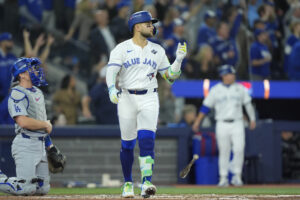
It’s a stunning and near-immediate pivot for a Mets club that is barely 12 hours removed from losing out on Kyle Tucker, who just last night went to the Dodgers. Los Angeles outbid the Mets’ reported four-year, $220MM deal with a four-year, $240MM contract that gives Tucker two opt-out opportunities (post-2027 and post-2028). Having missed on that big swing, the Mets now pivot to the market’s next-best bat and next-best all-around free agent, bringing Bichette in on a $42MM annual value that ties Zack Wheeler for the sixth-largest in MLB history.
In landing Bichette, the Mets are not only pivoting from Tucker in arguably the most notable way possible — they’re also keeping him from a division rival that had emerged as the ostensible frontrunner. Bichette met with the Phillies earlier this week, and made him a seven-year offer worth around $200MM. They believed they were close to a deal last night, but the Tucker decision prompted a pivot from the Mets, who swooped in and stole him from their rivals. Bichette now lands a mammoth annual value that could grow even further (via that $5MM bonus) if he opts out and returns to the market next winter, ahead of what would still be only his age-29 season.
Though the fit isn’t necessarily as clean as Tucker would have been for a Mets club that already had a deep infield and was lacking in outfielders, Bichette adds a clear plus bat to manager Carlos Mendoza’s lineup. The 27-year-old (28 in March) has been a well above-average hitter in all but one of his seven major league campaigns — a 2024 season that was cut short by multiple calf injuries and a broken finger standing as the lone exception.
Bichette hit just .225/.277/.322 in 80 games during that awful 2024 campaign. He not only bounced back in 2025 but turned in arguably the best performance of his career on a rate basis, slashing .311/.357/.483 with 18 home runs in 628 plate appearances. By measure of wRC+ (134), it was Bichette’s best season since his late call-up during the 2019 campaign (MLB’s juiced-ball season).
Even on its surface, Bichette’s 2025 season looks excellent. It doesn’t tell the tale of his finish, though, which had both positives and one very obvious negative. Bichette actually had a tepid start to his 2025 campaign. The underlying batted-ball data through his first month-plus was strong, but he hit just .275/.316/.363 through the first week of May. From that point forth, Bichette caught fire. Over his next 457 plate appearances, he laid waste to opposing pitchers at a .325/.372/.528 clip. That was 50% better than league-average, by measure of wRC+, and even that doesn’t fully do justice to Bichette’s jaw-dropping summer; over his final 238 plate appearances, the second-generation All-Star went supernova with a .381/.437/.591 slash (187 wRC+).
Unfortunately for both Bichette and the Blue Jays, that previously mentioned “very obvious negative” struck in early September when he suffered a sprained posterior cruciate ligament in his knee and missed the remainder of the regular season. He was also inactive for the early rounds of postseason play, only returning in the World Series. Bichette was clearly hobbled during the Fall Classic, limping to first base with ’88 Gibson-esque speed when putting the ball in play and displaying a lack of range at a new position: second base. Bichette’s shortstop glovework has been panned for years, and the Jays took the downtime as an opportunity to shift the defensively superior Andres Gimenez over to shortstop in his absence.
Despite the clearly injured knee, Bichette’s bat didn’t miss a beat in the World Series. He went 8-for-23 with seven singles and a titanic three-run homer off Shohei Ohtani in Game 7 of the World Series. Had the Jays’ bullpen managed to hold the lead, that would-be game-winner would have trailed only Joe Carter’s walk-off blast in franchise lore. Of course, that’s not how the game turned out, but Bichette’s 442-foot bomb still served to further underscore that even at less than 100%, he was a clear impact bat.
Bichette now carries a lifetime .294/.337/.469 batting line with him to Queens. He’s been 20-35% better than an average hitter every season of his career with the exception of that 2024 outlier, and this past season’s 14.5% strikeout rate was a career-low. He couples those plus-plus contact skills with above-average power and high-end batted-ball data; Bichette averaged 91 mph off the bat this past season (72nd percentile), and his 48.8% hard-hit rate sat in the 83rd percentile of big league hitters.
The question for Bichette and the Mets is how well he can handle a move to third base. His shortstop deficiencies were largely due to sub-par range. He doesn’t have a plus throwing arm necessarily, but it’s closer to average — at least in terms of the average velocity on his throws, as measured by Statcast — than was the case with his bottom-of-the-scale lateral movement. Bichette averaged 82.3 mph on his throws across the diamond last year — below par in MLB but still an upgrade (at least in terms of pure arm strength) over the man he’ll be replacing at the hot corner, Brett Baty (81.2 mph). Bichette may not be a plus defender at third, but even average defense coupled with his bat and good health would result in All-Star output.
Baty could now bounce between multiple positions. He’s played second base and left field in the past, and the Mets would surely be open to experimenting with him at first base, too. The designated hitter slot provides more opportunities for all. It’s a similar range of possibilities to the one faced by Jorge Polanco, who inked a two-year, $40MM deal last month. Polanco will reportedly be used extensively at first base and designated hitter despite having virtually no prior first base experience.
For a team that has preached run prevention for much of the offseason, lining up with Bichette at third base and Polanco/Baty at first probably isn’t how they drew things up originally — but the offseason is a layered beast that rarely unfolds in alignment with even the best-laid plans. Even if the Mets’ infield defense (and outfield defense, for that matter) is lacking, it’ll be solid up the middle thanks to Francisco Lindor and Marcus Semien. It should also be a highly productive offensive unit — particularly if Semien’s bat can bounce back at all.
Of course, the addition of Bichette also makes a potential trade of Baty — and several other infielders — more likely. Clubs seeking third base help include the Mariners, Angels and Pirates (as explored at length yesterday), among others. Any could show interest in Baty, Mark Vientos, Luisangel Acuña and/or Ronny Mauricio. Acuña, Vientos and Mauricio have all reportedly been available throughout the offseason anyhow. Some form of move seems likely, especially when considering both Acuña and Vientos are out of minor league options and looking to bounce back from poor seasons.
From a payroll vantage point, the Bichette contract is all the more staggering. Not only is the $42MM annual value the sixth-largest ever, it’s also only a fraction of what the Mets will actually have to pay due to this signing. New York was already on the cusp of the top tier of luxury penalization. Bichette catapults them $33MM north of that final cutoff point, per RosterResource’s estimates. They’ll pay a 95% tax on the first roughly $9MM of his annual value and a full-freight 110% tax on the remaining $33MM. Assuming an even distribution of his $126MM over the three-year term, the Mets would be paying more than $86MM for Bichette in 2026 alone. If he triggers that $5MM bonus upon opting out next winter, that’d also be subject to a 110% tax, bringing the Mets’ total bill on Bichette to about $97MM for just one year.
Moreover, the signing underscores the minimal amount that many big-market, CBT-paying clubs care about paying the 110% tax on short-term deals marquee players. The Dodgers’ signing of Tucker — just as will be the case with Bichette’s deal — has rekindled public outcry for a salary cap, but the players will likely only use these deals to illustrate the discrepancy between the middle and upper class of free agents; the union will surely argue that a cap would only further expand that gap and point out that half the money paid by CBT offenders is redistributed to other teams (in addition to standard revenue-sharing). That won’t fly with small-market owners, who’ll argue that they can’t compete with this type of expenditure. Both sides will dig in their heels.
It’s also fair to wonder whether this is a short-term blip or a burgeoning trend. Even big-market clubs seem increasingly against long-term contracts. For years, it was the Dodgers who tended to prefer short-term, high-AAV deals. But we’ve now seen the Mets limit their Tucker offer to four years and go three super-premium years on Bichette — while also declining to go beyond three years for Pete Alonso or Edwin Diaz. The Red Sox clearly prefer the trade market to free agency and surprised onlookers by even extending to five years to sign Ranger Suárez. The Yankees have reportedly been stuck on five years for their offer to Cody Bellinger while he seeks a seven-year term. Giants ownership publicly voiced an aversion to signing any pitchers to long-term contracts.
If baseball is indeed moving more toward NBA-style contracts — short term, ultra-high annual value — it’d mark a dramatic shift for a sport whose top players have overwhelmingly (albeit not always) preferred the stability of long-term arrangements, even if that means sacrificing some money on an annual basis. Time will tell, but that will all factor into both parties’ approach at the negotiating table next winter in an offseason that is widely expected to be impacted by a lockout and transaction freeze.
Turning back to the teams directly impacted by today’s signing, the Mets will part with their second- and fifth-highest selections in the 2026 draft as well as $1MM of space from next year’s bonus pool for international amateur free agents. That’s due to the fact that Bichette declined a $22.025MM qualifying offer. By that same token, the Blue Jays will be compensated with an extra pick. That selection will come after the fourth round of this summer’s draft — the lowest possible compensation — due to Toronto’s status as a luxury tax payor.
For the Jays, parting with Bichette has at least seemed possible throughout the winter but began to look more certain once they signed star NPB third baseman Kazuma Okamoto and plugged him into an already crowded infield. There was still some room for Bichette to return, but Toronto’s focus has reportedly been on Tucker. With Bichette now formally out of the picture, they’re lined up to go with Ernie Clement at second base, Gimenez at shortstop and Okamoto/Addison Barger at third base.
As for the Phillies, they’ve made their own immediate pivot, upping their offer to give longtime catcher J.T. Realmuto the third year he’s sought. Less than two hours after the Bichette agreement broke, Realmuto and the Phillies had a new deal in place. Philadelphia had reportedly only been comfortable signing one of Bichette or Realmuto, with the recent preference seeming to be the former. A Bichette signing would likely have led to Realmuto going elsewhere and one of Alec Bohm or Bryson Stott being traded. Trading either feels less likely — but certainly not impossible — now that Bichette is in Queens and Realmuto is staying put.
Even Bichette himself will now have major questions to consider in the near-term future. With a big season, he’ll assuredly opt out of his contract, cashing in $47MM (or thereabouts, depending on the division of salary) for one year and re-entering the market as a 28-year-old who can’t receive a qualifying offer. If he can do that and prove himself capable of playing an average or better third base, he could come out hundreds of millions ahead. That’s far from a given, though, and he’ll need to make that decision against the backdrop of a looming work stoppage.
It’s a dizzying sequence of interwoven, high-priced payouts for star players — the ramifications of which will reach further than we can accurately predict at this time. It seems clear that the Mets have at least one move coming with regard to their infield glut, and they’re still in search of help both in the rotation and in the outfield. With Tucker and Bichette coming off the board within a matter of 15 hours, Cody Bellinger suddenly stands as the top position player available — possibly with several clubs now keying in on him and providing more pressure for the incumbent Yankees to bridge the gap between their five-year offer and his seven-year ask. Will Bellinger similarly pivot to a short-term, high-AAV contract? If so, will that be in the Bronx or with a new club?
Questions abound, and there are surely several moves yet to be made, but the Mets are a more talented and more dangerous team now than they were this time yesterday — even if it’s not due to the player they were originally targeting. Their pivot is likely only just beginning, but adding a prime-aged, multi-time All-Star who has twice led the American League in hits is a pretty good first step in a pivot.
Will Sammon of The Athletic first reported the agreement and contract length. The New York Post’s Jon Heyman added the total guarantee and no-trade clause. Ken Rosenthal of The Athletic added details regarding the opt-outs and lack of deferrals. Jon Morosi of the MLB Network reported that Bichette was likely to play third base in Queens.
Phillies Notes: Bichette, Roster, Castellanos, Wheeler
The Phillies formally announced their re-signing of catcher J.T. Realmuto this morning. Realmuto, president of baseball operations Dave Dombrowski and manager Rob Thomson were all on hand for a media session conducted over Zoom shortly thereafter. Dombrowski, fielding questions regarding the reported pursuit of Bo Bichette and the late pivot back to Realmuto, candidly acknowledged that his club did indeed feel it was close to closing a deal with Bichette before the Mets jumped in following Kyle Tucker‘s deal with the Dodgers.
“I can’t say that we ever thought it was done,” Dombrowski said when asked if he’d felt they had an agreement in place with Bichette. “We thought we were very close to having a deal done. We thought it was going to happen, but it wasn’t done. … Until you sign a memo of understanding, you don’t have a deal done — and we did not sign one of those. It wasn’t that we weren’t moving toward that direction. It isn’t that we didn’t think we were going to get there. But we just did not get to that point.”
The Bichette talks were serious enough that Dombrowski acknowledged informing Realmuto’s camp that they were likely to go in another direction and wouldn’t be able to make both signings happen at this time. When they got word of Bichette’s deal with the Mets, Dombrowski said he was back on the phone with Realmuto and his agent within an hour or so — his only interim call going to owner John Middleton, to keep him apprised of the situation. The veteran baseball operations executive conceded that it’s a “gut punch” anytime free agent or trade negotiations get to that stage and don’t culminate in a deal before adding, “you can’t just wallow in what took place” and that he had to simply “shake it off” and continue trying to improve his club. Notably, he added that the Phils were never interested in a short-term, opt-out-laden contract with Bichette.
Given that the Phillies were willing to offer a reported $190-200MM to Bichette over a seven-year term, it’s fair to wonder whether there might be some forthcoming additions. Realmuto, after all, commanded less than 25% of that sum in total. Dombrowski, however, at least strongly implied that his club is done with significant spending this winter. Asked about the lingering availability of impact names like Framber Valdez and Cody Bellinger, Dombrowski declined to get into specifics regarding any particular free agent but demurred to say:
“I really can’t speak to that, by the baseball rules — because they’re free agents — but I’d just say I think we’re content where we are at this point.”
With Realmuto back in the fold, the Phillies’ current payroll (as projected by RosterResource) sits just over $281MM. They’re at more than $317MM worth of luxury obligations, meaning they’d pay a 110% tax on any subsequent additions to the roster. Based on the Bichette pursuit, it seems Middleton was willing to extend further beyond the current price of the roster, but not that the Phillies have the proverbial money burning a hole in their pockets.
That doesn’t mean there isn’t room for some smaller-scale additions. Dombrowski alluded to the potential of bringing in some depth options for the rotation. He also candidly confirmed on the record that the team plans to move on from Nick Castellanos in some capacity. Castellanos is owed $20MM this season — the last of a five-year, $100MM contract signed in the 2021-22 offseason. Asked point-blank if he still “expect[s] to make a change of scenery [for Castellanos] before spring training opens,” Dombrowski replied: “Yes, we do. We still plan on doing that.”
A change of scenery has been presumed for months now. The Athletic’s Matt Gelb reported early in the winter that the Phils were likely to either trade or release Castellanos. The latter has seemed likelier all along, if only because finding a taker for even part of Castellanos’ salary is a tall order. The 33-year-old (34 in March) hit .250/.294/.400 with 17 home runs last season — about 10% worse than league-average, by measure of wRC+. That lack of offensive help was coupled with more bottom-of-the-scale defense in the outfield, the second-worst walk rate and average exit velocity of his career, and the lowest hard-hit rate he’s ever posted.
It’s feasible that as spring draws nearer, the Phillies might find a buy-low taker willing to pay a few million of the deal. Even getting someone to take on $2MM of that remaining $20MM would actually trim $4.2MM off the Phillies’ 2026 budget, given the previously mentioned 110% tax they’re paying on every dollar over the top luxury threshold. Clubs like the Pirates, Reds and Royals have been looking for more bats all offseason and could theoretically roll the dice on a hopeful rebound. Other clubs could come calling if they incur some injuries in spring training. For now, Castellanos remains on the roster.
One other item of note from today’s media session included a brief update on injured ace Zack Wheeler. The 35-year-old righty underwent thoracic outlet surgery in late September, and a timeline on his return has been murky. That’s generally still true, but both Dombrowski and Thomson noted that Wheeler has been throwing from flat ground and is up to a distance of 90 feet. Thomson added that Wheeler had a “heavy” workload last week and is expected to be at the team’s spring complex for more throwing on Thursday.
“No timetable, but so far the reports have been good,” Thomson said of his veteran righty.
Wheeler was diagnosed with venous thoracic outlet syndrome late in the season. It’s an ominous injury but the less severe form of TOS (as opposed to neurogenic TOS). Venous TOS comes with blood clots that can be life threatening but, as D-backs righty Merrill Kelly explained to Jesse Dougherty of the Washington Post several years ago, a “more straightforward” diagnosis and recovery. (Kelly pitched nearly a full season in 2021, the year after his venous TOS procedure, and has since done the best work of his career over the past four seasons.)
The original timetable for Wheeler was six to eight months, though every rehab process is unique and contingent upon the individual pitcher’s body. It’s encouraging that Wheeler appears to be on track, but the fact that he’s not yet working off a mound with only three weeks until pitchers and catchers report doesn’t bode well for hitting the shorter end of that window. A six-month return would’ve put Wheeler in games by late March, just prior to Opening Day. Eight months would set him back until around Memorial Day weekend. The Phillies will surely have plenty of updates as spring training progresses.
In Wheeler’s absence, the Philadelphia rotation will include Cy Young runner-up Cristopher Sanchez, Jesus Luzardo, Aaron Nola and Taijuan Walker. Longtime top prospect Andrew Painter is the current favorite for the fifth spot, but he has yet to make a major league debut and struggled in Triple-A last year during his return season from Tommy John surgery. Righties Yoniel Curet, Alan Rangel and Jean Cabrera are all on the 40-man roster, but none of that trio has a major league start under his belt. Adding at least one veteran swingman or starter, if not two, seems like a prudent course of action — even if it’s only on a minor league deal with an invitation to spring training.