
MLBPA Announces 2014-15 Free Agents
The Major League Baseball Player’s Association has announced the official class of free agents for the upcoming offseason. Click here to find the complete list, along with an excellent foreword (featuring an interview with lefty Andrew Miller) that was penned by MLBTR’s own Tim Dierkes.
121 players will hit the open market, according to the MLBPA. Former teams will enjoy a five-day exclusive negotiating window before the newly-minted free agents will be eligible to sign with any club.
Of course, MLBTR will be all over the free agent news and rumors as they unfold over the coming months. Be sure to keep an eye on our list of current free agents, which will be updated as the market moves. And, of course, MLBTR’s Free Agent Tracker will keep you up to date on the deals that have been completed. Tim will unroll his top fifty free agent list in the coming days as well, so be sure to keep an eye out for that.
Poll: Which Team Will Spend Most In Free Agency?
It is always somewhat bittersweet for the baseball season to end, but rarely does it do so in such excellent fashion as last night’s Game 7. So as we tip our caps to the Giants (and, of course, the Royals), we can comfort ourselves in the knowledge that today is the start of the offseason.
Offseason spending, of course, does not guarantee anything. This last season proves that yet again. In an update I provided in mid-March, after most of the major outlays were in the books, the top three teams by total free agent commitments were the Yankees, Mariners, and Rangers. Though most postseason teams threw around some fairly significant dollars, led by the Dodgers with $105MM, half of them — including the newly-crowned champs — promised away less than $50MM.
Nevertheless, free agency (in addition, of course to the trade market) offers the chance not only to grab in-prime stars but also to plug holes, make upgrades, and find value in unexpected places. Will the Yankees follow their reported course of more limited spending this time around? Will the Dodgers trim payroll or make a splash? Do the Red Sox or White Sox fill up their largely open future balance sheets? Or is there a surprise team sitting on a hidden war chest?
That remains to be seen. For now, however, you can predict: which MLB team will commit the most total dollars (overall contract guarantees) through free agency? (Team order randomized.)
Which Team Will Spend The Most On Free Agency In 2015?
-
Cubs 30% (6,619)
-
Red Sox 22% (4,851)
-
Yankees 16% (3,466)
-
Dodgers 5% (1,146)
-
Mariners 3% (698)
-
Tigers 3% (668)
-
White Sox 2% (405)
-
Phillies 2% (403)
-
Mets 2% (345)
-
Blue Jays 2% (342)
-
Rangers 1% (308)
-
Giants 1% (255)
-
Cardinals 1% (236)
-
Angels 1% (212)
-
Orioles 1% (209)
-
Pirates 1% (169)
-
Astros 1% (166)
-
Twins 1% (163)
-
Braves 1% (151)
-
Padres 1% (136)
-
Reds 1% (115)
-
Athletics 0% (108)
-
Royals 0% (107)
-
Marlins 0% (107)
-
Rays 0% (105)
-
Brewers 0% (100)
-
Nationals 0% (77)
-
Diamondbacks 0% (74)
-
Indians 0% (55)
-
Rockies 0% (40)
Total votes: 21,836
Outrighted: Kalish, Valaika, Vitters, Meek
Here are the day’s outright assignments:
- The Cubs have made a series of roster trims, according to Mark Gonzales of the Chicago Tribune (via Twitter). Outfielder Ryan Kalish and infielders Chris Valaika and Josh Vitters have each been outrighted, according to Gonzales. Righty James McDonald has elected free agency as well.
- The Orioles have outrighted righty Evan Meek to Triple-A, the club announced. Meek will have the right to elect free agency, as he has previously been outrighted (including once earlier this year). Meek, 31, threw to a 5.79 ERA over 23 1/3 innings at the MLB level, all in relief. He struck out 6.2 and walked 4.2 batters per nine over that stretch. Meek has had better stretches in the majors, however, and even made an All-Star appearance with the Pirates back in 2010. Over 41 2/3 Triple-A frames this year, Meek worked to a 1.94 ERA with 8.0 K/9 against just 0.9 BB/9.
Reds To Exercise Club Option On Cueto, Buy Out Hannahan And Ludwick
2:21pm: The Reds have also declined Ludwick’s $9MM option, instead paying him a $4.5MM buyout, Cotillo tweets. The 36-year-old’s down 2014 season made that salary excessive, though the steep buyout tag and Cincinnati’s outfield needs made it a closer call than it might have seemed at first glance.
1:45pm: The Reds have kicked off their offseason with two unsurprising moves, deciding to exercise a $10MM club option over starter Johnny Cueto and decline a $4MM option for utilityman Jack Hannahan, according to Chris Cotillo of MLBDailyDish.com (Twitter links). Cincinnati will pay Hannahan a $2MM buyout rather than taking him back for 2015.
Both moves were widely expected. Cueto, 28, put up a Cy Young-worthy campaign (243 2/3 innings with a 2.25 ERA) and is an unquestioned bargain at that rate. The only question seems to be whether the club will take a crack at working out another extension or, if that is not an option, will listen to trade offers.
Meanwhile, the 34-year-old Hannahan did not play to expectations with the Reds and saw only 50 plate appearances last year. Across 212 trips to the plate over the previous two seasons, Hannahan slashed an anemic .209/.294/.278.
Cincinnati still has a slightly more difficult decision to make on Ryan Ludwick, whose club option — like Hannahan’s — comes with a buyout that reaches 50% of its value. In his case, the club can either pick him up at $9MM or buy him out for $4.5MM.
AL West Notes: Iwakuma, Young, Astros, Peacock
Hisashi Iwakuma‘s 2015 option technically vested by operation of performance bonuses, Mariners officials tell Bob Dutton of the Tacoma News Tribune. Of course, Seattle would gladly have exercised the $7MM option on its own, as Iwakuma has been outstanding since joining the team before the 2012 season. The club has interest in exploring a new deal for the 33-year-old righty, Dutton reports.
Here’s more from Seattle and the AL West:
- The Mariners have a rotation spot open but may not be interested in re-signing Chris Young to fill it, writes Dutton. That is due in large part to the fact that Taijuan Walker may have pitched himself into the starting five, making it hard for Seattle to commit dollars or make roster promises to free agents. While the team will no doubt pursue some veteran depth, Dutton notes that it is unlikely to match what Young can receive elsewhere.
- Down in Houston, the Astros are preparing for a busy offseason, as MLB.com’s Brian McTaggart writes. GM Jeff Luhnow said that the club is hoping to improve in the pen and corner infield while adding some pop through an outfielder. The team has as much as $20MM in added payroll capacity to accomplish that, per Luhnow, who says that the organization already has a list of free agent targets and has had contact with a dozen clubs in preparation for trade talks. “There’s been some turn over in front offices,” said Luhnow. “We think we know what players might be available, but you never know until the season’s over and people are taking stock of their areas of improvement and where they have excess and you never know where there’s going to be a match. You’ve just got to talk to everybody.”
- One player who the Astros will not be able to get a look at to start the spring is righty Brad Peacock, who had bone spurs removed from his right hip. Per Evan Drellich of the Houston Chronicle, the club does not view the surgery as a long-term concern, but Peacock seems rather unlikely to be ready by Opening Day. Having already dealt away Jarred Cosart at the trade deadline, Peacock’s situation could make Houston somewhat more inclined to add starting depth through free agency.
Free Agent Profile: Jason Hammel
A bounceback stint with the Cubs made Jason Hammel, a 6’6 righty, one of the most anticipated summer trade targets, and he ultimately became the second piece in the deal that sent top prospect Addison Russell to Chicago. But the 32-year-old faded in Oakland and now joins a loaded market for mid-level starters. Hammel’s reps at Octagon will go out looking for multiple years, but can he achieve it without taking a lower AAV?
Pros/Strengths
Though he went through a rough stretch after moving to Oakland, putting a hurt on his bottom-line results, Hammel actually finished quite strong. He allowed just 14 earned runs over his last 50 2/3 frames for the A’s, good for a sub-3.00 mark that was more reminiscent of his sturdy open to the year with the Cubs. On the whole, you can’t argue with 176 1/3 innings of 3.47 ERA pitching, and that’s what Hammel delivered in 2014.
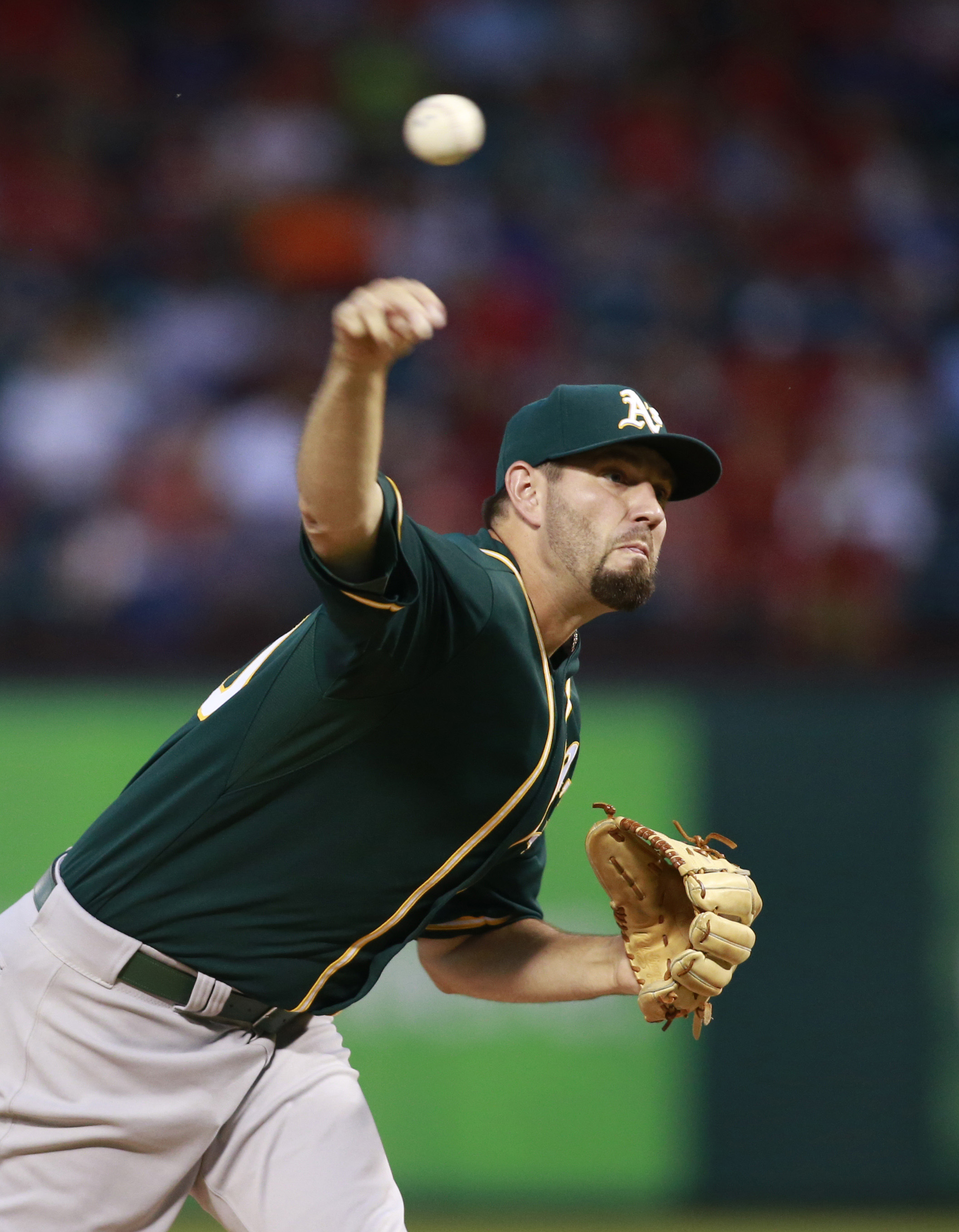
Neither is there reason to believe that those figures were the result of some dumb luck. Hammel did benefit from a .272 BABIP and 78.3% strand rate, but the 12.0% home run-per-flyball rate fell above his career average and could be due for a bit of regression. ERA estimators were generally supportive of the final earned-run tally, as Hammel posted a 3.92 FIP, 3.57 xFIP, and 3.50 SIERA.
Best of all, Hammel showed a restored ability to generate strikeouts. Back in 2012, his breakout year with the Orioles, Hammel posted 8.6 K/9 against 3.2 BB/9. In 2014, after a drop in the intervening year, he landed at 8.1 strikeouts and 2.3 walks per nine. He also has maintained his fastball velocity in the 92-93 mph range, a tick off from ’12 but in line with his career standards. And he increased the usage of his slider, with positive results.
Hammel also managed reasonable effectiveness against batters from both sides of the plate, yielding a .305 wOBA to lefties and a .297 mark to righties.
Cons/Weaknesses
In spite of his overall success last year, Hammel is not without his areas of concern. For one thing, the stellar groundball rate he reached in 2012 (53.2%) has dropped over a dozen percentage points in each of the last two years. That could be due in part to the fact that he has gone to the four-seamer more frequently, with his two-seam offering dropping in effectiveness.
Likewise, Hammel has seen an advanced proclivity to allow the long ball. His home run-per nine figures have both returned to the levels they sat when Hammel was struggling to establish himself at Coors Field. And pitching in Wrigley Field does not offer an excuse; the park actually landed in the middle of the pack in terms of permitting the long ball, and Hammel did not exhibit strong home/road splits in this department.
Then there is the question of durability — or, perhaps more to the point, innings. Hammel did miss significant time over 2012-13 with knee and elbow issues. He came back to deliver an injury-free 2014, of course, but those recent, reasonably significant issues cannot be discounted entirely.
On the whole, while his medical sheet does not look overly concerning, Hammel has yet to finish a season with more than 177 2/3 frames to his record. He nearly matched that mark this year, logging 176 1/3 innings, and probably would have bettered it had the A’s not skipped his turn down the stretch. But the fact remains that Hammel has not established himself as a 200-inning workhorse, even when he has been healthy — a fact which delivers its own concerns.
Personal
Hammel is married with one child. He writes on his personal blog that he loves spending extra time in the offseason with his wife, Elissa, and young son. LEGO construction, in particular, seem to be a preferred family pastime.
Per a somewhat outdated profile, Hammel resides in Rehoboth, Massachusetts, close to his wife’s hometown. Hammel himself was born in South Carolina and graduated from high school in Washington. He also attended Treasure Valley Community College in Oregon, from where he was plucked in the tenth round of the 2002 draft.
Market
This is where things start to get tough for Hammel. On the one hand, in terms of recent results and career workload, Hammel looks like a better bet than Scott Feldman, who landed three years and $30MM on last year’s market. And he is a good deal younger (or less risky) than the roughly comparable arms that landed two-year deals last year: Bartolo Colon (2/$20MM), Scott Kazmir (2/$22MM), Tim Hudson (2/$23MM), and Bronson Arroyo (2/$23.5MM).
But this is a different market, one that includes a good number of arms that offer more extended track records or higher upside.
I’ll crib from Tim Dierkes’s profile of Santana. As Tim noted there, the second tier of starters (behind the big three) includes not only Santana but names like Kenta Maeda, Brandon McCarthy, Francisco Liriano, Justin Masterson, Jake Peavy, and Hiroki Kuroda (assuming the latter decides to pitch). Other than Kuroda, the only players even eligible to receive qualifying offers are Santana and Liriano, meaning that Hammel will not stand out in that regard.
In some respects, Hammel’s trajectory over the last three years looks something like that of Santana entering last year’s market: first a strong year that made him look like a long-term piece, then a dud that led to a change of scenery, chased with an ultimately fulfilled chance to re-claim value. But 2013 Santana was arguably the second-best arm available in a thin market. For Hammel, there’s a case to be made that he lands outside the top ten.
Expected Contract
Though the competition is fierce, the volume of good arms loose on the market also indicates that multiple clubs will be looking to fill in the gaps that were left. But last year, in a free-spending environment that blew out previous cash outlays and awarded significantly more deals of three-or-more years in duration, only eight pitchers got more than two years guaranteed, with six others getting a second year (and that’s if you include Tim Lincecum, who was extended just before officially reaching free agency).
Ultimately, I think there is a decent chance that Hammel ends up being one of the hurlers who falls through the cracks somewhat and does not maximize his value in a competitive market. While a two-year deal at a strong AAV cannot be discounted as a realistic outcome, I’ll predict that Hammel gets a third year but has to sacrifice some annual salary to do so, landing at the Feldman deal with a three-year, $30MM contract.
Free Agent Profile: Jake Peavy
What a difference a few months can make. For Jake Peavy, a former ace turned would-be trusty veteran, a trade deadline deal to the Giants has changed perceptions and, perhaps, his market. Approaching free agency for the first time entering his age-34 season, Peavy now looks to be one of the more intriguing players to watch. (Of course, all eyes will be on him tonight as he takes the hill looking to clinch the World Series.)
Pros/Strengths
Twelve regular season starts with the Giants late this year yielded remarkable results: a 2.12 ERA and 3.03 FIP over 78 2/3 frames. Three more post-season outings have resulted in a 3.68 earned run mark across 14 2/3 innings, with time left for more positive impressions. With a constantly evolving pitch mix and approach, as he explained recently to Eno Sarris of Fangraphs, Peavy may have found an edge in the constantly evolving battle between pitcher and hitter.
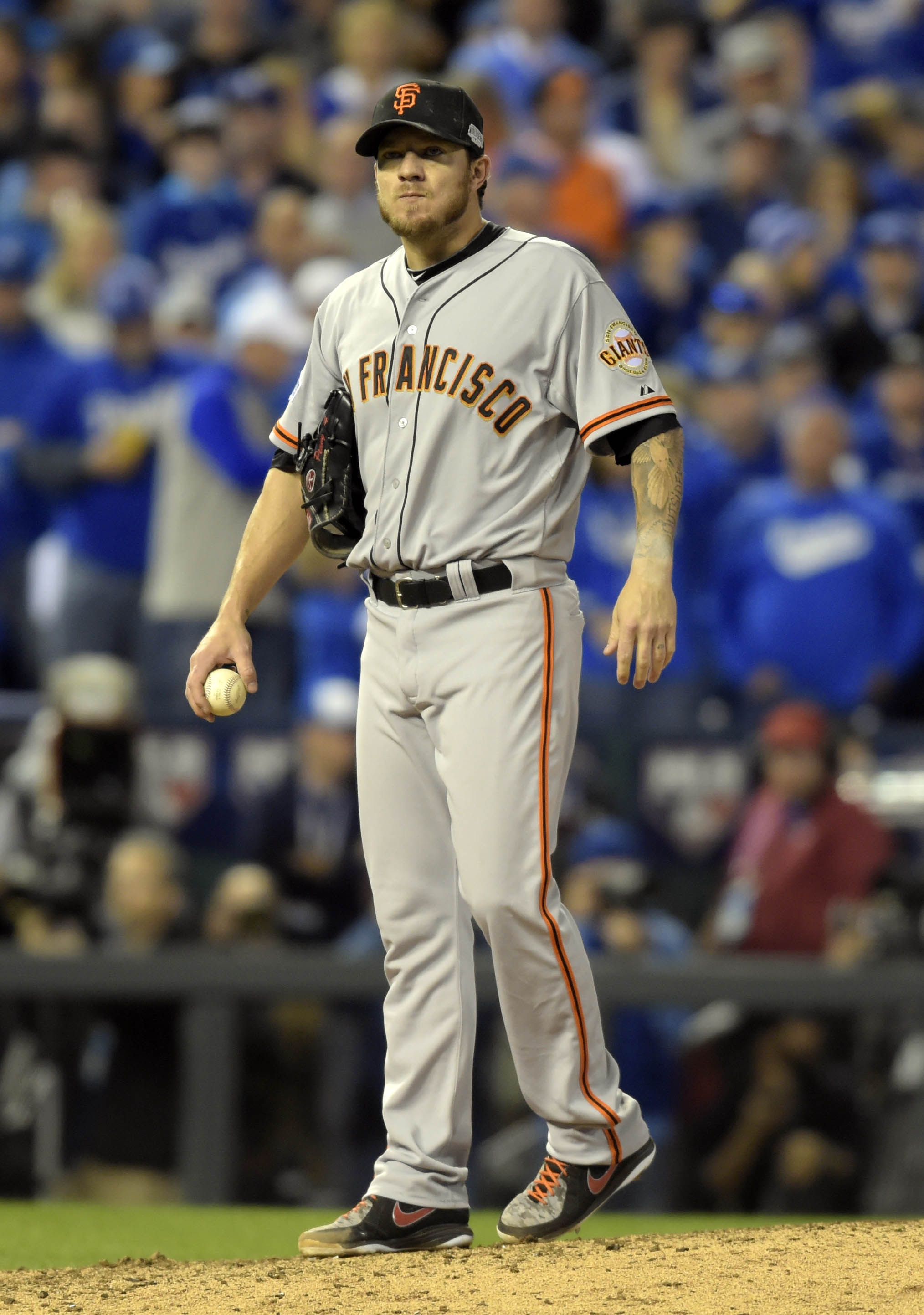
Though Peavy is no longer the strikeout threat he once was, he seems to have stabilized in the seven to seven-and-a-half strikeouts per nine range. And he continues to reliably post walk rates below three per nine innings. Though he is not a heavy groundball pitcher, Peavy has generally maintained a BABIP-against at or below .290.
Then, of course, there is Peavy’s impressive pedigree. From about 2004 through 2008, Peavy was one of the best starters in the game, and he has had excellent full-season results as recently as 2012 (3.37 ERA over 219 innings).
Peavy is often cited as a trustworthy veteran who is a positive clubhouse member. An intense competitor on the hill, the righty is certainly the type of player who holds appeal both to veteran-laden contenders and young teams looking to put a role model in place.
Cons/Weaknesses
His late run with San Francisco aside, Peavy has struggled mightily at times in recent years. He put up a 4.17 ERA in 2013 and allowed 4.72 earned per nine with the Red Sox to start the year in 2014. Neither did peripherals paint a much rosier picture, with ERA estimators pegging Peavy as a back-of-the-rotation option at best.
And it is not as if this were an isolated downturn. Sandwiching his solid work in 2012, Peavy had been an average or worse starter over the 2009-11 stretch. That decline can be traced, in part, to steady downticks in Peavy’s average fastball velocity. After working in the mid-90s earlier in his career, Peavy has not even averaged 91 mph since 2010 and just saw his average heater drop into the eighties for the first time.
Declining strikeout rates are one result; in his solid stretch with the Giants, Peavy has maintained only a 6.6 K/9 rate that falls shy of any of his full-season averages. On the year, he struck out just 7.0 per nine, his worst-ever rate. More tellingly, perhaps, Peavy’s K-BB% fell to 11.1%, far and away the worst mark his his 13-year career.
Neither has Peavy been a model of health. He has failed to reach 150 innings in four of the last six seasons. Shoulder and rotator cuff injuries are among his maladies, along with a more recent ribcage fracture. He also missed time due to an ankle injury and, further back, elbow strains. (Peavy has never undergone Tommy John surgery.)
Personal
Often described as a family man, Peavy and his long-time wife Katie have three sons. A native of Alabama, Peavy makes his permanent residence in his home state. Over the years, of course, he has moved from coast to coast, though Peavy has never chosen his own destination (aside from agreeing to extensions with the Padres and White Sox in advance of free agency).
When he is away from the ballpark, according to this aggregated profile, Peavy prefers to spend time in the outdoors. His family lives in a cabin on a substantial spread of land, and he hunts and fishes in his spare time. Peavy also plays the guitar and is a practicing Christian.
Market
In a market loaded with mid-level starters, Peavy occupies a somewhat unique place. He is the oldest of that group aside from Hiroki Kuroda, who is not expected to test interest broadly. In that respect, he probably stands alone to some extent as a solid veteran who can (theoretically, at least) be had on a somewhat shorter commitment.
A client of CAA Sports, Peavy could hold appeal to a variety of clubs that may or may not be as interested in other non-premium starters. More specifically, it is certainly possible to imagine the Giants being interested in a reunion, and the White Sox are another former club that could show interest in a shorter-term arrangement. Otherwise, the Cardinals, Angels, Rangers, Braves, D’backs, and Cubs all could make some degree of sense.
Peavy says he has interest in ending up in the same place as former Red Sox teammate Jon Lester, saying that “there’s a package deal out there for any team.” Choosing a landing spot based more on personal preferences — including, perhaps, re-uniting with Lester or other former teammates — than maximum contract would not be a surprise for Peavy. He said back in 2005 that “money is not why I’m pitching” and backed that up recently when he signed a reasonable extension with the White Sox rather than hitting the market.
Expected Contract
Though some have suggested that Peavy may have pitched his way into a three-year deal in recent months, a two-year contract still seems the likelier outcome — especially if Peavy prioritizes finding a home that suits him for non-financial reasons. Peavy should easily top the two-year, ~$22-23MM contracts given to several veterans last year, and could land a deal on the model of Ryan Dempster’s two-year, $26.5MM pact. Updating that contract for inflation, and accounting for a value boost after Peavy’s success in San Francisco, I predict that he will ultimately fall just shy of his last contract and sign for two years and $28MM.
Nationals Outright Ross Ohlendorf, Who Elects Free Agency
The Nationals have outrighted right-hander Ross Ohlendorf, the club announced. Ohlendorf has elected free agency.
Today’s move was precipitated by Ohlendorf’s activation from the 60-day DL, where he had resided all year. An early-year back strain ultimately sidelined Ohlendorf for much of the year (including time missed after a re-aggravation), though he did throw 15 minor league rehab innings.
Ohlendorf was a pleasant surprise last year for the Nationals, throwing 60 1/3 frames of 3.28 ERA ball after signing a minor league deal. That included seven starts and nine relief appearances, over which he struck out 6.7 and walked 2.1 per nine.
After that solid effort, Ohlendorf was retained on a $1.25MM arbitration deal (including $3MM in incentives). If he can show that he can maintain the velocity increase that fueled his success last year, it stands to reason that Ohlendorf will receive plenty of interest from teams looking for someone to compete in camp on a minor league deal.
Aroldis Chapman Changes Agents
Reds closer Aroldis Chapman has changed agents by moving to Relativity Baseball, per Jeff Passan of Yahoo Sports (via Twitter). Chapman had been represented by Hendricks Sports.
For Chapman, 26, the move comes at an important time for the contractual side of his career. He earned $5MM this year after opting into arbitration. That will no doubt happen again next year, and Chapman will be in for a significant raise after racking up 36 saves over 54 innings. Though those totals were limited by his DL stint to the start the year, the remainder of Chapman’s numbers — a 2.00 ERA, an absurd 17.7 K/9 (against 4.0 BB/9), and an equally ridiculous 3.5 H/9 — will support a nice new payday.
And that’s only the starting point for the southpaw fireballer, who is currently set up to become a free agent after the 2016 season. While that is a long way off for a reliever, he already has a hefty earning base and will cost a pretty penny to buy out ahead of time. Craig Kimbrel signed a four-year, $42MM deal (including an option year) entering his first arb-eligible season.
Logan White Leaves Dodgers, Joins Padres Front Office
The Padres have hired Logan White as senior adviser to general manager A.J. Preller and director of pro scouting, the club announced today. Jon Heyman of CBSSports.com first reported the hiring, while Dylan Hernandez of the Los Angeles Times was first to report the title of White’s new post (via Twitter).
White’s name has surfaced several times in recent months (as it had in previous years) as various teams, including the Padres, conducted GM searches. (MLBTR’s Ben Nicholson-Smith profiled White as a GM candidate back in 2011.) His internal situation in Los Angeles may have become unsettled with the hiring of Andrew Friedman and re-assignment of former GM Ned Colletti.
The 51-year-old had served the Dodgers for 13 seasons, reaching the position of VP of amateur scouting. In that role, the release says, White oversaw both the Dodgers’ amateur draft (with such notable successes as Clayton Kershaw and Chad Billingsley) and its international amateur efforts (helping to land players like Yasiel Puig, Hyun-jin Ryu, and Hiroki Kuroda). As his specialty area would suggest, White comes with a background in scouting. He ascended through the ranks for 15 years — including a stint with San Diego — before reaching the front office ranks with the Dodgers.
White’s new position seems to be rather expansive. He will have responsibility “for overseeing all of the organization’s professional scouting efforts and player acquisition at the Major and minor league level,” per the press release.