
Red Sox “Shopping” Connor Wong In Trade Talks
Rival teams have shown interest in Boston’s catching trio of Connor Wong, Carlos Narvaez, and Mickey Gasper, The Athletic’s Jen McCaffrey reports. It seems like Wong may be viewed the most expendable of the group, as McCaffrey writes that “the Red Sox are shopping Wong in particular.”
The 2024 season was seemingly a breakout for Wong, who hit .280/.333/.425 with 13 homers over 487 plate appearances. Last year, however, Wong stumbled to a .190/.262/.238 slash line over 188 PA. His playing time was reduced first by a pinkie finger fracture that cost him a month of action early in the season, and then as Wong struggled following his IL activation, Narvaez emerged as Boston’s preferred option behind the plate.
The situation has flipped to some extent in 2026, as Wong has rebounded to hit a respectable .264/.338/.375 over 82 PA, while Narvez is hitting only .214/.290/.313 over 125 PA. Gasper wasn’t called up from Triple-A until May 7, but over the last month has also gotten a good chunk of playing time both as a catcher and a DH, as Gasper is batting .306/.353/.387 in 69 PA.
Most teams only carry two catchers on their 26-man roster, though Gasper has hit well enough to earn himself more of a look on an offensively-challenged Red Sox team. The other wrinkle is that Narvaez is clearly the best defensive catcher of the group, which may be why Wong could be the relative odd man out, if the Sox prefer Gasper’s bat and Narvaez’s glove as the preferred catching combination. Gasper and Narvaez are also both pre-arbitration players, though Wong isn’t exactly expensive — he is earning $1.375MM in 2026 in the first of his three arb years.
With former big leaguers Jason Delay and Matt Thaiss both at Triple-A, the Red Sox may feel they have enough catching depth to move Wong elsewhere if the right offer emerges. Given that catcher is a traditionally thin position around the game, it isn’t surprising that Boston is getting calls on its backstops, even if it relatively rare to see a starting-level catcher dealt in-season.
The first week of June is also a little early for trades of true consequence, as clubs generally wait until much closer to the trade deadline for such moves. The amount of parity in the American League has also made trade talks more difficult to parse, as Red Sox chief baseball officer Craig Breslow alluded to when speaking with McCaffrey and other reporters yesterday.
“[We’re] having a lot of conversations, a lot of discussions, and I think it’s been kind of true industry-wide,” Breslow said. “But there are a lot of teams that probably feel pretty similar to us, which is to say that they have confidence in their rosters, they know they’re not playing as well as they’re capable of, and really, nobody is kind of putting the postseason out of reach. So there are a bunch of teams that are in it right now and are thinking along the same lines as we are.”
While the Red Sox have a 27-35 record, they are also only 3.5 games behind the 31-32 Rangers for the last AL wild card slot. To this end, Boston has been looking to add to its roster, with right-handed hitting a particular desire for the club. Wong is a right-handed hitter with roughly even splits for his career, though 2026 has been a reverse-splits year, with Wong enjoying far more success against right-handed pitchers than against southpaws.
If the Sox do fall out of the race and decide to sell, the team would have plenty of trade chips available, particularly from its relief corps. McCaffrey notes that the Red Sox have gotten calls on Aroldis Chapman, Garrett Whitlock, and Justin Slaten, but the club currently has “no interest in dealing anyone from that bullpen trio.” That stance is understandable given how Boston’s pen has helped carry the team this season, so even in a strength-for-strength scenario, the Red Sox might not want to deplete the bullpen to address another need.
Chapman and Whitlock are technically both in the final years of their contracts, but with some level of additional control. The $13MM mutual option for Chapman’s 2027 season vests into a guaranteed salary if he pitches only 40 innings, and he has already logged 19 2/3 frames. The Red Sox hold an $8.75MM club option (with a $1MM buyout) on Whitlock for 2027, and a $10.5MM club option ($100K buyout) on his services for 2028. Slaten would probably be the toughest to pry away in a trade due to his affordability, as the right-hander doesn’t reach arbitration eligibility until this winter.
Padres Shopping For Bullpen Help
The Padres have the one of the best bullpens in baseball, but president of baseball operations A.J. Preller is seemingly never content with his roster and always in the process of searching for upgrades. To that end, Dennis Lin of the The Athletic reports that Preller is already poking around for bullpen help, hoping to strike up an early deal with a team open to parting with some relief pitching.
It might sound counterintuitive, given that San Diego’s relief corps includes Mason Miller, Jason Adam, Jeremiah Estrada, Adrian Morejon and Bradgley Rodriguez (1.66 ERA in 21 2/3 innings). San Diego relievers rank seventh in the majors with a 3.32 ERA, second with a 25.5% strikeout rate, first with a 50.8% ground-ball rate, third with a 3.23 FIP and third with a 3.27 SIERA. However you measure it, manager Craig Stammen (a former reliever himself) has the nucleus of an elite relief unit in place.
The Padres have also gotten good work from lower-leverage arms like Ron Marinaccio, Yuki Matsui and Wandy Peralta. The main reason they’re not pacing the majors in most bullpen categories is shaky work from players who were promoted for brief looks. Alek Jacob, Kyle Hart and David Morgan have posted ERAs north of 5.00 in a combined 33 innings. Out-of-options knuckleballer Matt Waldron made three relief appearances (two behind an opener) and was tagged for seven runs in 9 2/3 “relief” innings before landing on the injured list.
The core of San Diego’s bullpen is as strong and deep as any you’ll find in the game, but injuries are an inevitability, and the team is presumably wary of overworking its top arms. Padres relievers rank seventh in the majors with 200 1/3 innings pitched.
The Padres are one of just three teams with five true relievers who’ve already topped 20 innings this season. They lean heavily on their go-to contingent of ‘pen arms, and their starters don’t work deep into games. Michael King and Randy Vásquez are both averaging about 5 2/3 frames per start — King a bit more, Vásquez a bit less. None of their other starters are averaging even five frames per appearance (save for Lucas Giolito, who’s only pitched one game since signing and went exactly five frames in that debut showing).
Few teams are likely open to sell-side trades at this point, but it’s nevertheless of note that Preller & Co. are actively seeking arms. They’re rare, but there have been a handful of early-season trades of note over the past couple seasons, as the Padres know first-hand. They picked up Luis Arraez in an early-May swap with Miami back in 2024. Last year, we saw the Brewers acquire Quinn Priester from the Red Sox in April and the Giants acquire Rafael Devers from the Red Sox in June. Earlier this month, San Francisco traded Patrick Bailey to Cleveland.
There’s no shortage of teams looking at extreme longshot playoff odds by now. Many were expected to be in this position, but the Giants, Astros, Royals, Tigers, Orioles and Mets all entered the season hopeful of contending. All are at least seven games under .500. The Angels and Rockies have baseball’s two worst records. Not everyone from that group will wave an early white flag. Most won’t, in fact. The Tigers aren’t going to sell early in their final guaranteed year with Tarik Skubal. The Mets have been playing better ball of late and are trending in the right direction. The Orioles aren’t likely to sell off any notable pieces this early, either.
One element to consider when looking at any Padres trade scenarios is the looming ownership change. The Seidler family has a deal to sell the franchise to billionaire Jose E. Feliciano and his wife, Kwanza Jones. Lin reports that the incoming ownership duo is willing to spend to bring a title to San Diego, though the extent to which that’s true isn’t clear. Still, the Padres operated on a tight budget late in the offseason, so any inkling of a possible budget increase is welcome news for their fans.
Lin lists Red Sox closer Aroldis Chapman as an arm that has long been on the Padres’ radar, but there’s no indication the Red Sox are looking to sell any pieces yet despite a poor 22-27 start to their season. Lin also speculates on possible interest in a Josh Hader reunion. With a $19MM annual salary on a Houston club that’s 11 games under .500, Hader makes a sensible target. That’s doubly true given the Padres’ thin farm system. If Hader hits the market and new ownership is indeed willing to boost the payroll, the Friars could offer to take on the majority or entirety of the Hader contract in order to reduce the prospect cost. Hader hasn’t pitched this season due to biceps tendinitis and ended last year on the shelf with a shoulder injury. There’s nothing to suggest the two parties have actually discussed parameters of a trade, but on paper, the match makes sense.
Other relief names who could hit the market at some point in the next couple months include Antonio Senzatela, Steven Okert, Bryan Abreu, Brooks Raley, Matt Strahm, Anthony Bender, Taylor Rogers and Andrew Kittredge, to name just a few. The market will begin to take clearer shape in the weeks ahead, but if any club decides to signal an earlier-than-usual willingness to part with some veteran talent, it sounds as though the Padres will be willing to engage in discussions to strengthen an already potent collection of relievers.
2026-27 Club Options: AL East
A couple weeks ago, MLBTR’s Darragh McDonald highlighted the players who could choose to return to the free agent market via opt-out clauses. We’ll now take a division by division look at those whose contracts contain club, mutual or vesting options. That kicks off tonight with the AL East.
Although it’s early in the season, a lot of these provisions are fairly easy to predict. The mutual options are almost certain to be declined by either the player or team (usually the latter). They’re accounting measures, essentially an unofficial deferral within the term of the contract itself. The player agrees to push back a percentage of the guaranteed money to the end of the deal in the form of an option buyout — which is paid after the end of the World Series rather than evenly distributed during the regular season as salary.
Baltimore Orioles
- RHP Zach Eflin: $25MM mutual option ($2MM buyout)
Eflin’s return to the Orioles was dashed by yet another injury: an elbow ligament that required Tommy John surgery. The O’s probably weren’t signing up for a $25MM salary even if he’d stayed healthy this year, but this is as obvious a buyout as these decisions get.
- LHP Dietrich Enns: $3.5MM club option ($125K buyout)
Enns pitched well for the O’s down the stretch after a deadline trade from Detroit. The 34-year-old southpaw worked to a 3.14 ERA while striking out 28% of batters faced across 28 2/3 innings. Although he’s nowhere close to six years of MLB service time, his contract contained a 2026 club option that presumably had a clause ensuring he’d become a free agent if the team declined. That’s fairly common for players like Enns who had spent the preceding couple seasons pitching in Asia.
The O’s restructured Enns’ contract to pay him a $2.5MM salary and guarantee a $125K buyout on a $3.5MM team option for the ’27 season. He has walked five batters over 4 1/3 innings to begin this season. Enns landed on the injured list a couple weeks ago with a foot infection. He began a rehab assignment in Triple-A on Saturday. This one is too early to judge.
- 1B Ryan Mountcastle: $7.5MM club option
Mountcastle agreed to tack on a $7.5MM option to avoid going to an arbitration hearing last offseason. Speculatively, that’s probably due to the CBA provision which doesn’t fully guarantee salaries determined at an arbitration hearing until Opening Day. Had Mountcastle not settled, the O’s might’ve released him for termination pay during Spring Training after making a splash on Pete Alonso earlier in the winter.
Although the O’s were surely happy to get the extra year of club control, it probably won’t be of much benefit. Mountcastle broke a bone in his left foot last week and will miss at least two months. It’s his second straight year with a significant injury. He lost a couple months to a hamstring strain in 2025. Mountcastle was already an odd roster fit who’d make more sense as a trade chip. Maybe he’ll return in the second half and hit well enough that the O’s feel the option price is too good to pass up, but it’s likelier this is getting declined.
Boston Red Sox
- LHP Aroldis Chapman: $13MM mutual option ($300K buyout); vests at $13MM at 40 innings pitched
Chapman’s option vests if he reaches 40 innings pitched this season and passes an end of year physical. He has surpassed 40 frames in three straight seasons. He’s at 7 2/3 innings thus far. It’d take at least one injured list stint — probably an absence of 6-8 weeks — for him to fall short of 40 innings.
In any case, the Sox would be happy to have him back at that price if he’s healthy. Chapman was probably the best reliever in MLB last season, firing 61 1/3 innings of 1.17 ERA ball with a 37% strikeout rate. The punchouts are down early this year in an exceedingly tiny sample, yet he has only allowed one run and is 4-4 in save opportunities. He remains at the top of his game at age 38.
- RHP Sonny Gray: $30MM mutual option ($10MM buyout)
Gray restructured his contract as a condition of the offseason trade that sent him from St. Louis to Boston. The deal initially came with a $35MM salary for this year and a $5MM option buyout. Gray agreed to move $4MM of salary back to the buyout while picking up an extra $1MM as a condition for waiving his no-trade clause. He’ll be a free agent.
- RHP Garrett Whitlock: $8.25MM club option ($1MM buyout)
Whitlock’s contract comes with an $8.25MM team option that includes $4MM in unspecified escalators. There’s also a $10.5MM club option for the ’28 season. Whitlock has been one of the best setup arms in MLB throughout his career. He rebounded from an injury-plagued ’24 season to fire 72 frames of 2.25 ERA ball with a 31% strikeout rate last year.
The righty’s command has been a little wobbly this year and his sinker velocity is down a couple ticks. Still, he’s only allowed two earned runs while striking out 11 through his first nine innings. No other Boston reliever is getting higher-leverage assignments on average. This is one of the likelier options to be exercised.
New York Yankees
- None.
Tampa Bay Rays
- 1B Yandy Díaz: $10MM club option; converts to $13MM option which automatically vests at 500 plate appearances
Tampa Bay preemptively locked in Díaz’s $12MM club option for the 2026 season during Spring Training ’25. In exchange, the first baseman gave the team a $10MM option for ’27 that would vest at $13MM as long as he stayed healthy enough to reach 500 plate appearances. Díaz is a little over 20% of the way there. Even if he suffers an injury that takes the vesting provision off the table, he’s been such a good hitter that Tampa Bay would probably be happy to exercise the $10MM option.
- RHP Nick Martinez: $20MM mutual option ($4MM buyout)
The mutual option in the Martinez contract was purely one of the aforementioned accounting mechanisms. The Rays aren’t paying him a $20MM salary even if he pitches to their expectations. He’ll be bought out.
- CF Cedric Mullins: $10MM mutual option ($500K buyout)
The same is very likely true for Mullins. A $10MM option price is rich for Tampa Bay unless the former All-Star outfielder has a resurgent season — in which case, he’d decline his end and look for a multi-year deal. The early returns aren’t encouraging, as Mullins is hitting .156 with two homers through his first 21 games. Over the past calendar year, he’s a .194/.257/.336 hitter.
- RHP Drew Rasmussen: $8MM club option ($500K buyout); option could escalate up to $20MM depending upon Rasmussen’s health and innings total
Before the 2025 season, the Rays signed Rasmussen to a two-year deal that bought out his final arbitration years. It included a complex club option for 2027 that was heavily dependent on his health. The option comes with an $8MM base value but includes up to $12MM in escalators based on starts and time spent on the injured list.
Rasmussen had only once topped 80 MLB innings at the time of his extension. He has undergone multiple elbow procedures and broke into the league as a reliever because of durability concerns. Rasmussen has stayed healthy over the past year-plus. He pitched a career-high 150 innings en route to a top 10 Cy Young placement in 2025. He’s out to a similarly excellent start to the ’26 campaign, allowing just four earned runs through his first 19 2/3 innings.
The option value will begin to climb before long. It’ll jump to $8.5MM once he reaches eight starts and includes additional escalators for every fourth start up through 28 appearances. If he makes 28+ starts, it’d jump to a minimum of $14MM. That’s just the beginning, as the number climbs if he avoids a long-term injured list stint. It’d get up to $20MM if he goes the entire season without an arm injury.
At $8MM, Rasmussen is an unmitigated bargain even for a low-payroll Rays club. The escalators will probably climb quickly enough that he’ll be a trade candidate. That could happen midseason if the team isn’t in the playoff hunt or early next offseason if they hold him at the deadline. If Rasmussen repeats last year’s production, he’s not going to be in any danger of being bought out — as closer Pete Fairbanks was when escalators pushed his option value from $7MM to $11MM.
Note: The Rays hold a $3.1MM club option on INF Taylor Walls. He’d remain eligible for arbitration if the team declines.
Toronto Blue Jays
- CF Myles Straw: $8MM club option ($1.75MM buyout); Guardians paying Toronto $1.75MM at season’s end as part of 2025 trade
The Blue Jays acquired Straw in a salary dump trade with the Guardians over the 2024-25 offseason. Toronto agreed to cover $11MM of the remaining two years and $14.75MM on Straw’s underwater contract. (He’d gone unclaimed on waivers that same offseason and was no longer on Cleveland’s 40-man roster.) In exchange, the Guards sent the Jays international bonus pool space. Toronto could then increase their offer to Roki Sasaki by an extra $2MM in a late, ultimately unsuccessful effort to sway the star NPB pitcher away from signing with the Dodgers.
Sasaki’s decision to join L.A. made this initially look like a complete bust for Toronto. To his credit, Straw has salvaged the move. He made the team in 2025 and did a nice job in a fourth outfield role, hitting .262/.313/.367 while playing his typically excellent outfield defense. He’s out to a good start this season as well and provides a high-floor depth option if Daulton Varsho misses any time.
Will that be enough to convince the Jays to keep Straw around? They certainly didn’t anticipate exercising an $8MM option at the time of the trade. That’s made clear enough by the teams’ agreement for the Guardians to send Toronto a $1.75MM payment — which matches the buyout value — at the end of the ’26 season. Cleveland is sending the money either way, though, so it’d amount to a $6.25MM call if the Jays want to bring Straw back.
That’s a little rich for a fourth outfielder, which is what Straw has been for the last few seasons. Varsho is an impending free agent and the Jays don’t have anyone waiting in the wings from the farm system. Straw’s play and the possibility of Varsho walking has made this a tougher call than even the Jays’ front office would have anticipated.
Jacob deGrom, Ronald Acuna Jr. Named Comeback Players Of The Year
The main event of Thursday’s award revelations came with the BBWAA’s announcement that Shohei Ohtani and Aaron Judge repeated as MVP winners. Major League Baseball also conducted its award ceremony tonight, revealing a handful of honors that are not decided by the writers.
Most notably, the league named Jacob deGrom and Ronald Acuña Jr. the respective Comeback Players of the Year. deGrom’s comeback from Tommy John surgery technically occurred at the end of the 2024 season. The two-time Cy Young winner made three late-season appearances last year. He took the ball 30 times this past season and worked to a 2.97 earned run average with 185 strikeouts across 172 2/3 innings. He earned his fifth All-Star nod and finished eighth in AL Cy Young balloting in his age-37 season.
Acuña bounced back from the second ACL tear of his career. The 2023 NL MVP had suffered the season-ending left knee injury on May 26, 2024. He made it back almost one year to the day later. The Braves activated Acuña from the injured list on May 23. He’d return to superstar form, hitting .290/.417/.518 with 21 homers in 95 games. Acuña went back on the injured list around the trade deadline with right Achilles tightness. He only missed a couple weeks and came back to hit .268/.402/.437 down the stretch despite an injury-riddled Atlanta team being well out of contention. It’s the second straight season in which a Brave was named NL Comeback Player of the Year. Chris Sale received that honor last season.
MLB announced a few other honors. Ohtani and Judge repeated as the respective Hank Aaron Award winners as the league’s best hitters. Ohtani yet again won the Edgar Martinez Award as MLB’s best designated hitter. Aroldis Chapman and Edwin Díaz won the respective Reliever of the Year honors. Díaz is free agency’s top reliever coming off a 1.63 ERA across 62 appearances. Chapman turned in a 1.17 ERA over 61 1/3 frames in what is arguably the best season of his fantastic career. He re-signed with the Red Sox on a $13MM deal in August. The BBWAA will reintroduce its own Reliever of the Year Award in 2026.
Brewers president of baseball operations Matt Arnold was named Executive of the Year for the second consecutive season. Milwaukee won an MLB-best 97 games and advanced to the NL Championship Series despite having an Opening Day payroll around $115MM. That was the eighth-lowest mark in the majors.
MLB also announced its 1st and 2nd teams. These are not league specific and are designed to honor the best players at each position. Those are as follows:
1st Team
- Catcher: Cal Raleigh, Mariners
- First Base: Vladimir Guerrero Jr., Blue Jays
- Second Base: Ketel Marte, Diamondbacks
- Third Base: José Ramírez, Guardians
- Shortstop: Bobby Witt Jr., Royals
- Outfield: Aaron Judge, Yankees
- Outfield: Julio Rodríguez, Mariners
- Outfield: Juan Soto, Mets
- Designated hitter: Shohei Ohtani, Dodgers
- Starting Pitcher: Tarik Skubal, Tigers
- Starting Pitcher: Paul Skenes, Pirates
- Starting Pitcher: Yoshinobu Yamamoto, Dodgers
- Starting Pitcher: Garrett Crochet, Red Sox
- Starting Pitcher: Max Fried, Yankees
- Relief Pitcher: Aroldis Chapman, Red Sox
- Relief Pitcher: Jhoan Duran, Twins/Phillies
2nd Team
- Catcher: Will Smith, Dodgers
- First Base: Nick Kurtz, Athletics
- Second Base: Brice Turang, Brewers
- Third Base: Junior Caminero, Rays
- Shortstop: Bo Bichette, Blue Jays
- Outfield: Cody Bellinger, Yankees
- Outfield: Corbin Carroll, Diamondbacks
- Outfield: Pete Crow-Armstrong, Cubs
- Designated Hitter: Kyle Schwarber, Phillies
- Starting Pitcher: Cristopher Sánchez, Phillies
- Starting Pitcher: Hunter Brown, Astros
- Starting Pitcher: Zack Wheeler, Phillies
- Starting Pitcher: Freddy Peralta, Brewers
- Starting Pitcher: Bryan Woo, Mariners
- Relief Pitcher: Edwin Díaz, Mets
- Relief Pitcher: Andrés Muñoz, Mariners
Tarik Skubal Wins AL Cy Young Award
For a second straight season, Tarik Skubal is the American League Cy Young award winner. He beat out Garrett Crochet and Hunter Brown, the other two finalists. Skubal received 26 of 30 first-place votes. The other four voters had him second behind Crochet, and those pitchers were 1-2 in some order on every ballot.
Skubal is the first pitcher to win back-to-back Cy Youngs since Jacob deGrom took the NL honors in 2018 and ’19. He’s the 23rd pitcher in MLB history to win the award twice. Skubal cemented himself as one of the two best pitchers on the planet by turning in a 2.21 earned run average across 31 starts. He recorded 241 strikeouts, 13 more than he did during last year’s award-winning season, and won a second straight ERA title.

The Tigers’ star southpaw was fourth in the AL in innings, second in strikeouts behind Crochet, and trailed only Logan Gilbert with a 32.2% strikeout rate (minimum 100 innings). Both FanGraphs and Baseball Reference credited him the most Wins Above Replacement of any AL pitcher. He also had the lowest FIP (2.45) and SIERA (2.71). He tied Brown and Bryan Woo for second in the league with 21 quality starts, one behind Crochet.
Skubal is headed into his final season of arbitration control. With no progress on a long-term extension, there’ll surely be teams trying to pry him out of Detroit. It’s very difficult to imagine the Tigers trading their ace on the heels of two consecutive playoff appearances, though. He’ll likely be back as A.J. Hinch’s Opening Day starter and go for a third consecutive AL Cy Young while trying to get Detroit back to October.
It’s the first top three finish for both Crochet and Brown. The Red Sox could not have asked for more out of Crochet in his first season in Boston. He led the AL in strikeouts and innings pitched (205 1/3) while pitching to a 2.59 ERA over 32 starts. This was only Crochet’s second season as a starting pitcher and his first logging a full starter’s workload. The White Sox had eased him back in the second half of the ’24 campaign to not put too much stress on his arm after years working in relief. He demonstrated he’s capable of maintaining his stuff and ace level over a full season with the Red Sox, who signed him through the 2031 season in April.
Brown’s top three placement earned the Astros an extra pick after the first round of the 2026 draft under the Prospect Promotion Incentive. Houston’s ace turned in a 2.43 ERA across 31 starts. He struck out a career-high 206 batters over 185 1/3 innings. This was Brown’s first time receiving any Cy Young votes. He’s entering arbitration and is under club control for another three seasons.
Voters unanimously had Skubal and Crochet as the AL’s best pitchers in some order. Brown was the consensus choice for third, receiving 24 of 30 third-place votes. The other six third-place nods went to Max Fried. Brown and Fried appeared on all but one ballot apiece. Woo finished comfortably in fifth. Carlos Rodón, Aroldis Chapman, Jacob deGrom, Trevor Rogers and Drew Rasmussen were the other pitchers to receive at least one vote.
Image courtesy of Stephen Brashear, Imagn Images. Full vote tally available via BBWAA.
MLBTR Podcast: Aroldis Chapman, And Offseason Possibilities For The Braves, Rangers, Pirates And Marlins
The latest episode of the MLB Trade Rumors Podcast is now live on Spotify, Apple Podcasts, and wherever you get your podcasts! Make sure you subscribe as well! You can also use the player at this link to listen, if you don’t use Spotify or Apple for podcasts.
This week, host Darragh McDonald is joined by Anthony Franco of MLB Trade Rumors to discuss…
- The Red Sox extending Aroldis Chapman (1:10)
- The Red Sox releasing Walker Buehler, who then signed with the Phillies (4:05)
Plus, we answer your questions, including…
- What will the Braves do this winter after claiming Ha-Seong Kim? (10:10)
- What can the Rangers do this winter? (22:05)
- What can the Pirates do for left field next year? (31:30)
- Who will the Marlins make available in trades this offseason or at next year’s deadline? (36:40)
Check out our past episodes!
- A Conversation With Pirates GM Ben Cherington — Also The O’s, Zack Wheeler, And The Rangers – listen here
- The Pohlads Aren’t Selling The Twins, Nathaniel Lowe, And Service Time Manipulation – listen here
- Walk-Year Performances, Roman Anthony’s Extension, And More! – listen here
The podcast intro and outro song “So Long” is provided courtesy of the band Showoff. Check out their Facebook page here!
Photo courtesy of James A. Pittman, Imagn Images
Red Sox Extend Aroldis Chapman
TODAY: The Sox officially announced Chapman’s extension. The Boston Globe’s Alex Speier also has the salary breakdown, starting with a $1MM signing bonus for the closer. Chapman will earn $12MM in 2026, and the 2027 mutual option is for $13MM with a $300K buyout. If Chapman pitches at least 40 innings in 2026 and he passes a post-season physical, he’ll lock in a $13MM salary for 2027.
AUGUST 30: The Red Sox have agreed to an extension with left-hander Aroldis Chapman that will keep the star reliever in town for the 2026 season, according to a report from Francys Romero of BeisbolFR. Romero adds that the deal includes an option for the 2027 season, which Chris Cotillo of MassLive adds is a vesting/mutual option. Cotillo goes on to report that Chapman is guaranteed $13.3MM by the deal, and that if the Wasserman client throws enough innings to vest his 2027 option he’ll earn $26MM over two seasons.
It’s not often that a player gets a raise headed into his age-38 season, but the fact that Chapman’s salary will jump by roughly $3.5MM headed into 2026 is a testament to the sensational season the veteran closer has had during his first year in Boston. Signed to a one-year, $10.75MM guarantee last November, the eight-time All-Star and two-time World Series champion has turned back the clock to produce what is arguably the best season of his entire career and undoubtedly his most impressive performance in nearly a decade.
In 57 games for the Red Sox this year, Chapman has pitched to an otherworldly 1.04 ERA while striking out 38.7% of his opponents. That’s the lowest ERA in the majors among qualified relievers, and only Mason Miller has struck out batters at a higher clip this year. Chapman’s 2.02 SIERA, 1.83 FIP, and 2.2 fWAR are all also MLB-best totals. If the newly-unveiled Relief Pitcher of the Year award was in play for the 2025 season, Chapman would be a slam dunk to win it in the American League. As it stands, he’ll have to settle for closing out big games for what is extremely likely to be a playoff-bound Boston club down the stretch and into the postseason.
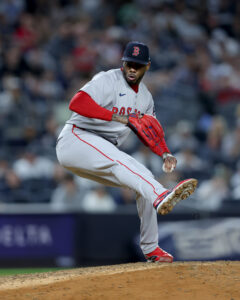 Early in Chapman’s career, it was hardly uncommon for his name to be in the conversation for the best relief arm in baseball at any given moment. The lefty made his big league debut back in 2010 as a member of the Reds and, over his first seven seasons in the majors, pitched to a dazzling 2.08 ERA with an even better 1.88 FIP and struck out 42.6% of his opponents faced. That includes a run of four consecutive All-Star appearances with Cincinnati from 2012-15 and a dominant 2016 season where he pitched to a 1.55 ERA with the Yankees and Cubs before throwing 15 2/3 innings for Chicago in the postseason en route to the first World Series championship of his career.
Upon returning to the Yankees in 2016, however, the then-29-year-old Chapman didn’t look quite as dominant. As he’s moved into his thirties, his numbers have remained strong overall but not quite reached the level he enjoyed in the first few seasons of his career. Across eight seasons from 2017 to 2024, Chapman pitched to a 3.17 ERA with a 2.94 FIP, struck out 37.7% of his opponents, and saw his walk rate creep up from 11.6% to 13.6%. After spending parts of seven years with the Yankees, Chapman bounced between the Rangers, Royals, and Pirates before returning to the AL East as a member of the Red Sox this year. Now that Chapman’s posting results in line with those he put up during his peak, his stretch of bouncing between teams every year and facing uncertainty every offseason has come to an end.
Impressive as Chapman’s 2025 campaign has been, it would hardly be reasonable for the Red Sox to assume this is what they’ll get from the lefty going forward. There’s plenty of year-to-year volatility for even the most elite relievers still in their prime, and that rings true all the more for a hurler with a middling 3.68 ERA over his last three seasons prior to this year who is now looking ahead to his age-38 season. Chapman’s age is surely why his extension is limited to just one guaranteed season. After all, even Kirby Yates‘s dominant 2024 season with the Rangers wasn’t able to secure him more than a one-year guarantee from the Dodgers, while David Robertson had to wait until mid-season in order to land what he viewed as appropriate value for his services.
That aforementioned deal between Yates and Los Angeles is a particularly noteworthy comp for Chapman’s deal with the Red Sox, given that Chapman’s $13.3MM guarantee clocks in just $300K ahead of the guaranteed salary Yates is receiving from L.A. this year. While the agreement clocks in $2.7MM back of the $16MM guarantee the Phillies afforded Robertson last month, it must be noted that the deal between Robertson and Philadelphia comes with a notable asterisk: Robertson will only be paid a pro-rated portion of that deal from his signing in late July until the end of the season, which works out to just over $6MM he’ll actually be paid by the Phillies.
All of that is to say Chapman’s deal falls more or less in line with expectations for an aging closer coming off a dominant season. The specific innings threshold Chapman has to meet in order to vest his 2027 option is not known, and where that threshold ultimately falls will determine how realistic that option vesting truly is. A threshold of 50 innings, for example, would be very easy for Chapman to reach given that he’s cleared that benchmark in every full season of his career except for 2022. A 60-inning threshold would be a much taller order, as while Chapman’s 52 innings of work to date suggest he’ll have a real chance to cross that benchmark for the second consecutive season this year, his 2024 season was the first time he threw that many innings in the regular season since 2015.
Regardless of whether Chapman is sticking around for 2027 or not, his continued presence in the late-inning mix for 2026 should be huge for the Red Sox. Chapman can continue to serve as a veteran presence in a bullpen that figures to be quite young next year, with arms like Garrett Whitlock and Justin Slaten pairing with Chapman in the late-inning mix. One other potential x-factor is Jordan Hicks, who has at times been a dominant closer over the years but has struggled badly this year after opening the season in the San Francisco rotation. Perhaps the Red Sox hoped he could step into the closer role in 2026 when they acquired him as part of the return for Rafael Devers back in June, but Hicks has continued to struggle badly since joining the Red Sox and seems more likely to fight to hold onto his roster spot next spring than for a late-inning role. Bringing Chapman back into the fold should help lessen the club’s reliance on Hicks to bounce back, and if he does turn things around he’d form a lethal back-of-the-bullpen duo with the veteran lefty.
Photo courtesy of Brad Penner — Imagn Images
Red Sox Notes: Houck, Newcomb, Fulmer, Chapman
The Red Sox haven’t approached right-hander Tanner Houck about a contract extension this spring, Houck himself tells Peter Abraham of the Boston Globe. The 28-year-old adds that he’s open to such talks and would be happy to stay in Boston long-term — “I love it here” — but isn’t concerning himself with the lack of extension talks at present.
Houck reached arbitration for the first time this offseason and agreed on a $3.95MM salary to avoid a hearing. That contract came on the back of a breakout 2024 season wherein he pitched a career-high 178 2/3 innings with a 3.12 ERA, 20.7% strikeout rate, 6.5% walk rate, 55.9% grounder rate and 0.55 HR/9 over the life of 30 starts. After having floated between the bullpen in rotation in recent seasons, that career-best performance cemented Houck’s spot in Boston’s rotation.
Injuries to Kutter Crawford, Brayan Bello and Lucas Giolito only further locked Houck into a prominent rotation role. He’ll likely take the ball in the Red Sox’ second game, behind Opening Day starter Garrett Crochet. The rest of the rotation looks a bit different than most would’ve expected heading into camp. Free-agent signee Walker Buehler is locked into a spot, but there’s been a competition for the final two outings that’s taken place as health troubles have arisen.
Jen McCaffrey of The Athletic wrote earlier in the week that right-hander Richard Fitts looked to have the fourth spot in the rotation locked up. The 25-year-old Fitts, acquired from the Yankees in the trade sending Alex Verdugo to the Bronx, has allowed only one run in 10 2/3 official spring innings. He’s punched out 13 of his 31 opponents (31.7%) against four walks (9.8%). Fitts posted a 4.17 ERA, 22.6% strikeout rate and 7.5% walk rate in 116 2/3 Triple-A innings last year and also made a brief MLB debut, pitching 20 2/3 frames with a 1.74 ERA (in spite of a paltry 10.6% strikeout rate in the majors).
More surprisingly, McCaffrey listed veteran Sean Newcomb as a strong candidate to earn the fifth spot. MassLive.com’s Christopher Smith suggests the same, writing that manager Alex Cora said the veteran lefty has “caught our eyes” with an impressive spring of his own. Newcomb, a Massachusetts native, has held opponents to one run on five hits and three walks with 10 strikeouts in 9 2/3 innings. Unlike many veterans around the league on non-roster invitations, Newcomb does not have an opt-out in his contract before the end of camp, Smith notes, so the Sox don’t need to worry about losing him if they opt for someone already on the 40-man roster, such as righty Quinn Priester.
Similarly, veteran reliever Michael Fulmer tells WEEI’s Rob Bradford that his minor league deal with Boston does not have an opt-out opportunity. The former AL Rookie of the Year signed a two-year minor league deal with the Sox in the 2023-24 offseason as he rehabbed from a UCL revision performed in Oct. 2023.
Fulmer didn’t pitch last year while rehabbing that procedure, but the 32-year-old has been outstanding this spring. He’s tossed 9 1/3 innings and held opponents to one run on nine hits and three walks with nine strikeouts. The fact that he can’t opt out is a bit of a strike against his Opening Day chances, particularly if the Sox want to carry a long reliever to support their diminished rotation, but Fulmer has put himself in a nice position to either break camp with the team or get an early-season look.
At the other end of the bullpen, Boston’s ninth-inning picture has been a question for much of the spring. The hope was surely that Liam Hendriks would look closer to vintage form and claim that role as he enters the second season of a two-year contract, but it’s lefty Aroldis Chapman who’s emerged as the favorite for ninth-inning work, Chris Cotillo of MassLive.com writes. Chapman has impressed the Sox with the quality of his raw stuff and has set down 10 of his 23 spring opponents on strikes. Hendriks has been tagged for six runs in five spring frames. Righty Justin Slaten also appears to be ahead of Hendriks on the closer depth chart — at least for the time being.
Certainly, that’s subject to change as the season wears on. Changes in the ninth inning are common, particularly when the frontrunner is a 37-year-old with persistent command issues and a recent injury history of note. Hendriks, Slaten or someone else entirely could wind up handling the bulk of the ninth-inning workload for skipper Alex Cora, but it sounds like Chapman will get first crack, thereby giving him a chance to become just the 14th pitcher in MLB history to tally 350 saves. He currently ranks 16th all-time, sitting just six saves behind Hall of Famer Rollie Fingers.
MLBTR Podcast: Blake Snell, Dodger Fatigue, And The Simmering Hot Stove
The latest episode of the MLB Trade Rumors Podcast is now live on Spotify, Apple Podcasts, and wherever you get your podcasts! Make sure you subscribe as well! You can also use the player at this link to listen, if you don’t use Spotify or Apple for podcasts.
This week, host Darragh McDonald is joined by Steve Adams of MLB Trade Rumors to discuss…
- The Dodgers signing Blake Snell (2:00)
- Baseball fans having Dodger fatigue and deferral fatigue (9:05)
- Are the Dodgers going to make more rotation additions? (14:30)
- The Dodgers extending Tommy Edman (16:25)
- The news of the Red Sox signing Aroldis Chapman breaks during recording (21:30)
- The Mets signing Frankie Montas (26:30)
- The Cubs signing Matthew Boyd (35:55)
- The Rangers signing Kyle Higashioka (43:15)
Plus, we answer your questions, including…
- What would the Pirates have to give to the Red Sox to get Triston Casas? (48:20)
- Why is Cody Bellinger‘s deal so tough for the Cubs to trade? (54:15)
Check out our past episodes!
- Yusei Kikuchi, The Aggressive Angels, And The Brady Singer/Jonathan India Trade – listen here
- The Rays’ Stadium Plans, Diamond Sports, And Some Offseason Rumors – listen here
- Roki Sasaki, Gerrit Cole’s Non-Opt-Out, And Cardinals Rumors – listen here
The podcast intro and outro song “So Long” is provided courtesy of the band Showoff. Check out their Facebook page here!
Red Sox Sign Aroldis Chapman
The Red Sox announced the signing of Aroldis Chapman to a one-year contract. The deal reportedly guarantees the Wasserman client $10.75MM.
Boston becomes the left-hander’s fifth different team since 2022. Chapman is no longer the elite closer he was during his peak with the Reds and Yankees. He’s still an effective, if somewhat volatile, reliever despite scattershot command. He turned in a 3.79 ERA over 61 2/3 innings for the Pirates this year. Signed as a setup option in front of David Bednar, Chapman recorded 22 holds before taking over as closer for the struggling Bednar late in the season. He picked up 14 saves, his highest total in three years, and only surrendered five leads.
Even as he enters his age-37 season, Chapman is one of the league’s hardest-throwing relievers. He averaged 97.8 MPH on his four-seam fastball and 99.8 MPH on his sinker. While Chapman is no longer in a league of his own in terms of velocity, that’s rare arm speed from the left side. Among southpaws with at least five innings pitched, only Jose A. Ferrer and Gregory Soto threw their four-seamers harder on average. Chapman’s sinker velocity led all southpaws and ranked fourth in MLB overall, trailing Emmanuel Clase, Justin Martinez and Seth Halvorsen.
That high-octane stuff continues to lead to plenty of strikeouts. Chapman fanned 37% of batters faced with Pittsburgh. Among relievers with 20+ innings, Chapman ranked eighth in strikeout rate. His 14.7% walk percentage was the ninth-highest mark among that group. Fewer than half of his plate appearances ended with a ball in play. There’ll be a lot of free passes, but Chapman’s stuff is good enough that he still manages to work out of trouble more often than not.
This is the second bullpen pickup of the offseason for chief baseball officer Craig Breslow and the Boston front office. They also brought in Justin Wilson last month to work in the middle innings. There could be room for one more addition with four Sox relievers hitting free agency. They’re expected to let Kenley Jansen walk and could also lose Chris Martin, Luis García and Lucas Sims. Liam Hendriks should be back from Tommy John surgery and is the favorite to replace Jansen as Alex Cora’s closer. Rule 5 pick Justin Slaten should be their top setup option from the right side. Cam Booser and Brennan Bernardino, who had been their top internal lefties, profile as middle relievers rather than high-leverage arms.
Chapman did not place among MLBTR’s Top 50 free agents. That said, he was one of the best available lefties for teams that didn’t want to play at the top of the market for Tanner Scott. He earns a very slight raise relative to last winter, when he signed with Pittsburgh for $10.5MM.
The move brings the Red Sox’s estimated payroll, including arbitration projections, to roughly $148MM (courtesy of RosterResource). Boston is up to approximately $181MM in luxury tax obligations. They’re $60MM shy of the base tax threshold. CEO Sam Kennedy indicated the Sox could exceed the threshold, one of myriad comments from team brass signaling a big offseason. There’ll be a lot more to come from Breslow and company, who are one of five teams known to be involved on Juan Soto and have been tied to every top-end free agent starting pitcher.
Chris Cotillo of MassLive first reported the Red Sox and Chapman had made progress on a deal. Mike Rodriguez confirmed there was a deal in place. Jeff Passan of ESPN reported the contract terms. Image courtesy of USA Today Sports.