
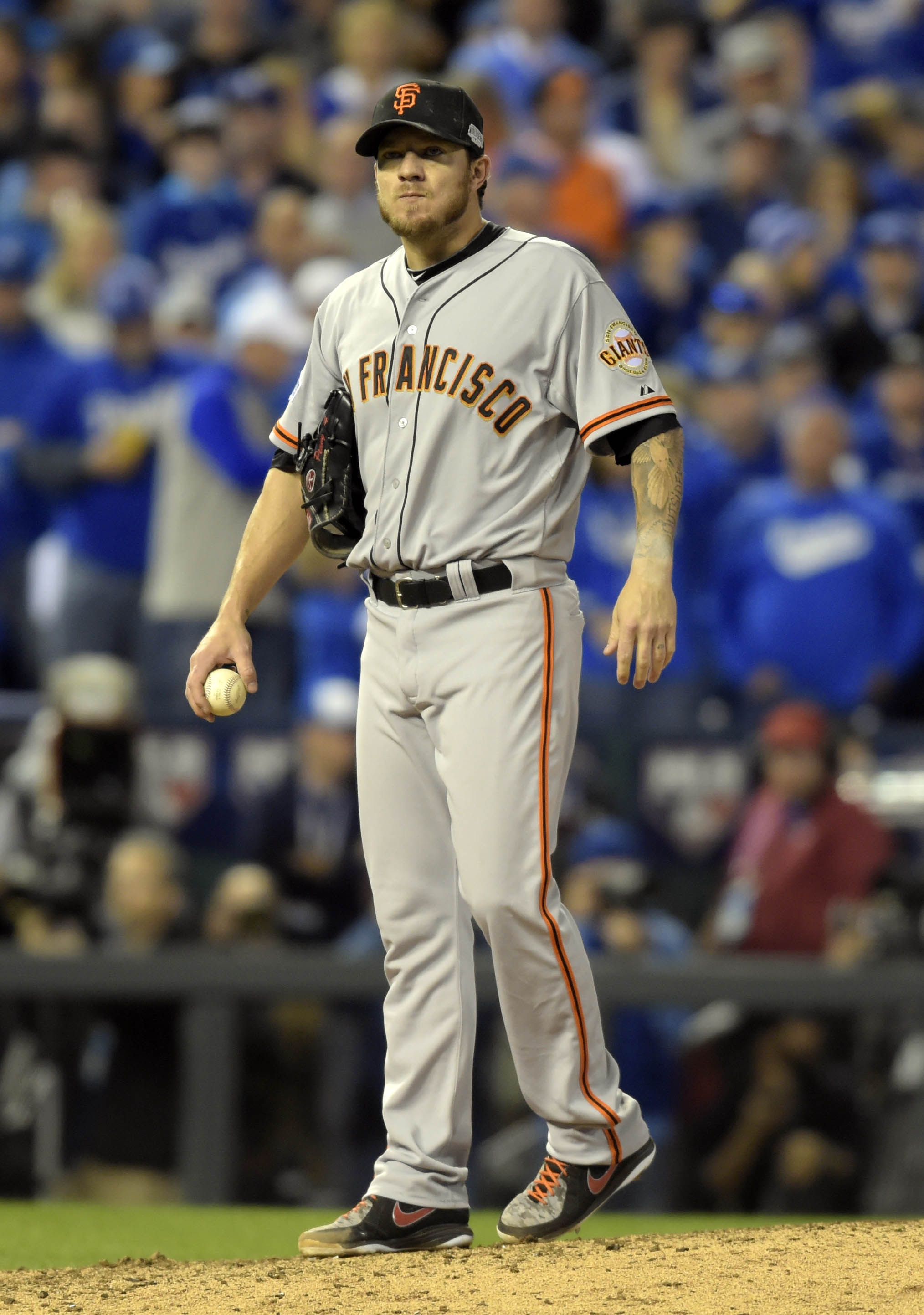
What a difference a few months can make. For Jake Peavy, a former ace turned would-be trusty veteran, a trade deadline deal to the Giants has changed perceptions and, perhaps, his market. Approaching free agency for the first time entering his age-34 season, Peavy now looks to be one of the more intriguing players to watch. (Of course, all eyes will be on him tonight as he takes the hill looking to clinch the World Series.)
Pros/Strengths
Twelve regular season starts with the Giants late this year yielded remarkable results: a 2.12 ERA and 3.03 FIP over 78 2/3 frames. Three more post-season outings have resulted in a 3.68 earned run mark across 14 2/3 innings, with time left for more positive impressions. With a constantly evolving pitch mix and approach, as he explained recently to Eno Sarris of Fangraphs, Peavy may have found an edge in the constantly evolving battle between pitcher and hitter.
Though Peavy is no longer the strikeout threat he once was, he seems to have stabilized in the seven to seven-and-a-half strikeouts per nine range. And he continues to reliably post walk rates below three per nine innings. Though he is not a heavy groundball pitcher, Peavy has generally maintained a BABIP-against at or below .290.
Then, of course, there is Peavy’s impressive pedigree. From about 2004 through 2008, Peavy was one of the best starters in the game, and he has had excellent full-season results as recently as 2012 (3.37 ERA over 219 innings).
Peavy is often cited as a trustworthy veteran who is a positive clubhouse member. An intense competitor on the hill, the righty is certainly the type of player who holds appeal both to veteran-laden contenders and young teams looking to put a role model in place.
Cons/Weaknesses
His late run with San Francisco aside, Peavy has struggled mightily at times in recent years. He put up a 4.17 ERA in 2013 and allowed 4.72 earned per nine with the Red Sox to start the year in 2014. Neither did peripherals paint a much rosier picture, with ERA estimators pegging Peavy as a back-of-the-rotation option at best.
And it is not as if this were an isolated downturn. Sandwiching his solid work in 2012, Peavy had been an average or worse starter over the 2009-11 stretch. That decline can be traced, in part, to steady downticks in Peavy’s average fastball velocity. After working in the mid-90s earlier in his career, Peavy has not even averaged 91 mph since 2010 and just saw his average heater drop into the eighties for the first time.
Declining strikeout rates are one result; in his solid stretch with the Giants, Peavy has maintained only a 6.6 K/9 rate that falls shy of any of his full-season averages. On the year, he struck out just 7.0 per nine, his worst-ever rate. More tellingly, perhaps, Peavy’s K-BB% fell to 11.1%, far and away the worst mark his his 13-year career.
Neither has Peavy been a model of health. He has failed to reach 150 innings in four of the last six seasons. Shoulder and rotator cuff injuries are among his maladies, along with a more recent ribcage fracture. He also missed time due to an ankle injury and, further back, elbow strains. (Peavy has never undergone Tommy John surgery.)
Personal
Often described as a family man, Peavy and his long-time wife Katie have three sons. A native of Alabama, Peavy makes his permanent residence in his home state. Over the years, of course, he has moved from coast to coast, though Peavy has never chosen his own destination (aside from agreeing to extensions with the Padres and White Sox in advance of free agency).
When he is away from the ballpark, according to this aggregated profile, Peavy prefers to spend time in the outdoors. His family lives in a cabin on a substantial spread of land, and he hunts and fishes in his spare time. Peavy also plays the guitar and is a practicing Christian.
Market
In a market loaded with mid-level starters, Peavy occupies a somewhat unique place. He is the oldest of that group aside from Hiroki Kuroda, who is not expected to test interest broadly. In that respect, he probably stands alone to some extent as a solid veteran who can (theoretically, at least) be had on a somewhat shorter commitment.
A client of CAA Sports, Peavy could hold appeal to a variety of clubs that may or may not be as interested in other non-premium starters. More specifically, it is certainly possible to imagine the Giants being interested in a reunion, and the White Sox are another former club that could show interest in a shorter-term arrangement. Otherwise, the Cardinals, Angels, Rangers, Braves, D’backs, and Cubs all could make some degree of sense.
Peavy says he has interest in ending up in the same place as former Red Sox teammate Jon Lester, saying that “there’s a package deal out there for any team.” Choosing a landing spot based more on personal preferences — including, perhaps, re-uniting with Lester or other former teammates — than maximum contract would not be a surprise for Peavy. He said back in 2005 that “money is not why I’m pitching” and backed that up recently when he signed a reasonable extension with the White Sox rather than hitting the market.
Expected Contract
Though some have suggested that Peavy may have pitched his way into a three-year deal in recent months, a two-year contract still seems the likelier outcome — especially if Peavy prioritizes finding a home that suits him for non-financial reasons. Peavy should easily top the two-year, ~$22-23MM contracts given to several veterans last year, and could land a deal on the model of Ryan Dempster’s two-year, $26.5MM pact. Updating that contract for inflation, and accounting for a value boost after Peavy’s success in San Francisco, I predict that he will ultimately fall just shy of his last contract and sign for two years and $28MM.
Peavy should get between 12 and 14 million for 2 yrs, I think the Cubs would be a good spot for him along with either Lester or Shields. You know the Cubs are going to upgrade their pitching this off season.
I think he will have trouble getting 28 MM. I think the Colon/Hudson/Arroyo/Kazmir pact of 2/22 is what he’ll end up with, and it’s also what I think he’s worth. He’s projected for 1.2 fWAR next season (195 IP of 3.66 ERA/3.91 FIP ball) and at his age and the recent struggles, I can’t see him far exceeding that deal. He’s very similar in overall value to Hudson/Colon/Arroyo at this point. Kazmir is better, but has more significant injury concerns. Dempster was more consistent and fit into Boston’s mold very well; plus, Dempster’s contract was an unmitigated disaster.
sounds reasonalble!
Yeah I’d probably put his range over two years at 20-30. So I am toward the high side, and I can certainly understand disagreeing with that.
In the Fangraphs World Series Game Six chat tonight, a commentator pointed out that MLBtr ran their Peavy Profile tonight and predicted 2/28, and both Jeff and Dave took the under, though they didn’t specify a number. I remember previously having seen Dave throw out 2/20, and I think 2/20-25 is realistic. If several options sign early for one team – say, the Cubs signing Lester, McCarthy, and Ervin, or something – early on, leaving many teams for fewer starters, I could see a small bidding war ensue, but I don’t view it as realistic. I basically view 25-30 MM as his ceiling, but don’t see him as realistic to attain his ceiling. I expect more like 20-25 MM. I’ve agreed with the majority of the figures thrown around here, and have largely had similar figures on the ones I did disagree with.
At this point, I view Peavy as inferior to McCarthy, Santana, Lester, Scherzer, Shields, Burnett, Kuroda, Hammel, and possibly a few others. I know Harang had a bad ’13 season, but RA-estimators haven’t been kind to Peavy outside 2012 in the last five years. He’s always been a sabermetric darling, but even those figures have been in sharp decline.
Were I forced to put money on it, I would too, haha. (I know, quite a lot of conviction in this prediction.)
But I ultimately went there b/c he’s got a sub-4.00 ERA and FIP over the last three years, has been tossing nearly 200 IP per, and there are comps like Dempster and Jorge De La Rosa out there. On the open market, it only takes one team, so I don’t think the 2/28 is out of reach.
I do agree it is near his ceiling.
The Giants want to bridge the gap until their starting pitching prospects are ready. I don’t think the Giants would go beyond 2 years, 20 mil. With teams so desperate for pitching, I can see a team going 3 years on him.
I think teams are more desperate for hitting now. Seems anyone can go out and pitch a QS nowadays since hitting is so weak. Pitchers going to have to compete with hitters for teams dollars
Teams want healthy pitchers, though. And depth. I still think a large part of the shift towards pitchers is that many bullpens can run out a Kimbrel, a Chapman, a Jansen, a Holland, Miller, Betances, Gregersen, Doolittle, Perkins, etc. that can shut down the opposing lineup.
I would not give him more than 1/12 with a vesting option for another 12. Nothing more than a back end of the rotation guy now. Perhaps with more value in the NL in a pitcher friendly park. Definitely not for the Cubs at that money, although if he really wants to play with Lester he might have to take 8 + incentives
You might be right about that projection, but if so, the team that signs him will get winner’s remorse. He finished the season hot but he doesn’t seem like he has much left in the tank.
I would be surprised if he got a 2 year deal honestly. Outside of a good 2012 and month and a half with the Giants he’s been very, very mediocre for 5 years now. I could see a desperate team going for 2 years, but I think the odds are he gets a 1 year deal.
126 ERA plus as recent as 2012. That’s better than good.
By ERA-, since 2010: 107, 116, 80, 101, 97. One of these is not like the others.
By FIP-, since 2010: 92, 77, 87, 96, 109. Significantly better, but dramatically trending in the wrong direction.
By xFIP-, since 2010: 94, 87, 97, 102, 111. Also very significantly trending in the wrong direction.
By fWAR, since 2010: 1.7, 3.1, 4.4, 2.4, 1.9. Wrong direction, due to combination of less effectiveness and worse health.
By RA9-WAR, since 2010: 1.3, 1.0, 5.3, 2.0, 2.7. Better, and paints the best picture of his future. I would tend to believe his peripherals more, especially since much of his RA9-WAR (2.0/2.7) comes from 40% of his inning load while in San Francisco.
His Steamer projection for 2015: 3.66 ERA, 3.91 FIP, 195 IP, 13.0 K-BB%, 1.03 HR/9.
He’s a decent back-end arm, and much like Arroyo/Colon/Hudson in pedigree, advanced age, etc. He deserves a 2/22-24 type contract, but 28 is pushing it. Dempster had a better recent track record than Peavy.
Peavy just lost a lot of money with his performance tonight! I think I would take a chance on McCarthy over Peavy at this point in time!
Peavy & Petit both — neither one looks anywhere as strong as they did yesterday.
I don’t believe Petit’s at fault whatsoever. He was thrown into a terrible situation and there were some horrible bounces – Eric Hosmer’s over-the-head double, I’m looking at you – that went Kansas City’s way.
You wouldn’t have done so before tonight? McCarthy is a significantly better free agent, and was before tonight. McCarthy’s issues with securing a huge deal are more focused on health, not effectiveness. He’s much better than Peavy.
100% agree with this. I have Peavy at the bottom of the range of mid-tier guys, with McCarthy towards the top.
This post couldn’t have come at a better time.
I was tipped off that he might be throwing tonight. Figured I’d make it interesting.
I would rather have Garcia… or Iglesias.
Somehow, I think Boston is content losing Iglesias in exchange for its 2013 World Series ring (especially with Bogaerts taking over at shortstop and their likely ability to target Headley, Hanley or Panda). Who knows how much Peavy helped in the long run, but he did net them a nice spec at the deadline this year and they won a World Series with him on their roster. You can’t really ask for more from a 1.5-year rental.
Agree.
But the value to the Tigers and White Sox will start NOW and for the next 4+ years… or more depending on the QO offers they may get at the end of their control and the draft pick if they leave.
That is why is so hard to declare winners and losers of trades like this.
I don’t think you can argue Peavy was really helpful in getting that ring though. They won the division by a solid margin and he didn’t perform well in the playoffs.
We really don’t know how his performance down the stretch (1.3 fWAR in 64 IP) affected Boston’s seeding. Who knows? The Athletics only finished a single game behind them. Do things go the same if Boston has to face Detroit in round one instead of Tampa Bay? Would Oakland advance if they faced Tampa Bay? Would Oakland beat Boston? They would’ve made the playoffs certainly but his contributions down the stretch didn’t hurt in securing the # 1 seed, and that’s not insignificant. He performed poorly in October, but Farrel yanked him early-ish, so it was at least mitigated. We don’t know if they would’ve won without Peavy. We do know they won it all with Peavy on the roster, and that justifies a win-now trade. That he got them a decent prospect also helps. Who knows if six years of Escobar outvalues three of Iglesias? And again, they had Stephen Drew at SS and Bogaerts played extremely well in October. The trade was definitely worth it IMO for Boston.
I’d be afraid with what I was getting with Peavy. Is he the guy had a 4.72 era with the Red Sox this year, or the guy who had the 2.17 era with the Giants this year? If you split the difference you’d be fine, but if he pitches more like he did with the Red Sox, 2 years could be a nightmare.
Or, quite possibly, is he the guy with varying batted ball luck throughout the last half decade who has been in decline based on his peripherals. He is neither a 4.7 ERA pitcher or a 2.2 ERA pitcher, but I know you probably knew this. He’s likely a 3.7-4 ERA pitcher. Or average-ish.
I’d put him at a four. Painfully average. His bad batted ball luck with the Red Sox this year was a direct result of getting way too much of the plate. He’s be a descent number four or five, but I don’t know too many teams that are willing to pay 28 million dollars for two years of that.
Do you think his horrible World Series will de-value him?
I’m not sure it will have a huge impact, but it certainly won’t help.
I doubt it. Two starts don’t change what you think Peavy is going forward. They haven’t changed his actual talent level. He’s a streaky pitcher, and that’s basically that.
It might be the difference for a bubble team looking to get into the playoffs versus a team that believes it has the talent to go deep into the playoffs.
He’s had a bad history at Kauffman, so really no surprise
I may be totally wrong, but I sense a change in philosophy among GMs where stars (or at least steady veterans) on the downside of their career may be going out of style. Formerly unknown fringe players who suddenly have things click seem to have an equal chance of success at a fraction of the cost. Peavy will likely get a decent two or three year deal, but I don’t think his value has increased that much since the trade to the Giants..
I think Peavy’s postseason work will impact his contract. The Braves and Cardinals have been linked to him, and Peavy has talked glowingly about the Cardinals. Why would they sign a pitcher who cannot help them if they reach postseason play, especially the World Series. Peavy has proven he is not an American League pitcher, which has been demonstrated against Kansas City again. Just take a look at his stats as per Baseball Reference: lifetime ERA of 3.23 in the NL and 4.13 in the AL; or for the “advanced” stats people, lifetime WAR of 26.8 over all/parts of 9 NL seasons and 10.4 over all/parts of 7 AL seasons. Do I want him back with my Giants? No, especially if he does reach the 2/$28 million level.
I don’t think that shows an NL/AL difference. Most of the NL numbers come from earlier in his career when Peavy was a much better pitcher. Also, Peavy is an extreme fly ball pitcher. For years he called Petco Park home, which suppresses home runs at an extreme rate. AT&T even more so the last few years.
In the AL, he was in parks that were really ill-suited for his style. U.S. Cellular Field is the 2nd most extreme hitters park in baseball, according to ScoutingBook. Fenway is #10.
His Postseason stock went from Apple to Enron in the World Series.
Might be worth mentioning that Peavy is legally blind without corrective lenses.