
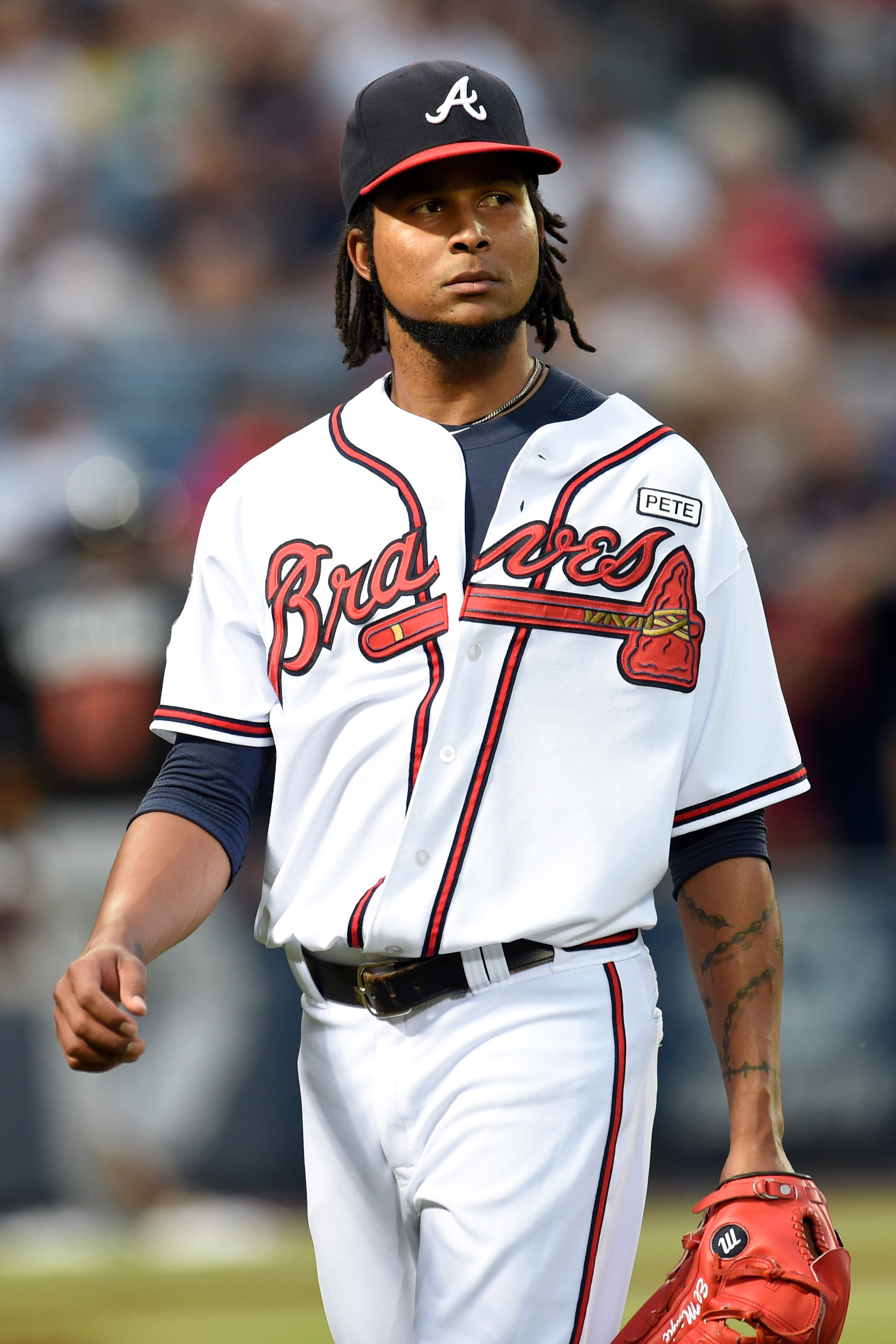
Ervin Santana‘s 2013-14 offseason did not go as planned following a strong 2013 campaign. After spending all winter searching for a strong multiyear deal, he settled for a one-year deal with the Braves in March matching the qualifying offer amount of $14.1MM. Turning down a qualifying offer from the Royals was considered a major factor in Santana’s disappointing market, as teams did not want to pay full price while surrendering a draft pick. Now, after another solid season, Santana must navigate the free agent market again, potentially with another qualifying offer.
 Strengths/Pros
Santana missed over a month in 2009 with a UCL sprain in his pitching elbow, but his agents presented teams with a statement from Dr. James Andrews last offseason in which the surgeon noted, “He doesn’t need any further treatment for his right elbow partial UCL tear, as on (the) MRI today it appears that it has completely healed.”
Santana had another healthy season despite signing late, and it might be enough to put the elbow concern to rest. In fact, he’s been quite durable, making at least 30 starts in each of the past five seasons and posted a sub-4.00 ERA in four of those campaigns. Though his first big league start didn’t come until April 9th, Santana still ranked 11th among free agent starters with 196 innings. Santana’s average of 6.32 innings per start ranked fifth among free agents.
Santana struck out 8.2 batters per nine innings in 2014, his best mark since 2008. That ranks fourth among free agent starters. Some of that can be attributed to moving to the National League and striking out pitchers, though Santana also increased his strikeout rate against non-pitchers. And despite a reputation as being fairly homer-prone, Santana allowed only 0.73 HR/9, fifth among free agent starters.
Santana’s 3.63 SIERA bettered his 3.95 ERA, and the skill-based estimate might be a better way to project what he’ll do next year. Only five free agent starters topped Santana’s 2.8 wins above replacement. After the Big Three of Max Scherzer, Jon Lester, and James Shields, there’s a case for Santana as the top pitcher in the second tier.
Weaknesses/Cons
One of the biggest cons for Santana is a potential draft pick cost, if he receives and turns down a $15.3MM qualifying offer from the Braves. More on that later.
Santana is relatively hittable, having allowed 8.9 hits per nine innings this year. Perhaps that was a fluke, given a .319 batting average on balls in play. Still, left-handed hitters batted .283 against Santana this year, and they also hit him hard in 2012.
As Fangraphs’ Mike Petriello pointed out this month, no right-handed starter has thrown sliders more often than Santana over the past two years (nearly 36% of the time). The pitch is generally considered to be hard on a pitcher’s elbow, even if Santana has proven himself to be durable. Any team entertaining signing Santana to a multiyear deal will be more concerned with what will happen moving forward.
While Santana did a nice job limiting the longball this year, his 8.8% home run per flyball rate wasn’t in line with his career norm and his 42.7% groundball rate wasn’t anything special. If his HR/FB returns to normal, he’ll return to being the pitcher who allowed 1.26 home runs per nine innings from 2010-13.
Personal
Santana looked up to Pedro Martinez as a boy growing up in San Cristobal in the Dominican Republic, and was signed by the Angels at age 17. He’s now married with two children. Jesse Sanchez’s MLB.com article and video from September 2013 gives great insight into his family life. Santana is described by his wife as a quiet yet silly guy who enjoys playing with his children.
Market
In my estimation, the second tier of free agent starting pitching this winter includes Santana, Kenta Maeda, Brandon McCarthy, Francisco Liriano, Justin Masterson, Jake Peavy, Hiroki Kuroda, and Jason Hammel. Of those eight, only Santana, Liriano, and Kuroda are even eligible to receive qualifying offers. Kuroda could retire, and even if he doesn’t he would be extremely picky where he plays.
After speaking to rival executives last month, ESPN’s Buster Olney predicted Santana would receive a qualifying offer from the Braves, while Liriano would not receive one from the Pirates. So there’s a very real scenario where Santana is the only second-tier pitcher to receive a qualifying offer. Even if some teams feel he’s the best pitcher in this tier, they could certainly turn to someone they rank lower who will not require draft pick forfeiture.
The qualifying offer situation muddies Santana’s free agency again, making it difficult to predict which teams will be involved. If he receives and turns down a QO, he’ll be a better fit for teams with protected first rounders like the Cubs, White Sox, Phillies, Red Sox, Twins, Astros, Rockies, Rangers, and Diamondbacks. The draft pick forfeiture would further be minimized if one of those teams first signs another player who turned down a QO, meaning Santana would only require forfeiture of a third-round pick. The Twins pursued Santana last winter and still need starting pitching. I don’t think a QO will kill Santana’s market, and certainly teams without protected first rounders will have interest. The Marlins, Yankees, Tigers, and Giants could get involved. The Blue Jays, Orioles, and Mariners were in on Santana last winter, but their needs may have changed.
Santana could also return to the Braves in 2015, as the team faces uncertainty in the rotation after Julio Teheran, Alex Wood, and Mike Minor.
Expected Contract
The Braves’ best chance of retaining Santana might be if he accepts a qualifying offer, which I find unlikely. Santana would not risk much by turning down a QO — last winter showed that a one-year deal near the qualifying offer value will probably be out there all winter and into Spring Training.
Obviously Santana does not want a repeat of that scenario, so it will be important for agent Jay Alou to set proper expectations. One year ago, MLBTR’s Steve Adams predicted a five-year, $75MM deal for Santana, and I agreed. Edwin Jackson‘s four-year, $52MM seemed like the floor. In November of 2013, Ken Rosenthal of FOX Sports reported Santana’s asking price was in excess of $100MM over five years, with Jon Heyman of CBS Sports pegging the price at $112MM over five. A week later, agents Bean Stringfellow and Joe White (who no longer represent Santana) showed Rosenthal the binder they created to showcase their client, which they felt made the $100MM case partially through an ill-conceived comparison to Zack Greinke. Stringfellow later denied asking for five years and $112MM, but it seems likely that he, White, and Alou started off too high for Santana, and once expectations were adjusted into the Edwin Jackson range, it was too late. Santana’s one-year deal was not owed entirely to the qualifying offer.
Now only Alou remains, and he should at least be able to score the now-standard four-year, $50MM deal this time. As I think Santana will be plenty appealing even with another qualifying offer, I’m predicting a four-year, $56MM deal this time around. Combined with the 2014 one-year deal, Alou would be able to say he ultimately got Santana five years and $70MM, not far off Steve Adams’ original estimate from last offseason.
“I’m predicting a four-year, $56MM deal this time around. Combined with the 2014 one-year deal, Alou would be able to say he ultimately got Santana five years and $70MM, not far off Steve Adams’ original estimate from last off-season.” Mularkey- Could Alou really say that with a straight face? I think Santana could say he earned that contract by pitching relatively well 2 seasons in a row. I hope it’s a big ballpark for Santana that’s for sure.
Alou could at least make that case.
Agents will be agents. “Mularkey” was too strong of language and it wasn’t a shot at the moderator even though I mistakenly made it sound that way. I was thinking of Alou even claiming it after leaving his agency. Sure Alou can claim it and I’m sure it will help him get clients. Still who knows where Santana would be if Medlen’ s elbow never popped at the moment it did. Perception is reality I suppose and if agents are good at anything it’s shaping perception in advance.
I don’t think predictions work that way. Predicting 5/75 last offseason isn’t the same as predicting 1/14.1, 196 IP of 3.63 SIERA ball to silence some doubters, then 4/56 this year after the market is already set this time around. 5 years @ 15 MM per year last offseason would’ve taken assumptions about how the market would develop. A year later, GMs know more about how the market is going to develop. It’s apples to oranges because Santana still had to pitch on a one-year deal with an uncertain future and prove 2012 was the outlier, not 2013.
That said, I do agree with the 4/50-60 ballpark for Ervin’s new contract, and I also can’t believe if the predicted 56 MM contract comes to pass that Ervin Santana will earn at least 113 MM in MLB salary, unless he retires before the end of the contract or something.
Came in for the Pedro Martinez mention but clicked on Edwin Jackson’s stats out of curiosity and now my mind is blown that he was born in Germany.
What is more mind blowing:
1. He was traded (with some others involved) for Max Scherzer.
2. He owns perhaps the least impressive no hitter of all time. Look up the stats for that game.
I think AJ Burnett’s was less impressive. 9 walks, 1 hit batter and 65 strikes to 63 balls. But a no-hitter none-the-less. Which is 1 more walk and 20 fewer pitches than Jackson
Santana has to be one of the more baffling and sometimes frustrating pitchers to watch. He has ace stuff but has a tendency to give up the long ball. In fact, if you look at his 2012 campaign, which many thought was his worst season, his peripherals were not much different from previous good seasons. But he have up a ton of HR’s that year and it ruined his season. His improvement in 2013 was pretty much about harnessing the long ball. Nice to see his K rate back to where it was during his best season. I say he’s worth the gamble for a team that needs a durable #3 starter to log innings. That’s the one thing Santana has always been able to offer, even if it’s a not so good season.
Do you really think there’s a good possibility of the Santana accepting the QO? Could really throw off the Braves offseason financially.
I’m curious to see if the Braves even risk offering it because of the potential financial handcuffing. $15mil for a guy that’s only their 3rd best starter (at best) on an extremely offensively challenged team isn’t great resource allocation. Any idea if you can quickly turn around and trade a guy that accepts a QO?
Braves did it with Rafael Soriano not too long ago in the Jesse Chavez trade…not sure if the QO rules have changed since that time, but it was at one point doable.
That’s what came to my mind but like you said, the system has changed since then. If they can still trade him if he accepts (albeit for a weaker return because money) then that’s better than nothing.
Personally i think theres a real chance the Bravos dont give Santana a QO, based on the danger that he was burnt last year by it, leaving a small (yet possible) chance he might take it this year, leaving them paying over $15m for a guy who put up only just a tad more than 1 WAR last year.
If they offer it, he takes it, they definitely handcuff themselves on the offensive spending they need (a point TDKnies already made) and may then have to rely on the trade market to shore up that end.
Ultimately however i agree with the approximate 4/50 guesses, because he is proven, he is durable (last time he started less than 30 games was 2009) and, frankly, hes a better pitcher than Jackson and we know what he got, albeit in a different market.
But yes, i return to my opening line, ive got a real feeling the Braves may NOT go with a QO, something Santana would probably himself approve of.
Another interesting FA case.
I think the QO kills Santana’s market. That combined with what happened last year to him, I think he would take the QO.
In that case Braves would have to trade him which is not a bad idea. He does have trade value at 1 yr 15 mill.
One thing I’m sure of, is that the Braves will not keep him
Tigers lose Scherzer. Price not interested in an extension. Could this be Plan C?
They’re are so many options to fill in that last spot. I could easily see Ervin or Liriano, Masterson or even a trade. Ultimately, worst case scenario they have a competition like in 2012, which wouldn’t be so bad.
The Braves have never had a super large payroll. If they give Santana a QO, there is a chance he’d take it. Can they afford tying up $15MM in Santana with their arbitration costs going up and not being able to move BJ Upton?