
Athletics Recall Gunnar Hoglund For MLB Debut
May 2: The Athletics have recalled Hoglund and optioned fellow righty Carlos Duran to Triple-A in his place, per a team announcement.
May 1: The A’s are set to promote pitching prospect Gunnar Hoglund for his major league debut, reports ESPN’s Jeff Passan. He’s already on the 40-man roster, so they’ll only need to open a spot on the active roster.
Hoglund, 25, was the 19th overall pick by the Blue Jays out of Ole Miss back in 2021. He landed with the Athletics as the headline prospect in the trade that sent Matt Chapman to Toronto. Hoglund’s path to the big leagues has been slowed by Tommy John surgery, but he pitched a full minor league season in 2024 and has been terrific through six Triple-A starts so far in 2025.
The elbow injury, plus some dip in velocity and diminished rate stats, prompted Hoglund’s stock to decline a bit in recent seasons. He still ranked 14th among A’s prospects at MLB.com heading into the season and 16th at Baseball America, but the general outlook had been that he profiled more as a back-of-the-rotation arm at this point.
That outlook has improved rapidly in 2025, however. After sitting 91.7 mph with his heater last year, Hoglund has seen his average fastball jump to 93.6 mph in 2025, per Statcast. His swinging-strike rate hasn’t made any substantial gains, but his overall strikeout rate is up from 22.7% last year to 26.1% this season. ESPN’s Kiley McDaniel wrote today that while Hoglund didn’t rank among his top-10 A’s prospects prior to the season, the early jump in his stuff has propelled him back to the No. 2 spot on his ranking of the A’s system, trailing only first baseman Nick Kurtz.
The improved stuff has led to improved results, at least in the earlygoing. Hoglund posted a 3.44 ERA, 22.7% strikeout rate, 7% walk rate and 39.1% grounder rate in 130 2/3 innings last year — with most of those innings coming in a pitcher-friendly Double-A setting. Despite pitching in an extremely hitter-friendly Triple-A Pacific Coast League this year — the same league in which he posted a 5.88 in five starts down the stretch in ’24 — Hoglund has delivered a 2.43 ERA, 26.1% strikeout rate, 6.1% walk rate and 44% ground-ball rate.
Adding a couple ticks to his fastball isn’t likely to put Hoglund on an ace trajectory, but there’s a notable gap between projecting as a mid-rotation arm and a more fungible fifth starter. With the arrow pointing up, the A’s will hope that he can now profile as more of the former. Beyond the velo jump, Hoglund has also begun to incorporate a sinker into his repertoire and has largely scrapped his slider in favor of more curveballs and changeups. He’s always had plus command, and the revamped and revitalized arsenal is reason for some optimism. McDaniel noted in his update on the A’s system that Hoglund now looks “the way he did at his best at Ole Miss.”
The A’s have effectively been working with four starters for the past couple weeks. Joey Estes has already been optioned to Triple-A after a pair of nightmarish starts to begin his season. Fellow righty J.T. Ginn hit the injured list with elbow inflammation a bit more than a week ago. Lefty Jacob Lopez got the nod in Tuesday’s game against the Rangers but was optioned to Triple-A after Texas tagged him for three runs in a 2 2/3-inning start during which he issued three walks.
Hoglund will step into the rotation alongside Luis Severino, Jeffrey Springs, JP Sears and Osvaldo Bido. Each of Severino, Sears and Bido has produced solid or better results. Springs had a decent start but has been torched for nine earned runs in his past 8 1/3 innings, ballooning his earned run average to 6.04.
On the whole, A’s starters rank 26th in the majors with a collective 4.66 ERA. Plugging Hoglund into the mix could be a nice boon. Getting a consistent fifth starter into the mix would ostensibly benefit the bullpen, which has the eighth-highest ERA in MLB (4.51), a reprieve as well.
In terms of service time, enough has elapsed in 2025 that Hoglund won’t accrue a full year even if he’s in the majors to stay. In that scenario, he’d finish the year with 151 days of service, putting him on track to be arbitration-eligible four times, rather than the standard three, as a Super Two player. The first of those trips through the arb process would come in the 2027-28 offseason, and he’d be under club control through 2031. Of course, being optioned to the minors at any point in the future could change either of those timelines, but the club’s hope will be that Hoglund’s minor league days are behind him. The A’s stockpiled a massive number of arms in their prior rebuild, but Sears is the only one who’s proven himself in the majors so far.
Giants To Sign Daniel Johnson To Minor League Contract
The Giants are expected to sign outfielder Daniel Johnson to a minor league contract, reports Shayna Rubin of the San Francisco Chronicle. The former big leaguer opened the season with the Mexican League’s Caliente de Durango.
Johnson, 29, has posted comical numbers in the Mexican League’s supercharged run-scoring environment. He’s hitting .429/.512/.943 with five homers and three doubles through 41 plate appearances (10 games). It’s outrageous production, but readers should bear in mind that the league-average ERA in the Mexican League this year is a sky-high 5.77. The league-average batting line currently sits at an eye-popping .292/.369/.461. Johnson’s numbers remain excellent, of course, but comparing them to the levels of offense one might expect in affiliated ball would be misleading.
A fifth-round pick of the Nationals back in 2016, Johnson was traded to Cleveland in 2018’s Yan Gomes deal. He reached the bigs with Cleveland in 2020 and 2021, and he appeared in a single game with the Orioles just last year, tallying only one plate appearance. Johnson has just 95 big league plate appearances to his credit, during which he’s posted a .200/.242/.333 slash.
While those numbers clearly don’t stand out, the lefty-swinging Johnson has a better Triple-A track record. In parts of five seasons there, he’s a .255/.324/.446 hitter. That includes 500 plate appearances of league-average offense with the Orioles’ Norfolk affiliate last year (.259/.320/.448) and a stronger .296/.384/.583 performance with the Padres’ El Paso club back in 2023.
The Giants don’t have an immediate need for help in the outfield. Each of Heliot Ramos, Jung Hoo Lee and Mike Yastrzemski is enjoying a productive season at the plate — the latter two in particular (although Ramos has been on fire himself the past two weeks or so). Twenty-three-year-old Luis Matos is on hand as a seldom-used fourth outfielder at the moment. Depth options on the 40-man roster but down in Triple-A include Wade Meckler, Grant McCray and former shortstop prospect Marco Luciano, who’s been deployed strictly as a left fielder in 2025.
Johnson will add some further depth to that group. He’s played center field exclusively in Mexico this season but has 1200+ innings at all three outfield spots in his professional career.
Mets To Promote Blade Tidwell
The Mets are planning to select the contract of right-handed pitching prospect Blade Tidwell, as first reported by Daniel Wexler. He’ll join the team in St. Louis this weekend. The Mets currently have Sunday’s starter listed as TBD, and Mike Puma of the New York Post reports that Tidwell will make that start.
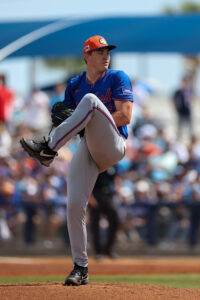
Tidwell, 23, was the Mets’ second-round pick in the 2022 draft. The former University of Tennessee standout is currently ranked among New York’s top-15 prospects both at Baseball America and at MLB.com.
The 6’4″ Tidwell is in his second run through the Triple-A level. He’s started the 2025 season with a rough-looking 5.00 ERA but much more appealing rate stats: a 31.6% strikeout rate, an 8.5% walk rate, a 38% ground-ball rate and a 0.67 HR/9 mark. Tidwell is averaging 96 mph on his four-seam fastball, up from last year’s 94.7 mph average, and has seen his swinging-strike rate jump from 11.6% to 14.5%. Fielding-independent metrics (3.17 FIP, 3.79 xFIP) feel Tidwell has been far better than his earned run average, which is currently skewed by a .369 average on balls in play.
Tidwell cruised through the low minors before struggling in his first brief stint in Double-A in 2023. He opened the 2024 season at Double-A and breezed through opponents in his second go-around before being bumped to Triple-A midway through the year. He was hit harder and struggled with his command in 17 starts there last year. Even with a 5.00 ERA, this year’s rate stats suggest that Tidwell is making gains in his second crack at Triple-A, just as he did in Double-A.
It’s likely that Tidwell’s initial call the majors will be a one-off. Even with an injury-ravaged rotation that’s seen Sean Manaea, Frankie Montas and Paul Blackburn hit the injured list already, the Mets have five healthy starters in Clay Holmes, Kodai Senga, David Peterson, Tylor Megill and Griffin Canning. Incredibly, all five have an ERA of 3.06 or lower. No team in the game is even close to the Mets’ MLB-leading 2.24 rotation ERA.
The Mets currently have a full 40-man roster, so they’ll need to make a corresponding moves on both the 26-man and 40-man rosters. Outfielder Jose Siri (fractured leg) and left-hander Danny Young (elbow sprain) are both 60-day IL candidates, so the Mets don’t necessarily need to designate someone for assignment in order to clear a path for Tidwell’s first big league promotion.
Royals Release Nick Gordon
The Royals have released infielder/outfielder Nick Gordon, who’d been with their Triple-A affiliate in Omaha, per the transaction log at MiLB.com. He’s free to explore opportunities with other teams.
Gordon, 29, has spent time with the Triple-A affiliates for both the Orioles and Royals already in 2025. Kansas City acquired him from Baltimore in exchange for cash early in the season. He’s tallied 20 games on the whole and turned in a .270/.333/.333 batting line with an 8.7% walk rate and 31.9% strikeout rate in 69 trips to the plate.
Selected with the No. 5 overall pick by the Twins back in 2014, Gordon hasn’t lived up to his prospect status but has seen action in parts of four MLB seasons — including a particularly solid 2022 run with Minnesota (.272/.316/.427 in 443 plate appearances). That solid year has been an outlier in his big league career, however. Gordon carries a lifetime .243/.283/.386 batting line in the majors and hit just .227/.258/.369 in 275 plate appearances with the Marlins last year.
Gordon was originally a shortstop but has greatly expanded his defensive profile as his professional career has progressed. He’s now seen significant time at shortstop, second base and across all three outfield spots. He was near-exclusively an outfielder in Miami last season, logging only 15 innings at second base. Though shortstop was his original position, it’s now generally regarded as his worst; he’s played only 4 1/3 innings there — majors and minors combined — since Opening Day 2023.
Yasmani Grandal Not Planning To Use Opt-Out In Red Sox Deal
Veteran catcher Yasmani Grandal has a May 1 opt-out in his minor league contract with the Red Sox. He’ll pass on that chance to return to the open market and remain in the organization despite not being selected to the big league roster today, per MassLive’s Chris Cotillo. He’ll remain in Triple-A as a depth option for Boston, at least for the time being.
Grandal is out to a nice start in his brief time with the organization. Signed to a minor league pact back on April 10, the 36-year-old has appeared in seven games and gone 6-for-24 with three doubles and a homer in 29 plate appearances. That’s a .250/.379/.500 batting line, which could put him in line for a big league look sooner than later, even if he won’t be called up immediately. Cotillo adds that the Red Sox are expected to be amenable to granting Grandal his release if a big league opportunity presents itself elsewhere.
The switch-hitting Grandal has been a consistent presence in the big leagues dating back to his 2012 debut. He spent the 2024 campaign with the Pirates — his fifth MLB club — and enjoyed a nice season in a part-time role. Appearing in 72 games and tallying 243 plate appearances, Grandal slashed .228/.304/.400 with nine home runs, a 9.9% walk rate, an 18.9% strikeout rate and his customary brand of framing-focused defense behind the plate. He only thwarted six of 72 stolen base attempts against him (8.3%), but he was excellent at manipulating the strike zone and drew positive grades for his ability to block balls in the dirt.
The Red Sox lost starting catcher Connor Wong to a broken finger early in April. That left them with the inexperienced tandem of Carlos Narvaez and Blake Sabol behind the plate. Seby Zavala, their most experienced option in Triple-A prior to signing Grandal, hit the minor league injured list with an oblique strain in mid-April as well. The subsequent results behind the plate have not been pretty. Narvaez is hitting .218/.274/.385 (81 wRC+) in 84 plate appearances. Sabol is hitting .125/.167/.188, albeit in only 18 plate appearances.
Sabol has been used as a true backup to Narvaez, in part because of concerns regarding his glovework. He’s just 1-for-21 in throwing out runners in the majors dating back to 2024 (1-for-11 this season). Narvaez opened the year with similar struggles, but he’s quieted some of the throwing concerns by following up a 1-for-8 start to catch four of the past nine runners who’ve taken off against him.
With or without Grandal, the Sox should have help on the horizon. Wong began a minor league rehab assignment in Triple-A on Sunday and has now appeared in two games. He’ll presumably need several more before he’s cleared to return, but it seems as though he might only end up missing around a month (or perhaps a slight bit more) in total with the injury.
The 28-year-old Wong slogged through an ugly start to the season, hitting just .087/.192/.087 in 26 plate appearances (2-for-23), but he hit .280/.333/.425 as Boston’s primary catcher in 2024. That’s the only season of Wong’s young career in which he’s delivered above-average offense — or even just average offense — over any meaningful sample. He’ll need to prove that wasn’t a fluke, but he’s the best option for the Red Sox for the foreseeable future. If Wong can’t get back to something close to that 2024 form, it’s easy to envision the Red Sox seeking catching help at this summer’s trade deadline. After trading Kyle Teel in the offseason Garrett Crochet blockbuster, Johanfran Garcia is the only catcher among Boston’s top 30 prospects at Baseball America or MLB.com. He’s 20 years old and has yet to play above A-ball.
Diamondbacks Place Justin Martinez On 15-Day IL, Transfer A.J. Puk To 60-Day IL
The D-backs announced Thursday that they’ve placed closer Justin Martinez on the 15-day injured list due to right shoulder inflammation. Lefty Jose Castillo‘s contract was selected from Triple-A Reno to take his spot on the active roster. Fellow southpaw A.J. Puk moves from the 15-day IL to the 60-day IL to create 40-man roster space for Castillo.
Martinez was set for an MRI this morning after experiencing an alarming velocity drop over the past week. He’s gone from averaging triple digits on his power sinker to sitting just 93.5 mph in his most recent appearance. Though the right-hander claimed he felt 100% healthy, he’ll head to the injured list with a still-vague injury designation. The D-backs will surely provide more information on his status and potential timeline later today.
This slate of injury-related moves is a brutal blow for a D-backs team that spent much of the offseason looking for established bullpen arms but wound up making generally smaller-scale moves. Martinez and Puk are the team’s two best relievers and entered the year as the favorites to work in save and high-leverage hold situations. They’re both on the shelf, and while Puk’s flexor strain won’t require surgery, today’s move to the 60-day IL only further underlines the fact that Arizona is going to be without him for quite some time.
Martinez, 23, averaged 100.2 mph on his sinker in 2024 and averaged better than 100 mph on the pitch in each of his first eight appearances this year. A dip into the 97-99 mph range over his next three outings was concerning but not necessarily cause for full-fledged alarm. Last night’s drop all the way to 93.5 mph, in an outing where he faced three hitters and allowed two walks and a home run, is another story entirely.
It’s become an ominous situation for D-backs fans to monitor, and one that’s compounded by Puk’s absence. Martinez broke out with a 2.48 ERA, 29.5% strikeout rate, 11.7% walk rate, 58.9% ground-ball rate, eight saves and seven holds across 72 2/3 innings for the Snakes last year. He clearly has some command issues, but the elite velocity coupled with plus strikeout and ground-ball rates helped to mitigate that bloated walk rate.
The D-backs, clearly bullish on Martinez’s future, signed him to a five-year, $18MM extension during spring training. The contract contains a pair of club options for the 2030-31 seasons, which would’ve been Martinez’s first two free agent years. At the time, there was little reason to fear an injury (beyond the general attrition rate of pitchers in today’s game). Now, the outlook is far hazier.
Were Puk healthy, the Diamondbacks would surely have just plugged him into the closer’s role and moved forward with Kevin Ginkel setting up. But Puk hit the injured list with elbow inflammation after a strong eight-inning start to his 2025 season, and a subsequent MRI revealed a flexor strain that’ll require a notable shutdown period.
With Martinez and Puk both shelved, the D-backs will likely turn closing duties over to a combination of Ginkel and Shelby Miller, who returned to Arizona on a minor league deal this offseason and has been outstanding after earning a job this spring. Ginkel only just returned from his own bout of shoulder inflammation, which sidelined him for the first month of the season. From 2022-24, he pitched a combined 164 2/3 innings with a 2.95 ERA, 26.1% strikeout rate and 7.9% walk rate. Miller has pitched 12 2/3 scoreless innings in his return to Phoenix, punching out a gaudy 31.9% of opponents against an 8.5% walk rate.
The 29-year-old Castillo isn’t likely to replicate the type of results that could’ve been expected from either Martinez or Puk, but he’s a reasonably experienced southpaw who’s had some prior success in the majors. Back in 2018-19, the southpaw looked to be breaking out as a viable bullpen arm for the division-rival Padres, pitching to a combined 3.23 ERA with a 35% strikeout rate and 8.4% walk rate in his first 39 big league innings.
Injuries have blown up Castillo’s career since. He suffered a torn ligament in his hand that cut his 2019 season short. A torn lat wiped out his 2020 season. He underwent Tommy John surgery in 2021 and missed most of the 2022 season as a result. It’s a staggering run of unfortunate maladies for the southpaw, but he’s shown some encouraging signs since joining the D-backs on a minor league deal last year.
In 24 innings between Arizona’s Rookie-ball and Triple-A affiliates last year, Castillo notched a 3.75 ERA. He whiffed 24.1% of his opponents and issued walks at an 8.1% clip with Triple-A Reno. This year, he’s started out by holding opponents to a run on four hits and no walks with seven strikeouts in 5 1/3 frames. Castillo has had an arduous grind to get back to the majors after pitching just two MLB frames from 2019-23. He’s now poised for his first real look in a bullpen since 2018, despite accumulating four years of MLB service time through his various stints on the 60-day injured list.
Because he only has four years of service, Castillo could be a multi-year option for Arizona if he can get back to his early career form. Enough time has already elapsed that he won’t be able to reach five years of service before the conclusion of the 2025 season. That means even if he’s back in the majors for good — and that’s far, far from certain — he can be controlled through the 2027 campaign via arbitration.
Mets Select Genesis Cabrera, Ty Adcock
10:30am: The Mets announced that Minter and right-hander Frankie Montas have been transferred from the 15-day IL to the 60-day IL, which opens a pair of 40-man spots for Cabrera and Adcock. Montas, like Minter, is dealing with a lat strain. His occurred during spring training, however, and the team’s hope is that he can be ready to join the rotation early this summer. He’s already spent 35 days on the IL, however, and the move to the 60-day list does not reset that clock.
9:20am: The Mets announced Thursday that they’ve selected the contracts of left-handed reliever Genesis Cabrera and right-handed reliever Ty Adcock. Lefty Brandon Waddell and righty Chris Devenski were optioned to Triple-A Syracuse to clear spots on the active roster. The Mets haven’t announced corresponding 40-man moves yet but noted in their announcement that those transactions will be revealed later today. A.J. Minter and Danny Young are both facing lengthy injury absences, so they may be moved to the 60-day injured list to open those 40-man spots. Devenski has presumably agreed to be optioned since he has at least five years of major league service time. Such players can’t be optioned to the minors without their consent.
The southpaw contingent of the Mets’ bullpen has been wiped out in a span of a few days. Up until recently, they had both Minter and Young available. Minter had a 1.64 earned run average through his first 13 appearances. Young’s 4.32 ERA through 10 outings was less impressive but he had a huge 35.1% strikeout rate and 63.2% ground ball rate, as well as a solid 8.1% walk rate. His .450 batting average on balls in play and 61.5% strand rate were both on the unlucky side, which is why his 1.40 FIP and 1.75 SIERA pointed to better results going forward.
That meant manager Carlos Mendoza had a couple of strong options from the left side but that has quickly changed. Minter landed on the 15-day IL on the weekend due to a lat strain and season-ending surgery is a possibility. Young hit the 15-day IL yesterday due to an elbow sprain and he may require Tommy John surgery. So not only are the Mets going to be without Minter and Young in the short term, but maybe for the entire season.
That is surely what has brought Cabrera up to the big leagues today. The 28-year-old signed a minor league deal with the Mets in the offseason and has been pitching for their Triple-A club. He has tossed eight innings over seven appearances for Syracuse. The 7.88 ERA in that time isn’t pretty but it’s a small sample and with a miniscule 34.9% strand rate. He has struck out 35.3% of batters faced and kept balls in play on the ground at a 50% clip, though also with a 14.7% walk rate.
Lack of control is the main knock on Cabrera. He has 275 2/3 innings of major league experience with the Cardinals and Blue Jays, having walked 11.4% of batters faced in that time. He’s been able to work around that at times with strikeouts, though he’s been inconsistent in that regard.
He had a 26% strikeout rate with the Cards in 2021, allowing him to post a 3.73 ERA. But he only punched out 16% of batters in 2022, which helped bump his ERA to 4.63. He corrected a bit in 2023 with a 24.3% strikeout rate and 4.04 ERA. It was a mixed bag last year, as his ERA dropped to 3.59 but mostly via luck. His 18.5% strikeout rate and 10% walk were both subpar figures, but he had a 78.8% strand rate. His 5.13 FIP and 4.58 SIERA both point to the ERA being a mirage.
The Jays seemingly didn’t have faith in him keeping runs off the board at that pace. They could have retained him via arbitration, with MLBTR contributor Matt Swartz projecting a modest $2.5MM salary for this year, but they cut him from the roster instead. That is what led to him landing with the Mets on a minor league deal. The injuries have created a path for him to get back to the majors. He will provide the Mets with one lefty reliever for now and the club will see which version of Cabrera they get.
The club also just needs arms generally, regardless of handedness. They are in the middle of a span where they play 13 straight games. Waddell and Devenski were just called up and combined to cover 6 1/3 innings in yesterday’s game, the former logging 4 1/3 and the latter going for two frames.
They have been swapped out for both Cabrera and Adcock. The 28-year-old Adcock has a fairly limited major league track record, with 20 innings tossed between the 2023 Mariners and 2024 Mets. He has a 5.85 ERA in that time. He has a much better 1.29 ERA in seven innings for Syracuse so far in 2025. That’s obviously a small sample but he has six strikeouts to just one walk.
His overall minor league track record isn’t huge either. The canceled 2020 season and Tommy John surgery in 2021 both put a dent in his ability to get work in. He only has 64 1/3 innings of official minor league work from 2022 to 2025, with a 3.92 ERA, 25.7% strikeout rate and 9.1% walk rate. He still has an option and can be sent back to Syracuse without being exposed to waivers if the Mets want to keep him on the 40-man as depth.
Royals Select Taylor Clarke, Option Noah Cameron
The Royals have selected the contract of righty Taylor Clarke from Triple-A Omaha and optioned lefty Noah Cameron back to Triple-A after yesterday’s MLB debut, per a team announcement. Righty James McArthur was transferred from the 15-day IL to the 60-day IL to open a spot on the 40-man roster for Clarke. McArthur has been on the IL all season while recovering from surgery to repair an olecranon fracture in his elbow — a procedure that saw two screws installed to help stabilize the joint.
Clarke, 32 in a couple weeks, pitched for Kansas City from 2022-23. That stretch marks the last time he took the mound in the big leagues. The Royals traded him to the Brewers in the 2023-24 offseason, and he spent last year with Milwaukee’s Triple-A club in Nashville, pitching to a 4.90 ERA in 68 frames.
Clarke was solid for the Royals in 2022 and struggled in 2023. He’s had something of a rollercoaster career between the D-backs and Royals, which has evened out with a 5.03 ERA, 21.4% strikeout rate and 8% walk rate in 279 1/3 innings of major league experience. The lanky 6’4″ righty returned to the Royals on a minor league contract over the winter and has enjoyed decent performances both in spring training and in Omaha. In 14 1/3 innings of Triple-A work this year, he’s logged a 4.40 ERA with a rough 15.3% strikeout rate but a respectable 8% walk rate. The vast majority of his struggles in Omaha came in one particularly rough appearance, wherein the Orioles’ Triple-A squad trounced him for four runs.
Cameron is considered to be one of the Royals’ top pitching prospects. The 2021 seventh-rounder fired 6 1/3 shutout innings during yesterday’s debut and even took a no-hitter into the seventh inning, although he did so while issuing five walks against only three strikeouts. It was a nice debut all the same, and he was rewarded with his first big league win in his first day on the job.
That was always known to be a spot start, however, so it should come as little surprise to see Cameron sent back to Omaha. He was filling in for ace Cole Ragans, who’s nursing a minor groin injury, but the Royals have (at least thus far) opted not to even place Ragans on the injured list. He’s slated take the mound for Kansas City on Sunday after being afforded some extra downtime with Cameron’s spot start. With Ragans, Seth Lugo, Michael Wacha, Kris Bubic and Michael Lorenzen all healthy, Cameron will head back to Omaha. He’ll be a top option for the club, should a need in the rotation arise in the weeks ahead.
Reds Option Alexis Diaz
The Reds have optioned former All-Star closer Alexis Diaz to Triple-A Louisville, per a team announcement. Fellow right-hander Luis Mey is being recalled from Louisville in his place. Mey will be making his MLB debut the first time he takes the mound.
It’s been a brutal season for Diaz, who already lost the closer’s role in Cincinnati. The 28-year-old righty opened the year on the 15-day injured list due to a hamstring strain. He returned a couple weeks ago but has been pitching with a career-low 93 mph average fastball velocity. He currently has more walks (five) and home runs allowed (four) than strikeouts (three). The result is a ghastly 12.00 ERA, which was inflated heavily by yesterday’s five-run meltdown against the Cardinals.
Diaz’s decline hasn’t been completely out of the blue. He was an excellent high-leverage arm in his first two seasons from 2022-23, finishing fifth in ’22 NL Rookie of the Year voting and making the ’23 All-Star team at the midpoint of a 37-save season. His 2024 campaign, however, was rife with red flags.
Last year’s 3.99 ERA wasn’t necessarily a harbinger for significant decline in and of itself, but Diaz’s average heater dropped from 95.2 mph in 2022-23 to 93.9 mph in 2024. His strikeout rate, which had topped 30% in each of his first two seasons, fell to a pedestrian 22.7%. His swinging-strike rate checked in at just 11% last year after sitting at a gaudy 15.6% over the two prior seasons. Diaz has never had good command, walking more than 12% of his opponents even at his peak, which makes the precipitous decline in his ability to miss bats all the more problematic.
Diaz hasn’t altered his pitch selection over the course of his career — he’s still a pure four-seam/slider reliever — but the shape, velocity and quality of his pitches have all gone the wrong direction. Beyond the drop in fastball velocity, his slider has actually gained a bit less than a mile per hour. What was once a nearly 9 mph gap between his heater and his slider is down to 5.7 mph at the moment. He’s also seen that slider lose a significant amount of its horizontal break; back in 2022, Statcast measured both the vertical and horizontal break of Diaz’s slider to be well above average. They’re both more than two inches worse than average now, and the whiff rate on the pitch has plummeted from 45% in ’22 to just 13% so far in ’25.
The Reds could’ve non-tendered Diaz over the winter, but they kept him around and agreed to a $4.5MM salary for the current season. Depending on the length of this optional assignment, the demotion could push the right-hander’s path to free agency back by a year. He entered the season with exactly three years of MLB service, and if he spends more than two weeks in Louisville, he won’t accrue a full year this season. That’d push his free agency back from the 2027-28 offseason to the 2028-29 offseason.
Of course, that’ll only come into play if Diaz is able to restore some of his prior form. If he continues to struggle anywhere close to this level, he’ll be a non-tender candidate in November or perhaps even a DFA candidate between now and season’s end. For the time being, he’ll look to get back on track in Triple-A.
Turning to the 23-year-old Mey, he’ll add a flamethrowing arm to Terry Francona’s bullpen — but one whose command troubles aren’t all that dissimilar from those of Diaz. Mey is averaging a colossal 99.1 mph on his power sinker this year, but he’s walked at least 15.6% of his opponents in each of his four years of full-season ball in the minors. He doled free passes at a grisly 17.6% clip in 55 innings between High-A and Double-A last year, and he’s walked 16.7% of his opponents in nine Triple-A frames in 2025.
The glut of walks hasn’t necessarily been offset by prominent strikeout rates. Mey has been average or better in that regard throughout his career but has never really climbed into plus range. His strikeout rate has hovered between 23% and 28% from year to year, settling at a collective 25.9% rate dating back to 2021. Similarly, his sinker has produced strong but not quite elite ground-ball rates as he’s climbed the minor league ladder. He clocked in at 52% there in 2024 and has a 54.2% grounder rate so far in 2025.
The sheer power of Mey’s sinker, coupled with a slider that’s drawn anywhere from above-average to plus grades on scouting reports, gives Mey the foundation of a potentially dominant reliever. He’ll need to substantially improve upon his command in order to reach that ceiling, but he’s an intriguing arm for the Reds to take a look at in place of their newly demoted closer. Mey will presumably slot into low-leverage situations to start out his big league career.
Rangers Trade Daniel Robert To Phillies
The Rangers have traded right-hander Daniel Robert, whom they’d recently designated for assignment, to the Phillies in exchange for minor league right-hander Enrique Segura, per announcements from both clubs. The Phillies optioned Robert to Triple-A Lehigh Valley.
Robert, 30, made his MLB debut with the Rangers in 2024 and pitched quite well in a small sample. He tossed 5 2/3 innings, holding opponents to two runs (3.18 ERA) on six hits and a pair of walks. He averaged just under 95 mph on his four-seamer, dodged hard contact of nearly any sort, and fanned six of his 26 opponents (23.1%).
It’s a tiny sample, of course, but Robert has also pitched well in the upper minors. It took several passes through Triple-A — he struggled there in 2022 and logged pedestrian numbers in 2023 before thriving in 2024 — but the recent results are impressive. Last year, Robert tossed 43 1/3 innings and notched a tidy 2.70 ERA. He punched out a weighty 31% of his opponents against a lower-than-average 7.7% walk rate. He’s picked up right where he left off so far in 2025, firing 11 2/3 frames with a 1.54 ERA, 34% strikeout rate and 8% walk rate.
Overall, Robert has a 2.45 ERA, 31.7% strikeout rate, 7.8% walk rate and 43.3% ground-ball rate in his past 55 Triple-A innings. That comes on top of his solid MLB debut in ’24. He’s averaged better than 95 mph during during that pair of Triple-A seasons and recorded a swinging-strike rate of nearly 14%. It’s been a nice run for the former 21st-round pick — who’s in the second of three minor league option years — making his DFA something of a surprise in the first place.
Given that recent run, it’s not a surprise that the Rangers were able to acquire a prospect in exchange for Robert — as opposed to the more common cash swaps we see involving players who’ve been designated for assignment. Segura entered the 2025 season ranked 21st among Phillies prospects, per FanGraphs’ Eric Longenhagen. He’s coming off a season in which he pitched well for six games with the Rangers’ Rookie-level club before moving up to Class-A at just 19 years old (about three years younger than the average player in that league).
Segura was hit hard in A-ball, as one might expect, but he’s been more effective there so far in 2025, his age-20 campaign. He posted a combined 5.76 earned run average in 75 minor league frames last year, all coming as a starter. This year, he’s tossed 17 innings with a 4.24 ERA, 25% strikeout rate and 10.5% walk rate. Those early rate stats represent modest gains over his 2024 levels (22 K%, 11.4 BB%).
Longenhagen highlights Segura’s projectable frame as reason to believe his stuff might play up as he continues to mature. That, paired with a smooth and repeatable delivery that is quite deceptive for right-handed opponents in particular, pushed him into the middle tiers of the Phillies’ prospect rankings at FanGraphs. Baseball America tabbed Segura 28th in Philadelphia’s system a couple years back, praising that same projectable build, his mechanics, and the potential for a plus slider.
Segura is a project, to be sure, but he’s a better prospect than most who are flipped in DFA trades, which seems reflective of the intriguing numbers Robert has posted over the past calendar year.