
Mets Sign Jakson Reetz To Minor League Deal
The Mets announced Friday that they’ve signed catcher Jakson Reetz to a minor league deal. He’s been invited to major league spring training. Reetz is a client of Warner Sports Management.
Reetz, 28, spent the 2024 season in the Giants organization. He appeared in only six big league games, homering once in 15 plate appearances, but spent the majority of his season in Triple-A. That marked his second straight year with the Giants’ top affiliate in Sacramento. He slashed .254/.368/.431 with five round-trippers and 20 doubles in 58 games/235 plate appearances.
A third-round pick by the Nationals back in 2014, Reetz once ranked among Washington’s top 10-20 prospects but has settled into journeyman status. He’s played for four different organizations in the past four years, spending time with the Nats, Royals, Brewers, Giants and now the Mets. Reetz popped 22 homers in just 63 games for the Brewers’ Double-A affiliate in 2022, but he sports a more tepid .241/.338/.467 slash in parts of four Triple-A seasons.
The Mets currently have Francisco Alvarez and non-tender candidate Luis Torrens atop their catching depth chart. Former first-round pick Kevin Parada has seen his stock drop since being drafted 11th overall out of Georgia Tech in 2022, as he’s yet to show any offensive production above the High-A level. Parada spent the 2024 season in Double-A and hit just .214/.304/.359 in 114 games — only a moderate improvement over the .185/.250/.389 slash he posted in 60 plate appearances there late in the 2023 season.
Reetz will add some experienced catching depth to compete for a backup role in spring training or to serve as a depth option in Triple-A. If he indeed heads to Syracuse, he could be the next man up in the event of an injury on the MLB staff, so the Mets don’t feel obligated to rush Parada when his development is clearly still a work in progress. With such little certainty beyond Alvarez, it wouldn’t be surprising to see the Mets add further catching depth throughout the offseason.
A’s Have Shown Interest In Walker Buehler
The Athletics entered the 2024-25 offseason without a single guaranteed contract on the books for 2025 and a tiny arbitration class, putting them in an odd position. On the one hand, that leaves considerable resources to add to the roster, even by their minimal payroll standards. On the other, persuading free agents to sign with a club that’s going to play the next several seasons in a Triple-A park will be a tall order. The A’s apparently have indeed been out there in the market, as manager Mark Kotsay acknowledged when speaking at this week’s Sports Business Administration Summit at USC that his club has been in contact with right-hander Walker Buehler (X link via Michael J. Duarte of NBC Los Angeles).
A match between the two parties doesn’t feel particularly likely. USC’s Kasey Kazliner adds that Kotsay suggested Buehler was not inclined to play in West Sacramento next season. That’s sure to be a common theme among free agents with any sort of strong market. The A’s will likely have to overpay to persuade free agents, as they did a few years back when handing out multi-year deals to utilitymen Aledmys Diaz and Jace Peterson (neither of which panned out well).
Even with a match unlikely, the Athletics’ interest in Buehler is of some note. It at least signals some intent to shop in a more expensive portion of the free agent pool than they did when signing players like Peterson, Diaz, Drew Rucinski and Shintaro Fujinami in recent offseasons. Buehler isn’t one of the top free agent arms on the market necessarily, but he’ll be a popular target in the second or third tier as clubs eye a potential rebound to the front-of-the-rotation form he showed earlier in his career, before missing the 2023 season while mending from his second Tommy John surgery.
Buehler’s regular season return in 2024 was decidedly sub-par. He pitched 75 1/3 innings with an ugly 5.38 ERA and career-worst strikeout and walk rates: 18.6% and 8.1%, respectively. His average four-seam fastball was 95 mph, about 1.4 mph down from its prior peak. His 8.2% swinging-strike rate ranked 190th among the 204 pitchers who pitched at least 70 innings in 2024 (starter or reliever).
Despite those struggles, injuries elsewhere on the staff thrust Buehler onto the postseason roster. His playoff run got out to a brutal start, as the Padres shelled him for six runs in five innings in his first appearance. It was smooth sailing from there. Buehler pitched 10 more shutout innings with a 13-to-4 K/BB ratio. That includes five shutout frames in Game 3 of the World Series. As fans surely remember, just 48 hours after that five-inning start in Game 3, Buehler came out of the ‘pen to set down Anthony Volpe, Austin Wells and Alex Verdugo in order, earning a save as he clinched the Dodgers’ World Series championship. It wasn’t the heart of the Yankees’ order, but a World Series-clinching save on 48 hours’ rest is still quite the way to finish out a season.
Buehler’s postseason heroics have left a lasting impression on many fans and pundits, though it’s unclear if big league clubs feel the same. Today’s front offices aren’t typically swayed by a small sample of big-game excellence. At season’s end, Buehler looked like a candidate for a modest one-year deal. That was true even through his first postseason start. Will scoreless starts of four and five innings, plus one gutty relief outing to close out the championship substantially increase his earning power? It seems unlikely. The Dodgers, who know Buehler best of all and are in need of pitching themselves, declined to make him a $21.05MM qualifying offer.
It’s possible that Buehler’s pre-surgery excellence and memorable postseason finish spark some interest on relatively modest multi-year deals. The likelier path to a big free agent payday, however, would be a deal that affords him the opportunity to return to the market next season. Perhaps he could follow the Sean Manaea/Ross Stripling/Andrew Heaney mold and land a two-year pact in the mid-$20MMs with an opt-out provision. Many clubs, however, will view Buehler similarly to Jack Flaherty last offseason and hope to land him on a one-year pact with a solid salary. (Flaherty signed for $14MM.) The Braves are among the teams reported to have interest.
As for the A’s themselves, they’ll presumably bring in rotation help one way or another. JP Sears currently sits atop the staff, but there’s not much certainty thereafter. Last year’s Rule 5 pick, Mitch Spence, tossed 151 innings with a 4.58 ERA, good command and below-average strikeout numbers. Right-hander Joey Estes totaled 127 2/3 frames with even better command but even lower strikeout numbers and a 5.01 ERA. Righty J.T. Ginn had similar rate stats to both and a 4.24 ERA in a smaller sample of 34 innings. Twenty-nine-year-old swingman Osvaldo Bido mopped up 63 1/3 innings with a 3.41 ERA, a strong 24.3% strikeout rate and an ugly 10% walk rate. Flamethrowing righty Joe Boyle sat 98 mph with his heater but posted a 6.42 ERA while walking 17.7% of his opponents in 47 2/3 innings (10 starts). Lefties Hogan Harris and Brady Basso both made a handful of starts in 2024, but both are already 27 and posted more concerning numbers in the minors. The A’s will need some form of rotation help — it’s just a matter of whether they can sway some veteran starters to sign on in West Sacramento or whether they’ll need to pursue more help via trade.
Diamondbacks’ Outfielders Drawing Trade Interest
The Diamondbacks are no stranger to dealing from their perennial outfield depth, and GM Mike Hazen tells Nick Piecoro of the Arizona Republic that his stock of center fielders is again drawing interest. Hazen wouldn’t rule out a trade eventually coming together. It doesn’t sound as though Arizona is actively shopping any of its outfield options but rather listening to fairly robust interest, given the lack of center field options in free agency and elsewhere on the trade market. Diamondbacks fans, in particular, will want to check out Piecoro’s piece for a full slate of quotes and insight from Hazen.
The Snakes have Corbin Carroll, Alek Thomas and Jake McCarthy lined up as their likely outfield heading into the 2025 season, with Lourdes Gurriel Jr. mixing into left field as well. There’ll likely be some rotation of that bunch through the outfield and DH spots throughout the season. (Gurriel, it should be noted, is not a center fielder and is not seemingly among the players most heavily inquired about at this time.)
Of the D-backs’ trio of center field-capable outfielders, only Thomas and McCarthy stand as feasible trade candidates. Carroll, the 2023 NL Rookie of the Year, had a slow start in 2024 but bounced back to form as the season went on, slashing .256/.348/.522 (136 wRC+) over his final 425 plate appearances. He signed an eight-year, $111MM extension after a brief but excellent 32-game cup of coffee late in the 2022 season. He’s a cornerstone player in Arizona. Other clubs have probably inquired all the same, but Carroll is staying put.
Thomas and McCarthy, however, are at least a bit more plausible as trade candidates. The former ranked as one of the game’s top prospects for years but has yet to solidify himself as a viable everyday player in the majors. He’s a plus defender and runner when healthy but has mustered only a .226/.271/.359 batting line in 916 trips to the plate in the majors.
Thomas, 24, doesn’t strike out at an alarming clip (19.3%) but also ranks third among 251 big league hitters (min. 900 plate appearances) with a 57.2% ground-ball rate dating back to 2022. That penchant for grounders has undercut what scouting reports tabbed as above-average raw power. Thomas did pop 18 homers between Double-A and Triple-A a couple seasons back, but he has only 20 homers in his 916 big league plate appearances. Without elevating the ball more regularly, he’s unlikely to hit for much power in the majors. That said, he did make plenty of hard contact this past season (91.6 mph average exit velocity, 48.6% hard-hit rate). Even if much of that happens on the ground, a player with Thomas’ speed should see a far better average on balls in play than both the .200 he posted in 2024 and the .260 he’s notched in his career. There’s plenty to like about Thomas, and there are surely teams in need of a center fielder who are hoping they can buy low.
McCarthy, 27, is another solid defender — perhaps not quite to the extent of a healthy Thomas — who turned in a sharp .285/.349/.400 batting line in 2024. He smacked eight homers, swiped 25 bags (in 31 tries) and showed very strong contact skills (15.8% strikeout rate). He doesn’t have much power but also doesn’t possess glaring platoon splits. McCarthy doesn’t walk as much as one would prefer from a prototypical leadoff hitter (6.3% in 2024, 7.1% career), but he makes enough contact and runs well enough to profile as a table-setter who can handle all three outfield spots.
Both Thomas and McCarthy have one minor league option remaining and are controllable for another four seasons, which only adds to their appeal for win-now and rebuilding clubs alike. The Royals, Phillies, Pirates, Reds, Mets and Yankees are just some of the teams that could be in the market for outfield help this winter (though some of those obviously depend on the outcome of more pressing free agent pursuits).
As notably, Hazen indicated that any trades from his big league roster would be made with an eye toward improving another area of the MLB squad. The D-backs could lose Christian Walker to free agency, for instance, leaving a potential void at first base. Hazen has already publicly indicated that he hopes to add another high-leverage reliever/closer, though Piecoro specifically calls out the fact that the D-backs aren’t likely to move multiple years of a controllable outfielder in a straight-up swap for a reliever.
Fans may speculate on the potential to effectively purchase someone like Thomas or McCarthy by taking on some or even all of the remaining $22.5MM on Jordan Montgomery‘s contract. That seems overwhelmingly unlikely. Four years of either Thomas or McCarthy would surely be valued at more than the remaining $22.5MM on that contract, and even Montgomery himself would probably still command several million dollars on a bounceback deal in free agency. Taking on his contract probably amounts to somewhere in the vicinity of $15MM in underwater money, and that sum isn’t nearly enough to persuade a team to part with a controllable big league outfielder.
Latest On Nolan Arenado
Speculation regarding a potential offseason trade of Nolan Arenado kicked up the moment president of baseball operations John Mozeliak announced the club would take a step back and focus on player development and that they were beginning a transitional process that would see Chaim Bloom take over as president of baseball operations beginning next offseason. Unsurprisingly, that announcement was quickly followed by reports that the Cardinals indeed planned to gauge the market for interest in Arenado.
Derrick Goold of the St. Louis Post-Dispatch now reports that, to no one’s surprise, the Cardinals have spent the early stages of the offseason doing just that. He adds one critical element, writing that Arenado has not specifically asked to be traded. That’s a key wrinkle in the saga, as it differs from the last time Arenado was traded. The then-Rockies third baseman was frustrated in the years following his initial extension in Colorado, as the team hadn’t put together a competitive roster. Given the circumstances leading to his last trade, it was only fair to wonder whether Arenado might waive his no-trade clause to try to facilitate a trade to a team with more of a win-now mentality than the 2025 Cardinals will have. That doesn’t appear to be the case at this time.
It’s still possible, of course, that Arenado could be on the move at some point this winter. While he apparently has not specifically requested a trade, there’s simultaneously no indication that he’s voiced a preference to remain with the Cardinals through their reset period (as teammates Willson Contreras and Sonny Gray, who also have no-trade clauses, reportedly have done). Arenado’s original motivation in pursuing a trade from the Rockies and his decision to forgo the opt-out in his contract following the 2021 season stemmed from a desire to put down roots in a perennially competitive setting.
If the Cards find a deal to their liking that would send him to a clear win-now team, they’d likely present him with the scenario and he’d then have to weigh the merits of approving a deal. But, that’s a far different scenario than Arenado asking to be moved and the pressure that would put on Mozeliak, Bloom and the rest of the front office to find a deal or head into the season with a veteran who’s clearly unhappy to be on the roster.
Arenado, 34 in April, has had consecutive underwhelming seasons at the plate. He’s posted a solid but unremarkable .269/.320/.426 slash (104 wRC+) since Opening Day 2023, striking out in only 15.5% of his plate appearances but also walking at a tepid 6.8% clip. Despite all the accolades he’s amassed in his career, he’s never been a consistent source of premium contact (at least by measure of exit velocity, barrel rate and hard-hit rate). Still, he posted career-low marks in all of those categories this past season, including a particularly light 3.2% barrel rate and 31.2% hard-hit rate.
That said, Arenado remains at least an average hitter with plus bat-to-ball skills and a premium glove at the hot corner. His defensive ratings aren’t as lofty as they were when the six-time Platinum Glove winner was widely regarded as perhaps the best defensive player in Major League Baseball, regardless of position. However, he still posted emphatically positive marks in Defensive Runs Saved (6) and Outs Above Average (9). Arenado’s nine errors this year tied for his career-low mark in a 162-game season. He’s as surehanded as they come, and though his arm strength (by measure of Statcast) has continued to dip in recent seasons, his range remains elite.
As recently as 2022, Arenado was an MVP finalist who posted a .293/.358/.533 batting line with 30 homers and elite glovework. Even if he can’t return to those heights, he’s an above-average player on a contract that doesn’t exactly pay him like a superstar anyhow. Arenado is owed $74MM over the next three seasons, but the Rockies are on the hook for $10MM of that sum ($5MM in both 2025 and 2026).
It’s a frontloaded deal — he’s owed $32MM, $27MM and $15MM in the next three seasons — so perhaps the hefty 2025 salary ($27MM after the Rockies’ contributions) could be a pause for some interested parties. On the other hand, a big-payroll club that’s accustomed to paying the luxury tax might not balk too much at Arenado’s effective $21.33MM average annual value, for tax purposes. His remaining guarantee and the associated AAV are generally in line with what good but non-superstar free agents like Christian Walker and Teoscar Hernandez are expected to command.
Goold notes that the Cardinals don’t feel any financial pressure at this point to shed the deal. They’ve already scaled back payroll quite a bit and could do so with further trades of shorter-term players. As such, they might not be compelled to simply move Arenado to a team that’s willing to absorb the contract but offer minimal prospects.
At the same time, if the Cardinals’ lack of financial pressure means they’d be comfortable paying down some of that remaining salary, they could in effect buy a better return. Covering even one-third of the contract would render Arenado priced comparably to the three years and $45MM that Jeimer Candelario secured in free agency last winter. Plenty of clubs might be intrigued in that scenario. It’s ultimately Arenado’s call, thanks to that no-trade protection, but to this point he’s not forcing the team’s hand.
Roki Sasaki’s Agent Denies Rumors Of Handshake Deal With Dodgers
Speculation about the likelihood of star Nippon Professional Baseball right-hander being likely to sign with the Dodgers — or even having a predetermined “handshake” deal to sign in L.A. once formally posted by the Chiba Lotte Marines — has drawn a sharp rebuke from his representatives. Agent Joel Wolfe of Wasserman emphatically denied that there’s any truth to those rumors, telling Evan Drellich of The Athletic:
“While a bunch of executives who should know me better and do a lot of business with me insult my integrity by insinuating that I would be a part of some type of nefarious agreement, in reality, this is just poor sportsmanship.”
Much of the speculation regarding the Dodgers and Sasaki stems from the Dodgers having the largest amount of money remaining in their 2024 international bonus pool — roughly $2.5MM. There’s also the fact that the Dodgers employ a pair of high-profile Japanese stars, Shohei Ohtani and Yoshinobu Yamamoto — the latter of whom is also represented by Wolfe and Wasserman. Of course, Wolfe/Wasserman are no strangers to representing high-profile international talent. They’ve also represented NPB stars like Kodai Senga and Seiya Suzuki, among others, in recent years.
MLB commissioner Rob Manfred suggested this week that Sasaki’s posting will likely stretch into the 2025 signing period, which throws a wrench into the thinking behind the Dodgers having an edge due to their remaining amount of international pool space. When the 2025 signing period kicks off on Jan. 15, the Dodgers will be tied with the Giants for the smallest pool in the game at $5,146,200, per Baseball America. (The Dodgers forfeited two draft picks and $1MM in international pool space when signing Ohtani last offseason.)
All clubs are able to acquire additional bonus pool space, which is tradeable in $250K increments. However, a club can only acquire up to 60% of its initial pool allotment. For the Dodgers, that means they’ll be capped at offering a bonus in the vicinity of $8.25MM to Sasaki, and even that would require trading plenty of assets in order to acquire the maximum $3.09MM in extra space they can add. Each of the Reds, Tigers, Marlins, Twins, Brewers, A’s, Mariners and Rays, meanwhile will start the 2025 period with pools of $7.555MM. The Padres, another commonly speculated landing spot for Sasaki, will begin the 2025 period with a $6.26MM pool.
In theory, any of those teams with a $7.555MM pool could offer a maximum bonus of just over $12MM if they succeed in acquiring the full 60% of possible additional space. The Padres and others in their bracket could top out at just over $10MM.
In practice, however, it’s unlikely another club would be able to acquire such a weighty slate of international funds. Teams throughout the league continue to thumb their nose at the supposed rules barring them from negotiating advance deals with teenage talent on the international free agent market. Most clubs have already committed the majority of their 2025 pools on handshake deals with teenage prospects in Latin America. Whichever club signs Sasaki will likely do so at the cost of reneging on existing agreements with amateurs in the Dominican Republic, Venezuela and other Latin American countries. Similarly, teams that don’t feel they have a real chance to sign Sasaki will be reluctant to trade significant chunks of their bonus pool, given that so many of those dollars are effectively committed elsewhere.
Baseball America’s Ben Badler took a comprehensive look at the ripple effects of Sasaki’s signing potentially pushing into next year’s period last week, before Manfred had publicly suggested that was likely. As Badler reports, the Dodgers and Padres have committed less of their 2025 pool to Latin American agreements than most clubs around the league, likely due to their hope that Sasaki would be posted and they’d be positioned to make the best offer.
However, it’s also likely that there will be clubs that are willing to scrap their existing verbal agreements in order to make a full-fledged pursuit of Sasaki. Some of those teams will inherently have more to offer the right-hander. The trickle-down effect could see players who thought they’d be signing with a Sasaki bidder instead explore last-minute deals with other clubs, creating a domino effect throughout the Latin American market.
Ken Rosenthal of The Athletic recently tackled this issue as well, exploring the many pitfalls of a flawed international free agent system the league and MLBPA have yet to sufficiently address. As he notes, it feels patently ridiculous that a player like Sasaki, who has dominated in NPB for the past four seasons and just turned 23, is categorized alongside a 16-year-old prospect from Latin America. Rosenthal suggested the league separate Sasaki from international bonus pools but not make him an unrestricted free agent; rather, cap his bonus at the $7.555MM sum the top teams will have in next year’s signing period. That’s an imperfect solution in and of itself, of course. It could also very well push Sasaki toward one of the widely expected landing spots (L.A. or San Diego) anyhow; all teams would effectively be on an even playing field, and a West Coast, win-now club would quite possibly hold more appeal than a Midwest team with less certain playoff aspirations.
There’s no perfect solution that can be put forth in the coming weeks. Sasaki’s decision to leave literally hundreds of millions of dollars on the table — Yamamoto waited until he was 25 years old to shed his “amateur” status and commanded a $325MM deal in L.A. — creates an impossible predicament for Major League Baseball and its current international amateur setup.
This situation will assuredly be a talking point, if not the focal point, during ensuing discussions regarding a potential international draft in the next wave of collective bargaining talks between MLB and the Players Association. For now, it’s a messy situation that’ll result in plenty of accusations, finger-pointing, and likely some jilted Latin American prospects who are left scrambling for new arrangements.
Mariners Showing Interest In Carlos Santana
Mariners general manager Justin Hollander already confirmed earlier in the offseason that the club has discussed a potential reunion with Justin Turner, and they’re also weighing a reunion with another former Mariner. Adam Jude of the Seattle Times reports that the M’s have spoken to free agent first baseman Carlos Santana, who spent part of the 2022 season in Seattle. Jude cites multiple sources in adding that interest in bringing one of the two back to Seattle is strong enough that it’s considered a “likelihood” the Mariners will close a deal with one of them.
Santana, 39 in April, is fresh off his best year since 2019. He spent the 2024 campaign in Minnesota, serving as the Twins’ everyday first baseman and winning a Gold Glove for his defensive efforts there. He also slashed .238/.328/.420 with 23 homers in 594 plate appearances. That’s good for a solid 114 wRC+ (indicating he was 14% better than league-average at the plate), but setting aside a catastrophically poor first three weeks of the season, Santana hit .253/.342/.460 (129 wRC+, or 29% better than average) after connecting on his first homer in late April.
That type of production would appeal to just about any club, particularly when coupled with excellent defense and a stellar clubhouse reputation. That latter factor is also a key part of the Mariners’ interest in both Turner and Santana, per Jude. At the end of the season, president of baseball operations Jerry Dipoto voiced a desire to add some veteran voices to help lead a young clubhouse, Jude writes, specifically name-dropping both Turner and Santana as examples of players who’ve played key leadership roles during partial seasons in Seattle.
There are other reasons to think both players fit the Mariners’ roster. Both Turner (17.6%) and Santana (16.7%) struck out well below the 22.6% league average in 2024. The Mariners’ collective 26.8% strikeout rate was the worst in MLB. Whittling that number down should be a priority, and either veteran first baseman would help the club take strides toward that end.
Both Turner and Santana are also natural fits to pair up with Luke Raley at first base. Turner’s right-handed bat makes him a logical platoon partner at first, and he hits righties enough to take DH at-bats even when Raley draws a start in the field. Santana’s glove probably would push Raley to a primary DH/corner outfield role, but the veteran switch-hitter is much better from the right side of the plate. For a Mariners club that hit only .213/.300/.363 against southpaws last year, Santana’s .286/.356/.578 slash against lefties has to look especially appealing.
Either Santana or Turner should be available on a one-year deal. Santana will surely command a raise on last year’s modest $5.25MM salary, whereas Turner could be in line for a cut from last year’s $13MM rate of pay. Again, for a Mariners club that’s expected to increase payroll, but perhaps not by leaps and bounds over the roughly $145MM mark at which they finished the 2024 campaign, that makes either veteran a logical target. RosterResource currently projects the Mariners for a $150MM payroll, though that figure could change in the next 36 hours based on non-tenders and/or potential trades of non-tender candidates.
The Mariners haven’t been shy about their desire to add infield bats this offseason. Dipoto and Hollander have voiced confidence in an outfield mix of Randy Arozarena, Julio Rodriguez, Victor Robles and Raley. They’re looking to add a bat capable of spending some time at first base and either a second baseman or third baseman — with Josh Rojas and Dylan Moore standing as candidates to platoon at the other spot. Turner or Santana would check one box and do so both affordably and while improving the club’s overall contact rate.
Red Sox, Dodgers Have Met With Blake Snell
Juan Soto‘s meetings with owners around the leagues have dominated headlines recently, but he’s not the only high-profile free agent or Scott Boras client setting up meetings with team contingents. Ken Rosenthal of The Athletic reports that left-hander Blake Snell has held recent meetings with both the Red Sox and Dodgers. The Blue Jays are also pursuing Snell, per Rosenthal’s report, and could soon set up a meeting of their own. The Orioles are another potential club who could do so.
Both Boston and Los Angeles have reason to be in on high-end rotation help this summer, and the 32-year-old Snell, a two-time Cy Young winner, clearly fits the billing. Similarly, Snell has good motivation to push for a swifter free agency than last offseason, after lingering on the market into spring training and signing a two-year deal with an opt-out in San Francisco less than two weeks before Opening Day.
For the Red Sox, Snell would add a No. 1 starter to the top of a rotation that could lose Nick Pivetta to free agency after he rejected a qualifying offer. Tanner Houck, Kutter Crawford and Brayan Bello are all rotation locks right now. Lucas Giolito will join them at some point in the season’s first half, but his timeline remains murky after he missed the entire 2024 season — his first in Boston — thanks to UCL surgery performed in spring training. Righty Garrett Whitlock is also on the mend from his own UCL procedure.
Candidates for the final two rotation spots at Fenway Park currently include Richard Fitts, Cooper Criswell, Quinn Priester and Zach Penrod. Criswell looked to have a leg up after a decent season, due to a lack of minor league options, but he’s reportedly eligible for a fourth option year, which gives the Sox even more flexibility with their staff.
Many Red Sox fans are understandably skeptical of the team’s willingness to follow through on pursuits of high-profile free agents. Boston faithful are still stinging from chairman Tom Werner’s widely mocked “full throttle” comments last offseason, which did not result in an acquisition larger than Giolito’s two-year, $38.5MM contract. But Red Sox chief baseball officer Craig Breslow has taken a more aggressive stance himself this time around, declaring that it’s time for the Red Sox to “deliver the team that’s capable of winning the AL East” even if that means the Sox need to be “aggressive in bringing players in who aren’t currently in the organization.”
From a payroll perspective, the Red Sox have more than enough space to accommodate multiple big-ticket additions this winter. RosterResource currently projects Boston for a $138MM payroll and $171MM worth of luxury obligations. That projection is nearly $100MM shy of their franchise-record payroll, while their luxury ledger right now leaves them $70MM shy of the first tier threshold. Of course, the Red Sox haven’t been shy about paying the luxury tax in the past, either. They did so as recently as 2022 and have now reset their penalty level by dipping back under the tax line. The Red Sox have an extremely small arbitration class — just Houck, Crawford and Jarren Duran — and will only add Triston Casas, Connor Wong and perhaps Zack Kelly to that group in 2026.
Turning to the Dodgers, there’s an obvious case for Snell as a fit. Connections like this can often be more anecdotal than substantive, but it at least bears mentioning that Dodgers president of baseball operations Andrew Friedman was running baseball operations in Tampa Bay when the Rays drafted and developed Snell. Outside their deals for Shohei Ohtani and Yoshinobu Yamamoto — two players with unique free agent circumstances — the Dodgers have preferred shorter-term, high-AAV deals in free agency. That could make Snell, whose maximum contract length is perhaps shorter than other top-tier starters because he’s about to turn 32 years old, a more typical “Dodgers” fit.
One deterrent for the Dodgers could be an already bloated luxury-tax bill. RosterResource pegs them at $270MM in obligations, meaning they’re already well into the second tier of penalty. Snell alone could push them into the fourth tier, particularly on a high-AAV short-term deal. Even using last year’s $31MM AAV as a hypothetical guideline — and Snell has a case for a higher one on another relatively short deal — Snell would cost the Dodgers nearly $57MM in year one of the contract. That’d also set the Dodgers up to pay a 110% tax on any dollars spent thereafter. Trades and non-tenders could lessen the sting, but likely not by much. Any free agent dollars spent by the Dodgers are going to hurt.
Still, the Dodgers likely feel they need to bite that bullet. The rotation in Los Angeles has nearly unmatched star power but similarly has nearly unrivaled question marks. Yamamoto, Ohtani and Tyler Glasnow make up a potentially dominant top three, but health concerns abound. Yamamoto missed more than two months with a shoulder injury in 2024. Glasnow was limited to only 22 starts last year, and his modest 134 innings represented a career-high. Ohtani didn’t pitch while recovering from the second UCL repair of his career.
Beyond that talented but risky top three are Tony Gonsolin (who missed all of 2024 recovering from Tommy John surgery), Dustin May (who missed all of 2024 recovering from forearm surgery and an esophageal procedure) and Bobby Miller (a breakout 2023 rookie who struggled immensely in 2024). Highly touted young arms like Gavin Stone (shoulder surgery), River Ryan (Tommy John surgery), Emmet Sheehan (Tommy John surgery) and Kyle Hurt (Tommy John surgery) will miss some or all of the 2025 season. Dodgers icon Clayton Kershaw will be back on some form of incentive-laden deal — he’s already declared as much — though the two parties have yet to come to specific terms. Kershaw started just seven games last year.
Snell, of course, has his own lengthy injury history — including a pair of groin and adductor injuries that limited him to six awful starts in the season’s first two months with the archrival Giants. However, upon returning in early July, the lefty looked back to Cy Young form. He fired 12 shutout frames between his first two starts, kicking off a three-month run for the ages. Snell tossed a no-hitter at Cincinnati’s Great American Ball Park against the Reds, fanned 15 Rockies in a start at Coors Field and at one point went on a streak of four double-digit strikeout performances in five starts.
Over the final three months of the season, Snell was comically dominant. He pitched 80 1/3 innings with a jaw-dropping 1.23 ERA, complemented by an elite 38.1% strikeout rate and a 10% walk rate that’s higher than average but passable for someone who can miss bats at Snell’s level. It was only 14 starts, but Snell was the best pitcher in baseball from July 2 onward.
Snell has a history of slow starts and blistering second-half surges, but as I examined late in the season for MLBTR Front Office subscribers, many of his first-half struggles have come in conjunction with unusual spring circumstances (i.e. the shortened 2020 season, the accelerated ramp-up from the 2021-22 lockout, and signing in late March last year). True, there are pitchers who’ve succeeded in spite of similar circumstances, but we’ve also repeatedly seen late-signing pitchers struggle early in the year (e.g. Jordan Montgomery, Jake Odorizzi, Lance Lynn, to name a few). It’s eminently possible that Snell is the type of pitcher who simply needs a full runway to realize his best form. He’d hardly be alone in that regard, and that characteristic gives him all the more motivation to have a deal in place well before spring training begins.
Snell faces some notable competition on the free agent market. Some clubs may not want to spend aggressively on another free agent before they know the outcome of the Juan Soto auction, and even those willing to spend sooner than that will also have to weigh the merits of signing a 32-year-old Snell versus a 31-year-old Max Fried, 30-year-old Corbin Burnes or 29-year-old Jack Flaherty. Fried and Burnes have qualifying offers attached to them, whereas Snell and Flaherty do not; in other words, teams will have to forfeit draft picks and international bonus pool space to sign Fried or Burnes — but not Snell or Flaherty. Snell is three years older than Flaherty but also more accomplished. He certainly has his warts and carries plenty of risk, but it’s easy enough to see how a club could view Snell as the most appealing of this offseason’s top-tier starters when factoring in likely length of contract, draft compensation, track record, health and other factors.
Twins Re-Sign Scott Blewett, Yunior Severino To Minor League Deals
The Twins have signed right-hander Scott Blewett and first baseman Yunior Severino to minor league deals, according to the club’s transactions tracker at MLB.com. Both players were just outrighted by the Twins a couple of weeks ago before electing free agency. They’ll rejoin the organization as depth options now.
This is the second straight offseason Blewett, 28, has signed a minor league deal with Minnesota. He pitched well both in Triple-A and in the majors for the Twins last season. He logged a 3.79 ERA in 54 2/3 frames with the Twins’ Triple-A club St. Paul, fanning 22.7% of his opponents against a tidy 7.1% walk rate. When the Twins summoned the former Royals hurler to the big leagues, he responded with 20 1/3 innings of 1.77 ERA ball. Blewett’s strikeout and walk rates were more pedestrian than that sparkling ERA, and metrics like FIP (4.00) and SIERA (4.05) felt he had a fair bit of good fortune, largely coming in the form of a 90.5% strand rate he’s not likely to sustain.
The 25-year-old Severino once ranked among the Twins’ top 10 prospects but has seen his stock drop as pronounced contact issues have persisted. He socked 35 homers between Double-A and Triple-A as recently as 2023 but fanned in nearly a third of his plate appearances that year. He dropped that strikeout rate to a still-alarming 27.8% in Triple-A this year but also saw his power output decline along with his strikeout rate; he hit just 21 homers while his ISO (slugging minus batting average) plummeted from .274 to .180.
In addition to the contact concerns, Severino is also a player without a clear defensive home. The former middle infielder has slid down the defensive spectrum as he’s filled out. He’s now primarily a first baseman and not considered to be a strong defender there. He’s also a below-average runner. Still, there’s clearly impressive raw power in Severino’s bat, and he’ll get another look in Triple-A at a time when the Twins’ first base situation is in flux. Carlos Santana became a free agent at season’s end, and former top prospect Alex Kirilloff surprisingly retired at just 26 years of age following a pair of wrist surgeries, a major shoulder surgery and a back injury that have resulted in him spending more time on the injured list than on active rosters in the past four seasons.
Red Sox Agree To Minor League Deals With Seby Zavala, Nate Eaton
The Red Sox have agreed to minor league deals with catcher Seby Zavala, per the team’s transaction log at MLB.com. Boston is also in agreement on a minor league deal with utilityman Nate Eaton, per Jon Morosi of MLB.com. Eaton would earn a $780K base salary if selected to the 40-man roster. Both players will be invited to major league spring training.
Zavala, a client of Headline Sports Group, spent the 2024 season in the Mariners organization. Seattle acquired him alongside flamethrowing relief prospect Carlos Vargas in the trade sending Eugenio Suarez to the D-backs. The hope was that Zavala, a terrific defender behind the plate, could hold down the backup job to workhorse catcher Cal Raleigh.
Things didn’t pan out that way, however. The 31-year-old Zavala has never hit much, but last year’s .154/.214/.282 slash (in a tiny sample of 43 plate appearances) was too anemic for the M’s to stomach. Zavala was designated for assignment three different times but opted to stick with the M’s via outright assignment each time. He became a minor league free agent at season’s end.
Zavala has appeared in 194 big league games. He’s a career .205/.271/.342 hitter in that time. He’s shown passable power for his position and also displayed some pop in the minors, but Zavala has punched out in a staggering 35.9% of his 557 big league plate appearances. That lack of contact leaves him with practically no hope of producing at even an average level.
Defensively, it’s another story. Zavala regularly posts elite framing marks and draws above-average grades for his ability to block pitches in the dirt, per Statcast. He posted a below-average caught stealing rate in 2023 but was within one percentage point of league-average in both 2024 and 2022. The Red Sox currently only have two catchers on the 40-man roster: Connor Wong and Mickey Gasper. Adding some experienced depth is a sensible endeavor.
Eaton, 28 next month, is a client of Gaeta Sports Management. He didn’t play in the big leagues this past season but logged 72 games and 178 plate appearances for the Royals from 2022-23. He batted only .201/.266/.283 in that time, but the versatile right-handed hitter has a far better track record in the upper minors. In parts of three seasons in Triple-A Omaha, he’s a .261/.320/.455 hitter with 40 homers and 60 steals in 255 games (1060 plate appearances).
Eaton has played primarily third base in his professional career but has at least 600 innings at each of the three outfield slots in addition to another 350 frames at second base and 60 at shortstop. Statcast credited him with 97th percentile sprint speed in his two big league seasons, measuring him at a blazing 29.6 feet per second.
Boston’s bench should have some spots up for grabs. Utilityman Rob Refsnyder, another right-handed bat, figures to have one spot locked down, and Gasper does as well for the time being, currently profiling as the backup to Wong. Romy Gonzalez, Nick Sogard, Enmanuel Valdez and Vaughn Grissom could all be in the mix for spots as well, but they all have minor league options remaining. Eaton’s versatility could earn him a look in the majors with a big spring or a strong early showing with the Sox’ Triple-A affiliate in Worcester.
Cubs Acquire Eli Morgan, Designate Patrick Wisdom For Assignment
The Cubs and Guardians have made a trade sending right-hander Eli Morgan from Cleveland to Chicago, per announcements from both clubs. Outfield prospect Alfonsin Rosario heads the other way. Chicago designated infielder Patrick Wisdom for assignment to open space on the 40-man roster.
Morgan, 28, isn’t a household name but nonetheless represents a notable addition to the Chicago relief corps. The former eighth-round pick is fresh off a terrific season in Cleveland, having posted a 1.93 ERA in 42 frames out of the bullpen. Morgan was the beneficiary of a microscopic .222 average on balls in play and a bloated 85.2% strand rate, both of which serve as a portent for some ERA regression. However, he’s been a quality reliever for the past three seasons, working to a combined 3.27 ERA in 176 innings for the Guards.
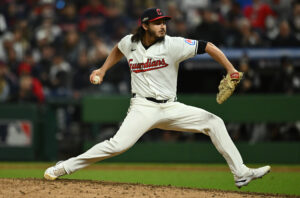
Morgan did see his strikeout rate check in at a career-low 20.4% this past season, which is something of a red flag. The primary culprit has been a drop in swinging strikes against his four-seamer, though he hasn’t lost much in the way of velocity on the pitch. Morgan still racks up plenty of whiffs with his slider and changeup, and that pair of secondary offerings has helped him to keep both righties and lefties off balance in his four-year MLB career. Even with the dip in punchouts — Morgan fanned 28.1% of his opponents in 2022 and 25.1% in 2023 — he maintained strong command, issuing a walk to only 6.6% of opponents.
For the Cubs, Morgan will be a multi-year option in the ‘pen — and an affordable one at that. He’s controlled for another three seasons and is projected by MLBTR contributor Matt Swartz to earn just $1MM this coming season. His role in Chicago will determine the extent to which his price tag rises over the next few seasons — saves are compensated more in arbitration than middle relief work, for instance — but the Cubs will very likely pay fewer than $10MM for the three years of service they’re acquiring.
In addition to adding Morgan to the bullpen mix, the Cubs are bidding farewell to the slugging Wisdom, who’s tagged 84 home runs in a Cubs uniform over the past four seasons. The 33-year-old has been a consistent source of power and been a frequent thorn in the side of left-handed pitching, but Wisdom’s limited skill set has long been evident and proved particularly restrictive in 2024, when he hit just .171/.237/.392 in 174 plate appearances.
Strikeouts have been an issue for Wisdom throughout his career, but at least from 2021-23, he was productive enough against lefties and affordable enough that the Cubs were willing to overlook his flaws. He’s fanned in a whopping 36.5% of his trips to the plate dating back to 2021 and has reached base at only a .290 clip — all while playing sub-par defense at third base (with occasional work at first base and very fleeting looks at second and in the outfield corners). From 2021-23, Wisdom hit .231/.312/.517 against lefties and at least hit for power against righties, even though his .206 average and .291 OBP were eyesores. He didn’t produce against pitchers of either handedness in 2024.
Swartz had projected Wisdom for a $3MM salary this coming season — perhaps a reasonable price tag for a defensively limited corner bat who can torment lefties to the extent he did in ’21-’23. But the Cubs’ veteran-laden roster — which includes no-trade clauses for Ian Happ, Dansby Swanson and Seiya Suzuki — offers minimal paths to reshaping an offense that simply hasn’t gotten the job done in recent seasons. Subtracting Wisdom both frees up a bit of cash and subtracts a narrow skill set from the roster. That spot on the bench can now be allocated to a new acquisition, presumably one with a more well-rounded skill set.
The Cubs can trade Wisdom for the next week or place him on waivers within the next five days. Friday’s looming non-tender deadline also affords the Cubs the opportunity to simply non-tender the now-DFA’ed Wisdom, which would allow him to immediately become a free agent without needing to first pass through waivers (the only time of year teams are allowed to do so). They could use that as a mechanism to try to quickly re-sign Wisdom on a minor league deal, though he’d likely want to canvas the rest of the league to see if his power potential could land him a 40-man spot elsewhere.
Cleveland had the most dominant bullpen in MLB this past season, so the Guardians surely feel they’re dealing from a position of strength. Morgan’s salary is hardly prohibitive, but even in spite of his success, the rest of the Cleveland was so dominant that Morgan rarely found himself working in leverage spots. Emmanuel Clase, Cade Smith, Hunter Gaddis and Tim Herrin all joined Morgan as relievers with 40-plus innings and sub-2.00 ERAs (sub-1.00, in Clase’s case).
The Cubs, meanwhile, dealt with bullpen issues throughout the 2024 season and ultimately wound up releasing last winter’s big relief acquisition, Hector Neris. Midseason pickup Jorge Lopez became a free agent at season’s end. As it stands, their late-inning mix is still full of relatively inexperienced arms, headlined by Porter Hodge, Tyson Miller, Keegan Thompson, Nate Pearson and Luke Little. Morgan will add some stability to that mix, but Chicago still seems likely to pursue further additions in the months ahead.
Rosario, 21 in June, was a sixth-round pick in 2023. He played 109 Single-A games in 2024, striking out 32.2% of the time but also drawing walks at a strong 12.3% clip. He hit 16 home runs and slashed .230/.344/.423 for a wRC+ of 127. He also stole 16 bases while playing both center and right field. Baseball America currently lists him as the Cubs’ #27 prospect.
Jeff Passan of ESPN first reported on Morgan going to the Cubs (X link). Jesse Rogers of ESPN mentioned Wisdom’s DFA (X link). Sahadev Sharma of The Athletic first mentioned that an A-ball prospect would be going to the Guardians (X link).