
Marlins To Hire Carson Vitale As Bench Coach
The Marlins are set to hire Carson Vitale away from the Mariners to serve as new manager Clayton McCullough’s bench coach, reports Daniel Kramer of MLB.com. Vitale has spent the past seven seasons with Seattle, including five as their major league field coordinator.
Vitale, 36, was Seattle’s minor league field coordinator before joining the big league staff in 2020. Prior to that, he was the Dodgers’ international field coordinator for two seasons (2016-17) and spent several years as a hitting coach and manager in the Angels’ minor league system. The Victoria, British Columbia native was drafted in the 38th round as a catcher out of Creighton University by the Rangers back in 2010 and played parts of two minor league seasons before setting a course down a coaching path.
Miami still has a ways to go in terms of filling out its coaching staff. The Marlins gutted their entire coaching staff after Skip Schumaker’s departure as manager, and McCullough’s hiring has only been official for two weeks. Miami has also reportedly hired former Giants assistant hitting coach Pedro Guerrero to serve as their new hitting coach, but he and Vitale are the only known hires to date. Both coaches have ties to Marlins assistant GM Gabe Kapler; Vitale worked with both Kapler and McCullough in Los Angeles, while Guerrero was on Kapler’s coaching staff in San Francisco and in Philadelphia when he managed the Giants and Phillies.
White Sox Maintain High Asking Price On Luis Robert Jr.
Much of the focus on the White Sox’ trade efforts this offseason will center around Garrett Crochet, and with good reason — he’s the top starting pitcher who’s readily available on the market. However, heading into the 2024 campaign, it was Luis Robert Jr. who was seen as Chicago’s potential top prize at the deadline. Another slate of injuries ruined the talented but fragile center fielder’s ’24 campaign and further added to his reputation as an injury-prone player. The Sox are still hoping to move Robert, writes Bob Nightengale of USA Today, but one rival general manager tells Nightengale that Chicago’s asking price is simply unrealistic, given all of the health concerns surrounding Robert.
“You’ve got to hope he finally stays healthy and can be the player everyone envisioned all along,” that GM said. “But the White Sox are acting like he’s some big star center fielder and are asking for your top prospects.”
It’s understandable that the Sox would be reluctant to sell low on Robert. He’s among the most talented players in the sport when healthy — he just simply hasn’t been healthy for the majority of his career. Robert has had six IL placements dating back to the 2021 season, many of which sidelined him for significant periods of time. A hip flexor strain in 2021 sidelined him for more than three months. He missed more than two months this past season owing to the same injury. Robert has also been shelved for a wrist sprain, an MCL sprain, and a more ominous viral infection in 2022 that resulted in blurred vision, dizziness and lightheadedness.
That massive slate of injuries looked to have taken its toll on Robert this past season. He landed on the injured list just a week into the season and returned in June but never really found his footing. Robert hit five homers in his first 36 plate appearances upon activation — but he only collected one other hit in that time. He tallied 396 plate appearances post-injury in 2024 and slashed just .225/.281/.370 with a 32% strikeout rate.
Clearly, that’s not the type of production that’s going to generate interest in a player who’s owed a $15MM salary next season. However, from 2021-23, Robert slashed a combined .287/.331/.511 with 63 homers and 37 steals in just 1292 plate appearances. He played plus-plus defense in center field along the way; despite playing only 301 games in that three-year span, Robert tallied 21 Outs Above Average — good for 12th among all major league outfielders. That strong run was headlined by a 2023 campaign — Robert’s age-25 season — during which he hit .264/.315/.542 and popped 38 home runs in a career-high 595 trips to the plate. Robert made the All-Star team, won a Silver Slugger, and drew some downballot MVP votes.
That’s the type of upside any team would be hoping to land when acquiring Robert. Unfortunately, while his per-game and per-inning performance in 2021-23 was excellent, that 2023 season is the only one in which Robert has exceeded 425 plate appearances. He’s appeared in only 65.9% of possible games in his five-year run with the White Sox.
Robert’s 2024 season wasn’t without its silver linings. His average sprint speed, per Statcast, ticked up to 28.8 feet per second — the second-best mark of his career. He’d been down at a still-strong but not-elite 27.9 ft/sec the first time he dealt with a hip flexor strain. His speed bounced back more this time around. And while his defensive grades dipped, that was largely due to some errant throws. Statcast still rated Robert’s range quite strongly. He also sat in the 84th percentile of MLB hitters in bat speed and typically hit the ball hard (90.1 mph average exit velocity, 40.6% hard-hit rate) when he made contact. He just didn’t make contact enough (career-worst 32.8% strikeout rate).
Robert’s contract pays him $15MM next year. There are a pair of matching $20MM club options for the 2026 and 2027 seasons on the deal. Getting the 2021-23 version of Robert for the next three seasons at a combined $55MM would be a steal, even if he spent about one-third of that time on the injured list, as he did in ’21-’23. (Both Baseball-Reference and FanGraphs agree Robert was worth about 10.5 WAR during that run, even with the missed time.)
The problem for interested teams, of course, is that there’s no guarantee he’ll get back to that level of play. Taking a one-year, $15MM flier is probably appealing to many outfield-needy clubs, particularly with the pair of club options looming. Taking on that salary and surrendering top-tier prospects is another story entirely. From the White Sox’ vantage point, trading Robert to simply clear $15MM in guaranteed money would be foolhardy. They barely have any money on the books, with an estimated payroll in the $75MM range, per RosterResource. That’s half their 2024 payroll. Selling low on Robert and watching him bounce back to stardom elsewhere would be agonizing for the Sox and their fans.
It all makes Robert a very difficult player to trade this winter. The Sox have no urgency to shed the relatively small amount that remains on his contract. Other clubs surely feel there’s little sense in trading top-tier prospects for an oft-injured player coming off a 100-game season that was the least-productive stint of his career.
The likeliest outcome would seem to be a midseason trade. If Robert bounces back, the Sox can put him back on the block and effectively market two-plus years of his services. If he continues to struggle, they could move him for a light return, knowing the eventual likelihood was that his option would be bought out anyhow. Perhaps a team could throw caution to the wind and make a surprisingly strong offer for him in the near future, but that seems unlikely. The Sox did move Dylan Cease in spring training when his Cactus League performance quieted some concerns about a pedestrian 2023 season, so it’s possible a big spring from Robert could garner some attention. In all likelihood, though, he seems ticketed to remain on the Sox to open the season, and clubs around the game will keep a close eye on his early performance. If he shows well in April, Chicago GM Chris Getz could follow in Miami counterpart Peter Bendix’s footsteps and make Robert available in late April/early May — as the Marlins did with Luis Arraez.
Braves Exploring Outfield Market, Prefer Left-Handed Bat
The Braves are poking around the market for outfield help after non-tendering Ramon Laureano and prefer to add a left-handed bat if possible, Ken Rosenthal of The Athletic reports.
It doesn’t seem as though Atlanta is intent on shopping at the top of the market. They’ve not been suggested as anything more than a speculative dark horse for top free agent Juan Soto. Veterans like Anthony Santander, Teoscar Hernandez, Jurickson Profar and Tyler O’Neill all seem likely to command multi-year deals of note. The Braves are looking for some depth to help cover early in the season, in the likely event that Ronald Acuna Jr. is unavailable to begin the year; president of baseball operations Alex Anthopoulos said at this month’s GM Meetings that they’re planning as though Acuna will open the season on the injured list.
With no Acuna, the Braves’ outfield would include Jarred Kelenic, Michael Harris II and some combination of Eli White, Luke Williams and recently signed Carlos D. Rodriguez. It’s logical that Atlanta would pursue some more solidity on that front. Some may feel Laureano could have provided just that, but his solid showing with Atlanta was buoyed by a .380 average on balls in play and came in spite of a 3.5% walk rate and 28.3% strikeout rate. Regression seems highly likely. Laureano hit just .218/.296/.373 in 2022-23 with a similar strikeout rate, twice the walk rate, and a BABIP about 100 points lower. Plus, he’s a right-handed bat.
Most of Atlanta’s moves in free agency and on the trade market thus far have been modest in scope. Anthopoulos rarely spends on long-term deals in free agency, preferring instead to operate on the trade market and to rely on a strong track record of in-house development. Atlanta has only given out three free-agent contracts greater than two years under Anthopoulos (link via MLBTR’s Contract Tracker): left-hander Will Smith (three years, $40MM), right-hander Reynaldo Lopez (three years, $30MM) and outfielder/DH Marcell Ozuna (four years, $65MM). None of that necessarily precludes a larger-scale deal, but history suggests it to be unlikely.
Fortunately for the Braves, there’s a fairly deep pool of inexpensive left-handed-hitting bats on this offseason’s market. Max Kepler, Michael Conforto, Alex Verdugo, Jesse Winker, David Peralta, Mike Tauchman and switch-hitting former top prospect Dylan Carlson are among the lefty bats available this winter. (Kepler and Conforto, in particular, might require multi-year deals.) The trade and waiver markets offer further possibilities.
Anthopoulos has already suggested this offseason that he expects his payroll to rise in 2025. The Braves spent about $232MM on last year’s roster and currently have a projected $202MM payroll in 2025, per RosterResource. That certainly leaves room for some additions, but Atlanta’s luxury-tax ledger is a bit more crowded.
The Braves have more than $217MM in projected luxury obligations, leaving them $24MM or so from hitting this year’s $241MM barrier. They’d be paying the tax for a third straight season if they cross that line and, as such, would be subject to the steepest tier of penalties. They’d start at a 50% tax on the first $20MM by which they exceed the line, followed by 62% for the next $20MM, 95% for the next $20MM (plus their top draft pick in 2026 dropping by ten places) and 110% for any dollars thereafter. With needs at shortstop, in the starting rotation and in the bullpen as well, Anthopoulos will have a hard time piecing everything together without crossing that line.
Brewers, Thomas Pannone Agree To Minor League Deal
The Brewers agreed to a minor league deal with lefty Thomas Pannone, reports Todd Rosiak of the Milwaukee Journal-Sentinel. The BHSC client will be in major league camp as a non-roster invitee to spring training in 2025.
It’ll be the second Brewers stint of Pannone’s career. He was also with the organization in 2023. While the 30-year-old’s broader track record in Triple-A doesn’t necessarily stand out, he’s been sharp against non-MLB competition in recent seasons. Pannone tossed 53 1/3 innings of 2.70 ERA ball with the Brewers’ Triple-A club in 2023, and he also spent parts of the 2022-23 seasons with the KBO’s Kia Tigers, pitching to a combined 3.49 ERA in 165 innings across those two seasons. Most recently, Pannone hurled 152 1/3 innings of 3.54 ERA ball between the Triple-A affiliates for the Cubs and Yankees in 2024. He fanned 21.9% of opponents against a 5.9% walk rate this past season.
All of that should allow Pannone to head to camp with the Brewers and compete for a rotation spot or long relief role. He’s stretched out and built up, meaning workload wouldn’t be an issue if the Brewers need to utilize him as a starter between Nashville and Milwaukee. (Notably, he’s out of minor league options, so if he’s added to the 40-man at any point, he’d have to stick or else be placed on waivers.)
For a Brewers club that is currently light on rotation depth, adding a lefty who’s pitched well for the past three seasons in the upper minors and in the KBO makes good sense. At the moment, Milwaukee’s rotation likely includes Freddy Peralta, Brandon Woodruff (likely on an innings limit after missing 2024 due to shoulder surgery), Aaron Civale, Tobias Myers and one of Aaron Ashby or DL Hall. That group could change, of course, depending on how the rest of the offseason plays out. Each of Myers, Ashby and Hall can be optioned. Civale has been a speculative trade candidate (as is the case with most Brewers veterans when they’re down to one final season of club control remaining). Lefty Robert Gasser could join the bunch late in 2025, but he’s recovering from UCL surgery performed in June.
Orioles Name Robinson Chirinos Bench Coach
The Orioles finalized their 2025 coaching staff, announcing Monday morning that they’ve named former big league catcher Robinson Chirinos their new bench coach. Chirinos announced his retirement as a player in May 2023. Baltimore also added Triple-A skipper Buck Britton to the big league coaching staff with the generic title of “major league coach.”
It’ll be the first professional coaching assignment for the 40-year-old Chirinos, who was often referred to as a future managerial candidate during his playing days. The O’s were also reported to have some interest in former Cubs skipper David Ross (like Chirinos, primarily a backup catcher during his playing days) for the role of bench coach. It’s not known whether Ross interviewed for the post or even reciprocated the interest. Regardless, the O’s will move forward with Chirinos in this role as the former catcher starts the next chapter of his baseball career.
Chirinos’ final season as a player came with the Orioles in 2022. He appeared in 67 games and hit just .179/.265/.287 in what was his age-38 campaign. For much of Chirinos’ peak, however, he was a quality bat for his position. From 2014-21, Chirinos hit .232/.327/.438 in 2147 plate appearances, good for a 104 wRC+. He hit .226/.319/.419 in his career overall, spending time with the Rangers, Astros, Rays, Cubs, Orioles and Mets along the way.
That 2022 stint with the O’s should make Chirinos a familiar face in the dugout and clubhouse. He was teammates with a large portion of Baltimore’s expected 2025 roster that year, including Adley Rutschman, Gunnar Henderson, Ryan Mountcastle, Cedric Mullins, Dean Kremer, Kyle Bradish, Felix Bautista, Jorge Mateo, Ramon Urias and more.
Britton, 38, should have a similar rapport with a number of the Orioles’ young players. He’s been managing their Triple-A affiliate in Norfolk for the past three seasons and managed at lower levels in the system in the three prior seasons. The older brother of former Orioles reliever Zack Britton, Buck enjoyed a nine-year minor league career himself, most of which was spent in the Orioles’ system. He’s long been viewed as a future coach and potential manager at the MLB level as well.
The Orioles’ final 2025 staff breaks down as follows: Brandon Hyde (manager), Chirinos (bench coach), Cody Asche (hitting coach), Sherman Johnson (asst. hitting coach), Tommy Joseph (asst. hitting coach), Drew French (pitching coach), Mitch Plassmyer (asst. pitching coach), Ryan Klimek (pitching strategy coach), Anthony Sanders (first base coach), Tony Mansolino (third base coach), Grant Anders (major league development coach), Tim Cossins (catching coach/field coordinator) and Britton (major league coach).
Nationals Non-Tender Kyle Finnegan
The Nationals announced Friday that they’ve non-tendered closer Kyle Finnegan and fellow right-handed reliever Tanner Rainey. Both pitchers are now free agents. It’s a surprise move for the Nats, who watched Finnegan make his first All-Star team in 2024 while pacing the team with 38 saves. He’d been projected by MLBTR contributor Matt Swartz to earn $8.6MM in arbitration.
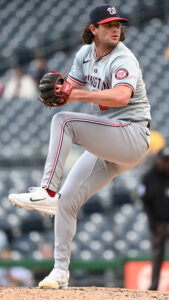
Unexpected as the move was, there’s a case to be made that Finnegan’s gaudy save totals have disproportionately inflated his value. The 33-year-old righty hasn’t been a bad reliever on a rate basis by any means, but he’s also not the shutdown weapon many might expect based on that All-Star nod and his 66 saves over the past two seasons. Finnegan pitched to a solid but unspectacular 3.68 earned run average in 63 2/3 innings this season. Despite a blazing 97.4 mph average on his fastball, Finnegan’s 22.1% strikeout rate was lower than the league average for relievers. His 8.9% walk rate was right at the league average. He’s also been fairly susceptible to home runs, serving up an average of 1.35 big flies per nine innings pitched over the past two seasons.
Hard as Finnegan throws, neither his four-seamer nor his splitter miss bats at a high level. This year’s 10.8% swinging-strike rate was below average. He’s also quite prone to hard contact, even beyond the home runs. He yielded an average exit velocity of 91.3 mph in 2024 and 92.2 mph in 2023. Over the past two seasons, a whopping 47.8% of the batted balls against him left the bat at 95 mph or greater.
Metrics like FIP (4.42), xFIP (3.91) and SIERA (3.90) simply haven’t bought into Finnegan as a premium reliever over the past two seasons, even as he’s been the Nationals’ go-to option in leverage situations. Washington has traded away most of its short-term veterans at this point but held onto Finnegan. Some have speculated that perhaps teams were unwilling to meet GM Mike Rizzo’s asking price in a trade, but today’s non-tender surely came on the heels of an effort to trade Finnegan. It’s likely that many teams around the league simply don’t feel Finnegan, at 33 years of age and with a worsening K-BB rates in three straight seasons, is worth his likely $8-9MM price tag in arbitration.
Some of that trepidation is surely borne from the fact that Finnegan pitched quite poorly in the season’s final two months. The right-hander carried a 2.32 ERA, 26% strikeout rate and 8% walk rate through late July. Over his final 21 innings, however, he was shelled for a 6.43 ERA with just a 15.7% strikeout rate and 9.6% walk rate. Finnegan didn’t experience a drop in velocity, but he was nowhere near as effective as he’d been for the first two-thirds of the season.
None of this is to say Finnegan won’t find interest now that he’s unexpectedly become a free agent. He now only costs money and a roster spot, and other clubs that are intrigued by the raw velocity on that four-seamer might well have some ideas about how to coax more swings and misses out of what’s clearly a power arm. A club willing to look past the poor finish to his 2024 season could certainly dream on the scenario of getting him back to the form he displayed leading into this year’s All-Star Game.
Finnegan probably won’t command an annual salary in the $8-9MM range like he might’ve earned in free agency, but he’s the rare non-tendered player who might also have a chance at commanding a multi-year deal at a lower rate of pay. More likely, he’ll ink a one-year deal and look to rebound before hitting the market on the heels of a stronger showing next winter. He’ll be heading into his age-34 campaign at that point — a downside of not making his MLB debut until his age-28 season.
Rainey, 31, is a far more straightforward non-tender case. The former flamethrowing reliever was a key piece of Washington’s bullpen in 2019-20, but injuries have taken their toll — most notably Tommy John surgery in 2022. Rainey pitched just one inning in ’23, and while he returned to toss 51 frames this past season, his 94 mph average fastball was nowhere near its 97.7 mph peak. He was tagged for a 4.76 ERA on the season while displaying strikeout (19%), walk (12.6%) and home run (1.41 per nine) rates that were significantly worse than league average. Swartz projected him for a $1.9MM salary in arbitration, but Rainey might need to settle for a minor league deal to show he can regain some of his pre-injury form.
Players Avoiding Arbitration: 11/22/24
The deadline for teams to tender contracts to arbitration-eligible players is tonight at 7pm CT. Throughout the day, we’ll surely see a handful of arb-eligible players agree to terms with their clubs to avoid a hearing.
These so-called “pre-tender deals” usually, although not always, involve players who were borderline non-tender candidates. Rather than run the risk of being cut loose, they can look to sign in the lead-up to the deadline. Those salaries often come in a little below projections, since these players tend to have less leverage because of the uncertainty about whether they’ll be offered a contract at all.
Under the 2022-26 collective bargaining agreement, players who sign to avoid an arbitration hearing are guaranteed full termination pay. That’s a change from prior CBAs, when teams could release an arb-eligible player before the season began and would only owe a prorated portion of the contract. This was done to incentivize teams and players to get deals done without going to a hearing.
All salary projections in this post come via MLBTR contributor Matt Swartz. This post will be updated throughout the day/evening as deals are announced and/or reported.
- The Mets announced that they have agreed to a one-year contract with right-hander Sean Reid-Foley, though salary figures have not yet been reported. He was projected for a $900K salary next year after posting a 1.66 ERA but in just 21 2/3 innings due to injury.
- The Rangers announced they avoided arbitration with right-hander Josh Sborz, who was projected for a $1.3MM salary next year. He’ll come in just shy of that at $1.1MM, per Jeff Wilson of Rangers Today (X link). He underwent a shoulder debridement procedure recently, per Evan Grant of the Dallas Morning News (X link) and will likely miss the first two or three months of 2025.
- The Tigers and infielder Andy Ibanez have agreed to a salary of $1.4MM next year, per Francys Romero (X link). That’s a shade below his $1.5MM projection. Ibanez hit .241/.295/.357 in 99 games for the Tigers in 2024.
- The Guardians avoided arbitration with right-hander Ben Lively, per Paul Hoynes of cleveland.com (X link). He’ll make $2.25MM next year, below his $3.2MM projection. Lively had a 3.81 ERA in 151 innings for the Guards this year.
- The Cubs and right-hander Julian Merryweather have avoided arbitration by agreeing to a salary of $1.225MM, per Jesse Rogers of ESPN (X link). That’s just shy of his $1.3MM projection. Merryweather had a 6.60 ERA in 2024 but was injured most of the time and only made 15 appearances. He had a solid 3.38 ERA the year prior in 72 innings. The Cubs also agreed to terms with catcher Matt Thaiss and righty Keegan Thompson, per Meghan Montemurro of the Chicago Tribune (X link), though salary figures have not yet been reported.
- The Blue Jays got a deal done with right-hander Erik Swanson, per Shi Davidi of Sportsnet on X. The righty was projected for $3.2MM next year but will make a smidge less than that, with Keegan Matheson of MLB.com (X link) relaying that Swanson will make $3MM. He had a 5.03 ERA in 2024 but was at 2.97 the year prior and also finished this year strong, with a 2.55 ERA in the second half.
- The Yankees reached agreement with center fielder Trent Grisham on a $5MM salary, reports Jorge Castillo of ESPN (on X). The deal contains another $250K in incentives. The two-time Gold Glove winner had been projected at $5.7MM. Grisham had an underwhelming .190/.290/.385 showing during his first season in the Bronx. The Yankees will nevertheless keep him around for his final year of arbitration, presumably in a fourth outfield capacity. The Yankees also announced that they have a deal with righty JT Brubaker, though figures haven’t been reported. He was projected for a salary of $2.275MM, the same figure he made in 2023 and 2024, two seasons he missed while recovering from Tommy John surgery.
- The Rockies reached deals with outfielder Sam Hilliard and lefty reliever Lucas Gilbreath, Feinsand reports (on X). Hilliard gets $1MM, while Gilbreath signed for $785K. Both figures come in shy of the respective $1.7MM and $900K projections. Hilliard popped 10 home runs over 58 games as a depth outfielder. Gilbreath only made three appearances after missing the entire ’23 season to Tommy John surgery. He posted a 4.19 ERA across 43 innings two years ago.
Earlier Agreements
- The Dodgers and right-hander Tony Gonsolin have agreed to a $5.4MM salary for 2025, per Robert Murray of FanSided (X link), an exact match for his projection. He had signed a two-year, $6.65MM deal to cover the 2023 and 2024 seasons. He made 20 starts for the Dodgers in the first year of that pact but he missed all of 2024 recovering from Tommy John surgery.
- The Guardians and Sam Hentges have agreed to a $1.337MM deal, according to Robert Murray of FanSided. That’s right in line with his projected $1.4MM salary. The left-hander has been an effective reliever for Cleveland over the past three seasons (2.93 ERA, 2.82 SIERA, 138 IP), but he missed the latter half of 2024 with a shoulder injury. After undergoing surgery in September, he will miss the entire 2025 season.
- The Orioles and infielder Emmanuel Rivera agreed to a $1MM deal, reports Mark Feinsand of MLB.com. He’d been projected at $1.4MM. He hit .238/.312/.343 this year.
- Right-hander Brock Stewart and the Twins agreed to a one-year deal worth $870K, MLBTR has learned. He’d been projected at $800K. Stewart, who missed much of the season due to injury, can earn another $30K via incentives. He’s been lights-out for the Twins when healthy over the past two seasons (2.28 ERA, 33.5 K%, 10.8 BB%). Minnesota and righty Michael Tonkin also agreed to a $1MM deal, tweets Jon Heyman of the New York Post. He’d been projected at $1.5MM. The Twins later announced that they had reached deals with Stewart, Tonkin and righty Justin Topa. Hewas projected for $1.3MM next year but will come in just shy of that in terms of guarantee. Per Bobby Nightengale of the Star Tribune (Bluesky link), it’s a $1.225MM guarantee in the form of a $1MM salary and then a $225K buyout on a $2MM club option for 2026.
- The Padres and Tyler Wade agreed to a one-year deal worth $900K, Heyman tweets. There’s a club option for an additional season. Wade, who hit .217/.285/.239 in 2024, was projected for that same $900K figure.
- Infielder Santiago Espinal and the Reds settled on a one-year deal at $2.4MM, Heyman tweets. That’s well shy of his $4MM projection and actually represents a slight pay cut after Espinal hit .246/.295/.356 for Cincinnati.
- The Rangers and righty Dane Dunning agreed to a one-year deal worth $2.66MM, Heyman reports. It’s a 19% cut after Dunning struggled to a 5.31 ERA in 95 innings this past season. He was projected at $4.4MM.
- The Giants and right-hander Austin Warren agreed to terms on a one-year deal, reports Justice de los Santos of the San Jose Mercury News. He missed most of the season recovering from Tommy John surgery but returned late with 10 2/3 innings of two-run ball out of the bullpen.
- The Brewers announced that they’ve signed catcher/outfielder Eric Haase to a one-year deal for the upcoming season. ESPN’s Jesse Rogers reports that the deal guarantees Haase $1.35MM with the chance to earn more via incentives. He’d been projected for a $1.8MM salary. Haase will fill the backup catcher role in Milwaukee next season. He’s controllable through the 2027 season.
- The Dodgers and right-hander Dustin May settled at $2.135MM, per Fabian Ardaya of The Athletic (X link). That’s the exact same salary he had in 2024. May will be looking to bounce back after spending all of this year on the injured list.
- The Phillies and right-hander José Ruiz settled at $1.225MM, per Robert Murray of FanSided (X link). That’s slightly above his $1.2MM projection. The righty can also unlock a $20K bonus for pitching in 30 games and $25K for pitching in 40. He made 52 appearances for the Phils in 2024 with a 3.71 ERA. Philadelphia also announced agreement with backup catcher Garrett Stubbs on a one-year deal. The Phils did not reveal the salary figure. Stubbs hit .207 in 54 games this year.
- The Tigers and infielder/outfielder Zach McKinstry agreed to a $1.65MM salary for 2025, per Robert Murray of FanSided (hat tip to Evan Petzold of the Detroit Free Press on X). That’s slightly ahead of his $1.3MM projection. He hit .215/.277/.337 this year while stealing 16 bases and playing each position except or first base and catcher,
Cubs Rumors: Rotation Market, Bellinger, Bullpen, Catcher
The Cubs’ focus this offseason has reportedly been on pitching, and while Sahadev Sharma of The Athletic reports that’s very much still the case, he also throws some cold water on the idea of Chicago making a major strike in free agency. Sharma’s colleague, Patrick Mooney, reported less than three weeks ago that the Cubs planned to “aggressively” pursue starters who could help near the top end of the rotation, but Sharma now writes that the “top tier of the starting pitching market has been ruled out.” That would seemingly remove the Cubs from the running for Corbin Burnes, Blake Snell and Max Fried, at the very least.
It’s the latest signal of a measured offseason approach, even at a time when the Cubs’ division appears ripe for the taking. The Cardinals are scaling back payroll and focusing more on player development in 2025 than on putting a playoff-caliber roster on the field. The Brewers, one year after trading Burnes, now seem likely to lose Willy Adames in free agency — and they could also trade closer Devin Williams. The Pirates and Reds have yet to break out as perennial contenders in the Central. Logically speaking, the deep-pocketed Cubs could take an aggressive stance and position themselves well in a wide-open division field.
For now, it seems they’ll shop primarily in the second and third tiers of the rotation market. Sharma points out that the Cubs have typically shied away from starters who’ve been attached to qualifying offers, though it’s worth noting that the Cubs were willing to part with draft picks and international funds in order to sign Dansby Swanson after he rejected a qualifying offer. They technically signed Cody Bellinger after he rejected a QO … though that offer came from the Cubs themselves, so they were really only “forfeiting” the theoretical comp pick they’d have received if he signed elsewhere.
Assuming the Burnes/Snell/Fried trio isn’t being considered by president of baseball ops Jed Hoyer and his staff, the Cubs will be looking at the next tier, with Jack Flaherty, Sean Manaea, Yusei Kikuchi, Nathan Eovaldi, Nick Pivetta and Luis Severino among the options. Of that group, Manaea, Pivetta and Severino rejected QOs and would cost the Cubs their second-highest pick and $500K of international space in their 2025 draft pool.
There are certainly names in that bunch who’d represent upgrades over incumbent starters at Wrigley Field. Justin Steele and Shota Imanaga form a nice one-two punch atop the in-house rotation, and the Cubs will follow them with veteran Jameson Taillon and young Javier Assad. Candidates for the fifth spot include Ben Brown, Jordan Wicks, Hayden Wesneski and top prospect Cade Horton. It’s a nice bunch of arms, but there’s some uncertainty in at least the fifth spot, if not the fourth. Assad posted a solid 3.79 ERA in 29 starts but did so with worse-than-average strikeout, walk and home-run rates. Metrics like FIP (4.64) and SIERA (4.72) are far less bullish than his earned run average.
Looking at the team’s payroll, the Cubs should have some spending room. RosterResource projects a $180MM payroll at the moment — $34MM shy of last year’s Opening Day mark. That includes a full arbitration class that could include some non-tender candidates (e.g. Nick Madrigal, Julian Merryweather).
The Cubs could also explore other ways to drop their payroll further. Ken Rosenthal of The Athletic wrote yesterday that the team could be looking to move Bellinger, though there are plenty of roadblocks to doing so. Bellinger is owed a $27.5MM salary in 2025 and a $5MM buyout on a 2026 player option. If he plays well for a season, the acquiring team would effectively be getting Bellinger at $32.5MM. That’s a hefty price tag in general and particularly for the 2024 version of Bellinger. While he played at an extremely high level in 2023, Bellinger was more of an above-average regular in 2024. A lack of impact left-handed bats and viable center fielders could still lead a team to consider the possibility, it’s hard to imagine a team giving a meaningful return and taking on the remainder/majority of Bellinger’s salary.
Still, moving Bellinger is also one of the only ways for the Cubs to plausibly pursue upgrades to the everyday lineup in 2025. As we noted when listing Bellinger near the back of our list of offseason trade candidates, the Cubs’ roster is already filled with expensive veterans who have no-trade clauses (Ian Happ, Dansby Swanson, Seiya Suzuki) or generally productive and affordable younger players like Michael Busch, Isaac Paredes and Pete Crow-Armstrong. Nico Hoerner might’ve been a trade candidate and could still be — but he also underwent flexor tendon surgery one month ago. Obviously, that cuts down on his appeal. The Cubs have a clear opening for an upgrade at catcher, but the free agent market offers little in the way of meaningful help there.
All of those challenges to upgrading the lineup make a notable splash on the pitching side of things feel more logical, but it seems the Cubs don’t feel similarly — at least not with regard to free agent starters. There are upgrades to be had on the bullpen market, of course, but the Cubs haven’t given out a multi-year deal to a reliever since Craig Kimbrel in 2019. Last winter’s $9MM guarantee to Hector Neris was the largest bullpen expenditure the Cubs have made since signing Kimbrel.
It’s possible the Cubs could just look to the trade market for much of their offseason dealing. The Cubs have a deep farm system with multiple top prospects whose path to a regular role at Wrigley is blocked. There aren’t, however, many impact arms or high-profile arms expected to be available. Crosstown ace Garrett Crochet headlines the offseason class of trade candidates, but demand for him will be fierce and trades of significance between the two Chicago clubs, while not unprecedented (Jose Quintana, Craig Kimbrel), also aren’t common.
There probably are still additional trades on the horizon for the Cubs. Sharma writes that this week’s acquisitions of reliever Eli Morgan from the Guardians and backup catcher Matt Thaiss from the Angels do not mean the Cubs are content in those areas. They’ll continue to explore both free agency and trades for help in those portions of the roster. But if pitching help remains their focus and they’re unwilling to shop in the high-rent district for starters, the Cubs will need to either break tradition with their free agent bullpen targets, get creative on the trade market, be content to address the middle ranks of the starting staff — or a combination of all the above.
The Best Fits For Juan Soto
Last offseason, MLBTR took extensive looks at how the market for each of the top free agents might shake out, providing those pieces to our Front Office subscribers. We're doing the same this winter, kicking things off with a look at the likely bidders for Juan Soto and where each stands with regard to payroll and the luxury tax, among other aspects that ought to be considered.
At this point, there's little need to chronicle Soto's greatness to this point in his career. In our Top 50 Free Agent rankings, I penned over 1000 words on Soto alone, outlining just some of the reasons he's rightly referred to as a "generational" talent (a term that perhaps is used a bit too cavalierly these days). To borrow a couple excerpts from that:
"It’s rare for a player to even make his big league debut at 19, let alone to immediately break out as a star. That’s precisely what Soto did, however, belting an opposite-field home run off Chad Green in his second big league plate appearance. One home run doesn’t make anyone a star, of course, but Soto was completely unfazed by MLB pitching and went on to post a .292/.406/.517 batting line and swat 22 homers all before turning 20. In the entire history of the game, no one as young as Soto has turned in a season that good. Soto’s 142 OPS+ in his rookie season is the best in MLB history (min. 300 plate appearances). Soto’s debut harkened back to Hall of Famer Mel Ott’s jaw-dropping 19-year-old rookie season with the New York Giants exactly 90 years prior."
That, of course, is just looking at his rookie year. Soto's only gotten better since then, recording more walks than strikeouts in five consecutive seasons. He belted a career-high 41 homers this past season while slashing .288/.419/.569. By measure of wRC+, he was 80% better than league average at the plate (and somehow still only his team's second-best hitter; we see you, Aaron Judge). Yet Soto and all of his career accolades are hitting the open market at just 26 years of age. Judge, by comparison, played his first full season at age 25. He was entering his age-31 season in free agency. Shohei Ohtani was entering his age-29 campaign. Free agents rarely hit the market this young, and it's feasible we haven't even seen the best version of Soto yet.
When it comes to contract expectations, throw precedent and norms out the window. If you're not willing to put down at least a decade -- and likely 12, 13, 14 or even 15 years -- you're not likely to get a seat at the table. (Though it's fun to at least think of a clean-payroll club offering an extreme AAV on a shorter-term deal with an opt-out; six years, $450MM anyone?)
We know most of the teams that have already met with Soto by now, but let's take a look at each and try to identify which clubs might emerge as the ever-popular "mystery team" based on their payroll, tax status, and other factors.

Unlock Subscriber-Exclusive Articles Like This One With a Trade Rumors Front Office Subscription
- Access weekly subscriber-only articles by Tim Dierkes, Steve Adams, and Anthony Franco.
- Join exclusive weekly live chats with Anthony.
- Remove ads and support our writers.
- Access GM-caliber tools like our MLB Contract Tracker
Phillies To Non-Tender Austin Hays
The Phillies have informed outfielder Austin Hays that they will not tender him a contract before tonight’s deadline, Jon Heyman of the New York Post reports. He’ll immediately become a free agent without having to first clear waivers. He’d been projected for a $6.4MM salary by MLBTR contributor Matt Swartz.
Hays, 29, spent his entire career with the Orioles before being traded to the Phils in exchange for Seranthony Dominguez and Cristian Pache a few days before the 2024 trade deadline. The Phillies hoped that Hays, who’d battled injuries in the season’s first half, could rebound with better health and solidify their outfield mix down the stretch. That’s not how things played out, however. Hays suffered a strained hamstring a couple weeks after the trade and only briefly returned before hitting the shelf with a kidney infection that took a significant toll on his body. He only took 80 plate appearances with Philadelphia and batted just .256/.275/.397 in that small sample.
All told, Hays endured three IL stints in 2024, missing time with that kidney infection, hamstring strain and a calf strain that shelved him for three weeks from late April to mid-May. His combined .255/.303/.396 slash between the two clubs was arguably the worst production of his big league career.
While injuries clearly hampered Hays’ 2024 campaign, he’s still only a season removed from an All-Star season. Hays turned in a nice .275/.325/.444 slash with 16 home runs and quality glovework in left field as recently as 2023. He’s long been the type of player who thrives in platoon settings and merely holds his own against same-handed opponents, but paired with his defensive acumen that’s enough for him to have been a solid regular in Baltimore. Hays is a lifetime .277/.331/.469 hitter against lefties (120 wRC+) and a .254/.304/.415 hitter against fellow righties (99 wRC+).
Teams seeking a low-cost, right-handed bat to plug into their outfield mix figure to have interest in Hays. Many non-tendered players ultimately sign minor league deals, but Hays was a notable enough contributor with the O’s from 2021-23 that he ought to find a one-year deal in free agency, presumably a price south of his projected arbitration salary.
The Phillies, meanwhile, were already known to be in the market for outfield help. Hays was a likely non-tender candidate for some time now, though they opted not to make the move before today — presumably gauging the market for potential trade partners. Philadelphia’s outfield includes Brandon Marsh, Johan Rojas and Nick Castellanos, but the Phils are interested in adding a bat to the outfield and either going with a Marsh/Rojas platoon in the other spot or giving Marsh a larger role if he can handle lefties better than in the past. The Phillies are planning to meet with Juan Soto and will surely be connected to a variety of other targets both on the open market and trade market.