
Dodgers, Tyler Glasnow Finalizing Extension
The Dodgers’ acquisition of Tyler Glasnow and Manuel Margot from the Rays was contingent upon the former agreeing to a contract extension, and a new deal between Glasnow and L.A. is now nearly complete. The Wasserman client will reportedly earn an additional $110MM over four years on top of the $25MM he’d been slated to earn. Glasnow will earn $90MM from 2025-27, and the Dodgers hold a $30MM club option on the 2028 season. If they decline their end, Glasnow has a $20MM player option (thus accounting for the $110MM in guaranteed new money). There’s no deferred money on the contract, which will be considered a five-year, $135MM deal for luxury tax purposes (equating to a $27MM per year hit).
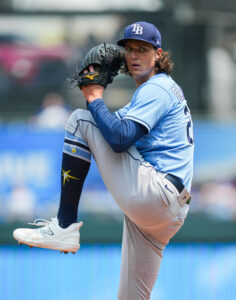
Glasnow, 30, stands as the first notable starting pitching upgrade the Dodgers have made this offseason. His acquisition gives them a top-of-the-rotation talent to bolster the roster — albeit one who’s spent more time on the injured list than the active roster in his career. Last season’s 21 starts and 120 innings were both career-high marks for the 6’8″ right-hander, who has missed time due to Tommy John surgery, a forearm strain, an elbow strain and a significant oblique strain that kept him out for two months to begin the 2023 season.
When he’s been healthy, however, Glasnow has been nothing short of excellent. Since being traded from the Pirates, his original organization, to the Rays in the 2018 Chris Archer heist, Glasnow has worked to a 3.20 earned run average, fanned an enormous 34.1% of his opponents and coupled that with a sharp 7.8% walk rate. He’s long had better-than-average grounder rates, but last year’s 52.1% mark was a career-best. He also notched a huge 16.5% swinging-strike rate that ranked second among all pitchers with at least 100 innings.
It’s a considerable bet to make on a pitcher who’s never topped 120 innings — easily the largest contract ever for anyone with such a limited track record of durability. There is, of course, a lot more nuance to Glasnow’s injury history than that 120 number, which MLBTR owner Tim Dierkes outlined in an article this afternoon for Trade Rumors Front Office subscribers. By the way, if you sign up for Front Office, we’ll be happy to send you any recent articles.
The four-year, $110MM in new money and effective five-year, $135MM term of Glasnow’s contract (for luxury tax purposes) roughly fall in line with previous extensions for high-end pitchers with injury concerns. Jacob deGrom inked a four-year, $120.5MM extension several years ago (prior to opting out and signing with the Rangers), and the contract also generally aligns with the five-year, $145MM term on Chris Sale‘s Red Sox extensions. Certainly, the Dodgers will be hoping for better results from their own investment.
The rotation in Los Angeles is slated to consist of Glasnow, Walker Buehler and Bobby Miller, at present. Emmet Sheehan is likely in line for the fourth spot, while Gavin Stone, Michael Grove, Ryan Yarbrough and others battle it out for the fifth spot on the staff. Of course, L.A. is widely expected to continue adding to the starting five, with reported targets including free agents Yoshinobu Yamamoto and Lucas Giolito, in addition to trade target Dylan Cease. It stands to reason there are other pitchers in both markets currently being eyed by president of baseball operations Andrew Friedman, GM Brandon Gomes and the Dodger front office.
From a payroll perspective, the Dodgers were already squarely into luxury-tax territory, sitting at a projected $251MM, per Roster Resource. Adding an additional $2MM to account for the new tax hit on Glasnow will push them up to about $253MM, which places them $4MM shy of the second tier of penalty.
The Dodgers’ bottom-line payroll is another story entirely, thanks not only the $680MM in deferred money on Shohei Ohtani‘s contract but also the $115MM in deferred money on Mookie Betts‘ 12-year deal and the $57MM in deferrals on Freddie Freeman‘s six-year contract. They still owe well south of $200MM in terms of actual player salary for the upcoming season, even when factoring in projected arbitration salaries. As such, there’s ample room to continue adding significant pieces to the roster, so long as the Dodgers don’t mind being taxed at increasingly steep rates. They’re a third-time luxury payor, so they’ll be taxed at 62% for any dollars spent from $257MM to $277MM, at 95% from $277MM to $297MM, and a hefty 110% for any dollars spent thereafter.
Beyond landing the biggest fish in the history of free agency and acquiring Glasnow and Margot, the Dodgers have also re-signed Jason Heyward and Joe Kelly, brought Daniel Hudson back on a minor league contract and traded lefty Victor Gonzalez to the Yankees in what’s been an active offseason so far. With clear needs in the rotation and perhaps on the bench and in the bullpen, it’s highly unlikely that Friedman, Gomes & co. will consider this their final significant deal of the winter.
Marc Topkin of the Tampa Bay Times first reported that the extension was all but finalized. ESPN’s Jeff Passan first reported the terms.
David McKinnon Signs With KBO’s Samsung Lions
Former Angels and Athletics corner infielder David MacKinnon has signed with the Samsung Lions of the Korea Baseball Organization, the team announced. Jee-ho Yoo of South Korea’s Yonhap News Agency tweets that MacKinnon is guaranteed $1MM on the deal — a $900K salary and $100K signing bonus.
MacKinnon, who turns 29 today, was a 32nd-round pick by the Angels in 2017 and made a brief big league debut in 2022, appearing in 22 games and taking 57 turns at the plate between Anaheim and Oakland. He posted a tepid .140/.228/.140 slash in that tiny sample, but MacKinnon has posted a hearty .294/.412/.464 slash in his minor league career — including a gaudy .318/.416/.585 output in his 2022 Triple-A run between the Angels and A’s organizations.
That minor league production led to interest from Japan last offseason, and MacKinnon spent the ’23 campaign playing for Nippon Professional Baseball’s Seibu Lions. He batted .259/.327/.401 and swatted 15 homers in 514 plate appearances there, and he’ll now jump to the KBO and continue to earn at a rate that vastly outpaces anything he’d earned as a late-round draft flier and career minor leaguer.
Athletics, Gerardo Reyes Agree To Minor League Deal
The A’s signed right-handed reliever Gerardo Reyes to a minor league contract, per their transaction log at MLB.com. Presumably, he’ll be in big league camp this spring and vie for a spot in a wide-open bullpen mix.
Reyes, 30, has pitched 37 2/3 big league innings between the Padres and Angels, including 9 2/3 frames with the Halos this past season. He owns a career 7.41 ERA in that time but has averaged 96.7 mph on his heater and fanned 27% of his opponents. Walks (11.2%) and home runs (1.43 HR/9) have both been issues for the hard-throwing righty, but Reyes has a decent track record in a hitter-friendly Triple-A Pacific Coast League (4.25 ERA, 30% strikeout rate). FanGraphs’ Eric Longenhagen ranked him among the Angels’ top 30 prospects in 2021, writing that arm strength and fastball movement alone gave him a chance to be a big league reliever.
Oakland isn’t going to be a choice destination for many free agents with the team clearly focused more on its pending move to Las Vegas than actually building a competitive roster for the 2024 season. But for a live-armed reliever like Reyes, who’s had a couple decent Triple-A seasons and is looking for a shot at a role in the majors, the A’s probably hold some appeal. Oakland’s only three relievers with even two years of MLB service are Sean Newcomb, Zach Jackson and Dany Jimenez. There’s virtually no certainty in the Athletics’ relief corps right now, so if Reyes were to show well in spring training or early in the Triple-A campaign, there’d be little standing in his way to a shot in the big leagues.
Guardians Designate Alfonso Rivas For Assignment
The Guardians announced Friday that they’ve designated first baseman Alfonso Rivas for assignment. His spot on the 40-man roster will go to catcher Austin Hedges, whose one-year deal to return to Cleveland is now official. The Guardians will have a week to trade Rivas, pass him through outright waivers or release him.
Rivas came to the Guardians in an offseason waiver claim from the Pirates. He’s never appeared in a game for the organization. The 27-year-old has logged big league time in each of the past three seasons, suiting up for the Cubs, Padres and Bucs. While Rivas had a productive rookie showing with Chicago in ’21, slashing .318/.388/.409 in a tiny sample of 49 plate appearances, he’s followed that up with a .233/.316/.342 showing in 410 plate appearances from 2022-23.
Although his production hasn’t carried over to the big leagues, Rivas is an accomplished Triple-A hitter with a .313/.424/.492 slash in parts of four seasons at that level. He’s walked at a gaudy 15.1% clip in Triple-A and fanned at a slightly lower-than-average 21% as well. While Rivas doesn’t have immense power, he’s smacked 40 doubles and 15 round-trippers in 637 trips to the plate at the Triple-A level. It’s an impressive track record of production in the upper minors — one that has clearly piqued the interest of multiple teams.
Rivas still has one minor league option remaining, so for a team looking to add a potential high-OBP left-handed bat to its depth chart or perhaps even its bench competition, Rivas makes some sense — either via waiver claim or low-cost trade.
Latest On Cardinals’ Pursuit Of Bullpen Help
The Cardinals acted quickly to reshape their rotation this offseason, signing right-handers Sonny Gray, Kyle Gibson and Lance Lynn within a span of a week. They’ve since shipped outfielder Tyler O’Neill to the Red Sox in a trade that netted a pair of potential bullpen arms, but they’re not done looking for help in their relief corps. Derrick Goold of the St. Louis Post-Dispatch reported earlier this week that the Cards have at least held internal discussions about free agent righty Hector Neris, and Mark Feinsand of MLB.com reports that the Cardinals hosted star NPB lefty Yuki Matsui for a meeting in St. Louis just yesterday. Goold also again linked the Cards to free agent Phil Maton, to whom they’ve been previously tied.
The meeting with Matsui is the more notable development at the moment. Reports out of Japan back in October pegged the Cardinals as a team with interest in the five-time NPB All-Star, but a sitdown in St. Louis is a more concrete indicator.
The 28-year-old Matsui has saved 30 or more games for the Rakuten Golden Eagles on six different occasions, including this past season’s career-high mark of 39. He pitched 57 1/3 innings in 2023 and worked to a scintillating 1.57 ERA, giving him three straight seasons with an ERA that clocked in under 2.00. Matsui also fanned nearly a third of his opponents and turned in a 5.9% walk rate. Dating back to 2019, the southpaw boasts a 2.20 ERA, 35.8% strikeout rate and 9.4% walk rate.
Matsui’s track record in Japan is clearly excellent, but there’s at least some reason to think MLB clubs might have some trepidation. He’s listed at just 5’8″ and 167 pounds — a Tim Collins-esque frame that rarely has found much success in the big leagues. MLBTR spoke to multiple scouts and evaluators about Matsui and other international free agents prior to the onset of free agency and received mixed reviews, though Matsui did draw praise for his slider and deceptive delivery. Every team’s opinion on Matsui will vary, of course, and it stands to reason that there are big league clubs that believe he can be a viable late-inning reliever in North American ball — even if he can’t quite replicate his staggering NPB numbers.
Because of his lengthy track record in NPB — he’s pitched 10 full seasons despite his youth — Matsui accrued enough service time to be a free agent who can sign in MLB without being subject to the MLB/NPB posting system. (NPB requires nine years of service to become an unrestricted free agent.) That fact, coupled with his age and his year-over-year excellence could help to mitigate concerns about Matsui’s size and lead to a multi-year deal.
Neris, meanwhile, is more of a known commodity. He’s accrued more than eight years of MLB service time since debuting with the Phillies back in 2014 and has regularly been a high-leverage option for both the Phillies and Astros — the only two clubs for whom he’s pitched to this point in his career. Neris logged 68 1/3 innings with the ‘Stros in 2023, posting a pristine 1.71 ERA in his second season with Houston. His two-year, $17MM deal with Houston contained a club option for 2025, but a clause in his contract converted that to a player option depending on Neris’ workload. He remained healthy and effective in his time with Houston and wound up vesting that player option, which he declined in search of another multi-year deal.
Last year’s shiny ERA is certainly eye-catching, though Neris’ 11.4% walk rate and tiny .219 average on balls in play are among the reasons that fielding-independent metrics are more bearish on his most recent performance (3.83 FIP, 3.89 SIERA). Those are still fine marks, of course, and Neris still fanned 28.2% of his opponents with swinging-strike and chase rates (14.1% and 35.1%, respectively) that were well north of the league average. Dating back to 2018, Neris sports a terrific 31.3% strikeout rate. He’s also avoided the injured list almost entirely in his big league career, with his only IL trip coming back in 2020, when he spent three weeks on the Covid-related IL.
Ryan Helsley will likely reprise his role as the Cardinals’ closer and be supported by Giovanny Gallegos and out-of-options southpaw JoJo Romero next season. The remainder of the Cardinals’ bullpen is a bit more fluid, with Andre Pallante, Zack Thompson, Nick Robertson (acquired from Boston for O’Neill) and Matthew Liberatore among the options for manager Oli Marmol. The Cardinals’ activity thus far has pushed their payroll a bit north of $175MM, but president of baseball operations John Mozeliak has previously hinted that there’s room to further add to that figure.
Max Scherzer Undergoes Back Surgery
The Rangers announced Friday that right-hander Max Scherzer underwent surgery to repair a herniated disc in his back. General manager Chris Young tells reporters that the team and Scherzer tried “multiple conservative treatments in pain management” before resorting to surgery (link via Kennedi Landry of MLB.com). Unfortunately, the last-resort option was apparently deemed necessary, and the operation will sideline Scherzer into June or even July.
“After returning to my offseason home in Florida, my discomfort in my back continued to get worse,” Scherzer himself said, per Ken Rosenthal of The Athletic. “During this time, I received a diagnosis of a herniated disc. After several conservative treatments and consulting with multiple specialists, I made the decision to have the recommended surgery. Getting this procedure done now will give me the best chance to pitch as much as possible for the Rangers in 2024. I look forward to putting in the rehab work and getting back on the mound next summer.”
It’s obviously unwelcome news for the Rangers, who just gave up Luisangel Acuña to acquire Scherzer and cash from the Mets at last year’s deadline. As part of that deal, the Scherzer agreed to pick up his 2024 player option so that the club knew it was getting him for more than just a rental situation. Now he will miss at least half of the upcoming season that was obviously important to them.
These back problems aren’t coming out of the blue today. Scherzer was removed from Game 3 of the World Series after just three innings due to issue with his back, varyingly described as tightness or spasms. He was removed from the club’s roster prior to Game 4. Though the club was able to secure the title without him, it seems the issue lingered and ultimately required a significant surgery.
The club is now in a very peculiar situation in terms of their rotation, with the first half outlook wildly different than the second. Jacob deGrom underwent Tommy John surgery in June and could potentially return late in the 2024 campaign, depending on how his rehab goes. The club also signed Tyler Mahle just yesterday, who is on a similar timeline to deGrom, having undergone his own TJS procedure in May.
That means the club could welcome each of Scherzer, Mahle and deGrom back to the club over the course of 2024, but none of them will factor into the Opening Day rotation. For now, that leaves them with Nathan Eovaldi, Jon Gray, Andrew Heaney and Dane Dunning as healthy options for the start of the season. Options for the back end would include Cody Bradford or Owen White, though they could also pursue external additions in the weeks to come.
This will likely give the club some interesting calculations to make. Last month, general manager Chris Young suggested their spending would likely be more modest this offseason, when compared to the big money they’ve recently thrown around on those aforementioned pitchers as well as Corey Seager and Marcus Semien. Although the club just won the World Series and surely banked some extra playoff money, there’s uncertainty around their broadcast revenues due to the ongoing bankruptcy of Diamond Sports Group, the owner of the Bally Sports network. The club’s competitive balance tax figure is currently at $233MM, per Roster Resource, just barely below next year’s base threshold of $237MM.
Rosenthal took a look at their situation earlier today, noting that the club was still interested in Clayton Kershaw, who underwent shoulder surgery and is yet another pitcher slated for a midseason return. That column came out before the Scherzer news, so it’s unknown if the club would still want to use its limited payroll room to bring in yet another pitcher that will miss the first half of the season.
But Rosenthal also adds that, if ownership becomes more comfortable with adding payroll, they could pivot to a reunion with Jordan Montgomery or one of the top starters on the trading block. Even with Glasnow seemingly headed to the Dodgers, pitchers like Dylan Cease, Shane Bieber or Corbin Burnes could be available for the right price.
If the club plans to stick with their conservative offseason, it may involve taking a risk on having limited pitching depth in the first half while banking on the returns of those injured guys for a strong second half push. But improving that depth might require them to alter their spending plans and/or go into luxury tax territory.
Pirates, Andrew McCutchen In Talks On Reunion
Talks between the Pirates and Andrew McCutchen on a potential reunion have begun to accelerate, reports Jason Mackey of the Pittsburgh Post-Gazette. A deal between the two sides could be completed by early next week.
A reunion between McCutchen and the Pirates has been seen as something of a formality for several months now. McCutchen returned to his original organization last year, signing a one-year deal worth $5MM to serve as the team’s designated hitter and a part-time outfielder. He told Mackey at the time of his signing that he hoped to finish his career back in Pittsburgh, which felt like home. Cutch reiterated his desire to play in Pittsburgh and Pittsburgh only back in May, and after his season ended in early September with a partial tear of his Achilles, Pirates GM Ben Cherington said they hoped for a new deal and planned to talk with McCutchen this winter.
The now-37-year-old McCutchen is a franchise icon with the Pirates, who selected him with the 11th overall pick back in 2005 and watched him develop from one of the game’s top prospects, to a Rookie of the Year candidate, to a five-time All-Star and eventual National League MVP (2013). McCutchen signed a $51.5MM extension with the Bucs in 2012 but was traded after the team picked up an option for the seventh and final season of the deal — a swap that brought current cornerstone Bryan Reynolds to Pittsburgh.
After stops with the Giants, Yankees, Phillies and Brewers, McCutchen returned home last year and spoke often about his love of Pittsburgh and his desire to finish out his career there. It wasn’t all pure nostalgia, however, as the four-time Silver Slugger proved he still had life in his bat as well. McCutchen tallied 473 plate appearances and posted a .256/.378/.397 batting line, swatting a dozen homers, collecting 19 doubles and walking at a massive 15.9% clip.
The timing of McCutchen’s injury was particularly unfortunate, as it came on the cusp of a milestone. McCutchen sits at 299 career home runs — just one shy of becoming just the 160th player in MLB history to reach 300 home runs. The Pirates open the 2024 season on the road, so it’s possible that his milestone round-tripper could come away from the home fans, but regardless of where that historic long ball takes place, the fans at PNC Park will give McCutchen a hero’s welcome whenever he first takes the field again next season.
Assuming McCutchen resumes his role as a primary designated hitter, he’ll slot into a lineup with Reynolds and Jack Suwinski locked into outfield spots, Ke’Bryan Hayes and Oneil Cruz on the left side of the infield, Henry Davis behind the plate and recently signed Rowdy Tellez at first base. The Pirates currently have a projected payroll of just $58MM, and re-signing McCutchen at or close to the same terms as last year would push that to $63MM. It’s not clear quite how high the team’s payroll will go, but Cherington said at this month’s Winter Meetings that the payroll will increase over last year’s $73MM mark.
Dodgers, Rays Discussing Deal Involving Tyler Glasnow, Manuel Margot
December 14: Jon Heyman of the New York Post reports today that the two sides are still discussing a trade. He says that “word is” the Dodgers “may also be” interested in an extension. It’s unclear what level of interest Glasnow has in an extension.
December 13, 1:00pm: No trade between the two parties is imminent, per Jack Harris of the L.A. Times. While Harris also hears this framework is being discussed, he further reports that the Dodgers aren’t the only team in “serious” trade talks with the Rays regarding Glasnow.
11:50am: While Rays outfielder Randy Arozarena has created some speculation by posting a picture of himself and Shohei Ohtani from the 2023 World Baseball Classic on Instagram, Marc Topkin of the Tampa Bay Times reports that Arozarena is not a part of the talks regarding Glasnow and Margot.
8:27am: The Dodgers and Rays are in talks on a trade that would send right-hander Tyler Glasnow and outfielder Manuel Margot from Tampa Bay to Los Angeles in exchange for Ryan Pepiot and outfielder Jonny Deluca, as first reported by Jack Azoulay-Haron of MLB Nerds and Bruce Kuntz of Dodgers Digest. Ken Rosenthal of The Athletic hears the same, cautioning that the deal is not complete and changes to the framework remain possible.
The 30-year-old Glasnow has been one of the most highly rumored trade candidates of the offseason, due both to his considerable $25MM salary for the upcoming season and his proximity to free agency. He’s entering the final year of his contract and will hit the open market next winter. MLBTR ranked Glasnow fifth on our early offseason list of the game’s Top 25 trade candidates.
Glasnow is a natural target for the deep-pocketed Dodgers, who have a pronounced need for starting pitching and who won’t bat an eye at the Tampa Bay ace’s salary. As it stands, the rotation in Los Angeles consists of Pepiot, Walker Buehler, Bobby Miller and Emmet Sheehan, with the fifth spot up in the air. (Ryan Yarbrough, Michael Grove and Gavin Stone are among the in-house options.) Buehler will be on an innings count in his first full season back from Tommy John surgery (the second TJS of his career). None of Pepiot, Miller or Sheehan have made more than 22 big league starts.
The Dodgers’ rotation has been ravaged by injuries in the past calendar year. Longtime ace and current free agent Clayton Kershaw may still re-sign with the club, but he had shoulder surgery after the 2023 season and is out until at least midsummer — if not longer. Tony Gonsolin had Tommy John surgery in August. Dustin May underwent a Tommy John revision and flexor surgery just after the All-Star break.
While Glasnow is far from a paragon of durability, he’s unquestionably a top-of-the-rotation arm when healthy. Last year’s 120 innings were actually a career-high for the 6’8″ righty, and the 2023 season was only his second in which he reached even 100 frames at the MLB level. Glasnow did make a full slate of starts during the shortened 2020 season, but last year’s 21 trips to the mound were still a career-high. He’s spent considerable time in his big league career on the injured list owing to Tommy John surgery, a separate forearm strain and a severe oblique strain, among other maladies.
Originally a fifth-round pick by the Pirates, Glasnow was a longtime top prospect in Pittsburgh but never quite put things together for the Bucs, struggling in an up-and-down tenure before ultimately being traded to the Rays alongside Austin Meadows and Shane Baz in the lopsided trade that sent Chris Archer from Tampa Bay to Pittsburgh. Like so many other pitchers, Glasnow broke out under the Rays’ pitching development and analytics program. In parts of six seasons with Tampa Bay, he’s pitched to a 3.20 ERA while punching out a whopping 34.1% of his opponents against a tidy 7.8% walk rate. He’s typically worked with above-average ground ball rates and turned in a career-best 51.2% grounder mark this past season.
Margot, too, can become a free agent following the 2024 season — though the Rays (or an acquiring team) also hold a $12MM club option with a $2MM buyout for the 2025 season. He’s set to earn $10MM in 2024, bringing the total guarantee remaining on his deal to $12MM.
The .264/.310/.376 batting line that the 29-year-old Margot posted in 336 plate appearances in 2023 was about seven percent below average, by measure of wRC+ (93), but it was also right in line with the larger .264/.317/.375 output he’s turned in during parts of four seasons with the Rays. Generally speaking, slightly below-average offense from Margot has been an acceptable trade-off for his sensational defense and solid value on the basepaths.
That wasn’t necessarily the case in 2023, however. Margot missed the majority of the 2022 season with a significant strain of the patellar tendon in his right knee, and his defensive grades in 2023 slipped closer to average. Statcast indicates that Margot’s range in the outfield and overall sprint speed both declined in ’23, which isn’t particularly surprising to hear for a player who was in his first season back from a major knee injury. If he’s closer to his pre-injury form, he could return to his status as a plus all-around contributor, but there’s no certainty of that happening.
A healthy Margot would be an excellent fit for the Dodgers’ roster. Los Angeles re-signed Jason Heyward to handle the bulk of the time in right field — Mookie Betts has already been announced as their primary second baseman next year — but Heyward will be strictly platooned. Margot’s right-handed bat has produced a career .281/.341/.420 output against left-handed pitching. He’s a strong fit at the plate, and if his defense can rebound to prior levels, the Dodgers probably feel they wouldn’t be losing much defensive value in swapping out Heyward for Margot against left-handed pitching. Margot could also be a late-game defensive replacement for Chris Taylor in left, and he’s good insurance in center field, should James Outman sustain an injury at any point.
As for the players reportedly being targeted by Tampa Bay, Pepiot is exactly what the Rays typically covet: an MLB-ready player with five seasons of club control who can step directly onto the roster in place of a star-caliber player being traded elsewhere. The 26-year-old righty has started 10 games and made seven relief appearances for the Dodgers since his MLB debut in 2022, pitching to a sharp 2.76 ERA in 78 1/3 innings — albeit with some more concerning underlying numbers.
Pepiot’s 25.1% strikeout rate is better than average, but his 10% walk rate is also higher than the league average and he’s been quite homer-prone (1.49 HR/9). He’s been fortunate that the majority of those long balls have come with the bases empty, but an extreme fly-ball pitcher who’s susceptible to homers inherently carries some risk. Fielding-independent metrics like FIP (4.76) and SIERA (4.15) are more bearish than Pepiot’s more rudimentary earned run average.
Pepiot works off a three-pitch mix — fastball, changeup, slider — sitting 94 mph with his heater and neutralizing lefties with a plus changeup. His slider has generated good results thus far in the big leagues, but scouting reports from his prospect days have characterized that offering as a bit below average, giving him the feel of a two-pitch righty who’s lacking a third solid offering. Pepiot doesn’t come with the same type of durability concerns as Glasnow, having pitched 128 1/3 innings in 2022 and never hitting the IL with a major arm injury. However, like Glasnow, he missed multiple months after opening the 2023 season on the shelf with a significant oblique strain.
Baseball America ranked Pepiot as high as the No. 55 prospect in the game earlier in 2023, noting that he’s improved upon that once below-average slider but done so at the expense of some of his changeup’s efficacy. Pepiot’s sub-par command also lends itself to deep counts and long innings, with BA’s scouting report noting that he often struggles to pitch beyond the fifth inning. That’s not a huge issue for either the Rays or the Dodgers; both clubs typically have deep bullpens and don’t shy away from five-and-dive starters who face a lineup only two times.
Pepiot is controllable for another five years and won’t even be arbitration-eligible until the 2025-26 offseason, which surely adds to his appeal for the Rays. Swapping him out for Glasnow is probably a step down in terms of per-inning quality, but Pepiot would give them an option in 2025 and beyond, when the Rays will have Jeffrey Springs, Drew Rasmussen and Shane McClanahan all returning from major arm surgeries.
At the same time, swapping out Glasnow for a league-minimum starter (and perhaps shedding some or all of Margot’s remaining money) would give the Rays the necessary financial room to add free-agent starter (or trade acquisition with a mid-range salary) for the upcoming 2024 season. As it stands, the Rays have Glasnow, Zach Eflin, Aaron Civale, former top prospect Taj Bradley (who struggled through his 2023 rookie showing) and reliever-turned-starter Zack Littell in the projected rotation.
Not to be forgotten in all of this, the 25-year-old Deluca is coming off a solid debut effort of his own. He’s controllable for another six seasons and would give the Rays a right-handed bat who can play all three outfield spots — similar to the more established Margot. Deluca tallied just 45 plate appearances in last season’s MLB debut but posted a respectable .262/.311/.429 batting line in that time. He also turned in a combined .294/.390/.566 slash between Double-A and Triple-A.
It’s gaudy production, though scouting reports at Baseball America and FanGraphs note that the former switch-hitter is still working to adjust to right-on-right scenarios and currently feels like more of a platoon option. FanGraphs’ Eric Longenhagen grades Deluca as a below-average center fielder but solid corner option. Deluca is a former baseball and track star with excellent athleticism who could at least profile as a matchup-based option across all three outfield spots, which is a skill set the Rays have utilized with great regularity in the past. He also has two minor league option years remaining, which only further enhances his appeal.
While it seems there are still some hurdles yet to be cleared, there’s some logic to the trade for both sides. The Dodgers would be swapping out a pair of controllable but unproven players for a high-end rotation upgrade and one or two years of an established right-handed platoon partner for Heyward — one who’s likely more capable of handling center field than the young outfielder with whom they’d be parting. Glasnow is an easy qualifying offer candidate next winter, so L.A. could receive some modest compensation if he departs. He’s also an L.A.-area native who’s signed one extension in the past, so the chance of a second multi-year deal to extend their control seems feasible.
The Rays, meanwhile, would turn two short-term assets into immediate MLB help that can be controlled all the way through 2028-29, freeing up money for short-term 2024 help and possibly adding Pepiot to a 2025 rotation group including McClanahan, Baz, Eflin, Civale and Bradley. It’s the type of swap that both teams have been frequently willing to make — typically with good success, which helps both achieve their status as perennial contenders (albeit via dramatically different methodologies).
Royals Trade Taylor Clarke To Brewers
The Brewers and Royals have agreed to a trade sending right-handed reliever Taylor Clarke from Kansas City to Milwaukee in exchange for minor league righty Ryan Brady and minor league infielder Cam Devanney, the teams announced Thursday. The trade of Clarke opens a spot on the Royals’ 40-man roster for newly signed Seth Lugo, whose three-year $45MM contract (the third year of which is a player option) is now official. Neither Brady nor Devanney is on the 40-man roster.

Clarke, 30, has spent the past two seasons in Kansas City after opening his career with a three-year stint in Arizona. He enjoyed a solid 2022 campaign with the Royals, tallying 49 innings of 4.04 ERA ball out of the bullpen with a roughly average 23.6% strikeout rate and a brilliant 3.9% walk rate.
That success didn’t carry over to the 2023 season, however. Clarke pitched 59 innings — his highest total since working as a starter with the D-backs as a rookie in 2019 — but was clobbered for a 5.95 ERA. His 24.4% strikeout rate was a slight improvement over the prior season, but walk rate more than doubled to 9%. Clarke also found himself far more susceptible to unfavorable contact; his opponents’ “barreled” ball rate more than doubled from 6.2% to 12.6%, and his HR/9 mark accordingly exploded, soaring from a manageable 1.10 to 1.83.
Rough season or not, Clarke averages 95 mph on his heater, can miss bats at an average or better rate and has a minor league option remaining. That makes him a decent depth pickup for a Brewers club that tends to rotate quite a few arms through the final couple spots in the bullpen. Clarke and the Royals agreed to a pre-tender deal in November, one that commits $1.25MM to the righty. That avoided a hearing in his second season of arbitration eligibility, and he’ll remain under team control through the 2025 campaign.
Brady, 25 in March, joined the Brewers as an undrafted free agent in the summer of 2022. The former BYU righty has delivered excellent results since turning pro, albeit primarily against younger competition. Brady debuted with Milwaukee’s affiliate in the Arizona Complex League in 2022 and split the 2023 season between High-A (49 innings) and Double-A (28 innings). He’s posted a sub-3.00 ERA at each stop, working to a composite 2.67 earned run average with a 24.2% strikeout rate, 6% walk rate and 50% ground-ball rate in 81 professional innings. Brady wasn’t ranked among the Brewers’ top prospects on any major publication, but he’ll bring a solid track record to the upper levels of Kansas City’s system.
Devanney, 27 in April, was Milwaukee’s 15th-round pick back in 2019. He’s played primarily shortstop in pro ball (1728 innings) but also has considerable experience at third base (730 innings) and second base (515 innings) in addition to brief looks at first base and in left field.
Devanney spent the 2023 season with the Brewers’ Triple-A club in Nashville, where he batted .271/.362/.461 in 390 plate appearances. That was about seven percent better than average, by measure of wRC+, in a hitter-friendly setting. Devanney walked at a healthy 11.8% clip against a lower-than-average 18.2% strikeout rate. He’s improved his bat-to-ball skills and plate discipline in recent seasons while also showing more power. Devanney entered the 2022 season with 12 career home runs, but he popped 23 long balls in 2022 and connected on another 11 this past season. He’s a right-handed hitter who torched lefties at a .318/.400/.534 clip this year and a .307/.384/.526 clip the year prior. Devanney isn’t a threat on the basepaths and has more pedestrian numbers versus righties, but he could be a lefty-mashing utility infielder if things go well.
Robert Murray of FanSided first reported the Brewers were acquiring Clarke. Jon Heyman of the New York Post added that two minor leaguers were going to the Royals in the deal.
Blue Jays Have Interest In J.D. Martinez
As they look for ways to bolster their lineup this winter, the Blue Jays have some interest in veteran slugger J.D. Martinez, Keegan Matheson of MLB.com wrote this week.
Toronto has a clear opening at designated hitter now that Shohei Ohtani has chosen to sign with the Dodgers, and Martinez would fill that role quite capably. The former Tigers, D-backs, Red Sox and Dodgers slugger is coming off a resurgent .271/.321/.572 batting line with Los Angeles, where he belted 33 home runs in just 479 trips to the plate. Martinez’s rebound in the power department was accompanied by a career-worst 31.3% strikeout rate, which is alarming for a 36-year-old bat-only player, but the 2023 production was undeniably excellent.
Martinez would effectively be replacing Brandon Belt, who enjoyed a productive season as the Jays’ primary designated hitter but comes with greater platoon splits. Belt, as he’s done throughout most of his peak, crushed right-handed pitching but was a non-factor against lefties (.235/.308/.265 in 39 plate appearances). Martinez, meanwhile, tormented both left-handers (.274/.343/.581) and right-handers (.270/.312/.569) alike.
The Jays currently project for a $203MM payroll, per Roster Resource, which clocks in about $11MM shy of their 2023 end-of-season mark. They’ll be in franchise-record payroll territory even if they don’t make any other additions, thanks largely to arbitration increases for Guerrero, Varsho, Jansen and others. That said, the Jays’ pursuits of Ohtani and Juan Soto, plus their reported interest in Yoshinobu Yamamoto and other free agents indicate that ownership is comfortable adding to the payroll. Martinez’s age likely caps him at a two-year deal (if not a one-year pact), which should only increase his appeal to a win-now club like Toronto.
It’s not an ideal fit between the two parties, as Martinez would give the Jays yet another right-handed bat in a lineup that’s already lacking lefty hitters. Daulton Varsho figures to slide over to center field if free agent Kevin Kiermaier signs elsewhere, and the lineup doesn’t have any other everyday players who bat from the left side. Cavan Biggio and outfielder Nathan Lukes could get some looks, as could infield prospect Addison Barger, but the vast majority of the lineup consists of right-handed bats: Bo Bichette, Vladimir Guerrero Jr., George Springer, Alejandro Kirk, Danny Jansen and Davis Schneider.
The Jays could still sign Martinez and bring in a different left-handed bat to help balance out the lineup. Cody Bellinger is the top free-agent outfield option, but the trade market includes names like Max Kepler and switch-hitter Dylan Carlson (to say nothing of the Giants’ glut of lefty-swinging outfielders that are increasingly redundant following their signing of Jung Hoo Lee). To call the free-agent market for left-handed-hitting infielders “bleak” would be an understatement, but the trade market again poses plenty of alternatives — switch-hitting Jorge Polanco perhaps chief among them. In addition to the Twins, both the Cardinals and Reds have potential infield surpluses from which they could deal.