
Rockies To Sign Chris Flexen
The Rockies have agreed to a deal with free-agent righty Chris Flexen, reports Thomas Harding of MLB.com. The O’Connell Sports client will join Colorado’s Triple-A rotation in Albuquerque for the time being and provide the Rox with some much-needed starting pitching depth.
Flexen, 29, was designated for assignment by the Mariners earlier in the month and went through an unusual cycle that saw him traded to the Mets and immediately designated for assignment a second time. The Mets took on the remainder of Flexen’s $8MM salary as a means of effectively purchasing reliever Trevor Gott from Seattle but weren’t interested in retaining Flexen themselves; he was released a few days after that second DFA.
Originally drafted by the Mets in 2012, Flexen never found his footing in his first several looks at the big league level but broke out overseas in the Korea Baseball Organization, thriving with the Doosan Bears in 2020. His lone season of KBO excellence (3.01 ERA in 116 2/3 innings) was enough for the Mariners to sign him to a two-year, $4.75MM deal the following offseason.
Flexen made good on that investment during his first two seasons in Seattle, logging a tidy 3.66 ERA in 317 1/3 innings, mostly working out of Seattle’s rotation. He was pushed to the bullpen following the 2022 trade deadline, when the Mariners acquired Luis Castillo, but generally continued pitching well in a relief setting. Even with that move to shorter stints, Flexen’s combined workload from 2021-22 was enough to trigger an $8MM vesting option for the 2023 season.
Heading into the 2023 campaign, Flexen was locked in as the Mariners’ long reliever and sixth starter — not because of his own performance but simply due to the depth the M’s had in the rotation. He quickly returned to the rotation after Robbie Ray required season-ending flexor surgery and a UCL repair, but things haven’t gone well for Flexen in any role this year. He appeared in 17 games — just four of them starts — and was tagged for a grisly 7.71 earned run average.
Flexen’s 3.66 ERA from 2021-22 never quite lined up with his below-average 16.5% strikeout rate, but a downturn of this magnitude still couldn’t have been expected. He’s been extraordinarily homer-prone this year (2.36 per nine innings) and has seen his generally strong command trend to worse-than-average levels as well (9.7% walk rate). That said, Flexen has also been plagued by a .350 average on balls in play, and his staggering 21.6% homer-to-flyball rate is sure to regress closer to his career 10% mark (though pitching in Colorado or Albuquerque likely won’t help that cause).
The Rockies aren’t in a position to be particularly picky with their rotation at the moment. Colorado entered the year with a suspect rotation in the first place and has seen the vast majority of its starters hit the injured list or perform poorly enough to be cut loose. Right-hander Jose Urena was released less than two months into the season despite signing a guaranteed $3.5MM deal over the winter. German Marquez underwent Tommy John surgery on May 12. Antonio Senzatela returned from last year’s torn ACL early in the season but lasted just two starts before being shut down with an elbow strain; he’s on the 60-day injured list at the moment. Young righty Ryan Feltner suffered a skull fracture in mid-May when he was hit by a Nick Castellanos comebacker. He thankfully avoided a more catastrophic injury but, like Senzatela, is on the 60-day IL and hasn’t pitched in two months.
Lefty Kyle Freeland was the lone member of the team’s Opening Day rotation who looked like he’d make it through the first half of the season unscathed — until he suffered a dislocated right (non-throwing) shoulder in the team’s final game before the All-Star break. He’ll quite likely head to the injured list himself.
In the wake of that staggering slate of injuries, the Rockies are left with a patchwork starting pitching staff that’s in dire need of reinforcements. Flexen may be bound for Triple-A right now, but that seems like it could be a short-term stay. Colorado’s only healthy starters at the moment are lefty Austin Gomber, righty Chase Anderson — another veteran acquired amid this wave of injuries — and right-hander Connor Seabold. They’ve taken looks at younger and less-experienced arms like Peter Lambert, Karl Kauffmann and Noah Davis this season, but none have performed well. On the whole, Rockies starters have “overtaken” the A’s for the worst ERA in baseball, currently sitting at a disastrous 6.47 mark in that regard.
There’s a clear path back to the Majors for Flexen in Colorado — perhaps clearer than with any other club that might’ve had interest. The Rays, for instance, were linked to Flexen over the weekend but have a deeper staff. There’s a short-term opening in Tampa Bay’s rotation, but it’s plenty feasible that as they get healthier, Flexen would again be pushed out. While pitching his home games at Coors Field certainly isn’t an enviable task, Flexen surely recognized the broader opportunity to settle back into a consistent starting role in Colorado and the staying power it presents. Even if his struggles continue, the Rockies will likely welcome a veteran innings eater to simply patch things over in the season’s final months. And, as the previously mentioned Urena demonstrated last year when he was acquired under relatively similar circumstances, if he handles that role well the Rockies could well be open to re-signing him on a guaranteed deal.
For now, Flexen will build up in Albuquerque and wait for a spot in the big leagues, but that opportunity could — and very likely will — present itself before long.
Rob Manfred Meets With Oakland Mayor To Discuss A’s Stadium Situation
Since the Athletics announced back in April that they’d agreed to purchase land for a stadium site in Nevada, a relocation to Las Vegas has seemed like a foregone conclusion. Commissioner Rob Manfred did little to dispel that notion yesterday when detailing the Athletics’ progress in the relocation application process, but he also took a meeting with Oakland mayor Sheng Thao at her request during this week’s All-Star break, reports Ken Rosenthal of The Athletic. In a separate Q&A, Thao tells Rosenthal that she requested the sit-down in large part due to Manfred’s prior public claims that the city of Oakland had not put forth a stadium proposal.
“Through the press, we have heard that Manfred has stated there was no proposal,” said Thao, who arrived at the meeting with copies of 268 pages worth of design guidelines, development plans and transactional documentation. “We wanted to dispel that notion. If people were misinformed, we wanted to make sure everybody had all the real-time information of how close we were to a ballpark.”
Fans of the A’s and other clubs alike will want to read both pieces in full. The first piece contains direct links to the hundreds of pages of material Thao brought to the presentation, while Rosenthal’s Q&A with Thao provides on-record stances from the first-term mayor, who was elected to her position back in January.
Thao repeatedly emphasized that her priority is to keep the A’s in Oakland, citing (among other factors) the larger market size, the less extreme weather and the larger plot of land for the A’s; the city’s Howard Terminal proposal includes a 100-acre real estate development, as opposed to the current nine-acre plot being discussed in Las Vegas.
Asked whether the city would be amenable to an expansion franchise following the potential relocation of the A’s, Thao replied that Las Vegas is the more logical site for an expansion club, citing the Athletics’ 50-year history in Oakland and pointing to the longstanding ties to fans in the city. Critics will surely point out the perennially poor attendance, but Thao countered by calling that factor a two-way street.
“You can’t divest from a team to make them one of the worst teams in the league — the fans know it, owners know it, everyone knows it — and then expect there to be a strong fanbase as well,” she told Rosenthal. “You can’t have your cake and eat it, too.”
For his part, Manfred simply told Rosenthal that he and Thao had a “good meeting.” He told Thao he’d pass the contents of her presentation onto MLB’s three-person relocation committee. Thao told Rosenthal the city is very much open to continuing to work with the A’s and work on its proposal. It still feels like a long shot, given that the Nevada senate recently approved the team’s stadium plan and governor Joe Lombardo recently signed a bill proposing $380MM in public funding.
Indeed, while A’s hopefuls may see a glimmer of hope with Manfred and Thao meeting, Mick Akers of the Las Vegas Review-Journal tweets that a source called the meeting “much [ado] about nothing,” adding that it’s likely “too little, too late” for the city of Oakland in its efforts to rekindle talks.
Mariners Claim Adam Oller
2:45pm: The Mariners have now officially announced the claim and that Oller will report to Triple-A Tacoma.
1:15pm: The Mariners have claimed right-hander Adam Oller off waivers from the Athletics, reports Jessica Kleinschmidt. The A’s hadn’t formally announced it, but Oller had recently been placed on outright waivers. The Mariners will assign Oller to Triple-A Tacoma for the time being, a source tells MLBTR. The Mariners haven’t announced the move yet, but they had multiple openings on the 40-man roster, so a corresponding move won’t be necessary.
Oller, 28, was acquired from the Mets alongside fellow right-hander J.T. Ginn in the trade that sent Chris Bassitt from Oakland to New York. He’s appeared in each of the past two seasons with Oakland — his first big league experience — but struggled to a 7.09 ERA with a 12.9% strikeout rate against an 11.9% walk rate in 94 innings. At the time of the trade, Oller was ranked 20th among Mets farmhands, per Baseball America, whose report tabbed him as a largely MLB-ready back-of-the-rotation starter or bulk reliever. Oller hasn’t thrown his slider as hard as advertised, however, and his swinging-strike rate and overall strikeout rate have both suffered as a result.
Oller posted a 3.45 ERA in 120 innings between the Mets’ Double-A and Triple-A affiliates in 2021, winning the organization’s minor league pitcher of the year award in the process. Though he struggled in the Majors last year, he still put up a 3.69 ERA at the Triple-A level. In 2023, however, he’s been hit hard both in the big leagues and the minors; he’s sitting on a 7.11 ERA in 50 2/3 frames, albeit with a solid 25.2% strikeout rate against a 10.3% walk rate.
For the Mariners, Oller will serve as depth either in an injury-plagued rotation or in a swingman role. Seattle lost 2021 AL Cy Young winner Robbie Ray to flexor and Tommy John surgery early in the season, and the M’s currently have Marco Gonzales (forearm strain) and Bryce Miller (blisters) on the injured list at the moment. They’re currently using rookie Bryan Woo in the rotation and also turned to journeyman southpaw Tommy Milone for a start not long before the break. Oller, who’s in the second of three minor league option years, can provide some up-and-down depth moving forward.
The Mariners have done well with low-profile pitching acquisitions in recent years, most notably turning minor league signee Paul Sewald into a high-end reliever. They’ve also coaxed strong performances out of unheralded trade acquisition Justin Topa and waiver pickups like Gabe Speier and Tayler Saucedo so far in 2023. They’ll aim to add Oller to that growing list of pitching successes.
Oller becomes the second pitcher acquired during the Athletics’ fire sale to depart the organization in under two years. The A’s also lost left-hander Zach Logue — acquired in the Matt Chapman trade — to the Tigers on waivers over the winter. Of the seven young pitchers they’ve tried in the rotation since acquiring them as part of the latest teardown, only southpaw JP Sears (4.32 ERA) has an ERA under 6.00. Not every arm they’ve acquired has pitched in the Majors yet, of course, but the early results of the Athletics’ latest wave of trades have not boded well, to say the least.
Brown: Astros Prioritizing Rotation Help
Astros general manager Dana Brown hasn’t been shy about his desire to add a left-handed bat to his lineup, publicly calling that his front office’s focus as recently as two weeks ago. However, asked this morning during his weekly appearance on 790 AM’s Sean Salisbury Show where he’d make an upgrade if he could only improve at one spot on his roster, the first-year GM changed course and suggested it’d be in the rotation (link contains full audio of the 11-minute interview).
“With the pitchers that we’ve had going down, it could put us in a situation where we come up short or we don’t get to that next round of the playoffs,” said Brown. “A good arm would be really, really helpful. … The problem is, there are not many good arms out there.”
[Related: Top 50 Deadline Trade Candidates]
Houston has seen more than its share of rotation injuries in 2023. Lance McCullers Jr. won’t pitch this year after undergoing flexor tendon surgery, and the ‘Stros have also lost fellow righty Luis Garcia to Tommy John surgery. Jose Urquidy has been out since late April due to a shoulder injury. And, since Brown’s last comments about prioritizing a bat, he’s revealed that ace Framber Valdez has been pitching through an ankle sprain. Meanwhile, right-hander Cristian Javier has been slumping (22 runs in his past 21 1/3 innings) and had his spot in the rotation skipped over leading into the break. Brown indicated this morning that Javier simply “needed a breather” and gave no indication that the right-hander is dealing with any sort of injury.
As it stands, the Astros are leaning on Valdez (ostensibly at less than 100%), Brandon Bielak and rookies Hunter Brown and J.P. France. Presumably, Javier will slot back into the rotation early in the second half. Houston has taken a look at right-handers Ronel Blanco and Shawn Dubin in the rotation, too. By and large, it’s a group of inexperienced starters. Outside of Brown, none of the rookies were considered particularly high-end prospects. Each of Brown, Bielak, France and Dubin is already approaching his 2022 innings total; Blanco has already exceeded last year’s workload. Urquidy has not yet begun a minor league rehab assignment.
Even with those injuries and workload concerns, Houston starters rank fourth in the Majors with a 3.74 ERA. Valdez’s outstanding year plays a large role in that collective figure, but Houston’s in-house rotation reinforcements have undeniably done a nice job in keeping the team afloat. With each rapidly approaching last year’s innings tally and with Valdez at least somewhat banged up, it’s natural to hear Brown express a desire to bolster the group.
In prior comments, Brown made clear that he’s not interested in parting with the top prospects in his system in exchange for rental players. Pitchers controlled beyond the current season could potentially fall into a different category, and if there are teams willing to put controllable arms up for sale, the Astros could be more apt to part with higher-end talent. Lucas Giolito, Jordan Montgomery, Jack Flaherty and Michael Lorenzen are among the rental arms expected to be available, while more controllable trade candidates include Shane Bieber and Paul Blackburn. Righties Kyle Hendricks and Lance Lynn both have team options for the 2024 season, though Lynn could be trending toward a buyout. Marcus Stroman and Eduardo Rodriguez have opt-out opportunities this winter, so they’ll be treated as rentals, at best, by interested parties.
Nationals, Rico Garcia Agree To Minor League Deal
The Nationals have agreed to a minor league deal with right-handed reliever Rico Garcia, reports Jessica Kleinschmidt. The Gaeta Sports client is headed to Triple-A Rochester for the time being.
Garcia, 29, rejected an outright assignment from the A’s earlier this week, instead electing to become a free agent. He’d pitched 8 2/3 innings out of the Oakland bullpen prior to being designated for assignment. In that short stint, he was tagged for eight runs on 13 hits and five walks with six punchouts while averaging 95.5 mph on his heater. Overall, Garcia has a 6.29 ERA in parts of four Major League seasons, but that’s come in a minuscule sample of just 32 2/3 innings between the A’s, Orioles, Giants and Rockies.
At the Triple-A level, Garcia has had considerably better results — particularly over the past two seasons. After pitching to a 2.34 ERA in 34 2/3 frames with the Orioles’ top affiliate last year, he’s logged 25 1/3 innings of 3.20 ERA ball with the Athletics’ Triple-A club so far in 2023. Since last year, Garcia has a 2.70 ERA with a 28.7% strikeout rate but a troublesome 13.7% walk rate. That includes an 18.6% rate of issuing free passes this year, but command issues of that magnitude haven’t existed in the past; Garcia has walked only 8.4% of his nearly 2000 opponents in the minor leagues overall.
Nationals relievers currently rank 28th in Major League Baseball with a collective 5.03 ERA, though their top relievers have been far more successful. That’s a group that includes trade candidates such as Kyle Finnegan, Carl Edwards Jr. and Hunter Harvey. Given the already shaky bullpen performance and the possibility of trading some of their steadiest arms as the team’s rebuild progresses, it’s only natural to see president of baseball ops Mike Rizzo stashing some additional depth in the upper minors.
Garcia entered the 2023 season with just under a year of Major League service time and crossed that threshold during his stint with the A’s. If he’s able to crack the Nationals’ roster and pitch well enough to hold down a roster spot, he’d be controllable for another five years.
Rangers, Matt Bush Agree To Minor League Deal
Less than a year after being traded from Texas to Milwaukee, right-hander Matt Bush is back in the Rangers organization. The 37-year-old Bush, released by the Brewers last week, has signed a minor league deal with the Rangers, per the team’s transaction log at MLB.com. The Full Circle Sports Management client has been assigned to Double-A Frisco for the time being.
Traded from the Rangers to the Brewers in exchange for utilityman Mark Mathias and lefty Antoine Kellylate last July, Bush never quite found his footing in Milwaukee. At the time of the deal, he boasted a 2.95 ERA (2.77 SIERA), 29.8% strikeout rate and 6.6% walk rate in 36 2/3 innings. Bush’s strikeout rate actually improved a slight bit down the stretch in Milwaukee, but his walk rate crept up two percentage points as well. Most problematically, he became quite susceptible to home runs, yielding six long balls in 23 innings down the stretch.
Bush still posted a serviceable 4.30 ERA in Milwaukee, home run troubles notwithstanding, and his strong strikeout/walk numbers were enough for the team to tender him a contract. The two parties agreed to a $1.85MM salary for the current season, but Bush took a step back in nearly every notable category. After averaging 97.4 mph on his fastball in 2022, the right-hander sat at 94.8 mph in limited work with the Brewers this season. That’s perhaps attributable to tendinitis in his right rotator cuff, which sent him to the injured list for nearly two months, but whatever the reason, the results were grim.
In 12 appearances this year, Bush pitched just 10 1/3 innings while allowing 11 runs on 11 hits and five walks. Five of those 11 knocks were homers, and Bush’s strikeout rate plummeted nearly 10 percentage points (from 30.3% to 20.8%) while his walk rate spiked more than five percentage points (from 7.4% to 12.5%).
The Rangers have been searching for bullpen upgrades for some time — they acquired Aroldis Chapman from the Royals in the only notable trade of deadline season thus far — so it’s not altogether surprising that they’d take what’s basically a free look at a pitcher they know quite well. Bush regularly worked in high-leverage spots with the Rangers from 2016-22, totaling 177 2/3 innings of 3.34 ERA ball with a 24.8% strikeout rate, 7.6% walk rate, 46 holds and 12 saves in that time. He won’t be viewed as any kind of definitive solution for the Rangers, who’ll presumably remain in the market for relief upgrades even after acquiring Chapman, but Bush could be a second-half option if he can get back on track in the minors.
The Cubs Hit A Jackpot In Minor League Free Agency — Now What?
Since the Cubs’ signing of Craig Kimbrel left them feeling burned for the first two seasons of the contract, ownership and the front office have eschewed spending on the bullpen. Rather than invest in high-priced relief options in free agency, the Cubs have spread out their bullpen investments over a series of small-scale additions, either on low-cost one-year deals or on minor league free agents. At times, they’ve had great success with the strategy (e.g. Andrew Chafin, David Robertson). Others haven’t gone so well (e.g. Brad Boxberger, Brandon Workman). They haven’t been burned by any big relief pitching commitments since Kimbrel, but they also have generally sat out on the top names on the market.
The merits of the strategy can be debated ad nauseum. On the one hand, it’s unequivocally a good thing to avoid being encumbered by any burdensome multi-year deals for relievers. On the other, the Cubs have the financial resources and payroll capacity to take such risks and withstand the missteps more than many of their smaller-payroll rivals. By steering clear of expensive, multi-year commitments they’ve also bypassed a number of quality relief options while trotting out bullpens with ERAs of 4.39 (2021), 4.12 (2022) and 4.01 (2023). Since 2021, Cubs relievers rank 20th in MLB with a 4.21 ERA.
It’s not as simple as stating, “You get what you pay for,” as player development plays an enormous role; the Guardians, for instance, have the second-best bullpen ERA in the past three years (3.30) despite signing just one reliever (Bryan Shaw) as a Major League free agent.
Relying on low-cost bullpen additions increases the importance of developing in-house relievers — which the Cubs have not done all that well — or striking it big in minor league free agency, where teams can potentially land multiple years of an effective reliever who’s not yet burned through his arbitration seasons. The Cubs’ lack of big investments and lack of development from the farm makes their biggest score in minor league free agency all the more important.
Mark Leiter Jr. has been nothing short of a godsend at Wrigley Field.

A 22nd-round pick by the Phillies back in 2013, Leiter (obviously) comes from a prolific baseball family. His father, Mark Sr., enjoyed an 11-year big league career. His uncle, Al, is a two-time All-Star and two-time World Series champion who pitched in 19 Major League seasons. Leiter Jr.’s cousin, Jack, was the No. 2 overall pick in the 2021 draft.
Just two years ago, Leiter Jr. looked to be a footnote in the Leiter family baseball lineage. He didn’t pitch in the Majors from 2019-21, despite solid numbers with the Tigers’ upper minors affiliates in ’21. When he quietly joined the Cubs on a minor league deal during MLB’s lockout — minor league free agency for players who didn’t finish the prior season on a 40-man roster or MLB injured list still continued during the stoppage — few thought much of it. Leiter looked like minor league depth and little more than that.
Perhaps that was how the Cubs saw things, too. Leiter didn’t break camp with the team in 2022 and was only summoned to the big leagues as a spot starter in mid-April. He started three games for the Cubs, yielded nine runs in 9 1/3 innings, and was optioned back to Triple-A Iowa. Over the next couple months, he was optioned back and forth a few different times, eventually moving into a full-time bullpen role.
For much of the season, Leiter was a nondescript swingman on a non-contending Cubs club. Trades of Scott Effross, David Robertson, Chris Martin and Mychal Givens, however, opened enough space in the bullpen for the Cubs to call Leiter back to the big leagues and stick him in the bullpen for good. The results were excellent. Although he carried a 5.35 ERA into last year’s All-Star break, Leiter was summoned to the Majors on July 30 and dominated in the season’s final two months: 29 innings, 2.17 ERA, 3.35 FIP, 27.4% strikeout rate, 9.4% walk rate, 50% ground-ball rate, three saves, four holds.
Even with that big finish to the season, however, Leiter didn’t stick on the Cubs’ 40-man roster all winter. Chicago held onto Leiter into January but ultimately chose to designate him for assignment in order to open a roster spot for Eric Hosmer (who’d eventually be released in June).
Perhaps it was Leiter’s lack of a power fastball, his spotty track record, his status as an out-of-options pitcher, or the fact that most clubs had already filled their 40-man rosters by mid-January and didn’t want to adjust — whatever the reason, Leiter cleared waivers. He elected free agency and re-signed with the Cubs less than two weeks later. President of baseball operations Jed Hoyer, manager David Ross and the rest of the Cubs brass have to be thrilled with that outcome.
This time around, Leiter wound up breaking camp with the team — and it’s hard to imagine where they’d be without him. In 36 2/3 innings, Leiter carries a 3.19 ERA with a career-high 34.7% strikeout rate against a tidy 8.0% walk rate. He’s kept the ball on the ground at a strong 48.8% clip, allowed just three home runs (0.74 HR/9), picked up three more saves and piled up 13 holds. The Cubs were hoping that offseason signees like Brad Boxberger and Michael Fulmer could hold down late-inning roles, but it’s been Leiter who’s stepped up as the team’s most reliable setup man.
Leiter doesn’t throw hard, averaging just 91.8 mph on his heater, but both his four-seamer and sinker take a backseat to his splitter anyhow. It’s a tumbling offering that opponents have hammered into the ground at a 52.9% clip… when they put the ball in play. Leiter carries a mammoth 49.2% whiff rate on the splitter, which is a huge reason that opponents are batting just .088/.186/.132 in the 102 plate appearances he’s ended with that pitch. Unsurprisingly, after throwing the pitch at a 22.7% clip last year (per Statcast), he’s ramped that usage rate up to 35.8% in 2023. It’s now his most-used pitch.
He’s had some rough outings recently, allowing a total of four runs in his past three innings, but the overall results this season have nevertheless been excellent. In fact, dating back to July 30 of last season, when Leiter was called to the big leagues for good, he’s now sporting a 2.74 ERA, 31.5% strikeout rate, 8.6% walk rate, 49.3% grounder rate and 0.69 HR/9 mark. Leiter has been proof that not all high-leverage arms need to feature triple-digit fireballs that blow opponents out of their socks.
Cubs management surely hopes the team can come firing out of the gates and play its way back into contention. The Cubs’ schedule coming out of the break, after all, isn’t exactly formidable. They’ll kick things off with three against the Red Sox before playing their next 13 games against the Nationals, Cardinals and White Sox — three of the worst teams in the Majors this season. It’s quite possible the Cubs can indeed climb back into the division race.
If, however, the Cubs continue to flounder and/or the Reds and Brewers pull away, Leiter is likely to draw some trade interest. Normally, a pitcher with more than three years of club control wouldn’t be a trade candidate for a team like the Cubs, who if not this year hope to contend in 2024. But Leiter is 32 — 33 next March — and only came to them on a minor league deal. If another club is willing to give up some actual prospect value, it’d be hard not to give serious consideration to the scenario.
Leiter’s emergence is a feel-good story — a 22nd-round pick that was never a top prospect despite coming from a high-profile baseball family, he hung on when his career looked lost, clawed back to the big leagues in his 30s and now finds himself as a valuable arm in a big league bullpen. More than that, however, his emergence could put the Cubs in a quandary — if they’re not able to turn their fortunes. Hang onto a quality reliever for his final three years of team control, or sell high and trade a 32-year-old who’s effectively “found money” for them when he’s at peak value? These are the types of decisions the Cubs will face over the next few weeks, making their immediate performance following the deadline a particularly important component of this year’s deadline season.
MLBTR Chat Transcript
Click here to read a transcript of Tuesday’s chat with MLBTR’s Steve Adams.
The Rockies Should Make Their Catcher Available At The Trade Deadline
There’s no secret to the fact that the Rockies enter the 2023 trade deadline in position to be sellers. General manager Bill Schmidt already told Patrick Saunders of the Denver Post last week that he’s received particularly high levels of interest in his veteran relievers. Within that same interview, Schmidt noted that he’d entertain offers on position players, but it would take a “legitimate” offer on someone like catcher Elias Diaz, who’s signed through the 2024 season, for the Rox to consider such a move.
It’s understandable for any baseball operations leader to take that stance. Any general manager or president of baseball ops is going to insist on a quality return — particularly for a player with multiple seasons of affordable control — unless ownership is simply mandating that they slash payroll. That’s clearly not the case in Colorado, where owner Dick Monfort annually broadcasts optimism about his team’s chances and is generally willing to spend (to varying extents) in free agency and via extensions for in-house players.
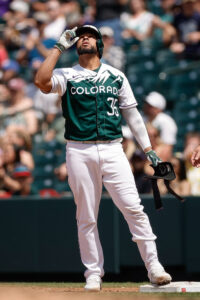
Diaz, 32, is a first-time All-Star this season, thanks largely to a .277/.328/.435 batting line. He’s smacked nine homers and added 15 doubles and a triple while walking at a 7.2% clip against a 21.3% strikeout rate. It’s not exactly elite production; wRC+ pegs him nine percent below average after weighting for his home park, and OPS+ has him four percent below average. However, relative to other catchers throughout the league, Diaz has been quite productive. The average catcher in 2023 is hitting .233/.300/.384. Even when adjusting for home park and league run-scoring environment, catchers have rated 13% worse than average at the plate, by measure of wRC+. In that regard, Diaz has been an above-average hitter relative to his position.
Of course, that’s just one season. Diaz’s offense has been a roller coaster throughout his career, peaking with a .286/.339/.452 slash (114 wRC+) in a much more pitcher-friendly Pittsburgh setting back in 2018 but at times bottoming out as it did just last year, when he hit .228/.281/.368 despite playing half his games at Coors Field. He’s had some good fortune on balls in play this year, with a .327 BABIP that’s about 50 points higher than the career .274 mark he carried into the season. There’s no major uptick in quality of contact that’s driven that change, either; Diaz averaged 88.4 mph off the bat in 2022 with a 39.3% hard-hit rate and is at 88.3 mph and 40.1% in those respective areas this year. It’s possible his bat will take a step back in the season’s second half, although even if it does, it shouldn’t wilt to last year’s surprisingly anemic levels.
Defensively, Diaz is a bit of a mixed bag. Framing metrics have universally panned Diaz’s work over the past two seasons, but he was above-average as recently as 2021. In terms of pitch blocking and throwing, Diaz is one of the game’s best. Dating back to 2021, he ranks eighth among all big league catchers in Statcast’s new Blocks Above Average metric, trailing only a handful of elite defenders (Austin Hedges, Sean Murphy, Jose Trevino, Jacob Stallings, J.T. Realmuto, Yan Gomes, Adley Rutschman).
It’s a similar story with Diaz’s throwing; he regularly boasts better-than-average pop times, and as recently as 2021 he paced the NL with a gaudy 42% caught-stealing rate. He’s at 29% this year, which is far better than it would’ve sounded in previous years, as the new rule changes in 2023 have contributed to a league-wide drop in caught-stealing numbers. The league average typically sat around 25% in seasons past, but it’s down to 20% this year. Statcast pegs Diaz as third-best in MLB with its Caught-Stealing Above Average metric (which strives to gauge throws on a case-by-case basis rather than treating all stolen base scenarios as equal).
There’s also Diaz’s contract to consider. He signed a three-year, $14.5MM extension with the Rockies a couple years ago, buying out his final arbitration season and first two free-agent years. He’s in the second year of that contract right now, earning a reasonable $5.5MM salary with a $6MM salary owed to him in 2024. It’s an affordable enough contract that any club could stomach it.
Relative to open-market prices, Diaz’s annual salary lines up with the type of money that steady mid-30s veterans or younger bounceback options might typically find. For context, Omar Narvaez signed a two-year, $15MM contract with an opt-out/player option this offseason despite having a down year in 2022. Mike Zunino signed a one-year, $6MM deal while seeking a rebound in Cleveland. The previously mentioned Hedges commanded a $5MM guarantee due solely to his defense. Diaz may not be an unmitigated bargain, but he’s at the very least a fairly priced backup — arguably one with some surplus value on his deal.
In general, it’s been a poor year for catchers throughout the league. Only 11 teams have received a wRC+ mark better than Diaz’s 91 from their catchers in 2023. Contenders and playoff hopefuls like the Rays, Astros, Reds, Marlins, Padres and Guardians have all received awful offensive production behind the plate. Speculatively speaking, Diaz could make sense for any of the bunch. That doesn’t mean they’ll all have interest, of course, but there ought to be a market for the veteran.
The Rockies, meanwhile, once again find themselves without a viable path to the postseason. Schmidt has voiced an understandable desire to add pitching to his system, and it stands to reason that there are clubs who might be willing to part with some arms in order to pry loose a catcher who could help not just for the current postseason push but also solidify the position next year. Colorado’s top catching prospect, Drew Romo, isn’t having a particularly strong season in Double-A this year but could conceivably be up in 2024 nonetheless. In the meantime, there’s little harm for a last-place club to let a journeyman like current backup Austin Wynns soak up the majority of starts in the season’s final couple months. He’s a sound defender who posted decent offensive production as recently as 2022. As far as 2024 is concerned, the Rox could always sign a veteran to a one-year deal this winter if need be.
Schmidt has pushed back against the notion of tearing everything down and trotting a Triple-A team out, citing the game’s integrity. That’s a commendable tack, and it provides some context for the type of offers he’d need to part with Diaz and other veterans. Diaz won’t simply be given away for the best offer, nor should he. It also bears pointing out that midseason trades of catchers can be difficult to pull off; acquiring a backstop in the midst of a playoff push and asking him to learn a new pitching staff on the fly is no easy task.
If no serious offers present themselves for Diaz, so be it. The Rockies can always listen in the offseason or hope for better results on a team scale in 2024. However, the Rox also have a history of hanging onto players who appear to be obvious trade candidates, either extending them (e.g Daniel Bard, C.J. Cron, arguably Diaz himself) or simply letting them walk in free agency (e.g Jon Gray, Trevor Story). Schmidt contended to Saunders that he simply didn’t receive “legitimate” offers for players like Gray and Story, and that’s certainly possible. Story, in particular, at least netted the Rox a draft pick after rejecting a qualifying offer.
Diaz won’t be a QO candidate post-’24, however, and his trade value is very arguably at its apex. He’s a first-time All-Star with strong throwing/blocking skills, enough offense for his position and an affordable contract. This summer is the best time to extract a quality return for him. Colorado shouldn’t simply trade him for a handful of magic beans, but setting too high an asking price and holding onto him runs the risk of again losing a quality player for little to no return at a time when the organization as a whole is hungry for quality minor league talent.
Niko Goodrum Signs With KBO’s Lotte Giants
Veteran infielder/outfielder Niko Goodrum, who opted out of a deal with the Red Sox last week, has signed with the Lotte Giants of the Korea Baseball Organization, the team announced (link via Jee-ho Yoo of South Korea’s Yonhap News Agency). He’ll be paid $400K for the remainder of the season. Goodrum, a client of Roc Nation Sports, will take the roster spot of former Dodgers and Rangers outfielder Zach Reks, who was cut loose after a knee injury tanked his 2023 season.
The 31-year-old Goodrum is a veteran of six Major League seasons who debuted with the Twins back in 2017. The switch-hitter has since spent time in Detroit and Houston, logging a combined .226/.299/.389 batting line in 1531 plate appearances between the three teams. The versatile Goodrum was particularly productive in 2018-19, when he played all four infield positions and all three outfield positions for the Tigers while posting a combined .247/.318/.427 slash with 28 homers and 24 steals in 964 plate appearances.
Goodrum’s 2023 season with the Red Sox’ Triple-A affiliate in Worcester was excellent. In 286 trips to the plate, he batted .280/.448/.440 with eight home runs, seven steals and a staggering 23.1% walk rate. Statcast credits Goodrum as a plus defender at both middle infield positions and a passable option in the outfield as well.
With a strong showing in the KBO, it’s possible Goodrum could sign on for another season in South Korea or perhaps head to Japan’s NPB. He’d have seven-figure earning power in either league, though it’s also possible he’ll look to parlay this year’s strong Triple-A showing and a (hopefully) similar level of production in the KBO into a guaranteed big league deal as a free agent next winter.
As for the 29-year-old Reks, he joined the Giants last year as a midseason replacement much as Goodrum is doing now. The 2017 tenth-rounder (Dodgers) hit .330/.410/.495 in 56 games and 251 plate appearances down the stretch, earning himself a $1.2MM guarantee to return ($1MM salary plus $200K signing bonus), but this year’s knee injury left him with a tepid .246/.338/.345 output in a similar sample size to his 2022 showing. Reks is a career .290/.388/.537 hitter in parts of three Triple-A seasons but has only received 44 plate appearances at the MLB level.