
Tigers Claim Tyler Holton, Place Casey Mize On 60-Day Injured List
The Tigers announced Friday that they’ve claimed lefty Tyler Holton off waivers from the Diamondbacks, who’d designated him for assignment earlier in the week. In order to open a spot on the 40-man roster, Detroit transferred right-hander Casey Mize to the 60-day injured list. Mize underwent Tommy John surgery and back surgery last year and wasn’t expected to be ready within the season’s first two months anyhow, so his eventual placement on the 60-day IL was a foregone conclusion.
The 26-year-old Holton made his MLB debut in 2022, pitching nine innings and allowing three runs on right hits and a pair of walks with six strikeouts during that brief cup of coffee. The rest of his season was spent in Triple-A Reno, where he logged a 4.43 ERA in 44 2/3 innings, fanning 23.5% of his opponents against a 9.3% walk rate.
It was a rebound effort for Holton, who’d previously limped to a 6.72 ERA between Double-A and Triple-A in 2021. Even amid those struggles, he notched a strong 26.5% strikeout rate, however, and his 6.5% walk rate was similarly encouraging. Solid strikeout, walk and ground-ball rates have been the norm for Holton since being selected in the ninth round of the 2018 draft. He doesn’t throw hard and has never ranked among the D-backs’ best prospects, but his track record of performance, MLB readiness and pair of remaining minor league option years all surely held appeal to the Tigers.
Prior to claiming Holton, the only left-handed bullpen option on the 40-man roster had been Tyler Alexander (assuming the club wants to keep Joey Wentz in a starting role). Non-roster veterans Chasen Shreve, Jace Fry and Miguel Del Pozo will all be in camp competing for a job as well. Holton will have a chance to land an Opening Day roster spot, though the Tigers can freely option him to Triple-A Toledo if one of the non-roster options outperforms him (or, if the team simply opts to carry one left-hander to begin the season). Wherever he starts the year, Holton figures to log some action in the big league bullpen in 2023, given the lack of certainty that permeates the Detroit bullpen following offseason trades of Gregory Soto and Joe Jimenez.
As for Mize, he underwent Tommy John surgery last June, so he’s unlikely to be an option until the season’s second half. The Tigers only recently revealed that Mize also underwent back surgery around that same time, however. Mize told reporters about the procedure earlier this week, explaining that his back issues have been slowly escalating over the past several years. Knowing he’d be off the mound for a year-plus anyhow, he opted for surgery aimed at alleviating the issue so he could truly be at full strength once he returns to the mound later this year.
Rangers Have Had Talks With Robbie Grossman
The Rangers have had discussions with free-agent outfielder Robbie Grossman about a potential contract, reports ESPN’s Buster Olney (Twitter link). The 33-year-old would give them another option to jump into their currently unsettled left field mix.
Pitching has been the overwhelming focus for the Rangers throughout the 2022-23 offseason, as they’ve signed Jacob deGrom, Nathan Eovaldi and Andrew Heaney while also acquiring Jake Odorizzi in a trade with the Braves. Two of the three spots in the team’s outfield seem generally spoken for, with slugger Adolis Garcia likely ticketed for everyday work in right field and defensive standout Leody Taveras slated for regular work in center field.
Left field is another story entirely. The position has gone unaddressed this winter even though Rangers left fielders were the least-productive unit of all 30 MLB clubs in 2022, when they ranked dead-last in the Majors in batting average, on-base percentage and slugging percentage. Texas left fielders combined to post an almost unfathomably feeble .186/.253/.255 batting line. That translated to a 47 wRC+, or roughly 53% worse than league-average production after weighting for home park and the league run-scoring environment. Rangers left fielders also struck out at a 29.6% clip (28th in MLB), hit 11 home runs (27th), and managed only five doubles (last in the Majors) and no triples.
There’s no clear, MLB-ready top prospect looming, either. The Rangers’ hope, to this point, has seemingly been that some combination of former top prospect Josh Smith, veteran utilityman Brad Miller, former first-round pick Bubba Thompson, infielder/outfielder Mark Mathias and a slate of minor league signees (e.g. Clint Frazier, Travis Jankowski, Elier Hernandez) can patch the position together.
However, Texas general manager Chris Young said last week that he’s still open to the possibility of adding an outfielder from outside the organization. Grossman obviously fits that bill, and while he might not be ticketed for everyday work himself, the veteran switch-hitter could at the very least occupy the short half of a potential platoon arrangement.
Grossman was an above-average bat in five of six seasons from 2016-21, with 2019 being the lone exception. He slipped to a .209/.310/.311 output in 477 plate appearances this past season between the Tigers and Braves, but he maintained his long track record of production against left-handed pitching. He mashed southpaws at a .320/.436/.443 pace in 2022 and is a career .279/.377/.413 hitter against lefties.
Grossman has had productive stretches against righties, too, though he’s been inconsistent in that regard. He’s batted .232/.335/.363 in his career against righties and walked at a hefty 12.7% clip, but over the past two seasons, Grossman has looked overmatched when batting from the left side of the dish: .196/.308/.331 (82 wRC+) in 793 plate appearances. Among the Rangers’ in-house options in left field, both Miller and Smith bat from the left side of the dish, making Grossman a somewhat natural platoon partner for either.
While Grossman was a defensive liability early in his career, he’s improved his glovework over time. Over the past four seasons, he’s tallied 2422 innings in left field and been a scratch defender per Defensive Runs Saved (0), while Ultimate Zone Rating (6.2) and Statcast’s Outs Above Average (2) feel he’s been a bit better.
Rays Void Prior Selection Of Trevor Kelley’s Contract
Feb. 17: The Rays have voided yesterday’s transaction selecting Kelley to the 40-man roster and transferring Kittredge to the 60-day injured list, tweets Neil Solondz of Rays Radio. Voiding the transaction is largely a technicality; the league flagged the transaction, citing a rule that non-roster invitees are ineligible to be selected to the 40-man roster until March 15. The move can still formally be processed at that time. It’s surely discouraging for Kelley, however, as he’ll now be exposed to some injury or performance-based risk over the next month that wouldn’t have been the case had he been immediately added to the 40-man roster.
Feb. 16: The Rays announced Thursday that they’ve selected the contract of right-hander Trevor Kelley, who’d been in camp on a minor league deal. Fellow righty Andrew Kittredge, who’s recovering from Tommy John surgery, was transferred to the 60-day injured list in order to open a spot on the 40-man roster. Marc Topkin of the Tampa Bay Times suggested earlier that Kelley could be selected to the 40-man roster sooner than later.
Kelley, 30, has seen Major League time with the Red Sox, Phillies and Brewers but has yet to find much big league success. He tallied a career-high 23 2/3 innings with Milwaukee last season but also was knocked around to the tune of a 6.08 ERA. The sidearmer posted a below-average 21.5% strikeout rate but a solid 8.4% walk rate. Home runs have been a major issue for Kelley, however, evidenced by a whopping 11 round-trippers surrendered in just 35 1/3 MLB frames (2.8 HR/9).
Those big league struggles notwithstanding, Kelley possesses an exceptional 1.81 ERA in a much larger sample of 164 1/3 innings at the Triple-A level. He’s also punched out 25.7% of his opponents there against an 8.7% walk rate. Kelley has a minor league option remaining as well, so he’ll give the Rays some flexibility with their bullpen. He’s not yet up to a year of MLB service, so if the Rays can coax some of that Triple-A performance out at the Major League level, the Rays can control him for as many as six seasons.
As for Kittredge, he was one of the Rays’ top relievers, pitching to a 2.17 ERA in 99 2/3 innings dating back to 2020. However, the 32-year-old Kittredge was limited to just 20 innings this past season, as a June IL placement due to discomfort in his right elbow ultimately proved a precursor to Tommy John surgery. It’s possible he’ll make it back to the big leagues at some point in the season’s second half, but there’s no way Kittredge was going to be ready within the season’s first couple months, so moving him to the 60-day IL amounts to little more than a formality. If the Rays need another 40-man roster spot, they can do the same with right-hander Shane Baz, who’s also on the mend from Tommy John surgery.
Corbin Burnes Expresses Disappointment With Brewers Following Arbitration Hearing
Brewers ace Corbin Burnes lost his arbitration hearing against the team this week and, upon being asked about the process in Brewers camp today, offered a rather candid assessment of the hearing (Twitter links, both with video, via Todd Rosiak of the Milwaukee Journal-Sentinel and Adam McCalvy of MLB.com). The two-time All-Star and 2021 NL Cy Young winner expressed “disappointment” not in the loss itself but in the way the team approached negotiations and conducted itself during the trial. Most troubling for Brewer fans is that, asked specifically about his relationship with the team, Burnes admitted that damage had indeed been done.
“There’s no denying that the relationship is definitely hurt,” the right-hander said. “There’s really no way of getting around that. Obviously, we’re professionals and we’re going to go out there and do our job. Keep doing what I can every fifth day that I go out there. But some of the things that are said, for instance, basically putting me at the forefront of why we didn’t make the postseason last year — that’s something that probably doesn’t need to be said.”
Burnes made clear that the Brewers did not, at any point, attack his character or disparage him as a person, but the implication was still that lines were crossed in the back-and-forth of the trial. Moreover, the 28-year-old was disappointed with the team’s lack of effort to avoid a trial at all.
“The Brewers never made a real attempt to try to come to a deal to avoid a hearing, at least from our perspective” Burnes explained. “…Even up until the days before, there were some phone calls back and forth, and basically it just came out that we were going to end up going to a hearing. That was kind of how it ended. I think we saw from the deadline day that we were going to end up at a hearing, just with the lack of attempts to get a deal done. It’s unfortunate that it ended up that way.”
The team, Burnes said, made a late but “pretty poor” two-year offer. However, MLB.com’s Adam McCalvy reports that said offer wasn’t even a guaranteed deal to buy out Burnes’ final two arbitration seasons, but rather a one-year deal with an option. Such contracts aren’t considered straight one-year deals by “file and trial” clubs, as the presence of an option prevents them from being cited as data points in future hearings.
Burnes’ candor upon being asked about the matter is simultaneously refreshing and fascinating — and, for Brewers fans, likely infuriating. (MLBTR readers are encouraged to take a few minutes to watch the entirety of his comments in the video links above to grasp the full scope of his comments and the issues he took with the team’s approach.) The typical line following arbitration hearings is that they’re “just business,” and while many players surely feel that way, Burnes’ comments are a reminder that there’s a personal component to the process and, at the end of the day, the teams are dealing with human beings.
For instance, the right-hander notes that his hearing was scheduled on Valentine’s Day, meaning he spent the majority of the day on a plane or in the trial, only making it home to see his wife around 11pm. He also spoke of the seven years he’s spent rising from the draft to his current status, calling it “tough to hear” some of the things that the team brought to its case against him. “They won [the hearing],” Burnes said, “but when it came down to winning or losing the hearing, it was more than that for me.”
It bears emphasizing that Burnes was asked to open up about the hearing and didn’t necessarily head to camp looking to broadcast any ill feelings toward his longtime employer, but the fact that he was willing to do so in a public setting speaks to the personal stakes that can come into play in these often contentious hearings. It’s a large reason that all parties are typically motivated to avoid going in front of an arbitration panel, though a handful of cases to reach this juncture every year.
The $750K gap that separated the Brewers’ $10.01MM submission and Burnes’ $10.75MM figure is generally considered peanuts for MLB clubs; that’s scarcely more than the league-minimum salary under the new collective bargaining agreement, and the fact that a team will go to a trial and risk just this type of alienation to save relatively trivial sums is often a point of consternation among fans.
We’ve explored the team perspective with regard to arbitration here at MLBTR in the past, pointing out that clubs take hard lines and are willing to go to trial more due to down-the-road implications than immediate, present-day savings. Making a concession on a $750K sum to keep Burnes happy, in a vacuum, seems like an easy call. But if every club took that approach and acquiesced on the small gaps in arbitration, those concessions would become data points for future arbitration cases, and arbitration salaries would spike in fairly rapid fashion. That explanation doesn’t necessarily lessen the frustration among fans and likely only increases it among players, but the simple fact of the matter is that hardline tactics like this generally work. Dontrelle Willis‘ $4.35MM salary as a first-time arbitration-eligible pitcher way back in 2006 stood as a standard for first-time arbitration-eligible pitchers for upwards of 15 years, for instance, despite escalating revenues and player salaries throughout the league.
Indeed, the Brewers released a statement of their own on the matter, praising Burnes as a leader and a vital cog for their team. Said general manager Matt Arnold:
“The arbitration process always presents uncomfortable situations for both the club and player involved. It is never easy to present a case against a member of the Brewers family. I’d like to reiterate that we view Corbin as one of the leaders of our franchise and value him as an elite talent in the game. Corbin is a major contributor to the organization both on and off the field, and we look forward to another outstanding season from him in 2023.”
The club’s intentions notwithstanding, Burnes clearly doesn’t feel as though those comments are in alignment with the manner in which he was characterized in the trial. Teams will go to great lengths to win an arbitration hearing, but it’s still eye-opening to hear that the Brewers’ argument in any way linked their postseason miss to Burnes’ performance; Burnes made 33 starts, pitched to a 2.94 ERA and actually had better results against teams with winning records (2.82 ERA) than he did against sub-.500 clubs (3.09 ERA). That includes a masterful 1.29 ERA and 32-to-4 K/BB ratio in 28 innings against the NL Central champion Cardinals.
There’s no indication that any bad blood between Burnes and the team will lead to a trade or prevent Burnes from accepting an extension offer, if the Brewers make a long-term offer to his liking. At the same time, it’s certainly telling to hear such open levels of frustration and disappointment from a star-caliber pitcher with free agency looming after the 2024 campaign. The resultant chip on Burnes’ shoulder could serve as extra motivation both in 2023 and in arbitration again next season, but the Milwaukee ace made clear that he doesn’t plan to dwell on the hearing and will shift his attention to the upcoming season.
“At the end of the day, it’s disappointing, but you’ve got to get past it,” said Burnes. “Obviously, now the focus is playing baseball, and going out and doing what I can for the teammates and the fans.”
D-backs Win Arbitration Hearing Against Josh Rojas
The Diamondbacks won their arbitration hearing against infielder Josh Rojas, tweets Mark Feinsand of MLB.com. He’ll earn the $2.575MM salary submitted by the team, rather than the $2.9MM sum at which his camp filed.
Rojas, 28, has solidified himself as both a versatile and valuable player for Arizona over the past two seasons, batting a combined .267/.345/.401 with 20 long balls, 57 doubles, four triples and 32 steals in 1060 plate appearances.
Originally acquired from the Astros as part of a four-player return for Zack Greinke, Rojas has gone from a jack-of-all-trades utilityman to the team’s primary third baseman, logging 740 innings at the hot corner in 2022. He’s logged at least 296 innings in both outfield corners and at every infield position other than first base, with defensive metrics generally agreeing that he’s a quality outfielder but a below-average glove on the infield (particularly at shortstop, where he didn’t log an inning in 2022).
With Nick Ahmed healthy again, former top prospect Geraldo Perdomo perhaps vying for a bench spot and top prospect Jordan Lawlar ascending the minor league ladder, Rojas’ days at shortstop are likely all but finished anyhow. He can still play there in a pinch, but as far as 2023 is concerned, he’ll likely split time at third base with veteran Evan Longoria and perhaps shift into the outfield corners and spell any of Corbin Carroll, Alek Thomas or Jake McCarthy from time to time. Because all three of those Carroll, Thomas and McCarthy can handle center, manager Torey Lovullo can slide Rojas into a corner whenever one of those outfielders needs a breather.
This was Rojas’ first trip through the arbitration process. As a Super Two player, he’ll still be eligible for arbitration in each of the next three offseasons. He can’t become a free agent until the completion of the 2026 season.
Luis Rengifo Wins Arbitration Hearing Against Angels
Infielder Luis Rengifo won his arbitration hearing against the Angels, tweets MLB.com’s Mark Feinsand. He’ll earn the $2.3MM salary at which he and his representatives from MVP Sports Group filed, rather than the team’s $2MM submission.
Rengifo, 26 later this month, appeared in a career-high 127 games in 2022 and tallied 511 plate appearances, batting .264/.294/.429 with 17 home runs, 22 doubles, four triples and six steals. He bounced all over the infield, logging 693 innings at second base, 250 innings at third base and 99 innings at shortstop (in addition to a 15-inning cameo in the outfield).
That marked the most productive season of a four-year career for Rengifo, who entered the season as a .216/.293/.325 hitter in 702 trips to the plate. The strong showing perhaps contributed to the Angels’ decision not to make a strong push for shortstop help this offseason. Instead, they’ll likely rely on a combination of Rengifo, David Fletcher and perhaps trade acquisition Gio Urshela to handle the bulk of the workload at shortstop.
Slick-fielding Andrew Velasquez remains on the 40-man roster as well, though he also has a minor league option left. Infield prospect Livan Soto is another candidate, although his brilliant .400/.414/.582 showing in an 18-game MLB debut last year was propped up by a .500 batting average on balls in play that clearly can’t be sustained over a larger sample. He’s also yet to play a single inning at the Triple-A level, so the Halos might want to give him some additional development time. A free agent like Elvis Andrus could conceivably fit in Anaheim still, but the Angels generally appear set with their infield depth given the combination of Rengifo, Fletcher, Urshela and free-agent pickup Brandon Drury.
This was the first trip through the arbitration process for Rengifo, who’ll be eligible for arbitration twice more before reaching free agency upon completion of the 2025 campaign.
Dodgers Place Three Pitchers On 60-Day IL, Finalize Three Free Agent Signings
The Dodgers announced Thursday that they’ve placed right-handers Walker Buehler, Blake Treinen and J.P. Feyereisen on the 60-day injured list. The trio of transactions clears space on the 40-man roster for the previously reported free-agent signings of David Peralta, Alex Reyes and Jimmy Nelson, whose one-year deals have now become official.
None of three IL placements come as a surprise. Buehler underwent Tommy John surgery late in the 2022 season and is expected to miss most, if not all of the upcoming 2023 campaign. Treinen, meanwhile, could miss the entire 2023 season after undergoing surgery to repair the labrum and rotator cuff in his right shoulder back in November. At the time the surgery was announced, the team provided an estimated recovery period of about 10 months, which would run into early September.
As for Feyereisen, he’s never thrown a pitch for the Dodgers but was acquired in a December trade that sent minor league lefty Jeff Belge to the Rays. The 30-year-old Feyereisen rattled off 24 1/3 shutout innings for Tampa Bay in 2022 and has a 1.48 ERA in 61 innings of relief work with the Rays dating back to 2021. However, he underwent a similar procedure to Treinen (rotator cuff and labrum repair) in early December and is reportedly looking at August as a best-case scenario for his own return.
The Rays entered the offseason with three players on their 40-man roster whom they expected to miss most or all of the 2023 season — righties Shane Baz and Andrew Kittredge are recovering from Tommy John surgery — creating enough inflexibility that they opted to designate Feyereisen for assignment and find a trade partner. It’s a long-term play for the Dodgers, as Feyereisen is controllable via arbitration for another three seasons after the 2023 campaign.
The trio of 60-day IL placements are effectively formalities, but this slate of Dodgers moves is also a good reminder that teams can now create roster space for new additions — be they Major League signings, waiver claims or trade acquisitions — without necessarily having to designate a current player for assignment. MLBTR’s Darragh McDonald recently ran through all 30 teams and looked at each club’s 60-day IL candidates to begin the season.
Padres Sign Michael Wacha
The Padres announced Thursday they’ve signed free-agent righty Michael Wacha. The CAA client will reportedly receive a $3.5MM signing bonus and a $4MM salary in 2023. After the upcoming season, the Padres will have to decide whether or not to pick up successive $16MM options for 2024 and 2025 — essentially a two-year, $32MM deal. If the club declines that option, Wacha will have a series of player options, respectively valued at $6.5MM in 2024 and then $6MM in 2025-26. Unlike the team option, Wacha’s options are a series of one-year decisions he’ll be able to make each offseason.
Since player options are considered guaranteed, all this amounts to a $26MM guarantee over four years, combining this year’s money with the three options. Additionally, Wacha can earn an extra $500K for reaching 20 and 25 starts and $1MM for 30 starts this season and any year under a player option. The incentives would not be available for 2024-25 if the club triggers its option. In a corresponding 40-man roster move, the Padres placed infielder Eguy Rosario on the 60-day injured list. It was reported a couple of weeks ago that Rosario suffered a broken ankle and would be out until “midsummer.”
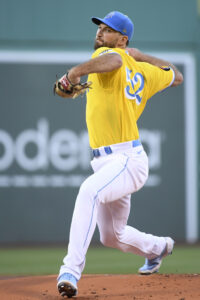
Wacha, 31, was the best remaining starting pitcher on the market and arguably the best free agent left standing overall. The right-hander turned in 127 1/3 innings of 3.32 ERA ball in 2022 — a fine rebound showing after a tough three-year stretch from 2019-21. Wacha’s 6% walk rate in 2022 was particularly sharp, and he scaled back his home run rate quite a bit in 2022 (1.83 HR/9 from 2019-21; 1.27 HR/9 in 2022). He was better than average at limiting hard contact from his opponents, surrendering an 88.2 mph average exit velocity and 35.4% hard-hit rate.
The 2022 performance, however, wasn’t without its red flags. A pair of trips to the injured list, one for an intercostal strain and another for shoulder inflammation, limited him to 23 starts. That shoulder issue was his fourth IL placement due to shoulder trouble since 2014. Wacha’s 20.2% strikeout rate and 41% ground-ball rate were below the league average, albeit by a matter of a couple percentage points each.
Ultimately, Wacha had a solid season but can’t reasonably be expected to replicate that shiny 3.32 ERA. Beyond some of last year’s under-the-hood numbers, it should be pointed out that from 2019-21, Wacha pitched 285 1/3 innings with a 5.11 ERA between the Cardinals, Mets and Rays. Wacha’s strikeout, walk and ground-ball rates in that stretch all compare favorably to his 2022 work, however, and the main culprit for his struggles in that stretch could well have been an anomalously high home-run rate that trended back toward his career levels in 2022.
In all likelihood, Wacha’s true talent level lies somewhere between the extremes of that 2019-21 stretch and his sharp 2022 output. Fielding-independent marks pegged him around 4.00 last year (4.14 FIP, 3.99 xFIP, 4.07 SIERA). That’d make him a solid option closer to the back end of a big league rotation, which is just where he’s likely to slot in with his new club in San Diego. Joe Musgrove, Yu Darvish and Blake Snell are slotted into the top three rotation spots, but Wacha will give the Friars a solid No. 4 option.
Both Nick Martinez and Seth Lugo have been expected to be utilized as starters with the Padres in 2023, but it’s not a given that Wacha will push either to the bullpen. There’s been talk of a six-man rotation in San Diego, which is only sensible given that Martinez and Lugo both worked primarily out of the bullpen in 2022. Martinez made 10 starts for the Padres but 37 relief appearances, finishing out the season at 106 1/3 innings. Lugo has been exclusively a reliever in 2021-22, with his last start coming for the 2020 Mets. Both righties will likely see their workloads monitored in 2023, so bringing Wacha into the mix both gives the Padres some sorely needed depth and gives them an organic mechanism with which to manage the innings counts for Martinez and Lugo.
Even looking beyond the possible six-man rotation, the Padres are now simply better positioned to withstand an injury to one of their top five arms. That’s of particular importance, as recent trades have thinned out the system’s depth. Gone are MacKenzie Gore, Chris Paddack, Luis Patino, Cal Quantrill and Robert Gasser, who were traded in the respective packages that netted Juan Soto, Taylor Rogers, Snell, Mike Clevinger (who departed as a free agent) and Josh Hader.
The top depth options behind Martinez and Lugo on the 40-man roster had been Adrian Morejon (57 1/3 innings in 2022), Ryan Weathers (6.73 ERA in Triple-A), Reiss Knehr (6.88 ERA in Triple-A), Pedro Avila (13 1/3 MLB innings) and Jay Groome (zero MLB experience; 67 innings in Triple-A). Non-roster veterans in camp include Julio Teheran, Wilmer Font and Aaron Brooks. Suffice it to say, any serious injury to the starting staff pre-Wacha would’ve stretched the depth; two might have been disastrous. Wacha helps to lessen such risks.
Wacha’s deal was surely structured with care, in an effort to keep the team shy of the third luxury tax barrier. The convoluted option sequence serves to tamp down the deal’s average annual value. Wacha’s deal comes with a $6.5MM hit for competitive balance tax purposes, with the 2023 money and three player options all treated as guaranteed years from a CBT angle.
San Diego had been estimated less than $7MM away from the third tier of luxury penalization, which kicks in at $273MM. If the Friars exceed that point, they’ll begin to be taxed at a 75% rate for any money spent up to $293MM (rather than the 45% rate at which they were taxed on the previous $20MM spent). That’s a small slap on the wrist by itself, but stepping into the third bracket of luxury penalties also pushes a team’s top pick in the next year’s draft (i.e. 2024) back by ten places. The team’s league-allotted bonus pool is also inherently reduced, in conjunction with the diminished slot value of that pick.
The Padres are a team in all-out win-now mode, but they’ve ostensibly been unwilling to pass the $273MM threshold and incur the associated draft penalties. Even this agreement with Wacha would likely not have been possible had the team not signed the aforementioned Darvish to an extension that tamped down the AAV on his own contract, giving them a couple million dollars of extra wiggle room with regard to the tax.
The apparent unwillingness to step into tier three of the luxury tax is understandable, to an extent, given that the front office surely wants to recoup some of the minor league talent that was lost in trades for Soto, Hader and others. That said, it’s still possible that in-season needs will prompt the team to make a tough decision on that front, as the trade deadline could come down to a matter of taking on salary (and crossing into that tax bracket anyway) or persuading trade partners to pay down the salary of any players being sent to San Diego, which would likely require the Padres to surrender additional minor league talent anyhow. There’s an argument that the Padres should’ve just barreled past the tax line in the offseason, but it seems they’ll continue trying to thread the needle of fielding the strongest possible club while preserving the strongest possible 2024 draft. Whether that path remains tenable come July remains to be seen.
Ken Rosenthal of the Athletic was first to report the agreement, financial terms and incentive breakdown.
Orioles Provide Health Updates On Several Pitchers
Orioles general manager Mike Elias met with the media as pitchers and catchers report to the team’s spring training facility in Sarasota, Fla., and the GM provided a handful of less-than-ideal updates regarding his pitching staff. Most notably, righty Dillon Tate sustained a forearm/flexor strain in late November and is expected to miss at least the first month of the season (Twitter link via Nathan Ruiz of the Baltimore Sun). Tate will open the year on the 15-day injured list.
Meanwhile, closer Felix Bautista has spent the winter rehabbing from the left knee injury that ended his season and has also been on a strengthening program for his right shoulder (Twitter link via MASNsports.com’s Roch Kubatko). His spring debut will be delayed, so he’s not a lock to be ready by Opening Day. Top prospect DL Hall is also behind schedule after experiencing some lower lumber discomfort about three weeks ago (via Andy Kostka of the Baltimore Banner). Elias didn’t rule out the possibility that southpaw Nick Vespi, who underwent surgery to repair a hernia in early January, would be ready for Opening Day, but that’s not a given either.
Tate’s injury status is presently the largest blow to the club, as he quietly stepped up as a high-end setup piece for Bautista in 2022. The former No. 4 overall draft pick logged a career-high 73 2/3 innings while recording a tidy 3.05 ERA. Tate picked up 16 holds and five saves, offsetting a below-average 20.5% strikeout rate with excellent walk and ground-ball rates of 5.5% and 57.1%, respectively.
The Orioles and Tate agreed to a $1.5MM salary earlier in the offseason, avoiding an arbitration hearing in Tate’s first trip through the process. He’s under control through the 2025 campaign and had previously looked to be in the running for Baltimore’s top setup option to Bautista. At least in the season’s early stages, some of those high-leverage innings that would’ve gone to Tate will now instead fall to veteran Mychal Givens — who returned to the O’s on a one-year free agent deal this winter — and lefty Cionel Perez.
Speaking of Bautista, there’s no firm indication that he’ll miss any regular-season time just yet, but even a short-term absence would be a notable hit to the bullpen. The 27-year-old hadn’t pitched above A-ball until 2021, when he posted a combined 1.54 ERA across three minor league levels, topping out with just 18 1/3 frames in Triple-A. That, apparently, was all the upper-minors seasoning he needed; Bautista not only made the Orioles’ Opening Day roster in 2022 but almost immediately broke out as one of the game’s top relievers.
In 65 2/3 innings last season, Bautista notched an outstanding 2.19 ERA and tallied the first 15 saves of his career. He averaged an obscene 99.3 mph on both his four-seamer and his sinker, which played a huge role in the right-hander’s gaudy 34.8% strikeout rate. Unlike many flamethrowers who lack any semblance of precision with their high-octane heaters, Bautista turned in a 9.1% walk rate that matched the league-average walk rate for relief pitchers. Obviously, it’s discouraging to hear that last year’s knee issue required what was apparently a relatively lengthy rehab process, but to this point the O’s haven’t broadcast any reason for major concern, either.
As for Hall, the back troubles could throw a wrench into his bid for a spot in the team’s rotation to begin the season. The former first-round pick (No. 21 in 2017) has stated at multiple points this winter that his goal is to win a starting job to begin the season. Given his prospect status and the general uncertainty on the Orioles’ staff behind Kyle Gibson and Cole Irvin, that seemed plausible, but expectations should likely be tempered until it becomes clearer as to when Hall’s spring regiment can begin in earnest.
The 24-year-old Hall made his MLB debut last season, starting one game and making ten relief appearances. In 13 1/3 frames, he was tagged for nine runs on 17 hits and six walks. The resulting 5.93 ERA was an eyesore, but Hall flashed huge strikeout potential by fanning 19 of the 64 batters he faced (29.7%). He hasn’t any problems missing bats in the minors, either, evidenced by a mammoth 43.4% strikeout rate in 35 1/3 career Double-A frames as well as a 36.1% mark in 76 2/3 innings at the Triple-A level.
Where Hall has struggled — and struggled repeatedly — is with his command. The lefty has walked an untenable 13.4% of his opponents across parts of five minor league seasons, including an even more troublesome 14.2% mark in Triple-A. That lack of command has prompted many scouting reports to peg Hall for a future in the bullpen, but the O’s are understandably intent on giving him a legitimate opportunity to stick as a starter. He’s been used almost exclusively as a starter in the minors, with 69 of his 77 total appearances coming out of the rotation.
If Hall is behind schedule to the point that he can’t be ready for a big league rotation spot early in the year, that’ll create additional opportunities for Kyle Bradish, Dean Kremer, Tyler Wells, Spenser Watkins, Bruce Zimmermann, Mike Baumann and top prospect Grayson Rodriguez. That said, so long as Hall’s back injury doesn’t prove too serious, he’ll likely get an opportunity early in the season. He and Rodriguez are the organization’s top two pitching prospects, and while Rodriguez (arguably the sport’s top all-around pitching prospect) is typically held in higher regard, Hall nevertheless landed in the No. 75 spot on Baseball America’s 2023 Top 100 prospect rankings.
Phillies Sign Aramis Garcia To Minor League Deal
The Phillies announced Thursday that they’ve invited three catchers to spring training as non-roster invitees: Aramis Garcia, Cody Roberts and Jack Conley. Conley was already in the system as a 2018 draftee, and Roberts was plucked from the Orioles in the minor league phase of this year’s Rule 5 draft. Garcia, however, was a free agent, meaning he’s inked a minor league deal with Philadelphia.
Garcia, 30, is the only member of this catching trio with big league experience. He’s appeared in parts of four MLB seasons between the Giants, Reds and A’s, batting a combined .216/.253/.332 in 320 trips to the plate. He spent the entire 2022 season with Cincinnati, logging most of his action in the Majors as the Reds dealt with injuries to Tyler Stephenson and cycled through a carousel of options behind the dish. Garcia has a solid 28% caught-stealing rate in his limited MLB action, and he’s turned in above-average framing grades as well, per FanGraphs.
In all likelihood, Garcia will be ticketed for Triple-A with the Phils, who have J.T. Realmuto entrenched as the starter behind the dish. Backup Garrett Stubbs, meanwhile, turned in an excellent .264/.350/.462 slash as Realmuto’s primary backup, placing him among the most productive backup catchers in the sport.
The Phillies have a well-regarded third option on the 40-man roster in young Rafael Marchan, but they traded Donny Sands to the Tigers in the swap that brought Gregory Soto to Philadelphia, thinning out their catching depth in the process. Garcia will join John Hicks as a non-roster invitee with big league experience, but it’d likely require an injury or two for either to force his way into the mix for an Opening Day roster spot.