
Twins Designate Kyle Garlick For Assignment
The Twins announced Wednesday that they’ve designated outfielder Kyle Garlick for assignment. His spot on the 40-man roster will go to shortstop Carlos Correa, whose return on a six-year, $200MM contract (with four vesting/club options) has now been formally confirmed by the team.
Garlick, 31 later this month, has spent the past two seasons with the Twins, hitting a combined .233/.283/.446 in 269 trips to the plate. Those numbers don’t necessarily stand out on their own, but Garlick’s platoon splits tell the tale of a useful part-time/platoon outfielder. He’s been overmatched by fellow right-handers, evidenced by a .207/.258/.345 output. However, Garlick has consistently shown plus power against lefties, batting .256/.303/.534 with 10 home runs and seven doubles in just 145 plate appearances versus southpaws since joining the Twins.
Unfortunately, Garlick has also had difficulty staying on the field during his two seasons in Minnesota. Over the past two seasons, he’s had trips to the injured list for a sports hernia (which required surgery), a calf strain, a hamstring strain, a ribcage contusion and a wrist sprain — the latter of which ended his 2022 season. There’s little doubting that Garlick can hit left-handed pitching, but his lengthy list of injuries, combined with sub-par defensive ratings in the outfield corners, have limited his utility as well.
Garlick seemed to have a place on the Twins’ roster heading forward, as he’s a natural platoon partner for their veritable cavalcade of left-handed-hitting corner outfielders and had already agreed to a modest $750K salary for the upcoming season. That’s only $30K north of the league minimum at this point, though, so it’s not as though the Twins had locked Garlick in for a particularly weighty sum.
Any team wishing to claim Garlick would need to take on that mild salary but would also be able to control Garlick for another four seasons, if they choose. The Twins will have a week to trade Garlick or attempt to pass him through outright waivers. He’s been outrighted once previously in his career, so if Garlick goes unclaimed, he’d have the ability to reject an assignment to Triple-A in favor of free agency.
Mets Among Teams With Interest In Zack Britton
The Mets are among the teams that have some interest in free-agent lefty Zack Britton, tweets Jon Heyman of the New York Post. Britton, of course, is plenty familiar with Mets skipper Buck Showalter from the pair’s days in Baltimore, and recently hired bullpen coach Dom Chiti was Britton’s bullpen coach for three years with the Orioles as well.
Britton would give the Mets at least two clear left-handers in the ‘pen, joining trade acquisition Brooks Raley as a southpaw who’s seemingly guaranteed a spot. Displaced starter David Peterson could vie for a bullpen gig himself, though perhaps the Mets would prefer to keep him stretched out in the event that they need to tap into their minor league depth. Peterson does have a pair of minor league option years remaining. The Mets also have both Joey Lucchesi (returning this year from Tommy John surgery) and Tayler Saucedo as left-handed bullpen options on the 40-man roster.
The 35-year-old Britton has seen his star dim in recent seasons, due primarily to injuries. Britton underwent arthroscopic surgery to remove a bone chip from his elbow in March 2021 — a procedure that sidelined him for the season’s first two months. He returned in June but pitched only briefly before a hamstring strain sent him back to the injured list. Britton’s return from that injury proved short-lived as well. He was put back on the IL with an elbow strain and went back under the knife for a second procedure to remove chips from his elbow Sept. 2021.
It was announced prior to the surgery that doctors would also be examining potential damage to his ulnar collateral ligament during the procedure. That ominous update was indeed a portent for a more severe injury, as the operation revealed that Britton required a reconstruction of said ligament; a Tommy John procedure wound up being performed as well.
Britton made a fairly improbable comeback when he was activated from the injured list in late September. However, he appeared in just three games with the Yankees and walked six of the nine men he faced before returning to the IL with what the team called shoulder fatigue. Britton’s 92.8 mph average sinker in those three appearances was nowhere close to either the 96.9 mph he averaged at his peak or the 94.9 mph he averaged during his last healthy season in 2020.
Given that recent run of health woes, Britton clearly comes with a good bit of injury risk. Due to the pair of surgeries and the pandemic-shortened 2020 campaign, he’s totaled just 38 innings since the conclusion of the 2019 season. Britton, to his credit, was excellent in 2020. However, he’s been rocked for a 6.16 ERA with more walks (20) than strikeouts (17) in 19 innings across the past two seasons.
Of course, at his peak, Britton was one of the game’s very best relievers. From 2014-20, the flamethrowing sinker specialist pitched to a combined 1.84 ERA in 367 1/3 innings with a 24% strikeout rate, a 9.2% walk rate and a 76.2% ground-ball rate that established him as the best ground-ball pitcher since batted-ball data began being tracked in 2002. Britton’s ground-ball rates in 2016 (80%), 2015 (79.1%) and 2019 (77.2%) are the three highest single-season marks from a qualified pitcher that have ever been tracked. Unsurprisingly, he suppressed home runs at an elite rate, averaging just 0.37 long balls per nine innings pitched during his seven-year peak.
Certainly, the Mets or any other team signing Britton will be hoping for a reliever closer to those levels than the ugly results he turned in during his injury-ruined 2021-22 seasons. It’s not realistic to expect Britton will return to his juggernaut 2015-16 form, but a healthy Britton is quite obviously still a talented, potential late-game option.
It’s at least worth noting that Heyman’s colleague, Mike Puma, tweets that although the Mets indeed have interest in Britton, it’s also possible their recent frustration following the Carlos Correa saga could impact any potential talks. Both Correa and Britton are represented by the Boras Corporation. Given the number of top-level free agents Boras represents each winter and the Mets’ penchant for chasing big-name stars, it’s overwhelmingly unlikely that the Mets would swear off dealing with the Boras Corporation entirely. That said, with the sting of that saga still fresh for all parties, some short-term frustration is feasible enough.
Nationals Sign Corey Dickerson
1:14pm: The Nationals have officially announced their signing of Dickerson.
7:30am: The Nationals and free-agent outfielder Corey Dickerson are in agreement on a one-year deal worth $2.25MM, tweets Mark Feinsand of MLB.com. The Excel Sports Management client can earn another $750K via performance incentives. The Nats Report first reported that Dickerson and the Nationals were in agreement on a deal.
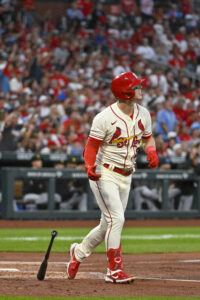
Dickerson, 33, will join his eighth big league team with this agreement — and his third in the National League East, having played prior stints with both the Phillies (2019) and Marlins (2020-21). His 2022 season was spent with the Cardinals, where he logged a .267/.300/.399 slash with six homers, 17 doubles and a triple in 297 plate appearances. That slash is at least somewhat skewed by an awful start to the season which saw him bat .180/.237/.213 through his first 97 plate appearances; from June 1 through the end of the 2022 campaign, Dickerson recorded 200 trips to the plate and posted a hefty .307/.330/.484 batting line.
In reality, Dickerson’s true talent level likely lies somewhere between the two extremes. The 2017 All-Star and 2018 Gold Glove winner is a lifetime .281/.324/.481 hitter but has settled in closer to a league-average bat since the 2020 season, slashing .266/.313/.403 in 872 turns at the plate.
The left-handed-hitting Dickerson carries a fairly sharp platoon split, with the majority of his power coming versus right-handed pitching. Dickerson’s 25.8% strikeout rate and 4.9% walk rate against lefties are also demonstrably worse than his respective 18.9% and 6.1% marks when holding the platoon advantage. Overall, Dickerson has held his own in terms of batting average against lefties (.259) but has paired that with a bleak .299 on-base percentage and just a .394 slugging percentage. Against righties, however, he’s slashed .287/.331/.505.
For a rebuilding Nationals squad with an all-right-handed-hitting outfield of Alex Call, Victor Robles and Lane Thomas, adding Dickerson on an affordable one-year deal is eminently sensible. His days as a center fielder should be behind him, but Dickerson can take plate appearances against right-handed pitching off the plates of each of his new fellow outfielders. Robles, in particular, was anemic against righties in 2022, slashing just .188/.238/.258 in 240 plate appearances. It’s also worth noting that Call was a 27-year-old rookie in 2022, and while his production in the upper minors (and in his 47-game MLB debut) certainly merited the promotion, he’s not exactly locked in as an established, everyday big leaguer just yet.
Dickerson could also see some time at designated hitter, and the Nationals will surely mix in 2022 breakout slugger Joey Menseses — another right-handed hitter. Meneses could log time at first base, spelling recent signee Dominic Smith against lefties, and he’s an option in the outfield corners and at designated hitter.
There should be plenty of at-bats to go around, and given the short big league track records of Call, Thomas and Meneses — to say nothing of Robles’ continued offensive struggles that now span the past three seasons — Dickerson should fit in nicely and raise the floor for a lineup that’s light on proven hitters. He’ll also give the Nationals a potential trade chip at the deadline. Dickerson alone isn’t going to fetch a prominent, top-tier prospect, but he can still net the Nats some minor league talent if he’s healthy and performing well.
With Dickerson in the fold, the Nationals’ payroll will inch beyond the $104MM mark. It’s a far cry from the $197MM Opening Day payroll the team trotted out in 2019, when they went on to win the World Series. However, this iteration of the Nationals is more focused on building up the farm and setting the stage for future seasons, and the front office’s rebuilding effort is taking place in conjunction with ownership’s exploration of a potential sale of the team.
Be that as it may, the generally slashed payroll leaves the Nats with plenty of latitude for additional spending, should further deals to their liking present themselves. Beyond Dickerson, Washington has thus far agreed to Major League deals with the aforementioned Smith (one year, $2MM), third baseman Jeimer Candelario (one year, $5MM), swingman Erasmo Ramirez (one year, $1MM) and right-hander Trevor Williams (two years, $13MM) in free agency. There’s still room for another veteran starter, and the bullpen has plenty of uncertainty that could be offset by the addition of a more reliable name.
Pirates Trade Zach Thompson To Blue Jays
The Blue Jays have acquired right-hander Zach Thompson from the Pirates in exchange for minor league outfielder Chavez Young, per a team announcement. Toronto has designated right-hander Junior Fernández for assignment in order to open a spot on the 40-man roster for Thompson, who’ll provide the Jays with some further rotation depth. Thompson was designated for assignment by the Pirates last week.
Thompson, 29, was drafted by the White Sox back in 2014 but was never added to their roster and reached minor league free agency after 2020. He then signed a minor league deal with the Marlins just in time for his breakout campaign. He cracked Miami’s roster that year and ended up making 26 appearances, 14 of them starts. He tossed 75 innings with a 3.24 ERA, 21% strikeout rate, 8.9% walk rate and 43.4% ground ball rate.
After that nice surprise campaign, the Marlins sold high and flipped Thompson to the Pirates as part of the Jacob Stallings deal. Unfortunately, the move to Pittsburgh didn’t go well for Thompson, who was deployed in a swing role. He made 22 starts and seven relief appearances, posting a 5.18 ERA over 121 2/3 innings. He still got grounders at a solid 45.3% rate but his strikeout rate dipped to 16.6%. The Bucs designated him for assignment last week when they made their signing of Rich Hill official.
Despite that poor season, there’s little harm for the Jays in taking a flier on him. Thompson still has a full slate of options and can be kept in the minors until he’s needed. The Jays have four rotation spots spoken for, with Alek Manoah, Kevin Gausman, Chris Bassitt and José Berríos firmly entrenched. The fifth spot is a bit less certain, but they have plenty of options, including Yusei Kikuchi, Mitch White and Nate Pearson. Thompson will jump into that mix and give the club another layer of depth. He has between one and two years of MLB service time, meaning he still hasn’t reached arbitration and can be cheaply retained for the foreseeable future.
In order to get that extra pitching depth, the Jays are parting with Young. The 25-year-old will jump to a new organization for the first time, having spent his entire career in the Jays’ system until now. He was selected in the 39th round of the 2016 draft, drafted out of the Bahamas. Since then, he’s climbed his way up the minor league ladder, hitting well at each stop until he got to Triple-A. In 78 Double-A games in 2021, he hit .265/.350/.409 for a wRC+ of 109. In 65 Triple-A games last year, his production dropped to .234/.331/.350, 86 wRC+. He’ll look to take a step forward at the plate with his new team, but he provides a solid floor to the Bucs from his speed and defense regardless. He’s played all three outfield positions, including plenty of center field, and has stolen at least 20 bases in each of the past four minor league seasons.
The Jays are also relinquishing Fernández, whom they just grabbed on waivers from the Yankees last week. The right-hander has huge velocity but has yet to figure out how to properly harness it. He averaged 98.8 mph on his four-seamer this year and 98.7 mph on his sinker last year but struck out just 16.7% of batters faced while walking 14.3% of them. 2022 was his last option year and he’s become a popular target on waivers in recent months. After being designated for assignment by the Cardinals in September, he’s been claimed off waivers by the Pirates, Yankees and Blue Jays. The Jays will now have a week to trade him or put him back on waivers yet again.
Mariners, Colin Moran Agree To Minor League Deal
The Mariners have agreed to a minor league contract with free-agent corner infielder Colin Moran, reports Kiley McDaniel of ESPN (Twitter link). He’ll be invited to Major League Spring Training.
Moran, 30, spent the 2022 season with the Reds after signing a one-year deal in early March. Cincinnati, however, cut the former Astro and Pirate loose after he appeared in 42 games and posted a lackluster .211/.305/.376 batting line in 128 plate appearances.
In parts of four seasons with the Pirates (2018-21), Moran was a roughly average hitter, turning in a combined .269/.331/.419 batting line with 44 home runs, 71 doubles and a pair of triples in 1527 plate appearances. At times, particularly in the shortened 2020 season, it’s looked as though the former No. 6 overall draft pick might have more in the tank.
Moran posted a massive 91.9 mph average exit velocity in 2020 and put a whopping 47.2% of his batted balls in play at 95 mph or more. He belted 10 home runs in just 200 plate appearances that season and posted career-best marks in slugging percentage (.472) and ISO (.225). That now looks like an outlier, however, as his batted-ball data since that time has fallen back in line with his solid but unspectacular career rates.
The Mariners have a pair of right-handed-hitting corner infielders in third baseman Eugenio Suarez and first baseman Ty France. Both rank among the Mariners’ most productive hitters and are likely to be in the lineup regardless of matchup, but Moran could feasibly make the club as a bench option and spell either in the case of injury or on days where the Mariners want to load up as many lefties as possible against a right-hander with particularly pronounced platoon splits. He could also step into the lineup at designated hitter from time to time.
Moran has been primarily a first baseman and designated hitter over the past two seasons, but he has more than 2000 career innings at the hot corner and has still spent more time there than anywhere else on the diamond. If he doesn’t crack the Opening Day roster and if his deal doesn’t contain a spring opt-out (relatively common for veterans of this status), he could head to Triple-A Tacoma and give the Mariners some depth.
Don Mattingly Named Advisor To Nashville Stars Baseball Group
The Nashville Stars, a hopeful expansion franchise led by a group including former big league pitcher and D-backs GM Dave Stewart, announced Tuesday that Blue Jays bench coach Don Mattingly has been named an advisor to the organization’s ownership group (officially titled Music City Baseball, LLC). The Stars/Music City Baseball also count Tony La Russa and Vanderbilt head coach Tim Corbin among their baseball advisors. Stewart, La Russa and Dave Dombrowski joined the Nashville group back in July 2020, and the Stars’ web site still lists Dombrowski as an advisor even after his hiring as Phillies president of baseball ops in Dec. 2020.
Mattingly will still serve as the Blue Jays’ bench coach this coming season. The Stars’ press release indicates that he will “provide counsel on key strategic matters and work to gain support in bringing a Major League Baseball franchise to Nashville.”
“Simply put, Don Mattingly knows baseball,” Stewart said in a statement within today’s press release. “He was a pure hitter, played near-flawless defense, and has been successful as a manager and coach because of his baseball mind. He is well-respected around the game of baseball, and we are lucky to have him with us.”
Mattingly, indeed, has an immensely impressive baseball resume spanning 14 seasons as a player and another dozen as a manager. The 1985 American League MVP, Mattingly was named to six All-Star teams and also won nine Gold Gloves and three Silver Slugger Awards. He retired after his age-34 season with a career .307/.358/.471 batting line, 222 home runs, 442 doubles and vastly more walks (558) than strikeouts (444).
Since retiring, Mattingly has served as both the hitting coach and bench coach for the Yankees, as well as the hitting coach for the Dodgers. Following the 2010 season, the Dodgers tabbed Mattingly as the successor to manager Joe Torre. He managed in L.A. from 2011-15 and in Miami from 2016-22. Mattingly remained at the Marlins’ helm through a sale of the franchise and a front office overhaul, but he and the team agreed to part ways late in the 2022 season. The 2023 campaign will be his first as the Blue Jays’ bench coach, and he’ll provide some valuable experience to John Schneider in his first full season as a Major League manager.
In addition to Mattingly, La Russa, Corbin and Dombrowski, some of the current and former advisors to the Stars/Music City Baseball include Bruce Bochy, R.A. Dickey, Mike Shildt, Barry Zito, Jarrod Parker and Todd Jones, per the Stars’ web site. There’s no clear timetable for when the league might earnestly seek to expand beyond its current slate of 30 teams. Commissioner Rob Manfred has stated at multiple times in the past that he indeed hopes to bring about further expansion of the league, though he’s also indicated that the long-running stadium issues for both the A’s and Rays must be addressed.
USA Today’s Bob Nightengale first reported that Mattingly had been named an advisor to the Stars’ ownership group.
Royals, Matt Beaty Agree To Minor League Deal
The Royals are in agreement on a minor league contract with first baseman/outfielder Matt Beaty, tweets Mark Feinsand of MLB.com. Beaty, a client of the Ballengee Group, will be invited to Major League Spring Training.
Beaty, 29, has spent his entire career to date in the National League West. A 12th-round pick by the Dodgers back in 2015, he made his debut with Los Angeles four years later and appeared in the Majors with the Dodgers each season from 2019-21. The Dodgers designated Beaty for assignment and traded him to the Padres last winter, but Beaty appeared in just 20 games and took only 47 plate appearances with San Diego.
The 2022 season proved to be the least productive of Beaty’s big league career, although small-sample caveats obviously apply. In those 47 trips to the plate, he went 4-for-43 with a double and a triple. That’s a far cry from Beaty’s generally solid production in three years with L.A., which saw him post a combined .262/.333/.425 batting line in 556 plate appearances. On the whole, Beaty is a .249/.320/.405 hitter in 603 Major League plate appearances, and he carries a solid .290/.383/.407 batting line in 435 plate appearances at the Triple-A level as well.
Defensively, Beaty has experience at all four corner positions, though he’s barely played any third base over the past few years. He’s primarily a first baseman and left fielder at this juncture, and given that he, like Kansas City first basemen Vinnie Pasquantino and Nick Pratto, swings left-handed, he’ll likely have a hard time getting into the lineup at first base.
The outfield mix in Kansas City is far less settled, however. Michael A. Taylor will reprise his role as the everyday center fielder, barring a trade, but the corner-outfield picture is fairly muddy at present. Veteran Hunter Dozier could mix in on occasion, and the Royals also have younger options in the form of Kyle Isbel, Edward Olivares and prospects Drew Waters and Nate Eaton all on the 40-man roster. Each of Eaton, Dozier and Olivares bats right-handed, while Isbel is a lefty and Waters is a switch-hitter.
There’s perhaps room for Beaty to find his way into that crowded mix — particularly if the Royals are more bullish on his ability to return to the hot corner on occasion. If he doesn’t crack the big league roster this spring, he’ll likely head to Triple-A Omaha and give the Royals some depth with a pretty decent track record both in Triple-A and the Majors — last year’s dismal results with the Friars notwithstanding.
Will Brewers’ Rotation Depth Lead To Houser Trade?
The Brewers’ lone free-agent move of thee offseason thus far — a one-year, $4.5MM deal with lefty Wade Miley — became official this afternoon. Miley returns for a second stint with the Brewers in hopes of rebounding from an injury-marred 2022 season with the division-rival Cubs. It’s a pretty straightforward deal for a veteran pitcher in search of a rebound. The Brewers offered opportunity and some incentives based on innings to a pitcher who’s had success in Milwaukee once before (2.57 ERA in 16 starts back in 2018). Miley gives the Brewers some depth and the potential for bulk innings at the back of the rotation.
Somewhat curiously, the Brewers already seemed to have plenty of that. Miley’s contract quite likely locks him into the fifth spot in the rotation. The Brewers have maintained that they won’t trade either Corbin Burnes or Brandon Woodruff this winter. Freddy Peralta is signed through 2024 with a pair of club options thereafter. Lefty Eric Lauer was second on the Brewers in terms of both innings pitched and games started in 2022, and while he had a rough finish to the year, there was a lengthy bit of time from summer of 2021 into the 2022 season where Lauer was one of the team’s best pitchers. He’s controlled another two years and seems unlikely to be moved.
That’s five starting pitchers, but the Brewers also signed young Aaron Ashby to a five-year, $20.5MM extension last season in the midst of his rookie campaign last year. That deal, which contains club options for the 2028-29 seasons, was clearly issued with the vision of Ashby pitching out of the rotation. Perhaps for the 2023 season, he’ll serve as a sixth starter and only be called upon to step into the rotation in the event of an injury, but he’s clearly in the long-term plan as a potential starter.
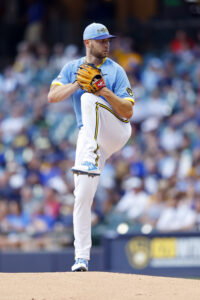
That brings the Brewers up to six rotation options, and that’s before considering right-hander Adrian Houser, who ranked fourth on the team in innings pitched and games started in 2022. Admittedly, 2022 wasn’t a great season for Houser, who limped to an uncharacteristic 4.73 ERA with a career-worst 15.2% strikeout rate and career-low 46.7% ground-ball rate.
Given those struggles from Houser and an uneven season for Ashby, it’s understandable if the Brewers wanted some low-cost stability at the back of the rotation. Miley can provide that, health permitting, but it doesn’t leave Houser with a clear role. He’s out of minor league options, and Ashby seems likelier to be ticketed for the long relief/swingman role over Houser. The Brewers even added an eighth rotation candidate — fellow out-of-options hurler Bryse Wilson — in a small swap with the Pirates. Wilson figures to be in the bullpen to begin the season, if he even makes it to Opening Day on the 40-man roster. For now, his presence gives the Brewers a trio of bullpen arms who operated primarily as starters in 2022.
Houser already throws decently hard (94.4 mph average four-seamer, 93.8 mph sinker in 2022), so it could be argued that he’s somewhat intriguing in a short relief role that might make his velocity tick up even further. But he also already agreed to a $3.6MM salary for the 2023 season, and that seems like a relatively expensive experiment for a Brewers team that declined a net $2.25MM salary for steady veteran reliever Brad Boxberger ($3MM option, $750K buyout).
Dropping Houser into short relief also overlooks the fact that from 2019-21, he was a solid member of the team’s rotation. He began the 2019 season in the ‘pen but moved to the rotation and hardly looked back; overall 55 of Houser’s 75 outings in that time came as a starter. He made only three relief appearances in 2020-21. And, during that three-year period from 2019-21, he pitched to a combined 3.78 ERA with a 20.4% strikeout rate, a 9.3% walk rate and an outstanding 57% ground-ball rate. The strikeout rate was below-average, and the walk rate was a bit elevated, but fielding-independent marks like FIP (4.26) and SIERA (4.28) still felt Houser was plenty serviceable.
There’s no getting around the fact that the 2022 season was an ugly one for Houser, but he’s still an affordable 29-year-old right-hander (30 next month) with a career 3.97 ERA in 428 innings, most of which has come as a starter. He’s eligible for arbitration once more next winter and can become a free agent after the 2024 season. Houser alone isn’t going to change a team’s fortunes in the rotation, but he’s also very arguably as good a bet as the bulk of the remaining unsigned free agents. Certainly, he’ll cost less from a financial perspective, though he’d of course require a modest package of young talent or perhaps a bat in a similar square-peg/round-hole situation.
With Houser falling to at least sixth, if not seventh on the Brewers’ rotation depth chart, he stands out as a natural trade candidate. World Series hopefuls probably aren’t going to look at Houser and think he’s someone they can acquire and plug into a playoff rotation, but there are plenty of teams still on the lookout for solid innings at the back of their starting staff.
Even for a rebuilding team, it’s conceivable they could buy low on Houser now and then recoup most of that value, if not more, at the deadline or next offseason if he’s able to bounce back or partially reinvent himself under the tutelage of a new organization. (That’s not a knock on the Brewers specifically, but it’s common for new teams to alter pitch selection, arm slot, etc.) He could also help take the pressure off a team’s young starters and allow those less experienced arms to be eased into the Majors.
Given the constant need for pitching throughout the league, there’s no shortage of teams that could feasibly make sense as a Houser suitor. The Orioles, for instance, are still reportedly on the hunt for another veteran arm. General manager Mike Elias was in the Astros’ scouting department in 2011 when Houser was a second-round pick. The Red Sox are teeming with injury uncertainty thanks to the presence of Chris Sale and James Paxton. Most of the Tigers’ young pitchers have befallen some type of injury in the past calendar year. The Nationals could use some more support for young arms like Cade Cavalli and MacKenzie Gore. The Rockies’ rotation is a collection of question marks, and Colorado tends to value ground-ball pitchers.
That’s just a handful of speculative landing spots, and it’s a given that other needs will arise during Spring Training, when camps begin to open and pitchers are inevitably sidelined due to injury. If the Brewers don’t find any offers to their liking now, they can simply hold onto Houser and see how demand looks in two months’ time. It’s possible an in-house injury will alter the calculus for the Brewers themselves, too. The nice part is that while Houser may be a bit pricier than they’d prefer, given his lack of a clearly defined role, he’s also not so expensive that the Brewers need to urgently pursue trades to dump his salary.
It’s been a quiet offseason for the Brewers on the free-agent front, but Milwaukee has already swung seven trades under newly installed baseball operations leader Matt Arnold. Gone from the ’22 Brew Crew via trade are Kolten Wong, Esteury Ruiz and Justin Topa. Newcomers include William Contreras, Jesse Winker, Abraham Toro, Javy Guerra, the previously mentioned Bryse Wilson, Owen Miller and Payton Henry. Based on the rotation depth they have with Miley in the fold and the lack of minor league options for Houser, he’s a decent candidate to change hands and push Arnold’s trade count in his first offseason at the helm up to eight.
P.J. Higgins Elects Free Agency
Catcher P.J. Higgins has rejected an outright assignment from the Cubs in favor of free agency, per Jon Heyman of the New York Post (Twitter link). Chicago designated Higgins for assignment in late December in order to open a spot on the roster for newly signed Tucker Barnhart, and Higgins cleared outright waivers last week. It was the second time in his career he’d gone unclaimed and been assigned outright to a minor league affiliate, however, which granted him the right to reject that assignment and explore his opportunities elsewhere.
Higgins, 29, appeared in 74 games for the Cubs in 2022, batting .229/.310/.383 with six homers, 11 doubles and a triple in 229 plate appearances. He walked at a 9.6% clip and punched out in 25.3% of those trips to the plate. That marked just the second season in which Higgins has had big league experience, with the 2021 season — when he appeared in just nine games — standing as the only other.
A 12th-round pick out of Old Dominion back in 2015, Higgins has been a generally productive hitter in the minors but has never received a particularly long big league look with the Cubs — due in no small part to the presence of Willson Contreras in the Majors for the entirety of his pro career to this point. Higgins has torn through Triple-A pitching at a .338/.429/.535 pace, though that’s come through just 274 plate appearances in a generally hitter-friendly setting. Overall, he’s a career .279/.365/.378 hitter in parts of seven minor league seasons.
Higgins was touted as an average or better defensive catcher back when Baseball America ranked him 22nd among Cubs farmhands in 2017, but he had some struggles in the Majors this past season. Higgins threw out just 16% of runners who attempted to steal against him — well below the league-average 24% — and he ranked near the bottom of the league with his average “pop time” in such situations, per Statcast. Both FanGraphs and Statcast pegged him as a below-average framer, as well, and Defensive Runs Saved dinged him at -6 for his work behind the plate in 2022.
That said, there’s more to Higgins’ defensive skill set than just his work behind the plate. He was an infielder at Old Dominion and in his first season of pro ball, and the Cubs have continued to get him work at other positions throughout his career. Catcher has remained his primary position since 2016, but Higgins has a total of 732 innings at first base, 575 innings at third base and even 93 innings at second and 37 innings at shortstop. He’s unlikely to be viewed as a regular option at any of those infield slots, of course, but it’s a nice bit of versatility to be able to market to other clubs as Higgins looks for a new opportunity as a minor league free agent for the first time in his career.
Giants Sign Luke Jackson To Two-Year Deal
The Giants announced Monday that they’ve signed free-agent righty Luke Jackson to a two-year contract that includes a club option for a third season. He’ll be guaranteed $11.5MM that’s paid out in the form of a $3MM salary in 2023, a $6.5MM salary in 2024 and then a $2MM buyout on a $7MM option for the third year. Jackson, a client of Beverly Hills Sports Council, didn’t pitch in 2022 after undergoing Tommy John surgery back in April. The Giants didn’t provide a timeline, but given the date of his surgery, it’s likely Jackson will open the season on the injured list.

The 31-year-old Jackson had something of a roller-coaster tenure in the Atlanta bullpen, at times operating as the team’s closer and on other occasions being relegated to low-leverage roles while struggling through rocky results. He saved his best performance for last, however, dominating as the team’s primary setup man during their run to the World Series in 2021.
Jackson, who shook off a disastrous 6.84 ERA in the shortened 2020 season, pitched to an outstanding 1.98 ERA with a 26.8% strikeout rate and 11.1% walk rate for the Braves during the ’21 regular season. He was virtually unhittable in the season’s final couple months, recording a 1.35 ERA and 33-to-10 K/BB ratio with just one homer allowed over his final 26 2/3 frames that year.
For much of the postseason, the same was true. Jackson was unscored upon through his first six games in the playoffs — four NLDS games and two in the NLCS — before the Dodgers ambushed him for four runs in just one-third of an inning. The Braves lost that game (with Jackson taking the loss) but hung on to win the series. The World Series offered a chance at redemption for Jackson, and he seized it, firing 3 2/3 shutout innings with just one hit, no walks and four punchouts.
Looking at Jackson’s career from a broader perspective, the former No. 45 overall pick (Rangers, 2010) was a touted pitching prospect with Texas before being sent to the Braves in exchange for right-handers Tyrell Jenkins and Brady Feigl. Neither of those pitchers did anything for Texas, and while Jackson’s first season with the Braves in 2017 was rather nondescript, he began to turn a corner the following season.
It was 2018 when Jackson entirely shelved his changeup, scaled back the usage of his four-seamer and curveball, and began to throw his slider more than any other offering. Since that point, Jackson has seen his strikeout rate leap from an awful 13.4% to a very strong 27.1%. He’s averaged 95.5 mph on his heater along the way and also gone from a fly-ball pitcher to a robust ground-ball worker, keeping a whopping 55.8% of balls put into play against him on the ground. Command has been a frequent issue, evidenced by a 10% walk rate in his past 203 1/3 innings (2018-21), but Jackson’s ability to miss bats, induce double-plays and avoid home runs (0.93 HR/9) have helped him to offset that below-average ability to locate the ball.
Though he’s likely IL-bound to start the year, Jackson could still jump back into the big league bullpen before the season’s halfway point. Once he does, he’ll add some more swing-and-miss to what has become an increasingly sound relief corps in San Francisco. Lefty Taylor Rogers was signed for late-inning work alongside presumptive closer Camilo Doval, and the Giants will also have John Brebbia and Tyler Rogers (Taylor’s twin brother) in the mix for late-inning opportunities. The pitching staff has as many as seven capable starters — Logan Webb, Alex Cobb, Alex Wood, Ross Stripling, Sean Manaea, Anthony DeSclafani, Jakob Junis — and the potential for two of them (Junis and perhaps DeSclafani) to pitch in relief only further deepens the bullpen.
Jackson’s modest $3MM salary in 2023 will push the payroll to a projected $192.2MM, per Roster Resource, while the Giants are now up to more than $213MM in luxury-tax obligations. That leaves plenty of room for some additional signings, whether to further deepen the relief corps or to add another bat to the lineup.